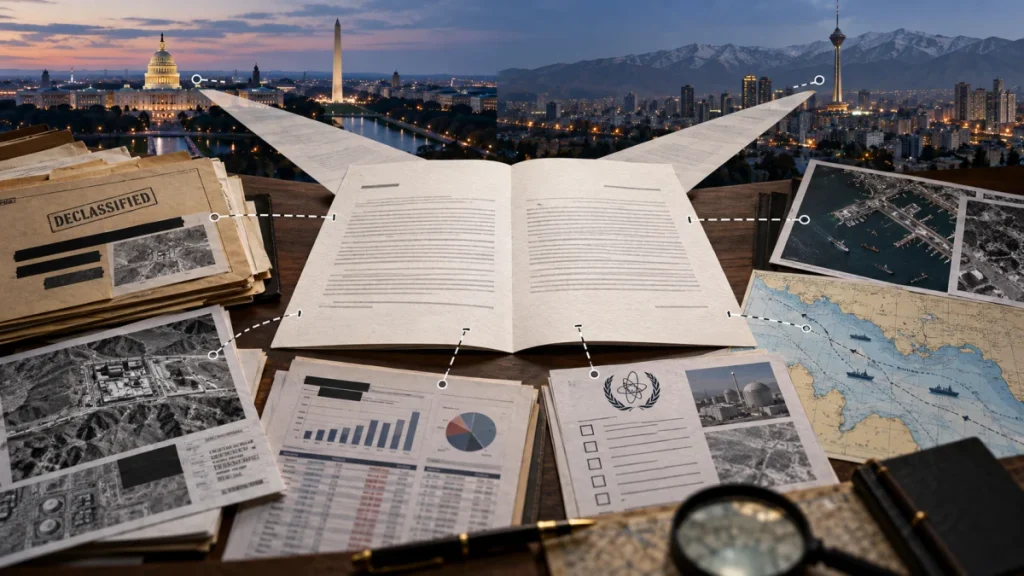
Donald Trump said it.
At an October 5, 2026 campaign rally in Grand Island, Nebraska, the President of the United States said:
“They can take out a city. Let them take — let it — let them take out Los Angeles. Let them take out San Diego.”
Some people in the crowd cheered.
That is the factual core of this story.
The White House says Trump meant the opposite of what those words sound like in isolation: that the U.S. war with Iran is preventing Iran from someday becoming capable of attacking American cities. FactCheck.org and PolitiFact both concluded that the surrounding context supports that interpretation.
That context belongs in the article.
It does not get to become the article.
It does not erase the President’s words. It does not erase the crowd reaction. It does not obligate residents of Los Angeles or San Diego to pretend the language was normal, harmless or presidential.
And it certainly does not require anyone to accept the absurd idea that the real problem here is that Americans were too stupid to understand what Trump supposedly meant.
If a President says “Let them take out Los Angeles. Let them take out San Diego,” and his defense is that everybody should reconstruct his intended meaning from a meandering speech until those words somehow mean their opposite, the communication failure belongs to the President.
Not California.
Not the press.
Not the millions of Americans who live in the cities he named.
Key findings
- Verified: Trump explicitly said, “Let them take out Los Angeles. Let them take out San Diego,” while discussing the Iran war at his October 5 Nebraska rally.
- Verified: Some people in the audience audibly cheered as he named the two cities.
- Context: The White House says Trump meant that the war was preventing Iran from eventually being able to attack U.S. cities. FactCheck.org and PolitiFact concluded that this is a plausible reading of the surrounding remarks.
- Also verified: California officials, a Republican Navy veteran running for Congress, and the U.S. Conference of Mayors condemned the language.
- Assessment: The contextual defense narrows what can responsibly be claimed about Trump’s intent. It does not make the words acceptable, erase their threatening effect on the people he was talking about, or explain why an American crowd cheered when American cities were named in a “take them out” formulation.
That distinction is the entire analysis.
Everything after it is accountability.
What exactly did Trump say about Los Angeles and San Diego?
The full transcript published by Roll Call’s Factbase shows Trump discussing the economic cost of the U.S. war with Iran.
He called the higher costs associated with the war a “small price to pay” for keeping the country safe.
Then came the line about American cities:
“They can take out a city. Let them take — let it — let them take out Los Angeles. Let them take out San Diego.”
He then returned to saying the war would end soon.
Nobody fabricated the words.
Nobody inserted “Los Angeles.”
Nobody inserted “San Diego.”
The President said them.
That matters because the presidency is not a podcast, a private group chat or an open-mic night. Words spoken by a President about American cities and a hostile foreign power carry weight whether the speaker intended every syllable with precision or not.
Did Trump literally tell Iran to bomb Los Angeles and San Diego?
The most careful answer is:
The full context does not establish that Trump was literally ordering or inviting Iran to attack the cities.
FactCheck.org and PolitiFact both reviewed the surrounding remarks. Their reading is that Trump was more likely trying to argue that the Iran war prevents a future scenario in which Iran could threaten American cities.
The White House says the same thing.
There. That is the context.
It took three paragraphs.
Now stop pretending it absolves him.
The context explains the intended argument. It does not sanitize the words.
Presidents are responsible for the words they choose.
That standard should not become controversial merely because Donald Trump is famously imprecise.
If Joe Biden, Barack Obama, George W. Bush or any other president stood before a partisan crowd and said, “Let them take out Dallas. Let them take out Houston,” nobody would seriously argue that Texans were obligated to shrug because aides later explained the sentence.
If a Democratic president said, “Let them take out rural Nebraska,” Republicans would be correct to be furious.
The rule is not complicated.
A President of the United States should not speak about American cities in language that sounds like permission for a foreign adversary to destroy them.
Even if the intended argument was the opposite.
Even if an aide can explain it later.
Even if a fact-checker can reconstruct the surrounding logic.
A President has a responsibility to communicate national security matters with enough care that “Let them take out Los Angeles” does not come out of his mouth in the first place.
The fact that Americans now routinely have to ask what Trump “really meant” after hearing the literal words spoken by the President is not a defense of his rhetoric.
It is an indictment of it.
Were people in the crowd really cheering?
Yes.
This is one of the most important facts in the story because it cannot be explained away by arguing about Trump’s internal intent.
FactCheck.org’s review specifically notes that some people in the Nebraska crowd began cheering as Trump said the line about Los Angeles and San Diego.
The Los Angeles Times also reported that the crowd cheered the remarks.
Trump did not appear to encourage or react to the cheering.
That should be reported too.
But it changes nothing about what the reaction reveals.
We cannot read the mind of every person who made noise.
We do not need to.
An American political crowd heard the President say, “Let them take out Los Angeles. Let them take out San Diego,” and applause was audible.
That happened.
No contextual paragraph can make it unhappen.
Los Angeles and San Diego residents are right to be furious
These are not imaginary cities on an electoral map.
They are home.
Los Angeles County contains more people than most U.S. states.
San Diego is home to nearly 1.4 million people and sits at the center of one of the most important military communities in the country.
San Diego Mayor Todd Gloria responded in an official statement that his city is not expendable and called on Trump to retract the remarks and apologize.
Los Angeles Mayor Karen Bass said the President’s comments were dangerous and could compromise public safety, according to reporting by The Washington Post.
The U.S. Conference of Mayors went further, saying no American president should ever describe an attack on an American city by a hostile foreign power as acceptable.
This was not merely partisan outrage.
Republican congressional candidate and Navy veteran Jim Desmond also condemned the remarks. As the Associated Press reported, Desmond said he served to protect Americans, not to write off American cities.
That is the correct instinct.
It should not require a party label.
No American owes Trump a charitable interpretation of threatening rhetoric about their city
There is an important distinction between saying Trump issued a legally actionable threat against Los Angeles and saying his rhetoric was threatening to the people who live there.
The first is a legal conclusion this article is not making.
The second is obvious.
Imagine being a parent in San Diego.
Imagine having a son or daughter serving at Naval Base San Diego or Camp Pendleton.
Imagine being one of the millions of people in Los Angeles who already watched the federal government repeatedly turn their city into a partisan target.
Then listen to the President say:
“Let them take out Los Angeles. Let them take out San Diego.”
You are not required to respond with a seminar on syntactic context.
You are allowed to be furious.
You are allowed to expect the Commander in Chief to speak as though your life matters.
You are allowed to notice that a president who claims to put “America First” somehow found himself standing before cheering supporters after naming two American cities in the language of destruction.
That is not media hysteria.
That is a normal human reaction to abnormal presidential rhetoric.
The White House response makes the problem worse, not better
The White House response has largely been to accuse critics and news organizations of misrepresenting Trump.
That is convenient.
It also dodges responsibility.
Yes, some headlines overstated the evidence by presenting the remark as an unambiguous instruction to Iran.
Correct them.
Then answer the actual problem.
Why did the President use those words?
Why those cities?
Why did the line land in a way that produced cheers?
Why is the administration more interested in scolding people for hearing the sentence than acknowledging that a President should never have delivered it that way?
A competent White House response would have been simple:
The President did not mean that Iran should attack Los Angeles or San Diego. He regrets the wording. No American city is expendable.
That would have ended much of the dispute.
Instead, the reflex was to blame everyone else for hearing the President’s own words.
That is not accountability.
It is cleanup.
California is not an enemy country
There is another reason the response hit such a nerve.
Trump has spent years using California as a political foil.
The Los Angeles Times reported that Trump has repeatedly invoked California at rallies as a symbol of Democratic governance and political opposition.
That background matters.
Los Angeles and San Diego were not random syllables.
They are American cities in a state Trump routinely uses as a partisan punching bag.
That does not prove Trump consciously wanted anyone harmed.
It does explain why Californians are not obligated to hear the line in some sterile vacuum.
Presidential rhetoric accumulates.
When a leader spends years telling supporters that particular states, cities and populations represent everything wrong with the country, he does not get to act shocked when violent-sounding language about those places lands differently.
A President can criticize California.
He can campaign against its policies.
He can attack its governor.
He can tell voters the state is horribly governed.
What he cannot reasonably expect is for Californians to hear “Let them take out Los Angeles. Let them take out San Diego” and conclude that the only inappropriate reaction is their own anger.
“America First” cannot mean America only when Republicans live there
This is where the rhetoric collapses under its own slogan.
Los Angeles is America.
San Diego is America.
Chicago is America.
Dallas is America.
New York is America.
Omaha is America.
A President does not get to sort Americans into politically useful cities and politically disposable ones.
Neither does a crowd.
If Iran attacked San Diego, it would be an attack on the United States.
If Iran attacked Los Angeles, it would be an attack on the United States.
There is no partisan exception.
There is no electoral-college exception.
There is no “but California” exception.
You cannot call yourself “America First” while cheering language about a foreign adversary taking out America.
That should be an embarrassingly easy standard to meet.
This was also a sales pitch for an unpopular war
The Iran context matters in one limited way: Trump was using the hypothetical danger to American cities to justify the cost of the war.
That is a political argument, not an established fact simply because the President says it.
And Americans are increasingly rejecting the war itself.
A September Economist/YouGov poll found 57% of Americans said going to war with Iran was the wrong decision, while 61% wanted the United States to reach a deal to end the war as quickly as possible.
That is enough context for this article.
We do not need to rehabilitate Iran.
We do not need to pretend Tehran is benevolent.
And we do not need to accept every premise Washington attaches to a war merely because the words “national security” appear next to it.
The question here is much simpler:
Did the President need to invoke Los Angeles and San Diego this way to make his argument?
No.
The crowd reaction is the part that should haunt “patriotic” politics
There is something profoundly broken about a political culture in which the names of American cities can function as applause cues when paired with destruction.
Maybe the people cheering misunderstood Trump.
Maybe some were simply cheering everything he said.
Maybe some heard “Los Angeles” and “San Diego” as symbols of a state they dislike.
None of those explanations is comforting.
The deeper problem is the same.
Partisanship has become strong enough that fellow Americans are increasingly processed first as members of an enemy tribe and only second as citizens of the same country.
That is how political dehumanization works.
People stop imagining a city as homes, schools, hospitals, veterans, children, workers and families.
They hear a partisan symbol.
Then cruelty becomes funny.
Disaster becomes deserved.
Violence becomes rhetorical entertainment.
And a crowd can cheer.
Patriotism is not a red-state protection racket.
Does cheering make someone a terrorist or a traitor?
Not as a legal matter.
Those words have specific definitions, and accuracy still matters when condemnation is deserved.
Cheering at a rally is not automatically terrorism.
It is not automatically constitutional treason.
But civic judgment is not a criminal prosecution.
Americans do not need a federal statute before they are allowed to call behavior disgraceful, anti-American or morally grotesque.
Anyone who genuinely cheers the idea of a foreign adversary destroying an American city has no credible standing to lecture other people about patriotism.
That is not a legal finding.
It is a moral one.
And no, the answer is not to “round them up”
This moment exposes a useful hypocrisy.
American politics is full of people demanding loyalty tests, mass deportations and crackdowns on people they describe as insufficiently American.
Then some of those same political spaces produce applause when a President talks about Los Angeles and San Diego being “taken out.”
No.
The answer is not to copy the authoritarian logic and start deporting people for ugly political speech.
The answer is to reject the loyalty-test politics entirely.
People are free to say awful things.
Other Americans are free to remember what they said.
They are free to cheer.
We are free to ask why.
They are free to wrap themselves in the flag.
We are free to point out when their behavior makes the costume ridiculous.
What should Trump supporters say about the Los Angeles and San Diego remarks?
This should not be difficult.
A Trump supporter can believe the President was misunderstood.
A Trump supporter can support the Iran war.
A Trump supporter can despise Gavin Newsom.
A Trump supporter can think California is badly governed.
And that same person should still be capable of saying:
The President should never have spoken about Los Angeles and San Diego that way, and cheering the line was wrong.
That is the minimum.
Nobody is being asked to become a Democrat.
Nobody is being asked to support California politics.
Nobody is being asked to like Los Angeles.
They are being asked to recognize Americans as Americans.
If that standard has become partisan, the country has a much bigger problem than one Trump quote.
Bottom line: Trump said it, the crowd cheered, and Californians do not have to pretend it was normal
The full context should be reported accurately.
Trump was most likely trying to argue that the Iran war prevents a future attack on American cities. Fact-checkers have good reason to say that.
That is not a magic eraser.
The President still said:
“Let them take out Los Angeles. Let them take out San Diego.”
Some people still cheered.
The residents of those cities still heard the Commander in Chief use their homes as imagery in a sentence about destruction.
California officials from both parties still found it unacceptable.
The U.S. Conference of Mayors still said the line crossed a boundary no president should approach.
And millions of Americans are perfectly entitled to ask why the President of the United States cannot make a national-security argument without casually putting American cities into the rhetorical blast radius.
The scandal is not that critics failed to parse Trump generously enough.
The scandal is that this is where American political rhetoric now lives.
A President says words that would be unthinkable from almost any predecessor.
A crowd cheers.
The White House tells everyone they heard it wrong.
And Americans are expected to move on.
No.
Los Angeles is America.
San Diego is America.
The people who live there are Americans.
Their President is supposed to protect them, not speak about their destruction so recklessly that aides have to explain afterward why his literal words supposedly meant the opposite.
And the people cheering that rhetoric should never again be allowed to pretend they alone own the definition of patriotism.
If your version of “America First” has room to cheer when American cities are named in the language of destruction, America was never first. Your faction was.
References and Further Reading
Primary transcript and context
-
Roll Call Factbase — Donald Trump Midterm Political Rally in Grand Island, Nebraska, October 5, 2026 — Full transcript of the rally and the primary textual record of Trump’s remarks about the Iran war, Los Angeles and San Diego.
-
FactCheck.org — The Context for Trump’s “Take Out” Los Angeles, San Diego Remarks — Reviews the surrounding remarks, the White House explanation and the crowd reaction. Its contextual reading is more favorable to Trump than many early headlines, making it an important source for separating intent from the actual words and reaction.
-
PolitiFact — In Context: What Trump Said About Gas Prices, Iran and Taking Out Los Angeles and San Diego — Reconstructs the complete passage and explains the White House argument that Trump was describing a threat his Iran policy was intended to prevent.
California and national reaction
-
City of San Diego — Mayor Todd Gloria Statement on President Trump’s Remarks About San Diego — Official response from San Diego’s mayor demanding a retraction and apology and rejecting the idea that any American city is expendable.
-
Associated Press — White House aide says Trump did not call for attacks on U.S. cities but explained how he’s preventing them — Independent reporting on the White House defense and criticism from California officials and Republican Navy veteran Jim Desmond.
-
U.S. Conference of Mayors — Statement on President Trump’s Remarks About Los Angeles and San Diego — National municipal leadership response arguing that no American city should be described as expendable or acceptable collateral in presidential rhetoric.
-
Los Angeles Times — Trump suggests letting Iran “take out” Los Angeles, San Diego during campaign rally — Local reporting documenting the remarks, the crowd reaction and the immediate California backlash.
-
Los Angeles Times — Trump loves to bash California to rally the base. “Let ’em take out” L.A. is just the latest — Context on Trump’s repeated use of California as a political foil.
Public opinion on the Iran war
- Economist/YouGov — Half of Americans expect the Iran war to continue for at least another year — September 2026 polling finding that 57% called the decision to go to war wrong and 61% wanted a negotiated end as quickly as possible.
Editorial currency note: This article reflects reporting and public statements available through October 6, 2026. Any later clarification, retraction or additional primary-source evidence should be incorporated if it materially changes the record.