
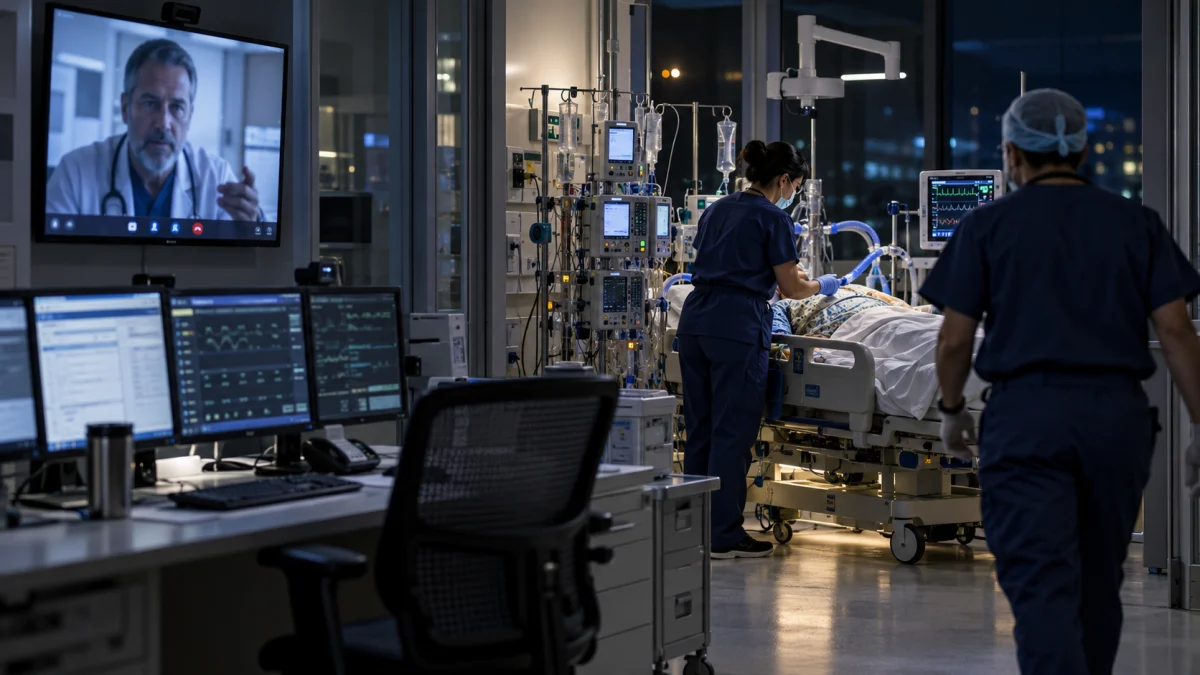
Yes. An intensive care unit can use a remote critical-care physician, and the federal and Connecticut rules reviewed by sherafy.com do not create a blanket requirement that a board-certified intensivist be physically inside every ICU 24 hours a day.
But that does not mean an ICU can replace bedside medicine with a video screen.
Federal hospital rules require physician responsibility for patient care and require a doctor of medicine or osteopathy to be on duty or on call at all times. Connecticut regulations require general hospitals to be organized to provide adequate care for acute emergencies at all hours. And published tele-ICU guidance says remote physician staffing should not replace the bedside resources needed for emergency procedures such as intubation.
That distinction is what makes the death of Conor James Hylton, a 26-year-old University of Connecticut dental student, more important than the viral description of a young man dying in a "fake ICU."
Hylton died on August 15, 2024, at Bridgeport Hospital’s Milford Campus. His estate filed a medical-malpractice and wrongful-death lawsuit in Connecticut Superior Court in March 2026 against Bridgeport Hospital, Yale New Haven Hospital and Northeast Medical Group. The complaint alleges that after Hylton was transferred to intensive care, no on-site physician assessed him for nearly four hours before he suffered a medical crisis. It further alleges that the doctor summoned to perform an emergency intubation lost additional time because he did not know how to find the ICU.
Those allegations are serious. They are also still allegations in pending civil litigation, not final findings by a court.
The strongest question raised by the case is therefore not whether medicine can be practiced remotely. It is much more concrete:
If the critical-care specialist is remote, who is physically responsible for reaching the patient’s bedside when the screen shows an emergency?
What happened to Conor Hylton?
Hylton was a UConn graduate and, at the time of his death, a student at the UConn School of Dental Medicine.
According to the complaint filed by his estate, Hylton went to the Milford Campus emergency department at approximately 11 a.m. on August 14, 2024. The complaint lists diagnoses including pancreatitis, dehydration, metabolic acidosis and alcohol withdrawal. His condition deteriorated and he was transferred to the ICU.
More detailed reporting based on medical records, the lawsuit and documents cited in the litigation places that ICU transfer at approximately 12:38 a.m. on August 15. An analysis included with the lawsuit said there was no on-site ICU intensivist during the overnight shift. A hospitalist was physically present at the hospital, according to that analysis, but the lawsuit alleges that the hospitalist did not examine Hylton after his transfer to intensive care. CNN’s reporting, republished by KVIA, describes the same basic chronology.
At about 4:30 a.m., the complaint says Hylton became unresponsive, displayed seizure-like activity, vomited and became bradycardic, prompting an emergency response. Connecticut reporting on the lawsuit says he was intubated but could not ultimately be resuscitated.
The estate alleges that an off-site tele-ICU clinician directed the response and that an emergency-department physician summoned to perform the intubation had difficulty locating the ICU. Investigation material described by CNN reportedly attributed about 10 additional minutes of delay to that problem.
Hylton died shortly after 6 a.m. His father has said that the physician who pronounced his son dead appeared on a video screen. News 12 Connecticut reported the same allegation from the complaint.
Timeline of Hylton’s final hours
| Approximate time | What the public record says | Evidence status |
|---|---|---|
| Aug. 14, ~11 a.m. | Hylton presents to the Milford Campus emergency department | Complaint |
| Aug. 14 | Diagnoses include pancreatitis, dehydration, metabolic acidosis and alcohol withdrawal | Complaint |
| Aug. 15, ~12:38 a.m. | Hylton is transferred to the ICU as his condition worsens | Medical-record/lawsuit reporting |
| ~12:38-4:30 a.m. | Estate alleges no on-site physician personally assesses him | Lawsuit allegation |
| ~4:30 a.m. | Hylton becomes unresponsive, has seizure-like activity, vomits and becomes bradycardic; emergency response begins | Complaint and local reporting |
| After ~4:30 a.m. | Remote critical-care team directs urgent response; on-site physician is summoned for intubation | Lawsuit/investigation reporting |
| During response | Summoned physician allegedly has difficulty finding the ICU; investigation material reportedly attributes about 10 minutes of added delay | Reported investigation material cited in litigation |
| Shortly after 6 a.m. | Hylton dies; his father and the complaint say a remote physician participated in the pronouncement by video | Family account/lawsuit allegation |
The timeline matters because the viral version frequently compresses several different questions into one claim that "there was no doctor."
That is not precise enough.
What is verified, what is alleged, and what is still unknown?
The case is easier to understand when the evidence is separated by status.
| Claim | What can responsibly be said now |
|---|---|
| Hylton died at Bridgeport Hospital’s Milford Campus on Aug. 15, 2024 | Documented. The filed complaint identifies the place, date and age. |
| Hylton was a UConn dental student | Documented. His obituary identifies him as a student at the UConn School of Dental Medicine. |
| The Milford ICU used remote critical-care coverage | Documented/undisputed in public coverage. Yale New Haven Health operates a tele-ICU program and the lawsuit concerns its use at Milford. |
| There was no on-site intensivist overnight | Supported by the medical analysis included with the lawsuit, as described by CNN and Connecticut reporting. This is not the same as saying no physician was anywhere in the hospital. |
| No on-site physician assessed Hylton for nearly four ICU hours | A central allegation in the lawsuit and reported investigation material. It has not been adjudicated. |
| A physician lost time because he could not locate the ICU | Alleged and described in investigation material cited by the lawsuit. The reported added delay is about 10 minutes. |
| The hospital violated care standards | Reported survey/deficiency material is significant, but the underlying government deficiency report has not been independently retrieved by sherafy.com. |
| Tele-ICU caused Hylton’s death | Not established. Negligence, contribution and legal causation remain issues for the litigation and expert testimony. |
| "Fake ICU" is an official designation | No. It is the characterization used by the family’s attorney, not a medical or regulatory category. |
That last distinction is important. Correcting an exaggerated version of the story does not make the underlying allegations less serious. It makes clear what would actually have to be proven.
Was Conor Hylton really in a "fake ICU"?
There is no recognized federal or Connecticut hospital category called a "fake ICU." The phrase comes from the family’s attorney and has become the shorthand used in headlines and social media.
The facts alleged in the case are more specific.
A tele-ICU generally connects a remotely located critical-care team with the bedside ICU through audiovisual systems, electronic medical records and real-time patient data. The remote specialist may be an intensivist, meaning a physician trained in critical-care medicine.
That does not mean every clinician involved in the patient’s care is remote.
| Role | What the role generally does | Does the role have to be the person physically at the bedside? |
|---|---|---|
| Intensivist | Critical-care specialist who manages severely ill patients | Not universally; some hospitals use remote intensivists |
| Tele-intensivist | Intensivist providing critical-care oversight remotely | No; the role is remote by design |
| Hospitalist | Physician who manages hospitalized patients, usually across inpatient units | Depends on the hospital’s staffing model |
| ICU nurse | Continuous bedside assessment, monitoring, medication administration and escalation | Bedside/local role |
| Emergency physician or procedural clinician | May respond when urgent hands-on intervention is required | Must be physically present to perform procedures such as intubation |
The Hylton case therefore should not be described as proving that he was in an imaginary ICU. The better question is whether the local bedside system supporting the remote intensivist was adequate for the acuity of the patients being treated there.
Does an ICU have to have a doctor physically present 24/7?
Not necessarily a board-certified intensivist physically inside the ICU.
The federal hospital rules reviewed by sherafy.com impose physician-responsibility requirements, but they do not say that every ICU must contain an intensivist around the clock.
Under the current federal 42 CFR § 482.12, every Medicare patient must be under the care of an eligible practitioner, an MD or DO must be responsible for medical or psychiatric problems outside certain other practitioners’ scopes, and an MD or DO must be on duty or on call at all times.
"On duty or on call" is not the same as "physically standing in the ICU."
Connecticut’s hospital regulations likewise require an organized medical staff and state that each general hospital must be organized to provide adequate care for acute emergencies at all hours. The state’s hospital regulations, R.C.S.A. § 19-13-D3, also address round-the-clock emergency-room coverage and physician availability.
In the federal and Connecticut rules reviewed for this article, sherafy.com did not find a blanket provision requiring a board-certified intensivist to be physically inside every ICU 24 hours per day.
That does not answer whether a particular hospital’s staffing model met the standard of care for a particular patient. Those are separate questions.
Federal law has a 24/7 doctor disclosure rule, but it is not ICU-specific
One federal rule is especially relevant because it reveals a gap between what a regulation asks and what a patient may actually want to know.
Under 42 CFR § 489.20(w), a hospital must provide written notice if an MD or DO is not present in the hospital 24 hours a day, seven days a week. The notice must explain how the hospital will meet a patient’s medical needs during an emergency when no physician is present. For hospitals with remote locations or satellites, that determination is made separately for each location that provides inpatient services.
When the notice is required, the hospital must obtain a signed acknowledgment from the patient before admission or the covered outpatient service.
But the rule is framed around whether an MD or DO is physically present at that hospital location. It does not say that an intensivist must be physically present in the ICU, and it does not create an ICU-specific notice requirement merely because the critical-care specialist is remote.
That creates what is best described as a disclosure mismatch, not a proven loophole in the Hylton case.
A patient may care about this question:
"Is the critical-care doctor responsible for this ICU physically here tonight?"
The federal rule asks a different question:
"Is any MD or DO physically present at this hospital location 24/7?"
If a physician was physically present somewhere at the Milford Campus, the federal notice rule may not have required a special disclosure solely because the intensivist was remote. The public record reviewed by sherafy.com is not sufficient to determine whether § 489.20(w) was triggered in Hylton’s case or whether Bridgeport Hospital complied with it.
That should not be turned into an allegation of a federal violation without the hospital’s staffing records and admission documents.
Did Hylton know his critical-care doctor would be remote?
The family says no.
Hylton’s attorney has said the family was not told that there was no on-site ICU intensivist and that they would have sought transfer had they understood the staffing arrangement. That is the family’s account, not an independently established fact about what paperwork Hylton received or signed.
Connecticut law makes the question worth investigating.
Connecticut General Statutes § 19a-906 generally requires a telehealth provider, at the first telehealth interaction with a patient, to explain the treatment methods and limitations of the telehealth platform, obtain the patient’s consent and document the notice and consent. The statute also requires the telehealth provider to conform to the professional standard of care expected for appropriate in-person care.
At the same time, the law expressly says it does not prohibit on-call coverage, provider-to-provider consultations, hospital inpatient orders or the use of telehealth for a hospital inpatient. Those provisions were in Connecticut’s telehealth law before Hylton’s 2024 hospitalization.
The public material reviewed by sherafy.com does not establish:
- what specific telehealth disclosure Hylton received;
- whether a general hospital or telehealth consent covered the arrangement;
- whether the remote intensivist’s role constituted the type of provider-patient interaction requiring separate consent in these circumstances;
- whether an exception or provider-to-provider consultation structure applied; or
- whether Hylton or an authorized representative signed relevant documentation.
That makes consent and disclosure an important discovery question in the lawsuit, not a violation that can responsibly be declared from the available public record.
What is a tele-ICU supposed to do?
Yale New Haven Health’s own current description is useful because it does not describe tele-ICU as a substitute for all bedside care.
The system says its InSight Tele-ICU gives ICU patients an additional layer of care. Remote critical-care physicians and nurses monitor vital signs and electronic medical records. If they see a patient’s condition deteriorating, they contact physicians and nurses at the hospital and work with them on treatment.
Yale’s page states plainly that the service "does not replace bedside doctors and nurses."
A separate Yale New Haven Health program update, published in October 2025, says the system’s tele-ICU had been operating for a decade and described overnight remote intensivists, critical-care nurses and advanced-practice providers monitoring patients while collaborating with bedside teams.
Those current and historical descriptions establish the intended model. They do not prove that every element of that model operated correctly at Milford on the night Hylton died.
That is exactly what the lawsuit disputes.
A remote intensivist cannot physically intubate a patient
Tele-ICU has a simple physical limit: a remote specialist can see data, review the chart, talk with staff, diagnose, recommend treatment and issue orders within the clinician’s role. The specialist cannot reach through a screen to perform an emergency procedure.
The American Telemedicine Association’s published Guidelines for TeleICU Operations make that distinction explicit. The guidance says a remote physician staffing model should not replace bedside resource availability for invasive or emergency care such as chest-tube placement, central-line placement or intubation. It also describes tele-ICU physician models as supporting and supplementing the attending physician’s plan of care.
That guidance is a professional standard document, not a statute. But it captures the operational issue at the center of the Hylton case.
A remote intensivist can recognize that a patient needs an airway.
Someone physically at the hospital still has to secure it.
That is why the allegation that a doctor could not find the ICU matters
The allegation that the responding physician had difficulty finding the unit may sound almost absurd in isolation. In a tele-ICU model, it is directly relevant to how the system is supposed to work.
Remote critical care depends on a chain:
detection -> communication -> escalation -> bedside response -> physical treatment.
If the remote clinician recognizes deterioration but the local response system cannot rapidly deliver the clinician who can perform the necessary procedure, the benefit of immediate remote recognition can be lost during the final step.
CNN’s reporting on documents cited in the litigation says an investigation attributed about 10 minutes of additional intubation delay to the responding physician’s difficulty locating the ICU. That remains part of the reported investigation/litigation record rather than a court finding.
Whether that delay caused or materially contributed to Hylton’s death is a different question, one that cannot be answered responsibly from the public excerpts alone.
This distinction is similar to a broader patient-safety problem sherafy.com examined after a Tennessee hospital pharmacy error sent the wrong medication to four surgery patients: catastrophic events are often more useful to understand as failures across a chain of safeguards than as a one-person mistake.
What did regulators actually find?
This is one area where much of the coverage has become more certain than the source trail allows.
The amended lawsuit cites an investigation involving the Connecticut Department of Public Health and the Centers for Medicare & Medicaid Services. Fierce Healthcare reported that the plaintiffs relied on that investigation in alleging substandard care.
CNN reported more detail. According to CNN’s report republished by KVIA, documents attached to the litigation included a hospital letter dated July 18, 2025 responding to a Statement of Deficiencies attributed to the state Department of Public Health and CMS. CNN said complaint-survey material completed May 19, 2025 described the hospital as "not in substantial compliance" with patient-care requirements and identified problems involving communication, assessments and the response to Hylton’s deterioration.
But there is an unusual wrinkle: CNN also reported that Connecticut DPH told the outlet it could not confirm whether a state investigation existed.
Sherafy.com has not independently located the underlying CMS-2567 Statement of Deficiencies or the complete government survey report in a publicly indexed primary source.
The safest description is therefore:
Survey and deficiency documents cited in the litigation and reported by multiple outlets describe significant care deficiencies, but the complete original regulatory record is not currently available to sherafy.com for independent review.
That is stronger than simply repeating the plaintiffs’ press release, and more accurate than silently converting secondary descriptions of the documents into an independently verified government finding.
Did tele-ICU cause Conor Hylton’s death?
That has not been established.
There are at least three separate propositions here:
- Was Hylton’s care below the applicable standard?
- Did the way remote and local clinicians were organized contribute to any failure in care?
- Did any such failure cause or materially contribute to his death?
A person can reasonably conclude that the allegations describe alarming potential care failures without pretending all three propositions have already been proven.
The public record also contains unresolved disagreement over the mechanism of Hylton’s death. Hearst Connecticut reporting based on the lawsuit and family interview says hospital records listed a gastrointestinal bleed, while the family’s attorney disputes that characterization. The complaint reportedly cites a tele-ICU attending note suggesting aspiration most likely led to respiratory failure and pulseless electrical activity arrest.
The lawsuit also says the hospital did not offer the family an autopsy.
Those fragments are not enough for sherafy.com to independently diagnose the cause of death. They are enough to show why causation remains a live issue rather than a settled fact.
Are tele-ICUs safe?
The evidence does not support a blanket claim that tele-ICU care is inherently unsafe.
Tele-ICU is not one standardized intervention. Programs differ in whether the remote team continuously monitors patients or consults periodically, what local physicians are present, how bedside nurses are staffed, who has authority to write orders, how quickly emergency procedures can be performed and how escalation is structured.
A 2026 systematic review of 16 tele-ICU studies found generally favorable associations with mortality, adherence to clinical protocols, communication and system responsiveness. But the authors also emphasized substantial variation among tele-ICU models and limited evidence on long-term sustainability and cost-effectiveness.
Meanwhile, the large TELESCOPE randomized clinical trial, involving 30 ICUs and more than 17,000 patients in Brazil, found that a structured intervention built around daily multidisciplinary rounds led by a remote intensivist did not significantly reduce ICU length of stay or improve the trial’s secondary outcomes compared with usual care.
Those findings are not contradictory.
They show that "tele-ICU" is a delivery model whose performance depends heavily on implementation. Adding a remote specialist is not automatically beneficial, and using a remote specialist does not automatically make an ICU unsafe.
That is why the Hylton case should be scrutinized as a question of staffing, responsibility, escalation, communication and bedside capability rather than treated as proof that remote critical care itself is illegitimate.
How common are tele-ICUs in the United States?
The viral claim that roughly 15% of U.S. ICU beds "now" use tele-ICU is not a statistic sherafy.com would publish as a current 2026 figure.
The strongest national estimate located for this article comes from a peer-reviewed study using the 2018 American Hospital Association Annual Survey. Among 4,396 responding hospitals, 788 hospitals, or 17.9%, reported telemedicine critical-care capability. Those programs provided potential coverage to 27,624 ICU beds, about 28% of the ICU beds reported by responding hospitals.
That study was published in 2021 using 2018 data. It is valuable for showing that tele-critical care was already widespread, but it is not a 2026 national census.
The distinction also corrects a common denominator error: the study measured both the share of responding hospitals using tele-critical care and the share of reported ICU beds potentially covered. Those are not interchangeable percentages.
What should patients and families ask if an ICU uses remote doctors?
The viral advice to automatically "demand transfer" if an intensivist is remote goes too far.
For some hospitals, especially smaller or rural facilities, tele-critical care can provide specialist access that would otherwise be unavailable. Transfer itself may also carry risk, particularly for an unstable patient. Whether a transfer is medically appropriate is a clinical decision that depends on the patient’s condition and the capabilities of the current and receiving hospitals.
A better approach is to ask concrete questions about who is responsible and who can act:
- Who is the physician responsible for the patient right now?
- Is that physician physically in this hospital or working remotely?
- Is the intensivist on site, on call or remote?
- Which physician can reach the bedside immediately if the patient deteriorates?
- Who performs emergency intubation or another urgent invasive procedure overnight?
- What is the escalation process if the bedside nurse and remote critical-care team are concerned?
- How quickly can an in-person physician reach this ICU?
- What telehealth notice or consent applies to this care?
Those questions get closer to the actual safety issue than simply asking whether a hospital uses telemedicine.
What the Hylton lawsuit still has to establish
The public record is enough to identify serious questions, but not enough to close them.
Among the most important unresolved issues are:
- the precise Milford Campus ICU staffing model on the night of August 14-15, 2024;
- which physician had bedside medical responsibility after Hylton entered the ICU;
- what Bridgeport Hospital’s own policies required at the time;
- whether those policies were followed;
- what the tele-intensivist knew and when;
- what bedside staff communicated to local and remote physicians;
- why the estate says no on-site physician assessed Hylton for nearly four hours;
- the actual interval between Hylton’s acute deterioration and successful intubation;
- whether any delay changed the medical outcome;
- what telehealth and physician-presence disclosures Hylton received;
- the complete findings of the DPH/CMS complaint-survey process;
- what corrective measures, if any, followed that process; and
- what parts of the plaintiff’s account the defendants ultimately dispute with evidence.
As of September 30, 2026, sherafy.com found no public final judgment or settlement resolving the malpractice case. Yale New Haven Health has said it is aware of the lawsuit and is committed to safe, high-quality care, but has declined substantive comment because the litigation is pending.
The most defensible conclusion
Conor Hylton’s death does not establish that an ICU becomes illegitimate simply because its intensivist is remote.
It exposes a harder problem.
The federal and Connecticut rules reviewed for this article do not guarantee that a board-certified intensivist will be physically inside every ICU around the clock. Federal law does require physician responsibility and on-duty or on-call physician availability. It also requires disclosure when no MD or DO is physically present at a hospital location 24/7. Connecticut requires hospitals to provide adequate care for acute emergencies at all hours, while its telehealth statute imposes standards of care and a consent framework that may depend on the precise type of telehealth interaction involved.
Professional tele-ICU guidance fills in the operational reality: remote critical-care expertise is supposed to work with bedside resources, not make hands-on emergency capability unnecessary.
If the Hylton estate ultimately proves that a critically ill patient went nearly four hours without an in-person physician assessment, that an urgent airway response was delayed because the responding doctor could not find the ICU, and that communication and monitoring systems failed around him, the central failure would be more specific than "telemedicine replaced medicine."
It would be a failure of the system that was supposed to connect remote expertise to immediate bedside action.
That is the question the litigation still has to answer.
References and Further Reading
Court Record and Legal Requirements
-
Hylton estate complaint: William H. Hylton, Administrator of the Estate of Conor James Hylton v. Bridgeport Hospital et al. — Public docket mirror of the Connecticut Superior Court complaint filed in March 2026. Establishes the parties, date and place of death, diagnoses alleged in the complaint and the core negligence claims.
-
42 CFR § 482.12 — Condition of Participation: Governing Body — Federal hospital rule requiring physician responsibility for patient care and an MD or DO to be on duty or on call at all times; also addresses telemedicine agreements.
-
42 CFR § 489.20(w) — Physician-Presence Notice Requirement — Federal rule requiring written notice and patient acknowledgment when an MD or DO is not physically present at a hospital location 24/7. Remote locations and satellites are assessed separately.
-
Connecticut General Statutes § 19a-906 — Telehealth Services — Connecticut telehealth law covering standard of care, notice and consent at the first telehealth interaction, and inpatient/on-call/consultation provisions.
-
Regulations of Connecticut State Agencies § 19-13-D3 — Short-Term Hospitals — State hospital regulations addressing medical staff, patient safety and the requirement to provide adequate care for acute emergencies at all hours.
Tele-ICU Program and Professional Guidance
-
Yale New Haven Health — Telehealth Services / InSight Tele-ICU — Yale New Haven Health’s own description of the tele-ICU as additional critical-care support that works with bedside physicians and nurses rather than replacing them.
-
Yale New Haven Health — Tele-ICU Team Marks 10 Years — 2025 system update describing the program’s history, overnight remote monitoring and collaboration with bedside teams.
-
American Telemedicine Association — Guidelines for TeleICU Operations — Professional operational guidance stating that remote physician staffing should not replace bedside resources required for invasive or emergency procedures such as intubation.
Research and Data
-
Ofoma et al., “Characteristics of U.S. Acute Care Hospitals That Have Implemented Telemedicine Critical Care” — Peer-reviewed analysis of 2018 American Hospital Association data. Found tele-critical-care capability in 17.9% of responding hospitals, potentially covering 28% of reported ICU beds.
-
Qtait et al., “Implementation and Impact of Tele-Intensive Care Unit Models on Critical Care Outcomes: A Systematic Review” — 2026 systematic review of 16 studies showing generally favorable associations while emphasizing substantial differences among program designs and limited long-term economic evidence.
-
TELESCOPE Randomized Clinical Trial — JAMA — Cluster-randomized trial across 30 ICUs finding that one structured remote-intensivist intervention did not significantly reduce ICU length of stay or improve secondary outcomes compared with usual care.
Independent Reporting and Case Context
-
News 12 Connecticut — Lawsuit Claims 26-Year-Old Died Due to Substandard Care at Milford Campus — Local coverage summarizing the filed allegations and Yale New Haven Health’s response.
-
CT Insider — North Haven Dental Student Died After Bridgeport Hospital Put Him in “Fake ICU,” Lawsuit Says — Detailed Connecticut reporting on the allegations involving staffing, assessments, monitoring, communication and emergency response.
-
CNN reporting republished by KVIA — Family Sues Over Death During Tele-ICU Care — Detailed reconstruction based on records and litigation material, including the reported 12:38 a.m. ICU transfer, hospitalist presence, alleged intubation delay and survey/deficiency documents. Also reports DPH’s inability to confirm the investigation when contacted.
-
Fierce Healthcare — Yale New Haven Health Hospital’s Tele-ICU Model Highlighted in Wrongful-Death Lawsuit — Healthcare-industry reporting on the amended lawsuit and the DPH/CMS investigation cited by the plaintiffs.
-
The Hour / Hearst Connecticut — Hylton Family Interview and Cause-of-Death Dispute — Family interview and reporting on the dispute over the recorded mechanism of death, the remote pronouncement allegation and the absence of an autopsy offer alleged in the suit.
Editorial currency note: This article was fact-checked through September 30, 2026. The Hylton litigation remains unresolved in the public record reviewed for this article. Court filings, hospital policies, tele-ICU staffing arrangements, Connecticut law and federal regulations can change. The regulatory-survey discussion is intentionally qualified because sherafy.com has not independently obtained the complete underlying CMS/Connecticut Statement of Deficiencies described in the litigation and secondary reporting.