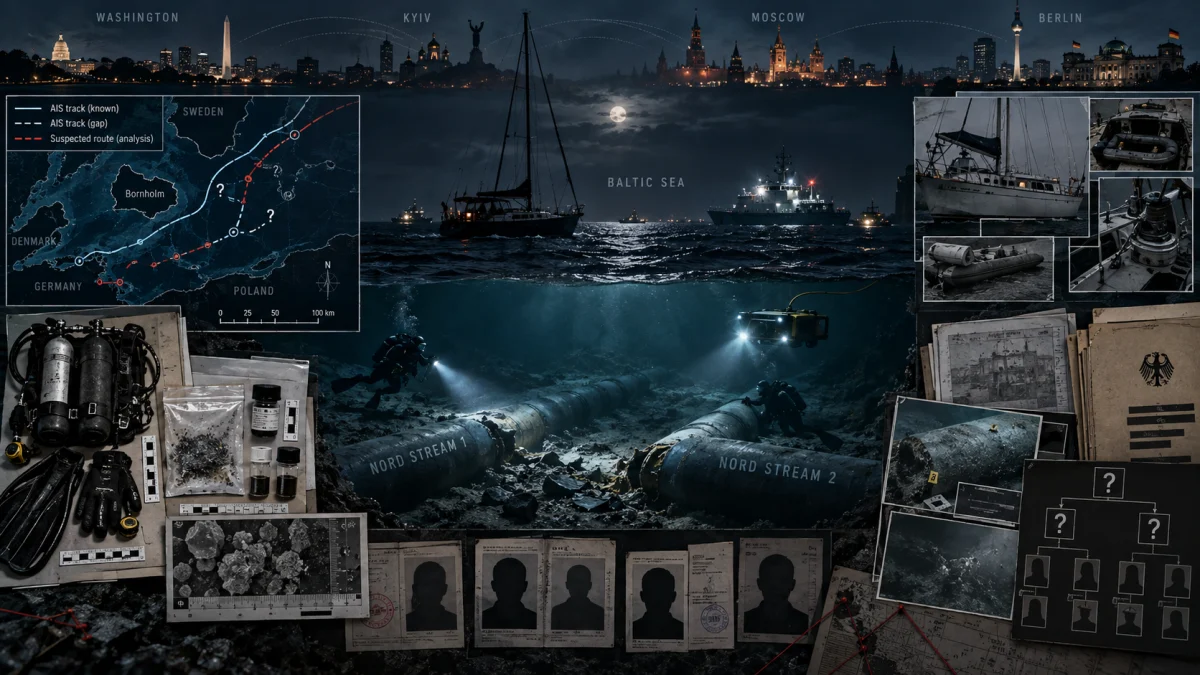
Four years after explosions ruptured the Nord Stream pipelines, the strongest publicly disclosed evidence points most directly to a Ukrainian military-linked sabotage team that German investigators say operated from the sailing yacht Andromeda. German federal prosecutors now go further: they allege that Ukrainian military personnel developed the operation on behalf of Ukrainian state authorities.
That is not yet a final judicial finding.
The first defendant, Ukrainian national Serhii K., denies involvement. Germany’s federal prosecutor indicted him on June 30, 2026, and Hamburg’s Higher Regional Court subsequently found sufficient suspicion to send the case to trial. His trial is scheduled to begin October 14, 2026. German Federal Public Prosecutor’s Nord Stream indictment announcement Hamburg Higher Regional Court’s September 2026 trial announcement
What has changed since 2022 is the amount of evidence available.
The case is no longer simply a contest between three geopolitical theories: Russia destroyed its own pipelines, the United States secretly destroyed them, or Ukraine did it. German investigators have assembled a specific physical and documentary trail involving a particular yacht, military explosives, diving equipment, false identities, border records, witnesses and identified suspects. Germany’s Federal Court of Justice has reviewed much of that evidence and concluded, at the pretrial detention stage, that there are compelling grounds to suspect the attack was initiated and controlled by a foreign state. Federal Court of Justice decision StB 60/25 on the Nord Stream investigation
At the same time, legitimate questions about the United States have not disappeared. President Joe Biden really did publicly promise that Nord Stream 2 would not proceed if Russia invaded Ukraine. U.S. intelligence also appears to have received advance warning in 2022 of a Ukrainian military plan to attack Nord Stream. A 2026 Der Spiegel investigation goes further, alleging earlier CIA discussions with Ukrainian planners, although the CIA disputes that account.
Those facts justify scrutiny of U.S. foreknowledge.
They do not, on the evidence presently public, establish that the United States planted or detonated the explosives.
The public evidence against Russia is weaker still. Russian responsibility was widely suspected immediately after the explosions, but NATO itself did not attribute the attack to Moscow, Western investigators were reporting by late 2022 that they had found no evidence tying Russia to the sabotage, and no comparable public forensic trail has since emerged.
The evidence is therefore not evenly balanced.
What the Evidence Currently Supports
| Claim | Current evidence status |
|---|---|
| Nord Stream was deliberately sabotaged with explosives. | Established. Swedish investigators found explosive residue, and subsequent German evidence describes externally placed explosive charges. |
| The yacht Andromeda was used in the operation. | Strongly supported, not yet finally adjudicated. German investigators cite explosives aboard the yacht, diving equipment, witnesses, concealed identities and route evidence. |
| A Ukrainian military-linked team carried out the sabotage. | Strongly supported, but still before trial. Germany has charged an alleged Ukrainian military officer and identified additional alleged participants. |
| Ukrainian state authorities directed the operation. | A serious prosecutorial allegation supported by broader state-direction evidence, but not yet proven at trial. Germany’s prosecutor explicitly alleges Ukrainian state involvement; the Federal Court separately found foreign-state direction highly probable. |
| Volodymyr Zelensky personally ordered or knew about the attack. | Not established. Ukraine and Zelensky deny state involvement. |
| Valerii Zaluzhnyi personally authorized it. | Reported by investigative sources, but not established in the public German judicial record. |
| The CIA knew beforehand of a Ukrainian Nord Stream attack plan. | Strongly supported by leaked intelligence and corroborating reporting, with caveats about the original source and details. |
| CIA personnel directly discussed the operation with Ukrainian planners in spring 2022. | Disputed investigative allegation. Der Spiegel reports it; the CIA rejects the reconstruction. |
| The United States carried out the bombing. | Not established by the strongest public evidence. Seymour Hersh alleged a U.S.-Norwegian operation, but several testable operational details in his account conflict with independent records. |
| Russia blew up its own pipelines. | Not supported by a comparable public forensic case. Russian capability and possible motives were investigated, but the physical and human evidence disclosed by Germany points elsewhere. |
The distinction matters because “Ukraine,” “the Ukrainian military,” “Ukrainian state authorities,” “Zaluzhnyi,” and “Zelensky” are not interchangeable claims. Neither are “the CIA knew,” “the CIA discussed it,” and “the United States carried it out.”
What Happened to Nord Stream on September 26, 2022?
Nord Stream 1 and Nord Stream 2 were four large undersea gas-pipeline strings running from Russia toward Germany through the Baltic Sea.
On September 26, 2022, explosions ruptured both strings of Nord Stream 1 and one of Nord Stream 2’s two strings near the Danish island of Bornholm.
Sweden’s Security Service later announced that investigators had recovered foreign objects from the seabed containing explosive residue, confirming deliberate sabotage. Swedish Security Service: explosive residue confirmed sabotage of Nord Stream
Germany’s subsequent investigation became much more specific.
According to a December 2025 decision by Germany’s Federal Court of Justice, investigators believe four timed explosive charges were attached externally to three pipeline strings approximately 70 to 80 meters below the surface. The court record says each charge weighed at least 14 kilograms and contained a mixture of RDX and HMX, powerful explosives predominantly associated with military use.
The court says the charges detonated in two time periods, at approximately 2:03 a.m. and 7:03 p.m. on September 26. The three affected strings were rendered unusable.
That reconstruction matters because some of the arguments still circulating about Nord Stream are based on what investigators knew in late 2022 rather than what is publicly documented in 2026.
The Strongest Evidence: The Andromeda Yacht
The breakthrough in Germany’s investigation centers on a roughly 15-meter sailing yacht named Andromeda.
When the Andromeda theory first became public in 2023, skepticism was understandable. The idea that a small team operating from a recreational-sized yacht could destroy heavily constructed pipelines at significant depth sounded implausible to many observers.
The evidence disclosed since then is considerably stronger.
Germany’s Federal Court of Justice says an expert determined that the yacht was structurally suitable for:
- transporting the equipment required for the operation;
- sailing to the attack area;
- supporting the necessary diving operations.
The people arranging the charter also requested a dinghy suitable for supporting dives.
German investigators say the crew then took unusual steps to conceal both themselves and the yacht’s movements.
According to the court record:
- the yacht was rented through an intermediary acting for unidentified third parties;
- forged identity documents were used;
- the intermediary specifically requested a vessel without AIS, the radio-based tracking system commonly used to identify vessels and monitor routes;
- the crew did not maintain the normal voyage log;
- crew members later presented forged Bulgarian identity documents during a Polish border check.
Witnesses placed Andromeda in the broader Bornholm area during the relevant period.
After the yacht returned to Germany, witnesses reported seeing diving suits, diving cylinders and other diving equipment removed from it. The charter company’s employee reportedly found no crew aboard when the vessel was formally returned, and the renters never reclaimed their security deposit.
Then comes the most important physical evidence.
Investigators Found RDX and HMX on Andromeda
German forensic investigators searched Andromeda in January 2023.
According to the Federal Court of Justice, they found traces of RDX and HMX below deck. The pattern suggested that explosives had been handled on a table inside the cabin. The court also noted that the yacht had not been rented to another customer between the suspicious voyage and the forensic examination.
RDX and HMX were also detected on pipeline fragments recovered from the explosion sites.
That does not independently prove every allegation about who was aboard.
But recursively, the total pattern becomes difficult to dismiss as a random collection of coincidences:
a yacht capable of supporting the operation + deliberate avoidance of tracking + false identities + diving equipment + presence in the relevant region + military explosive traces aboard + the same classes of explosive at the pipeline sites.
A theory that Andromeda was merely an elaborate decoy remains logically possible.
It now requires substantially more assumptions than the simpler explanation that the yacht was actually involved.
Could a Small Yacht Really Carry Enough Explosives to Blow Up Nord Stream?
This was once one of the strongest objections to the Andromeda theory.
Early estimates sometimes inferred that hundreds of kilograms of explosive would have been required because of the size of the seismic signals recorded during the ruptures. A small sailing yacht carrying divers, equipment and that much explosive seemed much harder to reconcile.
Later geophysical analysis substantially changed that picture.
A multinational study involving the Geological Survey of Denmark and Greenland and Germany’s Federal Institute for Geosciences and Natural Resources concluded that the seismic signatures can largely be explained by the rapid release of highly pressurized gas from the pipelines themselves. The study estimated an upper bound of roughly 50 kilograms of TNT equivalent for the chemical explosive component of the modeled events, while noting that smaller explosive yields could also fit the observations. Source analysis of the 2022 Nord Stream seismic events — GEUS and partner institutions
That figure should not be mechanically compared with the German court’s description of four charges weighing at least 14 kilograms each. Physical explosive mass and TNT-equivalent yield are not identical measurements.
The important point is narrower:
the seismic evidence no longer requires the enormous explosive payloads that helped make the yacht scenario look impossible.
Germany’s own court-reviewed expert evidence separately concludes that Andromeda was capable of carrying the equipment and supporting the dives required for the attack.
The “a yacht could never have done this” argument therefore does not survive the current technical evidence particularly well.
Who Is Serhii K., and What Evidence Ties Him to Andromeda?
German prosecutors identify Serhii K. as a former Ukrainian army officer who allegedly coordinated the sabotage group.
Germany’s Federal Public Prosecutor says Serhii K. and other Ukrainian military personnel developed the plan after Russia’s full-scale invasion and formed a team consisting of professional divers, a skipper and an explosives specialist. Prosecutors allege the group used false documents to rent Andromeda, transported military-grade explosives and attached timed charges to the pipelines.
Serhii K. denies involvement.
The evidence disclosed by Germany goes beyond simply matching him to a name supplied by intelligence agencies.
According to the Federal Court of Justice, Polish border-control records contained a photograph associated with a false Ukrainian passport used under the identity “S. K.” Investigators compared that image with photographs from Serhii K.’s genuine passport.
An expert concluded with a degree approaching certainty that the photographs showed the same person.
The court also notes that Serhii K. was an officer in a Ukrainian military special unit.
Investigators do not claim that he was one of the divers. In fact, the court says investigators have not established that he possessed diving, maritime or explosives expertise. That is part of why they infer that his role was probably coordination and command rather than the technical placement of the bombs.
There is an important limitation.
According to ZDF, which reviewed the full German indictment, investigators did not find fingerprints or DNA belonging to Serhii K. aboard Andromeda. The case against him instead relies on the cumulative documentary, photographic, witness, travel and circumstantial record.
That distinction belongs in any serious account. A strong circumstantial case can be legally powerful, but it should not be converted into nonexistent DNA evidence.
Did Ukraine Blow Up Nord Stream?
The most defensible answer is now:
The strongest public evidence points to a Ukrainian military-linked operational team, but the criminal case has not yet been decided at trial.
Germany’s Federal Public Prosecutor has moved beyond describing the suspects merely as sympathetic to Ukraine.
Its June 2026 indictment says Serhii K. was a Ukrainian army officer and alleges that he and other military personnel developed the Nord Stream sabotage plan on behalf of state authorities in Ukraine.
That is a significant change from the early “pro-Ukrainian group” language used in 2023.
Germany’s Federal Court of Justice reached a related but carefully distinct conclusion in December 2025. Reviewing the evidence for purposes of Serhii K.’s detention, the court said there were compelling grounds to believe the operation had been initiated and controlled by a foreign state and that the suspect and his associates were highly likely acting on that state’s behalf.
The court did not explicitly identify Ukraine in that particular finding.
The federal prosecutor’s later indictment does.
That distinction matters.
A Prosecutor’s Allegation Is Not a Conviction
Germany has not yet judicially established beyond a reasonable doubt that Ukrainian state authorities ordered the attack.
On September 2, 2026, Hamburg’s Higher Regional Court admitted the indictment and opened the main proceeding after concluding that Serhii K. was sufficiently suspected, based on the preliminary record, to stand trial.
The first hearing is scheduled for October 14, 2026, with at least 16 trial dates already scheduled through December and additional hearings expected in early 2027.
So the strongest accurate formulation today is:
German prosecutors allege Ukrainian state direction, and Germany’s Federal Court has independently found foreign-state direction highly probable at the pretrial stage. The allegation remains to be tested in a full criminal trial.
Does the Evidence Show Zelensky Ordered Nord Stream Blown Up?
No public evidence currently establishes that Ukrainian President Volodymyr Zelensky personally ordered the sabotage.
Ukraine denies state responsibility.
Investigative reporting has repeatedly explored whether the operation may have moved through Ukraine’s military or intelligence hierarchy while being kept from Zelensky, but the precise command chain remains unresolved in the publicly available judicial material.
That is where the distinction between evidence and inference becomes particularly important.
The German prosecutor’s allegation supports the proposition:
Ukrainian state authorities were involved.
It does not automatically prove:
Zelensky personally gave the order.
Those are different claims.
What About Valerii Zaluzhnyi and Roman Chervinsky?
Earlier reporting by The Washington Post and Der Spiegel identified former Ukrainian intelligence officer Roman Chervinsky as an alleged operational coordinator and reported, based on confidential sources, that the chain of command ultimately led toward then-Ukrainian armed-forces commander Valerii Zaluzhnyi.
Both men have denied involvement. Washington Post investigation into Roman Chervinsky and the alleged Nord Stream command chain
Those reports are significant because portions of the broader Ukrainian-team story later aligned with evidence disclosed by German authorities.
But they are not equivalent to a public court finding that Zaluzhnyi personally authorized the sabotage.
ZDF’s review of the 2026 indictment adds an intriguing detail: while Serhii K. was in Italian extradition detention, intercepted conversations reportedly referred to a commander named “Roman” and discussed whether the operation should publicly be characterized as an official military operation.
That may be consistent with previous reporting about Chervinsky.
Consistency is not proof of identity.
Until the evidence establishing who “Roman” is becomes public and is tested, the article should not silently turn the two names into the same established person.
Did Biden Say the United States Would “End” Nord Stream 2?
Yes.
This quote is real, and pretending otherwise only makes discussion of the evidence worse.
During a February 7, 2022 press conference with German Chancellor Olaf Scholz, President Joe Biden said that if Russia invaded Ukraine, “there will be no longer a Nord Stream 2. We will bring an end to it.”
When asked how the United States could accomplish that when the project was under German control, Biden replied: “I promise you, we’ll be able to do it.” Official transcript of Biden’s February 7, 2022 press conference with Olaf Scholz
Eleven days earlier, Under Secretary of State Victoria Nuland had said that if Russia invaded, “one way or another, Nord Stream 2 will not move forward.” She also discussed extensive consultations with Germany. U.S. State Department briefing containing Victoria Nuland’s Nord Stream 2 remarks
These comments establish something real:
The Biden administration was strongly opposed to Nord Stream 2 and intended to prevent the project from becoming operational after a Russian invasion.
That is relevant to motive.
It is not evidence by itself that Biden was announcing a clandestine plan to bomb the pipeline.
Germany Had Already Stopped Nord Stream 2 Months Before the Explosion
The chronology is essential.
On February 22, 2022, seven months before the explosions, Germany withdrew the security-of-supply assessment required for Nord Stream 2 certification. That effectively halted the authorization process. German Economy Ministry announcement halting Nord Stream 2 certification
By September 2022, Nord Stream 1 was also no longer delivering Russian gas to Germany. Germany’s Federal Network Agency records flows declining during 2022 and reaching zero by September. German Federal Network Agency review of gas supplies in 2022
So by the time someone physically destroyed three pipeline strings, Biden’s publicly stated goal of preventing Nord Stream 2 from becoming operational had already been achieved politically.
That does not eliminate every conceivable American motive. Physically destroying the infrastructure removed the possibility that a future German government could simply reverse course and restart direct Russian pipeline imports.
But it substantially weakens the simple argument:
Biden said Nord Stream 2 would end → Nord Stream later exploded → therefore Biden publicly confessed to bombing it.
The first two facts are true.
The conclusion does not logically follow without evidence connecting the United States to the operational act.
What Did the CIA Know Before Nord Stream Was Bombed?
This is where the U.S. side becomes much more consequential.
In June 2023, The Washington Post reported that the CIA had received a European intelligence report months before the explosions describing a Ukrainian military plan to attack Nord Stream.
According to the reporting, the intelligence described a small team of divers connected to the Ukrainian military and a plan involving underwater explosives. The CIA shared information about the warning with Germany and other European allies. Washington Post: U.S. knew of a Ukrainian Nord Stream attack plan before the explosions
The intelligence report was not perfect.
It reportedly derived from a Ukrainian source through a European intelligence service. U.S. officials initially questioned aspects of its credibility. Some operational details differed from the attack that eventually occurred.
But in retrospect, the broad similarities are difficult to ignore:
Ukrainian military connection + small diving team + boat + underwater explosives + Nord Stream target.
That makes advance American intelligence knowledge a materially supported part of the Nord Stream story.
It still does not establish that Washington carried out the attack.
Did the CIA Discuss the Nord Stream Plan Directly With Ukrainians?
A major 2026 investigation raises that possibility.
In February 2026, Der Spiegel reported that Ukrainian sabotage specialists had discussed the Nord Stream concept directly with CIA personnel in Kyiv as early as spring 2022.
According to Spiegel’s Ukrainian sources, American personnel initially appeared receptive enough that technical aspects of the operation were discussed. The publication also reports that Washington later reversed course and explicitly attempted to stop the Ukrainians from carrying out the attack. Der Spiegel: How early did the CIA know about Nord Stream attack plans?
The CIA disputes this reconstruction.
That leaves us with three different evidentiary levels:
- The CIA received advance intelligence about a Ukrainian Nord Stream plot: strongly supported.
- CIA personnel had earlier direct discussions with Ukrainian planners: credible but disputed investigative reporting.
- The CIA authorized or executed the sabotage: not established by the available public evidence.
Collapsing those three propositions into one claim produces bad analysis in either direction.
Dismissing all questions about U.S. foreknowledge is no longer credible.
Neither is treating foreknowledge as proof that U.S. divers planted the bombs.
Was Seymour Hersh Right That the United States Blew Up Nord Stream?
Investigative journalist Seymour Hersh published the most detailed public allegation of direct American responsibility in February 2023.
Hersh alleged that President Biden authorized an operation in which U.S. Navy divers planted explosives during the NATO BALTOPS 22 exercise, with Norwegian assistance, and that the charges were later triggered using a signal involving a Norwegian P-8 aircraft. Seymour Hersh: How America Took Out the Nord Stream Pipeline
Hersh’s investigative record is substantial.
But reputation cannot substitute for verification.
The Nord Stream article depended overwhelmingly on an unidentified source, and several of its unusually specific operational details were independently testable.
Some do not appear to survive that test.
The Norwegian Minehunter Problem
Hersh described Norwegian naval involvement involving an Alta-class minehunter.
Norwegian fact-checkers reviewed ship movements, satellite data and military information and found that no Alta-class Norwegian minehunter participated in BALTOPS 22.
A similar Norwegian vessel that did participate could be tracked and did not match the movements required by Hersh’s account. Faktisk review of Norwegian ships and aircraft cited in the Hersh Nord Stream account
The P-8 Problem
The allegation involving a Norwegian P-8 is more difficult still.
Norway’s P-8 fleet had not yet entered normal operational service at the time of the September 2022 explosions, and available tracking and Norwegian military information do not place a Norwegian P-8 at the attack sites performing the mission Hersh described.
This does not mathematically prove that no American agency could possibly have participated in Nord Stream sabotage.
It does something more limited and important:
it undermines specific operational details in the principal published account claiming that U.S. forces carried it out.
Meanwhile, the independently accumulated German evidence points toward a different operational team using Andromeda.
The newer evidence of CIA foreknowledge therefore should not be presented as though it retroactively validates Hersh’s story.
In some respects it points in the opposite direction: a Ukrainian-origin operation known to U.S. intelligence is a materially different account from an operation devised and executed by U.S. Navy divers.
Did Russia Blow Up Its Own Nord Stream Pipelines?
Russia was widely suspected immediately after the explosions.
That suspicion was not irrational.
Russia possessed extensive undersea capabilities, had already demonstrated a willingness to employ covert and hybrid tactics in Europe, and was engaged in an escalating confrontation with NATO governments.
Possible motives were proposed almost immediately: frightening Europe, demonstrating the vulnerability of Western infrastructure, creating uncertainty in energy markets or producing strategic confusion.
But motive and capability are not attribution.
NATO Did Not Officially Blame Russia
NATO’s September 29, 2022 statement called the Nord Stream damage deliberate sabotage and supported investigations to determine its origin.
It did not identify Russia as the perpetrator. NATO statement on the September 2022 Nord Stream damage
Nevertheless, political commentary and early reporting quickly hardened Russian suspicion into something that was sometimes presented much more confidently than the evidence justified.
By December 2022, that confidence was already eroding.
The Washington Post reported after speaking with 23 diplomatic and intelligence officials in nine countries that investigators had found no evidence at that point tying Russia to the explosions. Some officials who had initially suspected Moscow said they no longer believed Russia was responsible. Washington Post: investigators had found no evidence tying Russia to Nord Stream sabotage
In February 2023, Germany’s federal prosecutor likewise said Russian responsibility was not demonstrable on the evidence then available. Tagesschau interview with Germany’s federal prosecutor on the Nord Stream investigation
There have been reports of Russian military vessels operating in the broader Baltic region around the relevant period. That means Russian involvement was never an absurd hypothesis that investigators should have ignored.
But as of 2026, no publicly disclosed Russian evidentiary chain resembles what Germany has produced around Andromeda:
- no equivalent explosive-residue link to a Russian operational platform;
- no comparable false-document trail;
- no publicly identified Russian sabotage team tied through border records and witnesses;
- no German prosecution accusing Russian personnel of carrying out the attack.
Absence of publicly disclosed evidence is not proof of impossibility.
But attribution should follow positive evidence.
On the evidence available to the public today, the Russia theory and the Ukrainian-linked theory are not evidentially equal.
Why Would Ukraine Destroy Nord Stream If the Gas Was Already Turned Off?
This is an important question because both Nord Stream 2 and, by September 2022, Nord Stream 1 were already effectively out of service.
If the immediate goal were merely to stop gas on September 26, blowing up the pipelines was unnecessary.
Russia could already withhold supply. Germany had already blocked Nord Stream 2’s certification.
The more significant distinction is between stopping current flows and removing future capacity.
A political or regulatory decision can be reversed.
A physically destroyed pipeline cannot simply be reopened after a change of government, ceasefire, peace settlement or energy policy.
German prosecutors explicitly allege that the purpose of the sabotage was to permanently prevent gas deliveries through the pipelines and prevent Russia from obtaining gas-sale revenue that could support its war effort.
A broader strategic inference is also reasonable: permanently severing Nord Stream removed one major piece of infrastructure around which a future direct German-Russian energy relationship could have been rebuilt.
That inference fits the physical choice to destroy the pipes rather than merely wait for flows to remain suspended.
It should remain labeled as inference unless evidence from the planners themselves establishes the complete motive.
Why Did Sweden and Denmark Close Their Nord Stream Investigations?
The closure of the Swedish and Danish investigations is sometimes misrepresented as evidence that investigators found nothing.
That is not what their public statements say.
Sweden
Swedish prosecutors closed their investigation in February 2024 because they concluded that Swedish jurisdiction did not apply and found no indication that Sweden or Swedish citizens had participated.
The Swedish prosecutor said investigators had developed a good picture of the incident and had transferred material capable of being used as evidence to the continuing German investigation. Swedish Prosecution Authority: why Sweden closed its Nord Stream investigation
That is not an exoneration of every suspected perpetrator.
It is a jurisdictional decision.
Denmark
Danish police and the Danish Security and Intelligence Service separately concluded that Nord Stream had been deliberately sabotaged, but said there was not a sufficient basis to pursue a criminal case in Denmark. Danish police and PET statement closing Denmark’s Nord Stream investigation
Germany continued.
That difference helps explain why the public evidence became increasingly German.
A Second Alleged Diver Was Arrested in 2026
The investigation is still active.
On August 19, 2026, Croatian authorities arrested another Ukrainian national, identified by German prosecutors as Vladimir Z., under a German European arrest warrant.
Germany’s Federal Public Prosecutor alleges that Vladimir Z. is a trained diver who belonged to the group around Serhii K. and participated in the dives during which explosives were placed on the pipelines. German Federal Public Prosecutor announcement on the arrest of alleged Nord Stream diver Vladimir Z.
On September 24, Reuters reported that a Croatian court had approved his extradition to Germany, but his lawyers intended to appeal. The extradition was therefore not yet final as of September 28. Reuters: Croatian court allows extradition of Nord Stream suspect, appeal expected
That development matters because the German case is no longer built around a vague description of an unidentified “pro-Ukrainian group.”
Investigators are attempting to put alleged individual members of the operational team before German courts.
The Nord Stream Evidence Timeline
The easiest way to understand how the public story changed is chronologically.
January 27, 2022
Victoria Nuland says Nord Stream 2 will not move forward if Russia invades Ukraine.
February 7, 2022
Joe Biden says that if Russia invades, there will no longer be a Nord Stream 2 and promises that the United States and Germany will be able to stop it.
February 22, 2022
Germany halts the certification process for Nord Stream 2.
Spring 2022
According to disputed 2026 reporting by Der Spiegel, Ukrainian sabotage specialists discuss a Nord Stream concept with CIA personnel. The CIA rejects that reconstruction.
June 2022
European intelligence reportedly provides the CIA with information describing a planned Ukrainian military attack on Nord Stream involving divers and underwater explosives. The intelligence is shared with Germany and other allies.
September 2022
Nord Stream 1 gas deliveries to Germany fall to zero.
September 7–23, 2022
According to Germany’s current reconstruction, the Andromeda team sails into the Baltic, operates around the Bornholm region and attaches four timed explosive charges to three pipeline strings.
September 26, 2022
The charges detonate and rupture both Nord Stream 1 strings and one Nord Stream 2 string.
September 29, 2022
NATO calls the incident deliberate sabotage but does not identify a perpetrator.
November 2022
Swedish investigators confirm explosive residue at the pipeline sites.
December 2022
Western officials tell The Washington Post that investigators have not found evidence tying Russia to the sabotage.
February 2023
Seymour Hersh publishes his allegation that U.S. forces, assisted by Norway, carried out the attack.
Germany’s federal prosecutor separately says Russian responsibility is not demonstrable on the available evidence.
March 2023
The Andromeda trail becomes public, initially producing considerable skepticism.
June 2023
The leaked advance intelligence about a Ukrainian military attack plan becomes public.
February 2024
Sweden closes its case for jurisdictional reasons and says relevant evidence has been transferred to Germany. Denmark closes its own criminal investigation while affirming that the pipelines were deliberately sabotaged.
December 2025
Germany’s Federal Court of Justice reviews the accumulated evidence and finds strong grounds to suspect Serhii K. participated in the operation. It also finds compelling grounds to believe the sabotage was initiated and controlled by a foreign state.
February 2026
Der Spiegel reports alleged earlier CIA contacts with Ukrainian sabotage planners. The CIA disputes the account.
June 30, 2026
Germany’s Federal Public Prosecutor indicts Serhii K.
July 2, 2026
The indictment is publicly announced. Prosecutors explicitly allege that Ukrainian military personnel developed the operation on behalf of Ukrainian state authorities.
August 19, 2026
Vladimir Z., an alleged diver in the operation, is arrested in Croatia.
September 2, 2026
Hamburg’s Higher Regional Court admits the indictment against Serhii K. and opens the main criminal proceeding.
September 24, 2026
A Croatian court approves Vladimir Z.’s extradition to Germany, subject to appeal.
October 14, 2026
Serhii K.’s trial is scheduled to begin in Hamburg.
What We Still Do Not Know
Despite the evidence accumulated since 2022, several important questions remain genuinely unresolved.
Who gave the final order?
German prosecutors allege direction by Ukrainian state authorities.
The public indictment summary does not identify the highest official who supposedly authorized the operation.
Did Zelensky know?
There is no public judicial evidence establishing that Zelensky personally knew about or approved the attack.
His government denies responsibility.
Did Zaluzhnyi authorize it?
Investigative reporting has pointed toward Zaluzhnyi, but that claim remains based substantially on confidential sources and has been denied. It has not been established by the publicly released German court evidence.
Who exactly was “Roman”?
The name appearing in reported intercepted conversations is intriguing and may align with previous reporting about Roman Chervinsky.
That identification should not be treated as settled without the supporting evidence.
How much did the CIA know, and when?
A June 2022 advance warning is strongly supported by reporting around leaked intelligence.
Whether CIA personnel had direct planning discussions with Ukrainian operatives even earlier remains disputed.
Did Washington merely know, try to stop the attack, tolerate it or play some other role?
The presently public evidence does not resolve that question completely.
What it does do is separate foreknowledge from execution.
The former has meaningful evidentiary support.
The latter does not currently have a comparable public forensic case.
So Who Blew Up Nord Stream?
The most intellectually defensible answer in September 2026 is more specific than “nobody knows,” but less absolute than “the case is solved.”
The strongest publicly disclosed evidence points to a Ukrainian military-linked team using the yacht Andromeda to sabotage Nord Stream. German federal prosecutors now allege that the mission was developed by Ukrainian military personnel on behalf of Ukrainian state authorities. Germany’s Federal Court of Justice has independently found strong grounds to believe a foreign state initiated and controlled the operation.
That cumulative evidence is substantially stronger than what existed when the Andromeda theory first appeared in 2023.
It includes:
- RDX and HMX traces aboard the yacht;
- matching classes of explosive at the pipeline sites;
- diving equipment;
- witnesses placing the yacht in the relevant region;
- deliberate avoidance of AIS tracking;
- forged identities;
- Polish border records;
- photographic identification of an alleged Ukrainian special-forces officer;
- arrests and indictments of alleged participants;
- and advance Western intelligence describing a remarkably similar Ukrainian military sabotage plan.
Taken together, those facts make Ukrainian military-linked execution the strongest current public explanation.
Exactly who authorized it at the highest level remains unresolved.
The evidence regarding the United States is different.
Washington strongly opposed Nord Stream 2. Biden’s famous statement is authentic. U.S. intelligence also appears to have known before the explosions that Ukrainian military personnel were contemplating a Nord Stream attack, and credible but disputed reporting raises the possibility that CIA personnel knew even more than previously acknowledged.
Those facts justify continued scrutiny.
They still do not establish that American personnel planted the explosives.
The principal published account alleging direct U.S. execution, Seymour Hersh’s 2023 story, contains operational details that conflict with independently checkable vessel and aircraft records.
The Russia theory has an even larger evidentiary problem. Russia had the capability to sabotage undersea infrastructure and conceivable strategic motives, but investigators have not publicly produced anything resembling the physical, documentary and human-evidence trail now associated with the Ukrainian-linked team.
So the evidence should not be flattened into three equally plausible national theories simply because all three have been politically convenient at different times.
The public record has moved.
In 2022, the question was largely speculative: Who would have had the motive and capability to blow up Nord Stream?
In 2026, investigators are asking a much narrower question:
How far up the Ukrainian state chain did authorization for the operation go, and what did Western intelligence services know before it happened?
The upcoming German trial may finally put some of the evidence behind those questions into open court.
Until then, the responsible conclusion is neither certainty nor agnosticism.
It is to follow the evidence as far as it currently goes.
References and Further Reading
German Court and Prosecutorial Records
German Federal Public Prosecutor: Indictment over the Nord Stream pipeline explosions, July 2, 2026
The prosecutor’s official announcement of the case against Serhii K. It alleges that Ukrainian military personnel developed the sabotage plan on behalf of Ukrainian state authorities and describes the alleged team, yacht, explosives and mission.
German Federal Court of Justice: Decision StB 60/25, December 10, 2025
The most detailed publicly accessible judicial account of the German evidence, including the Andromeda, RDX/HMX traces, diving equipment, false documents, witness evidence, suspect identification and the court’s assessment of foreign-state direction.
Hamburg Higher Regional Court: Nord Stream indictment admitted for trial, September 2, 2026
Confirms that the indictment was admitted, the main proceeding opened and the first trial hearing scheduled for October 14, 2026.
German Federal Public Prosecutor: Arrest of alleged Nord Stream diver Vladimir Z., August 2026
Describes the arrest of a second alleged member of the sabotage team and prosecutors’ allegation that he participated in the underwater placement of explosives.
Scandinavian Investigations
Swedish Security Service: Nord Stream sabotage confirmed through explosive residue
Sweden’s 2022 announcement confirming that explosive residue was recovered during the seabed investigation.
Swedish Prosecution Authority: Closure of Sweden’s Nord Stream investigation, February 2024
Explains that Sweden closed its case because Swedish jurisdiction did not apply and transferred relevant material to Germany.
Danish Police and PET: Closure of Denmark’s Nord Stream investigation, February 2024
States that Danish investigators concluded the pipelines were deliberately sabotaged but lacked sufficient basis to pursue a Danish criminal case.
U.S. Statements and Policy Context
Official transcript: President Biden and Chancellor Scholz press conference, February 7, 2022
Primary transcript containing Biden’s widely cited remarks that Nord Stream 2 would not proceed if Russia invaded Ukraine.
U.S. State Department briefing with Victoria Nuland, January 27, 2022
Primary transcript containing Nuland’s statement that Nord Stream 2 would not move forward after a Russian invasion and her discussion of U.S.-German consultations.
German Economy Ministry: Suspension of Nord Stream 2 certification, February 22, 2022
Documents Germany’s decision to halt the certification process months before the pipeline explosions.
German Federal Network Agency: Review of Germany’s 2022 gas-supply situation
Documents declining Nord Stream 1 imports and the cessation of Nord Stream deliveries before the September explosions.
U.S. Intelligence and Ukrainian Command Questions
Washington Post: U.S. intelligence knew of a Ukrainian Nord Stream attack plan before the explosions
Reports on a leaked European intelligence document describing a Ukrainian military sabotage plan provided to the CIA months before the attack.
Der Spiegel: How early did the CIA know about the Nord Stream attack plans?
A 2026 investigation alleging more direct early contacts between CIA personnel and Ukrainian sabotage specialists. The CIA disputes the reconstruction.
Washington Post: Roman Chervinsky and the alleged Ukrainian Nord Stream command chain
Investigative reporting linking Chervinsky to operational coordination and examining allegations involving Ukraine’s military command. These claims remain partly dependent on confidential sources and denials should be considered alongside them.
Technical Evidence
GEUS and partner institutions: Source analysis of the 2022 Nord Stream seismic events
Technical analysis showing that rapid high-pressure gas release can explain much of the seismic signal, weakening early assumptions that the attack necessarily required hundreds of kilograms of chemical explosive.
Russia Attribution and Early Investigative Assessments
NATO: Statement on the damage to the Nord Stream pipelines, September 29, 2022
NATO’s official contemporaneous statement described deliberate sabotage but did not attribute responsibility to Russia or another state.
Washington Post: Western investigators had found no evidence tying Russia to Nord Stream, December 2022
Contemporaneous reporting based on interviews with officials across nine countries showing that early Russian attribution was weakening within Western intelligence and diplomatic circles.
Tagesschau: German federal prosecutor discusses the Nord Stream investigation, February 2023
Records the German prosecutor’s statement that Russian responsibility could not then be demonstrated.
The U.S.-Sabotage Allegation
Seymour Hersh: How America Took Out the Nord Stream Pipeline
The original 2023 article alleging a Biden-authorized U.S.-Norwegian operation.
Faktisk: Review of Norwegian ship and aircraft claims in the Hersh Nord Stream account
Checks several specific and testable elements of Hersh’s account against Norwegian military information, ship movements and aircraft data.
Editorial currency note: This article reflects publicly available evidence through September 28, 2026. Serhii K.’s trial is scheduled to begin October 14, 2026, and the status of Vladimir Z.’s extradition remains subject to appeal. Court testimony or newly released evidence could materially change the assessment of individual responsibility or the alleged authorization chain.