
There is no single number at which the U.S. Strategic Petroleum Reserve suddenly becomes unusable.
As of the week ending September 18, 2026, the reserve contained 284.552 million barrels of crude oil, according to the U.S. Energy Information Administration’s latest weekly inventory data.
That puts the SPR below the 300-million-barrel level that has increasingly appeared in discussions about how far the reserve can safely be depleted.
But 300 million barrels is not a statutory floor. It is not a Department of Energy rule saying the caverns collapse below that level. And it is not the same thing as the 252.4-million-barrel threshold written into federal law or the roughly 70-million-barrel operational minimum attributed to the Department of Energy.
Those numbers answer different questions.
That distinction matters because the SPR does not fail like a fuel tank that works perfectly until the gauge reaches empty.
Its usefulness can deteriorate long before it runs out of oil.
| Level or figure | What it actually means |
|---|---|
| 284.552 million barrels | Latest reported SPR inventory, for the week ending September 18, 2026 |
| ~300 million barrels | An expert warning range associated with increasing operational and geomechanical concerns, not an official federal collapse threshold |
| ~250 million barrels | A practical minimum for maintaining safer high-rate operations proposed by a petroleum engineering expert |
| 252.4 million barrels | A statutory threshold that restricts one specific category of limited drawdown |
| ~70 million barrels | Approximate systemwide operational minimum attributed to DOE based on cavern mechanics |
| Cavern-specific limits | The engineering reality: individual caverns have different remaining safe drawdown capacities |
The simplest answer, therefore, is also the most important:
The SPR has a legal threshold, operating constraints and cavern-specific engineering limits. It does not have one universal "minimum" that captures all three.
Why 300 Million Barrels Keeps Coming Up
The 300-million-barrel figure is best understood as an operational warning level, not a switch.
Texas A&M petroleum engineering professor Siddharth Misra has argued that the SPR enters a more difficult operating range as inventory approaches roughly 250 million barrels.
In September, Reuters reported Misra’s assessment that roughly 250 million barrels represents a practical minimum for safer operations, while the absolute physical operating floor could be substantially lower.
Misra has separately warned that concerns become more serious once inventories fall below approximately 300 million barrels because lower inventories can make it harder to maintain the rapid withdrawal rates the reserve was designed to provide.
That does not mean cavern collapse begins at barrel 299,999,999.
No DOE regulation, federal statute or Sandia National Laboratories report reviewed for this article establishes 300 million barrels as a nationwide structural failure point.
The more defensible interpretation is that the margin for operating the reserve aggressively becomes less comfortable as inventory falls, particularly because the SPR consists of individual underground caverns with different shapes, wells, inventories and histories.
And there is independent government evidence that low inventory was already affecting performance before the reserve approached today’s level.
The Government Accountability Office’s May 2026 review of the Strategic Petroleum Reserve found that low cavern inventories were among the factors limiting drawdown capability at some SPR sites.
The important question is therefore not whether 300 million barrels is a magic number.
It is what capabilities begin disappearing as inventory moves downward through that range.
What Actually Happens at 252.4 Million Barrels?
This number has a completely different origin.
252.4 million barrels is written into federal law.
Under 42 U.S.C. § 6241, the president may authorize a type of release known as a limited drawdown when an energy supply shortage of significant scope or duration exists or is likely to develop.
That authority comes with several restrictions.
A limited drawdown cannot exceed 30 million barrels, continue for more than 60 days, begin if fewer than 252.4 million barrels are stored in the reserve, or reduce the reserve below 252.4 million barrels.
The Department of Energy’s own SPR FAQ describes the same restriction.
But this is where an important misunderstanding develops.
252.4 Million Barrels Is Not an Absolute Legal Floor
Federal law separately provides broader emergency authority when the president determines that a severe energy supply interruption exists or when action is required under the international energy program.
The 252.4-million-barrel restriction applies specifically to the limited-drawdown authority in subsection 6241(h).
It is therefore inaccurate to describe 252.4 million barrels as a universal point below which the federal government can never release another barrel from the SPR.
Crossing it would eliminate or constrain one statutory pathway.
It would not make the remaining oil legally untouchable during a qualifying major emergency.
This distinction is easy to miss because the same law contains both authorities.
Then Where Does the 70-Million-Barrel Minimum Come From?
This is an engineering number rather than a statutory one.
A Department of Energy source told Reuters that the SPR’s minimum operating level is approximately 70 million barrels.
Separately, reporting citing a DOE spokesperson said the department considers approximately 10% of storage capacity, or around 70 million barrels, a conservative operating minimum based on cavern mechanics.
That figure deserves an important qualification.
We could not locate a publicly available DOE regulation or Sandia technical report declaring 70 million barrels to be a universal systemwide cavern-collapse threshold.
The best available description is therefore narrower:
About 70 million barrels is a publicly reported, DOE-attributed estimate of the inventory needed to safely manage the SPR system at very low levels.
That is not the same thing as proving that 70.1 million barrels is safe while 69.9 million is not.
The underlying engineering is considerably more complicated.
The Real Engineering Limit Is Cavern by Cavern
This may be the most important fact missing from most discussions of the SPR.
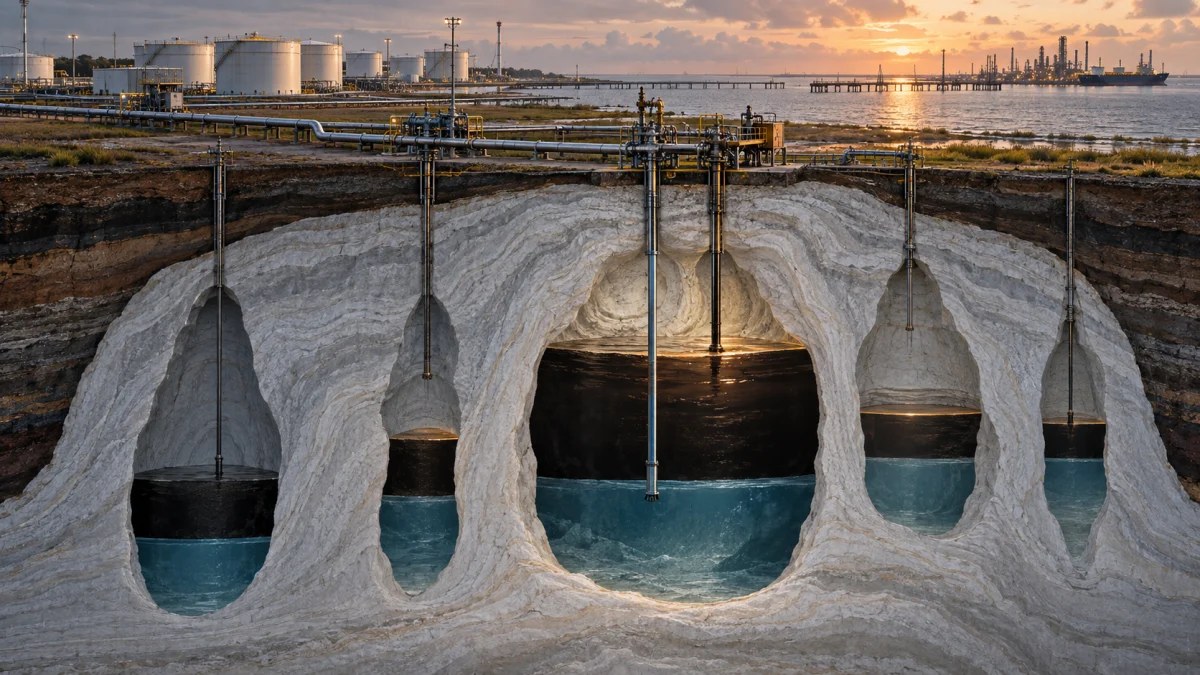
The reserve is not one enormous underground tank.
It is a network of 60 active salt-storage caverns at four sites in Texas and Louisiana, with each cavern having its own geometry, operational history, wells and remaining drawdown capacity.
Sandia National Laboratories performs continuing assessments of how many additional full drawdowns individual caverns can tolerate without compromising long-term cavern stability, well integrity or oil quality.
Its 2025 Annual Report of Available Drawdowns for Each Oil Storage Cavern defines an available full drawdown as the ability to remove all the oil from a cavern at full drawdown rates while preserving the cavern’s long-term usability.
That is a much more useful way to understand the real physical limit.
The GAO’s 2026 review reported that, as of the end of 2024, 47 of the SPR’s 60 active caverns, about 78%, still had at least four available full drawdowns remaining.
All but one had at least one remaining drawdown.
That finding does not support the idea that the entire SPR is on the verge of underground collapse.
It also does not mean repeated withdrawals are harmless.
Both statements can be true.
Why Taking Oil Out Physically Changes the Cavern
SPR oil does not come out simply because someone opens a valve.
The oil is stored thousands of feet underground inside caverns created in salt formations.
To withdraw crude, operators pump fresh water into the bottom of the cavern. Because oil floats on water, the incoming water forces the crude upward and into the withdrawal system.
The Department of Energy’s description of SPR storage operations explains this displacement process directly.
There is one important complication.
The cavern itself is made of salt.
Fresh or undersaturated water dissolves salt.
That means withdrawing oil does not merely change the amount of liquid inside the cavern. It can also change the shape and volume of the cavern itself.
Sandia’s analysis of the enormous 2022 withdrawal provides an unusually clear example.
Its 2023 cavern-drawdown report found that approximately 222 million barrels of oil were released during calendar year 2022. Nearly the same volume of raw water was injected.
Sandia estimated that the process produced approximately 34 million barrels of additional cavern volume through salt leaching.
That is a major physical change.
But cavern growth is not automatically catastrophic.
Sandia models where the injected water contacts salt, how cavern geometry changes, how stresses evolve and whether additional drawdowns could threaten long-term stability.
Its monitoring has found that most caverns have tolerated previous drawdowns well, although some require closer surveillance or have fewer remaining full drawdowns than others.
GAO also reported an unintuitive result: the enormous 2022 drawdown actually improved the geometry of some caverns, including by eliminating problematic salt structures created by earlier partial withdrawals.
So the engineering question cannot be reduced to:
Less oil = more cavern damage.
It depends on where water travels, which salt surfaces it reaches, how the cavern changes shape and what condition its wells are in.
Why the SPR Can Become Less Useful Before It Becomes Empty
This is the distinction that makes "How many barrels are left?" an incomplete question.
The reserve’s real strategic value depends on at least four different things:
- how much crude is physically stored;
- how much of that crude is accessible;
- how quickly it can be withdrawn;
- and how quickly the system can move that crude into pipelines, terminals and refineries.
Those numbers are not identical.
GAO found that, as of December 2025, DOE estimated the SPR’s effective drawdown capability at approximately 2.7 million barrels per day, compared with a design rate of approximately 4.415 million barrels per day.
That was only 61% of design capability.
The same assessment found that effective refill capability was about 56% of design.
The date matters.
Those figures describe the reserve’s condition in late 2025. They should not simply be applied to today’s 284.6-million-barrel inventory as though nothing at the facilities has changed.
But the finding demonstrates the larger point:
Stored oil and immediately deliverable oil are not the same thing.
GAO reported that more than a quarter of SPR crude inventory was unavailable for drawdown in December 2025 because of construction and cavern outages.
Again, that does not mean more than a quarter of today’s inventory is unavailable.
It means anyone trying to calculate "usable SPR oil" by looking only at the headline inventory number is missing a major part of the system.
So How Much of the SPR Is Actually Usable Right Now?
There is no defensible single public figure.
The EIA tells us how much crude is stored.
Sandia tracks the engineering availability of individual caverns.
DOE operates the wells, pumps, pipelines, water systems and distribution infrastructure.
GAO periodically evaluates how those systems perform together.
But no current public dashboard simply says:
284.6 million barrels stored, X million barrels immediately usable.
That distinction matters because "usable" can itself mean several things.
Oil may physically exist inside a cavern but be temporarily inaccessible because of a well outage.
A cavern may be accessible but incapable of supporting maximum withdrawal rates.
Oil may reach the surface but face downstream pipeline or terminal constraints.
High vapor pressure can also affect deliverability.
And some caverns have substantially more remaining engineering life than others.
The reserve therefore becomes progressively constrained rather than simply switching from "working" to "empty."
Why Bryan Mound Matters
Bryan Mound is useful as a case study because it shows why the national inventory number cannot tell the entire story.
The Department of Energy lists Bryan Mound as the SPR’s largest storage site, with 19 caverns and 247.1 million barrels of authorized storage capacity.
DOE’s 2026 SPR distribution specifications give Bryan Mound a design drawdown rate of 1.5 million barrels per day, the highest of the four individual sites.
But underground oil storage depends on more than cavern volume.
GAO reports that Bryan Mound sits in a historical sulfur-mining area whose geology places additional stress on some wells.
In May 2024, one Bryan Mound well experienced an unexpected failure despite showing no previous warning signs.
DOE, Sandia and the former site contractor estimated that as much as 400,000 barrels of crude oil were lost in the failure, according to the GAO investigation.
That failure was not attributed to the SPR’s current low inventory.
It should not be used as evidence that today’s drawdown is causing Bryan Mound to collapse.
What it demonstrates is why the condition of wells, caverns and surrounding geology matters just as much as the national barrel count.
Could the SPR Salt Caverns Actually Collapse?
Salt caverns can experience serious structural problems, but "the SPR falls below 300 million barrels and the caverns collapse" is not how the engineering evidence describes the risk.
Salt behaves differently from rigid rock.
Over long periods it creeps, deforms and responds to changes in pressure and cavern geometry. Repeated withdrawals can enlarge caverns, reduce spacing between nearby caverns and alter stress around wells.
Sandia therefore evaluates factors including cavern geometry, tensile and dilatant stresses, salt damage, enhanced creep, well integrity and the effects of one cavern’s operation on neighboring caverns.
The Sandia methodology for determining remaining cavern drawdowns explicitly treats these variables as cavern-specific engineering constraints.
GAO summarized the long-term issue simply: every drawdown cycle expands cavern volume and reduces spacing between caverns, eventually reducing their useful life.
But GAO also found that the caverns were generally in good condition.
The reasonable conclusion is neither "nothing is wrong" nor "the caverns are about to collapse."
It is:
Repeated heavy use consumes a finite underground storage asset, and the amount of remaining operational margin differs from cavern to cavern.
What Happens If the SPR Falls Below 252.4 Million Barrels?
Several things should be separated.
First, the limited-drawdown authority discussed earlier would become unavailable under current federal law.
Second, qualifying emergency authorities would still exist.
Third, the engineering system would have less inventory distributed across caverns, potentially creating additional constraints on high-rate delivery depending on which caverns contain the remaining crude.
Fourth, the reserve would have substantially less capacity to absorb another large oil-market shock before approaching the much lower operating levels discussed by DOE and outside experts.
What would not automatically happen at 252.4 million barrels is a nationwide cavern failure.
The statute is setting a legal threshold.
It is not describing rock mechanics.
What Would Happen Near 70 Million Barrels?
This is harder to answer because the United States has never operated the modern SPR anywhere near that inventory level.
The approximately 70-million-barrel figure is a DOE-attributed estimate of the amount needed to safely manage the cavern system at extremely low inventory.
Approaching it would leave far less oil available for emergency market intervention and presumably force increasingly careful management of which caverns remained in service and how they were operated.
But available public evidence does not support drawing a precise line and saying structural collapse begins immediately below 70 million barrels.
The figure is better understood as an operating floor, not a geological countdown timer.
And there is a large difference between an SPR that can technically continue operating and an SPR capable of fulfilling its original strategic mission at large scale.
That is why the debate over 70 million versus 250 million barrels can sound contradictory even when the participants are talking about different things.
One number asks:
How little oil could the physical system theoretically manage?
The other asks:
How much oil does the system need to remain a useful rapid-response reserve?
Those are not the same question.
The Current 2026 Withdrawals Are Also Different From a Straight Sale
There is another reason today’s declining inventory cannot simply be extrapolated toward zero.
In March 2026, the United States committed 172 million barrels of SPR crude as part of a coordinated International Energy Agency response to the major disruption in global oil supplies.
But DOE structured the current action primarily as an exchange.
In an exchange, companies receive SPR crude now and contractually return crude later, generally with additional barrels as a premium.
When the program was announced, DOE said it expected approximately 200 million barrels to be returned within the following year.
By June, DOE said earlier exchange tranches totaling more than 133 million barrels had achieved an approximately 26% premium in barrels scheduled for return. The June 2026 solicitation explains the exchange structure and premium-barrel mechanism.
That does not make today’s low inventory imaginary.
The barrels are physically outside the reserve until they are returned.
And projected future returns remain future deliveries until they actually occur.
But it does mean a straight-line assumption that current withdrawals continue indefinitely until the SPR reaches zero is inappropriate.
A substantial amount of the 2026 release is contractually intended to come back.
How Many Days of Oil Does the SPR Have Left?
This is one of the most tempting calculations and one of the least useful.
Dividing SPR inventory by total U.S. daily petroleum consumption produces a "days remaining" number.
But that calculation compares an emergency stockpile of crude oil with the country’s entire petroleum system and implicitly assumes the SPR would have to replace every barrel Americans normally consume.
That is not its purpose.
The United States continues producing crude oil domestically. Commercial inventories continue operating. Imports and exports continue. Refineries continue buying crude through normal channels.
The SPR is intended to supplement the market during a major disruption, not become America’s only source of petroleum.
The more important questions are how much oil can be delivered per day, for how long, through which facilities, and what portion of the reserve remains operationally accessible.
That is why an SPR with hundreds of millions of barrels could still be seriously constrained even while remaining nowhere close to empty.
The Number to Watch Is Not Just the Inventory
The headline SPR inventory matters.
At 284.552 million barrels, it is already far below the reserve’s roughly 714-million-barrel authorized storage capacity.
But the strongest available evidence suggests that anyone trying to judge U.S. emergency-oil capacity should watch more than the weekly EIA number.
Inventory needs to be considered alongside effective drawdown capability, cavern availability, well integrity, downstream distribution capacity and the schedule on which exchanged barrels actually return.
That is also consistent with GAO’s broader conclusion.
In its 2026 review, GAO found that neither Congress nor DOE had established a current long-term target size for the SPR that fully reflects today’s oil market, infrastructure and national-security requirements. GAO said the lack of a unified target and updated operational criteria complicates decisions about the reserve’s future size and capabilities.
Even the federal government therefore does not currently have one definitive number answering:
How much oil should the SPR contain?
The Bottom Line
The U.S. Strategic Petroleum Reserve does not have one universal minimum.
The figures commonly cited in discussions about the reserve describe different limits:
Around 300 million barrels is an expert warning range associated with increasing operational concerns, not a federal collapse threshold.
Around 250 million barrels has been proposed by a petroleum engineer as a more practical minimum for maintaining safer high-rate emergency operations.
252.4 million barrels is a statutory threshold governing limited drawdowns, not an absolute prohibition on emergency use.
Around 70 million barrels is the approximate systemwide operating minimum attributed publicly to the Department of Energy.
And underneath all of those numbers is the more complicated reality:
The physical limits of the SPR are ultimately cavern-specific.
The reserve can lose strategic effectiveness long before it runs out of oil. Low inventories can reduce withdrawal capability. Wells and infrastructure can become bottlenecks. Every substantial water-driven withdrawal alters the underground salt caverns to some degree.
At the same time, the available engineering evidence does not show that crossing 300 million barrels triggers a sudden underground collapse.
The real story is more consequential than a single threshold.
America’s emergency oil reserve has entered a range where the difference between oil that exists underground and oil that can be delivered rapidly, safely and repeatedly matters more with every additional drawdown.
That is the number policymakers, markets and anyone watching the SPR should care about.
References and Further Reading
Current Inventory and Federal Law
U.S. Strategic Petroleum Reserve Weekly Inventory Data — U.S. Energy Information Administration
EIA’s primary weekly dataset for crude oil stored in the SPR. The latest available figure used in this article is 284.552 million barrels for the week ending September 18, 2026.
42 U.S.C. § 6241 — U.S. House Office of the Law Revision Counsel
The underlying federal statute governing SPR drawdowns, including the 252.4-million-barrel restriction applicable to limited drawdowns.
Strategic Petroleum Reserve FAQs — U.S. Department of Energy
DOE’s explanation of emergency, limited, test and exchange drawdown authorities.
Cavern Engineering and Operational Capability
Energy Security: Congress and DOE Need a Unified Plan to Align Priorities and Investments for the Strategic Petroleum Reserve — Government Accountability Office, 2026
The most comprehensive recent federal review of SPR inventory, drawdown capability, aging infrastructure, cavern and well conditions, modernization work and long-term planning.
Annual Report of Available Drawdowns for Each Oil Storage Cavern in the Strategic Petroleum Reserve — Sandia National Laboratories, 2025
Sandia’s cavern-by-cavern assessment framework for determining how many additional full withdrawals can occur without compromising long-term stability.
2023 Annual Report of Available Drawdowns for Each Oil Storage Cavern — Sandia National Laboratories
Documents the physical effects of the 2022 withdrawals, including roughly 222 million barrels released, nearly equivalent raw-water injection and an estimated 34 million barrels of cavern leaching.
Strategic Petroleum Reserve Cavern Leaching Monitoring — Sandia National Laboratories
Explains how raw-water injection dissolves salt during oil withdrawals and how Sandia models resulting changes in cavern geometry.
SPR Storage Sites — U.S. Department of Energy
DOE’s technical overview of the four SPR storage sites and the water-displacement process used to withdraw crude from underground salt caverns.
Strategic Petroleum Reserve Distribution Systems 2026 — U.S. Department of Energy
Provides design storage and drawdown capabilities for Bryan Mound, Big Hill, West Hackberry and Bayou Choctaw.
The 250M, 300M and 70M Operating Estimates
Depleted U.S. Oil Stash Loses Potency as Iran War Grinds On — Reuters reporting
Reports the DOE-attributed 70-million-barrel operating floor and Texas A&M petroleum engineer Siddharth Misra’s assessment that roughly 250 million barrels represents a more practical minimum for safe operations.
Low U.S. Strategic Reserves Raise Concerns About Salt-Cavern Integrity — Fortune
Contains Misra’s explanation of why he considers inventories below roughly 300 million barrels increasingly concerning from an operational and geomechanical perspective.
The 2026 Emergency Exchange
United States to Release 172 Million Barrels From the Strategic Petroleum Reserve — U.S. Department of Energy, March 2026
DOE’s original announcement of the U.S. contribution to the coordinated IEA release and its projection that approximately 200 million barrels would subsequently be returned.
DOE June 2026 Strategic Petroleum Reserve Exchange Solicitation
Explains the exchange mechanism and reports that earlier 2026 exchange tranches had secured additional premium barrels for later return.
Related sherafy.com Research
How China Blunted the Iran War’s Global Oil Shock — sherafy.com
Explains how inventories, refinery activity and reduced Chinese crude demand helped absorb part of the 2026 disruption to Middle Eastern oil supplies.
Why Does the U.S. Import Oil If It Produces More Than Any Other Country? — sherafy.com
Explains why domestic production does not isolate the United States from global crude markets and why crude quality, refinery design and transportation infrastructure matter.
Editorial currency note: SPR inventory changes weekly, facility availability can change as maintenance and construction are completed, and the 2026 emergency exchange includes future return obligations. The inventory figure in this article reflects EIA data through September 18, 2026. Legal authorities and engineering assessments should be rechecked if this article is materially updated.