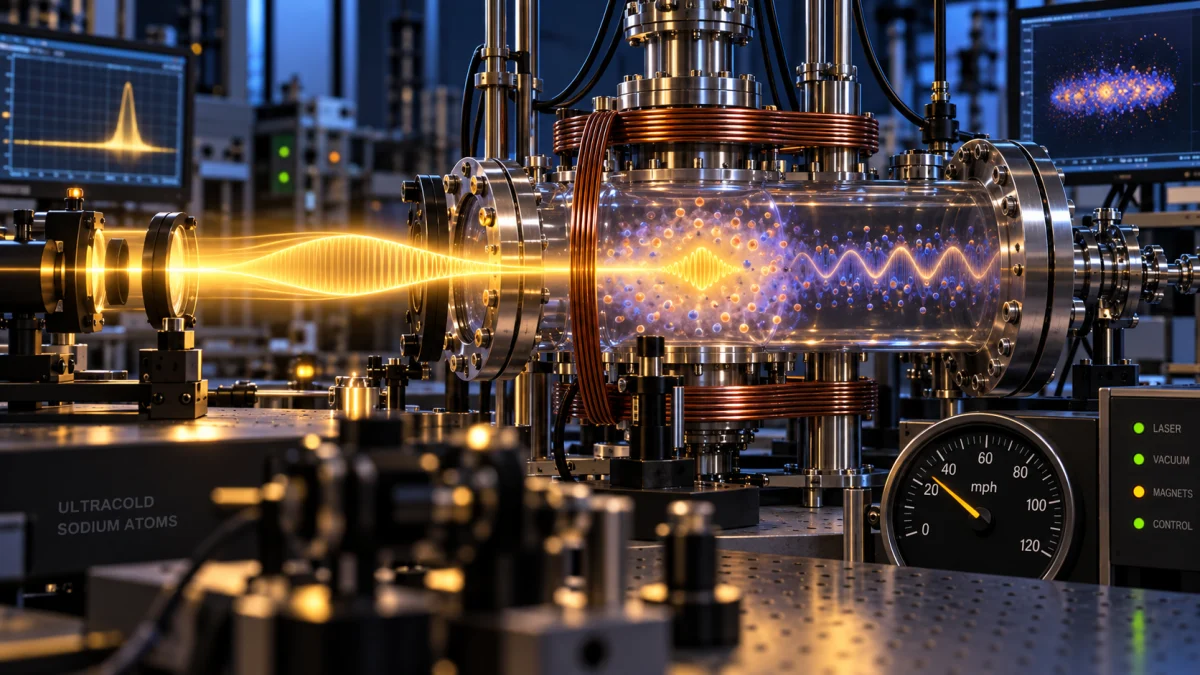
Yes, Lene Hau and her colleagues really did slow a light pulse to about 38 miles per hour. Their landmark 1999 experiment measured a pulse propagation speed of just 17 meters per second in an ultracold cloud of sodium atoms.
But they did not change (c), the fundamental speed of light in a vacuum.
What they slowed was the group velocity of an optical pulse traveling through a specially prepared atomic medium. Two years later, Hau’s team went further and effectively brought a light pulse to a complete stop by transferring its coherent optical information into the atoms, then regenerating the pulse later.
So the viral version of this story is unusually close to the truth. The misleading part is the mental picture it creates.
Hau did not make ordinary photons cruise through empty space at neighborhood speed and then park them in midair. She learned to control a coupled system of light and matter so precisely that an optical pulse could be slowed by many orders of magnitude, converted into an atomic excitation, stored, and turned back into light.
The original result was published in Nature in the paper “Light speed reduction to 17 metres per second in an ultracold atomic gas”.
Yes, the 38 MPH Number Is Real
The famous result comes from a paper by Lene Vestergaard Hau, S. E. Harris, Zachary Dutton and Cyrus Behroozi published in Nature on February 18, 1999.
Their experiment used a cloud of sodium atoms cooled into the nanokelvin range. By preparing the atoms with another laser and exploiting a quantum effect called electromagnetically induced transparency, or EIT, the team caused an incoming probe pulse to propagate extraordinarily slowly.
The researchers reported a minimum pulse velocity of:
17 meters per second, or about 38 miles per hour.
The original Nature paper describes the optical pulses as propagating roughly 20 million times more slowly than light in a vacuum.
So someone driving on an ordinary freeway can indeed move faster than 17 m/s.
That statement is mathematically true.
It is also an easy way to misunderstand what Hau actually accomplished.
What Was Actually Moving at 38 MPH?
The important word is pulse.
Hau’s team was measuring the group velocity of an optical pulse as it propagated through the prepared sodium gas.
That is not the same thing as changing the fundamental constant (c).
In a vacuum, light travels at approximately 299,792 kilometers per second, or about 186,282 miles per second. That universal value remained untouched.
Inside matter, however, the propagation of an optical pulse depends on how the electromagnetic field interacts with the material.
Ordinary materials already affect the propagation of light. Hau’s achievement was pushing that phenomenon into an extraordinary quantum regime where the pulse envelope could be slowed from hundreds of millions of meters per second to just 17.
The 1999 paper attributes the exceptionally low velocity to the combination of very steep frequency-dependent optical dispersion and the high density of the ultracold sodium gas.
It is therefore more precise to say:
Hau slowed the group velocity of a light pulse inside a specially prepared medium to about 38 mph.
It is not accurate to imagine each individual photon simply traveling through the experiment at exactly 38 mph like a tiny particle moving down a road.
How Do You Slow Light That Much?
The central mechanism was not merely cooling sodium to an extraordinary temperature.
It was electromagnetically induced transparency.
Atoms strongly absorb light at particular resonant frequencies. Under ordinary conditions, Hau’s sodium cloud would have absorbed the probe light rather than letting it pass through cleanly.
A second laser, usually called the coupling or control laser, changed that.
The coupling laser prepared the atoms so that different quantum pathways involved in absorbing the probe light interfered with one another. Under the right conditions, that interference suppresses absorption.
An otherwise opaque medium becomes transparent across a very narrow range of frequencies.
Hence the name: electromagnetically induced transparency.
EIT itself predates Hau’s experiment. K.-J. Boller, Atac İmamoğlu and Stephen E. Harris reported the first experimental demonstration of electromagnetically induced transparency in Physical Review Letters in 1991.
The important part for slow light is that the narrow EIT transparency window also creates extremely steep dispersion.
A light pulse is not composed of just one perfectly isolated frequency. It contains a narrow range of frequency components. When the optical response of the medium changes sharply across those frequencies, the way the pulse envelope travels through the material can change dramatically.
The major Reviews of Modern Physics treatment “Electromagnetically induced transparency: Optics in coherent media” describes how coherent preparation of atomic systems can radically alter their optical behavior, including pulse propagation.
In simplified form, Hau’s slow-light process looks like this:
coupling laser → quantum interference → transparency window → extreme dispersion → extraordinarily low group velocity
That is a much better description than saying the photons were simply “bumping into atoms” over and over until they slowed down.
What Did the Bose-Einstein Condensate Have to Do With It?
The ultracold sodium was enormously useful, but there is an important distinction.
A Bose-Einstein condensate is not fundamentally required to produce slow light through coherent atomic effects.
Hau’s experiment used sodium cooled into the Bose-Einstein-condensed regime, creating exceptionally favorable conditions for the experiment. As the gas became colder and denser, the team was able to obtain exceptionally small pulse velocities.
But other researchers soon demonstrated ultraslow light without using a Bose-Einstein condensate.
In June 1999, an independent group reported group velocities of roughly 90 meters per second in a hot rubidium gas.
That experiment is important because it makes clear that a BEC itself is not some exotic substance that physically grabs photons and forces them to crawl.
The underlying physics involves coherent control of how light and matter interact.
Hau’s ultracold, dense sodium system simply allowed that interaction to be pushed to an extraordinary extreme.
Did Lene Hau Prove Einstein Wrong?
No.
Nothing in these experiments contradicts special relativity.
The fundamental speed (c) is the invariant speed associated with light in a vacuum. Hau did not change that constant.
She manipulated how an optical pulse propagated through matter.
Those are different things.
Light traveling through a material did not suddenly become surprising in 1999. What was extraordinary about Hau’s work was the enormous and controllable magnitude of the slowdown.
An optical pulse that would normally cross a laboratory essentially instantaneously could be compressed until it fit inside a small cloud of atoms and then made to crawl through that cloud at a human-scale speed.
There was no faster-than-light communication, no violation of causality and no rewriting of Einstein’s theory.
Hau’s experiment was remarkable because it exploited quantum mechanics with extraordinary precision, not because it broke relativity.
Then Hau’s Team Effectively Stopped the Light
The next experiment is where the language becomes even more interesting.
In January 2001, Chien Liu, Zachary Dutton, Cyrus Behroozi and Lene Hau published another Nature paper, “Observation of coherent optical information storage in an atomic medium using halted light pulses”.
This time, slowing the pulse was only the beginning.
Using EIT, the researchers reduced the pulse’s group velocity so dramatically that the pulse became spatially compressed inside the atomic cloud.
Then they switched off the coupling laser.
The experiment effectively halted the probe pulse while transferring its coherent optical information into the atomic medium.
The stored state could persist for roughly a millisecond in that experiment.
When the researchers switched the coupling laser back on, the process reversed.
The stored atomic coherence was converted back into an optical field, and the probe pulse emerged again.
This is the scientific basis for the familiar statement that Hau stopped light and started it again.
But it does not mean that ordinary photons were sitting motionless inside the apparatus waiting for somebody to press Play.
Did the Photons Literally Stop Moving?
Not in the everyday sense of photons sitting stationary in space.
A particularly useful theoretical framework was developed by Michael Fleischhauer and Mikhail Lukin.
Their 2000 Physical Review Letters paper, “Dark-State Polaritons in Electromagnetically Induced Transparency”, describes coupled excitations of light and matter known as dark-state polaritons.
A dark-state polariton can be thought of, loosely, as a controllable hybrid between an electromagnetic excitation and a collective excitation of the atoms.
Its character depends on the control field.
As conditions are changed, the excitation can become increasingly matter-like.
Conceptually, the process looks something like this:
mostly light → light-matter excitation → stored atomic excitation → light-matter excitation → light again
When the light is “stored,” the electromagnetic part of the excitation is no longer simply a conventional light pulse sitting motionless inside the chamber.
The relevant coherent state has been mapped into the atoms.
Turning the coupling laser back on reverses that mapping and regenerates the optical pulse.
That distinction does not make “stopping light” fake.
It explains what physicists actually mean by it.
Other Scientists Independently Stored Light Too
Hau’s laboratory was not the only group to demonstrate the underlying phenomenon.
On January 29, 2001, D. F. Phillips, A. Fleischhauer, A. Mair, R. L. Walsworth and M. D. Lukin published “Storage of Light in Atomic Vapor” in Physical Review Letters.
Their experiment used rubidium vapor rather than Hau’s ultracold sodium system.
The researchers reported dynamically reducing a light pulse’s group velocity to zero, mapping its coherent excitation into atomic spin coherence, storing it for a controlled interval, and releasing it again.
That independent demonstration matters.
The effect was not an unexplained quirk peculiar to one Bose-Einstein condensate in one laboratory.
It reflected a reproducible mechanism for coherently transferring information between electromagnetic fields and matter.
Why Do Some Sources Say 15 MPH Instead of 38 MPH?
This is one of the more confusing details in modern retellings of Hau’s work.
The 1999 primary paper is clear: the famous published measurement was 17 m/s, which converts to approximately 38 mph.
Yet Harvard’s current faculty biography for Hau says her team slowed a pulse to 15 mph.
Those statements are not evidence that the 38-mph result was wrong.
Hau’s laboratory performed multiple slow-light experiments under different conditions.
A 2007 Harvard Magazine account of her later light-to-matter experiment explicitly says the optical pulse in that experiment was slowed to 15 mph as it entered the first Bose-Einstein condensate.
The cleanest interpretation is therefore that the two numbers describe different experimental configurations or stages of Hau’s research.
For the landmark result published in 1999, the correct number is the one stated in the primary paper:
17 meters per second, or about 38 miles per hour.
Was the Famous Experiment Actually Done at Harvard?
The common description is understandable, but the institutional history is slightly more complicated.
The 1999 Nature paper lists Hau with both the Rowland Institute for Science and Harvard University’s Department of Physics.
At the time, the Rowland Institute was an independent research institution in Cambridge, Massachusetts.
Harvard’s biography of Hau says she was a senior scientist at Rowland before joining the Harvard faculty in 1999.
The Rowland Institute’s own history says it joined Harvard in 2002, becoming the Rowland Institute at Harvard.
So describing Hau today as a Harvard physicist is completely reasonable.
Historically, however, the famous early slow-light experiments emerged from her work at the Rowland Institute while she also held a Harvard affiliation.
There is a similar wrinkle with the year.
The paper was published in February 1999, but Nature records that the manuscript was received on November 3, 1998.
The experiment itself therefore necessarily predates the publication year commonly attached to it.
In 2007, the Experiment Became Even Stranger
The 38-mph result is usually where viral versions of this story stop.
Hau’s team did not.
In 2007, Naomi Ginsberg, Sean Garner and Hau published “Coherent control of optical information with matter wave dynamics” in Nature.
Their experiment used two separate Bose-Einstein condensates.
A slow-light pulse entered the first condensate and was stopped and stored.
The optical information was converted into a traveling matter-wave excitation.
That excitation then moved to a second condensate approximately 160 micrometers away.
There, the researchers used another control field to regenerate the optical pulse.
Popular accounts sometimes summarize this by saying Hau turned light into matter and then turned matter back into light.
That captures the basic wonder of the experiment, but it can again create an overly literal picture.
The researchers did not take an individual photon and transform it into a sodium atom.
They transferred the coherent state associated with an optical pulse into a controllable excitation of matter and subsequently used that excitation to recreate an optical pulse.
That is already strange enough.
What Happened to the Information While the Light Was “Stopped”?
This question gets to the real scientific importance of the experiments.
Photons are excellent carriers of information because light moves rapidly and can travel long distances.
Those same properties make photons difficult to hold in one place.
Matter is much easier to keep stationary.
A controllable light-matter interface offers a way to exploit the strengths of both.
In the stopped-light experiments, information represented by the optical excitation could be mapped into a collective atomic state.
Later, that state could be converted back into light.
This general idea became important in the development of optical quantum memory.
A 2017 NIST review, “Optical quantum memory based on electromagnetically induced transparency”, describes EIT as a promising method for implementing quantum memory in quantum communication and quantum-computing systems.
That is a more defensible description of the research’s technological legacy than some of the more speculative predictions that accompanied the original experiments.
Hau’s sodium apparatus did not simply become a commercial computer-memory module.
Its deeper significance was helping demonstrate that coherent information carried by light could be slowed, transferred into matter, stored and retrieved.
So Could Your Car Really Overtake Hau’s Light?
In one very narrow sense, yes.
A vehicle traveling 60 mph has a greater numerical speed than the 38-mph group velocity measured for Hau’s pulse inside the prepared sodium cloud.
But you could not pull alongside the experiment on the freeway.
The ultraslow propagation existed only inside a tiny and extraordinarily controlled laboratory environment.
Once the pulse was no longer propagating through that slow-light medium, the 38-mph figure no longer described its motion.
So:
Could a car’s speedometer display a number larger than Hau’s measured light-pulse velocity? Yes.
Could you race an ordinary beam of light down the interstate and win? No.
What the Viral Claim Gets Right and Wrong
| Claim | What the evidence says |
|---|---|
| Lene Hau slowed light to 38 mph. | Correct. The 1999 Nature paper reports a pulse velocity of 17 m/s, about 38 mph. |
| She used ultracold sodium atoms. | Correct. The experiment used sodium cooled into the nanokelvin regime. |
| A Bose-Einstein condensate is what fundamentally slows the light. | Incomplete. Coherent light-matter physics and EIT are central; ultraslow light was also demonstrated in hot atomic vapor. |
| She changed the universal speed of light. | Incorrect. The vacuum constant (c) was unchanged. |
| She later stopped light. | Correct with qualification. The optical excitation was mapped into atomic coherence and later regenerated. |
| The photons simply sat motionless until she restarted them. | Misleading. During storage, the coherent excitation resides in the atomic system rather than as an ordinary stationary light pulse. |
| The work disproved Einstein. | Incorrect. The experiments are compatible with special relativity. |
| She later transferred optical information through matter and recreated the light elsewhere. | Correct. The 2007 experiment transferred the information between two condensates through a traveling matter-wave excitation. |
The Bottom Line
The viral story is not a myth.
Lene Hau’s team really did report a light-pulse group velocity of about 38 mph. They later effectively stopped an optical pulse and regenerated it.
The important correction is not that those achievements were fabricated or wildly exaggerated.
It is that phrases such as “the speed of light” and “stopped light” mean something more precise in these experiments than they do in ordinary conversation.
The universal constant (c) never changed. Einstein’s speed limit survived untouched.
Hau instead engineered the quantum interaction between light and matter so that an optical pulse’s group velocity became extraordinarily small.
And when her team later brought that velocity effectively to zero, the experiment did not leave a collection of ordinary photons hanging motionless in space.
The coherent optical excitation had been transferred into matter.
Then it was turned back into light.
The technically correct explanation is more complicated than the viral version.
It is also considerably more interesting.
References and Further Reading
Primary Experimental Papers
Light Speed Reduction to 17 Metres per Second in an Ultracold Atomic Gas — Nature (1999)
Lene Vestergaard Hau, S. E. Harris, Zachary Dutton and Cyrus H. Behroozi. The primary paper documenting the 17 m/s slow-light measurement in ultracold sodium and the role of electromagnetically induced transparency.
Observation of Coherent Optical Information Storage in an Atomic Medium Using Halted Light Pulses — Nature (2001)
Chien Liu, Zachary Dutton, Cyrus H. Behroozi and Lene Vestergaard Hau. The primary experimental report demonstrating halted pulses, storage of coherent optical information in the atomic medium, and subsequent regeneration.
Coherent Control of Optical Information with Matter Wave Dynamics — Nature (2007)
Naomi S. Ginsberg, Sean R. Garner and Lene Vestergaard Hau. Documents the transfer of optical information through a traveling matter-wave excitation and revival of a light pulse from a second Bose-Einstein condensate.
Storage of Light in Atomic Vapor — Physical Review Letters (2001)
D. F. Phillips, A. Fleischhauer, A. Mair, R. L. Walsworth and M. D. Lukin. An independent experiment showing reversible storage and release of an optical excitation in rubidium vapor.
EIT and the Light-Matter Mechanism
Observation of Electromagnetically Induced Transparency — Physical Review Letters (1991)
K.-J. Boller, A. İmamoğlu and S. E. Harris. The first experimental demonstration of electromagnetically induced transparency through destructive quantum interference.
Ultraslow Group Velocity and Enhanced Nonlinear Optical Effects in a Coherently Driven Hot Atomic Gas — Physical Review Letters (1999)
Michael M. Kash and colleagues. Demonstrated group velocities of roughly 90 m/s in hot rubidium vapor, showing that a Bose-Einstein condensate is not fundamentally required for ultraslow light.
Dark-State Polaritons in Electromagnetically Induced Transparency — Physical Review Letters (2000)
Michael Fleischhauer and Mikhail D. Lukin. Develops the dark-state-polariton framework used to describe controllable coupled excitations of light and matter and their reversible storage.
Electromagnetically Induced Transparency: Optics in Coherent Media — Reviews of Modern Physics (2005)
Michael Fleischhauer, Atac İmamoğlu and Jonathan P. Marangos. A comprehensive review of EIT, coherent optical media, pulse propagation and related quantum-information applications.
Quantum-Memory Context
Optical Quantum Memory Based on Electromagnetically Induced Transparency — NIST (2017)
Lijun Ma, Oliver T. Slattery and Xiao Tang. Reviews the physical principles, experimental development and quantum-information applications of EIT-based optical memory.
Historical and Institutional Context
Lene V. Hau — Harvard Department of Physics
Harvard’s current faculty biography provides career chronology and summarizes Hau’s slow-light, stopped-light and later light-matter research.
Fantastic! — Harvard Magazine (2007)
A contemporary account of Hau’s 2007 experiment that helps distinguish the later approximately 15-mph implementation from the famous 38-mph result reported in 1999.
The Rowland Institute at Harvard — Institutional History
The institute’s current history notes that the independent Rowland Institute of Science joined Harvard in 2002, clarifying the institutional status of Hau’s laboratory during the original work.
Editorial currency note: These are historical experimental findings rather than changing policy or consumer information. Where later institutional summaries use different shorthand values, particularly 15 mph versus 38 mph, this article gives priority to the original peer-reviewed measurement for the specific experiment being discussed.