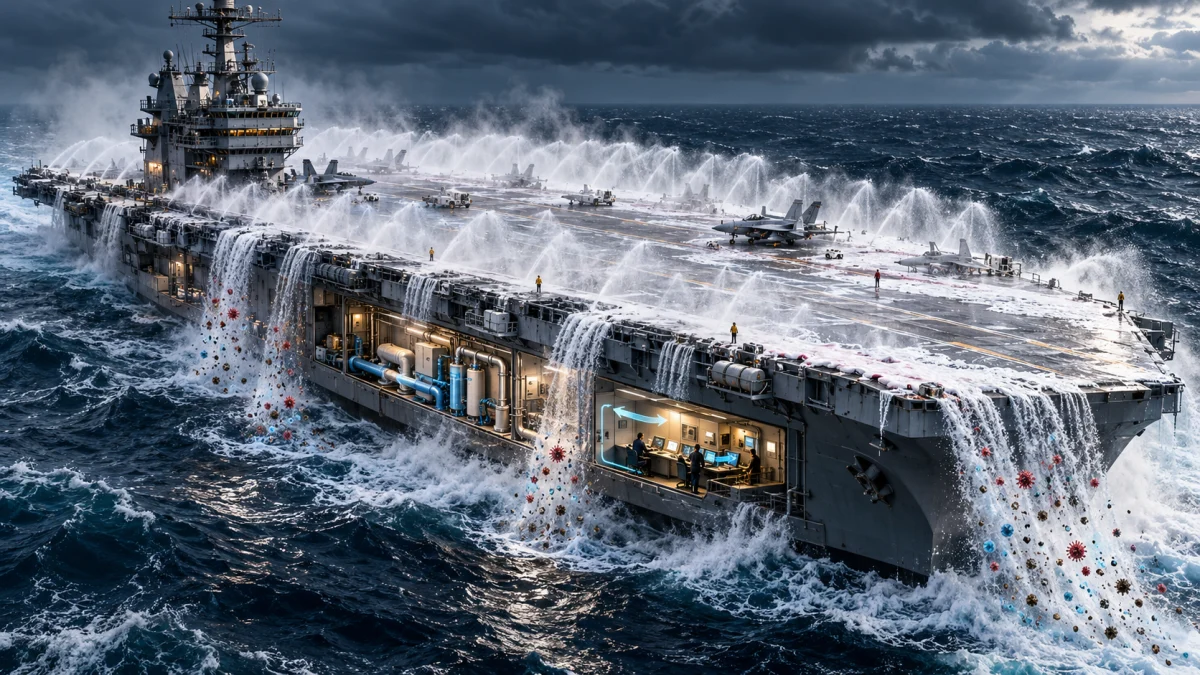
When a U.S. Navy aircraft carrier suddenly begins spraying liquid across its flight deck, island and other exposed surfaces, the ship is not simply giving itself a very expensive bath. It is testing a countermeasure washdown system designed to help the ship survive chemical, biological or radiological contamination.
The basic idea is surprisingly simple: cover exposed portions of the ship with flowing liquid so dangerous contaminants have less opportunity to settle and remain on the vessel.
The engineering behind it is considerably more complicated.
And one detail that regularly gets lost in viral explanations is important: what you are seeing is not necessarily ordinary seawater, and it is not necessarily firefighting foam either.
Military guidance describes shipboard CBR washdown systems that create a protective curtain of raw water supplied by the ship’s firemain. Aircraft carriers, however, can also use aqueous film-forming foam, or AFFF, through portions of their countermeasure and firefighting systems. In August 2026, for example, the Navy explicitly described a countermeasure washdown test aboard the future USS John F. Kennedy as covering the flight deck in AFFF.
So the most accurate answer is not simply "water" or "foam."
It depends on the ship, the system being tested and the part of the ship being protected.
What Is a Countermeasure Washdown System?
A countermeasure washdown system, commonly abbreviated CMWD, is part of a warship’s damage-control and CBR survivability equipment.
One military shipboard training document describes the system as routing pressurized raw water from the ship’s firemain through sprinkler fittings on exposed weather decks. The result is effectively a protective umbrella of flowing water over portions of the vessel.
The Navy formally treats countermeasure washdown as one layer of protection against chemical, biological, radiological and nuclear threats, alongside decontamination stations, detection equipment and the ship’s Collective Protection System.
And the technology is not limited to aircraft carriers. The Navy’s published specifications for the Arleigh Burke-class destroyer USS Mitscher, for example, specifically list both a Collective Protection System and a Countermeasure Washdown System as equipment intended to allow continued operations in chemical, biological and radiological environments.
Aircraft carriers simply make the system much more visually spectacular.
When hundreds of outlets begin spraying across an enormous flight deck, it can look as though the carrier has created its own rainstorm.
Why Would Spraying the Ship Protect It From a Chemical or Radiological Attack?
The key is preventing contamination from sticking in the first place.
Imagine radioactive fallout particles or droplets of a persistent chemical agent reaching a completely dry flight deck. Once deposited, that material can remain on the surface, contaminate equipment and create an exposure hazard for sailors who later have to work there.
Now imagine the same contaminant hitting a deck already covered by a continuously moving film of water.
The contaminant has a much better chance of being caught in the runoff and carried away.
Military CBRN washdown guidance makes this distinction explicitly. If warning is available, the ship should be wetted before an attack because contaminants striking a surface already covered by flowing water can be washed overboard. The same guidance says washdown is generally more effective as a preventive measure than as an attempt to clean completely dry surfaces after contamination has already settled.
That makes "washdown" slightly misleading if it creates the mental image of sailors cleaning something after the fact.
Part of the system’s value is pre-wetting.
It does not "neutralize radiation"
There is another distinction worth making.
If radioactive fallout lands on the flight deck, spraying it with seawater does not somehow make the radioactive material stop being radioactive.
The objective is primarily contamination control.
If radioactive particles can be prevented from remaining on exposed surfaces or can be physically removed, the amount of radioactive material sitting on the ship is reduced. Similar logic applies to chemical and biological contamination, although the properties of different agents vary significantly.
In other words:
The system is removing or limiting contamination, not switching off radioactivity.
That distinction matters because "protecting a ship from a nuclear attack" can otherwise sound considerably more magical than what the system actually does. A washdown system does not protect a carrier from the blast or thermal effects of a nuclear weapon. It is part of the ship’s defenses against the contamination environment that can follow.
Is the Carrier Spraying Seawater or Firefighting Foam?
Potentially either, and sometimes both are involved in the broader system.
This is where simplified explanations of carrier washdown become particularly messy.
For conventional shipboard CBR washdown, military training material describes raw water from the firemain being distributed through sprinkler heads.
Aircraft carriers introduce another problem: enormous quantities of aviation fuel and aircraft operating on enclosed hangar decks and open flight decks.
That creates a requirement for highly capable firefighting systems as well.
One of those agents has historically been aqueous film-forming foam, or AFFF.
And on U.S. carriers, the CBR washdown and firefighting functions are not always neatly separated in the way an outside observer might expect.
The Navy’s description of a 2015 countermeasure washdown test aboard USS George Washington said that the system used both seawater and AFFF. During that particular test, the Navy reported that a mixture containing 6% AFFF and 94% water was sprayed through parts of the ship before decks were subsequently sprayed with seawater.
More recently, during August 2026 acceptance trials for the Ford-class carrier John F. Kennedy, Navy documentation explicitly described CMWD as protecting against chemical, biological and radiological attacks by covering the flight deck in AFFF.
So there is no responsible universal rule that says:
"Countermeasure washdown is always plain seawater."
But the opposite claim is also wrong:
"Whenever you see a Navy ship spraying itself, that spray is 6% AFFF and 94% water."
System architecture and procedures differ by ship, class, location and evolution.
| What is happening | What may be used | Purpose |
|---|---|---|
| CBR countermeasure washdown | Seawater/raw firemain water | Prevent or remove exterior contamination |
| Carrier CMWD evolution | May incorporate AFFF depending on system and configuration | CBR protection and system testing |
| Aviation firefighting | Water and firefighting foam | Suppress flammable-liquid fires |
| Full system test | Depends on ship and equipment being tested | Verify equipment works before it is needed |
That distinction explains why photographs and videos of apparently similar Navy "washdowns" do not always look identical.
What Does AFFF Actually Do?
AFFF was developed specifically for dangerous flammable-liquid fires, making aircraft carriers an obvious environment in which such capability matters.
The phrase "foam smothers the fire" is directionally correct, but the actual mechanism is more interesting.
Naval Research Laboratory material explains that AFFF creates an extremely thin aqueous film between the liquid fuel and the foam blanket. That film helps prevent fuel vapor and oxygen from mixing while the foam blanket further separates the fuel from the atmosphere. The water content also contributes cooling.
That is particularly useful for fires involving aviation fuels.
So AFFF is not simply soapier water thrown onto the flames. It is designed to attack one of the critical mechanisms that allows a liquid-fuel fire to continue burning and reignite.
Where Did the "6% Foam, 94% Water" Claim Come From?
This is where a viral explanation can be simultaneously based on real information and still become misleading.
Several striking figures commonly repeated in descriptions of carrier washdown can be traced directly to a May 2015 Navy report about USS George Washington.
During that particular test, the Navy reported:
- a mixture of 6% AFFF and 94% water;
- more than 200 preventive-maintenance checks on the AFFF system before the evolution;
- testing around the hangar bay, flight deck, island and fantail;
- and approximately 2,000 gallons of AFFF used during the hangar-bay washdown.
Those numbers are real.
What is not justified is silently turning them into specifications for every aircraft carrier countermeasure washdown.
The Navy report repeatedly describes a particular ship and a particular test.
There is also a small but important ambiguity in the famous 2,000-gallon figure. The Navy article says the hangar-bay washdown used "approximately 2,000 gallons of AFFF," while elsewhere describing the applied mixture as 6% AFFF and 94% water. The article does not separately clarify in that sentence whether its 2,000-gallon figure refers to foam concentrate or proportioned solution.
Without additional documentation, it would be irresponsible to silently resolve that ambiguity.
The safe conclusion is simply:
The Navy reported approximately 2,000 gallons of AFFF associated with that hangar-bay washdown. It should not be presented as the amount every carrier uses.
The same caution applies to the maintenance figure.
The Navy reported more than 200 preventive-maintenance checks before the George Washington evolution. That establishes how extensive preparation could be on that carrier’s AFFF system in 2015. It does not establish a universal "200-check rule" for every ship or every modern CMWD test.
Does the Washdown System Keep Chemical Agents From Getting Inside the Ship?
It helps, but it is only one layer of the defense.
Reducing contamination on the exterior means there is less hazardous material available to spread into interior spaces through personnel, equipment, airflow and normal ship operations.
But the Navy does not rely on deck sprinklers to make the inside of a warship safe.
Ships can also use a Collective Protection System, or CPS.
NAVSEA describes CPS as an air-filtration system integrated into shipboard HVAC. Filtered air is supplied to protected areas while slight positive pressure is maintained inside them. Because pressure is higher inside the protected zone than outside, air tends to flow outward through small leakage paths rather than allowing contaminated outside air to leak inward.
Airlocks and decontamination stations provide additional barriers when personnel move between exposed and protected spaces.
A useful way to think about the overall defense is:
Washdown fights contamination on the outside.
Filtration and positive pressure protect the air inside.
Detection and decontamination procedures manage what still gets through.
No single layer makes the ship invulnerable.
Together, they give the crew a better chance of continuing to operate in a contaminated environment.
Does the System Run Before or After an Attack?
Potentially both.
But if the threat is known in advance, before is better.
Military guidance says contaminants that strike a ship already covered by flowing water are more likely to be washed away. Once agents have deposited onto dry surfaces, post-attack washdown may not remove them as easily or completely. Prompt washdown after exposure is still useful, but delaying it gives contamination more opportunity to remain on the vessel.
That explains something otherwise strange about these systems.
The ship may begin spraying itself before there is anything visible to wash off.
That is not premature decontamination.
It is the point.
Why Does the Navy Test Something It Hopes Never to Use?
Because hundreds of sprinklers, valves, pumps, proportioners and pipes are only useful in an emergency if they actually work together.
On September 5, 2026, USS Theodore Roosevelt conducted a countermeasure washdown while operating in the Pacific. Navy photographs show sailors monitoring the flight-deck sprinkler system during the evolution.
Other photographs in the same series show sailors dealing with the physical realities of keeping deck systems operational during training.
The George Washington example makes the maintenance burden even clearer. The Navy’s 2015 report described more than 200 preventive-maintenance checks before the AFFF system was put through the countermeasure washdown test.
A system intended for a chemical attack or major flight-deck fire does not get the luxury of failing when somebody finally needs it.
That is why the apparently spectacular footage is, from the crew’s perspective, also a maintenance and readiness test.
What About AFFF and PFAS?
There is an uncomfortable modern complication.
Traditional military AFFF formulations have been associated with per- and polyfluoroalkyl substances, or PFAS, chemicals whose persistence has prompted extensive environmental cleanup and a broader Defense Department transition away from fluorinated firefighting agents in many applications. Navy environmental material identifies historical AFFF use as a major source of PFAS releases at military facilities.
But shipboard firefighting is treated differently under current procurement rules.
As of September 2026, the Defense Federal Acquisition Regulation Supplement generally prohibits procurement of firefighting agents containing more than one part per billion of PFAS, but expressly exempts firefighting agents procured solely for use aboard ocean-going vessels.
That does not mean every carrier washdown visible today necessarily contains legacy PFAS-based foam.
It does mean the military’s move away from PFAS firefighting agents has not produced a simple "AFFF is gone from Navy ships" answer.
The operational challenge is obvious: the Navy must balance the environmental and health problems associated with persistent fluorinated compounds against the need to rapidly suppress extremely dangerous fuel fires at sea.
What the Viral Explanation Gets Right and Wrong
| Claim | What the evidence shows |
|---|---|
| The ship is using a countermeasure washdown system. | Correct when the footage is identified as a CMWD evolution. |
| The system protects against chemical, biological and radiological contamination. | Correct. That is an established purpose of CMWD. |
| It can also be associated with firefighting. | Correct, particularly aboard carriers, but the exact system configuration matters. |
| The spray is 6% AFFF and 94% water. | Documented for USS George Washington during a specific 2015 test, not established as a universal mixture for every washdown. |
| More than 200 maintenance checks are required. | Documented for the George Washington AFFF system before that test, not a universal Navy specification. |
| The hangar-bay test used about 2,000 gallons of foam. | The Navy reported approximately 2,000 gallons of AFFF during that specific evolution. The wording does not resolve every detail of the quantity. |
| The system keeps contamination from reaching the inside of the ship. | Partly correct but oversimplified. Washdown reduces exterior contamination; CPS filtration, positive pressure, airlocks and decontamination provide additional interior protection. |
| It neutralizes radioactive fallout. | Misleading. Washdown primarily prevents or physically removes radioactive contamination from surfaces; it does not make radioactive material nonradioactive. |
| Pre-wetting the ship can be better than waiting until afterward. | Correct. Military guidance specifically identifies washdown as more effective when used preventively. |
The Bottom Line
When an aircraft carrier suddenly appears to make its own rainstorm, the Navy is not simply cleaning the deck.
Countermeasure washdown is part of the ship’s survivability system. It can coat exposed areas before chemical, biological or radiological contamination arrives, reducing the amount that remains on the vessel and helping carry contaminants away before they become a larger problem.
But the simple viral explanation usually leaves out an important complication.
There is no universal rule that every washdown is just seawater, nor that every carrier is spraying the same 6% AFFF mixture seen in a particular Navy report.
Shipboard CBR washdown systems can use firemain water. Carrier systems can also incorporate AFFF, and the Navy documented AFFF being used specifically for countermeasure washdown testing aboard the future USS John F. Kennedy as recently as 2026.
The famous 6% foam, 94% water mixture, 200-plus maintenance checks and roughly 2,000-gallon figure are also genuine Navy numbers.
They just belong to one documented USS George Washington evolution in 2015, not to every aircraft carrier every time the sprinklers come on.
The underlying idea is much more durable than any one viral clip:
Keep contamination moving instead of letting it settle, keep the ship’s interior isolated and filtered, and make sure the systems are tested before the day the crew actually needs them.
References and Further Reading
Countermeasure Washdown and Ship Survivability
George Washington Completes Countermeasure Wash-Down System Testing — U.S. Navy
The Navy’s May 2015 account is the primary source for the widely repeated 6% AFFF/94% water mixture, 200-plus maintenance checks and approximately 2,000-gallon figure aboard USS George Washington.
PCU John F. Kennedy Conducts Countermeasure Wash-down Testing During Acceptance Trials — DVIDS/U.S. Navy
A particularly useful contemporary source because the Navy explicitly describes the August 2026 carrier CMWD evolution as a defense against chemical, biological and radiological attack using AFFF on the flight deck.
USS Theodore Roosevelt Countermeasure Washdown — DVIDS/U.S. Navy
September 2026 Navy imagery documenting a current Nimitz-class carrier conducting a countermeasure washdown in the Pacific.
OPNAV Instruction 9070.1B: Survivability Policy for Surface Ships — Department of the Navy
Navy survivability guidance identifies countermeasure washdown, decontamination stations and collective protection among passive defenses for mitigating CBRN attacks.
CBRN Washdown System Training Material — U.S. Army Training and Doctrine Command
Technical training material explaining firemain-fed raw-water washdown, pre-wetting and why preventive washdown can be more effective than post-exposure decontamination.
Interior Protection and Firefighting
Collective Protection System — Naval Sea Systems Command
NAVSEA’s description of shipboard CPS filtration and positive pressurization, which provides an important second layer of protection beyond exterior washdown.
NRL RDT&E Protecting Ships and Crew — Department of the Navy CHIPS
Explains the physical mechanism of AFFF, including formation of an aqueous film that suppresses fuel vapor and separates it from oxygen.
AFFF and PFAS
DFARS Subpart 223.74: PFAS in Firefighting Agents — Acquisition.gov
Current Defense procurement rule limiting PFAS-containing firefighting agents while providing an exemption for agents intended solely for use aboard ocean-going vessels.
Editorial currency note: Shipboard firefighting agents, PFAS procurement rules and Navy equipment configurations can change. Regulatory information in this article was checked against the DFARS in effect in September 2026. Historical quantities and mixture ratios are identified with the particular ship and test from which they originated.