
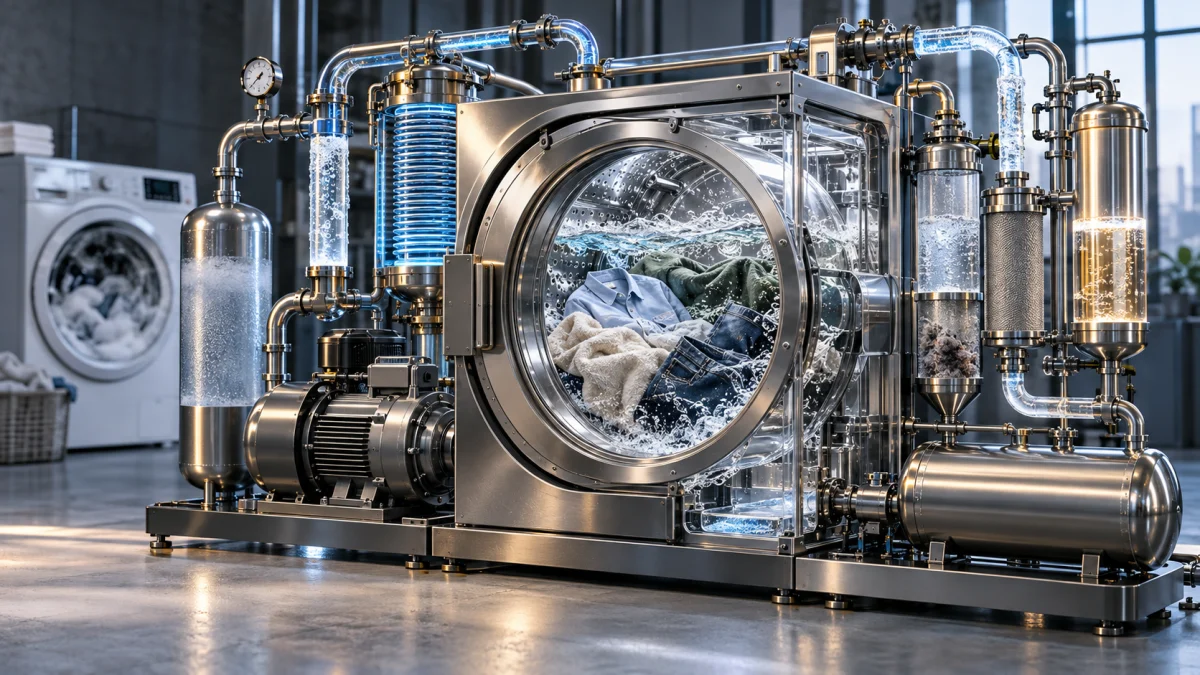
Yes, clothes can actually be washed in liquid carbon dioxide instead of water. The stranger part is that this is not really a new technology.
Commercial liquid-CO₂ garment-cleaning systems existed in the 1990s. One system called DryWash was available for order by July 1996, while another developed by Micell Technologies was cleaning customers’ clothing at a North Carolina dry cleaner by late 1998.
They did not revolutionize laundry.
Liquid CO₂ turned out to be an elegant cleaning solvent trapped inside a difficult engineering problem. It can dissolve oils, requires little or no conventional drying and can be recovered for reuse. But keeping carbon dioxide liquid requires substantial pressure, and CO₂ by itself is much better at removing some kinds of contamination than others.
Those two problems — pressure and cleaning chemistry — help explain why liquid-CO₂ washing largely disappeared from public view.
Now they are also the two problems that major appliance manufacturers appear to be attacking again.
LG Electronics has been developing commercial CO₂ washing equipment and received Korean regulatory permission in late 2025 to move toward commercial operation. Samsung, meanwhile, has developed patent families explicitly aimed at lowering CO₂ washing pressures enough for household equipment, adjusting solvent mixtures according to the type of stain, and even spraying liquid CO₂ inside a garment-care cabinet. Samsung-affiliated researchers also published a peer-reviewed study in 2025 on improving liquid-CO₂ cleaning performance with co-solvents.
As of September 2026, that does not mean you can walk into an appliance store and buy a Samsung or LG liquid-CO₂ washer for your laundry room.
But it does mean an idea that supposedly belonged to the future of laundry 30 years ago may not be finished yet.
How Can a Gas Wash Clothes?
The first misconception is contained in the question itself.
The clothes are not being washed in CO₂ gas.
They are being washed in liquid carbon dioxide.
Carbon dioxide changes phase depending on temperature and pressure. At ordinary atmospheric pressure, we normally encounter it as a gas. Compress it sufficiently under appropriate temperatures, however, and it becomes a liquid.
According to the National Institute of Standards and Technology, CO₂ has a critical temperature of about 304.13 kelvin, or 31°C, and a critical pressure of approximately 7.38 megapascals, or 73.8 bar. Above both values, it enters a supercritical state in which the traditional distinction between liquid and gas disappears. NIST thermophysical data for carbon dioxide
Below that critical temperature, sufficiently pressurized CO₂ can exist as an ordinary liquid.
That liquid can function as a cleaning solvent.
Liquid CO₂ Cleaning Is Not Necessarily Supercritical CO₂ Cleaning
This distinction is routinely blurred in descriptions of the technology.
Liquid CO₂ and supercritical CO₂ are not interchangeable terms.
Supercritical CO₂ has many industrial applications, including extraction and chemical processing. But a clothes-cleaning machine does not inherently need to cross the CO₂ critical point.
Traditional liquid-CO₂ garment systems operate with CO₂ in its liquid phase. Samsung’s own recent patent literature, for example, describes conventional liquid-CO₂ machines as requiring pressures of roughly 50 bar or higher at room temperature to keep their cleaning solvent liquid. Samsung patent: Washing Machine and Method for Controlling Same
Calling every CO₂ clothes-cleaning process "supercritical CO₂ washing" therefore creates a technically incorrect picture.
How a Liquid-CO₂ Washing Machine Actually Works
An early commercial system documented by the U.S. Environmental Protection Agency provides a useful picture.
Micell Technologies’ Micare system used a rotating basket somewhat resembling a large front-loading washing machine. Clothes were loaded into a sealed pressure vessel, most of the air was evacuated, and gaseous CO₂ was introduced to pressurize the chamber.
Liquid CO₂ and specialized cleaning agents were then added.
During cleaning, the garments were agitated while the cleaning fluid circulated through filters. At the end of the wash, the liquid was pumped back into storage. Part of it went through distillation to remove contaminants and detergent residues, while gaseous CO₂ was compressed and returned to storage for reuse. EPA: Liquid Carbon Dioxide Surfactant System for Garment Care
The EPA case study described a 60-pound-capacity machine with a cycle lasting roughly 35 to 45 minutes. Micell reported recycling about 98% of its CO₂ in the system.
There is an important qualification: the EPA explicitly warned that the performance information in that 1999 case study had been supplied by the manufacturer and had not been independently corroborated by EPA.
That matters because many later descriptions of early CO₂ cleaning repeat commercial claims without preserving that caveat.
Why the Clothes Do Not Need a Normal Drying Cycle
This is one of liquid CO₂’s genuinely clever properties.
After ordinary washing, clothing contains liquid water. Removing it requires mechanical extraction followed by evaporation, which usually means heating the fabric and moving a lot of air.
CO₂ behaves differently.
When the pressure inside a CO₂ washing system is reduced, residual liquid CO₂ on the textile changes back into gas. The machine recovers as much of that gas as practical rather than trying to evaporate liters of water out of the clothes.
Peer-reviewed research on CO₂ dry cleaning notes this as a fundamental advantage: a conventional drying step is unnecessary because CO₂ leaves the fabric during depressurization. Mechanical Action in CO₂ Dry Cleaning — The Journal of Supercritical Fluids
That does not mean the process consumes no energy. Compressors, pumps, cooling equipment, solvent recovery and distillation all require power.
It simply shifts where the energy is being used.
CO₂ Is Surprisingly Good at Some Kinds of Dirt
The chemistry helps explain both why this technology is attractive and why it has been so difficult to perfect.
Liquid CO₂ is relatively nonpolar.
That makes it useful for dissolving many oily and hydrophobic contaminants, including fats, oils and components of human sebum.
Its low surface tension can also help it penetrate textile structures. Samsung’s recent liquid-CO₂ spray patent specifically points to its ability to dissolve oils and fats while penetrating fabrics. Samsung Liquid Carbon Dioxide Spray Dry Cleaning System patent application
If everyone’s clothing were contaminated only with body oil and grease, liquid CO₂ would have a much easier path to victory.
Unfortunately, dirt is not one substance.
The Problem: Sweat, Wine, Blood, Dust and Grease Are Chemically Different Problems
Real laundry can contain:
- oils and fats;
- sweat and salts;
- sugars;
- proteins;
- beverages;
- pigments;
- clay and dust;
- soot and carbon particles;
- cosmetics;
- food residues.
A solvent that performs well on one group may perform poorly on another.
The nonpolar character that helps CO₂ attack oils makes it relatively poor at dissolving many polar or water-soluble substances.
Then there is particulate dirt.
A 2004 peer-reviewed study found that liquid CO₂ had particular difficulty removing small soil particles below roughly 20 micrometers. Adding surfactants improved particulate cleaning performance substantially, but the best result in that experiment still did not match perchloroethylene, or PCE. Surfactants for Particulate Soil Removal in Dry-Cleaning With High-Pressure Carbon Dioxide
Later researchers tried improving the mechanical side of the process as well.
A 2014 study tested rotating drums, liquid-CO₂ sprays and ultrasound. Using the best combination of commercial machine and process evaluated in that study, average cleaning performance across its tested soils remained 25% below PCE and 18% below water, although it outperformed the tested K4 solvent and showed lower soil redeposition.
Those numbers should not be interpreted as a universal ranking of every modern laundry process. They describe particular machines, soils and experimental conditions.
But they demonstrate the central problem very clearly:
Making CO₂ liquid was not enough. Engineers also had to make it behave like a broadly capable laundry detergent system.
Why Mechanical Cleaning Is Harder Than It Sounds
Chemistry is only part of washing.
When clothing tumbles in water, the liquid and drum create bending, rubbing, deformation and flow through the textile. Those mechanical forces help loosen particles and carry them away.
Liquid CO₂ behaves differently.
The 2014 study found relatively sluggish textile movement inside the CO₂ system and substantially less mechanical action than expected. Researchers therefore investigated CO₂ jets and other methods to physically disturb the clothing and dislodge particles.
This explains why some of the earliest systems used high-speed CO₂ jets rather than simply copying an ordinary washer.
The EPA’s 1998 garment-care conference proceedings describe the DryWash machine as using high-speed jets of liquid CO₂ to soak and agitate garments inside a stationary cleaning vessel. That product was listed as having first become available for order in July 1996. EPA Garment and Textile Care Conference Proceedings documenting DryWash
Modern Samsung research has circled back to remarkably similar ideas.
The First CO₂ Laundry Revolution Already Happened
This history is important because liquid-CO₂ cleaning is often presented as though somebody recently discovered that carbon dioxide could wash clothing.
The technology already had a commercialization wave in the 1990s.
DryWash emerged from work involving Hughes Aircraft and Los Alamos National Laboratory. EPA records show that it was commercially available for order by 1996.
Micell Technologies pursued another approach using liquid CO₂ with specially designed surfactants. By late 1998, a Hangers Cleaners location in Wilmington, North Carolina, was using Micell’s system on customer garments.
The expectation was not merely that CO₂ would remain an obscure industrial process. Developers were trying to build a genuine alternative to conventional dry cleaning.
It didn’t happen at scale.
Why Didn’t Liquid CO₂ Replace Dry Cleaning?
There was no single fatal flaw.
The technology ran into several problems simultaneously.
1. CO₂ Was Not a Universal Cleaning Solvent
It handled many oily contaminants well but needed detergents, water, alcohols or other additives to broaden its cleaning range.
The more chemistry engineers added, the less the system resembled the wonderfully simple pitch of "just wash it in recycled CO₂."
2. The Machines Needed High-Pressure Hardware
This is the engineering problem that never went away.
A liquid-CO₂ washer is not merely a washing-machine drum with a different hose attached.
It needs pressure-rated vessels, pumps, valves, compressors, storage, filtration, solvent recovery and often distillation and refrigeration equipment.
An EPA-funded, peer-reviewed analysis completed in 2002 identified low-cost high-pressure equipment and effective cleaning auxiliaries as important barriers to broader CO₂ cleaning. EPA report on supercritical and near-critical CO₂ processing and cleaning
Atmospheric-pressure alternatives had an obvious economic advantage: they did not require the entire cleaning system to double as pressure-processing equipment.
3. Competitors Kept Improving Too
CO₂ did not compete against a frozen version of 1980s dry cleaning.
Other solvent systems, improved PCE machines and professional wet-cleaning processes were developing simultaneously.
That matters because a new technology does not merely have to work.
It has to work sufficiently better to justify replacing equipment, training workers, modifying facilities and accepting new maintenance and safety requirements.
By 2002, the First Commercial Wave Was Already Retreating
The historical record is unusually revealing.
The 2002 EPA-funded review reported "significant consolidation" in the CO₂ dry-cleaning business. Chart Industries, which had been involved with DryWash, exited the business after disappointing growth. The report said the operation had generated only about $126,000 in net sales during 2001.
Some former employees continued through a spinout called Cool Clean, which also acquired the Hangers franchising operation associated with Micell.
That does not mean liquid CO₂ was scientifically disproven.
It means something much more ordinary happened:
A technically functional process failed to win the economics of a mass market.
That distinction is important because the technology did not subsequently disappear.
Liquid-CO₂ Cleaning Quietly Found Places Where Its Advantages Matter More
Today, liquid CO₂ remains in specialized textile applications.
Tersus Solutions currently markets closed-loop liquid-CO₂ processing for applications including textile recommerce, outdoor and technical garments, footwear, down products, military equipment, firefighter gear and other personal protective equipment. Because this is the company’s own description of its technology, its performance claims should be treated as interested-party claims rather than independent proof. Tersus Solutions liquid-CO₂ textile cleaning technology
There is, however, independent evidence that such systems are more than demonstrations.
A California Energy Commission project conducted at Port Hueneme Naval Base tested a Tersus liquid-CO₂ system for military garments. The project reported 117.5 gallons of water saved per 150 pounds of laundry, along with higher throughput and lower utility costs in its comparison with conventional water-based cleaning. California Energy Commission: Carbon Dioxide-Based Cleaning of Military Textiles
Those findings should not automatically be generalized to every laundry facility or future household washer. Machine size, electricity mix, throughput, garment type and the conventional system being displaced all matter.
But they establish something important:
Liquid-CO₂ textile cleaning survived commercially because there are applications where avoiding water, heat or aggressive solvents is valuable enough to justify specialized machinery.
Now LG Is Trying Commercial CO₂ Washing Again
This is where the story stops being merely historical.
LG Electronics received a Korean regulatory sandbox exemption several years ago to test a commercial CO₂ washing machine.
The regulatory problem itself illustrates the engineering challenge. Compressing and liquefying CO₂ brought the machine under Korean high-pressure-gas rules, creating facility requirements that complicated ordinary installation. LG was initially permitted to conduct testing under special conditions.
By late 2025, the project had advanced.
Korean reporting in January 2026 said LG and Laundrygo operator Uisicjoo Company had received a temporary permit for commercial CO₂ washing-machine operations and were preparing for possible deployment at Laundrygo facilities. The reporting said LG was initially targeting the commercial B2B market, not launching a household washer. January 2026 report on LG’s commercial CO₂ washing-machine plans
That distinction matters.
LG has not announced a mass-market CO₂ washing machine for people’s homes.
But the company’s patent activity indicates that the underlying technology is still being developed.
An LG international patent application published in October 2025 describes an "anhydrous washing machine" that compresses and cools gaseous carbon dioxide into liquid CO₂ and uses it for washing and rinsing. Its priority date is March 2024, demonstrating that this is recent R&D rather than merely an old patent portfolio inherited from the first CO₂-cleaning boom. LG patent application WO2025206532A1: Washing Machine
Samsung Is Attacking the Old Pressure Problem Directly
Samsung’s recent work may be even more revealing because its patent filings explicitly identify the reasons traditional CO₂ machines are difficult to shrink.
One Samsung patent family explains that conventional liquid-CO₂ washers generally require a system operating at 50 bar or more at room temperature.
Samsung’s proposed approach mixes CO₂ with an additive that lowers the mixture’s vapor pressure enough to keep it liquid at 10 bar or below.
The patent states the objective plainly: lowering pressure could reduce machine size and weight, reduce operating energy and make the system more suitable for household use.
This did not remain only an international application.
The U.S. Patent and Trademark Office issued U.S. Patent 12,644,220 to Samsung on June 2, 2026. Its claims include creating a CO₂/additive washing mixture that remains liquid at 10 bar or less, washing laundry with it, and separating the CO₂ afterward through distillation. USPTO Patent 12,644,220: Washing Machine and Method of Controlling the Same
This is significant because it attacks exactly the problem that burdened the first generation:
What if the entire washing chamber no longer has to be built around roughly 50-bar liquid-CO₂ pressure?
It is still a patent, not a product announcement.
But the engineering target is unmistakable.
Samsung Is Also Trying to Solve the Stain Problem
Lowering pressure solves only half the historical problem.
The washing fluid still needs to remove ordinary household contamination.
Samsung’s work again addresses that directly.
A U.S. patent application published on August 27, 2026 describes a washing machine with separate liquid-CO₂ and washing-solvent supplies. A sensor identifies the type and degree of contamination on the laundry, and the machine adjusts the ratio of CO₂ to the secondary solvent accordingly. Samsung U.S. Patent Application 20260250897
The patent’s background essentially acknowledges the original weakness: because CO₂ is nonpolar, it readily handles oil-soluble contaminants but can perform poorly against water-soluble ones.
The proposed solution is interesting because it changes the concept.
Instead of insisting that CO₂ must do everything, the machine could use different solvent proportions for different dirt.
That is much closer to treating laundry as the messy chemistry problem it actually is.
Samsung Researchers Are Testing the Chemistry in the Laboratory Too
Patent filings can demonstrate what a company wants to protect, but they do not prove that the underlying approach performs well enough for a commercial appliance.
Peer-reviewed research gives us another piece of evidence.
In 2025, researchers from Sungkyunkwan University and Samsung Research and Samsung Electronics’ Digital Appliances division published a study in Chemosphere investigating compressed liquid CO₂ with different co-solvent mixtures for cleaning cotton textiles. Cleaning Contaminants From Cotton Textiles Using Compressed Liquid CO₂ and Co-Solvent Mixtures — PubMed
The study investigated how additional solvents could compensate for CO₂’s limited ability to dissolve polar contaminants.
That is important evidence of an active engineering program because it connects the patent problem to experimental chemistry.
It is still a laboratory study, not proof that a future Samsung washer will remove every household stain better than a modern water-based machine.
But Samsung researchers are clearly working on the same fundamental problem that frustrated CO₂ cleaners two decades earlier.
Samsung Has Another Idea: Don’t Pressurize the Whole Garment Chamber
A separate Samsung patent application published in January 2025 takes an entirely different approach.
Instead of filling a pressure-rated washing drum with liquid CO₂, the proposed system stores CO₂ in a pressurized tank and then sprays it through nozzles into a sealed garment cabinet.
As the liquid leaves the nozzle, it becomes a two-phase stream containing both gaseous and liquid CO₂.
Samsung proposes using the gaseous jet to physically disturb and remove particles while liquid droplets dissolve oils and other contaminants. The gaseous CO₂ can then be filtered, recompressed, condensed and returned to the storage tank. Samsung Liquid Carbon Dioxide Spray Dry Cleaning System and Method
The patent even describes the system in the context of an "air dresser" architecture.
That is notable because it represents another possible route around the high-pressure-drum problem:
Keep the high-pressure CO₂ in dedicated components instead of requiring the entire garment chamber to operate like an industrial pressure vessel.
Again, there is no announced Samsung consumer CO₂ AirDresser.
But there are now multiple independent lines of Samsung R&D attacking different parts of the same problem.
Is Liquid-CO₂ Washing Actually Better for the Environment?
There is a good environmental argument for the technology.
There is also an exaggerated version.
The strongest advantage is straightforward:
It can dramatically reduce or eliminate process water.
The California Energy Commission military-textile demonstration reported saving 117.5 gallons of water per 150 pounds of laundry in its application.
Eliminating a conventional water-evaporation drying stage can also be advantageous, and CO₂ can be recovered and circulated repeatedly.
It may additionally reduce reliance on some traditional organic dry-cleaning solvents.
But none of those facts means a CO₂ washer is automatically low-carbon.
Compressors, refrigeration equipment, pumps and solvent recovery all consume energy.
The climate result therefore depends on the entire system: where the CO₂ came from, how much escapes, what electricity powers the machine, how efficiently the fluid is recovered, what cleaning technology it replaces, and whether garment life changes.
Washing Clothes in CO₂ Is Not Carbon Capture
This is an especially easy misconception to create.
A washer using recycled industrial CO₂ is using carbon dioxide.
It is not necessarily permanently storing carbon dioxide.
The International Energy Agency makes this distinction clear when evaluating CO₂-utilization technologies: CO₂ used is not the same as CO₂ avoided. A legitimate climate comparison requires lifecycle analysis, including the source of CO₂, energy consumption, the product or service being displaced and how long the carbon remains retained. International Energy Agency: Putting CO₂ to Use
Laundry CO₂ is intended to circulate through the cleaning system, not remain permanently locked inside your shirt.
So the strongest environmental argument is not:
"This washing machine captures greenhouse gas."
It is:
"This process may replace large amounts of water, drying and certain cleaning solvents while repeatedly reusing its working CO₂."
Those are different claims.
Is Liquid CO₂ Safe?
It is reasonable to describe CO₂ as avoiding many of the toxicity concerns associated with conventional chlorinated dry-cleaning solvents.
It is not reasonable to say that concentrated CO₂ is harmless.
Carbon dioxide is an asphyxiation hazard at high concentrations.
NIOSH lists an immediately dangerous to life or health concentration of 40,000 ppm, with occupational exposure limits far below that level. Liquid CO₂ also introduces cold-temperature and compressed-fluid hazards. NIOSH Pocket Guide: Carbon Dioxide
Then there is the physical pressure itself.
This is why CO₂ washers require pressure vessels, controlled depressurization, leak management, ventilation and multiple safety systems.
The solvent may avoid one category of hazard without making the machine mechanically trivial.
Regulation Is Giving Alternative Dry Cleaning Another Opening
There is another reason interest in alternative garment-cleaning technologies persists.
Perchloroethylene, also called PCE or perc, has faced increasing health and environmental restrictions.
California completed its phaseout of PCE in dry-cleaning operations by January 1, 2023. California Air Resources Board: Phase Out of Perchloroethylene From the Dry Cleaning Process
At the federal level, EPA’s December 2024 PCE rule established a 10-year dry-cleaning phaseout and prohibited use of PCE in newly acquired dry-cleaning machines after six months. EPA: Risk Management for Perchloroethylene
There is an important current qualification.
EPA began reconsidering the 2024 rule in 2025 and adjusted certain compliance dates in 2026. The precise federal requirements should therefore be treated as an evolving regulatory matter rather than an immutable timetable. EPA update on reconsideration of the PCE risk-management rule
Regardless of the final regulatory schedule, the larger market problem remains: the garment-care industry has reasons to keep looking for alternatives.
Liquid CO₂ is one of them, not necessarily the winner.
Water vs. PCE vs. Liquid CO₂: What Is Actually Different?
| Feature | Water Washing | PCE Dry Cleaning | Liquid-CO₂ Cleaning |
|---|---|---|---|
| Primary cleaning fluid | Water | Perchloroethylene | Pressurized liquid CO₂ |
| Normal operating pressure | Near atmospheric | Near atmospheric | Historically high pressure; modern Samsung R&D proposes mixtures at ≤10 bar |
| Oil and grease removal | Usually depends heavily on detergents | Strong | CO₂ naturally has useful affinity for nonpolar/oily soils |
| Water-soluble soils | Strong natural advantage | Requires cleaning chemistry | A known CO₂ weakness; co-solvents/additives can improve it |
| Small particulate soils | Mechanical action and detergents work well | Generally strong | Historically challenging |
| Conventional drying needed | Usually yes | Solvent recovery/drying stage | Residual CO₂ leaves fabric during depressurization |
| Water consumption | Potentially substantial | Low | Very low or none in the main cleaning bath |
| Machine complexity | Comparatively low | Specialized solvent-handling system | Pressure vessel plus compression, recovery and often distillation/refrigeration |
| Major historical obstacle | Water, drying and fabric compatibility | Health/environmental concerns | Pressure, cost and broad-spectrum cleaning performance |
The table explains why there is no simple "best solvent."
Different systems solve different problems.
Could a Household CO₂ Washer Finally Work?
Possibly.
But several things still need to happen before this becomes an ordinary appliance.
Pressure Has to Become Manageable
A normal household does not want industrial high-pressure equipment sitting beside the dryer.
Samsung’s ≤10-bar solvent-mixture patent is therefore much more important than simply filing another CO₂ washing-machine patent.
If that approach proves practical, it could fundamentally change the economics, weight and safety engineering.
It Has to Clean the Boring Stuff
A technology demonstration can select favorable stains.
A household washing machine cannot.
It has to cope with sweat, ketchup, wine, grass, cooking oil, makeup, dirt, children’s food, blood, dust and whatever else gets thrown into the same hamper.
The Samsung work involving additional solvents and contamination sensing appears aimed precisely at this problem.
The Solvent System Has to Be Cheap and Simple
A machine that saves water but requires expensive proprietary solvents, complex maintenance or frequent CO₂ servicing could lose its economic case quickly.
CO₂ Recovery Has to Be Excellent
A closed-loop system becomes much less attractive if every load requires substantial replacement CO₂.
It Has to Beat Modern Water Washing, Not 1996 Water Washing
This may be the hardest challenge.
Modern washers already use less water and energy than older machines. Heat-pump dryers are improving drying efficiency. Detergent chemistry has advanced. Professional wet cleaning has become an important alternative to traditional solvent dry cleaning.
CO₂ therefore has to beat technologies that have spent the same 30 years improving.
What Is Verified, and What Is Still Speculation?
Verified: Liquid-CO₂ garment cleaning is real and has operated commercially since the 1990s.
Verified: High-pressure equipment costs and cleaning chemistry were recognized barriers during the first commercialization wave.
Verified: Independent research has documented weaknesses in particulate cleaning and overall performance under some tested conditions.
Verified: Specialized liquid-CO₂ textile cleaning remains in commercial use.
Verified: LG has continued developing CO₂ washing machinery and is pursuing commercial deployment in Korea.
Verified: Samsung has recent patents and patent applications explicitly aimed at lowering washing pressure, broadening stain removal and changing the physical architecture of CO₂ garment cleaning.
Verified: Samsung researchers have participated in recent peer-reviewed experimental work on liquid-CO₂ textile cleaning.
Not established: That Samsung or LG will release a mass-market household liquid-CO₂ washer.
Not established: That a future CO₂ machine would clean better, cost less or produce lower lifecycle emissions than the best modern water-based appliances.
A patent is evidence that an idea is being developed and protected.
It is not evidence that Best Buy will stock it next year.
The Bottom Line
Liquid-CO₂ laundry works. The mystery was never whether carbon dioxide could clean clothing. The real problem was whether a CO₂ cleaning system could become cheap, versatile and simple enough to beat everything else.
The first commercial wave failed to answer that question convincingly.
DryWash reached the market in the 1990s. Micell put real customer clothing through liquid-CO₂ machines. Engineers demonstrated solvent recovery, short cycles and attractive fabric-care properties.
But the technology carried two structural weaknesses.
CO₂ needed high-pressure machinery.
And CO₂ did not naturally clean every type of ordinary dirt equally well.
By the early 2000s, the nascent CO₂ dry-cleaning industry was already consolidating.
Yet the underlying technology did not disappear. It migrated toward applications where waterless, low-temperature treatment of valuable textiles was worth the complexity.
Three decades after the original hype, LG and Samsung are now returning to essentially the same engineering puzzle.
LG is pushing commercial equipment toward real-world operation.
Samsung has patented ways of reducing operating pressure, changing solvent chemistry according to the contamination and spraying CO₂ through a garment cabinet rather than simply pressurizing a traditional drum.
None of that proves the CO₂ washing machine is finally about to enter the average laundry room.
But it does reveal something more interesting than a supposedly "new" invention:
Engineers have spent nearly 30 years trying to make a fundamentally clever washing method practical. For perhaps the first time in decades, some of the world’s largest appliance manufacturers are directly attacking the reasons it failed the first time.
That is the part worth watching.
References and Further Reading
Historical and Government Sources
EPA — Liquid Carbon Dioxide Surfactant System for Garment Care (1999)
The EPA case study documents Micell’s early commercial system, its operating cycle and the Wilmington, North Carolina installation. Importantly, EPA states that the performance data supplied in the report had not been independently corroborated.
EPA — Garment and Textile Care Program: An Eye to the Future Conference Proceedings
Historical EPA proceedings document the DryWash liquid-CO₂ system and state that it became available for order in July 1996.
EPA — Report on Supercritical and Near-Critical CO₂ in Chemical Synthesis and Processing
A peer-reviewed EPA-funded analysis describing CO₂ solvent chemistry, high-pressure equipment challenges and the early-2000s consolidation of the CO₂ dry-cleaning industry.
Cleaning-Performance Research
Surfactants for Particulate Soil Removal in Dry-Cleaning With High-Pressure Carbon Dioxide — The Journal of Supercritical Fluids
Experimental research examining one of liquid CO₂’s important weaknesses: removal of small particulate soils and the role of surfactants and co-solvents.
Mechanical Action in CO₂ Dry Cleaning — The Journal of Supercritical Fluids
Compares different methods of mechanical action in liquid-CO₂ cleaning and provides comparative performance results against water, PCE and another dry-cleaning solvent.
Cleaning Contaminants From Cotton Textiles Using Compressed Liquid CO₂ and Co-Solvent Mixtures — PubMed
The 2025 peer-reviewed study includes researchers from Samsung Research and Samsung’s Digital Appliances division and examines modern approaches to expanding the range of contaminants removable with liquid CO₂.
LG and Samsung Technology Development
LG Patent Application WO2025206532A1 — Washing Machine
A recent LG patent family describing an anhydrous washing machine that creates and recirculates liquid CO₂ for washing and rinsing.
Samsung Patent WO2024219729A1 — Washing Machine and Method for Controlling Same
Describes Samsung’s approach to using additives to maintain a liquid CO₂-containing cleaning mixture at substantially lower pressures, with household use explicitly identified as an objective.
USPTO Patent 12,644,220 — Washing Machine and Method of Controlling the Same
The U.S. patent issued to Samsung in June 2026 covering aspects of the lower-pressure CO₂/additive washing system.
Samsung U.S. Patent Application 20260250897 — Washing Machine and Method for Controlling Same
Published in August 2026, this application describes detecting contamination and changing the liquid-CO₂/secondary-solvent ratio accordingly.
Samsung Patent Application US20250034772A1 — Liquid Carbon Dioxide Spray Dry Cleaning System and Method
Describes a garment-cabinet architecture using liquid-CO₂ spray, two-phase CO₂ flow and gas recovery rather than simply filling a conventional high-pressure drum.
Current Applications and Environmental Context
California Energy Commission — Carbon Dioxide-Based Cleaning of Military Textiles
Reports results from a liquid-CO₂ textile-cleaning demonstration at Port Hueneme Naval Base, including water savings and operating-performance measurements.
Tersus Solutions — Liquid-CO₂ Textile Cleaning Technology
Current commercial provider information showing applications for liquid-CO₂ textile processing in recommerce, technical garments, PPE and other specialized markets. Performance claims on this page are company claims.
International Energy Agency — Putting CO₂ to Use
Explains why simply using captured or recycled CO₂ does not automatically create a climate benefit and why lifecycle analysis is necessary.
NIOSH Pocket Guide — Carbon Dioxide
Authoritative occupational-safety information on carbon-dioxide exposure limits and concentrated-CO₂ hazards.
PCE and Dry-Cleaning Regulation
California Air Resources Board — Phase Out of Perchloroethylene From the Dry Cleaning Process
Documents California’s phaseout of PCE from dry-cleaning operations by January 1, 2023.
U.S. EPA — Risk Management for Perchloroethylene (PCE)
Current federal information on PCE health risks, dry-cleaning restrictions, compliance dates and EPA’s ongoing reconsideration of portions of the 2024 rule.
Editorial currency note: LG and Samsung’s CO₂-washing projects are active areas of development, and U.S. PCE regulation remains under reconsideration as of September 2026. Patent filings demonstrate protected technical work but do not establish future product launches. This article should be updated if either company announces a commercially available household CO₂ washer or if EPA materially changes the federal PCE dry-cleaning requirements.