

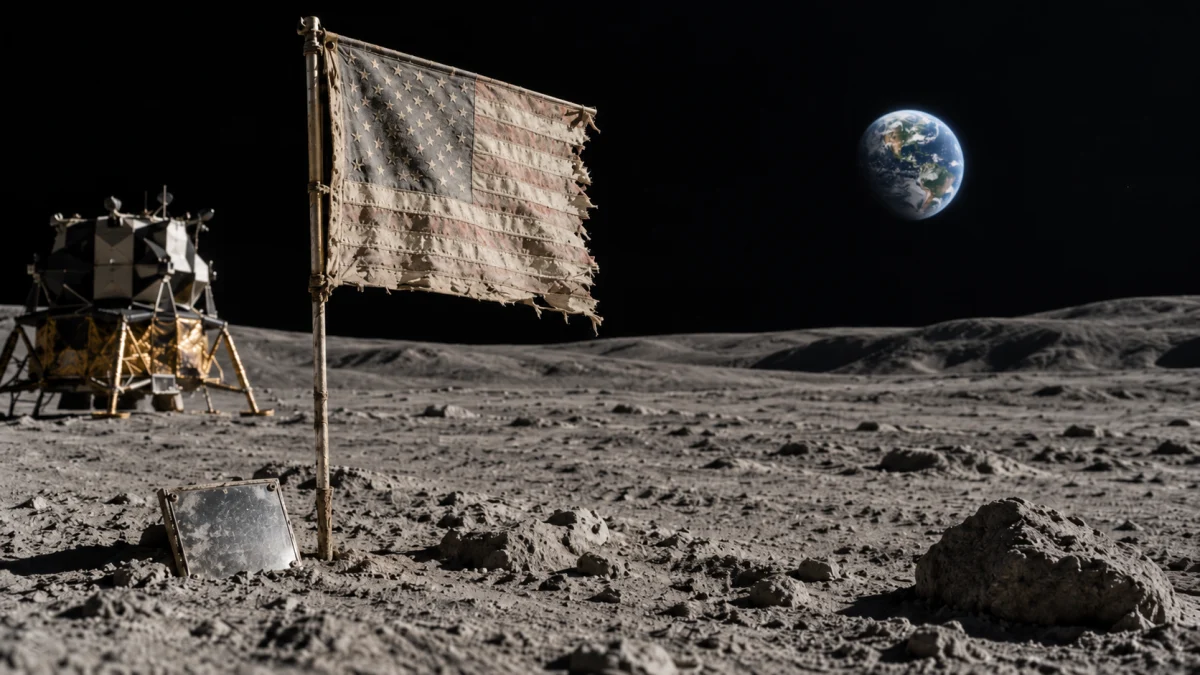
There is an image circulating online that is almost too perfect.
The American flag planted on the Moon in 1969, once brilliant red, white and blue, is supposedly still standing there today except that more than half a century of unfiltered sunlight and radiation has bleached it completely white.
It is a remarkable image.
It is also not quite what we know.
Nobody has taken a modern close-up photograph showing the Apollo 11 flag standing on the Moon as a white flag. In fact, the Apollo 11 flag was almost certainly knocked over when the lunar module Eagle lifted off. Buzz Aldrin later recalled seeing it fall, and modern orbital imagery shows no corresponding flag shadow at the Apollo 11 site.
But the underlying science behind the story is considerably less fictional.
Apollo astronauts ultimately planted six American flags on the Moon. NASA says Lunar Reconnaissance Orbiter imagery indicates that flags left by Apollo 12, 16 and 17 remained standing decades later. The spacecraft can detect their shadows. It cannot tell us what color the fabric is.
Those flags were ordinary nylon exposed for decades to an extraordinary environment: vacuum, radiation, intense ultraviolet light and repeated temperature swings between brutally hot lunar days and brutally cold lunar nights. NASA’s historical analysis concluded that the colors were likely badly bleached and that some of the material may have become brittle or even begun disintegrating.
So the viral version gets ahead of the evidence.
We cannot say that someone has looked through a telescope in 2026 and found a perfectly white American flag waving on the Moon.
There is no wind there to wave it anyway.
What we can say is somehow more interesting.
Something humanity placed on another world specifically because its colors meant something to us has been sitting beneath the Sun for more than half a century while nature slowly destroys the thing that made those colors recognizable.
Nothing invaded it.
Nobody burned it.
Nobody tore it down.
The Moon did not defeat the United States.
The Moon simply did not care.
What We Actually Know About the Flags
| Claim | What the evidence supports |
|---|---|
| The Apollo 11 flag is still standing. | Probably not. Aldrin said he saw it fall during lunar-module liftoff, and orbital imagery does not show its shadow. |
| NASA photographed the Apollo 11 flag completely white in 2026. | No. There is no such confirmed contemporary close-up image. |
| Some Apollo flags still appear to be standing. | Yes. Orbital imagery has detected shadows associated with several later Apollo flags. |
| The flags have probably faded badly. | Reasonable and well-supported. NASA’s historical assessment says intense UV exposure likely bleached the fabric. |
| The nylon may be physically deteriorating. | Also plausible. Decades of UV, radiation, vacuum and temperature extremes can degrade the material, although its exact current condition cannot be directly inspected from Earth. |
That distinction matters.
Not because correcting the meme ruins the metaphor.
Because the metaphor does not need help.
The Colors Were Always Temporary
Think about what the flag originally represented in July 1969.
It was unmistakable.
Thirteen stripes.
Fifty stars.
Red.
White.
Blue.
One of the most recognizable national symbols on Earth placed somewhere that, until that moment, no human being had ever stood.
It announced an extraordinary achievement by the United States.
And yet the object itself contained none of that meaning.
The nylon did not know what country it represented.
The lunar soil did not recognize the stars.
The Sun did not preserve the red because Americans had fought beneath that color.
Radiation did not spare the blue because millions of people considered it sacred.
We supplied all of that.
That does not make the meaning fake.
Human meaning is real precisely because human beings make it real.
A wedding ring is just metal until people attach a promise to it.
Money is paper, metal or entries in a database until a society agrees that it can settle debts.
A courthouse is stone until institutions give the decisions made inside it legal force.
A border is coordinates until governments, laws, communities and ultimately physical power make that line consequential.
These things can be extremely real without being eternal.
That distinction may be one of the hardest things for human beings to hold in our heads at the same time.
Something can matter enormously today without being a permanent feature of the universe.
The Stranger Message Was Sitting Right Beside the Flag
Apollo 11 left something else behind.
Attached to the lunar module was a stainless-steel plaque showing both hemispheres of Earth.
Its inscription began:
“Here men from the planet Earth…”
And it ended:
“We came in peace for all mankind.”
That choice becomes more remarkable with time.
The United States had just accomplished something no other country had accomplished.
It planted its flag.
But when the astronauts tried to describe themselves to whoever might encounter that artifact in some distant future, the first identity they chose was larger:
planet Earth.
There were effectively two messages sitting beside each other in the Sea of Tranquility.
One said:
This was America.
The other said:
We were humans.
The first required the observer to understand a particular arrangement of stars, stripes, colors, governments and borders.
The second required considerably less explanation.
The Flag Did Not Make the Moon American
There is another fact that makes the symbolism even better.
Planting the flag did not establish American sovereignty over the Moon.
The United States had already ratified the 1967 Outer Space Treaty. Article II states that outer space, including the Moon, is not subject to national appropriation through a sovereignty claim, occupation or other means. NASA’s own historical account describes the Apollo flag-raising as explicitly symbolic rather than territorial.
So one of history’s most famous acts of planting a national flag was not actually an act of claiming the ground beneath it.
The flag marked achievement.
It marked origin.
It marked pride.
It did not move the border.
There was no border to move.
That distinction is worth sitting with.
Borders Are Real. They Are Also Historical.
Saying that borders change is sometimes treated as though it means borders do not matter.
Of course they matter.
Stand on the wrong side of one without the right document and you may discover exactly how much.
Borders determine jurisdiction, citizenship, taxation, military authority, trade, access, legal rights and the ability of governments to exercise power.
They can determine whether a family lives together.
They can determine whether someone can work.
They can determine whether someone is deported.
They can determine whether someone is protected by one government, another government or effectively no government at all.
Temporary does not mean imaginary.
But look at a political map from almost any sufficiently distant point in history and another fact becomes impossible to ignore:
the lines move.
The United States itself is an unusually clear example.
The country that declared independence in 1776 did not have today’s borders.
The 1803 Louisiana Purchase added approximately 828,000 square miles and roughly doubled the nation’s size.
The Treaty of Guadalupe Hidalgo after the Mexican-American War transferred more than 525,000 square miles and helped establish the southern boundary of the present-day United States.
The United States purchased Alaska from Russia in the nineteenth century.
People lived in all of those places before the lines changed.
The soil did not move.
The mountains did not move.
In many cases, the people did not move.
The jurisdiction moved over them.
A person could theoretically wake up in the same home, on the same land, among the same family, and find that history had changed the political meaning of the ground beneath their feet.
That should not make us indifferent to borders.
It should make us humble about them.
The Immigration Argument Is More Complicated Than “We Are All Immigrants”
There is a lazy version of this argument that says:
Everyone is an immigrant, therefore nobody can object to immigration.
That does not survive serious history.
Indigenous nations inhabited North America long before the United States existed. European settlement and subsequent U.S. expansion displaced, combined, renamed and in some cases destroyed Native communities. The Library of Congress describes enormous upheaval as expanding settler territory and U.S. policy pushed Indigenous peoples from their lands.
Nor is the African-American story properly described as ordinary immigration. Millions of Africans were forcibly transported through the transatlantic slave trade. The Library of Congress explicitly describes this as forced relocation rather than primarily a history of immigration.
History deserves better than squeezing conquest, migration, refuge, enslavement, colonization and voluntary immigration into one comfortable category.
They are not the same.
But recognizing those differences does not weaken the larger point.
It makes it harder to dismiss.
You Can Believe in Immigration Laws and Still Remember How History Works
Nothing about this essay requires believing that countries should abolish their borders.
A society can reasonably debate how many people it can absorb, what qualifications should apply, how asylum should work, what obligations citizens owe one another and what rules should govern entry.
Those are real policy questions.
What history challenges is something different:
the extraordinary confidence with which inherited belonging can sometimes become permanent moral entitlement.
For many Americans, somewhere in the family history is a moment when somebody arrived.
Perhaps recently.
Perhaps centuries ago.
Eventually the story changes.
The newcomer becomes a resident.
The resident becomes a citizen.
The citizen has children.
The children have grandchildren.
The immigrant ancestor becomes a photograph nobody can identify.
Arrival becomes history.
History becomes belonging.
And belonging eventually begins to feel as though it always existed.
That is understandable.
People put down roots.
Communities become home.
Children do not experience themselves as temporary guests simply because an ancestor crossed an ocean five generations earlier.
Nor should they.
But there is an uncomfortable transformation that can happen afterward.
Yesterday’s arrival becomes today’s native certainty about tomorrow’s arrival.
The contradiction is not:
Your ancestor immigrated, therefore you are forbidden from supporting immigration restrictions.
That is childish.
The more serious question is:
At what point did our own family’s arrival become ancient enough that we stopped recognizing arrival as part of the human story?
And when did arriving earlier give us permission to speak as though arriving later were fundamentally unnatural?
There may be legitimate answers about law, capacity, security or democratic consent.
But “because this is simply where we belong and they do not” becomes considerably harder to treat as self-evident once history enters the room.
The Map Has a Terrible Memory
Human beings are remarkably good at forgetting that maps have previous versions.
A border survives for several generations and begins to feel primordial.
A country lasts a few centuries and begins to feel geological.
A flag flies throughout someone’s entire lifetime and begins to feel timeless.
But history keeps receipts.
France once controlled the Louisiana Territory.
Mexico once governed California.
Russia once governed Alaska.
Before any of them, Indigenous nations lived across landscapes that later governments would draw into entirely different jurisdictions.
The present map is not false.
It is simply the present map.
There were others before it.
There will almost certainly be others after it.
We do not know what the United States will look like in 200 years.
Perhaps its borders will be essentially unchanged.
Perhaps the country will be larger.
Perhaps smaller.
Perhaps federal structures will evolve in ways that would seem strange to us now.
Perhaps the United States will still be immediately recognizable in the year 2400.
Perhaps it will be studied the way Americans today study political entities that once seemed permanent to the people living inside them.
We cannot know.
And that uncertainty is the point.
Imagine Someone Finding the Flag in 500 Years
Suppose human beings return repeatedly to the Apollo sites centuries from now.
A researcher approaches the location where Americans once planted a three-by-five-foot nylon flag.
Perhaps some material survives.
Perhaps only the pole remains.
Perhaps neither survives.
The researcher knows exactly what happened there because historical archives are intact.
Or perhaps the context has become obscure.
Imagine, for a moment, that the United States no longer exists in anything resembling its twentieth-century form.
The researcher might need an explanation.
Why fifty stars?
Why thirteen stripes?
What was a “United States”?
Where were its borders?
Why did this country possess the resources to reach the Moon before everyone else?
Why did its citizens care so deeply about this particular arrangement of colors?
None of those questions insults the United States.
We ask equivalent questions about vanished states, kingdoms, republics and empires constantly.
Their people did not believe they were living in a historical intermission.
They were living in the present.
Just like us.
This Does Not Make Nations Pointless
There is a temptation to take the cosmic perspective too far.
If nations eventually change, why care about nations?
If borders move, why defend laws?
If everything disappears eventually, why build anything?
Because temporary things matter.
Childhood is temporary.
That does not make protecting a child pointless.
A human life is temporary.
That does not make murder inconsequential.
A house may eventually collapse.
That does not make homelessness irrelevant.
A nation can be historically temporary and still provide generations of people with security, law, community, infrastructure, education, culture and identity.
Or it can fail catastrophically at those things.
The fact that a political system is human-made does not diminish its responsibility toward the humans living inside it.
If anything, it increases it.
Governments were made for people.
People were not made for governments.
We Spend Enormous Energy Fighting Over the Wrapping
This is where the view from the Moon becomes uncomfortable.
From Earth, our distinctions can feel overwhelming.
American.
Mexican.
Israeli.
Palestinian.
Indian.
Pakistani.
Ukrainian.
Russian.
Conservative.
Liberal.
Capitalist.
Socialist.
Citizen.
Foreigner.
This side of the line.
That side of the line.
Some of these distinctions carry enormous real-world consequences.
Some represent profound differences in history, law, culture or values.
They cannot simply be wished away.
But underneath them sits a remarkably stubborn human baseline.
People generally want somewhere safe to sleep.
They want enough food.
They want people they love.
They want their children to have a future.
They want meaningful work, or at least work that does not destroy them.
They want some amount of control over their own lives.
They want to get sick without becoming destitute.
They want to walk outside without wondering whether a bomb is about to hit their building.
They want not to be humiliated.
They want not to be terrified.
They want enough stability that ordinary boredom becomes possible.
And every political ideology insists that it has discovered the best machinery for producing some version of that life.
Capitalism.
Socialism.
Social democracy.
Libertarianism.
Nationalism.
Internationalism.
Different tax systems.
Different welfare systems.
Different immigration systems.
Different theories of ownership, obligation and freedom.
Those arguments matter.
But sometimes we become so attached to the machinery that we forget what the machine was supposed to do.
A society is supposed to work for human beings.
That principle sits comfortably with the broader culture sherafy.com is trying to build: curiosity without compulsory tribalism, skepticism without turning suspicion into an identity, and the ability to disagree without first denying one another’s humanity.
You can disagree profoundly about how a country should function while still recognizing the person across the argument as somebody trying, in their own imperfect way, to live a tolerable life.
That is not political centrism.
It is species-level perspective.
Distance Does Something Strange to Certainty
Perhaps this is why photographs of Earth from space have always unsettled people.
The borders disappear.
Not metaphorically.
Literally.
There is no line visible between California and Mexico from the Moon.
No stripe separating France from Germany.
No physical border between India and Pakistan glowing across the continent.
The jurisdictions remain real because people on Earth maintain them.
But nature does not annotate them.
From far enough away, the planet is just weather, oceans, land and light.
Move farther still and even the continents disappear.
Move farther than that and Earth itself becomes a point.
Every border war.
Every immigration debate.
Every campaign slogan.
Every passport.
Every national anthem.
Every customs checkpoint.
Every wall.
Every argument about who belongs where.
All happening on that point.
That perspective does not answer the policy questions.
It does something more useful before we answer them.
It changes the scale at which we understand ourselves.
There Is Nothing Wrong With Loving a Flag
None of this requires embarrassment about national identity.
There is nothing irrational about loving the country that raised you.
There is nothing shameful about feeling something when you see its flag.
A flag can represent family members who served.
A language.
A constitutional tradition.
A liberation struggle.
A community.
A place that gave someone refuge.
A place where someone’s grandparents finally became safe.
Symbols acquire meaning because people pour memory into them.
But loving a symbol should not require believing the symbol is eternal.
In fact, knowing that it is temporary may make caring for what it represents more urgent.
You inherit a country for a while.
You do not own history.
The Most Durable Message Apollo 11 Left Was Not the Flag
There is a strange symmetry at Tranquility Base.
The flag was made of nylon.
The plaque was made of stainless steel.
One depended on color.
The other depended on words.
One identified a nation.
The other identified the travelers as people from a planet.
One of those messages may prove much easier for a distant future to understand.
The flag said who accomplished the landing.
And that mattered.
The plaque said something larger:
“Here men from the planet Earth…”
Fifty-seven years later, sunlight has had plenty of time to work on the flags.
Give it another hundred years.
Another five hundred.
Another thousand.
Countries may rise.
Countries may merge.
Borders may move.
Languages may change.
Entire political arguments that feel existential today may require paragraphs of explanation.
People living through those changes will almost certainly believe their own arrangements are permanent too.
That seems to be one of our habits.
The Moon offers a quieter correction.
We planted one of our most powerful national symbols on an airless world and left it beneath a Sun that had no idea what America was.
The colors began their long encounter with physics.
The map continued its long encounter with history.
Neither diminishes what the symbol meant in 1969.
Neither tells us to stop caring about the places where we live.
They simply remind us not to confuse belonging with permanence.
Someday, someone may stand where Armstrong and Aldrin stood and need an explanation for the flag.
They may need to be told what the stars represented.
Why there were fifty.
Why the stripes numbered thirteen.
Where the country’s borders once ran.
Why people fought under it.
Why people saluted it.
Why other people protested it.
Why it meant freedom to some people, power to others, home to millions and something much more complicated to many more.
History can explain all of that.
But the words beside it may require almost no translation at all.
Here men from the planet Earth.
Before the border.
Before the passport.
Before the argument.
That was always true.
References and Further Reading
-
NASA, “Six Flags on the Moon: What Is Their Current Condition?” NASA’s historical review of the Apollo flags, including the evidence that Apollo 11’s flag fell, the later LRO shadow observations and expert assessment that ultraviolet exposure likely bleached and degraded the nylon. NASA: Six Flags on the Moon
-
NASA, “Flag Day: Flying High — The Stars and Stripes in Space.” Summarizes the six Apollo flags and what Lunar Reconnaissance Orbiter imagery can and cannot establish about those remaining at the landing sites. NASA: The Stars and Stripes in Space
-
NASA Science, “Apollo 11 Plaque.” Documents the plaque attached to Eagle and its identification of Armstrong and Aldrin as people “from the planet Earth” who came “for all mankind.” NASA Science: Apollo 11 Plaque
-
NASA Technical Reports Server, Anne M. Platoff, “Where No Flag Has Gone Before.” Historical study of the political and engineering decisions behind placing the American flag on the Moon, including its explicitly symbolic rather than territorial status. NASA Technical Report: Where No Flag Has Gone Before
-
United Nations Office for Outer Space Affairs, Outer Space Treaty. Article II establishes that the Moon and other celestial bodies are not subject to national appropriation through sovereignty claims, occupation or other means. UNOOSA: Outer Space Treaty
-
Library of Congress, “Native American — Immigration and Relocation in U.S. History.” Provides primary-source-based historical context on Indigenous nations, European settlement, U.S. expansion and forced Native displacement. Library of Congress: Native American History and Relocation
-
Library of Congress, “African — Immigration and Relocation in U.S. History.” Explains why the African-American historical experience cannot accurately be reduced to ordinary immigration, emphasizing the enormous scale of forced relocation through slavery. Library of Congress: African American Immigration and Forced Relocation
-
National Archives, Louisiana Purchase Treaty. Documents the 1803 acquisition that added roughly 828,000 square miles and approximately doubled the territorial size of the United States. National Archives: Louisiana Purchase Treaty
-
National Archives, Treaty of Guadalupe Hidalgo. Documents the territorial changes following the Mexican-American War and the development of the present U.S.-Mexico boundary. National Archives: Treaty of Guadalupe Hidalgo
-
National Archives, Purchase of Alaska. Documents the 1867 agreement and subsequent payment through which the United States acquired Alaska from Russia. National Archives: Purchase of Alaska
Editorial note: The present color and physical integrity of the Apollo flags cannot be directly determined from orbital imagery. Claims that an Apollo flag has been visually confirmed as completely white should therefore be treated as unsupported. The bleaching and degradation assessment is based on the known lunar environment, material properties and NASA’s historical analysis.