Yes. In 1994, while Dookie was turning Green Day into a mainstream phenomenon, there are at least two well-documented cases in which organizers tried to remove openly gay punk band Pansy Division from shows and Green Day threatened not to perform without them.
At George Mason University in Fairfax, Virginia, Pansy Division founder Jon Ginoli recalled that a promoter tried to pull his band because of concerns about what the openly gay group would say and sing onstage. Green Day’s response, according to Ginoli, was blunt: “If you pull Pansy Division, we won’t play the show. We’ll find another city.” The promoter backed down, and Pansy Division played.
Days later, at Z100’s December 5 concert at Madison Square Garden, Ginoli says organizers again tried to remove Pansy Division from the bill. In his memoir, he recalled that Green Day said it would not perform if Pansy Division was excluded. Again, Pansy Division stayed on the bill and played. Pansy Division’s own concert archive confirms the Madison Square Garden appearance.
That history has acquired new relevance in 2026 because the structure is unusually familiar.
Macklemore performed pro-Palestinian material while opening for Ed Sheeran. Multiple venues later objected to his continued participation. Robert Kraft confirmed that Gillette Stadium would not host him. The tour promoter ultimately removed Macklemore while Sheeran said he had spent days trying to mediate with venues and other parties. sherafy.com reconstructed the venue, promoter and headliner roles in detail in its investigation of Macklemore’s removal.
The two episodes are not identical, and comparing them does not establish which artist faced greater risk or what any musician is morally required to do.
But together they expose an important distinction that gets lost whenever celebrity activism is reduced to whether someone issued a statement:
Speaking is one kind of action. Negotiating is another. Commercial leverage is another. And threatening to withdraw the thing everyone else needs from you is something else again.
Green Day’s 1994 story matters because it shows, in unusually concrete terms, what the last category can look like.
Pansy Division Was Not a Safe Opening Act in 1994
Pansy Division formed in San Francisco in 1991 around an intentionally explicit idea: make punk rock as an openly gay band and refuse the assumption that gay musicians needed to soften, hide or encode their sexuality.
Their own biography describes the group as one of the first rock bands to be so deliberately and visibly gay. Their songs were funny, sexual, confrontational and unapologetic. By 1994, that meant putting material about gay love and gay sex in front of thousands of teenagers who often had never encountered anything comparable in mainstream music. Pansy Division describes the Green Day tour as a sudden jump from gay and gay-friendly club audiences to thousands of young listeners every night.
The social environment was materially different from today.
The U.S. military’s “Don’t Ask, Don’t Tell” policy took effect on February 28, 1994, allowing gay, lesbian and bisexual people to serve only so long as their sexual orientation did not become known. The Defense Department says more than 13,000 service members were eventually separated during the policy’s lifetime.
Virginia, where the Fairfax confrontation occurred, still had a sodomy law that could be used against gay people. Lambda Legal later documented how Virginia invoked that law even in a 1999 adoption dispute, before the Supreme Court invalidated consensual sodomy laws nationwide in Lawrence v. Texas in 2003.
None of that means every American in 1994 was hostile to gay people, or that LGBTQ advocacy was absent. It means the legal and cultural cost structure was very different, and an explicitly gay punk band singing explicitly gay songs to mainstream teenage audiences was not a commercially neutral choice.
Green Day knew that when it invited them.
Green Day Was Becoming Huge at the Exact Moment This Happened
It is easy, three decades later, to remember Green Day as an untouchable legacy act and accidentally project that security backward onto 1994.
That was not the position the band occupied when it brought Pansy Division on tour.
Green Day had come out of the East Bay punk scene and released its earlier records through Lookout! Records. Moving to Reprise, a Warner label, created a serious rupture with parts of the scene around Berkeley’s 924 Gilman Street, where major-label affiliation was treated as a betrayal of the club’s anti-corporate ethos.
Billie Joe Armstrong has described the transition as both exciting and frightening. Dookie was recorded in 1993 and released on February 1, 1994. It did not instantly become a blockbuster, but by the summer, “Longview,” “Basket Case,” Lollapalooza and Woodstock ’94 had accelerated the band from successful punk act to mass-market phenomenon.
Pansy Division was there while it happened.
Ginoli recalled that when Green Day first invited them out, the band was still traveling in a bookmobile. During the tour, the crowds became larger, MTV exposure multiplied and the experience of being able to casually meet fans began disappearing.
That chronology matters.
Green Day did not wait until it had spent decades accumulating enough money, institutional security and cultural approval to make the association harmless. It made the choice while its relationship with mainstream success was still new and while parts of its original scene were already accusing it of abandoning its principles.
That does not prove Green Day had “more to lose” than a modern stadium artist such as Ed Sheeran. There is no serious way to convert different careers, contracts and eras into one objective unit of professional risk.
What can be established is narrower: Green Day was newly exposed to mainstream commercial power, and when organizers challenged one of its support acts, the band was willing to place its own performance on the negotiating table.
Fairfax Is the Clearest Example
The November 27, 1994 show at George Mason University’s Patriot Center provides the cleanest surviving account.
Ginoli recalled that the promoter was concerned about Pansy Division’s lyrics and the reaction they might provoke. Ginoli argued that the band’s explicit discussion of gay life was precisely the point, particularly in a state where gay sexual conduct remained criminalized.
Then, according to Ginoli, the promoter tried to remove Pansy Division.
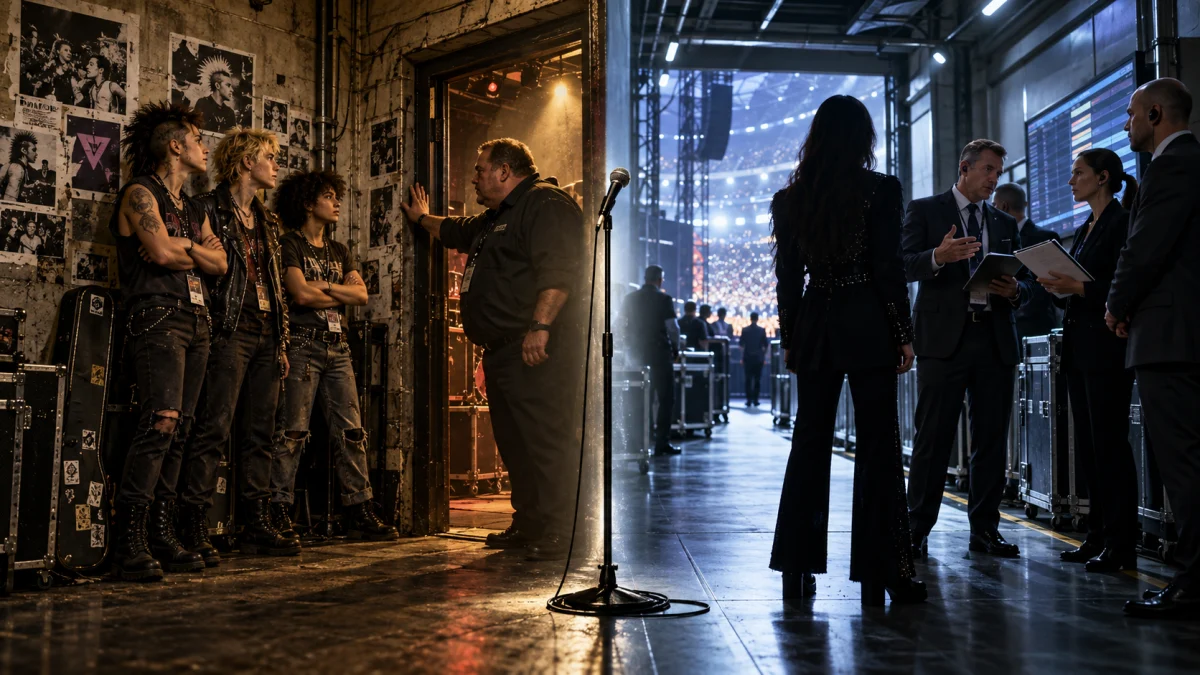
Green Day answered that if Pansy Division was pulled, Green Day would not play and would find another city.
The promoter backed down.
Pansy Division played the show.
This is an important distinction from symbolic endorsement. Green Day was not simply saying it approved of Pansy Division. It made its own participation conditional on Pansy Division being allowed to participate too.
The leverage existed because the promoter wanted Green Day badly enough that losing the headliner was a worse outcome than accepting the opener.
That is how leverage works. It does not require legal ownership of the venue. It requires control over something the other party values.
Then It Happened Again at Madison Square Garden
The Madison Square Garden episode makes the history harder to dismiss as a dispute involving one conservative local promoter.
On December 5, 1994, Green Day was part of Z100’s large multi-artist holiday concert at Madison Square Garden. The bill included Hole, Weezer, Melissa Etheridge, Sheryl Crow, Toad the Wet Sprocket, Indigo Girls, Bon Jovi and Pansy Division.
Ginoli wrote that Z100 tried to remove Pansy Division from the show. His memoir does not establish the station’s internal reasoning with the same detail available for Fairfax, so it would be irresponsible to invent a motive.
What Ginoli does say is that Green Day responded by saying it would not perform if Pansy Division was excluded.
Pansy Division got a short set and played Madison Square Garden.
The result matters because the threat was credible enough to change the outcome.
Why the 2026 Macklemore and Ed Sheeran Dispute Is Such an Unusual Comparison
Most historical celebrity comparisons are superficial. This one is not.
The underlying structures are strikingly similar:
| Question | Green Day / Pansy Division, 1994 | Ed Sheeran / Macklemore, 2026 |
|---|---|---|
| Who was challenged? | Opening act Pansy Division | Opening act Macklemore |
| What triggered the dispute? | Openly gay lyrics and performance content in Fairfax; attempted removal also occurred at the Z100 show | Pro-Palestinian statements and performance material during Sheeran’s MetLife dates |
| Who applied institutional pressure? | A Fairfax promoter; later Z100 attempted to remove Pansy Division from the MSG bill | Multiple venues objected; Robert Kraft confirmed Gillette Stadium would not host Macklemore |
| Who had formal control? | Varied by event; Green Day did not own the venues | Macklemore’s agreement was with the promoter; venues controlled access to their stadiums |
| What did the headliner do? | Green Day threatened not to perform if Pansy Division was removed | Sheeran says he spent days trying to negotiate with the venues and other parties |
| Did the headliner publicly threaten to walk? | Yes, according to Ginoli’s accounts | No comparable public ultimatum has been identified in the record reviewed by sherafy.com |
| Outcome for the opener | Pansy Division performed | Macklemore was removed from the remaining tour dates |
The present-day case is more complicated than “Ed Sheeran fired Macklemore.”
He did not, based on the evidence available.
As sherafy.com‘s earlier investigation into Macklemore’s removal found, Macklemore’s contract was with the promoter, Messina Touring Group. Multiple venues threatened not to host shows with Macklemore on the lineup. Kraft acknowledged that Gillette Stadium would not allow him to perform there. Sheeran said he spent the week attempting to mediate and was ultimately told the promoter and venues had made their decision.
That distinction matters because formal contractual authority and practical star power are not the same thing.
A headliner may not possess a contractual switch that forces a stadium to admit an opener. A stadium may likewise be unable to easily replace a headliner who is willing to cancel. The eventual outcome depends on contracts, insurance, cancellation exposure, relationships, timing, money and how credible each side believes the other’s threat to be.
Green Day’s 1994 example does not prove that a Sheeran walkout threat would have succeeded in 2026.
It proves something more limited and more useful: a headliner can sometimes convert its own participation into bargaining power even when someone else formally controls the venue.
Sheeran Did Eventually Speak About Gaza, and That Changes the Comparison
Any current article that describes Ed Sheeran as simply silent on Gaza is now outdated.
On September 19, after the Macklemore dispute and the withdrawal of other supporting acts, Sheeran addressed the controversy from the stage in Philadelphia. He called what was happening in Gaza “catastrophic and unjustifiable,” said he worried about venues preapproving performances, and described the dispute as an argument about freedom of speech.
That creates a more precise comparison than “Green Day spoke out and Sheeran did not.”
Sheeran did speak out.
He also says he privately tried to prevent the situation from ending the way it did.
What he did not do, at least based on the public record reviewed for this article, was issue the particular kind of ultimatum attributed to Green Day in 1994: if the opener cannot perform, neither will the headliner.
Those are different forms of action.
Acknowledging that difference does not require inventing Sheeran’s motives. He has publicly said he was concerned about disappointing fans and about the touring crew and others whose livelihoods depend on the shows. Those considerations are real. They also illustrate why a willingness to cancel carries leverage in the first place: cancellation imposes costs on many people, not only the artist.
The historical comparison becomes useful precisely when those costs are left visible rather than wished away.
“Speaking Out” Is Too Broad a Category
Celebrity politics is often discussed as if there are only two states: silent or vocal.
The Green Day episode suggests a more useful framework.
An artist can make a public statement.
An artist can make a financial contribution.
An artist can use private persuasion or negotiation.
An artist can use institutional leverage, making continued participation conditional on a particular outcome.
And an artist can be willing to absorb the consequence if the other side refuses.
These actions can overlap, but they are not interchangeable.
A public statement communicates a position. A donation transfers resources. Negotiation attempts to persuade. A walk-away threat changes the other party’s economic calculation.
Green Day’s 1994 response belonged to that final category because the band made the promoter’s preferred outcome, a Green Day performance, contingent on preserving Pansy Division’s place on the stage.
That is why the story remains more interesting than a generic anecdote about a progressive rock band.
It is an example of values being translated into bargaining behavior.
Where Taylor Swift Fits, and Where She Does Not
Taylor Swift presents a different case.
As of September 23, sherafy.com‘s review of Taylor Swift’s public record could not identify a public statement from her about Gaza, Palestine, Israel or a ceasefire. The same investigation also emphasized what that silence does not establish: her private beliefs or reasons.
The Green Day story does not solve that uncertainty.
It does not prove Swift is silent because of commercial concerns. It does not prove she privately supports or opposes any particular policy. And it does not establish that the risks faced by a global pop artist in 2026 are the same as those faced by an East Bay punk band in 1994.
What the history does challenge is a much broader assumption: that commercial exposure automatically means an artist has no meaningful room to resist institutional pressure.
Sometimes commercial importance creates vulnerability.
Sometimes it also creates bargaining power.
Which effect dominates depends on whether the artist is willing and able to make access to that commercial value conditional.
Green Day’s “Sellout” Story Makes This More, Not Less, Interesting
There is a useful irony in the timing.
Green Day was already being attacked by parts of its original punk community for signing to a major label and entering the mainstream. In the simplest version of that story, signing with Reprise was the moment the band abandoned the ethical independence of the scene that produced it.
But the Pansy Division episodes complicate that narrative.
Major-label success did not merely expose Green Day to more commercial pressure. It also gave the band something it had not possessed at the same scale before: leverage over commercial institutions that wanted access to Green Day’s audience.
At Fairfax, the promoter wanted the headliner enough that the threat of losing Green Day changed the decision about Pansy Division.
At Madison Square Garden, according to Ginoli, the same basic logic prevailed.
The mainstream platform was not inherently courageous or cowardly. It was power.
The consequential question was how the band used it.
What the Comparison Does Not Prove
A clean historical analogy can become propaganda very quickly if its limits are ignored.
So several boundaries matter.
It does not prove Green Day faced more risk than Ed Sheeran. The careers, contracts, venues and economic structures were different, and there is no responsible way to quantify the comparison precisely.
It does not prove Sheeran could have forced every venue to accept Macklemore. A threat to cancel can fail. A stadium can call the artist’s bluff. Contractual penalties, insurance provisions and cascading tour obligations can change the balance dramatically.
It does not prove Sheeran supported Macklemore’s removal. His public account is that he tried to mediate and opposed venues dictating performance content.
It does not prove anything about Taylor Swift’s private beliefs. Silence is observable. Motive is not.
And it does not make gay rights in 1994 and Palestinian advocacy in 2026 identical political causes. The analogy concerns the use of entertainment-industry leverage when an opener becomes unacceptable to people controlling access to the stage. The underlying political issues remain distinct.
Those limitations make the comparison stronger because they leave the part that actually can be demonstrated.
What Is Actually Verified
The strongest evidence supports the following conclusions:
- Green Day invited openly gay punk band Pansy Division onto substantial portions of its 1994 touring schedule while Dookie was rapidly expanding the band’s mainstream audience.
- In Fairfax, a promoter tried to remove Pansy Division, and Ginoli says Green Day threatened not to perform if that happened. Pansy Division played.
- At Madison Square Garden, Ginoli says Z100 tried to remove Pansy Division from the bill, and Green Day again threatened not to perform without them. Pansy Division played.
- In 2026, multiple venues objected to Macklemore remaining on Ed Sheeran’s tour following his pro-Palestinian performances, and Kraft confirmed that Gillette Stadium would not allow him to perform there.
- Sheeran says the promoter made the ultimate removal decision and that he spent days trying to negotiate with venues and other parties.
- The tour continued without Macklemore. Other supporting acts withdrew.
- Sheeran later publicly condemned the situation in Gaza as catastrophic and unjustifiable and criticized venues attempting to control performance content.
The historical difference is therefore not that one artist possessed influence and another possessed none.
It is that the documented leverage was used differently, and the institutional outcomes were different.
The Part of the Green Day Story Worth Remembering
The easiest lesson from 1994 is that Green Day supported a gay punk band before doing so was commercially comfortable.
That is true, but incomplete.
The more useful lesson is about power.
Green Day did not own the Patriot Center. It did not own Madison Square Garden. It did not control every promoter, radio station or institution surrounding its rapidly expanding career.
What it controlled was Green Day.
And on at least two documented occasions, that was enough.
The band made access to its own performance conditional on Pansy Division keeping access to the stage. The people trying to remove Pansy Division then had to decide which mattered more: excluding the opening band or keeping the headliner.
They chose the headliner.
Thirty-two years later, that is why the story belongs in the conversation about Macklemore, Ed Sheeran, Taylor Swift and celebrity political speech generally.
Not because every artist faces the same circumstances. Not because every cause is interchangeable. Not because an old punk story can tell us what any modern celebrity privately believes.
But because it demonstrates a distinction that celebrity discourse often blurs:
Having a platform is not the same as using the platform as leverage.
A statement tells the public where an artist stands.
A credible willingness to withdraw tells institutions what that position may cost them.
Green Day’s 1994 tour provides a rare historical example where we can see the difference in the outcome.
References and Further Reading
Green Day and Pansy Division, 1994
Welcome to Paradise: The Oral History of Green Day’s Dookie — The Ringer
A detailed oral history of Green Day’s transition from the East Bay punk scene to mainstream success. Includes Jon Ginoli’s account of the Fairfax confrontation, Green Day’s ultimatum to the promoter, the band’s major-label transition and the rapid growth of Dookie during 1994.
Memoir: Pansy Division’s Jon Ginoli — Magnet Magazine
An excerpt from Ginoli’s memoir containing his account of the Fairfax show and the Z100 Madison Square Garden concert, including his recollection that Green Day refused to perform if Pansy Division was removed.
Official Pansy Division Gig List, 1991–2026 — Pansy Division
The band’s chronological concert archive. It documents the extensive 1994 touring schedule with Green Day, including Fairfax on November 27 and Madison Square Garden on December 5.
Pansy Division Biography — Pansy Division
The band’s account of its formation, openly gay identity and the impact of being taken onto Green Day’s Dookie-era tour in front of dramatically larger and younger audiences.
Pansy Division’s Jon Ginoli — The A.V. Club
A retrospective interview in which Ginoli says Green Day’s decision to take Pansy Division on tour reflected the band’s values and substantially expanded what a queer punk band could reach.
LGBTQ Legal and Cultural Context
DOD to Upgrade Discharges From “Don’t Ask, Don’t Tell” Policy — U.S. Department of Defense
Official Defense Department history confirming that Don’t Ask, Don’t Tell took effect in February 1994 and remained in force until 2011.
Arc of History — Lambda Legal
Historical overview of LGBTQ legal battles, including the consequences of state sodomy laws before Lawrence v. Texas invalidated such laws in 2003.
Macklemore, Ed Sheeran and the 2026 Tour Dispute
Why Was Macklemore Dropped From Ed Sheeran’s Tour? — sherafy.com
Our detailed reconstruction of Macklemore’s removal, including Kraft’s confirmed Gillette Stadium decision, objections from multiple venues, the promoter’s formal role and Sheeran’s account of his own involvement.
Why Are People Mad at Macklemore? Palestine Backlash Explained — sherafy.com
Separates Macklemore’s actual MetLife remarks from the competing allegations around them and traces how political criticism became organized venue and commercial pressure.
Ed Sheeran Says Situation in Gaza Is “Catastrophic and Unjustifiable” — Associated Press
Reports Sheeran’s September 19 Philadelphia remarks, his criticism of venue interference, his explanation of attempts to mediate, and the aftermath of Macklemore’s removal.
Taylor Swift and the Larger Celebrity-Speech Question
Has Taylor Swift Spoken About Gaza? What Her Silence Actually Shows — sherafy.com
Our review of Swift’s public record through September 23, 2026. It distinguishes the observable fact of her public silence on Gaza from unsupported claims about why she has remained silent.
Editorial currency note: The Green Day and Pansy Division events discussed here are historical. The Sheeran and Macklemore dispute remains recent and may continue to develop through additional statements, contracts, venue records or reporting. This article should be updated if new evidence materially changes who exercised formal or practical authority over the 2026 tour decision.