Yes, humans can already communicate with plants in a limited technological sense. But we cannot translate a plant’s thoughts, hold an open-ended conversation with one, or use its electrical signals as evidence that it is conscious.
That distinction matters because the science has progressed much farther than the usual joke about talking to houseplants.
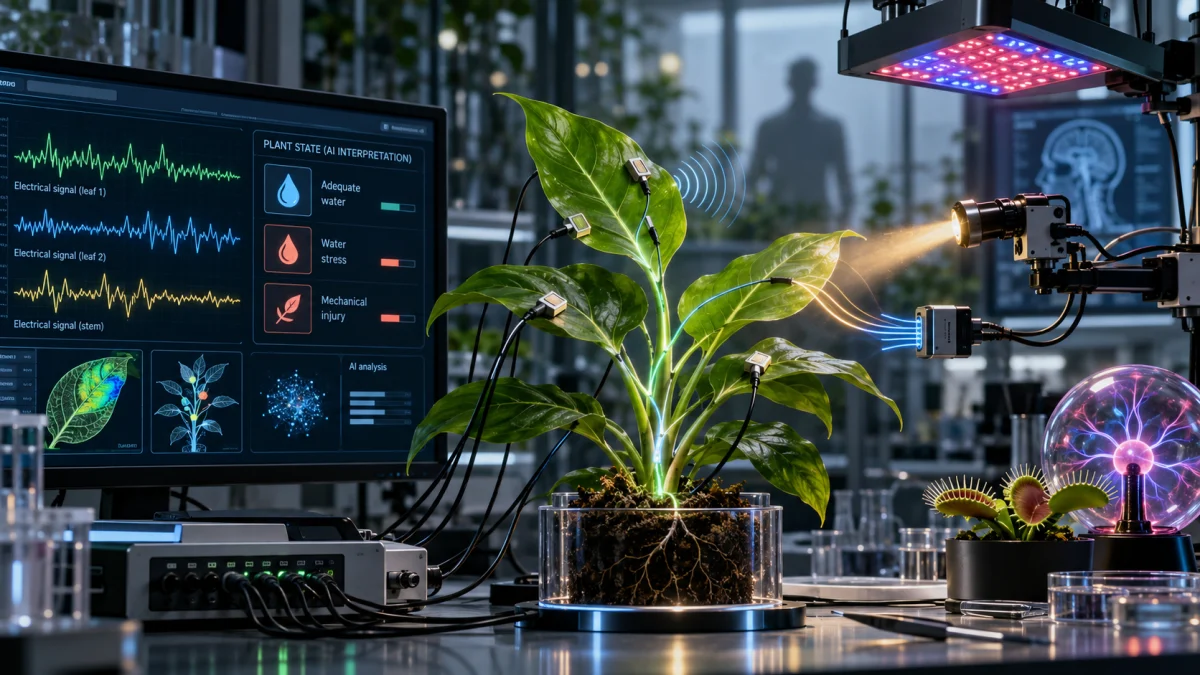
Plants generate measurable electrical, chemical, hydraulic and mechanical signals. Researchers can record some of those signals, identify changes associated with stress and environmental conditions, and use machine learning to classify certain plant states. Scientists are also developing systems designed to make plants report conditions to humans and, in the other direction, technologies capable of modifying plant physiology.
Cornell University’s NSF-supported Center for Research on Programmable Plant Systems, or CROPPS, goes so far as to say that it develops tools to "listen to and communicate with plants." Its researchers study electrical signals, calcium waves, reactive oxygen species, hydraulic waves and other mechanisms that move information through plants. Cornell CROPPS plant-communication research
That does not mean scientists have discovered a secret plant language waiting to be translated into English.
The better way to understand the field is as a ladder. We are already surprisingly high on the first several rungs. The highest ones remain unproven.
The Plant Communication Ladder
| Level | What it means | Current status |
|---|---|---|
| 1. Plants detect their environment | Light, touch, temperature, injury, water conditions and chemicals trigger responses | Established |
| 2. Plants transmit information internally | Electrical, calcium, chemical, hydraulic and mechanical signals coordinate responses | Established |
| 3. Plants affect other organisms through signals or cues | Chemicals and other outputs can influence nearby organisms | Established in many systems |
| 4. Humans record plant signals | Electrodes, cameras, chemical sensors and microphones measure plant responses | Established |
| 5. Computers classify plant states | Algorithms distinguish some stresses or environmental conditions from plant data | Demonstrated experimentally |
| 6. Plants automatically report conditions to humans | A biological response triggers a human-readable alert | Demonstrated as proof of concept |
| 7. Humans deliberately alter plant physiology | Light, chemicals, electrical systems and bioelectronics deliver controlled inputs | Established in specific systems |
| 8. Closed-loop human-plant communication | Plant state is detected, interpreted and answered with a targeted input | Emerging research goal |
| 9. Translation of arbitrary plant thoughts or language | A general decoder turns plant signals into semantic statements | Not demonstrated |
| 10. Communication proves plant consciousness | Signaling establishes subjective experience or a universal consciousness | Not established |
The biggest misunderstanding begins when evidence from Levels 1 through 7 is treated as evidence for Levels 9 or 10.
It is not.
Plants Really Do Generate Electrical Signals
Plants do not have animal nervous systems, but electrical signaling is very much part of plant biology.
Changes in membrane voltage can propagate through plant tissues following stimuli such as injury. Researchers commonly discuss electrical phenomena including action potentials and slower propagating electrical responses, although the precise classification and mechanisms of plant electrical signals are more complicated than analogies with animal neurons sometimes suggest.
A 2024 review in Current Opinion in Plant Biology describes a network involving membrane depolarization, calcium changes, reactive oxygen species, pH and ion-conducting proteins. The authors emphasize both the importance of electrical signaling and how much remains to be understood about exactly how these signals are generated and propagated. 2024 review of plant electrical signaling
Plants also move information mechanically and hydraulically.
In 2025, CROPPS researchers published a PNAS study developing a hydromechanical framework for long-distance plant signaling after injury. The model describes how rapid pressure changes through the xylem and associated flows may transmit mechanical information and help carry chemical elicitors to distant tissues. PNAS study on hydromechanical signaling in plants
In other words, a plant is not a passive object whose distant parts operate independently. Damage one location and information about that event can propagate elsewhere through several interacting biological pathways.
That is communication inside an organism.
It is not yet language.
Can AI Decode Plant Electrical Signals?
This is where the word decode needs some discipline.
Researchers can train machine-learning models to recognize patterns in plant electrical recordings associated with known experimental conditions. That is genuinely useful. It can even reveal stress before a human observer sees obvious symptoms.
For example, a 2021 study recorded electrical potential changes in commercial greenhouse tomato plants subjected to iron deprivation. Researchers trained a machine-learning system to distinguish healthy and iron-deficient conditions and reported that it could identify the developing deficiency six days before the earliest visible symptoms appeared. study on early detection of iron deficiency from tomato electrical signals
Other experiments have similarly used machine learning to classify plant electrophysiological responses to controlled environmental stimuli. 2018 machine-learning study of plant electrophysiological responses
That is meaningful decoding in an engineering sense.
But consider what the experiment actually establishes.
Suppose researchers expose plants to several known conditions, such as adequate nutrients and iron deprivation. They record the electrical patterns, label the data and train an algorithm to recognize which patterns tend to accompany which condition.
If the system later sees an unfamiliar recording and correctly predicts iron deficiency, it has extracted information from the plant.
It has not necessarily discovered that the plant possesses an internal symbol meaning:
"I need iron."
Those are different scientific claims.
Classification is not the same as translation
Machine learning excels at discovering statistical relationships in complex signals.
A medical algorithm can classify an electrocardiogram without claiming that a human heart is speaking a language. The same distinction applies to plants.
A system that predicts drought, nutrient stress or injury from plant physiology may be enormously valuable while telling us nothing about whether the plant forms semantic representations resembling words or thoughts.
That distinction becomes even more important as AI models get better.
Increasing classification accuracy does not automatically move us from reading physiology to translating a mind.
Scientists Have Already Made a Plant "Send" a Text Message
This sounds like exactly the kind of story that would normally require a skeptical disclaimer.
But the experiment actually happened.
In April 2025, students and researchers working with CROPPS built a proof-of-concept system around Arabidopsis thaliana. When the plant was physically stressed, an optical response was observed through a microscope, processed by a computer and translated into a predefined text alert.
The message read: "Hi, I’m hurt! Please help!"
Cornell described the system as a step toward plant-to-human communication. Cornell’s report on the CROPPS plant-texting prototype
The important part is understanding what happened between the plant and the phone.
It was approximately:
plant stress → biological response → optical detection → computer interpretation → human-language message
The plant did not select English words and compose a sentence.
The researchers decided what biological event to detect and what message the software should display when that event occurred.
That may sound less extraordinary.
It should not.
A crop that can automatically report physiological trouble before obvious damage occurs could have obvious agricultural value. A field of plants capable of signaling drought, disease, nutrient deficiency or pest stress to an automated management system would turn the crop itself into part of the sensor network.
The important breakthrough is not that Arabidopsis learned to text.
It is that a biological state can increasingly become machine-readable information.
Can Humans Communicate Back to Plants?
This is the part that turns monitoring into potential two-way communication.
Humans have always manipulated plants through their environments: water, light, temperature, nutrients, pruning, hormones and chemicals all produce biological responses.
Modern plant bioelectronics makes the question more precise.
A 2026 review in Nature Reviews Electrical Engineering describes technologies capable of real-time monitoring of plant physiology as well as systems intended to modulate plant processes. Researchers are developing electronic interfaces, wearable sensors, implanted sensors and controlled delivery systems that increasingly connect electronics directly with living plants. Nature Reviews Electrical Engineering review of plant bioelectronics
But this is exactly where the state of the technology should not be exaggerated.
The same review emphasizes that most plant-bioelectronics studies remain at the proof-of-concept stage. It also notes that dynamic or feedback-regulated modulation of plants remains largely unexplored.
So the pieces required for a real closed loop increasingly exist:
plant produces signal → sensor measures it → algorithm interprets it → system selects intervention → plant receives intervention → plant produces new response
That begins to resemble a primitive technological dialogue.
But a robust, general-purpose plant conversation system is not sitting in laboratories waiting to be commercialized.
Not yet.
Plants Also Make Sounds That AI Can Classify
Electrical signals are not the only source of machine-readable plant information.
In 2023, researchers reported in Cell that stressed tomato and tobacco plants emitted airborne ultrasonic sounds that could be recorded from a distance.
The researchers trained machine-learning models to distinguish plant conditions from those sounds, including dehydration and injury. The experiments included both acoustic chambers and greenhouse conditions. Cell study on ultrasonic sounds emitted by stressed plants
That produced predictable headlines about plants "screaming."
But even here, terminology matters.
A sound can contain information without being an intentionally transmitted message.
Scientists distinguish between a cue, which another organism can potentially use as information, and a communicative signal, which generally implies that the trait evolved at least partly because of its effect on a receiver.
A scientific commentary accompanying the plant-sound work emphasized that the broader ecological meaning of these sounds remains an open research question. Cell commentary on plant bioacoustics
So:
Plants under stress make detectable ultrasonic sounds.
Those sounds can contain information about plant condition.
It does not automatically follow that:
The plant is deliberately crying for help.
Yes, Scientists Really Did Put a Venus Flytrap Near a Plasma Ball
This is one of the stranger connections to recent viral claims about plant communication.
And this part is real.
A 2021 paper in Bioelectrochemistry examined interactions between cold atmospheric-pressure plasma, a commercial plasma ball and the Venus flytrap, Dionaea muscipula.
The researchers found that the plasma ball induced electrical signals of very high amplitude in the plant tissue. The paper discusses the system in ordinary physical terms: a plasma ball creates high-frequency electrical conditions, and the plasma and biological tissue can interact through the resulting electromagnetic environment. Bioelectrochemistry study of a plasma ball and Venus flytrap
The paper does not demonstrate telepathy, consciousness or a hidden information field.
It demonstrates that an electrically excitable plant can respond electrophysiologically to a powerful physical stimulus.
That is fascinating on its own.
The Venus flytrap is particularly useful for this kind of research because electrical activity plays a well-established role in its rapid trap-closing mechanism.
The broader lesson is worth remembering whenever a dramatic plant experiment appears online:
A strange electrical response is evidence that something happened electrically. The meaning of that response requires a separate experiment.
Can Plants Detect Human Emotions?
This is where the evidence becomes much more preliminary.
A small research literature has explored whether plant electrical activity changes in association with nearby humans or human behavior.
A 2024 Biomimetics paper examined plant electrical responses while people performed different eurythmic gestures near lettuce, basil and tomato plants. 2024 study of plants and nearby human gestures
A 2025 pilot study went further, recording electrical activity from one Purple Heart plant while a computer-vision system classified a nearby person’s facial expressions. A machine-learning model achieved about 73% accuracy in distinguishing the study’s positive and negative emotion labels.
But the authors themselves describe the result as preliminary. The experiment involved one plant, a limited recording period, and facial-expression labels generated by another algorithm rather than independently validated psychological states.
A 2026 follow-up from the same broader research line compared plant electrical activity with wearable measurements from one human participant across 11 days and reported several correlations with measured stress. Again, it was explicitly a single-participant proof of concept, not evidence that plants can read human minds. 2026 study correlating plant bioelectric activity with human stress measurements
These experiments are interesting enough to investigate.
They are nowhere near strong enough to conclude that plants perceive emotions as emotions.
A nearby human can change light, heat, vibration, air movement, carbon dioxide, electromagnetic conditions and other environmental variables. Establishing that a plant responds differently under two human-associated conditions is only the beginning of determining what the plant is actually responding to.
Does Plant Communication Mean Plants Are Conscious?
No experiment discussed above establishes that conclusion.
This is perhaps the most important conceptual distinction in the entire subject.
These terms describe different things:
Responsiveness means an organism changes after a stimulus.
Signaling means information can be transmitted through a biological system.
Information processing means the organism’s response depends on incoming information.
Communication means information passes between biological systems or between a biological system and an external receiver.
Cognition is a more contested category involving processes such as learning, memory, decision-making or information integration.
Sentience generally means the capacity for subjective experience.
Consciousness concerns subjective awareness, though its precise scientific and philosophical definition remains disputed.
Evidence for an earlier item on that list does not automatically establish the later ones.
A 2024 review in Biology & Philosophy examined arguments for plant sentience and reached a particularly useful conclusion: the behavioral and physiological similarities usually cited in this debate are not, by themselves, diagnostic of consciousness. The author concluded that current research has not yet performed the kinds of tests that could provide evidence for plant sentience. 2024 critical review of plant sentience
That does not prove that plant sentience is metaphysically impossible.
It means something narrower and scientifically more useful:
We currently do not have evidence that plant electrical signaling, stress responses, learning-like behavior or machine-decodable physiology demonstrate subjective experience.
And there is an even larger leap from plant sentience to claims that plants participate in a universal consciousness.
None of the electrical, acoustic, bioelectronic or plant-signaling research discussed here establishes such a phenomenon.
So How Close Are We to Actually Talking to a Plant?
It depends entirely on what question you want to ask.
We are becoming increasingly capable of asking constrained questions such as:
Are you experiencing a particular nutrient deficiency?
Are you dehydrated?
Have you been physically injured?
Has your environment changed?
Are measurable stress pathways active?
Sensors and algorithms can sometimes infer answers to questions like these from plant biology.
What we cannot currently ask is:
What are you thinking about?
Or:
How do you feel about the person standing next to you?
Or even:
What information would you choose to communicate if nobody had predetermined the available categories?
Those require a fundamentally different level of evidence.
What Would It Take to Discover a Real Plant Language?
If someone claims to have built a genuine plant-language translator, simply showing changing electrical traces would not be enough.
A serious demonstration would need to establish several things.
First, the purported signals would need reproducible structure across repeated experiments.
Second, particular signal patterns would need to correspond reliably to particular meanings rather than merely correlating with broad physiological states.
Third, those meanings would need to generalize to new plants and new situations that were not part of the training data.
Fourth, researchers would need to eliminate simpler explanations such as temperature, humidity, vibration, light, electrical interference and other environmental variables.
Fifth, if the system claims two-way communication, distinct incoming messages should produce distinct and reproducible responses from the plant.
Sixth, the phenomenon should survive independent replication by researchers who did not build the original device.
And if someone wants to call the system a language, an even higher threshold appears: evidence that signals carry structured or referential information rather than simply reflecting physiological state.
That is the difference between:
detecting what happened to a plant
and
understanding what a plant is saying.
What About the Viral Claim That Humans Can Already Talk to Plants?
A recent Instagram video from creator Prince Matias, using the handle @matias_viz, claims that he has developed technology capable of communicating with plants and connects the idea to a broader "universal consciousness."
The first half of that premise now sits next to a legitimate and rapidly developing scientific field.
Plants really do produce rich biological signals. Scientists really are building technologies to read them. AI really can classify some conditions from plant physiology. Researchers really do describe some of their work as plant-to-human communication.
Even the plasma-ball component has a real scientific analogue.
But those facts do not validate every larger interpretation built on top of them.
At the time of this review, sherafy.com could not identify a publicly accessible peer-reviewed paper, technical specification, independently replicated dataset or other scientific record establishing that the particular device shown in the viral claim has achieved open-ended plant communication.
That leaves the device itself unverified, not disproven.
The claim that plant signaling demonstrates connection to a universal consciousness goes substantially further and is not supported by the research reviewed here.
The distinction is important because dismissing the entire idea as absurd would miss some remarkable science.
Accepting the entire claim because parts of it resemble legitimate research would make the opposite mistake.
What Scientists Can Actually Decode From Plants
| Plant output | What researchers have inferred | Method | Evidence level |
|---|---|---|---|
| Electrical activity | Physiological and environmental changes | Electrodes + signal analysis | Established research field |
| Electrical activity | Developing iron deficiency in tomato plants | Electrophysiology + machine learning | Experimental demonstration |
| Electrical activity | Responses to controlled environmental stimuli | Electrophysiology + machine learning | Multiple experimental studies |
| Optical stress reporter | Physical injury/stress state | Microscopy + programmed reporter + software | Proof of concept |
| Ultrasonic sounds | Dehydration and injury | Microphones + machine learning | Strong experimental evidence |
| Electrical response to plasma ball | Response to electromagnetic/plasma stimulation | Electrophysiology | Experimental demonstration |
| Electrical activity near humans | Correlations with gestures or measured emotional states | Electrodes + machine learning | Preliminary, limited studies |
| Arbitrary thoughts or sentences | Semantic meaning chosen by a plant | No validated method | Not demonstrated |
| Consciousness | Subjective experience | No established plant test | Not demonstrated |
The Bottom Line
Humans are beginning to communicate with plants, but not in the way the phrase usually implies.
Plants generate sophisticated biological signals. Scientists can measure some of them. Machine-learning systems can extract useful information from them. Researchers have built proof-of-concept systems that convert a plant’s biological response into a human-readable alert, while bioelectronics increasingly offers ways to monitor and manipulate plant physiology.
That is enough to make the phrase "talking to plants" less metaphorical than it used to be.
But there is still a large scientific distance between identifying a stress pattern and translating a thought.
There is an even larger distance between biological signaling and consciousness.
The remarkable discovery is therefore not that plants have secretly been speaking English, nor that scientists have found proof of a universal plant mind.
It is that plants contain enough dynamic, measurable biological information that we are becoming increasingly capable of listening to their physiology and making useful sense of what we hear.
That achievement needs very little embellishment.
References and Further Reading
Plant Communication and Programmable Systems
Plant Communications — Center for Research on Programmable Plant Systems, Cornell University CROPPS overview of plant communication research, including electrical signals, calcium waves, reactive oxygen species, hydraulic signaling and its goal of developing tools to listen to and communicate with plants.
CROPPS Hackathon Ushers in New Era of Plant Communication — Cornell Chronicle Documents the 2025 proof-of-concept system that detected a plant stress response and converted it into a predefined text message.
A Unified Framework for Hydromechanical Signaling Can Explain Transmission of Local and Long-Distance Signals in Plants — PNAS Primary research describing a physical framework through which pressure changes and associated flows may contribute to long-distance wound signaling.
Plant Electrical Signals and Bioelectronics
Revisiting Plant Electric Signaling: Challenging an Old Phenomenon With Novel Discoveries — Current Opinion in Plant Biology 2024 review of action potentials, slow-wave potentials and the interacting mechanisms underlying plant electrical signaling.
Bioelectronics for Basic Plant Science and Precision Agriculture — Nature Reviews Electrical Engineering 2026 review of sensors, plant bioelectronic interfaces and physiological modulation, including the important limitation that most systems remain proof-of-concept.
Early Diagnosis of Iron Deficiency in Commercial Tomato Crop Using Electrical Signals — Frontiers in Sustainable Food Systems Demonstrates machine-learning classification of tomato electrical signals and reported detection of developing iron deficiency before visible symptoms appeared.
Automatic Classification of Plant Electrophysiological Responses to Environmental Stimuli Using Machine Learning and Interval Arithmetic — Computers and Electronics in Agriculture An earlier demonstration that plant electrophysiological recordings can contain enough information for machine-learning classification of environmental stimuli.
Plant Sounds
Sounds Emitted by Plants Under Stress Are Airborne and Informative — Cell Primary 2023 study showing that stressed tomato and tobacco plants emit ultrasonic airborne sounds that can be recorded and classified according to plant condition.
Plant Bioacoustics: The Sound Expression of Stress — Cell Scientific commentary placing the plant-sound findings in ecological context and highlighting unanswered questions about their biological function.
Plasma-Ball Experiment
Cold Atmospheric Pressure He-Plasma Jet and Plasma Ball Interactions With the Venus Flytrap: Electrophysiology and Side Effects — Bioelectrochemistry Primary 2021 experiment reporting high-amplitude electrical signals in Venus flytrap tissue during interaction with a commercial plasma ball.
Human-Plant Interaction and Consciousness
Can Plants Perceive Human Gestures? Using AI to Track Eurythmic Human-Plant Interaction — Biomimetics Exploratory study examining changes in plant electrical activity during nearby human movements.
Silent Signals: Correlating Plant Bioelectric Activity With Human Emotional States via Wearable Sensing — Biomimetics 2026 single-participant proof-of-concept study reporting correlations between plant bioelectric activity and wearable measurements associated with human stress.
A Critical Review of Plant Sentience: Moving Beyond Traditional Approaches — Biology & Philosophy 2024 review explaining why current behavioral and physiological evidence does not, by itself, establish plant sentience and proposing stronger tests for future research.
Editorial currency note: Plant bioelectronics, programmable plants and machine-learning analysis of plant signals are rapidly developing research areas. Capabilities described as experimental or proof-of-concept may change as new results are published.