No, popcorn does not simply explode into a completely random shape.
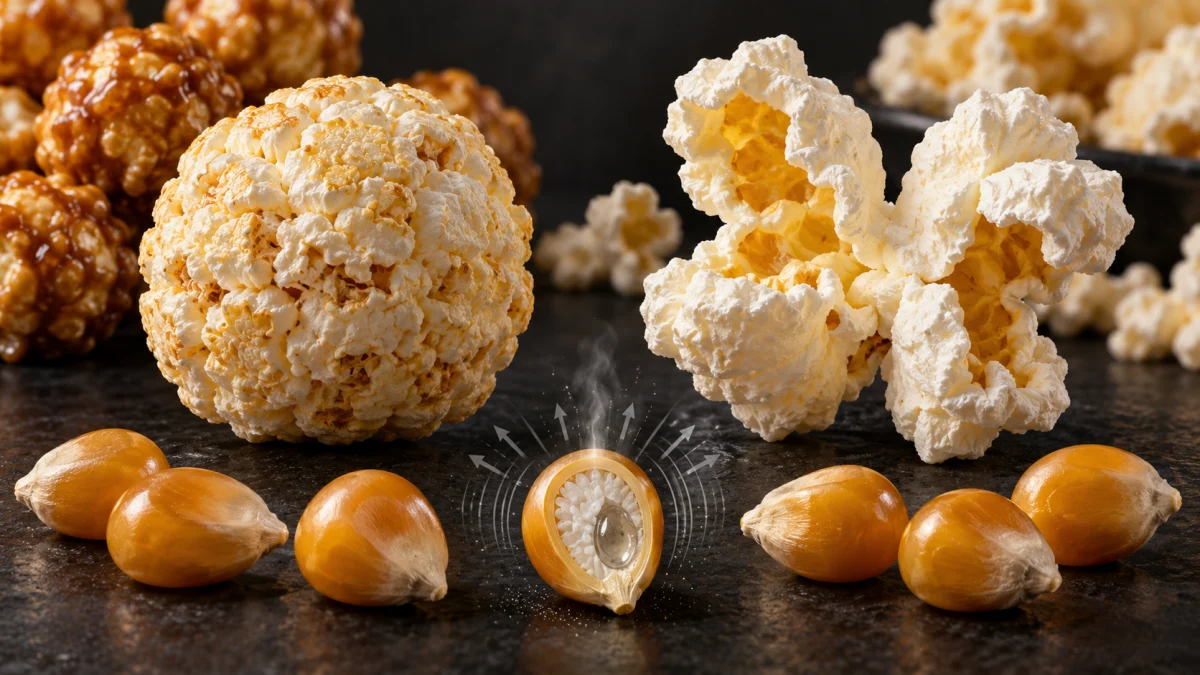
The familiar craggy popcorn with several protruding “wings” is broadly classified as butterfly popcorn. The compact, roughly spherical popcorn commonly used for caramel corn and other coated products is called mushroom popcorn.
Those are real characteristics that popcorn breeders can select for. But there is an important catch: a mushroom-type kernel is not genetically programmed to become one perfect little ball every time.
Popcorn shape is a biological trait with a strong genetic component, influenced further by the kernel’s physical structure, growing environment, moisture and popping conditions. Recent research suggests the resulting shapes are better understood as a continuum than as two perfectly separated boxes.
So if you spent most of your life assuming every piece of popcorn simply exploded however it felt like exploding, you were wrong.
But only in a much more interesting way than you might expect.
Mushroom and butterfly are real popcorn types
In the popcorn industry, an individual popped piece is called a flake. Popcorn hybrids have long been classified by the kind of flake they tend to produce.
The two broad commercial categories are:
| Butterfly popcorn | Mushroom popcorn | |
|---|---|---|
| Shape | Irregular, with protruding wings or lobes | Compact, rounded or ball-like |
| Structure | Light, highly expanded and relatively fragile | Denser and mechanically sturdier |
| Typical use | Classic snack popcorn, microwave popcorn, theater-style popcorn | Caramel corn, candy-coated popcorn and other products that must be mixed or tumbled |
| Does every kernel look identical? | No | No |
The American Chemical Society’s popcorn explainer describes the same two basic shapes, while agricultural literature has recognized the distinction for decades.
A University of Wisconsin Extension guide to commercial popcorn similarly notes that popped popcorn may resemble either a butterfly or mushroom, with butterfly types traditionally preferred for direct eating and mushroom types useful for confectionery products.
This is not merely a difference in how manufacturers happen to cook the same generic bag of corn. Breeders actually develop popcorn hybrids for these traits.
And that is where things get much stranger.
Popcorn shape is not random, but it is probabilistic
One of the clearest demonstrations comes from an unlikely place: Iowa State University’s popcorn breeding program.
Yes, there are actual popcorn breeders.
Iowa State’s descriptions of its public popcorn inbred lines include multiple lines specifically developed for mushroom-type flakes. In a 2002 evaluation, one line called BPM2 produced about 90% mushroom flakes. Another, BPM1, produced about 75%.
Think about what those numbers mean.
These were not bags accidentally contaminated with the wrong popcorn. They were genetic breeding lines explicitly selected for mushrooming ability, yet even their popped kernels did not necessarily produce the same shape every time.
That is a much better model for understanding popcorn.
A particular genotype can make one outcome much more likely without making that outcome inevitable.
The same phenomenon has appeared in academic breeding research. A 2021 study of experimental quality-protein popcorn hybrids found hybrids producing varying mixtures of mushroom and butterfly morphology.
So the labels on a bag of “mushroom popcorn” are meaningful. They just should not be interpreted as though someone installed a tiny spherical popcorn mold inside every kernel.
What actually happens when popcorn pops?
To understand where the shape comes from, it helps to appreciate just how violent the transformation is.
A popcorn kernel is essentially a tiny biological pressure vessel.
Its outer hull, or pericarp, is unusually good at containing pressure. Inside is a dense, starchy endosperm containing water.
As the kernel heats, that water produces increasing vapor pressure while the starch softens. The hull holds together until the pressure becomes greater than the structure can withstand.
Then it fails.
A 2015 physics study published in the Journal of the Royal Society Interface heated kernels while observing their behavior. Only 34% of the tested kernels had popped at 170°C, but 96% had popped at 180°C, or about 356°F.
The researchers’ pressure-vessel model put the pressure around the point of rupture at roughly 10 bar, equivalent to about 145 pounds per square inch.
Then the pressure suddenly collapses.
The hot starch expands outward, cools and solidifies into the white foam-like structure we recognize as popcorn.
The transformation occurs extraordinarily quickly. The same researchers even found that expanding starch can briefly form what functions like a little “leg,” launching the freshly popped kernel into the air.
Popcorn does not just explode. For an instant, it practically jumps.
The hull matters more than it looks
The outside of an unpopped kernel seems almost irrelevant once you are staring at a bowl of fluffy white popcorn. In reality, it is crucial.
A classic 1993 Journal of Food Science study of 18 popcorn hybrids examined characteristics including pericarp thickness, kernel size, density, hardness and shape. Pericarp thickness showed a particularly strong relationship with popping expansion.
That makes physical sense.
The kernel has to retain pressure long enough for the internal temperature and pressure to rise sufficiently. A cracked or otherwise compromised hull lets vapor escape prematurely, which is one reason damaged kernels can become the sad little residents of the bottom of the popcorn bowl.
Moisture matters too. The University of Wisconsin Extension popcorn guide cites an optimal range for maximum expansion of roughly 13% to 14.5% kernel moisture, with about 13.5% performing particularly well in the research it summarizes.
But none of these variables operates alone.
The kernel is a small biological structure whose genetics determine properties of its hull, endosperm, chemical composition, size and shape. Heating then subjects that structure to an extremely rapid mechanical event.
What lands in the bowl is the result.
Genetics loads the dice. The popping process still gets a vote.
This is the point most simple “two types of popcorn” explainers miss.
A 2012 study in the Journal of Cereal Science specifically investigated what determines popped popcorn morphology.
Researchers tested three butterfly-type hybrids grown in three different environments, varied microwave power between 750 and 1,240 watts, and changed the amount of oil.
They then classified the resulting butterfly flakes according to whether they had expanded primarily in one, two or multiple directions.
The proportions changed substantially between tests.
Depending on the conditions, unilateral flakes ranged from 1% to 24%, bilateral flakes from 20% to 55%, and multilaterally expanded flakes from 31% to 68%.
The researchers found that morphology was influenced by the popcorn hybrid, growing location, amount of oil and microwave wattage.
That means two important ideas can be true simultaneously:
Popcorn shape is genetically influenced.
And:
The exact shape of an individual popped kernel is not completely predetermined by its genetics.
What we should not conclude from this experiment is that sufficiently clever cooking will reliably transform ordinary butterfly popcorn into mushroom popcorn. The study was examining variation among butterfly morphologies.
If you specifically want round popcorn, beginning with a mushroom-producing hybrid still matters.
So are there actually two popcorn shapes, four shapes or five?
This question sounds trivial until you try to answer it scientifically.
For consumers and commercial food production, two broad flake types is a perfectly reasonable classification: mushroom and butterfly.
But butterfly popcorn itself can expand in visibly different ways.
Researchers have described butterfly flakes as:
- unilateral, with expansion concentrated more heavily in one direction;
- bilateral, with two major regions of expansion; and
- multilateral, with several expanded lobes.
Add mushroom morphology and you now have four useful research categories.
That still does not mean nature has issued an official rule declaring that popcorn comes in exactly four shapes.
In June 2026, researchers published a particularly useful study in the journal Genes. They performed image analysis on 957 popped kernels from popcorn breeding material and measured their circularity rather than merely eyeballing them.
Their 2026 popcorn genetics study separated flakes operationally into mushroom, unilateral butterfly, bilateral butterfly and multilateral butterfly categories.
But the underlying circularity measurements did not separate into neat clusters.
They formed a continuous distribution.
The researchers explicitly described flake morphology as a quantitative trait rather than a strictly discrete classification.
That is probably the most scientifically accurate answer to the whole question.
There are two useful broad popcorn shapes. There are multiple recognizable subtypes. But actual popcorn morphology exists along a spectrum.
Claims that there are exactly “five types of popcorn shapes” therefore need qualification. Researchers can and do create classification scales with different numbers of categories depending on what they are measuring.
There is no universal biological law establishing five official popcorn shapes.
Popcorn stubbornly refuses to organize itself that neatly for us.
Why is caramel popcorn usually round?
Now that you know what mushroom popcorn looks like, you may begin seeing it everywhere.
Especially in caramel corn.
That is not an aesthetic coincidence.
The 2012 Journal of Cereal Science paper notes that mushroom-producing hybrids make more durable flakes, which makes them useful for mixing and coating applications.
Butterfly popcorn’s wings create the classic light, irregular popcorn structure, but those projections are also vulnerable to breaking during industrial handling.
Imagine stirring delicate butterfly flakes through warm caramel, tumbling them to distribute the coating, cooling them, packaging them, shipping the bag and eventually having someone toss it into a shopping cart.
A rounder, more compact piece has a structural advantage.
Mushroom popcorn is therefore commonly selected for products in which the popcorn needs to survive the manufacturing process while carrying a relatively heavy coating.
The important distinction is mechanical durability, not some magical ability of mushroom popcorn to absorb caramel.
And it does not mean every caramel-corn manufacturer uses exactly the same popcorn.
Is movie-theater popcorn mushroom or butterfly?
Usually, the classic fluffy movie-theater style is butterfly popcorn, not mushroom popcorn.
The same 2012 food-science paper describes butterfly-type hybrids as common in movie theaters and retail microwave popcorn, while mushroom flakes are associated with mixing and coating applications.
That is a useful distinction, but it should not be turned into another absolute rule. A theater or popcorn manufacturer can choose whichever hybrid fits its product.
The important point is that movie-theater versus home popcorn is not what defines the two shapes.
The flake morphology does.
If I buy mushroom popcorn, why do I still get butterfly pieces?
Because “mushroom popcorn” describes a popcorn type selected for a strong tendency to produce mushroom flakes. It does not necessarily guarantee a 100% spherical batch.
The Iowa State breeding data make this unusually clear. One mushroom inbred produced about 90% mushroom flakes in the cited evaluation; another produced about 75%.
Processing conditions, kernel moisture and other variables can further influence popping performance.
So a bag producing some non-round pieces is not, by itself, proof that the manufacturer secretly filled it with ordinary popcorn.
On the other hand, if a seller advertises a specific mushroom-flake percentage, that is a measurable product claim. A batch performing far below that advertised percentage is a different question.
Can you make mushroom popcorn at home?
Yes.
The simplest approach is to buy kernels from a mushroom-producing popcorn variety and follow the producer’s recommended popping method.
Do not assume that buying ordinary supermarket popcorn and simply turning the burner higher will reliably transform butterfly popcorn into mushroom popcorn.
Temperature, moisture and popping method certainly affect expansion and morphology. But genetics remains part of the equation.
In other words, cooking technique can influence the hand you were dealt.
It does not necessarily replace the deck.
Why did so many of us never notice any of this?
There is probably a simple reason.
Most people encounter conventional butterfly popcorn first. And butterfly popcorn genuinely does produce a chaotic-looking collection of lobes, protrusions and irregular shapes.
If that becomes your mental definition of popcorn, the natural conclusion is:
Popcorn just comes out in random shapes.
Meanwhile, mushroom popcorn tends to hide in plain sight inside caramel corn, gourmet popcorn, candy-coated products and gift tins. We classify those foods by their flavor rather than stopping to perform morphological analysis on the underlying corn.
Reasonable behavior, admittedly.
Then somebody points out the round popcorn.
And suddenly you start seeing it everywhere.
That observation is not itself a scientific finding. It is simply a plausible explanation for why an industrial distinction that popcorn breeders and food scientists have studied for decades can feel like completely new information to someone who has eaten popcorn for just as long.
The answer
Popcorn shape is not random, but neither is every kernel locked into one predetermined form.
Popcorn breeders select hybrids with strong tendencies toward particular flake morphologies. Mushroom varieties favor compact, round flakes that resist breakage and work well for coated products. Butterfly varieties favor the irregular, highly expanded pieces most people recognize as ordinary popcorn.
But genetics is only part of the story.
Kernel structure, moisture, growing environment and popping conditions influence what happens during the rapid pressure-driven expansion of the starch. Individual kernels from the same broader type can therefore emerge looking noticeably different.
And the newest research suggests that trying to force all those outcomes into a few rigid boxes may miss the underlying biology.
There are two useful commercial categories.
There are several useful scientific subcategories.
And underneath them is a continuum of exploding corn.
Which, somehow, is considerably more complicated than popcorn had any right to be.
References and Further Reading
Popcorn Morphology and Genetics
Yang et al., “SSR-Based Genetic Diversity, Population Structure, and Marker–Trait Associations for Popping-Related Traits in Popcorn Germplasm” — Genes, 2026
The newest major source used here. The researchers analyzed 957 popped kernels with image-based measurements and found continuous variation in flake circularity rather than strictly discrete morphological groups. The genetic associations reported are preliminary and were derived from a relatively small collection of inbred lines, so they should not be interpreted as a complete genetic map of popcorn shape.
Sweley et al., “Effects of hybrid, environment, oil addition, and microwave wattage on popped popcorn morphology” — Journal of Cereal Science, 2012
Direct experimental evidence that popcorn morphology is influenced by both intrinsic and external factors, including hybrid, growing environment, oil addition and microwave power. Also provides useful distinctions among butterfly-flake morphologies and commercial uses of mushroom versus butterfly popcorn.
Iowa State University Committee for Agricultural Development — Popcorn Inbreds
Primary breeding-program descriptions of butterfly and mushroom popcorn lines. Particularly useful because Iowa State reports mushroom-flake percentages for specific inbreds, demonstrating that “mushroom” can describe a tendency rather than an all-or-nothing outcome.
Parsons et al., “Final Selection of Quality Protein Popcorn Hybrids” — Frontiers in Plant Science, 2021
Breeding research documenting hybrids that produced different mixtures of butterfly and mushroom morphology.
Physics and Kernel Structure
Virot and Ponomarenko, “Popcorn: critical temperature, jump and sound” — Journal of the Royal Society Interface, 2015
Experimental and physical analysis of popcorn’s approximately 180°C critical popping temperature, pressure-vessel behavior, rapid starch expansion, jumping motion and characteristic popping sound.
Mohamed, Ashman and Kirleis, “Pericarp Thickness and Other Kernel Physical Characteristics Relate to Microwave Popping Quality of Popcorn” — Journal of Food Science, 1993
Study of 18 popcorn hybrids examining how pericarp thickness and other kernel properties relate to popping expansion.
Park et al., “Chemical Composition and Physical Characteristics of Unpopped Popcorn Hybrids” — Journal of Food Composition and Analysis, 2000
Comparison of butterfly- and mushroom-type popcorn hybrids before popping, useful for understanding that the commercial distinction involves different hybrids rather than merely different shapes imposed after the fact.
Agricultural and General Science References
University of Wisconsin Extension — Popcorn
Agricultural overview covering popcorn hybrids, butterfly and mushroom flakes, commercial uses, kernel moisture and popping expansion.
American Chemical Society — The Secret Science of Popcorn
Accessible scientific explanation of the two broad popcorn shapes and why the sturdier mushroom morphology is useful for coated products.
Editorial currency note: Popcorn genetics and image-based morphology research continues to develop. The broad mushroom/butterfly distinction is longstanding, but specific genetic markers and scientific classification schemes may be refined as larger breeding populations are studied.