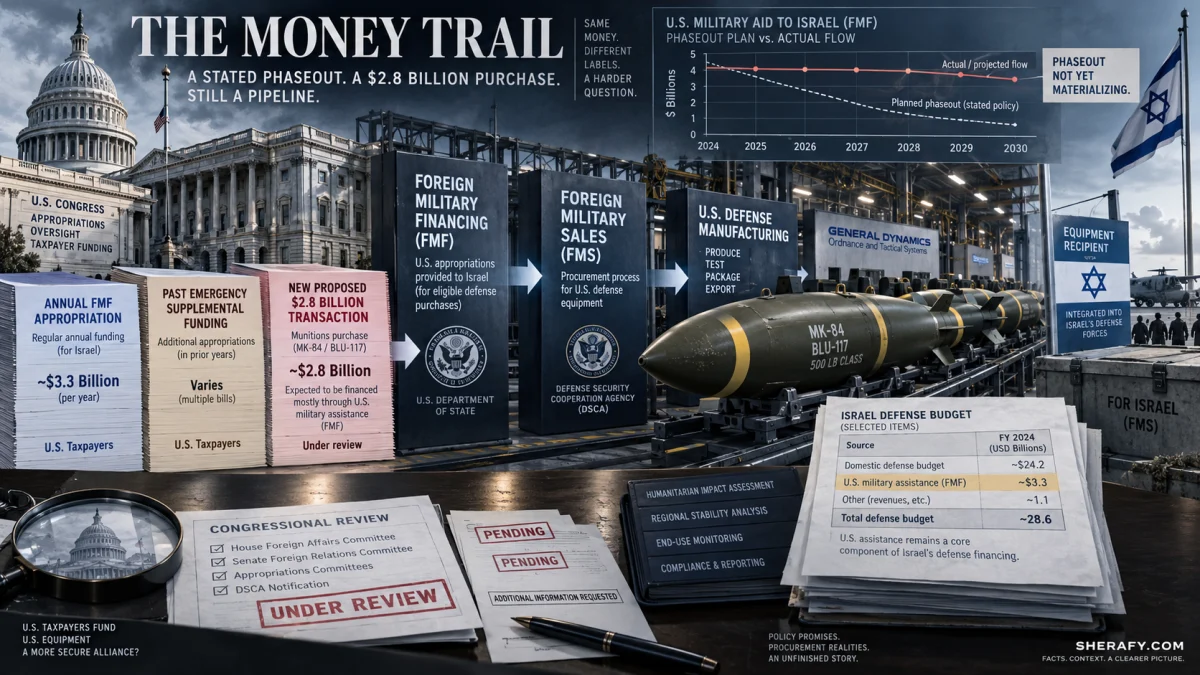
The proposed $2.8 billion Israeli munitions package is not simply a new $2.8 billion check from Congress. But most of the purchase would reportedly still be paid for with U.S. military assistance, meaning American taxpayers would subsidize Israel’s acquisition of the weapons.
That distinction matters because two misleading versions of this story are possible.
One is to call the proposed sale “another $2.8 billion in aid” and simply add it on top of the regular U.S. aid appropriation. That risks counting the same money twice.
The other is to emphasize that the $2.8 billion represents an arms-sale value rather than a new appropriation so heavily that the central fact disappears: Israel is seeking another major weapons acquisition that the Associated Press reports will be financed mostly through U.S. Foreign Military Financing, or FMF. The Associated Press’s September 15 report on the proposed sale
The latter distinction does not make the taxpayer subsidy disappear.
It tells us where to count it.
The package reportedly includes 20,000 MK-84 and 20,000 BLU-117 2,000-pound bomb bodies. Other reporting has also identified 20,000 I-2000 Penetrator warheads associated with the proposal. The transaction is not final. Congress has been informally notified, and senior Democrats on both the House Foreign Affairs Committee and Senate Foreign Relations Committee are withholding consent while asking how the weapons would be used.
That brings the story directly into conflict with another development this year.
In May, Israeli Prime Minister Benjamin Netanyahu told CBS News that he wanted to “draw down to zero the American financial support” and, when asked when that transition should begin, replied: “let’s start now.” His proposed timetable was approximately ten years. CBS News’s May 10 interview with Netanyahu
Israel has not promised to reach zero immediately.
But “start now” creates a reasonable, testable question:
Where has the reduction actually started?
As of September 18, there is no published year-by-year phaseout schedule. Israel continues to receive the regular U.S. FMF grant. Israel’s own 2026 defense-budget documents continue to incorporate billions of dollars in American assistance and cooperative defense funding. And the Israeli government is pursuing another major weapons purchase that would reportedly be financed predominantly by U.S. military assistance.
That does not prove Netanyahu’s long-term pledge is false.
It does establish that the financial relationship he says Israel should begin leaving remains deeply embedded in Israel’s current procurement system.
Start with the accounting: what is actually new?
The clearest way to understand the story is to separate a weapons transaction from the government money used to finance it.
| Amount | What it represents | Is it a new 2026 appropriation specifically for this sale? |
|---|---|---|
| About $2.8 billion | Estimated value of the newly proposed Israeli munitions transaction | No. It is the estimated transaction value. Most would reportedly be financed through FMF. |
| $3.3 billion | Regular FY2026 FMF grant to Israel | Yes, as an annual appropriation, but it exists independently of this particular sale. |
| $500 million | Annual U.S.-Israeli cooperative missile-defense funding under the current MOU framework | Separate from the $3.3 billion FMF grant. |
| $3.5 billion | Emergency FMF Congress added in April 2024 | Yes. This was genuinely additional wartime FMF, not part of the normal annual $3.3 billion. |
| $5.2 billion | Additional 2024 funding for Israeli missile and laser-defense programs | Yes. Separate emergency Defense Department appropriations, not regular FMF. |
Congress’s FY2026 appropriations law provides not less than $3.3 billion in FMF grants solely for Israel. Consolidated Appropriations Act, 2026
The annual $500 million missile-defense framework is separate, even though the two figures are frequently combined into the familiar $3.8 billion annual U.S.-Israel security-assistance figure.
The proposed $2.8 billion transaction is different from both.
It is a purchase.
And according to current reporting, most of the purchase would be paid for using FMF.
So saying:
“The United States is proposing a roughly $2.8 billion U.S.-financed weapons transaction for Israel.”
is supported by the evidence.
Saying:
“Congress just gave Israel another $2.8 billion on top of its regular aid.”
is not.
But “not a new $2.8 billion appropriation” does not mean “not taxpayer-financed”
This distinction is where coverage can become technically accurate but substantively misleading.
Foreign Military Financing is taxpayer-funded assistance.
Under the Defense Security Cooperation Agency’s financial rules, FMF can be transferred into the Foreign Military Sales Trust Fund and used to finance specific FMS cases. The trust fund can then be cited directly on procurement contracts or used to reimburse Defense Department accounts for equipment and services. DSCA Security Assistance Management Manual, Chapter 9
In simplified form:
Congress appropriates FMF → FMF finances an Israeli FMS case → U.S. contractors or Defense Department accounts are paid → Israel receives the military equipment.
That arrangement creates two beneficiaries.
U.S. defense companies can receive the procurement revenue.
Israel receives weapons without having to finance the entire acquisition from its own national budget.
Those are not mutually exclusive facts.
The common response that “the money is spent in America” explains where much of the procurement money ultimately goes. It does not erase the financial benefit to Israel.
If Israel used $1 billion of its own tax revenue to acquire weapons, its government would have $1 billion less available for another defense or civilian purpose.
If a U.S. grant finances that purchase instead, Israel receives the military capability while preserving more of its own resources.
That is the economic value of the subsidy.
Israel can buy American weapons with Israeli money
Nothing about the Foreign Military Sales system inherently requires American taxpayers to finance Israel’s purchases.
DSCA regulations explicitly allow foreign purchasers to finance FMS cases with their own national funds. DSCA rules governing FMS financing methods
That means an end to FMF would not automatically mean an end to Israeli purchases of U.S. weapons.
Israel could still seek U.S. government approval to purchase American aircraft, bombs, missiles and other equipment while paying from Israel’s national budget.
And Israel has a substantial national defense budget.
The Knesset’s final 2026 defense-budget summary puts funding from the Israeli state budget at approximately NIS 143 billion, with another approximately NIS 22 billion in expenditure contingent on income, including the U.S. aid grant and other revenues. Knesset summary of Israel’s approved 2026 defense budget
The relevant question is therefore not whether Israel has a legal mechanism to purchase U.S. arms without U.S. grants.
It does.
The question is why the grant financing continues while Israel’s prime minister publicly argues that Israel has become capable of weaning itself from that financing.
Israel’s own 2026 budget shows how deeply U.S. support remains embedded
One of the most revealing documents is not an American appropriations law.
It is Israel’s own 2026 budget proposal.
The detailed January budget document included the following U.S.-related financing lines for the defense budget:
| Israeli 2026 budget line | Amount listed |
|---|---|
| MOU U.S. assistance for procurement in the United States | $3.050 billion |
| MOU U.S. assistance convertible to shekels | $250 million |
| Joint projects | $500 million |
| U.S. assistance associated with Operation Guardian of the Walls | $270 million |
| U.S. assistance associated with the Iron Swords war | $1.487 billion |
| Total of these U.S.-related lines | $5.557 billion |
The figures appear in the Israeli government’s detailed 2026 budget proposal. Israel’s 2026 state-budget proposal, see the defense-financing table on page 67
That $5.557 billion should not be described as one interchangeable annual U.S. cash grant.
It combines several different categories: the normal MOU financing, jointly funded programs and assistance associated with earlier conflicts.
But it demonstrates something important that gets lost when the aid debate is reduced to the regular $3.3 billion figure:
U.S. financing remains structurally incorporated into Israel’s current defense planning.
The final Knesset budget summary subsequently confirmed that roughly NIS 22 billion of defense spending is contingent on revenue that includes the U.S. aid grant and other sources.
That is difficult to square with any impression that Israel has already begun operating independently of American financial support.
What Netanyahu actually said about ending the aid
Netanyahu’s position has become progressively more explicit during 2026.
On February 5, the Knesset’s Foreign Affairs and Defense Committee reported that Netanyahu called for developing Israeli military industries that would not depend on American aid and said he intended to end U.S. aid within a decade. Official Knesset account of Netanyahu’s February 5 remarks
He later described the transition as including the remaining years of the existing U.S.-Israel assistance agreement and continuing afterward.
Then came the May CBS interview.
Netanyahu said he wanted to “draw down to zero the American financial support” and said the process should “start now.”
That is not the same as promising to reject the entire current $3.8 billion framework immediately.
A ten-year drawdown obviously permits aid to continue during the transition.
But it still raises a straightforward accountability question:
What financial step has marked the beginning of that drawdown?
As of September 18, no public Israeli or U.S. document reviewed for this article provides a year-by-year reduction schedule.
No public announcement says Israel has declined the FY2026 FMF grant.
The Trump administration’s FY2027 budget request still includes not less than $3.3 billion in FMF grants for Israel. White House FY2027 Budget Appendix
And Israel is seeking a new multibillion-dollar munitions acquisition that would reportedly be financed mostly through FMF.
The evidence therefore supports a narrower conclusion than either side of the political debate may prefer:
Netanyahu has articulated a future phaseout. The public financial record does not yet show a corresponding reduction in the regular FMF grant.
That could change.
It has not happened publicly yet.
“Zero aid” may not mean zero U.S. taxpayer spending on Israeli defense
There is another ambiguity in Netanyahu’s proposal that deserves much more attention.
Israel is not proposing to replace its military relationship with the United States with no relationship at all.
The Israeli Ministry of Defense announced in June that the countries had opened formal discussions on a successor framework for the current agreement, which expires in 2028.
The ministry said the new arrangement is intended to expand joint investment, research, development and co-production while gradually moving from aid to what it called a completely reciprocal partnership. Israel Ministry of Defense announcement on the post-2028 framework
Congressional Research Service analysis makes the distinction even clearer.
The current U.S.-Israel relationship includes numerous cooperative programs in missile defense, counter-tunneling, counter-drone systems and emerging technologies. Only the regular $500 million annual missile-defense component falls within the current MOU; CRS says Congress appropriated another $202 million for cooperative Israeli defense programs outside the MOU in FY2026. CRS analysis of possible changes in U.S. military aid to Israel
So at least three different futures are theoretically possible:
- traditional FMF grants fall to zero and Israel pays for its weapons itself;
- FMF grants fall while U.S. funding for cooperative defense projects remains;
- some of what is now called “aid” is replaced with differently structured joint procurement, research or co-production spending.
No completed post-2028 agreement has yet established which model will prevail.
Therefore, Netanyahu’s commitment to eliminate the financial component of aid should not automatically be translated into a commitment to eliminate all U.S. taxpayer spending connected to Israeli defense.
Those are different propositions.
Whether the future arrangement represents a genuine reduction in U.S. fiscal support or partly a restructuring of that support is something the eventual agreement will have to reveal.
The proposed $2.8 billion package is not final
The transaction also should not be described as a completed weapons transfer.
The administration has presented it through the informal congressional-review process used before formal notification of major Foreign Military Sales.
On September 16, Representative Gregory Meeks, the ranking Democrat on the House Foreign Affairs Committee, announced that he would not clear the proposed sale.
His objection was not simply to military assistance in principle.
Meeks said the administration had not provided adequate assurances that the weapons would be used consistently with U.S. law and appropriate civilian protections, particularly given possible use of 2,000-pound bombs in densely populated areas of Gaza and Lebanon. Meeks’s September 16 statement placing a hold on the proposed sale
Two days later, Semafor reported that Senator Jeanne Shaheen, the ranking Democrat on the Senate Foreign Relations Committee, had separately been withholding consent since July while seeking answers about possible use of the weapons in Gaza, Lebanon, Syria and the conflict with Iran. Semafor’s September 18 report on Shaheen’s hold
These congressional holds are politically consequential but not permanent legal vetoes.
Under the Arms Export Control Act process, a qualifying sale to Israel normally receives a 15-day formal congressional-review period after formal notification. Congress can attempt to stop a sale legislatively, and administrations also possess statutory emergency authorities that have previously been used to bypass ordinary review requirements.
As of this article’s publication cutoff, however, the current $2.8 billion proposal remains just that:
a proposed transaction under review, not a completed transfer.
Exactly what weapons are included?
The most firmly established inventory comes from current reporting based on officials familiar with the package.
The Associated Press reports:
- 20,000 MK-84 2,000-pound bomb bodies
- 20,000 BLU-117 2,000-pound bomb bodies
That is 40,000 2,000-pound bombs or bomb bodies in the core reported package.
Additional reporting has described 20,000 I-2000 Penetrator warheads.
There is an important technical distinction here.
A previous formal DSCA notification for Israel listed MK-84 and BLU-117 bomb bodies separately from I-2000 Penetrator warheads. In February 2025, for example, DSCA described a $2.04 billion proposed sale containing 35,529 MK-84 or BLU-117 bomb bodies and 4,000 I-2000 Penetrator warheads. DSCA’s February 2025 Israel munitions notification
For that reason, saying the new proposal contains “60,000 complete bombs” could overstate what the available reporting establishes.
The safer description until the formal transaction documents are published is:
40,000 reported 2,000-pound MK-84 and BLU-117 bomb bodies, with an additional 20,000 I-2000 Penetrator warheads also reported as part of the proposal.
Why the 2,000-pound bombs themselves are part of the controversy
These are not routine replacement parts.
The Biden administration paused a shipment of 2,000-pound bombs to Israel in 2024 because of concerns about their possible use and mass casualties in densely populated Gaza. The Trump administration later released previously held weapons. The current proposal would involve tens of thousands more.
That history explains why Meeks’s objection focuses specifically on how the bombs could be used.
His statement describes the proposed 40,000 bombs as among the most destructive weapons in the U.S. arsenal and says the administration has not provided sufficient assurances about civilian safeguards.
Those are Meeks’s stated reasons for the hold, not a determination by this article that a future Israeli use would necessarily violate U.S. or international law.
The sale has not occurred, and the future use of weapons not yet transferred cannot be known.
But the civilian-protection concern is not hypothetical political rhetoric invented after the fact. It is one of the issues currently preventing the transaction from moving smoothly through informal congressional review.
Where will the $2.8 billion actually come from?
This remains the biggest unanswered accounting question.
Current reporting says most of the package would be financed with FMF.
It does not publicly establish:
- the exact FMF amount;
- which fiscal year’s FMF would be used;
- whether previously obligated assistance would finance any portion;
- whether payments would rely on future annual FMF appropriations;
- how much Israel might contribute from national funds;
- or the final payment schedule.
That missing information matters because Israel has a financing arrangement most countries do not use in the same way.
CRS explains that Israel has long been permitted to use cash-flow financing, allowing it to enter multiyear weapons purchases whose payments are made over time rather than requiring the full value of the contract to be covered up front.
That can include future FMF appropriations.
CRS notes that the United States and Israel have agreed to tens of billions of dollars in arms sales since October 7, 2023, and that payment schedules on existing purchases could extend into whatever post-2028 arrangement replaces the current aid MOU. If future Congresses stop appropriating FMF, Israel could have to make those payments with its own national funds, arrange other financing or potentially modify or terminate contracts. CRS report on U.S. aid, FMF and Israeli cash-flow financing
This means another oversimplification should be avoided:
“The money has already been appropriated, so the new sale has no future taxpayer cost.”
That cannot currently be established either.
Without the payment schedule, the public does not know how much of the transaction would ultimately be covered by previously appropriated FMF versus future appropriations.
What about the emergency $3.5 billion Congress approved in 2024?
This is where the difference between new money and a new purchase becomes particularly clear.
In April 2024, Congress actually did appropriate an additional $3.5 billion in emergency FMF for Israel, above the ordinary annual funding. The law explicitly calls it an “additional amount” and designated the funding as an emergency requirement. Public Law 118-50, the 2024 Israel security supplemental
That $3.5 billion was available for obligation through September 30, 2025.
Congress separately appropriated $5.2 billion for Israeli missile and laser defense, including Iron Dome, David’s Sling and Iron Beam.
That 2024 legislation is what genuinely new supplemental U.S. spending looks like.
The September 2026 $2.8 billion transaction has not been accompanied by a comparable new $2.8 billion appropriation.
But there is another technical wrinkle.
DSCA rules state that after FMF money is properly transferred to the FMS Trust Fund, it is considered expended and can remain available there for later disbursements consistent with the purposes for which it was appropriated and obligated.
So the fact that the 2024 appropriation’s obligation window ended in 2025 does not mean every dollar associated with previously obligated contracts had to be physically paid to manufacturers by then.
At the same time, we found no public evidence tying this new $2.8 billion transaction specifically to the 2024 $3.5 billion emergency appropriation.
Making that connection without a financing document would be speculation.
The correct answer today is:
We know most of the transaction is reportedly FMF-financed. We do not yet know which FMF dollars.
Why would Israel keep using FMF if Netanyahu says it no longer needs the aid?
There are several nonexclusive explanations supported by the structure of the existing relationship.
First, the current U.S.-Israel MOU runs through FY2028. Israel has not announced that it is abandoning that agreement immediately.
Second, Israel has already entered into large multiyear weapons purchases whose financing schedules were built around expected FMF.
Third, using an available grant is financially advantageous to Israel even if its government believes it can eventually afford to operate without one.
Fourth, Netanyahu is proposing a gradual transition rather than an abrupt cutoff.
Those factors explain how Israel can continue accepting aid while advocating a future phaseout.
They do not answer the accountability question created by “start now.”
A genuine phasedown does not have to begin at zero.
It does have to begin somewhere.
No publicly released schedule reviewed for this article identifies that first reduction.
Does Israel’s proposed phaseout eliminate the criticism?
No, but it changes the nature of it.
It would be inaccurate to criticize Netanyahu for failing to achieve in 2026 what he said should take roughly a decade.
It is reasonable, however, to examine whether the first steps he said should begin immediately are visible in actual financial policy.
So far:
- Israel continues to accept the existing FMF structure.
- Its 2026 budget explicitly incorporates U.S. support.
- The administration’s FY2027 proposal still uses the full $3.3 billion FMF figure.
- Israel is pursuing a new $2.8 billion weapons transaction financed mostly with FMF.
- No public annual phaseout schedule has been released.
- The proposed successor framework still envisions substantial U.S.-Israeli joint defense investment.
The responsible conclusion is not that the phaseout promise has been disproved.
It is that the transition remains substantially a future commitment rather than a reduction visible in current FMF levels.
American public opinion has changed, but the polls need precise wording
The timing also matters because public skepticism about military aid to Israel has increased.
The September 2-9 Marquette Law School national poll asked adults specifically whether the United States provides too much military aid to Israel, not enough, or about the right amount.
The result:
| Response | September 2026 |
|---|---|
| Too much military aid | 55% |
| About the right amount | 33% |
| Not enough | 12% |
Marquette Law School Poll, September 2026 national survey
That is a majority saying the amount of military aid is too high.
It does not mean 55% favor terminating all U.S. aid.
Those are different positions.
Other recent surveys measure still different questions. Polls asking whether the United States is “too supportive” of Israel measure broader foreign-policy attitudes, while favorability polls asking whether people view Israel positively or negatively do not directly measure support for aid at all.
Those findings can provide context, but they should not be substituted for the actual military-aid question.
The strongest case for continuing the financing
Supporters of continued assistance have several substantive arguments.
Israel continues to face major regional military threats and has expended large quantities of munitions during conflicts involving Gaza, Lebanon and Iran.
A sudden cutoff could also disrupt multiyear procurement arrangements already structured around FMF. CRS specifically warns that existing weapons contracts may have payment obligations extending beyond the current assistance agreement.
And because most FMF purchases are made from U.S. defense suppliers, continued financing supports parts of the American defense-industrial base as well as Israeli military capability.
Netanyahu himself is not proposing to sever the U.S.-Israel defense relationship. He has advocated replacing grant dependence with a partnership involving more joint development, production and investment.
Those arguments explain why supporters might prefer a long transition rather than an abrupt cutoff.
The strongest criticism does not require pretending the entire $2.8 billion is new aid
Critics do not need the weaker claim that Congress has just written Israel a fresh $2.8 billion check.
The documented facts already raise substantial questions.
Israel says it wants to become financially independent of U.S. military grants.
Its own budget shows American assistance remains part of current defense financing.
It is seeking a major new munitions acquisition financed mostly by that assistance.
The United States could approve the same weapons for purchase with Israeli national funds instead.
And the proposed weapons include tens of thousands of 2,000-pound bombs whose possible use in populated areas has already caused members of Congress to place holds on the transaction.
Those are the issues that survive the accounting correction.
In fact, separating the numbers accurately makes the underlying question stronger:
Why is U.S. grant money still underwriting acquisitions that Israel could finance itself if its government believes it is ready to begin ending that financial dependence?
The answer may ultimately be that both governments are choosing to use the remaining years of the existing aid system while unwinding contractual obligations and negotiating its replacement.
If so, a published phaseout schedule would make that transition measurable.
There is no such public schedule yet.
What is verified, what is not, and what can reasonably be inferred
Verified
The proposed transaction is worth roughly $2.8 billion. Current reporting identifies 20,000 MK-84 and 20,000 BLU-117 2,000-pound bombs or bomb bodies, with additional I-2000 Penetrator warheads also reported.
Most of the transaction would reportedly be financed through U.S. FMF. That means taxpayer-funded military assistance would finance most of Israel’s purchase.
The $2.8 billion sale value is not itself a new $2.8 billion appropriation. No comparable September 2026 supplemental appropriation has been identified.
Israel still receives the regular U.S. assistance structure. FY2026 law provides the annual $3.3 billion FMF grant, while separate defense appropriations support the $500 million cooperative missile-defense framework.
Israel’s own 2026 budget documents incorporate U.S. financing. The detailed proposal identified $5.557 billion across several U.S.-related aid and cooperative-program lines, while the final Knesset summary confirms that U.S. aid is included in the defense budget’s contingent-revenue financing.
Netanyahu has publicly called for phasing financial U.S. military support down to zero and said the process should begin now.
The sale is not final. Meeks and Shaheen are withholding consent during informal congressional review.
Not established by the public record
We do not know exactly which fiscal-year FMF appropriations would pay for the new package.
We do not know how much would come from already obligated funds versus future FMF payments.
We do not have a complete public payment schedule.
We do not have the final formal sale terms or complete contractor allocation.
We do not have a published year-by-year Israeli phaseout schedule.
We do not have evidence that Israel has formally rejected its current FY2026 aid.
And we do not have evidence establishing that the 2024 emergency $3.5 billion FMF appropriation specifically finances this new transaction.
Reasonable inference
It is reasonable to describe the proposed transaction as mostly U.S.-taxpayer-financed based on the reported use of FMF.
It is misleading to describe the entire $2.8 billion transaction value as a separate new $2.8 billion appropriation without evidence of such an appropriation.
It would also be misleading to use that accounting distinction to imply that American taxpayers are not subsidizing the purchase.
And it is reasonable to conclude that, as of September 2026, Netanyahu’s promised transition away from U.S. financial support has not yet produced a publicly documented reduction in the standard FMF level.
What cannot responsibly be inferred from that fact alone is why Netanyahu made the pledge or whether he ultimately intends to carry it out.
Bottom line
The real story is neither “America just gave Israel another $2.8 billion” nor “this is merely an ordinary arms sale that costs American taxpayers nothing new.”
Both descriptions obscure part of the financial reality.
The Trump administration is seeking approval for a roughly $2.8 billion munitions transaction for Israel. Most of the purchase would reportedly be financed with U.S. Foreign Military Financing.
That makes it a heavily U.S.-subsidized acquisition.
But the transaction’s $2.8 billion face value should not automatically be added to the regular $3.3 billion annual FMF grant as though Congress created a separate $2.8 billion aid account. The exact mix of previously appropriated, current and potentially future FMF financing has not been publicly disclosed.
The larger contradiction is harder to dismiss.
Netanyahu has said Israel should begin now to phase the financial component of U.S. military support down to zero.
Yet Israel’s own 2026 budget continues to incorporate billions of dollars in American assistance and cooperative funding. The full regular FMF level remains in current U.S. budget planning. Israel has not announced that it is declining that aid. And it is pursuing another major weapons acquisition that would reportedly be paid for predominantly through the same U.S. financing system.
A ten-year phaseout can reasonably take ten years.
But if the transition has begun, the public record should eventually show where the number starts going down.
As of September 18, 2026, that reduction is not yet visible.
References and Further Reading
The proposed $2.8 billion transaction
Trump administration plans to send powerful bombs to Israel in $2.8 billion weapons sale — Associated Press Current reporting on the package’s estimated value, 40,000 MK-84 and BLU-117 bombs, informal congressional status and FMF financing.
Meeks Places Hold on Trump Administration’s $2.8 Billion Bomb Sale to Israel — House Foreign Affairs Committee Primary statement from Representative Gregory Meeks explaining his objection and concerns over civilian protections and legal use.
Shaheen holds up $2.8B arms sale to Israel — Semafor Reporting that Senator Jeanne Shaheen has separately withheld consent while seeking information on the weapons’ potential use.
Israel — Munitions and Munitions Support, February 2025 — Defense Security Cooperation Agency Useful comparison showing how DSCA distinguishes MK-84/BLU-117 bomb bodies from I-2000 Penetrator warheads in a formal munitions notification.
U.S. financing and appropriations
Consolidated Appropriations Act, 2026 — Public Law 119-75 Primary statutory source for the regular FY2026 $3.3 billion FMF grant and other Israel-related appropriations.
Israel Security Supplemental Appropriations Act, 2024 — Public Law 118-50 Primary evidence of the genuinely additional $3.5 billion emergency FMF appropriation and its September 30, 2025 obligation deadline.
DSCA Security Assistance Management Manual, Chapter 9 Explains FMF financing, national-fund financing, the FMS Trust Fund and how money is disbursed on defense contracts.
U.S. Foreign Aid to Israel: Overview and Developments Since October 7, 2023 — Congressional Research Service Detailed treatment of FMF, cash-flow financing, multiyear procurement obligations and the consequences of a future aid phaseout.
Israeli budget and aid-phaseout policy
Israel’s 2026 state-budget proposal — Knesset Contains the detailed defense-financing table listing regular U.S. assistance, joint projects and additional U.S.-related financing.
Knesset approval summary for Israel’s 2026 defense budget Confirms approximately NIS 143 billion in state-budget defense funding and roughly NIS 22 billion in contingent-income spending that includes U.S. aid.
Netanyahu wants Israel “to draw down to zero the American financial support” — CBS News Original May interview containing Netanyahu’s clearest statement that the financial component should be phased out and the process should begin now.
Official Knesset account of Netanyahu’s February 5 aid remarks Parliamentary record documenting Netanyahu’s stated intention to end U.S. aid within a decade and develop less-dependent Israeli defense industries.
U.S. and Israel launch talks on a new defense-cooperation framework — Israel Ministry of Defense Primary Israeli government description of the planned post-2028 transition toward joint investment, R&D and co-production.
Possible Changes in U.S. Military Aid to Israel: Considerations for Congress — Congressional Research Service Explains the distinction between traditional FMF and other jointly funded U.S.-Israeli defense programs and identifies policy questions raised by a possible phaseout.
Public opinion
September 2026 national survey — Marquette Law School Poll Finds 55% of U.S. adults saying the United States provides Israel too much military aid, while 33% say the amount is about right and 12% say it is not enough. The question does not ask whether all aid should end.
Editorial currency note
This article reflects records and reporting available through September 18, 2026. The factual picture could change quickly if the State Department formally notifies Congress of the transaction, the congressional holds are lifted or bypassed, final financing terms become public, Congress changes FY2027 assistance levels, or the United States and Israel publish the terms of a post-2028 security-cooperation agreement.
Tags: Israel, U.S. Military Aid, Foreign Military Financing, Foreign Military Sales, Benjamin Netanyahu, U.S.-Israel Relations, Arms Sales, Defense Spending, Congress, DSCA, Military Assistance, Gaza