The United States does not depend heavily on China for rare-earth magnets because America lacks rare-earth-bearing rock. It depends on a China-centered supply chain because mining the rock is only the first step.
The harder industrial chain comes afterward: concentrating the ore, chemically separating nearly identical rare-earth elements, converting oxides into metals, making specialized alloys and powders, manufacturing high-performance magnets, and qualifying those magnets for products that may have to survive years inside a car, aircraft, industrial motor or defense system.
The numbers make the distinction unusually clear. According to the International Energy Agency’s 2026 rare-earth supply-chain analysis, China accounted in 2024 for about 60% of global mining of the four main magnet rare earths, 91% of their refined output, and 94% of global sintered permanent-magnet production. Those four magnet elements are neodymium, praseodymium, dysprosium and terbium.
That progression—60% → 91% → 94%—is the simplest explanation for why opening another mine does not by itself break the dependency.
There is also an important 2026 update. The familiar explanation that America mines rare earths at Mountain Pass, California, only to send them to China for processing is now outdated. MP Materials says it stopped all sales to China in July 2025, expanded domestic separation, and began making neodymium-iron-boron magnets on industrial-scale equipment in Texas. At the same time, other U.S. magnet plants have entered production or commissioning.
So the real question has changed.
America is no longer starting from zero. The question is whether it can rebuild the entire mine-to-magnet industrial system at enough scale, quality and cost to compete with an ecosystem China spent decades developing.
The rare-earth bottleneck gets worse the farther downstream you go
China’s position is often described loosely as a "rare-earth monopoly." That obscures where the concentration actually occurs.
| Stage | China’s share | Why it matters |
|---|---|---|
| Mining of magnet rare earths | 60% | Concentrated, but substantial ore exists elsewhere |
| Refining and separation | 91% | Individual rare earths must be chemically separated before most high-value uses |
| Sintered permanent magnets | 94% | This is the high-value finished material manufacturers actually need |
These are the IEA’s 2024 figures specifically for the magnet rare earths neodymium, praseodymium, dysprosium and terbium—not for every rare-earth element or every type of magnet.
The distinction matters because a mine does not produce a motor magnet.
It produces ore.
Between those two products sits an industrial chain containing some of the most technically demanding chemistry and precision materials manufacturing in the sector.
The IEA estimates that permanent magnets account for roughly 95% of rare-earth consumption by value, even though rare earths are also used in catalysts, glass, ceramics, polishing compounds and other applications. The economic center of gravity therefore sits much farther downstream than the mine.
Rare earths are not actually that rare
The name is misleading.
The U.S. Geological Survey’s 2026 Mineral Commodity Summaries describes rare earths as relatively abundant in Earth’s crust. What is less common is finding them in concentrations that can be economically mined and processed. They also usually occur mixed together rather than as conveniently separated piles of neodymium, dysprosium or terbium.
The United States already mines a substantial amount.
USGS estimates that American mines produced about 51,000 metric tons of rare-earth-oxide equivalent in mineral concentrates in 2025, principally from Mountain Pass in California, with additional monazite production from heavy-mineral sands. China produced approximately 270,000 tons out of a global 390,000 tons that year.
Readers may notice that this puts China’s share of all rare-earth mine production near 69%, while the IEA figure above says 60%.
Both can be correct.
The USGS number covers broader rare-earth mine production in 2025. The IEA’s 60% figure refers specifically to neodymium, praseodymium, dysprosium and terbium—the four rare earths most important to permanent magnets—in 2024. Different years and different baskets of elements produce different percentages.
This is one reason rare-earth statistics can appear contradictory when they are repeated without definitions.
A rare-earth mine is only the beginning
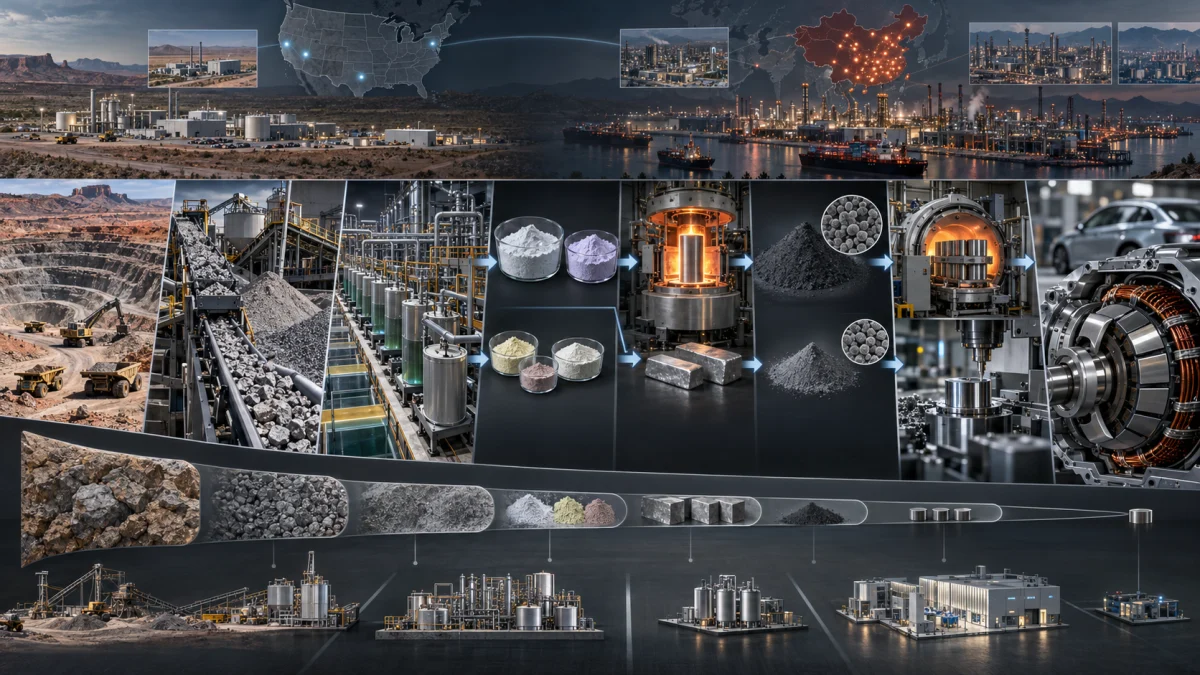
The journey from ore to a high-performance magnet looks roughly like this:
Mine → concentrate → chemical extraction → separation → rare-earth oxide → metal → alloy → fine powder → aligned and pressed material → sintered magnet → machining and coating → finished, qualified component.
Each step is a distinct industrial capability.
The ore first has to be crushed and concentrated. Chemical processing then removes unwanted material and creates a mixed rare-earth stream. The individual rare earths must subsequently be separated from one another, often using multi-stage solvent extraction.
That separation step is unusually difficult because neighboring rare-earth elements have very similar chemical behavior. A chemical process that preferentially grabs neodymium may also tend to grab praseodymium. Instead of one dramatic separation, processors progressively split the elements across repeated stages until the desired purity is reached.
The IEA describes separation as the technical core of rare-earth processing and notes that the full chain then continues through metal refining, alloying and magnet manufacturing.
After separation, neodymium and praseodymium oxides still are not magnets. They must be converted into metal, combined with iron, boron and other ingredients into carefully controlled alloys, processed into extremely fine powders, aligned in a magnetic field, pressed, sintered, heat treated, machined and protected against corrosion.
For demanding applications, manufacturers may introduce small quantities of heavy rare earths such as dysprosium or terbium to help a magnet retain coercivity—its resistance to demagnetization—at high temperatures.
By the time a finished magnet reaches a traction motor, the original mine represents only one part of its technological history.
Mountain Pass shows why the old explanation is now incomplete
Mountain Pass is the most important example because it shows both the old U.S. weakness and the new one.
For years, MP Materials’ predecessor business model left a major gap after mining and concentration. MP itself historically sold large quantities of Mountain Pass concentrate through Shenghe for processing connected to China.
That fact became the basis for a widely repeated line: America mines rare earths and then sends them to China because it cannot process them itself.
That description should no longer be used without qualification.
According to MP Materials’ 2025 annual SEC filing, the company ceased all sales of its products to China in July 2025 and allowed its Shenghe offtake agreement to expire in January 2026. Its June 2026 filing confirms that the arrangement was not extended.
Mountain Pass has also moved beyond producing concentrate. MP reported 2,599 metric tons of separated neodymium-praseodymium oxide production in 2025, more than double its 2024 output, and produced its first NdFeB magnets on commercial-scale equipment at its Independence facility in Fort Worth, Texas.
That does not mean the U.S. rare-earth problem is solved.
MP’s June 2026 regulatory filing still described finished-magnet sales to General Motors as something it expected to begin during 2026. Manufacturing a first magnet, scaling repeatable production, passing customer qualification and supplying large automotive programs are different milestones.
That distinction becomes especially important when evaluating announcements about new magnet factories. Nameplate capacity is not the same thing as proven annual production of qualified magnets.
The United States now makes rare-earth magnets again
Another outdated claim is that the United States makes essentially no sintered rare-earth magnets.
That was substantially true only a few years ago. It is no longer true in 2026.
eVAC Magnetics began producing commercial rare-earth magnets at its Sumter, South Carolina, facility in 2025 and announced its first U.S.-made NdFeB magnet shipment that December. The company says its current plant has roughly 2,000 metric tons per year of nameplate magnet capacity.
Noveon Magnetics is also producing sintered NdFeB magnets in San Marcos, Texas, and announced a $215 million financing round in January 2026 to expand domestic manufacturing. Public reporting says the company is targeting more than 2,000 tons of annual output as it scales.
USA Rare Earth commissioned the first phase of its Stillwater, Oklahoma, magnet line in March 2026. The company said that phase was intended to ramp toward a 600-metric-ton annual run rate by the end of 2026, with another expansion planned afterward.
MP Materials, meanwhile, is scaling Independence toward an estimated 3,000 metric tons per year and plans a second Texas facility called 10X. MP’s disclosed target is approximately 7,000 tons per year from 10X, with commissioning expected to begin in 2028, for a combined company target of about 10,000 tons annually once both facilities are built and scaled.
Those developments are significant.
They are also much smaller than the industrial ecosystem they are attempting to replace.
The IEA estimates China accounted for 94% of global sintered permanent-magnet production in 2024. New American factories therefore represent the beginning of a diversified supply chain, not evidence that the existing concentration has disappeared.
Heavy rare earths remain a particularly difficult gap
Neodymium and praseodymium receive much of the attention because they form the foundation of high-performance NdFeB magnets.
But some of the hardest dependencies involve the much smaller quantities of heavy rare earths used in demanding magnet applications.
The USGS 2026 heavy-rare-earth summary estimated U.S. net import reliance for heavy-rare-earth compounds and metals at 100% in 2025. Shipping records cited by USGS showed China supplying 100% of U.S. imports of terbium compounds and metals during 2021–2024, as well as very large shares of several other heavy rare earths. That statistic refers to compounds and metals, not to every finished magnet imported into the United States, but it illustrates how incomplete the domestic upstream and midstream chain remains.
The U.S. defense department provided a $150 million direct loan in 2025 to add heavy-rare-earth separation capabilities at Mountain Pass. The existence of that project itself helps identify the bottleneck: having Mountain Pass’s large light-rare-earth resource does not automatically provide a domestic source of separated dysprosium and terbium.
Other non-Chinese projects are also developing heavy-rare-earth separation. But in 2026 this remains an area where mine output, separation capacity and magnet demand do not yet line up into a mature domestic chain.
Why can’t the U.S. simply build the same factories?
It can build them. The harder question is how quickly they can be built, scaled and qualified at competitive cost.
Rare-earth dominance is not simply possession of a chemical recipe.
A mature magnet industry requires engineers and operators who know how to keep separation systems stable, maintain purity across large production runs, control alloy chemistry, make extremely consistent powders, optimize sintering, machine brittle magnetic material accurately, apply protective coatings and produce millions of parts without drifting outside customer specifications.
It also requires the specialized furnaces, separation equipment, electrolysis systems, strip casters, mills, magnetic alignment presses and other machinery used at each stage.
Then comes customer qualification.
A company manufacturing an industrial motor or vehicle cannot necessarily replace one magnet with another because the new supplier says the magnetic grade is equivalent. Automotive, aerospace and defense customers may need to test material consistency, dimensional tolerances, thermal behavior, corrosion resistance, mechanical integrity and long-term performance before approving a component.
China’s advantage therefore compounds.
Large magnet factories create demand for nearby metal and alloy producers. Those producers create demand for refiners. Equipment makers improve because they have many customers. Skilled workers circulate through the industry. Magnet producers work directly with motor and electronics manufacturers on new grades and geometries. Production experience accumulates.
The IEA identifies magnet manufacturing and metallization—the conversion of refined oxides into metals and alloys—as the largest remaining bottlenecks in diversifying the rare-earth supply chain outside China.
That is an industrial ecosystem, not merely a mineral deposit.
Environmental costs are part of the explanation—but not the whole explanation
Rare-earth processing can be chemically intensive, and some deposits contain thorium or other naturally occurring radioactive material that must be managed appropriately.
These issues contributed to the difficult history of U.S. rare-earth processing and help explain why operating a modern separation facility can be more complicated and expensive than simply digging ore from an open pit.
But the common claim that China dominates rare earths simply because "China allows pollution and America does not" is too simplistic.
Waste handling and environmental compliance affect economics. So do labor, energy, financing, scale, equipment availability, process knowledge, existing customers, supplier density and decades of accumulated manufacturing experience.
If environmental rules were the only barrier, building compliant plants with enough money would recreate the entire supply chain. The continuing bottlenecks in metallization, magnet making, specialized equipment and customer qualification show why that is not the case.
China’s dominance was not an accident—but it was not caused by one secret deal either
There is evidence that Chinese policy deliberately encouraged more rare-earth processing and manufacturing to occur domestically.
One unusually strong piece of evidence comes not from political rhetoric but from a trade dispute.
In the World Trade Organization case over China’s earlier rare-earth export restrictions, the WTO’s summary of the case says the panel found that China’s export quotas were designed to achieve industrial-policy goals rather than conservation, and that the structure of domestic and export restrictions encouraged extraction while securing preferential access for Chinese manufacturers. The panel and Appellate Body reports were adopted in 2014; China subsequently removed the measures found inconsistent with WTO rules.
That history supports the conclusion that industrial strategy played a role in moving value-added activity downstream into China.
It does not, by itself, prove every stronger version of the story sometimes told online: that one American corporate sale transferred the entire industry, that Western processing disappeared solely because of environmental regulation, or that China’s current position can be traced to a single coordinated maneuver.
The stronger explanation is cumulative.
China developed mining, separation, metallization, magnet manufacturing and the enormous electronics, motor and industrial customer base that consumes those magnets. Foreign producers simultaneously faced low prices, capital requirements, environmental liabilities and the economics of competing against an increasingly integrated Chinese system.
Eventually, the most important advantage was no longer merely cheaper ore.
It was having most of the rest of the chain in one place.
China’s 2025 export controls showed why the concentration matters
Supply-chain concentration can remain largely invisible until material stops moving.
That happened in 2025.
China introduced export controls covering several heavy rare earths and related products in April. According to the IEA, export volumes then fell sharply in April and May, and some automakers outside China reduced utilization or temporarily stopped production because they could not obtain enough magnets. A wider set of controls announced in October 2025 was suspended for one year the following month.
The episode demonstrated an important distinction.
A rare-earth magnet may contain only a relatively small mass of specialized material compared with the vehicle, robot, server, aircraft or motor around it. But if there is no qualified substitute available, the inexpensive component can stop production of the expensive product.
Supply-chain importance is therefore not proportional to weight or raw-material value.
Why opening more mines will not solve the problem by itself
This may be the single most important point.
Imagine the United States doubled rare-earth mine production tomorrow.
If the additional material still lacked sufficient domestic or allied separation capacity, metallization, alloy production and magnet factories, the country would have more ore without a corresponding increase in finished magnets.
The IEA’s outlook illustrates exactly this imbalance.
For projected demand outside China in 2035, existing and announced diversified projects could provide roughly half of required mining supply, about one-quarter of refining needs, and well below one-fifth of magnet needs under the agency’s analysis. It estimates that closing the remaining gap would require, on top of planned expansions, roughly twice as much mining capacity, four times as much refining capacity and six times as much magnet capacity.
In other words, the project pipeline becomes thinner as the material approaches its most useful form.
The rocks are not the end of the problem.
They are the beginning.
Can’t manufacturers simply stop using rare-earth magnets?
Sometimes they can.
Rare-earth permanent magnets are extraordinarily useful, but "irreplaceable" is too strong.
Electric motors can be designed without neodymium magnets. Induction motors, switched-reluctance motors and other architectures can avoid rare-earth permanent magnets entirely. Ferrite magnets can also replace rare-earth magnets in some applications.
The tradeoff is that the alternatives do not necessarily reproduce the same combination of power density, efficiency, size, weight, temperature behavior and controllability.
The U.S. Department of Energy’s electric-motor research overview notes, for example, that induction motors offer reliability but generally lower power density and overall efficiency than interior permanent-magnet motors, while switched-reluctance motors avoid expensive magnets but face issues such as noise and vibration.
USGS makes the broader point more simply: substitutes exist for many rare-earth applications, but they are generally less effective.
So the right answer is not that modern technology literally cannot function without rare-earth magnets.
It is that engineers often chose them because they solve difficult design problems extremely well. Removing them can shift the cost or engineering penalty somewhere else.
Recycling helps, but it cannot immediately replace primary supply
Rare-earth magnets contain valuable material that can be recovered from manufacturing scrap and, increasingly, from end-of-life motors and electronics.
That makes recycling an important additional source of supply. Companies including Noveon and MP Materials are developing or expanding recycling systems, and the IEA estimates that recycling could eventually make a substantial reduction in primary rare-earth requirements.
But there is a timing problem.
Much of today’s potential end-of-life magnet stock is still installed in products. A motor manufactured this year may remain in service for a decade or more. Growing demand also means that even highly effective recycling cannot supply the initial material needed for every new magnet.
Recycling can reduce dependence on newly mined material. It does not make mining, separation or magnet manufacturing disappear.
So how dependent is the United States on China in 2026?
There is no single honest percentage.
It depends on what is being measured.
USGS estimated that the United States produced 51,000 tons of rare-earth concentrate in 2025, but only about 8,900 tons of rare-earth compounds and metals. It estimated U.S. net import reliance for compounds and metals at 67%, and China accounted for roughly 71% of U.S. rare-earth compound and metal imports during 2021–2024. A substantial additional quantity enters the country already embedded in finished products.
For heavy-rare-earth compounds and metals, USGS put U.S. net import reliance at 100% in 2025.
At the global level, the IEA’s figures show that the concentration rises sharply as the supply chain moves downstream: 60% of magnet-rare-earth mining, 91% of refining and 94% of sintered magnet production were in China in 2024.
Yet those figures coexist with a genuine change in the U.S. industrial picture.
Mountain Pass now separates substantial quantities of NdPr domestically. MP no longer sells its products into China. eVAC is shipping U.S.-made magnets. Noveon is manufacturing and expanding. USA Rare Earth has commissioned a new line. MP is ramping finished magnet production and developing a much larger second facility.
The United States therefore has something in 2026 that it largely lacked only a few years ago:
a domestic rare-earth magnet industry that is actually being rebuilt.
What it does not yet have is China’s combination of scale, heavy-rare-earth supply, separation capacity, metallization, equipment ecosystem, experienced workforce and enormous downstream manufacturing base.
That is the remaining dependency.
Frequently asked questions
Does Mountain Pass still send its rare earths to China?
Not according to MP Materials’ current regulatory filings. The company says it ceased all sales to customers in China in July 2025 and did not renew its Shenghe offtake agreement when it expired in January 2026. It is now separating more material domestically, selling outside China or retaining concentrate for further processing.
Does the United States currently make neodymium magnets?
Yes. This is an important change from only a few years ago. eVAC is producing commercial NdFeB magnets in South Carolina; Noveon manufactures them in Texas; USA Rare Earth commissioned production equipment in Oklahoma in 2026; and MP Materials has begun manufacturing on industrial-scale equipment in Texas while ramping toward finished-magnet sales.
Why does the U.S. still import rare earths if Mountain Pass is so productive?
Because mine concentrate and finished industrial materials are different products. The U.S. currently has more mining capacity than domestic capacity in several downstream processing and manufacturing stages. Different deposits also contain different proportions of the individual rare earths manufacturers require.
Are rare earths actually rare?
Not in the literal sense. Rare-earth elements are relatively abundant in Earth’s crust. The difficulty is finding economically attractive concentrations and then separating individual elements that occur together and behave chemically very similarly.
Which rare earths are most important for permanent magnets?
For the highest-volume high-performance NdFeB magnets, the key elements are neodymium and praseodymium, with dysprosium and terbium particularly important in some applications requiring stronger resistance to demagnetization at elevated temperatures. The IEA therefore uses Nd, Pr, Dy and Tb as its "magnet rare earth" group.
Does every electric vehicle require rare-earth magnets?
No. Electric vehicles can use induction motors, reluctance motors and other designs that do not require rare-earth permanent magnets. Permanent-magnet motors remain attractive because they can offer an unusually favorable combination of efficiency, compactness and power density.
The bottom line
The phrase "rare-earth dependence" makes the problem sound geological.
It is mostly industrial.
The United States has rare-earth deposits. It has one of the world’s major operating rare-earth mines. It now separates meaningful quantities of magnet material domestically. And, as of 2026, it again has American factories producing or ramping high-performance rare-earth magnets.
China nevertheless remains overwhelmingly dominant because the competitive advantage grew strongest after the ore leaves the ground.
The difficult part is not simply finding neodymium.
It is reproducing, at industrial scale, the long chain that transforms a mixed mineral deposit into precisely separated elements, high-purity metals, specialized alloys and millions of qualified magnets—and then supplying them cheaply and consistently enough that manufacturers are willing to design their products around them.
That is why a country can have rare earths underground and still depend on another country for magnets.
And it is why the most important rare-earth race is increasingly not a race to find more rocks.
It is a race to rebuild everything that happens after the mine.
References and Further Reading
Current supply-chain data
International Energy Agency — Rare Earth Elements: Pathways to Secure and Diversified Supply Chains. Published April 8, 2026. The strongest current overview of the mine-to-magnet chain, including China’s shares of magnet-rare-earth mining, refining and sintered magnet production; projected supply gaps; recycling; and downstream bottlenecks.
U.S. Geological Survey — Mineral Commodity Summaries 2026: Rare Earths. Primary U.S. government source for 2025 domestic mine production, compounds and metals production, world output, resources, trade and import reliance.
U.S. Geological Survey — Mineral Commodity Summaries 2026: Heavy Rare Earths. Documents U.S. heavy-rare-earth import reliance, trade sources and the development status of domestic heavy-rare-earth processing.
U.S. mine-to-magnet buildout
MP Materials — 2025 Form 10-K filed with the SEC. Primary corporate filing confirming the end of MP’s China sales, expiration of its Shenghe arrangement, domestic processing expansion and magnet-manufacturing strategy.
MP Materials — Second Quarter 2026 SEC filing. Provides the latest verified operating status used in this article, including continued NdPr production and the ramp toward finished-magnet sales.
eVAC Magnetics — Sumter Rare-Earth Magnet Facility Update. Company source documenting commercial production at the South Carolina plant and its approximately 2,000-ton annual nameplate capacity.
Noveon Magnetics — January 2026 U.S. Manufacturing Expansion. Documents the company’s $215 million financing round and continued expansion of U.S. sintered rare-earth magnet manufacturing.
USA Rare Earth — Stillwater Magnet Production Commissioning. Company announcement documenting the March 2026 commissioning of its first commercial production line and stated ramp targets.
U.S. Department of Defense — Heavy Rare-Earth Separation Loan for Mountain Pass. Primary government source documenting the $150 million financing intended to add domestic heavy-rare-earth separation capability.
Historical trade-policy context
World Trade Organization — China: Measures Related to the Exportation of Rare Earths, Tungsten and Molybdenum (DS431). Primary WTO summary of the dispute over China’s earlier export duties and quotas, including the panel’s findings concerning industrial-policy effects and the subsequent removal of measures found inconsistent with WTO rules.
Technology and alternatives
U.S. Department of Energy — Electric Motors Research and Development. Technical overview of permanent-magnet, induction and reluctance motor architectures and the engineering tradeoffs among them.
Editorial currency note: Rare-earth export controls, plant commissioning schedules, customer qualifications, production capacity and government financing can change quickly. Operational and policy information in this article was checked against sources available through September 16, 2026. Announced or nameplate manufacturing capacity should not be interpreted as equivalent to actual annual production.