People are angry at Macklemore for several different reasons, and collapsing all of them into the word “antisemitism” obscures more than it explains.
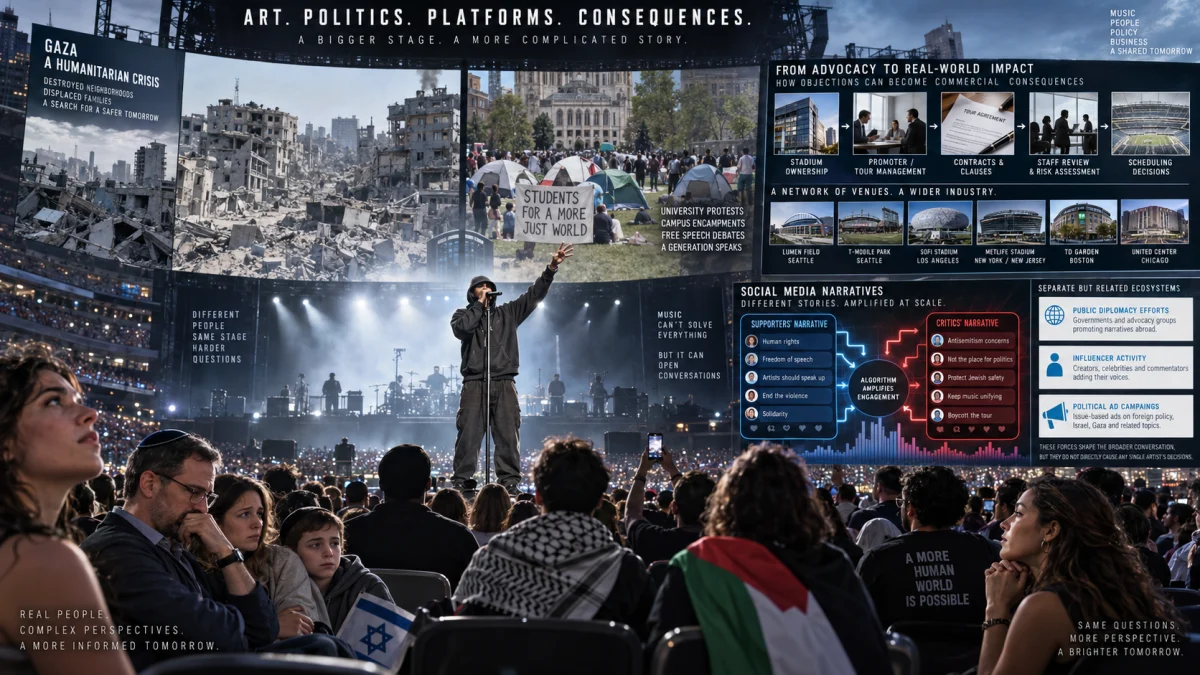
At Ed Sheeran’s September 4 and 5 shows at MetLife Stadium, Macklemore called for a “Free Palestine,” expressed solidarity with people in Gaza and the occupied West Bank, praised Columbia University protesters, invoked the terms “apartheid” and “genocide,” and performed his pro-Palestinian song “Hind’s Hall” while images connected to Gaza and the student protest movement appeared on stage.
He also directly addressed Jewish listeners.
The Boston Globe’s transcript of Macklemore’s MetLife remarks records him saying that criticism of Israel, apartheid and what he considers genocide was “in no way” criticism of Jewish people, before saying his message was that all people should receive dignity, respect and equality.
That does not automatically settle whether everything in his performance, his imagery, his song or his longer public record can reasonably be criticized as antisemitic. It does establish something important, however: the speech itself was not an explicit attack on Jews. It contained no anti-Jewish slur, threat against Jews, collective blame of Jews for Israel’s conduct, or allegation that Jews secretly control political or cultural institutions.
The backlash is instead the product of several overlapping disputes: what “Free Palestine” means; when anti-Israel or anti-Zionist speech crosses into antisemitism; how Jewish audiences experienced the presentation; what happened during the Columbia protests Macklemore celebrated; his own earlier controversies; the power of organized pro-Israel advocacy and stadium owners; and an online information environment that disproportionately rewards emotionally maximal interpretations.
Those things can interact. They are not interchangeable.
What Macklemore actually said at MetLife
The starting point should be the speech itself, because much of the controversy now comes to people secondhand.
At the first MetLife show, Macklemore said one reason he wanted to join Sheeran’s stadium tour was to use those stages to say “Free Palestine.” He specifically mentioned Gaza and the occupied West Bank. He then introduced “Hind’s Hall” by praising the Columbia students whose encampment protest spread to other campuses.
At the second show, he went further. He thanked Columbia University Apartheid Divest, Students for Justice in Palestine and Jewish Voice for Peace. He then addressed Jewish listeners and explicitly separated them from his criticism of Israel. He closed with calls for freedom in Palestine, Lebanon, Cuba, Congo and Sudan and described U.S. Immigration and Customs Enforcement as a “terrorist organization.”
During the performances, he also displayed images associated with destruction in Gaza and the protest movement. That visual presentation became important to some critics independently of his literal words.
That produces the first distinction most simplified accounts miss:
There was a political message, and there was a presentation of that message.
A person can believe “Free Palestine” is legitimate political speech while finding graphic war imagery at a family-oriented stadium concert upsetting. Conversely, someone can dislike Macklemore’s message without that objection establishing that his message was antisemitic.
Those are separate claims requiring separate evidence.
Some critics objected to Macklemore’s message. Others objected to how he delivered it
Pink is particularly useful because her actual position became more nuanced than the viral argument surrounding her.
After initially amplifying criticism of Macklemore, Pink clarified that her objection was not to the phrase “Free Palestine,” and she said she was not asking for Macklemore to be fired or silenced. She described the presentation as frightening to her and people she loved and said she wanted to be able to express that reaction as a Jewish mother without being told her fear was merely propaganda.
That should be taken seriously for what it is: a description of how someone experienced the performance.
It is not the same proposition as saying Macklemore expressed hatred toward Jews.
Other critics went considerably further.
Elan Carr, CEO of the Israeli-American Council, which organized a petition for Macklemore’s removal, told BBC Radio 4 that Macklemore had slandered Israel and Jewish people. Carr characterized the genocide accusation as a “blood libel” connected to Jews and said “Free Palestine” itself amounted to a call for the extermination of Israel and the Jewish people.
That is Carr’s interpretation. It is not a universally accepted definition of either the phrase or antisemitism.
And this disagreement is central to understanding why the controversy became so combustible.
Is saying “Free Palestine” antisemitic?
There is no single universally accepted rule that makes the phrase “Free Palestine” antisemitic on its face.
The International Holocaust Remembrance Alliance’s working definition of antisemitism, frequently used by governments and institutions, says that targeting Israel when it is conceived as a Jewish collective can be antisemitic. Its examples also include collective accusations against Jews and certain forms of delegitimization or discriminatory treatment of Israel.
But the IHRA document simultaneously says that criticism of Israel comparable to criticism directed at other countries cannot itself be regarded as antisemitic, and it stresses that context matters.
The competing Jerusalem Declaration on Antisemitism draws the boundary more explicitly. It identifies holding Jews collectively responsible for Israel, treating Jews as agents of Israel or relying on traditional Jewish conspiracy stereotypes as antisemitic. At the same time, it says support for Palestinian political and human rights, opposition to Zionism as a form of nationalism, advocacy for different constitutional arrangements between the Jordan River and Mediterranean Sea, and evidence-based criticism of Israeli policy are not, on their face, antisemitic.
The two frameworks are not identical, and their application to Israel-related speech remains heavily disputed.
But neither supports the simplistic rule that criticism of Israel = antisemitism.
Nor does the phrase “Free Palestine,” standing alone, specify what political system its speaker wants. It can be used by people advocating two states, one democratic state, equal civil rights under other arrangements, Palestinian sovereignty, or—sometimes—eliminationist politics. Its meaning therefore has to be evaluated in context rather than assumed from the two words alone.
Macklemore’s immediate context matters. He referred to Palestinians in Gaza and the West Bank, explicitly separated Jews from his criticism of Israel, and invoked peace, dignity and equality. That is relevant evidence when assessing what he was communicating.
It is not a license to ignore other material if other material crosses a line. It simply means the conclusion has to come from evidence rather than from the slogan by itself.
Why the Columbia reference bothered some Jewish listeners
Macklemore’s praise of Columbia protesters carries baggage that the short concert speech did not explain.
The 2024 Columbia protest movement was not simply a peaceful protest in which nothing antisemitic happened. Nor was it simply an antisemitic mob.
Columbia’s own Task Force on Antisemitism report collected testimony from nearly 500 students. Jewish and Israeli students described verbal abuse, ostracism, antisemitic stereotypes and, in some cases, physical violence. The task force concluded that serious failures had occurred in the university’s treatment of Jewish and Israeli students.
That history gives Jewish listeners a factual reason to hear unqualified praise of the Columbia movement differently from someone whose primary memory is students protesting Palestinian civilian suffering and demanding university divestment.
But Columbia’s own later data also complicate the picture.
A university-commissioned NORC study involving more than 9,000 respondents found that Jewish and Muslim students reported unusually poor belonging during the 2023–24 academic year. Only 34% of Jewish students and 41% of Muslim students reported positive feelings of belonging. Sixty-two percent of Jewish students and 53% of Muslim students said they did not feel accepted because of their religious identity. Large majorities of both groups were worried about expressing their beliefs.
So two realities existed simultaneously: Jewish students experienced documented antisemitism and fear, while Muslim students also experienced serious exclusion and anxiety in the same environment.
There is another important distinction. Macklemore praised the encampment movement broadly and thanked organizations including Jewish Voice for Peace. His song “Hind’s Hall,” meanwhile, is named for Hamilton Hall, which a group of protesters occupied and symbolically renamed for Palestinian child Hind Rajab. The encampment and the later building occupation were related but not identical events.
Praising a protest movement does not logically mean endorsing every statement, participant or incident associated with that movement.
Conversely, the presence of Jewish activists inside that movement does not prove antisemitism was absent.
Both shortcuts fail.
“Hind’s Hall” is part of the controversy, not just the speech
Macklemore’s politics did not suddenly appear at MetLife.
He released “Hind’s Hall” in May 2024 in support of university protesters and Palestinian rights. The song criticizes U.S. political support for Israel, describes Israeli rule using the language of apartheid, rejects the proposition that anti-Zionism is inherently antisemitic and invokes Jewish participation in pro-Palestinian protests. Macklemore also pledged the song’s streaming proceeds to UNRWA.
He had already condemned Hamas’s October 7 attacks while also describing Israel’s subsequent campaign in Gaza as genocidal.
That broader record matters because Robert Kraft and other critics have not confined their objections to two words uttered at MetLife. Kraft specifically referred to Macklemore’s “recent actions,” the material displayed onstage and what Kraft described as a broader history of antisemitic rhetoric and imagery.
The harder question, then, is what parts of that “history” actually support the label.
Macklemore does have a real 2014 antisemitic-caricature controversy
The strongest concrete antisemitism-related episode in Macklemore’s older record occurred in 2014.
He appeared at a Seattle performance wearing a dark wig and beard and an oversized prosthetic nose. The costume was widely interpreted as resembling a stereotypical Jewish caricature. Macklemore denied intending to portray a Jewish person but acknowledged how the costume could be interpreted and apologized.
The historical response matters too.
Then-ADL director Abraham Foxman said the organization accepted Macklemore’s statement that he had not intended a hateful Jewish caricature and “unreservedly” accepted his apology.
That does not erase why the imagery offended people. It does prevent us from rewriting the 2014 episode as though Macklemore had admitted deliberately dressing as an antisemitic Jewish stereotype.
Both parts belong in the record.
The “Fuck America” episode is evidence of provocative politics, not antisemitism by itself
A second episode routinely pulled into the present controversy happened in 2024, when Macklemore said “Fuck America” during a pro-Palestinian benefit concert in Seattle.
Days later, Las Vegas’s Neon City Festival announced that he would no longer headline, citing “unforeseen circumstances.” Macklemore subsequently described the remark as a “slip up” while reaffirming his support for Palestinians.
That incident is relevant to a claim that Macklemore has a history of unusually confrontational political speech and has previously suffered professional consequences for it.
It is not, by itself, evidence of antisemitism.
This illustrates one reason the present controversy is confusing. Several episodes are now routinely stacked together—an offensive costume, anti-Israel political speech, “Hind’s Hall,” Columbia, a vulgar anti-America remark and the MetLife visuals—until the cumulative list sounds like proof of a single underlying allegation.
But the evidentiary value of each item is different.
Jewish Americans themselves are sharply divided over Israel
One of the biggest mistakes in coverage is talking about a “Jewish reaction” as though nearly eight million Jewish Americans process Israel in the same way.
They do not.
A major AP-NORC survey of Jewish Americans published in July 2026 found striking differences by religiosity. Forty percent of religiously affiliated Jewish adults said they were very or extremely emotionally attached to Israel, compared with 11% of secular Jewish adults. Forty-eight percent of religious Jews said supporting Israel was a key component of Jewish identity, compared with 12% of secular Jews.
Views of the war were similarly divided. Fifty-two percent of religiously affiliated Jewish respondents considered Israel’s Gaza operation justified, compared with 21% of secular Jews. And 37% of Jewish adults under 45 told AP-NORC that Israel had committed genocide in Gaza, compared with 23% of those 45 and older.
That last finding is particularly relevant here.
Calling Israel’s conduct in Gaza “genocide” is clearly regarded by some Jewish people and organizations as deeply offensive or even antisemitic. But the word itself cannot function as a reliable proxy for anti-Jewish animus when a substantial minority of Jewish Americans—including more than a third of those under 45 in this survey—use the same characterization.
Context, reasoning and surrounding language still matter.
The family pressure and social pressure are real enough to measure
There is also evidence for something that is difficult to see from outside Jewish families and communities: disagreement about Israel increasingly has interpersonal consequences.
In the AP-NORC survey, roughly four in ten Jewish Americans reported either unfollowing or blocking someone or disagreeing with family members over Israel-related issues. Fifty-five percent had been offended by comments about Israel, and roughly three in ten said they had stopped speaking to someone because of disagreements surrounding Israel.
At the same time, a separate AP-NORC survey found only 34% of Jewish adults saying they currently felt safe as a Jewish person in the United States, while about two in ten reported verbal or online harassment related to being Jewish during the previous year.
These findings help explain something that otherwise appears contradictory.
A Jewish American can strongly disagree with the Israeli government, feel morally disturbed by events in Gaza, and still experience anti-Israel discourse through a background of genuine concern about antisemitism. Another may want to criticize Israel publicly but know that doing so will cause arguments with parents, relatives, synagogue acquaintances or longtime friends. Someone else may feel pressure in precisely the opposite direction.
The data support the existence of these relationship costs.
They do not establish that every Jewish critic of Israel is secretly afraid to speak, nor that older Jewish Americans simply “do not know the history.” The more defensible conclusion is that Israel occupies very different places in different Jewish identities, and those differences are partly generational, partly religious and partly personal.
That distinction matters because there is no single “Jewish position” for an algorithm, advocacy group, artist or journalist to represent.
How disagreement with Macklemore became an actual employment consequence
The next part is less abstract.
Organized opposition did not merely create negative headlines. It ultimately acquired enough leverage to affect a multimillion-dollar stadium tour.
The Israeli-American Council launched a petition calling for Macklemore to be removed. Robert Kraft, owner of Gillette Stadium and founder of an organization focused on combating antisemitism, then said he would not allow Macklemore to perform at Gillette, citing the MetLife performance and Macklemore’s broader record.
Messina Touring Group, the promoter for the U.S. leg of Sheeran’s tour, subsequently provided a remarkably direct explanation: venues on upcoming dates had informed the promoter that concerts could not proceed with Macklemore on the lineup, creating the possibility of tour cancellations affecting hundreds of thousands of fans. Macklemore was then removed.
The evidence has since become stronger.
The Wall Street Journal’s September 16 reconstruction of the dispute reports that Kraft held a roughly 40-minute telephone conversation with Sheeran and made clear that Gillette Stadium would not host Macklemore. According to people familiar with the discussions, Carolina Panthers owner David Tepper and Atlanta Falcons owner Arthur Blank had also reached the same conclusion, while Philadelphia Eagles owner Jeffrey Lurie subsequently did so as NFL owners communicated about the situation.
That reporting goes materially beyond Macklemore’s initial allegation that Kraft had rallied other owners.
Ed Sheeran has maintained that the ultimate decision was not his. He said Macklemore’s contract was with the promoter, that venues had threatened to pull shows, and that he spent the week attempting to mediate among Macklemore, Kraft, other stakeholders and activists before being told that the promoter and venues’ decision was final.
All four remaining supporting acts subsequently withdrew from the tour in solidarity with Macklemore.
For the detailed contract-and-venue mechanics, see our separate investigation into who actually had the power to remove Macklemore from Ed Sheeran’s tour.
The important conclusion here is narrower:
There is no need to posit a secret or ethnic power structure to explain the professional consequence. The documented actors have names, organizations, commercial relationships and contractual leverage.
The Israeli-American Council applied public pressure. Kraft exercised control over his venue. Other owners reportedly reached similar positions. Venues communicated consequences to the promoter. The promoter faced the prospect of losing tour dates and removed the supporting artist.
That is a real exercise of institutional power.
Calling it “Jews silencing Macklemore” would transform identifiable decisions by particular people and organizations into a collective accusation against an ethnic and religious group. That is both factually inaccurate and precisely the kind of reasoning that can drift into genuine antisemitism.
But organized pro-Israel persuasion is also real
Avoiding conspiracy language does not require pretending that sophisticated efforts to influence American opinion about Israel do not exist.
They are extensively documented.
The Israeli Embassy in Washington’s own public-diplomacy page says its Jewish Community Coordinator works with affiliated and unaffiliated Jewish communities and describes the coordinator’s primary objective as fostering greater cohesion within the Jewish community toward Israel and integrating Israeli perspectives and engagement.
The same embassy says its Digital Diplomacy and Social Media Office conducts campaigns promoting Israel’s interests and values to American audiences, while using digital analytics and addressing antisemitism, misinformation and anti-Israel sentiment.
That is not speculation. It is the Israeli government’s description of its own work.
There are also much larger paid communications programs disclosed through the U.S. Justice Department’s Foreign Agents Registration Act system.
A 2025 FARA-filed statement of work between Havas Media Germany and Clock Tower LLC describes a State of Israel-backed nationwide U.S. communications campaign. The document called for audience segmentation including Gen Z, influence and network mapping, message testing, at least 100 original creative assets and 5,000 variants per month, with at least 80% of content tailored to Gen Z audiences across platforms including TikTok, Instagram and YouTube. It set a target of at least 50 million paid impressions per month.
The same filing contains an unusually explicit search-and-AI component. It describes SEO work intended to improve the visibility of “relevant narratives” and the deployment of websites and content intended to produce “GPT framing results on GPT conversations.”
That language establishes the campaign’s stated objective. It does not establish that it succeeded in changing any particular AI system’s answers, nor does it imply cooperation by an AI company.
A separate FARA filing for Bridges Partners records an Israeli Ministry of Foreign Affairs-related influencer campaign through Havas Media Germany called the “Esther Project.” The paperwork describes payments for influencer production, onboarding additional influencers and recurring batches of social content.
FARA registration is a transparency requirement. These filings are evidence of disclosed foreign-principal communications work, not evidence that the registrants committed a crime.
And foreign-government public diplomacy should not be conflated with domestic American lobbying.
For example, an investigation of Meta’s political-ad library by The Markup estimated that advertisers spent roughly $14.8 million to $22.1 million on political ads mentioning Israel during the year after October 7, 2023, generating an estimated 1.5 billion to 1.7 billion impressions. AIPAC was among the major spenders and told The Markup its campaign was aimed at mobilizing “pro-Israel Americans.”
AIPAC is an American advocacy organization. The Israeli Embassy is a foreign government mission. The FARA-registered contractors were working for a foreign principal. Those categories should not be collapsed into one entity merely because their messaging can overlap.
Did these influence campaigns create the Macklemore backlash?
We found no evidence that they did.
That boundary is important enough to state plainly.
The existence of a large pro-Israel communications apparatus does not prove that a particular controversy was manufactured by that apparatus.
We have found no evidence that Clock Tower, Bridges Partners, the Israeli government or AIPAC bought an anti-Macklemore campaign that triggered his removal. We also have not found evidence establishing that Jewish Americans were specifically targeted, on the basis of being Jewish, with paid advertisements designed to make them hostile toward Macklemore.
What we can establish is the broader environment in which the controversy occurred.
An American Jewish social-media user might encounter official Israeli outreach, communications from Jewish communal organizations, domestic pro-Israel advocacy, paid political advertising, influencer content, news coverage, posts from friends and relatives, counter-messaging from Palestinian-rights advocates, and algorithmically recommended reactions to all of the above.
But we cannot reconstruct an individual person’s feed merely from that person’s Jewish identity.
That is where a serious investigation has to stop rather than filling the evidentiary gap with intuition.
The social-media algorithm does not need to “choose Israel” to distort the argument
There is another mechanism that requires no secret coordination whatsoever.
Engagement-based social-media systems have incentives to surface content that people click, react to and share. Research increasingly shows that emotionally intense and divisive political content performs unusually well under those conditions.
A 2025 preregistered algorithmic audit published in PNAS Nexus examined engagement-based ranking and found evidence that such ranking can amplify divisive political content beyond what users themselves report preferring. The research specifically examined emotionality, partisanship and out-group hostility.
A separate Nature Human Behaviour study on moral outrage online found that observers systematically perceived social-media authors as more outraged than the authors themselves reported being. The effect was stronger among people who relied more heavily on social media for political information. Experiments found that this overperception inflated beliefs about intergroup hostility and ideological extremity.
Another large randomized study found that adding negative words to online news headlines increased click-through rates, illustrating the basic attention advantage of negativity.
None of these studies examined Macklemore specifically.
Their value is explanatory.
A post saying “Macklemore attacked Jews” is emotionally cleaner and more combustible than a post explaining that he attacked Israeli policy, explicitly separated Jewish people from Israel, used disputed legal labels, praised a protest movement containing documented antisemitic incidents, and presented imagery some Jewish viewers found frightening.
The opposite distortion works just as well.
“A secret Jewish establishment silenced Macklemore” is more combustible than explaining that identifiable pro-Israel organizations and particular billionaire venue owners exerted documented pressure while millions of Jewish Americans hold sharply different views about Israel.
Algorithms do not need to decide which of those narratives is morally correct.
They merely need to discover that absolutism, outrage and perceived threat reliably command attention.
The result can be a feed in which each group disproportionately encounters the most hostile version of what the other group believes.
“Genocide” is a charged accusation, but using the word does not by itself establish antisemitism
One recurring argument is that Macklemore’s use of the word “genocide” transformed political criticism into an anti-Jewish blood libel.
That is one interpretation. It is not the only evidentiary fact relevant to the term.
The genocide allegation against Israel is the subject of an active case at the International Court of Justice brought by South Africa. As of September 2026, the court has not issued a final merits judgment finding that Israel committed genocide. In May 2026, the court established additional written-pleading deadlines extending into 2027 and 2029.
Israel categorically rejects the genocide accusation, arguing that it is conducting a war against Hamas rather than the Palestinian population and denies possessing the specific intent required for genocide.
At the same time, Macklemore did not invent the characterization.
In July 2025, the Israeli human-rights organizations B’Tselem and Physicians for Human Rights Israel separately concluded that Israel’s conduct in Gaza constituted genocide. Other international experts and institutions have made related findings, while Israel and other critics reject their analyses.
The legally accurate description is therefore:
Genocide is a serious and contested legal characterization of Israeli conduct. It is not currently a final ICJ merits judgment.
Whether a particular person’s use of the term is antisemitic requires additional evidence about what the person is saying about Jews. The word alone cannot answer that question—especially when, as AP-NORC found, 37% of Jewish Americans under 45 themselves told pollsters that Israel had committed genocide in Gaza.
The same problem applies to “apartheid”
“Apartheid” is also not merely a word invented by online activists.
In 2021, Human Rights Watch published a detailed legal analysis concluding that Israeli authorities were committing the crimes against humanity of apartheid and persecution in the circumstances it examined. HRW carefully distinguished that legal assessment from simply labeling Israel an “apartheid state,” a phrase that has no defined status in international criminal law.
Other organizations and scholars have disputed such findings and their application to Israel.
The point for the Macklemore controversy is not to resolve the entire apartheid debate inside a story about a concert.
It is to recognize that saying “apartheid” is a substantive political and legal claim about state policy. It does not automatically reveal what the speaker believes about Jewish people.
The Jerusalem Declaration explicitly states that comparing Israel with apartheid or pointing to systematic racial discrimination is not, by itself, antisemitic.
A person can still deploy Israel-related criticism in an antisemitic way—by blaming Jews collectively, invoking Jewish conspiracy stereotypes or targeting Jews because they are Jews.
Those additional elements have to be demonstrated.
This controversy keeps collapsing four different questions into one
The easiest way to understand why people are talking past each other is to separate questions that social media continually fuses together.
First: Is criticism of Israeli government conduct legitimate political speech? Yes, criticism of a government is not automatically hatred of an ethnic or religious group. Even the IHRA definition expressly preserves ordinary criticism of Israel.
Second: Can anti-Israel or pro-Palestinian activism become antisemitic? Yes. Columbia’s own record supplies concrete examples of Jewish students encountering stereotypes, abuse and exclusion during a period of intense Israel-Palestine activism. Political purpose does not immunize prejudice.
Third: Does every Jewish person’s discomfort prove that the underlying speech was antisemitic? No. An individual’s fear or offense is real as an experience, but classification of a statement still requires examining the statement, its context and its effects.
Fourth: Can powerful organizations or individuals exert pressure to punish criticism of Israel without that becoming evidence of a Jewish conspiracy? Yes. In this case, the pressure is unusually well documented. It came from identifiable advocacy organizations, specific stadium owners and commercial decision-makers—not from “the Jews.”
All four propositions can be true at once.
What the evidence actually supports
Verified
Macklemore used Ed Sheeran’s MetLife concerts to deliver explicitly pro-Palestinian political remarks. He praised Columbia protesters, used the terms “apartheid” and “genocide,” performed “Hind’s Hall,” and displayed imagery connected to Gaza and protests. He also explicitly told Jewish listeners that his criticism of Israel was not criticism of them.
The Israeli-American Council publicly sought his removal. Robert Kraft refused to host him at Gillette Stadium. Messina Touring Group said multiple venues would not host shows with Macklemore on the lineup. The Wall Street Journal subsequently reported that several NFL owners had communicated and reached similar positions.
There are also documented Israeli-government public-diplomacy programs, Jewish-community outreach efforts, FARA-registered U.S. communications contracts, influencer activity and substantial pro-Israel political advertising.
Disputed
Whether Macklemore’s recent Israel-related speech constitutes antisemitism is disputed.
Whether “Free Palestine” inherently calls for Israel’s destruction is disputed.
Whether Israeli conduct legally constitutes genocide remains before the ICJ and has not been finally adjudicated there; human-rights groups and experts have reached differing conclusions, and Israel rejects the allegation.
The characterization of Israeli policy as apartheid likewise has substantial documentation behind it but remains politically and legally contested.
Reasonable inference
The venue owners’ opposition created direct economic pressure on the promoter, because the promoter explicitly said keeping Macklemore could cause tour dates to be cancelled.
Jewish Americans who already feel unsafe or who closely associate Israel with family and Jewish identity may experience highly accusatory anti-Israel rhetoric differently from Jewish Americans whose identity is less connected to the Israeli state. Current polling strongly supports the underlying differences, although it cannot tell us how any individual listener felt.
Engagement-driven social systems likely make absolutist interpretations of the controversy more visible than nuanced ones. That inference is consistent with experimental and audit research, but no study has audited the actual Macklemore feeds.
Not established by the evidence we reviewed
There is no evidence that Jewish Americans collectively organized Macklemore’s removal.
There is no evidence that a hidden Jewish network controlled the tour.
There is no evidence that the Israeli government, its FARA-registered communications contractors or AIPAC engineered this particular controversy.
There is no evidence we found of a paid anti-Macklemore advertising campaign specifically targeting Jewish Americans.
And while the Wall Street Journal now reports communication among several NFL owners, that should not be expanded beyond what the reporting establishes into an unsupported claim that every venue participated in a single centralized conspiracy.
So why are people mad at Macklemore?
Because different people believe very different things happened on that stage.
Some saw a famous musician using an enormous platform to talk about Palestinian suffering and human rights.
Some Jewish listeners saw Gaza war imagery, praise for a campus movement associated with real episodes of antisemitism and accusations against Israel that they regard as defamatory and threatening.
Some pro-Israel organizations regard Macklemore’s underlying political message itself as crossing the line into antisemitism.
Other Jewish Americans—including Jewish critics of Israel and Jewish participants in the Palestinian-rights movement—reject that equation and see accusations of antisemitism being extended too far into legitimate political criticism.
Venue owners then converted one side of that argument into an economic fact: Macklemore could remain on the bill, or some stadium dates could continue, but not both. The promoter chose the tour.
Then the internet did what it reliably does with complicated disputes.
One story became “Macklemore attacked Jews.”
Another became “Jews silenced Macklemore.”
Neither adequately describes the evidence.
The stronger account is less convenient but more useful: Macklemore delivered a forceful pro-Palestinian and anti-Israeli-government political message; some Jewish listeners experienced parts of it as threatening or offensive; organized pro-Israel actors interpreted the message as antisemitic and exercised real institutional leverage; many other people, including Jewish Americans, reject that interpretation; and engagement-driven media systems magnified the most confrontational versions of the dispute.
There is real antisemitism in American life, including within some ostensibly pro-Palestinian spaces. There is also real political pressure aimed at constraining criticism of Israel. Acknowledging one does not logically require denying the other.
That may ultimately be the most important lesson of the Macklemore controversy.
The line should not be drawn according to which side is offended.
It should be drawn by examining what was actually said, whom it targeted, what evidence supports the underlying claims, who exercised power afterward, and which conclusions the record can—and cannot—support.
References and Further Reading
Macklemore’s Remarks and the Tour Dispute
“Read What Rapper Macklemore Said on Stage That Led to His Removal From Ed Sheeran Tour” — The Boston Globe. The clearest published transcript of Macklemore’s MetLife remarks, including his comments about Palestine, Columbia protesters, Jewish listeners and his broader political message.
“Macklemore Dropped From Ed Sheeran Tour After Onstage ‘Free Palestine’ Statements” — Rolling Stone Canada. Contains Messina Touring Group’s direct statement that multiple venues would not permit concerts to proceed with Macklemore on the lineup.
“The 40-Minute Phone Call That Left Ed Sheeran’s Tour Hanging by a Thread” — The Wall Street Journal. September 16 reporting identifying Robert Kraft and additional NFL owners involved in the objections and describing communications among them.
“Ed Sheeran Responds to Backlash Over Removing Macklemore From Tour” — The Guardian. Documents Sheeran’s explanation that venues and the promoter made the final decision and that he attempted to broker a resolution.
Antisemitism, Israel and Palestinian Political Speech
IHRA Working Definition of Antisemitism — International Holocaust Remembrance Alliance. One of the most widely adopted institutional frameworks for identifying antisemitism, including Israel-related examples and its explicit statement that ordinary criticism of Israel is not inherently antisemitic.
Jerusalem Declaration on Antisemitism. An alternative framework developed by scholars of antisemitism and related fields, with detailed guidance distinguishing anti-Jewish collective blame from criticism of Israel, Zionism and state policy.
Columbia University
Columbia University Task Force on Antisemitism, Report No. 2. Documents testimony from hundreds of Jewish and Israeli students concerning harassment, ostracism, stereotypes and some physical incidents surrounding the 2023–24 campus crisis.
Columbia Student Belonging and Exclusion Survey — Task Force Report No. 3. NORC-administered survey showing unusually low belonging and high fear among both Jewish and Muslim students during the 2023–24 academic year.
Jewish-American Attitudes
“Among American Jews, Views on Jewish Identity and Israel Vary by Religiosity” — AP-NORC. June 2026 probability-based survey of 1,022 Jewish American respondents documenting major divisions by religiosity and age, as well as interpersonal conflict surrounding Israel.
AP-NORC Religion Research: Jewish Americans and Antisemitism. Provides additional context on Jewish Americans’ concerns about personal safety and antisemitic harassment.
Public Diplomacy, Advertising and Influence
Israeli Embassy in Washington — Public Diplomacy Department. The embassy’s own description of Jewish-community outreach and digital campaigns promoting Israeli interests and responding to anti-Israel sentiment.
Clock Tower LLC / Havas Media Germany FARA Statement of Work. Justice Department filing describing a State of Israel-backed U.S. campaign involving Gen-Z content, paid impressions, SEO, audience mapping and an explicit objective involving “GPT framing.”
Bridges Partners / Havas Media Germany FARA Filing — “Esther Project”. Primary FARA documentation of an Israeli Ministry of Foreign Affairs-related influencer campaign with payments for influencer production and recurring content.
“How Meta Brings in Millions Off Political Violence” — The Markup. Data-driven analysis of Israel-related political advertising on Facebook and Instagram after October 7, including spending by AIPAC and other political advertisers.
Algorithms and Online Outrage
“Engagement, User Satisfaction, and the Amplification of Divisive Content on Social Media” — PNAS Nexus. A preregistered audit examining how engagement-based ranking can amplify divisive political content beyond users’ stated preferences.
“Overperception of Moral Outrage in Online Social Networks Inflates Beliefs About Intergroup Hostility” — Nature Human Behaviour. Experimental and field evidence that people systematically overestimate others’ online outrage, contributing to exaggerated perceptions of group hostility and ideological extremity.
Gaza Legal Characterizations
International Court of Justice May 2026 Procedural Order in South Africa v. Israel. Confirms that the genocide case remains in litigation and establishes future written-pleading deadlines rather than issuing a final merits determination.
B’Tselem and Physicians for Human Rights Israel: Genocide Findings. Documents the July 2025 conclusions by two Israeli human-rights organizations that Israeli conduct in Gaza constitutes genocide.
Israel Ministry of Foreign Affairs: The ICJ and the Crime of Genocide. Israel’s official argument rejecting the genocide allegation and disputing the required showing of genocidal intent. This is an interested-party source included to document Israel’s position, not as neutral adjudication.
“A Threshold Crossed: Israeli Authorities and the Crimes of Apartheid and Persecution” — Human Rights Watch. Detailed legal analysis underlying HRW’s conclusion that specified Israeli policies and practices constitute the crimes against humanity of apartheid and persecution.
Historical Macklemore Context
“Anti-Defamation League Accepts Macklemore’s Word Over Costume” — The Guardian, 2014. Contemporary account of Macklemore’s stereotypical-costume controversy, his apology and the ADL’s response accepting his statement that he did not intend an antisemitic caricature.
“Macklemore Dropped From Music Festival After ‘F— America’ Comment” — Pitchfork and Macklemore’s subsequent clarification. Useful for distinguishing his history of provocative political speech and professional consequences from evidence specifically concerning antisemitism.
Editorial currency note: The Macklemore–Sheeran dispute is developing rapidly. Statements from venues, artists and tour organizers may change the factual record. The ICJ genocide case also remains pending, and polling data describe particular survey periods rather than permanent characteristics of Jewish-American opinion.