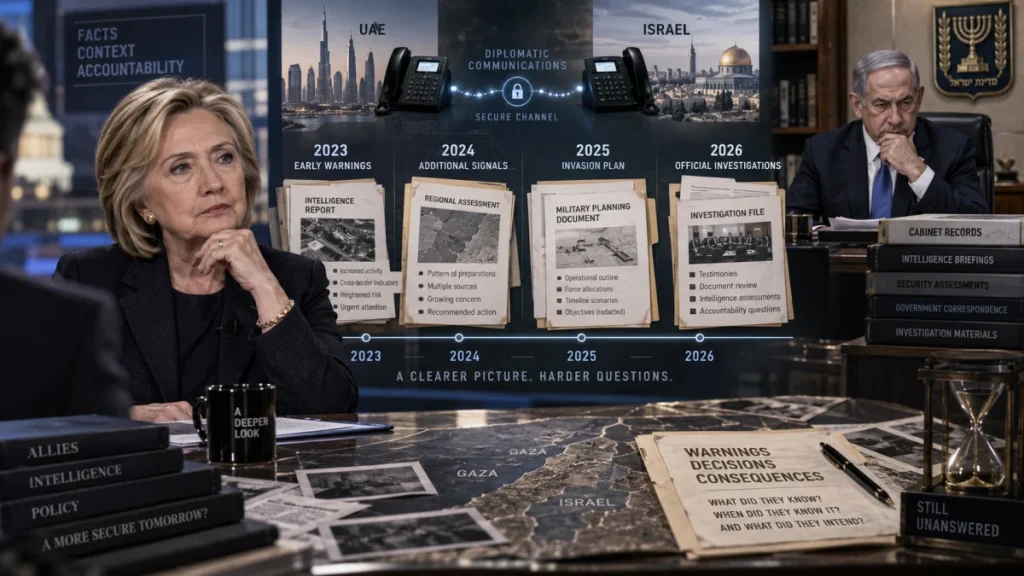
Yes — but the most accurate version of the story is more specific, and more consequential, than the viral shorthand.
Israel’s Ministry of Foreign Affairs commissioned research from the American marketing conglomerate Stagwell to determine which messages could improve attitudes toward Israel in the United States and Europe during the Gaza war. According to the leaked research, one of its clearest conclusions was that “the notion of radical Jihadism was universally effective.” Another successful message portrayed “Free Palestine” not as a liberation slogan but as a slogan associated with terrorism. (Research Live)
This was not simply a poll asking whether people liked Israel.
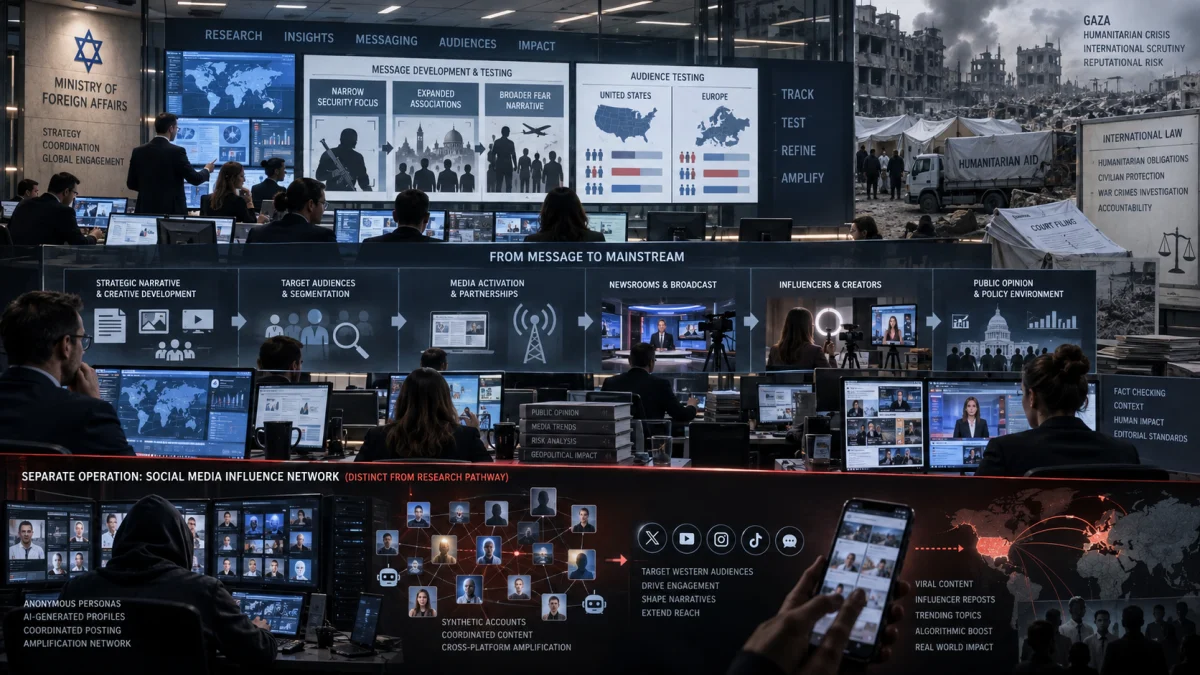
The research included message testing designed to determine what could change people’s opinions. Separately, a Stagwell contract filed with the U.S. Justice Department described work for Israel’s Foreign Ministry intended to “strategically shap[e] global narratives”, place selected civil-society spokespeople in major media, cultivate influencers, react rapidly to breaking news and develop a social-media program that would “flood the zone” with Israel’s message.
Stagwell and its subsidiary SKDK later said the proposed bot program was not actually carried out and that SKDK’s implemented work was limited to media relations. That distinction matters. But it does not erase what the underlying contract proposed or what the separate Stagwell research discovered about using fear of “radical Islam” as a persuasion strategy. (Politico)
There is also an important piece missing from most accounts of the Stagwell controversy.
Before that research became public, investigators had already uncovered a separate Israel-linked influence operation using fake personas and explicitly anti-Muslim content to influence audiences in North America. Meta and OpenAI attributed that network to an Israeli political marketing company called STOIC. Reporting subsequently linked STOIC’s work to Israel’s Ministry of Diaspora Affairs, although the ministry denied involvement. (OpenAI)
Taken together, the evidence does not establish that Stagwell invented an anti-Muslim propaganda campaign or secretly ordered Israel to “make people hate Muslims.”
It does establish something narrower but difficult to dismiss: fear of Islamism and jihadism was being treated as a measurable political asset — something capable of moving Western audiences toward Israel — while Israel was facing extraordinary international scrutiny over its conduct in Gaza.
That deserves considerably more scrutiny than calling the Stagwell work ordinary “reputation research.”
What exactly is Stagwell?
Stagwell is a large international marketing and communications company whose businesses span advertising, public relations, political consulting, data, research and digital campaigning.
Its network includes SKDK, a major Democratic public-affairs firm, as well as firms that have worked on Republican political campaigns. Stagwell is led by longtime political strategist and pollster Mark Penn.
The Israeli project came through another advertising conglomerate, Havas.
According to advertising-industry reporting, Israel’s Government Advertising Agency, commonly called LAPAM, worked with Havas, which in turn subcontracted Stagwell for research on behalf of Israel’s Ministry of Foreign Affairs. (The Drum)
That distinction is worth understanding because several different Stagwell-related projects have become mixed together online.
There were at least two relevant tracks:
- Stagwell’s Israel Messaging Research, which tested what arguments could improve perceptions of Israel.
- A separate Stagwell/SKDK public-relations contract, whose written scope contemplated media placements, spokespeople, influencers, rapid-response messaging and a bot-based social-media program.
The projects are related through the same broader Israel-Havas-Stagwell relationship, but they should not be presented as if they were one document.
The leaked research was about persuasion, not merely understanding public opinion
The strongest defense of Stagwell’s work is that companies and governments conduct opinion research constantly.
That is true but incomplete.
According to the market-research publication Research Live, the project began with qualitative focus groups in the United States, United Kingdom, Germany and France and proceeded to quantitative message testing, including Spain. A later phase involved “animatic testing” — showing people different versions of messages and measuring how well they changed perceptions. (Research Live)
The Drum reported that more than 13,000 people were surveyed and that recommendations included emotional storytelling, terrorism-focused messaging and connecting Islamic radicalism to the Israeli-Palestinian conflict. (The Drum)
That moves the project beyond descriptive polling.
The question was no longer merely:
What do Europeans and Americans think about Israel?
It became:
Which message makes them think differently?
And one of the answers was unusually clear.
“The notion of radical Jihadism was universally effective”
The leaked presentation’s section on recommended messages included this finding:
“the notion of radical Jihadism was universally effective”
Research Live independently reported the wording after reviewing the controversy surrounding the leaked deck. It also reported another recommendation: a message characterizing “Free Palestine” as “a slogan of terror, not freedom” performed particularly well among American conservatives. (Research Live)
This matters because “radical jihadism” was not simply being discussed as an objective security subject.
It was being tested as a persuasive frame.
The Israeli-Palestinian conflict could be presented to a Western audience primarily through questions such as civilian casualties, occupation, humanitarian access, settlements or compliance with international law.
Or it could be reframed around a different question:
Is radical Islam also coming for you?
The latter changes the psychological position of the audience. Israel is no longer merely a foreign government whose conduct the audience is evaluating. Israel becomes part of the audience’s own perceived struggle against an external threat.
That distinction is fundamental to understanding why the research caused such controversy.
The DOJ filing is even more revealing about the broader communications strategy
A public Foreign Agents Registration Act filing with the U.S. Department of Justice provides a much clearer picture of what Stagwell’s broader work for Israel was supposed to accomplish.
The April 2025 schedule identifies Stagwell Global LLC as the service provider for Havas on behalf of LAPAM and Israel’s Ministry of Foreign Affairs.
Its stated objective was not neutral public-opinion analysis.
The document says Stagwell would provide public-relations support intended to ensure the presence and credibility of civil-society spokespeople in international media while:
“strategically shaping global narratives, and influencing public perception in alignment with the foreign policy goals and values of Israel’s Ministry of Foreign Affairs”
The language is unusually explicit.
Recruit “civil society” voices
The contract called for recruiting three to five spokespeople representing various “civil society voices.”
Those people would receive media training for television appearances and difficult interviews.
The significance is not that using spokespeople is inherently improper. Governments and advocacy organizations do it constantly.
The important detail is that a foreign government’s communications contractor was tasked with helping select and prepare people who would appear publicly as civil-society voices, while their communications infrastructure was being developed as part of a strategy aligned with that government’s foreign-policy objectives.
That relationship is highly relevant context for audiences evaluating how apparently independent voices reach major news programs.
Target BBC, CNN, Fox and AP
The contract called for approaching journalists, editors and producers and specifically mentioned outlets including BBC, CNN, Fox and the Associated Press.
Stagwell was to create opportunities for its selected spokespeople to respond to emerging stories so that their appearances would:
“amplify the narrative in alignment with Israel’s foreign policy goals.”
It also contemplated monitoring news coverage so spokespeople equipped with tailored messaging could be inserted into breaking-news cycles.
Again, this is substantially more than measuring Israel’s reputation.
It is an attempt to influence the information environment in which audiences form that reputation.
Test and cultivate influencers
The agreement also instructed the service provider to test whether influencers were effective and, where appropriate, develop ongoing relationships with them to ensure effective messaging.
That matters because contemporary state communications no longer operate primarily through press conferences and newspaper advertisements. Influencer networks can blur the distinction between government messaging, advocacy, entertainment and seemingly organic political opinion.
“Flood the zone”
The most controversial provision is blunt.
The contract proposed that Stagwell develop a bot-based program across platforms including Instagram, TikTok, LinkedIn and YouTube that would:
“flood the zone”
with the Foreign Ministry’s pro-Israel message.
The agreement listed a total agency fee of $600,000, billed at $50,000 per month from April 2025 through March 2026.
However, this is where precision becomes especially important.
A contract describing proposed work does not prove every part of that work was performed.
SKDK and Stagwell subsequently said they did not operate the bot initiative. SKDK said its actual work concerned media relations, and the firm terminated its Israeli-government engagement early. (Politico)
Therefore, it would be wrong to report that Stagwell definitely deployed the bots.
It is entirely accurate to report that Stagwell signed a scope of work that explicitly proposed them.
Those are not the same claim.
The anti-Muslim influence campaign that predates the Stagwell leak
This is where the larger story becomes considerably harder to dismiss as an unfortunate choice of terminology in one marketing presentation.
In March 2024, the Atlantic Council’s Digital Forensic Research Lab identified a coordinated network operating across Facebook, Instagram and X that was promoting a supposed Canadian organization called United Citizens for Canada.
The DFRLab investigation into the network documented at least:
- 50 Facebook accounts;
- 18 Instagram accounts; and
- more than 100 X accounts.
The accounts used apparently AI-generated faces, repeated or nearly identical comments, suspicious creation patterns and other markers of coordinated inauthentic behavior. (DFRLab)
And the messaging was not merely anti-Hamas.
DFRLab described it explicitly as anti-Muslim and Islamophobic.
The campaign warned Canadians that Muslim immigration and “Islamic movements” threatened their society. One piece of content used a manipulated photograph to suggest people were demanding “Shariah for Canada.” The original photograph actually showed a banner referring to the United Kingdom. (DFRLab)
That is qualitatively different from legitimate criticism of Hamas, ISIS or jihadist organizations.
It involved deceptive accounts amplifying misleading content to portray Muslims and Islamic political influence as a domestic threat to another country.
OpenAI traced the network to an Israeli political marketing firm
OpenAI independently identified activity from the same broader operation and called it “Zero Zeno.”
According to OpenAI’s investigation of the influence operation, the accounts were operated from Israel by STOIC, an Israeli political campaign management company.
The operation used AI to generate articles, comments and fake personas distributed across Instagram, Facebook, X and websites. Its campaigns included pro-Israel and anti-Hamas material, criticism of UNRWA and a Canada-focused operation attacking what the posts characterized as “radical Islamists.” (OpenAI)
OpenAI also found that fake accounts sometimes interacted with material produced by the same network, apparently manufacturing the appearance of organic public engagement.
There is an important counterpoint: OpenAI assessed the operation’s actual impact as relatively small. It found little evidence that the network achieved major authentic engagement. (OpenAI)
That means the operation was real; it does not mean it was particularly successful.
Was the Israeli government behind STOIC?
Here the evidence is strong but not uncontested.
After Meta and OpenAI attributed the operation to STOIC, reporting by The New York Times, Haaretz and the Israeli watchdog FakeReporter connected it to Israel’s Ministry of Diaspora Affairs.
The New York Times reported, as summarized by the Times of Israel’s account of the investigation, that the ministry allocated approximately $2 million and hired STOIC to carry out an influence campaign.
DFRLab subsequently summarized the evidence similarly, reporting that Meta connected the network to STOIC and that subsequent reporting found the company had received roughly $2 million from the Israeli ministry. (DFRLab)
The Israeli ministry denied involvement, so it would be improper to describe state sponsorship as an uncontested fact.
But it would be equally misleading to describe the government link as an unsupported internet allegation. Multiple investigations traced the operation to an Israeli company, while reporting based on documents and government sources connected its financing to an Israeli ministry. (DFRLab)
Stagwell and STOIC are not the same operation
This distinction is essential.
There is no evidence reviewed for this article showing that:
- Stagwell operated STOIC’s fake accounts;
- Stagwell designed the 2024 Canadian Islamophobia campaign;
- STOIC used Stagwell’s research;
- or Stagwell’s leaked recommendations caused the earlier operation.
Chronology alone makes the last proposition impossible: the STOIC campaign was already operating in early 2024.
These are separate operations involving different companies.
What makes the comparison important is the strategic overlap.
The earlier covert campaign used fabricated Western identities and anti-Muslim fear.
The later Stagwell research independently concluded that messaging around “radical Jihadism” was “universally effective” at moving audiences.
That does not establish coordination.
It establishes that the same emotional lever appearing in a documented Israel-linked covert influence operation was subsequently identified through professional message testing as particularly useful to Israel’s international communications.
That is a much stronger observation than simply accusing one advertising company of Islamophobia.
Is “anti-Muslim propaganda” a fair description of the Stagwell strategy?
For the Stagwell research alone, that description needs qualification.
The leaked deck used terms such as “radical Islam” and “Jihadism.” Those are not synonymous with Muslims generally, and opposition to violent jihadist movements is not inherently anti-Muslim.
If that were the only evidence, saying Stagwell literally instructed Israel to promote hatred of Muslims would go beyond the documents.
But communications cannot be evaluated only by whether a strategist typed the word “Muslims” into a slide.
The relevant question is how the frame works in practice.
A persuasion campaign can begin with a legitimate extremist threat and then expand its associations — immigration, Muslim communities, pro-Palestinian activism, “Free Palestine,” universities, Western cultural survival — until audiences are encouraged to perceive a much broader population or political movement through the lens of terrorism.
And in the separate STOIC case, investigators documented exactly that kind of expansion: content about supposed Islamic takeover, immigration and fabricated demands for Sharia law targeted ordinary Western audiences. (DFRLab)
So the evidence supports two different statements:
Verified: Stagwell found fear-oriented messaging about “radical Islam” and jihadism highly effective for improving attitudes toward Israel.
Verified in a separate campaign: An Israel-linked influence network spread explicitly anti-Muslim and Islamophobic content through fake identities.
What remains unproven is that Stagwell directed the second operation or specifically instructed Israel to promote hatred against Muslims as a religious group.
That distinction should not be used to minimize the evidence. It should be used to describe it accurately.
The rhetoric later appeared at the highest levels of Israeli politics
There is another reason the Stagwell research is worth revisiting rather than treating it as an isolated advertising scandal.
By 2026, senior Israeli officials were publicly presenting Israel’s conflicts as part of a wider Western struggle against radical Islam.
An analysis by Poland’s state-funded Centre for Eastern Studies documented Prime Minister Benjamin Netanyahu portraying Israel as a barrier protecting Europe from radical Islam, while Diaspora Affairs Minister Amichai Chikli described radical Islam as the leading threat to Western societies and warned of Europe becoming vulnerable to a “takeover from within.” (OSW Ośrodek Studiów Wschodnich)
The institute observed that this rhetoric overlaps substantially with anti-immigration and anti-Muslim political movements in Europe.
That does not prove Stagwell wrote those speeches or caused the shift. No evidence reviewed here establishes that causal chain.
But the correspondence is noteworthy: the public political frame closely resembles the frame that the government’s commissioned message research found effective.
In other words, the research did not identify an obscure advertising gimmick. It identified a narrative that fits comfortably into a larger political strategy: Israel as the forward line of defense for Western civilization against radical Islam.
Was this designed to distract from Gaza?
This is the part of the viral claim that requires the most careful language.
There is no Stagwell document reviewed here that says:
Distract people from Israeli atrocities by making them afraid of Muslims.
So presenting that as a quotation or proven instruction would be false.
But the strategic function of the messaging is visible without such a sentence existing.
Stagwell was retained while Israel’s conduct in Gaza was producing an extraordinary international reputational crisis. The research was explicitly designed to discover which arguments could improve perceptions of Israel. (Adweek)
At the same time, Israel faced escalating legal scrutiny.
The International Criminal Court’s arrest warrants for Benjamin Netanyahu and Yoav Gallant found reasonable grounds to believe they bore criminal responsibility for alleged crimes including starvation as a method of warfare and the crimes against humanity of murder, persecution and other inhumane acts. These are allegations at the warrant stage, not convictions. (International Criminal Court)
The International Court of Justice’s provisional-measures proceedings ordered Israel to take measures to prevent acts covered by the Genocide Convention and facilitate humanitarian assistance. The ICJ has not issued a final merits judgment finding Israel responsible for genocide, an important distinction that is often lost online. (International Court of Justice)
Separately, the UN Independent International Commission of Inquiry concluded in September 2025 that Israeli authorities and security forces had committed genocide in Gaza; in 2026 it reiterated that conclusion and reported additional alleged war crimes in the West Bank. That commission is an investigative body, not the ICJ, and Israel categorically rejects its genocide finding. (United Nations)
Against that background, changing the central question from:
“What has Israel done in Gaza?”
to:
“What does radical Islam threaten to do to us?”
is plainly a form of strategic reframing.
It moves the audience’s attention away from evaluating Israeli conduct on its own terms and toward identifying with Israel against a perceived common enemy.
Whether one chooses to call that a “red herring” is an interpretation.
That it can function as a diversionary frame is a reasonable inference from how the message is constructed and what the research was explicitly trying to accomplish.
Gaza is the strongest documented connection — not every Israeli military theater
There is a temptation to extend this finding automatically to Gaza, the West Bank, Lebanon and every other controversy involving Israel.
The evidence does not justify that shortcut.
The documentation reviewed here most clearly connects the Stagwell project to Israel’s international reputation during the Gaza war.
There is extensive independent evidence of alleged and documented violations involving the West Bank, and the UN Commission of Inquiry reported in June 2026 that Israeli forces and settlers were responsible for severe violations there while also documenting crimes by Palestinian armed groups. (United Nations)
But we have not found evidence showing that Stagwell was specifically commissioned to distract audiences from Israeli conduct in the West Bank or Lebanon.
A rigorous investigation should not turn a strong Gaza connection into a broader claim for which the paper trail has not been established.
Why this story is more serious than “Israel hired a PR company”
Governments employ public-relations firms. They conduct polling. They advocate their positions abroad.
None of that, by itself, is especially remarkable.
What makes this case different is the combination of evidence.
The record shows:
- Israel’s government commissioned research into how to change Western attitudes toward Israel.
- The research found messaging about “radical Jihadism” especially effective.
- Another successful message reframed “Free Palestine” as associated with terrorism.
- A Stagwell contract separately contemplated shaping global news narratives in accordance with Israeli foreign-policy objectives.
- It called for recruiting and training “civil society” spokespeople.
- It contemplated relationships with influencers.
- It proposed inserting tailored messaging into breaking-news cycles.
- It proposed a bot-based program to “flood the zone,” although Stagwell and SKDK say that component was never carried out.
- A separate Israel-linked operation had already used fake Western personas to promote explicitly Islamophobic narratives.
- Investigative reporting connected that operation’s contractor to Israeli government funding, which the relevant ministry denied.
- Senior Israeli officials later publicly employed a broader “Israel defending the West from radical Islam” narrative closely resembling the strategic frame identified as effective in the research.
No single item proves a centrally orchestrated campaign to make Westerners hate Muslims.
Together, however, they make it difficult to treat the exploitation of anti-Muslim or anti-Islamist fear as an accidental side effect of Israel’s communications strategy.
The defensible conclusion is that fear of “radical Islam” was deliberately identified and tested as a persuasion tool for increasing Western sympathy toward Israel, while separate Israel-linked influence activity demonstrably crossed the line into explicitly Islamophobic messaging.
That conclusion requires neither conspiracy theory nor softened euphemisms. It follows from the documents themselves.
What the evidence does — and does not — establish
Strongly established: Stagwell conducted persuasion-oriented research for Israel’s government and found “radical Jihadism” framing especially effective.
Strongly established: Stagwell Global signed a contract whose proposed scope included shaping international narratives, preparing civil-society spokespeople, influencer work, rapid-response messaging and a bot-based “flood the zone” program.
Important qualification: Stagwell and SKDK say they did not actually carry out the bot portion of that scope.
Strongly established: A separate coordinated influence operation spread anti-Muslim and Islamophobic content using deceptive accounts, and Meta and OpenAI traced the operation to the Israeli firm STOIC.
Reported with substantial corroboration but officially denied: Israeli government funding for STOIC’s operation.
Reasonable inference: Framing Israel as Western civilization’s defense against radical Islam can divert attention from scrutiny of Israeli conduct by replacing a conduct-based question with a common-enemy narrative.
Not established: That Stagwell created the STOIC operation, that Stagwell explicitly instructed Israel to promote hatred of Muslims generally, or that every subsequent “radical Islam” statement by an Israeli official came from Stagwell’s research.
That is where the evidence currently lands.
And in this case, the documented version is already serious enough that there is no reason to exaggerate it.
References and Further Reading
Stagwell Research and U.S. Government Records
U.S. Department of Justice FARA filing: Stagwell/SKDK agreement involving Israel’s Ministry of Foreign Affairs — The underlying filing contains the scope covering civil-society spokespeople, media outreach, influencers, rapid response, narrative shaping, the proposed “flood the zone” program and the $600,000 fee.
Research Live: “Stagwell criticised for Israel-Palestine research” — Independent market-research trade reporting describing the project’s methodology and the leaked recommendation that “the notion of radical Jihadism was universally effective.”
The Drum: “Havas subcontracted Stagwell Group to conduct research for Israeli government” — Establishes the Havas-LAPAM-Stagwell relationship and distinguishes the research brief from related Stagwell work.
ADWEEK: Stagwell’s Israel research and messaging work — Additional industry reporting on the leaked project and Stagwell’s response.
The Separate Anti-Muslim Influence Operation
DFRLab: “Inauthentic campaign amplifying Islamophobic content targeting Canadians” — Detailed forensic investigation of the fake-account network, manipulated content and anti-Muslim messaging.
OpenAI: Operation “Zero Zeno” — Independent attribution of the influence activity to the Israeli political campaign company STOIC and documentation of its use of AI-generated content and personas.
DFRLab follow-up on pro-Israel sockpuppet networks — Places the STOIC operation within a wider pattern of inauthentic pro-Israel social-media activity and summarizes subsequent attribution reporting.
Times of Israel: Report on Israeli Diaspora Ministry funding of STOIC campaign — Summarizes reporting that approximately $2 million was allocated to the operation; the ministry denied involvement.
International Legal Context
International Criminal Court: Netanyahu and Gallant arrest warrants — Primary ICC record explaining the alleged war crimes and crimes against humanity underlying the warrants.
International Court of Justice: South Africa v. Israel provisional measures — Primary source for what the ICJ actually ordered and useful for avoiding the common false claim that the Court had already issued a final genocide judgment.
UN Commission of Inquiry: Legal analysis and genocide finding concerning Gaza — The Commission’s September 2025 findings, distinct from the still-separate ICJ merits case.
Israel Ministry of Foreign Affairs response rejecting genocide allegations — Israel’s stated position disputing the Commission’s findings.
Broader Political Context
Centre for Eastern Studies: Israel’s growing alliance with the European right — Documents the later “radical Islam” and Western-civilizational framing used by senior Israeli officials and its overlap with European anti-immigration politics.
Editorial currency note: Foreign-agent registrations, contracts, international court proceedings and investigations into influence operations can be amended or supplemented. This article reflects records and reporting available through September 16, 2026.