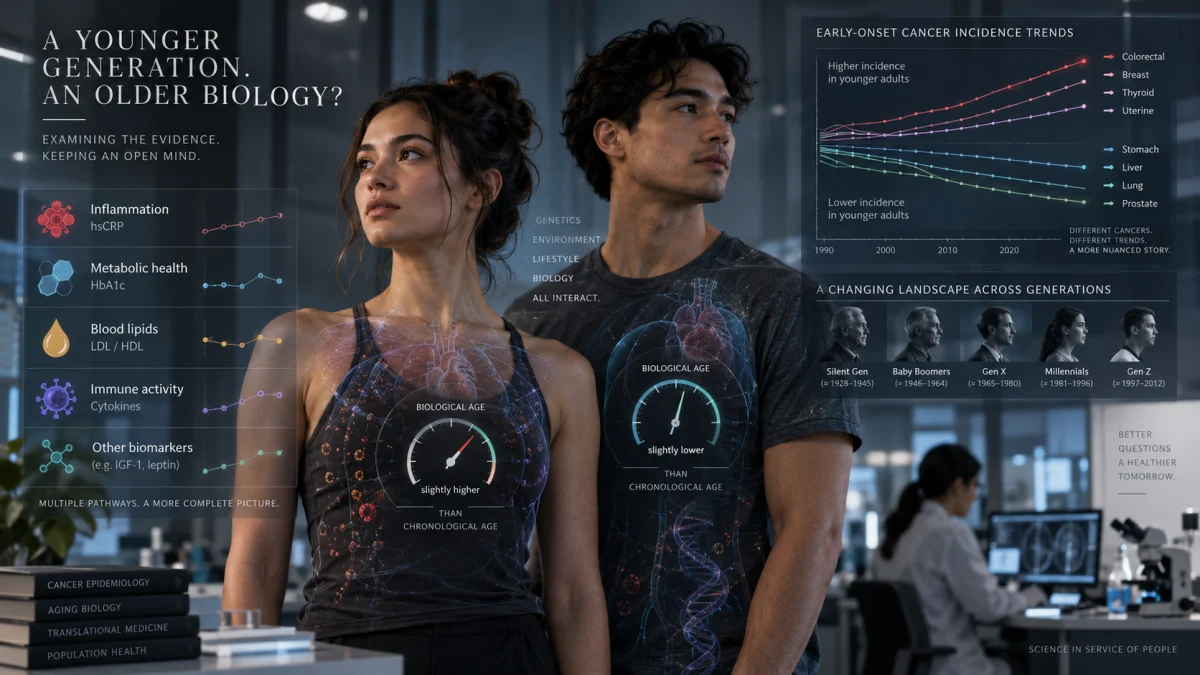
A major 2026 study found credible evidence that people from more recent birth cohorts have older-looking biological profiles at the same chronological age. It also found that people whose biological-age scores looked more advanced had a modestly higher risk of developing certain cancers before age 55.
But the study did not show that Millennials or Gen Z are literally aging 92% faster. It did not show that they have 92% more cancer. And it did not establish accelerated biological aging as the reason some cancers are becoming more common in younger adults.
Those distinctions matter because the strongest version of the viral claim does not survive a close reading of the data.
The peer-reviewed Nature Medicine study, published June 22, 2026, found that later birth cohorts scored higher on a biological-aging measure called PhenoAge. In the primary UK analysis, each one-standard-deviation increase in the PhenoAge “age gap” was associated with an 8% higher relative hazard of early-onset solid cancer. Yet when the results are separated by cancer type and compared with actual U.S. incidence trends, a much more complicated picture appears. (Nature)
Breast cancer provides the clearest example. It has been one of the largest contributors to the increase in cancers diagnosed among younger Americans, but PhenoAge showed essentially no association with early-onset breast cancer in the study. Lung cancer showed the opposite pattern: it had the strongest and most reproducible biological-age association, even though lung-cancer incidence among Americans under 50 declined in a major National Cancer Institute analysis. (Nature)
That does not make the study wrong.
It tells us that three questions being blended together in headlines are actually different:
Are younger generations showing different biological profiles? The evidence says yes.
Does an older biological-age profile predict cancer risk in an individual? To some extent, yes.
Does accelerated biological aging explain why cancer rates are changing across generations? That has not been demonstrated.
What the Nature Medicine study actually found
Researchers led by Washington University School of Medicine analyzed 154,169 UK Biobank participants under 55 for the birth-cohort portion of the study. The prospective UK cancer analysis included 148,317 participants followed for a combined 953,582 person-years, during which 2,984 early-onset solid cancers were identified. (Nature)
The researchers then partially validated their findings using the U.S. National Institutes of Health’s All of Us Research Program.
Among the UK participants, people born from 1965 through 1974 had a standardized PhenoAge age gap about 0.23 standard deviations higher than participants born from 1950 through 1954 after accounting for chronological age.
The U.S. result was much larger. Among 10,262 All of Us participants used for the birth-cohort analysis, people born from 1990 through 1999 had an age-gap score about 0.92 standard deviations higher than people born from 1965 through 1969. (Nature)
That 0.92-standard-deviation result is the source of one of the most easily misunderstood numbers in the story.
No, the study did not find that Gen Z is “aging 92% faster”
The paper describes the 1990–1999 group’s standardized PhenoAge-defined age gap as 92% higher than the 1965–1969 reference group.
That does not mean their biological aging rate was 92% faster.
The researchers took a biological-age estimate, statistically removed the portion associated with chronological age, and standardized the remaining “age gap.” A difference of 0.92 means that the later cohort was shifted approximately 0.92 standard deviations toward the biologically older end of that particular score.
It does not mean someone ages 1.92 years for every calendar year. It does not mean a 30-year-old is physiologically 57.6 years old. And it does not mean cancer risk is 92% higher.
This distinction is especially important because the study did not repeatedly measure entire generations over decades to calculate their actual rate of aging through time. The authors themselves state that repeated longitudinal measurements will be needed to quantify within-person aging trajectories. (Nature)
The stronger conclusion supported by the study is therefore:
Later birth cohorts had systematically less favorable biological-age profiles at comparable chronological ages.
That is still an important finding. It is simply narrower than “Gen Z is aging 92% faster.”
What is PhenoAge actually measuring?
PhenoAge is not a microscope that can inspect a body and reveal its one true biological age.
It is a statistical model.
The version used in this study combines chronological age with nine common blood measurements: albumin, alkaline phosphatase, creatinine, C-reactive protein, glucose, mean cell volume, red-cell distribution width, white-blood-cell count and lymphocyte proportion.
The original algorithm selected those markers because, together with age, they predicted all-cause mortality. It then converts the resulting mortality-risk profile into the chronological age of a reference person with approximately the same predicted risk. (Nature)
So if PhenoAge estimates someone as “older” than their chronological age, the scientifically useful interpretation is that their blood chemistry resembles a physiological risk profile associated with an older reference population.
It does not establish that every organ, cell or molecular pathway in that person’s body has literally aged by the same number of years.
This is a recurring problem with biological-age headlines. As sherafy.com has previously found when examining claims that a vegan diet “reversed” biological aging and that insomnia treatment slowed biological aging, different aging clocks can move differently because they measure overlapping but non-identical biological signals.
A major Nature Medicine review of aging biomarkers similarly concluded that there is still no consensus on how such biomarkers should be validated before routine clinical translation. (Nature)
Does biological age predict early-onset cancer?
In this study, yes—but the overall association was modest.
Among the 148,317 UK participants in the prospective cancer analysis, each one-standard-deviation increase in PhenoAge age gap was associated with an 8% higher relative hazard of developing an early-onset solid cancer before 55:
HR 1.08, 95% CI 1.03–1.13.
People in the highest PhenoAge tertile had about a 15% higher relative hazard than those in the lowest tertile:
HR 1.15, 95% CI 1.03–1.28. (Nature)
Those findings remained after adjustment for factors including BMI, smoking and smoking intensity, alcohol, diet, physical activity, socioeconomic measures, diabetes, cardiovascular disease and chronic obstructive pulmonary disease. Additional analyses also accounted for telomere length and genetic predisposition to aging and selected cancers. (Nature)
But an 8% higher hazard is not an eight-percentage-point increase in the chance of getting cancer.
The study does not provide a validated calculation saying, for example, that a particular PhenoAge score changes an individual’s cancer probability from 2% to 10%. Relative hazard ratios and absolute personal risk are different quantities.
The U.S. cancer replication was much smaller than the headline sample size suggests
The All of Us analysis is important because it showed that the generational biological-age pattern extends into a more recent and more racially diverse U.S. population.
But the birth-cohort analysis and the cancer analysis should not be confused.
There were 10,262 All of Us participants in the biological-age birth-cohort analysis. The prospective cancer analysis contained 8,935 participants and only 104 incident early-onset solid cancers over 14,791 person-years.
Each standard-deviation increase in PhenoAge age gap was associated with a 22% higher cancer hazard:
HR 1.22, 95% CI 1.01–1.47, P=0.04. (Nature)
That provides useful independent support for the overall association.
It is not a large enough U.S. cancer sample to reproduce the detailed cancer-by-cancer findings with confidence. The paper appropriately describes the U.S. results as partial validation. (PubMed Central (PMC))
The strongest cancer evidence is not actually from Millennials or Gen Z
This is another detail that disappears in generational headlines.
The large UK cohort producing the study’s strongest prospective cancer estimates included birth cohorts only through 1974.
In other words, the well-powered cancer analysis primarily tells us about people from older generations and Generation X—not a giant cohort of Millennials and Gen Z followed until they developed cancer.
The All of Us analysis does extend the biological-age comparison through people born in the 1990s, which captures Millennials and, depending on where generational boundaries are drawn, the oldest members of Gen Z. But the accompanying U.S. prospective cancer analysis contained only 104 cancer cases. (Nature)
So the study supports saying that the biological-age cohort shift extends into younger generations.
It provides much weaker evidence for the stronger claim that accelerated aging in Millennials or Gen Z has already been shown to cause their cancers.
Different biological-age clocks did not fully agree
One of the strongest features of the study is that researchers did not rely exclusively on PhenoAge. They also tested the Klemera–Doubal Method, or KDM, and a metabolomic aging measure.
But those analyses make the overall story less uniform.
For all early-onset solid cancers combined, PhenoAge produced the statistically significant HR of 1.08 per standard deviation.
KDM produced:
HR 1.03, 95% CI 0.97–1.09.
The metabolomic age gap produced:
HR 1.04, 95% CI 0.99–1.08.
Neither of those overall associations was statistically significant. (Nature)
The different clocks did produce stronger agreement for selected cancers, especially lung cancer.
That makes the most accurate summary:
The broad cancer association was strongest with PhenoAge, while different biological-aging measures produced more consistent signals for certain individual cancers.
That is more precise than saying multiple aging clocks simply “confirmed” the same overall result.
Lung cancer produced the strongest biological-aging signal
Lung cancer stood out.
Each one-standard-deviation increase in biological age was associated with an early-onset lung-cancer hazard ratio of:
1.57 with PhenoAge
1.53 with KDM
1.89 with the metabolomic age measure. (Nature)
That degree of agreement across different aging measures makes the lung finding difficult to dismiss as an isolated quirk of PhenoAge.
Researchers also performed an exploratory proteomic analysis attempting to estimate aging in individual tissues and organ systems. Immune-system aging was associated with early-onset lung cancer at HR 1.89 per standard deviation.
But that analysis contained only 21 lung-cancer cases. It should therefore be regarded as a mechanistic clue requiring replication, not a clinically established lung-cancer biomarker.
There is also an epidemiological puzzle: lung cancer is not one of the cancers clearly driving the U.S. early-onset increase.
In the NCI’s comprehensive analysis of U.S. cancer trends from 2010 through 2019, lung-cancer incidence decreased among people under 50. (Cancer.gov)
That apparent contradiction is instructive rather than fatal to the study.
A biomarker can predict which individuals are more susceptible to a disease without explaining why the population incidence of that disease is rising or falling.
Those are different questions.
Breast cancer creates the opposite problem
Breast cancer is arguably the most important counterexample to a broad “biological aging explains young cancer” narrative.
The NCI estimated that female breast cancer accounted for approximately 4,800 additional early-onset diagnoses in 2019 compared with the number expected if 2010 incidence rates had remained unchanged. That was the largest absolute increase among the cancers analyzed. (Cancer.gov)
The American Cancer Society’s 2026 cancer statistics also report that breast-cancer incidence rose about 1.4% per year among women younger than 50 from 2013 through 2022, faster than the 0.7% annual increase among women 50 and older. (PubMed Central (PMC))
Yet the Nature Medicine analysis included 1,258 early-onset breast cancers and found virtually no relationship with PhenoAge:
HR 1.01, 95% CI 0.94–1.08. (Nature)
If one systemic accelerated-aging process were the main explanation for the broad increase in early-onset cancer, we would expect a clearer signal in one of the cancers contributing the greatest number of additional young-adult diagnoses.
We do not see one here.
That does not prove biological aging is irrelevant. It strongly suggests it is not a sufficient general explanation.
Colorectal cancer is where the hypothesis becomes more interesting
Colorectal cancer presents a more compelling overlap between real population trends and the biological-aging results.
The NCI estimated roughly 2,100 additional early-onset colorectal cancers in 2019 relative to 2010 incidence rates. (Cancer.gov)
More recent American Cancer Society colorectal cancer statistics for 2026 report that incidence among adults aged 20–49 increased about 3% annually from 2013 through 2022, even as incidence continued to fall among adults 65 and older. Colorectal cancer now ranks as the leading cause of cancer death among U.S. adults younger than 50. (American Cancer Society Journals)
The biological-aging findings were mixed but noteworthy.
PhenoAge produced an early-onset colorectal-cancer HR of 1.14 per standard deviation.
KDM produced a stronger HR of 1.49.
The metabolomic aging measure produced HR 1.09, with a confidence interval including no effect. (Nature)
The exploratory organ-aging analysis also associated biologically older adipose tissue with colorectal cancer at HR 1.60, although that analysis was based on only 37 colorectal cancers.
Taken together, the evidence is not uniform enough to say biological aging has been established as the cause of early-onset colorectal cancer.
It is strong enough to make aging-related metabolic and inflammatory physiology a serious research lead.
Uterine cancer shows another mixed signal
PhenoAge was associated with early-onset uterine cancer at:
HR 1.31, 95% CI 1.04–1.66.
The metabolomic clock also showed an association:
HR 1.44, 95% CI 1.12–1.85.
But KDM did not:
HR 1.13, 95% CI 0.81–1.57. (Nature)
Uterine cancer is also one of the cancers genuinely increasing among younger Americans. NCI estimated about 1,200 additional early-onset uterine cancers in 2019, and younger-age uterine-cancer mortality has also increased. (Cancer.gov)
The overlap is therefore biologically plausible, but again not sufficient to prove causation.
Multiple-comparison correction makes some of the headline findings less certain
Cancer-site analyses involve testing many hypotheses at once. That increases the chance that some apparently significant results arise by chance.
The researchers appropriately used a false-discovery-rate correction.
In the main PhenoAge analysis, the nominal associations for colorectal cancer and uterine cancer were:
Colorectal: P=0.04
Uterine: P=0.02.
After correcting for the multiple cancer-site comparisons, their FDR-adjusted values were approximately 0.09 and 0.08, respectively—above the study’s 0.05 threshold. The lung and overall gastrointestinal findings were more statistically robust. (Nature)
This does not mean the colorectal and uterine findings are false. The alternative-clock results provide additional evidence for both in different ways.
It means those individual PhenoAge associations should be described as suggestive rather than conclusively replicated site-specific findings.
What happens if “early-onset” means under 50 instead of under 55?
This distinction matters because much of the public discussion about young-adult cancer uses under 50, while the study’s primary analysis defined early-onset cancer as occurring before 55.
The researchers explain that they chose 55 partly because birth-cohort effects appear to extend into ages 50–54 and partly to preserve enough cancer cases for meaningful statistical analysis. (Nature)
They also ran a sensitivity analysis using an under-50 cutoff.
For all solid cancers combined, the association remained statistically significant:
954 cancers; HR 1.12, 95% CI 1.03–1.22; FDR-adjusted P=0.025.
But the individual cancer analyses became much less certain. There were only 24 lung cancers, 75 colorectal cancers and 23 uterine cancers. None of those individual site results survived the study’s multiple-comparison threshold.
So saying the under-50 analysis was “similar” is reasonable in terms of direction.
It was not equally convincing at the individual cancer level.
The generational difference is statistically real but does not define individuals
Another overlooked result helps put the cohort finding in perspective.
Birth cohort was very strongly statistically associated with PhenoAge age gap, but the statistical models reported R² values of only 0.003 in UK Biobank and 0.009 in All of Us.
Those numbers should not be interpreted as proving the cohort effect is meaningless. A small population shift can matter across millions of people even while individuals overlap enormously.
But they do mean that knowing someone’s generation tells you very little about that person’s specific PhenoAge score.
There will be biologically healthier people in later generations and biologically older-looking people in earlier generations.
“Gen Z is biologically old” is therefore not a defensible individual-level conclusion.
Early-onset cancer itself is not one single trend
The phrase “cancer is exploding in young people” can also hide important distinctions.
An NCI-led analysis examined 33 cancer types across the entire U.S. population and found that from 2010 through 2019, incidence increased in at least one under-50 age group for 14 cancer types.
But incidence decreased for 19 other cancers, including lung cancer.
Nine of the 14 cancers increasing in younger people also increased in at least one older age group. And the overall rate of all cancers combined did not increase among younger people during the study period. (Cancer.gov)
Four cancers accounted for more than 80% of the additional early-onset diagnoses calculated by NCI:
female breast, colorectal, kidney and uterine cancer. (Cancer.gov)
That matters because a proposed explanation for “early-onset cancer” should ultimately explain why specific cancers behave differently.
A mechanism that strongly predicts lung cancer but not breast cancer cannot, on its own, explain a population pattern dominated by rising breast, colorectal, kidney and uterine cancers.
So does biological aging cause cancer?
The study cannot answer that.
It is observational.
The investigators did a serious job of addressing obvious alternative explanations. Their models controlled for smoking, BMI, alcohol, diet, physical activity, socioeconomic factors and several chronic diseases. They excluded cancers occurring very shortly after baseline in an effort to limit reverse causation. They also tested genetic risk scores and telomere length. (Nature)
Those steps make the association harder to dismiss as a simple crude correlation.
They still do not establish causation.
At least three causal models fit the evidence.
One possibility is that accelerated biological aging itself creates conditions favorable to cancer—for example through chronic inflammation, impaired immunity, accumulated molecular damage or altered tissue environments.
A second possibility is that common upstream exposures cause both an older PhenoAge profile and higher cancer risk. Obesity, smoking, alcohol, metabolic dysfunction, environmental exposures, diet and other factors could alter blood biomarkers while separately affecting carcinogenesis.
A third—and perhaps the most biologically realistic—possibility is a mixture: upstream exposures alter physiological systems captured by biological-age measures, and some of those physiological changes then become part of the causal pathway to cancer.
The study cannot cleanly distinguish those models.
Independent experts reached essentially the same conclusion. In comments collected by the Science Media Centre, cancer immunometabolism researcher John Riches emphasized that the study did not establish direct causation. Jyoti Nangalia of the Wellcome Sanger Institute similarly noted that biological-age measurements may be capturing combined genetic, lifestyle and environmental exposures, leaving open whether the measured changes drive cancer or share underlying causes with it. (Science Media Centre)
Biological age may be more useful as an integrated risk marker than as “the cause”
This may ultimately be the most useful way to interpret the study.
PhenoAge contains information about inflammation, glucose metabolism, kidney function, blood-cell characteristics and other physiological systems.
Those are exactly the sorts of biological consequences through which decades of diet, smoking, obesity, infections, pollutants, stressors and metabolic disease could become embedded in the body.
The Nature Medicine authors themselves describe age gap as a possible integrative measure of physiological dysregulation arising from established and emerging cancer risk factors. (Nature)
In other words, biological age may function partly like a dashboard warning light.
The warning light can predict that something is wrong without itself being the engine problem.
That interpretation also helps reconcile the apparently contradictory cancer findings. A PhenoAge score could identify a physiological state that raises an individual’s susceptibility to lung cancer, for example, while falling smoking prevalence simultaneously pushes population lung-cancer rates downward.
Likewise, breast cancer incidence could rise because of mechanisms poorly represented by PhenoAge.
Is obesity making younger generations age faster?
Possibly, but this study does not prove it.
People with higher biological-age scores in UK Biobank tended to have higher BMI and substantially higher smoking exposure, among other differences. The statistical models adjusted for those variables, which means the PhenoAge-cancer association was not simply the raw difference between smokers or heavier participants and everyone else. (Nature)
But statistical adjustment cannot reconstruct every person’s lifetime exposure history or eliminate all residual confounding.
The NCI says researchers are investigating obesity, alcohol, the microbiome, environmental exposures and other factors as contributors to some early-onset cancers, but strong epidemiological evidence is still lacking for many individual suspects. Researchers increasingly expect multiple interacting causes rather than one universal explanation. (Cancer.gov)
So “obesity is making Millennials age faster, which is giving them cancer” moves several steps beyond the available evidence.
Can you test your biological age?
Technically, yes. Clinically, the meaning is much less straightforward.
PhenoAge itself can be calculated from chronological age and common blood measurements. Other commercial biological-age tests use DNA methylation, proteins, metabolites, fitness measures or proprietary algorithms.
They should not be treated as interchangeable.
Different clocks were trained against different outcomes and, as this very study demonstrates, can produce different associations with the same disease.
A biological-age result can therefore be scientifically informative without being a validated medical diagnosis.
The broader aging-biomarker literature still lacks consensus on the requirements for clinical validation, particularly when a test is supposed to guide an individual treatment or prevention decision rather than simply predict outcomes in populations. (Nature)
Should a high biological-age score make you start cancer screening earlier?
This study provides no evidence that it should.
Researchers did not establish a PhenoAge cutoff at which screening should begin. They did not calculate the test’s sensitivity and specificity for detecting cancer. They did not show that adding PhenoAge to existing clinical risk models prevents deaths. And they did not run a trial showing that people screened according to biological age fare better.
Current cancer-screening guidance remains based on age and established risk factors.
For average-risk colorectal cancer, for example, the current U.S. recommendation is to begin screening at 45, with earlier or different evaluation appropriate for some people at increased risk. (USPSTF)
Symptoms are a separate issue from screening. A person with concerning symptoms should not wait for a routine screening age simply because they are young.
Nothing in the new Nature Medicine study changes that distinction.
Can biological aging be reversed?
A biological-age score can change.
Whether that means human aging has literally been “reversed” is a much harder question.
The Nature Medicine researchers had repeat blood measurements for 3,809 UK Biobank participants about 4.4 years apart. Only about 60% of people initially in the lowest or highest PhenoAge tertile remained in the same tertile at the later measurement. (Nature)
That tells us the score is not immutable.
But a change can reflect genuine physiological improvement or deterioration, ordinary biological variability, measurement noise, treatment, lifestyle change or combinations of those factors.
Most importantly for this article, the cancer study did not test whether deliberately lowering PhenoAge reduces future cancer incidence.
“Biological age can change” and “lowering your biological age prevents cancer” remain very different statements.
How reliable is the study?
This is a strong observational study, not proof of a causal mechanism.
Its major strengths include a very large prospective UK cohort, linkage to cancer registries, extensive adjustment for known risk factors, sensitivity analyses, several conceptually different aging measures, genetic analyses and partial validation in an independent U.S. cohort. The authors also made the UK Biobank analysis code publicly available. (Nature)
Its limitations are equally important.
The biological-age cohort comparison was not a decades-long longitudinal measurement of aging rates. The detailed cancer findings came primarily from UK Biobank, whose participants are not perfectly representative of the general population. A separate 2025 analysis found approximately 10% lower overall cancer incidence in UK Biobank than in the underlying population, consistent with healthy-volunteer selection. That problem is especially relevant when estimating absolute risks, although it does not automatically invalidate relative associations such as hazard ratios. (PubMed Central (PMC))
The alternative aging clocks did not all reproduce the overall cancer association. The U.S. cancer validation had only 104 events. The organ-specific analyses were exploratory and included only 21 lung cancers and 37 colorectal cancers. And changing the early-onset cutoff from 55 to 50 left the overall association intact but substantially weakened the individual cancer-site evidence. (Nature)
Those limitations narrow the conclusion.
They do not erase it.
Who funded the research?
The study was conducted as part of the PROSPECT team and received funding through Cancer Grand Challenges, Cancer Research UK, the U.S. National Cancer Institute, the French National Cancer Institute, the Bowelbabe Fund for Cancer Research UK, additional NIH programs and institutional support.
The paper states that the funders had no role in study design, data collection and analysis, the decision to publish or preparation of the manuscript. (Nature)
The authors also disclosed outside interests. Jason Buenrostro reported several advisory, consulting and company relationships. Yin Cao reported past consulting work for Need, Geneoscopy and Bayer outside this study and said she had no current consulting relationships. Other authors declared no competing interests. (Nature)
Nothing in those disclosures provides evidence that the cancer findings were commercially engineered or that a relevant conflict explains the results.
The more obvious incentive issue appears in how the research was communicated.
Why is a June study suddenly back in the news in September?
There was no new September dataset.
WashU published its original institutional story on June 22, the same day as the Nature Medicine paper. Its headline said younger generations were experiencing “faster aging” linked to early-onset cancer. (WashU Medicine)
On September 14, ScienceDaily published a new page built from WashU Medicine material. The page explicitly identifies WashU Medicine as the source and says the original story was written by WashU’s Julia Evangelou Strait. (ScienceDaily)
ScienceDaily’s article does correctly explain inside the story that the U.S. difference was 92% of one standard deviation, rather than a 92% literal aging rate.
But the renewed coverage is amplification of the June research, not independent September confirmation of the finding.
That distinction is useful whenever an older paper suddenly appears to have become “new” again because institutional publicity, aggregation or social media gives it a second life.
What does the evidence actually support?
The strongest conclusion is more interesting than either extreme.
There is credible evidence that later generations have shifted toward less favorable physiological profiles on established biological-aging measures.
There is also credible prospective evidence that a more advanced PhenoAge profile contains information about the risk of developing some cancers earlier in life.
The evidence is particularly intriguing for lung cancer and potentially for colorectal and uterine cancers.
But the total pattern argues against treating accelerated biological aging as a single demonstrated explanation for the broader rise in early-onset cancer.
The cancers do not line up that neatly.
Breast cancer is contributing large numbers of additional younger cases but showed virtually no PhenoAge association. Lung cancer produced the strongest biological-aging signal even though its incidence fell among younger Americans during the NCI trend period. Different aging clocks disagreed about the overall cancer association. And the strongest prospective cancer dataset did not consist primarily of Millennials and Gen Z.
The most defensible interpretation is therefore that biological-age measures may be capturing an accumulated physiological signature of many exposures and risk pathways.
Some of those processes may themselves help cause certain cancers. Others may simply travel alongside the real causes. The present study cannot fully separate the two.
That is not a disappointing result.
If researchers can eventually determine which modern exposures are producing those biological shifts, which components of the aging scores actually contribute to cancer, and whether changing those pathways reduces disease, biological-age research could become useful for prevention.
We are not there yet.
For now, the study gives scientists a potentially valuable new way to investigate why some cancers are appearing earlier.
It does not tell us that Gen Z is aging 92% faster.
And it does not solve the mystery of why cancer is changing among younger adults.
References and Further Reading
Original study and supplementary data
Tian et al. — “Biological aging and generational shifts in early-onset cancer risk” — Nature Medicine (2026) The primary peer-reviewed study. Contains the UK Biobank and All of Us cohort analyses, cancer hazard ratios, aging-clock comparisons, methods, funding and conflict disclosures.
Supplementary Tables 1–8 — Nature Medicine supporting information Contains the under-50 sensitivity analysis, birth-cohort model statistics, mediation analysis, KDM and metabolomic results, and the small organ-specific cancer analyses that materially qualify several headline claims.
Early-onset cancer trends
National Cancer Institute — “Incidence rates of some cancer types have risen in people under age 50” Authoritative U.S. population-level analysis showing that 14 cancer types increased in at least one younger age group while 19 declined. Provides the estimated excess case counts for breast, colorectal, kidney, uterine and pancreatic cancers.
National Cancer Institute — “As Rates of Some Cancers Increase in Younger People, Researchers Search for Answers” Useful NCI synthesis of the unresolved causal hypotheses behind early-onset cancer, including obesity, alcohol, environmental exposures, microbiome changes and birth-cohort effects.
Siegel et al. — “Cancer statistics, 2026” — CA: A Cancer Journal for Clinicians Current American Cancer Society national cancer statistics, including age-specific breast-cancer trends and the distribution of cancers diagnosed before age 50.
Siegel et al. — “Colorectal cancer statistics, 2026” — CA: A Cancer Journal for Clinicians Current detailed U.S. colorectal-cancer surveillance showing rapidly increasing incidence among adults under 50 and the growing mortality burden in younger adults.
Biological-age interpretation and independent assessment
Moqri et al. — “Validation of biomarkers of aging” — Nature Medicine Major review explaining the unresolved challenges involved in validating biological-aging biomarkers for clinical use.
Science Media Centre — Independent expert reaction to the biological-aging and cancer study Comments from cancer researchers not involved in the study, emphasizing both the significance of the findings and the unresolved question of whether biological aging is causal or reflects shared upstream exposures.
“Cancer incidence inconsistency between UK Biobank participants and the population” — BMC Medicine Independent analysis documenting lower cancer incidence among UK Biobank participants and explaining why healthy-volunteer selection is particularly relevant to absolute-risk estimates.
Clinical screening guidance
U.S. Preventive Services Task Force — Colorectal Cancer Screening Recommendation Current U.S. recommendation for average-risk colorectal screening beginning at age 45. The biological-aging study does not establish a reason to alter screening according to PhenoAge.
CDC — Screening for Colorectal Cancer Current patient-facing guidance distinguishing routine screening from evaluation of symptoms and noting circumstances in which risk may warrant different screening.
Media chronology
WashU Medicine — “Faster aging in younger generations linked to rise in early-onset cancer” The June 22 institutional release accompanying publication of the Nature Medicine paper. Useful for distinguishing the researchers’ findings from the stronger language used in institutional promotion.
ScienceDaily — “Cancer is rising in younger adults. Faster biological aging may help explain why” The September 14 second-wave story. ScienceDaily identifies WashU Medicine as the source and the WashU writer as the original author, making this renewed distribution rather than independent scientific replication.
Editorial currency note: Cancer-incidence statistics and screening recommendations were checked through September 15, 2026. Screening guidance and epidemiological estimates can change as new data become available.