The United States did help rescue the Japanese yen in 2026. But describing the intervention as American charity toward Japan gets the economics almost backward.
Washington had its own problem.
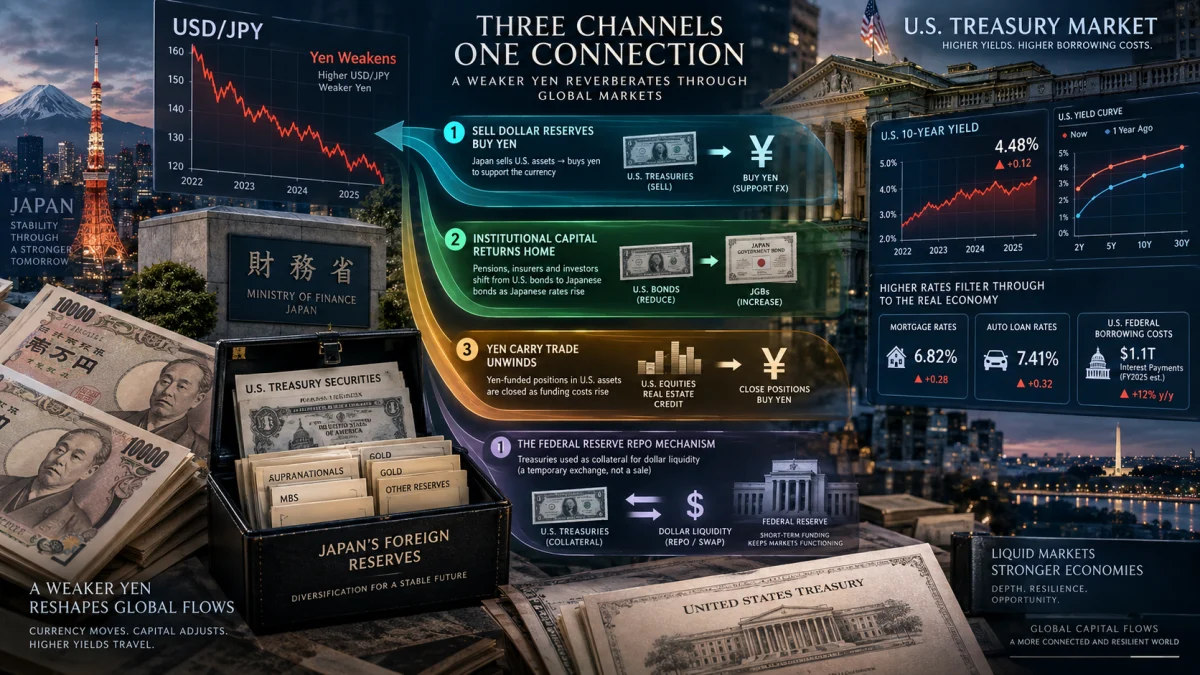
Japan sits at the center of the global financial system and is the largest country-level foreign holder of U.S. Treasury securities. A disorderly yen collapse could have forced Japanese authorities and investors to rearrange enormous dollar portfolios, including U.S. government bonds. Large Treasury sales or reduced Japanese demand could push Treasury prices down and yields up, feeding directly into American mortgage rates, corporate borrowing, federal interest costs and financial markets.
Treasury Secretary Scott Bessent eventually said essentially that himself: disorderly yen markets could produce “forced unwinds” that destabilize global markets and raise borrowing costs for Americans.[1]
So the most pragmatic explanation for the intervention is not:
America spent money to save Japan.
It is closer to:
America helped stabilize Japan because the methods Japan might otherwise have needed to stabilize itself could damage America.
That distinction explains much of what happened.
First, This Was Not a Conventional Bailout
“Bailout” is useful shorthand, but technically it is the wrong description.
On July 31, 2026, Japan’s Ministry of Finance purchased yen in coordination with the U.S. Treasury after the currency had fallen to historically weak levels. Japan said the operation was intended to counter “excessive volatility and disorderly movements” and was conducted under a U.S.-Japan foreign-exchange agreement reached in September 2025.[2][3]
The United States did not lend Japan emergency money.
Bessent later said Treasury exchanged foreign currencies already held by the U.S. Exchange Stabilization Fund for yen. Japan therefore did not incur a debt to the United States and had nothing to repay.[1:1]
That matters.
This was a coordinated foreign-exchange intervention, not an IMF-style rescue loan, bank recapitalization or sovereign bailout.
But economically, Washington was unquestionably helping arrest a collapse in Japan’s currency.
The more interesting question is why.
The Treasury-Market Problem Hiding Behind the Yen
Japan is not an ordinary foreign economy from Washington’s perspective.
According to the latest available Treasury International Capital data before publication, Japanese investors and institutions held about $1.117 trillion in U.S. Treasury securities at the end of June 2026, making Japan the largest country-level foreign holder.[4]
That $1.117 trillion should not be confused with a single Japanese government account. It includes Japanese private and official holdings.
Japan’s government separately maintains one of the world’s largest foreign-exchange reserve portfolios.
The distinction matters, because there are actually several ways a yen crisis can spill into the U.S. bond market.
Channel 1: Japan Can Need Dollars to Buy Yen
When Japan wants to strengthen the yen through direct intervention, the basic transaction is simple:
Sell foreign currency → buy yen.
Japan’s Ministry of Finance explicitly describes its own mechanics this way. When authorities conduct yen-buying intervention, foreign currency can be raised through the sale of foreign-currency securities and then exchanged for yen.[5]
A substantial portion of global central-bank dollar reserves is traditionally held in safe dollar securities, especially U.S. government debt.
That means a sufficiently large Japanese currency defense can create pressure to liquidate dollar assets.
Not every dollar Japan uses has to come from selling a Treasury bond. Japan can use cash deposits, other securities and financing arrangements.
But Treasury liquidation is important enough that the Federal Reserve has an entire facility designed partly to prevent foreign monetary authorities from doing exactly that.
The FIMA Facility Is the Clearest Clue
The Federal Reserve’s Foreign and International Monetary Authorities Repo Facility, or FIMA Repo Facility, allows approved foreign central banks and governments to temporarily exchange Treasury securities for dollars rather than selling those Treasuries outright.
The Fed is unusually explicit about why this exists.
Its stated purpose includes giving foreign monetary authorities access to dollars without dumping Treasury securities into the open market and thereby putting upward pressure on U.S. yields.[6]
The logic is:
Foreign country needs dollars
→ rather than sell Treasuries
→ it temporarily pledges Treasuries to the Federal Reserve
→ receives dollars
→ later repurchases the securities.
The transaction is collateralized. It is not a gift.
And after announcing the July 2026 coordinated yen intervention, Japan specifically said it planned to use the Federal Reserve’s FIMA Repo Facility in the future.[2:1]
That detail is enormously revealing.
It does not prove that protecting Treasury prices was the sole motive for supporting the yen.
It does show that both governments were thinking about the same financial plumbing: how Japan could obtain the dollars required for currency operations without destabilizing the Treasury market.
That is not conspiracy theory. It is literally what the facility was built to do.
We Have Already Seen What Foreign Treasury Liquidation Can Do
The concern is not theoretical.
During the March 2020 global financial panic, foreign investors made record net sales of roughly $420 billion in U.S. Treasury securities in one month, with foreign official institutions accounting for more than half of those sales.[7]
Instead of functioning perfectly as the world’s safe-haven market, Treasuries themselves became severely stressed.
The Federal Reserve subsequently cited the need to give foreign authorities an alternative to outright Treasury sales when explaining the FIMA facility.[6:1][7:1]
So when Washington worries that a major foreign reserve holder might suddenly need large amounts of cash, it has a demonstrated reason to care.
Japan is especially important because of its enormous financial footprint.
Japan Was Already Spending Extraordinary Amounts Defending the Yen
The scale of Japanese intervention makes this more than an academic concern.
Japan’s Ministry of Finance reported ¥15.3993 trillion in foreign-exchange intervention from July 30 through August 26, 2026.[8]
That followed another ¥11.7349 trillion of intervention during the April-May period.[9]
In other words, Tokyo was not threatening hypothetically to defend its currency.
It was already deploying very large sums.
The American contribution appears to have been dramatically smaller. Treasury has not officially disclosed the exact size of the July 31 U.S. transaction, but analysis of changes in U.S. reserve holdings points to roughly $500 million of euros being exchanged for yen.[10]
That would make the U.S. intervention important less because of its raw purchasing power than because of its signal.
Washington was telling currency traders:
Japan is no longer defending the yen alone.
The Second Problem: Inflation Can Push Japanese Money Back Home
There is another mechanism that is easy to confuse with direct intervention.
A collapsing yen makes foreign products more expensive in yen terms.
Japan imports enormous quantities of energy, raw materials, food and industrial inputs. A weaker currency therefore tends to increase Japanese import costs and can add to domestic inflation.
If inflation becomes too strong, the Bank of Japan has an obvious response:
raise interest rates.
As of September 2026, the Bank of Japan was targeting its overnight rate at around 1 percent, with markets expecting further tightening.[11]
That creates a separate Treasury-market problem.
For decades, extremely low Japanese interest rates encouraged Japanese institutions to search overseas for yield.
Suppose a Japanese institution can earn little on Japanese government bonds but significantly more on U.S. Treasuries.
Buying Treasuries is attractive.
But if Japanese yields rise while the currency risk associated with owning dollars also increases, the equation changes.
A pension fund, insurer, bank or other investor may decide:
Why accept dollar currency risk for a relatively small additional yield when Japanese bonds now pay more?
Money can come home.
That is repatriation.
And if enough Japanese money moves home, U.S. Treasury demand can weaken even without the Japanese government selling a single bond for currency intervention.
“Inflation Makes People Sell Bonds” Is Basically Right — but Too Simplified
There is a real mechanism behind that shorthand.
Inflation reduces the purchasing power of the fixed payments made by a conventional bond.
If investors expect higher inflation, they generally demand a higher nominal yield to compensate.
Because existing bond prices and yields move inversely:
higher required yield → lower bond price.
But Japan adds another layer.
A weak yen can raise Japanese inflation.
Higher inflation can push the Bank of Japan toward higher rates.
Higher Japanese rates make Japanese bonds more competitive with Treasuries.
That can encourage Japanese capital to leave dollar assets and return home.
So the stronger causal chain is:
Yen falls
→ Japanese import prices rise
→ inflation pressure increases
→ BOJ faces pressure to raise rates
→ Japanese yields become more attractive
→ some Japanese investors repatriate capital
→ demand for U.S. assets can weaken
→ Treasury yields can rise.
That is a much stronger argument than simply saying “inflation causes Japan to dump bonds.”
There Is a Third Problem: The Yen Carry Trade
Japan’s exceptionally low interest rates also created one of the world’s most important funding currencies.
Investors could borrow cheaply in yen and use the proceeds to buy higher-yielding assets elsewhere.
This is the yen carry trade.
A simplified example:
Borrow yen at 1%.
Convert the yen into dollars.
Buy an asset yielding 5%.
Pocket the spread, assuming exchange rates remain favorable.
The problem appears when the yen suddenly rises.
The investor eventually has to repay a yen-denominated liability, which has now become more expensive in dollar terms.
Leveraged investors may therefore rush to:
- sell foreign assets;
- buy yen;
- repay yen borrowing.
That creates a feedback loop.
The stronger the yen becomes, the more painful certain carry trades become, and the more positions may have to unwind.
This is one reason Washington was not choosing between “market intervention” and “no consequences.”
Every path had consequences.
Let the yen collapse too far, and Japan may intervene aggressively, tighten monetary policy or trigger financial instability.
Strengthen the yen too quickly, and leveraged carry trades can unwind.
The policy objective was therefore not necessarily to manufacture one ideal exchange rate.
It was to prevent a disorderly move large enough to make everyone reposition simultaneously.
Bessent Eventually Said the Quiet Part Out Loud
On August 27, Bessent responded to questions from Senator Elizabeth Warren about why U.S. resources had been used in the operation.
His defense went directly to the American interest.
Japan is a major Treasury holder, he argued, and disorderly yen markets could produce forced unwinds capable of destabilizing global markets and ultimately increasing borrowing costs for American households and businesses.[1:2]
That is important because it moves the Treasury argument out of the realm of outside speculation.
The Treasury secretary himself connected:
yen instability
to
financial-market unwinds
to
American borrowing costs.
Whether one agrees with the intervention is a separate question.
But the motivation is considerably easier to understand once that connection is recognized.
Why Higher Treasury Yields Matter Politically
Treasury yields are not an abstract Wall Street number.
They sit near the foundation of American borrowing costs.
Treasury rates influence pricing across:
- mortgages;
- corporate bonds;
- commercial loans;
- auto financing;
- consumer credit;
- municipal borrowing;
- government interest expense.
If a major foreign holder suddenly becomes a large seller, Treasury prices can fall.
When Treasury prices fall, yields rise.
Higher yields then ripple through the rest of the economy.
There is also an obvious political incentive.
The 2026 intervention occurred only months before U.S. midterm elections, at a time when Washington was already intensely sensitive to elevated long-term borrowing costs.
There is no public evidence establishing electoral politics as the reason for the yen intervention.
But it is reasonable inference that an administration heading into an election would prefer not to see a foreign currency crisis add still more pressure to mortgage rates, government financing costs and financial markets.
That is ordinary political economy, not evidence of a secret quid pro quo.
The U.S. Had Another Reason to Dislike an Extremely Cheap Yen
Currency values also affect trade competitiveness.
A weaker yen generally makes Japanese-produced goods cheaper in foreign-currency terms, while making imported goods more expensive for Japanese consumers.
For an American administration simultaneously emphasizing domestic manufacturing and trade balances, an extreme yen depreciation therefore creates another uncomfortable outcome:
Japanese manufacturers gain a currency advantage relative to U.S. producers.
This was probably a secondary consideration compared with financial stability and Treasury markets, but it reinforces the broader point.
A collapsing yen was not simply Japan’s problem.
Washington Faced Almost the Same Problem in 1997–1998
The historical parallel is striking.
In June 1997, Japanese Prime Minister Ryutaro Hashimoto suggested that Japan had sometimes been tempted to sell U.S. Treasury securities and shift reserves elsewhere.
American markets reacted immediately.
The Dow Jones Industrial Average fell 192.25 points, or 2.5 percent, while Treasury yields moved higher as investors contemplated what large-scale Japanese selling might mean.[12]
Japanese officials quickly tried to calm the market.
The episode exposed a structural reality that remains relevant almost three decades later:
The borrower and the creditor can become dependent on each other.
Japan depended heavily on access to the American market and on dollar assets.
The United States benefited from Japanese demand for its debt.
Then came the Asian financial crisis.
By June 1998, the yen was again under severe pressure and Japan was struggling with recession and a damaged banking system.
On June 17, U.S. authorities finally intervened.
The Federal Reserve Bank of New York reported that U.S. monetary authorities sold $833 million of dollars for Japanese yen, split evenly between the Federal Reserve and Treasury’s Exchange Stabilization Fund and coordinated with Japan.[13]
Treasury Secretary Robert Rubin publicly framed the intervention in terms of Japan strengthening its economy, adding that “Asia and the international community as a whole” had a major stake in Japan’s success.[14]
That was true.
But the United States also had a stake.
An uncontrolled Japanese crisis threatened Asian economies, global financial markets, U.S. exports and America’s own bond market.
The same interdependence is visible in 2026—only on a much larger financial base.
Why Japan Cannot Simply Dump $1 Trillion of Treasuries
This argument can easily become exaggerated.
Japan possessing enormous Treasury holdings does not mean it can casually threaten to dump a trillion dollars of bonds without harming itself.
A huge liquidation would push Treasury prices lower.
Japan would therefore be selling into a market whose price it was helping depress.
It could crystallize losses on its remaining holdings.
Large-scale dollar selling would also tend to strengthen the yen—the objective of currency intervention, but potentially far beyond the level Japanese exporters would want.
And damage to the U.S. economy would feed back into Japan through trade, financial markets and global demand.
This is why Japan’s Treasury portfolio is simultaneously:
an asset, a reserve, a source of liquidity and a constraint.
The United States and Japan are financially entangled.
Neither side can inflict unlimited economic pain on the other without absorbing substantial damage itself.
So What Would a Full Yen Crisis Actually Look Like?
The dangerous scenario is not necessarily Japan suddenly waking up and selling every Treasury bond it owns.
A realistic crisis would be more incremental.
Step 1: The yen falls sharply
Japanese import costs rise and investors begin questioning where the currency will stabilize.
Step 2: Japan intervenes
The Ministry of Finance sells foreign currency assets to obtain yen.
Some financing could involve liquidating dollar securities.
Step 3: The Bank of Japan tightens policy
Higher Japanese rates help support the currency and fight inflation.
Step 4: Japanese investors reconsider foreign assets
Domestic bonds become relatively more attractive.
Some capital comes home.
Step 5: Carry trades unwind
Investors who borrowed cheaply in yen reduce leveraged positions and buy yen to repay financing.
Step 6: U.S. asset demand weakens
Depending on which investors are affected, Treasuries, equities or other dollar assets can face selling pressure.
Step 7: Treasury yields rise
American borrowing becomes more expensive.
Step 8: Washington has its own problem
Mortgage rates, corporate financing costs, federal interest expense and financial-market volatility all become harder to manage.
At that point, helping Japan stabilize the yen is no longer foreign aid in any meaningful economic sense.
It is domestic financial-risk management.
Why Washington’s Small Intervention Could Matter Anyway
Foreign-exchange intervention often works partly through psychology.
The U.S. Treasury does not need to spend $100 billion if joining the intervention changes traders’ assumptions about how much political and financial firepower stands behind the currency.
Before July 31, a trader shorting the yen was betting primarily against Tokyo.
Afterward, the trader was potentially betting against Tokyo and Washington.
Bessent made that signaling strategy unusually explicit in September when discussing the yen intervention and telling traders they were free to bet against him if they wished.[15]
That rhetoric was aggressive and arguably risky.
But it reveals how Treasury viewed the operation.
The objective was not simply to purchase enough yen mechanically to alter supply and demand.
It was to change expectations.
Was the United States Really Saving Itself?
To say the intervention was only about the United States would go too far.
Japan genuinely faced a currency problem.
Washington has strategic reasons to prefer stability in one of America’s most important allies.
A disorderly Japanese financial crisis could destabilize Asia more broadly.
The United States and Japan had also explicitly agreed in 2025 that foreign-exchange intervention could be appropriate when markets exhibited excessive volatility or disorderly appreciation or depreciation.[3:1]
All of those explanations are real.
But the evidence does not support portraying U.S. participation as selfless assistance to Japan.
The American government had a substantial direct financial interest in preventing the yen crisis from escalating.
Japan owns an enormous amount of U.S. debt.
Its central bank and private financial institutions are deeply connected to dollar markets.
A weakening yen can force intervention.
Inflation can force higher Japanese interest rates.
Higher Japanese rates can encourage capital repatriation.
Currency volatility can unwind leveraged global trades.
And all of those mechanisms can eventually reach the U.S. Treasury market.
The Federal Reserve’s FIMA facility exists precisely because foreign financial stress can cause Treasury liquidation that then damages financial conditions inside the United States.
Japan’s announcement that it intends to use that facility makes the relationship particularly clear.
The Pragmatic Answer
The United States did not rescue Japan because Japan was incapable of saving itself.
Japan has vast financial resources.
Nor was Washington simply doing a favor for an ally.
The two economies are financially interconnected enough that Japan defending itself aggressively could become America’s problem.
The most pragmatic interpretation of the July 2026 intervention is therefore:
Washington helped stop the yen from falling disorderly because preventing a Japanese currency crisis was cheaper and safer than dealing with the possible consequences—Treasury sales, capital repatriation, carry-trade liquidation, higher U.S. interest rates and broader financial instability.
That does not make the intervention necessarily wise.
Currency intervention can fail. It can create moral hazard. It can distort prices. Supporting the yen can itself accelerate carry-trade unwinds. And ultimately, foreign-exchange purchases cannot permanently override monetary policy, inflation and interest-rate fundamentals.
But asking, “Why would America spend resources saving Japan?” starts from the wrong premise.
The better question is:
What would a Japanese currency collapse have cost the United States?
Once the problem is framed that way, Washington’s decision becomes much less mysterious.
References and Further Reading
Primary U.S. and Japanese Sources
U.S. Department of the Treasury — U.S.-Japan Finance Ministers’ Joint Statement The governing bilateral framework for exchange-rate cooperation and intervention against disorderly market movements. U.S.-Japan Finance Ministers’ Joint Statement
Japan Ministry of Finance — Statement on the July 31 Coordinated Yen Intervention Primary confirmation that Japan purchased yen jointly with the United States and plans to use the FIMA Repo Facility. Japan Ministry of Finance statement
U.S. Treasury — Major Foreign Holders of Treasury Securities The core dataset showing Japan’s roughly $1.117 trillion Treasury position as of June 2026. Treasury International Capital Table 5
Japan Ministry of Finance — Foreign Exchange Intervention Operations Official monthly data showing the extraordinary scale of Japan’s 2026 currency operations. Japan foreign-exchange intervention statistics
Treasury-Market Mechanics
Federal Reserve — FIMA Repo Facility FAQs Perhaps the most important technical source for understanding the American interest: the Fed explicitly designed the facility partly to prevent foreign monetary authorities from selling Treasuries into stressed markets. Federal Reserve FIMA Repo Facility FAQs
Federal Reserve — Financial Stability Report on the March 2020 Treasury Selloff Provides an empirical example of how large foreign asset liquidations can contribute to dysfunction in the Treasury market. Federal Reserve Financial Stability Report
Federal Reserve Bank of New York — The Important Role of the Foreign Investor in the U.S. Treasury Market Explains why foreign participation matters to Treasury liquidity and why FIMA can reduce the need for asset sales. New York Fed discussion of foreign Treasury investors
Historical Context
Federal Reserve Bank of New York — 1998 U.S. Yen Intervention Primary documentation of the last U.S. yen-buying intervention before 2026. 1998 New York Fed intervention report
U.S. Treasury — Robert Rubin Statement on Japan, June 17, 1998 Shows Washington’s public reasoning during the Asian financial crisis and Japan’s banking problems. Treasury Secretary Rubin’s 1998 statement
IMF — The Asian Crisis: Causes and Cures Useful background on how exchange-rate instability, financial leverage and regional contagion interacted during the 1997-98 crisis. IMF analysis of the Asian financial crisis
Current Analysis and Oversight
Senate Banking Committee — Warren Questions Treasury’s Yen Intervention Provides the congressional oversight argument and illustrates why calling the transaction a taxpayer-backed loan can be misleading. Senate Banking Committee inquiry into the yen intervention
Reuters — Bessent Says Disorderly Yen Moves Could Raise U.S. Borrowing Costs Important because Treasury itself explicitly connected yen instability with American interest rates. Reuters report on Bessent’s intervention rationale
Editorial currency note: Treasury International Capital data are released with a lag. As of September 12, 2026, June 2026 is the latest published country-level Treasury holdings data; July data are scheduled for release September 16. Exchange rates, reserve holdings, BOJ policy expectations and intervention totals may therefore change after publication.
Reuters. “Bessent Says Disorderly Yen Moves Can Destabilize Global Markets.” August 29, 2026. Bessent explicitly connected yen instability, forced unwinds and higher U.S. borrowing costs. (Investing.com) ↩︎ ↩︎ ↩︎
Ministry of Finance, Japan. “Statement by Ms. KATAYAMA Satsuki, Minister of Finance, Japan.” August 3, 2026. Confirms the coordinated July 31 yen purchase and Japan’s intention to use the Fed’s FIMA Repo Facility. (Ministry of Finance Japan) ↩︎ ↩︎
U.S. Department of the Treasury. “U.S.-Japan Finance Ministers’ Joint Statement.” September 11, 2025. Establishes the bilateral framework permitting intervention against excessive volatility and disorderly currency movements. (U.S. Department of the Treasury) ↩︎ ↩︎
U.S. Department of the Treasury, Treasury International Capital System. “Major Foreign Holders of Treasury Securities.” June 2026 data. Japan held approximately $1.1167 trillion, the largest country total. ↩︎
Ministry of Finance, Japan. Foreign Exchange Fund Special Account explanation. Describes how yen-buying intervention can be funded through sales of foreign-currency securities and other foreign assets. (Ministry of Finance Japan) ↩︎
Board of Governors of the Federal Reserve System. “FIMA Repo Facility FAQs.” Explains that FIMA provides foreign monetary authorities with dollars as an alternative to selling Treasury securities into the market. (Federal Reserve) ↩︎ ↩︎
Board of Governors of the Federal Reserve System. “Financial Stability Report: Asset Valuation.” November 2021. Documents record foreign Treasury sales during March 2020 and the role of the FIMA facility in reducing forced liquidations. (Federal Reserve) ↩︎ ↩︎
Ministry of Finance, Japan. “Foreign Exchange Intervention Operations, July 30-August 26, 2026.” August 28, 2026. Reports ¥15.3993 trillion of intervention. (Ministry of Finance Japan) ↩︎
Ministry of Finance, Japan. “Foreign Exchange Intervention Operations, April 28-May 27, 2026.” May 29, 2026. Reports ¥11.7349 trillion of intervention. (Ministry of Finance Japan) ↩︎
Financial Times. Analysis of U.S. reserve data concluded that the American yen purchase was most plausibly about $500 million, apparently funded through euro holdings; Treasury had not officially disclosed the amount. (Financial Times) ↩︎
Bank of Japan. Current market-operations guidance as of September 2026. The BOJ was targeting the overnight call rate at around 1 percent ahead of its September 17-18 policy meeting. (Bank of Japan) ↩︎
Los Angeles Times and Washington Post historical reporting, June 1997. Hashimoto’s Treasury-sale comments helped trigger a 192.25-point, 2.5 percent Dow decline and a rise in Treasury yields. (Los Angeles Times) ↩︎
Federal Reserve Bank of New York. “U.S. Intervention in Second Quarter Totals $833 Million.” July 30, 1998. Documents the June 17 U.S. purchase of Japanese yen. (Federal Reserve Bank of New York) ↩︎
U.S. Department of the Treasury. “Statement by Treasury Secretary Robert E. Rubin on Japan.” June 17, 1998. Explains the Clinton administration’s public rationale for the coordinated intervention. (U.S. Department of the Treasury) ↩︎
CNN transcript of remarks by Treasury Secretary Scott Bessent, September 9, 2026, discussing the government’s yen intervention and his expectations regarding Japanese policymakers. (CNN Transcripts) ↩︎