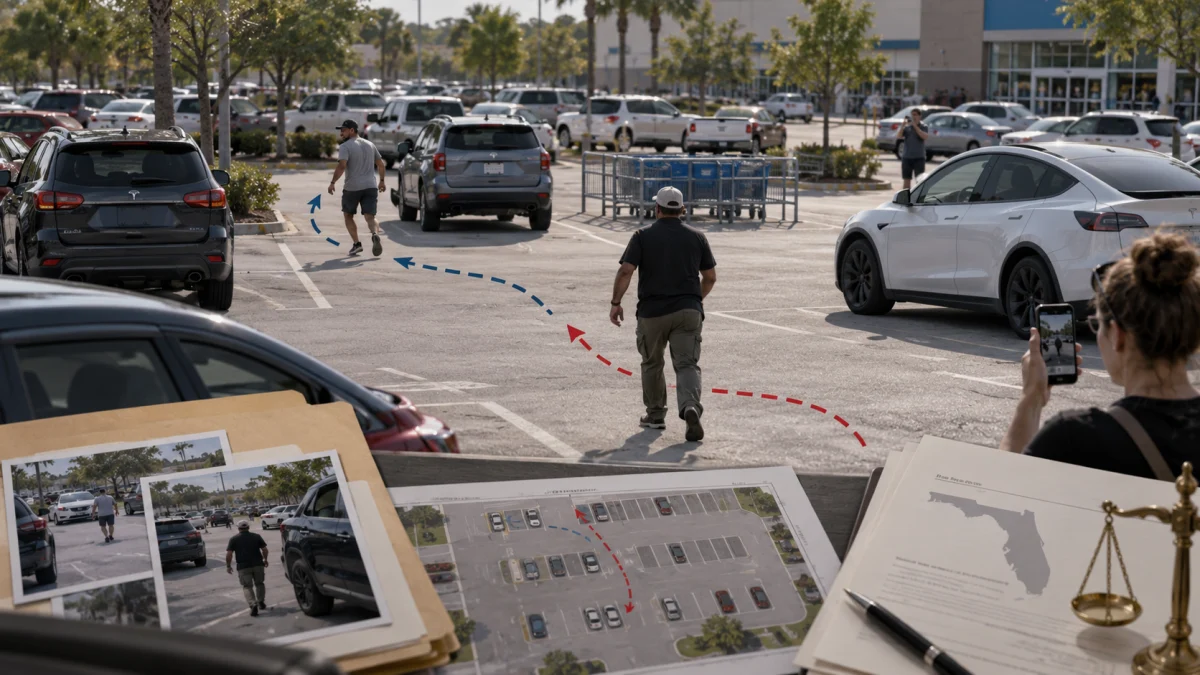
Melissa Payne was not cleared because Florida law allows someone to shoot another person for threatening to key a car. It generally does not.
Broward County prosecutors declined to charge Payne because they concluded that the entire sequence of her June 30, 2026 confrontation with 62-year-old Bart DiGuglielmo left the state unable to overcome her claim that she reasonably feared imminent great bodily harm when she fired.
That distinction matters.
According to the State Attorney’s reconstruction of several videos and witness statements, DiGuglielmo threatened Payne’s vehicle, drove away, parked elsewhere, returned toward her, appeared visibly angry, repeatedly approached despite seeing her firearm and hearing explicit warnings, and continued following her as she physically backed away around parked vehicles. He then returned to Payne’s car, motioned as though he would damage it with his keys, turned, and approached Payne again immediately before she fired one shot into his abdomen. (Broward State Attorney’s Office)
The prosecutor’s conclusion was also narrower than some headlines suggest.
The official memo expressly says the video does not establish that Payne “was in the right.” Instead, prosecutors concluded that they could not prove, under Florida’s Stand Your Ground immunity framework, that her fear of great bodily harm was unreasonable. (Broward State Attorney’s Office)
Those are not the same thing.
And after examining the Florida statutes and appellate decisions behind the memo, there are two additional complications worth understanding: Florida case law distinguishes merely displaying a firearm from pointing it while threatening to shoot, and the prosecutor’s opening statement that Florida simply “allows open carrying of firearms” is less legally settled in Broward County than the memo makes it sound.
What actually happened in the Walmart parking lot?
The shooting occurred shortly after noon on June 30 outside the Walmart at 7900 W. McNab Road in North Lauderdale.
The Broward Sheriff’s Office initially identified the deceased as Bart DiGuglielmo, 62, of Lauderhill. Payne’s name was not publicly released in that initial announcement. (Sheriff’s Office)
The later State Attorney’s memo provides a much more detailed chronology because, according to prosecutors, multiple cellphone recordings, a nearby Tesla and other cameras captured essentially the entire incident. (Broward State Attorney’s Office)
The confrontation, reconstructed
| Stage | What prosecutors say the evidence shows |
|---|---|
| Parking dispute | Payne and DiGuglielmo tried to enter the same parking space, resulting in a brief stalemate. |
| DiGuglielmo enters Walmart | He left his vehicle in the travel lane, retrieved a cart and walked into the store. Payne then parked. |
| Threats to the car | About 90 seconds later, witnesses reported hearing DiGuglielmo threaten to “mess her car up” and, in other accounts, use profanity while threatening her property. |
| DiGuglielmo drives away | He drove off rapidly but parked approximately two aisles away rather than leaving. |
| He returns toward Payne | After sitting in his vehicle for about 90 seconds, he walked toward Payne’s aisle rather than directly toward the Walmart entrance. |
| He watches Payne | Prosecutors say he lingered near trees while smoking. Two witnesses described him as visibly angry and shaking. |
| Payne gets out armed | When he began approaching her, Payne exited with a phone in her left hand and firearm in her right. |
| Payne warns him | A witness heard Payne warn that she would shoot if he kept approaching. Other witnesses heard her tell him not to come near her or her vehicle. |
| DiGuglielmo initially backs away | The memo says the video shows him withdraw at first. |
| He advances again | Prosecutors say he then resumed approaching Payne. |
| Payne retreats | Payne backed into an empty parking space, between parked vehicles and eventually around another vehicle. |
| DiGuglielmo follows | The memo describes DiGuglielmo as continuing to pursue her through that movement. |
| He returns to Payne’s car | With keys in hand, he made a motion prosecutors interpreted as threatening to damage it. |
| Final approach | DiGuglielmo turned back toward Payne and approached again. |
| Payne fires | Payne fired one shot, striking him in the abdomen. She then placed the firearm on the roof of her vehicle. |
Payne was briefly detained. The memo says that when she spoke with a deputy after receiving Miranda warnings, her account was consistent with the available video evidence. DiGuglielmo was transported to Broward Health Medical Center and died from the gunshot wound. (Broward State Attorney’s Office)
That sequence—not simply the argument over who got a parking spot—is the factual foundation of the no-charge decision.
No, Florida law does not generally let you shoot someone for threatening your car
This is perhaps the biggest misconception surrounding the case.
Florida treats defense of property differently from defense of a person.
Under Florida Statute §776.031, someone may use or threaten force short of deadly force when reasonably necessary to prevent or stop unlawful interference with property.
But deadly force in defense of property is permitted only when the person reasonably believes it is necessary to prevent the imminent commission of a forcible felony. (Florida Senate)
A threat to scratch, key or otherwise damage a car therefore does not by itself create a general right to shoot the person making the threat.
DiGuglielmo’s family’s attorney, Melissa Rodriguez, has emphasized this point, arguing that threats concerning property did not justify killing him. (wplg)
On that narrow proposition, the objection is important.
But it doesn’t fully describe the prosecutor’s theory.
The car threats were treated as context for what happened afterward. Payne’s actual use of deadly force was analyzed principally under Florida’s law governing defense of a person.
So what did Payne have to fear for deadly force to be lawful?
Florida Statute §776.012 permits deadly force when someone reasonably believes it is necessary to prevent:
- imminent death;
- imminent great bodily harm; or
- the imminent commission of a forcible felony.
If that standard is satisfied, and the person is not committing a crime and is somewhere they have a right to be, Florida imposes no duty to retreat before using deadly force. (Florida Senate)
Notice what the statute does not require.
The other person does not necessarily have to:
- have a gun;
- have a knife;
- strike first;
- actually cause an injury.
The issue is whether the belief that serious harm was imminent was objectively reasonable from the circumstances confronting the person who used force at the time.
That is why the fact that DiGuglielmo appears to have been unarmed is important—but not automatically decisive.
Doesn’t the fact that DiGuglielmo was unarmed mean the shooting wasn’t justified?
No. Not under Florida law.
A remarkably relevant Florida appellate decision was issued only a year before Payne’s shooting.
In Spencer v. State, the Fourth District Court of Appeal considered a defendant who shot an unarmed man after the man had made threats and aggressively approached him.
The victim fast-walked toward Spencer while threatening to beat him. Spencer knew him to have carried a firearm previously, although no firearm was found after the shooting. When the approaching man was approximately six feet away, Spencer shot him once. (Justia Law)
The Fourth District concluded that the state had failed to overcome Spencer’s self-defense immunity by clear and convincing evidence and ordered the prosecution terminated. (Justia Law)
One judge’s concurrence made the point especially clearly: the victim’s being unarmed did not eliminate the possibility that an objectively reasonable person could fear great bodily harm from his aggressive physical approach.
But the judge also emphasized the other side of the principle.
Had Spencer fired merely because threats were being made from farther away, immunity would have been much harder to justify. What mattered was that the victim had progressed from verbal threats to aggressive pursuit and was nearly upon him. (Justia Law)
That logic is highly relevant to Payne’s case.
It does not prove Payne’s shooting was necessarily justified. Spencer involved additional facts, including previous threats, significant differences in physical condition, and the defendant’s knowledge that the victim had previously carried a gun.
But it does demonstrate why “DiGuglielmo was unarmed” is not, by itself, the end of the legal analysis.
Payne actually backed away
The phrase “Stand Your Ground” can make this case sound like Payne simply remained in place because Florida law said she could.
According to the prosecutor’s video reconstruction, that isn’t what happened.
Payne backed away.
After DiGuglielmo resumed approaching, Payne moved into the parking space created when a minivan pulled away. She then backed between two vehicles, retreated farther and moved around another parked vehicle while prosecutors say DiGuglielmo continued following her. (Broward State Attorney’s Office)
Legally, Florida did not require her to retreat if the requirements for deadly self-defense were already satisfied.
Factually, however, retreat is still evidence.
Someone repeatedly moving away from another person while warning that person to stop approaching presents a different factual scenario from someone seeking out or advancing toward a confrontation.
That distinction becomes particularly clear when Payne’s case is compared with one of Florida’s best-known parking-lot shootings.
Why the Michael Drejka case ended differently
In 2018, Michael Drejka shot and killed Markeis McGlockton outside a Clearwater convenience store following an argument over a disabled parking space.
McGlockton was unarmed.
Unlike DiGuglielmo, however, McGlockton actually physically shoved Drejka to the ground.
Yet Drejka was ultimately convicted of manslaughter.
Why?
Because the critical question was not simply what McGlockton had already done. It was what threat existed when Drejka fired.
The appellate record says McGlockton advanced no farther after pushing Drejka, made no further threats, turned and retreated several steps. Drejka then drew his gun and shot him. The surveillance video and eyewitness testimony supported the conviction. (Justia Law)
The contrast is instructive:
| Drejka/McGlockton | Payne/DiGuglielmo |
|---|---|
| McGlockton physically shoved Drejka | No physical strike by DiGuglielmo is identified in the memo |
| McGlockton was unarmed | DiGuglielmo appears to have been unarmed |
| McGlockton stopped advancing | Prosecutors say DiGuglielmo repeatedly continued or resumed advancing |
| Witnesses said McGlockton retreated | Prosecutors say Payne repeatedly backed away |
| Drejka fired after the retreat began | Prosecutors say Payne fired after DiGuglielmo approached again |
The comparison exposes a critical misunderstanding of self-defense law:
Past aggression is not automatically enough, and the absence of a completed assault is not automatically fatal to a self-defense claim. The immediate circumstances when deadly force is used matter enormously.
Did prosecutors find that Melissa Payne was “right”?
No—not in the way that phrase is normally understood.
This is one of the most important sentences in the entire 22-page State Attorney’s memo:
“The video does not demonstrate that MP was in the right…”
The memo immediately explains the actual conclusion: the evidence did not allow the State of Florida to overcome her claim that she reasonably feared great bodily harm by clear and convincing evidence. (Broward State Attorney’s Office)
That is a legal conclusion about whether the government could prosecute her under Florida’s immunity framework.
It is not the same as:
- a jury finding that every factual dispute favored Payne;
- a judge declaring every action she took lawful after an evidentiary trial;
- a finding that DiGuglielmo deserved to be shot;
- a rule allowing shootings over parking disagreements.
There was no criminal trial.
And because Payne was not charged, there was no judicial pretrial Stand Your Ground immunity hearing.
Why does the “clear and convincing evidence” standard matter?
Florida’s Stand Your Ground statute goes beyond eliminating a duty to retreat.
Section 776.032 also creates immunity from criminal prosecution when force is lawfully justified under the state’s self-defense statutes.
In a criminal prosecution, once a defendant presents a prima facie immunity claim at a pretrial hearing, the statute places the burden on the party seeking to defeat immunity to do so by clear and convincing evidence. (Florida Senate)
That is a substantial burden.
In Spencer, the Fourth District described it as requiring evidence strong enough that the facts sought to be established are highly probable and produce a firm conviction without hesitation. (Justia Law)
Payne’s case did not reach such a hearing because prosecutors never charged her.
Instead, the State Attorney’s Office used that immunity standard in its pre-charge evaluation and asked whether it could establish clearly and convincingly that Payne’s claimed fear was unreasonable.
It concluded that it could not. (Broward State Attorney’s Office)
That procedural distinction is worth preserving.
Saying merely that Payne was “granted Stand Your Ground immunity” can create the impression that a judge held an immunity hearing and issued an order. The public record instead shows a prosecutorial decision not to charge based on the office’s conclusion that the statutory immunity applied and could not be overcome.
But didn’t Payne escalate the encounter by getting out with a gun?
This is the most difficult question in the case—and the State Attorney’s memo deals with it rather briefly.
Payne did not remain inside the vehicle.
According to the memo, she got out holding a phone in one hand and a firearm in the other.
A reasonable reader can ask:
If DiGuglielmo had not yet attacked her, did Payne become the aggressor by introducing a gun into the confrontation?
The memo addresses that argument in a footnote. Prosecutors say Florida permits non-deadly force to protect property, and because Payne was concerned about DiGuglielmo’s threats to damage her vehicle, merely getting out with the firearm did not make her conduct unlawful. The memo cites §776.031 and Little v. State. (Broward State Attorney’s Office)
There is considerable legal support for distinguishing displaying a gun from actually using deadly force.
In Burns v. State, another Fourth District case, the court held that merely displaying a firearm, without more, constitutes non-deadly force. Burns had openly held and loaded a handgun during a confrontation but neither pointed it at anyone nor verbally threatened to shoot. (Justia Law)
But the same opinion explains an important boundary.
In Little, the court had addressed circumstances in which a defendant pointed a loaded firearm at another person while issuing commands. The court observed that pointing a gun while effectively communicating “comply or I may fire” can amount to a threatened use of deadly force. (Justia Law)
That makes Payne’s conduct better understood as a sequence, not one legal event:
| Conduct | Why it matters |
|---|---|
| Getting out while visibly holding the gun | Mere display can constitute non-deadly force |
| Telling DiGuglielmo not to approach | Context matters; displaying a weapon is not automatically threatened deadly force |
| Explicitly warning that she would shoot if he continued | This more clearly implicates the rules governing threatened deadly force |
| Pointing the firearm directly toward him later | Stronger still as a threatened use of deadly force |
| Firing | Actual deadly force |
This does not necessarily mean Payne unlawfully became the aggressor.
By the time the confrontation reached the explicit threat-to-shoot and pointing stages, prosecutors were relying on defense of Payne herself—not simply protection of the automobile.
And Florida also has separate rules governing people who initially provoke force but then withdraw or exhaust reasonable avenues of escape. Payne’s documented backward movement would potentially matter to that analysis as well. (Florida Senate)
Still, this is one place where the State Attorney’s memo is less complete than it could be. Its footnote moves quickly from getting out with a firearm to the conclusion that the conduct was lawful property defense without fully separating later firearm display, verbal threats and direct pointing.
That does not establish that the ultimate no-charge decision was wrong.
It does mean the legal path is more nuanced than the memo’s footnote suggests.
There is also an unusual open-carry issue in the prosecutor’s memo
The first page of the memo makes a broad statement: Florida “allows open carrying of firearms,” citing the First District Court of Appeal’s 2025 decision in McDaniels v. State. (Broward State Attorney’s Office)
McDaniels did indeed declare Florida’s general open-carry prohibition unconstitutional under the Second Amendment. Florida Attorney General James Uthmeier subsequently instructed law enforcement and prosecutors statewide that, in his view, the decision bound Florida trial courts and that ordinary open-carry prosecutions should cease. (Justia Law)
But there is a complication.
On June 17, 2026—13 days before the Walmart shooting—the Fourth District Court of Appeal issued Eubanks v. State.
The Fourth District expressly acknowledged McDaniels but said that an opinion from another appellate district is only persuasive authority to the Fourth District. It consequently stated that §790.053 remained a current statute that was “presently valid and potentially enforceable in this district.” (Justia Law)
Why is that relevant?
Because Broward County is in Florida’s Fourth Appellate District. (Fourth District Court of Appeal)
Even more unusually, the Payne memo itself cites Eubanks on its first page—but for a separate issue concerning firearm rights for 18-to-20-year-olds—without discussing Eubanks’ treatment of the open-carry statute. (Broward State Attorney’s Office)
Florida’s published 2026 statute also continues to contain §790.053’s prohibition on open carry, including an exception for certain brief displays and displays made in necessary self-defense. (Florida Senate)
Does that mean Payne was illegally carrying a gun?
We cannot responsibly make that leap.
First, McDaniels declared the general prohibition unconstitutional, and the Florida Attorney General has directed statewide non-enforcement in ordinary circumstances. (My Florida Legal)
Second, Eubanks itself said its discussion of open carry was dicta because the defendant in that case had not been charged with violating the open-carry statute. (Justia Law)
Third, Payne’s case concerns not merely carrying a visible holstered firearm in public, but displaying and eventually using a weapon during an asserted self-defense encounter. Different statutory protections and prohibitions can apply.
So the defensible conclusion is narrower:
The memo’s blanket statement that Florida simply “allows open carrying of firearms” glosses over a genuine appellate-law complication that existed in Broward County at the time of the shooting.
That issue deserves clarification, but it does not by itself overturn the State Attorney’s ultimate self-defense analysis.
Could DiGuglielmo’s family still sue Payne?
Potentially, yes.
Florida’s Stand Your Ground statute provides immunity from both criminal prosecution and civil actions when the force was justified. It also allows a successful civil immunity defendant to recover reasonable attorney’s fees, court costs, lost income and other defense expenses. (Florida Senate)
But the prosecutor’s no-charge decision does not automatically prevent DiGuglielmo’s family from filing a civil case.
The Florida Supreme Court addressed this issue in Kumar v. Patel.
The court held that even when a defendant has already received a judicial criminal Stand Your Ground immunity determination, that decision does not automatically bind a separate civil plaintiff who was not a party to the criminal proceeding. Civil immunity has to be addressed separately in the civil case. (Root)
In fact, Kumar notes an important difference in burdens: a criminal defendant can receive immunity because the state failed to defeat it by clear and convincing evidence, yet still fail to establish civil immunity under the different standard applicable in civil litigation. (Root)
Payne’s position is procedurally even more distinct because there was no previous court immunity ruling at all—only the prosecutor’s decision not to charge her.
So if the family brings a wrongful-death or related action, Payne could assert Stand Your Ground civil immunity, but a civil court would have to address that issue.
As of our review on September 8, 2026, we have not identified a reported civil lawsuit arising from the shooting.
What about the drugs found in DiGuglielmo’s blood?
The prosecutor’s memo says postmortem testing detected amphetamines, Delta-9 THC and sertraline in DiGuglielmo’s blood. (Broward State Attorney’s Office)
That finding should not be stretched beyond what the released record establishes.
The memo does not provide:
- quantitative blood concentrations;
- a time-of-use estimate;
- whether any amphetamine finding was associated with a prescribed medication;
- therapeutic versus impairing ranges;
- a toxicologist’s conclusion that DiGuglielmo was intoxicated;
- evidence that any substance caused his behavior.
Therefore:
The presence of those substances is verified. Whether DiGuglielmo was impaired by them, and whether they contributed to his actions, is not established by the closeout memo.
Calling him “drugged up,” as some coverage has done, adds a conclusion the released toxicology summary does not itself support.
What facts actually mattered legally?
The simplest way to understand this case is to separate each fact from what people sometimes assume it proves.
| Fact | What it reasonably supports | What it does not prove |
|---|---|---|
| The dispute began over a parking space | Explains how the encounter started | That parking disputes justify deadly force |
| DiGuglielmo threatened Payne’s car | Context for Payne’s perception of hostility | That property damage alone justified shooting |
| DiGuglielmo was apparently unarmed | Important evidence when evaluating the threat | That self-defense was legally impossible |
| Payne openly displayed a firearm | She deliberately introduced a visible weapon | By itself, that she used deadly force unlawfully |
| Payne warned him she would shoot | He allegedly knew continued approach could escalate dangerously | Automatically that every later use of the gun was justified |
| He initially backed away | Shows the warning affected his behavior | That the confrontation necessarily ended there |
| He allegedly approached again | Supports the state’s imminent-threat analysis | By itself, that deadly force was unquestionably necessary |
| Payne repeatedly backed away | Supports an inference that she was trying to create distance | That retreat was legally required |
| She fired only after another approach | Central to evaluating imminence | That prosecutors proved she was morally or factually “right” |
| No charges were filed | State concluded it could not overcome self-defense immunity | A jury acquitted Payne or a judge held an immunity hearing |
| Florida provides civil immunity | Payne could invoke it in a lawsuit | That the family is legally barred from filing one |
So was the shooting legally justified?
The strongest answer supported by the available record is more precise than either side’s slogan.
There is substantial evidence supporting the Broward prosecutor’s conclusion that a Stand Your Ground claim would be difficult for the state to overcome.
The evidence identified in the official record includes DiGuglielmo’s repeated threats, his decision to return toward Payne after relocating his vehicle, witnesses describing him as angry and shaking, his continuing approach despite an explicitly visible firearm and verbal warning, Payne’s repeated backward movement, his continuing pursuit and his final approach immediately before the shot. (Broward State Attorney’s Office)
Recent Fourth District precedent also demonstrates that Florida law can treat an unarmed but aggressively approaching person as creating a reasonable fear of great bodily harm depending on the full circumstances. (Justia Law)
At the same time, the evidence does not support saying that Florida authorized Payne to kill someone merely because he threatened her automobile.
And there are reasonable legal questions about the transition from lawful display of a gun to threatened deadly force, as well as an unresolved tension between the State Attorney’s broad description of Florida open-carry law and the Fourth District’s recent Eubanks language.
Those questions warrant scrutiny.
They do not, on the current record, establish that prosecutors necessarily reached the wrong result.
The most accurate way to describe the case
This wasn’t legally a shooting over a parking space, even though a parking space started the confrontation.
And it wasn’t legally a shooting for threatening to key a car, although those threats formed part of the context.
The decisive issue was what happened afterward.
Broward prosecutors concluded that the recorded sequence of threats, repeated approaches and pursuit—combined with Payne’s warnings and repeated movement away from DiGuglielmo—left the state unable to establish by the demanding standard it applied that her fear of imminent great bodily harm was unreasonable.
That is why Melissa Payne was not charged.
Whether the same evidence would ultimately produce civil immunity, or whether Florida courts will eventually resolve the remaining conflict surrounding open carry, are separate questions.
References and Further Reading
Primary records and Florida law
-
Broward State Attorney’s Office — Stand Your Ground Immunity Memo in the death of Bart DiGuglielmo (Sept. 1, 2026) — The central primary source, including the prosecution’s video chronology, witness evidence and legal analysis.
-
Broward Sheriff’s Office — Altercation Over a Parking Space Escalates to Fatal Shooting — Initial law-enforcement release confirming the date, location, case number and DiGuglielmo’s age.
-
Florida Statute §776.012 — Use or Threatened Use of Force in Defense of Person — Governs deadly force based on reasonable fear of imminent death or great bodily harm.
-
Florida Statute §776.031 — Use or Threatened Use of Force in Defense of Property — Shows why ordinary property damage does not itself authorize deadly force.
-
Florida Statute §776.032 — Immunity From Criminal Prosecution and Civil Action — Establishes Florida’s Stand Your Ground immunity framework and criminal pretrial burden.
-
Florida Statute §776.041 — Use or Threatened Use of Force by an Aggressor — Relevant to arguments about initial provocation, withdrawal and escape.
-
Florida Statute §790.053 — Open Carrying of Weapons — The statutory open-carry prohibition that remained published in the 2026 Florida Statutes despite McDaniels.
Key Florida cases
-
Spencer v. State, Fourth District Court of Appeal (2025) — Particularly relevant modern Stand Your Ground precedent involving the shooting of an unarmed but aggressively approaching person.
-
Burns v. State, Fourth District Court of Appeal (2023) — Explains why mere firearm display can constitute non-deadly force and distinguishes it from threatening discharge.
-
Little v. State, Fourth District Court of Appeal (2020) — Important to the distinction between displaying a firearm and pointing it while issuing a coercive command.
-
Drejka v. State, Second District Court of Appeal (2021) — A useful contrasting Florida parking-lot shooting in which video showed the victim retreating before the fatal shot.
-
McDaniels v. State, First District Court of Appeal (2025) — Declared Florida’s general open-carry prohibition unconstitutional.
-
Eubanks v. State, Fourth District Court of Appeal (2026) — Said McDaniels was persuasive rather than binding on the Fourth DCA and described §790.053 as presently valid and potentially enforceable there; its open-carry discussion was dicta.
-
Florida Attorney General — Guidance Regarding Open Carry Following McDaniels — Explains the Attorney General’s statewide non-enforcement position following McDaniels.
-
Kumar v. Patel, Supreme Court of Florida (2017) — Establishes that a criminal immunity determination does not automatically control a subsequent civil immunity proceeding.
Family response and contemporary reporting
- Local 10 — Family Disputes Decision Not to Charge Melissa Payne — Includes comments from DiGuglielmo’s daughter and family attorney disputing the self-defense conclusion.
Editorial currency note: This article reflects Florida statutes, published appellate decisions and publicly available case records reviewed through September 8, 2026. Firearm law, appellate precedent and any subsequent civil litigation may change the analysis.