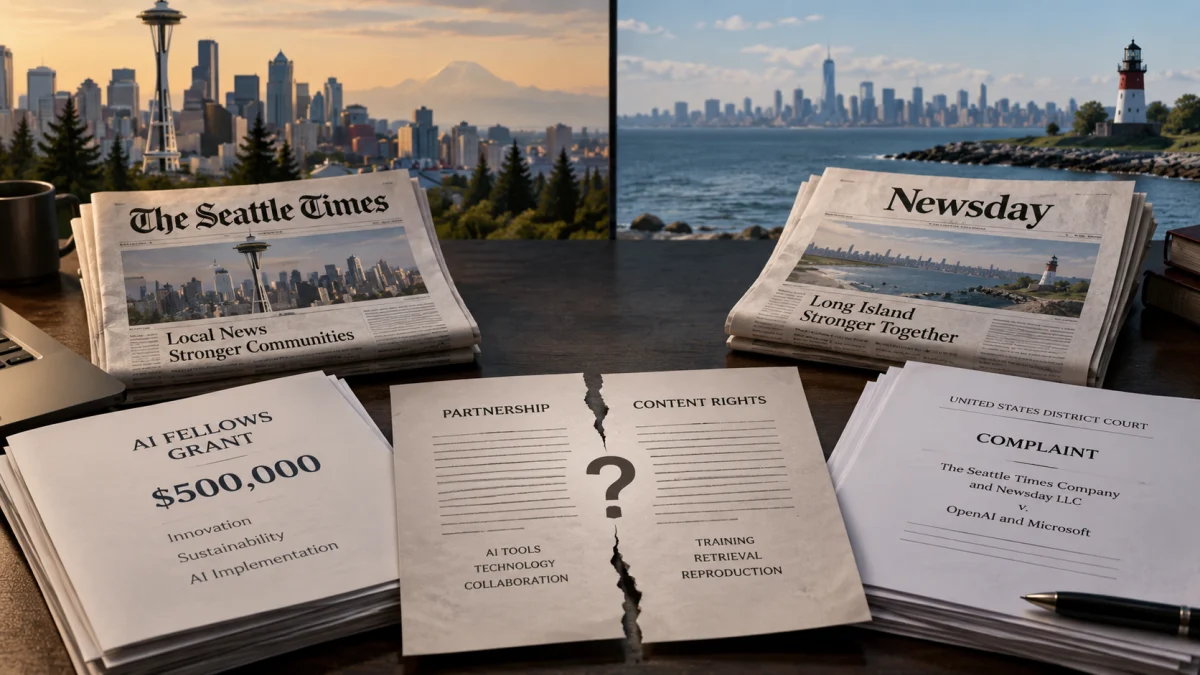
The Seattle Times and Newsday did accept substantial AI-program funding from a fellowship financed by OpenAI and Microsoft. But the available evidence does not show that the newspapers thereby licensed their journalism for AI training, retrieval or reproduction.
The distinction matters because it has largely disappeared from the simplified version of the story circulating online.
The Lenfest Institute’s 2024 federal tax filing records $500,000 grants to both Newsday LLC and The Seattle Times Company. Lenfest categorizes each as an “AI Fellows” grant intended to hire a fellow to work largely on business sustainability and implementation of AI technology. OpenAI and Microsoft financed the larger fellowship program with a combined $5 million in direct funding and $5 million in software and enterprise credits.
So the financial relationship is real.
The more important question is what the money purchased.
On the day the program was announced in October 2024, Axios reported that it did not include publisher-content licensing or real-time data exchanges for training and serving OpenAI and Microsoft models. The publicly disclosed projects also look like publisher-side AI adoption: Seattle planned AI tools for advertising and sales, while Newsday planned tools for summarizing public data. (Axios)
There is an important limitation: the executed grant certifications, enterprise order forms and any possible side agreements are not public. That prevents a categorical statement that no relevant contractual provision exists anywhere.
But the evidence currently available points strongly toward two distinct transactions:
- OpenAI and Microsoft helped fund newspapers’ use of AI technology.
- The newspapers say OpenAI and Microsoft separately used their journalism without obtaining the content rights necessary to do so.
Those propositions are not inherently contradictory.
Nor does that mean the newspapers have already proven copyright infringement. Their allegations remain allegations, OpenAI maintains generally that training on publicly available internet material can constitute fair use, and parts of this complaint leave unresolved whether particular reproduced articles came from model training or from later web retrieval.
What exactly did The Seattle Times and Newsday receive?
The October 2024 Lenfest announcement described a two-year program jointly backed by OpenAI and Microsoft.
Each company committed:
- $2.5 million in direct funding
- $2.5 million in software and enterprise credits
That produced an advertised program value of up to $10 million. Five publishers initially received fellows, including The Seattle Times and Newsday. (The Lenfest Institute for Journalism)
Lenfest’s subsequent Form 990 supplies a detail the original announcement did not make as concrete: each of those two publishers received a $500,000 cash grant from Lenfest.
| Benefit | The Seattle Times | Newsday |
|---|---|---|
| Lenfest AI Fellows cash grant | $500,000 | $500,000 |
| OpenAI/Microsoft technology credits | Yes | Yes |
| Individual value of credits publicly disclosed | Not found | Not found |
| Original project | Advertising, sales support and analytics | Public-data summarization and aggregation |
| Publicly disclosed blanket journalism license | None found | None found |
The precise wording matters. OpenAI and Microsoft financed the program, but Lenfest was the grantor of record for the $500,000 awards. Saying “OpenAI paid The Seattle Times $500,000” compresses the funding chain too far.
The tax filing also tells us that Lenfest’s grants were not simply informal gifts. Its stated grant procedure requires a recipient to sign a certification saying the money will be used for its intended purpose and to comply with applicable reporting requirements. Those executed certifications have not surfaced publicly.
That missing paperwork remains relevant. But the purpose Lenfest reported to the IRS was specific: an AI Fellows grant to hire a fellow for projects focused largely on business sustainability and implementation of AI technologies.
What were the newspapers supposed to do for the program?
This was not purely unrestricted philanthropy.
Lenfest said participating news organizations would share their learnings, product developments, case studies and technical information so other publishers could replicate successful projects. (The Lenfest Institute for Journalism)
That is something of value to an AI collaborative.
But it is not equivalent to giving OpenAI and Microsoft rights in every article those publishers have produced.
The specific projects reinforce the distinction.
Newsday’s announced plan was to build AI tools that summarize and aggregate public data for its newsroom, readers and a potential marketing-services product.
The Seattle Times planned to use AI in advertising go-to-market work, sales training and sales analytics, with the possibility of applying what it learned elsewhere in the company. (The Lenfest Institute for Journalism)
There is much better public documentation of what Seattle actually built.
The Seattle Times really did use OpenAI and Microsoft technology
The relationship should not be minimized into a newspaper merely cashing a grant check.
A 2025 Lenfest case study shows that The Seattle Times developed an AI-powered advertising prospecting system using:
- a custom GPT inside ChatGPT;
- an Azure-hosted API server;
- its Adpoint advertising CRM;
- public-web information for research and citations.
The publication also developed an internal information tool using Microsoft Copilot Studio over SharePoint-grounded business data such as advertising specifications, deadlines, training materials, case studies and business rules. (The Lenfest Institute for Journalism)
That establishes a genuine technical collaboration.
It does not establish that The Seattle Times handed OpenAI its journalism archive for use in foundation-model training.
In fact, the disclosed data flows for the best-documented Seattle project point elsewhere: advertising records, internal business information and the public web. (The Lenfest Institute for Journalism)
Newsday’s ultimate implementation is less publicly documented. Lenfest’s launch materials establish its public-data project, but we found no equivalent technical case study detailing which models, APIs and internal datasets Newsday ultimately used.
That uncertainty should not be filled with assumptions.
Contemporary reporting said the fellowship was not a content-licensing deal
One piece of evidence deserves unusual weight because of its timing.
Axios reported on October 22, 2024—the same day the fellowship was announced—that the deal did not include licensing terms or real-time publisher-data exchanges for training and serving OpenAI and Microsoft models. (Axios)
That reporting predates the September 2026 lawsuit by almost two years.
That provenance matters. Neither the newspapers nor the AI companies had the current litigation as an incentive to retroactively characterize the program as one thing or another.
Axios did not publish the underlying contracts, so its report cannot substitute for them. But it is strong independent evidence that the fellowship was understood at inception as an AI-development program rather than a publisher-content acquisition deal.
OpenAI’s actual publisher licenses look very different
OpenAI’s own public agreements make the distinction easier to see.
When OpenAI struck a deal with News Corp in May 2024, it explicitly announced that it had permission to display News Corp material and would receive access to current and archived content from publications including The Wall Street Journal and others. (OpenAI)
Its partnership with Axel Springer was equally explicit about another right: OpenAI said the arrangement involved using content from Axel Springer publications to advance the training of its models. (OpenAI)
OpenAI itself has described its journalism partnerships as serving different purposes:
- deploying AI tools for journalists and publishers;
- accessing additional historical or nonpublic content for model training;
- displaying current news in ChatGPT with attribution. (OpenAI)
Those are distinct rights and activities.
That makes the shorthand “The Seattle Times partnered with OpenAI, therefore OpenAI could train on The Seattle Times” particularly weak.
A technology partnership can contain a content license. It does not become one automatically.
Using ChatGPT or Azure does not normally give the provider training rights to customer data
The standard commercial terms in effect around the fellowship provide additional context.
OpenAI’s November 2023 Business Terms said business customers retained ownership rights in their inputs and that OpenAI would use customer content as necessary to provide the service, comply with law and enforce its policies. Critically, the terms said OpenAI would not use customer content to develop or improve its services. (OpenAI)
Microsoft’s Azure AI documentation similarly says customer prompts, outputs, embeddings and training data are not provided to OpenAI and are not used to train generative-AI foundation models without the customer’s permission or instruction. (Microsoft Learn)
These sources establish the ordinary product architecture, not the specific contracts signed by Seattle or Newsday. A negotiated order form can change standard terms.
But they undermine another common assumption:
Giving a business access to ChatGPT Enterprise or Azure OpenAI does not ordinarily mean that business is agreeing to donate its data for foundation-model training.
It is also important to distinguish two completely different pathways:
- a newspaper deliberately sending specific information to an AI service as a customer;
- an AI company independently crawling the newspaper’s website for its own training or retrieval systems.
Permission for the first does not automatically create permission for the second.
Could there still be a license without a formal signed content deal?
Yes, in principle. This is why “there is no signed license, therefore there was no permission” is too simplistic.
Section 204 of the Copyright Act generally requires a signed writing for a transfer of copyright ownership. But the statutory definition of such a transfer specifically excludes a nonexclusive license. (Legal Information Institute)
Copyright law also recognizes circumstances in which nonexclusive permission can be inferred from conduct.
The U.S. Copyright Office describes implied licenses as situations in which the circumstances and parties’ behavior reflect an understanding that a work may be used for a specific purpose. The Second Circuit has also described implied-license cases as arising in relatively narrow circumstances. (U.S. Copyright Office)
So the legally useful question is not simply:
Was there a signed license?
It is:
Did anything in the contracts or the parties’ conduct objectively authorize the particular training, crawling, retrieval, storage or reproduction now challenged in court?
The scope of any permission would be crucial.
A newspaper giving an AI system access to its advertising CRM so that the system can help salespeople research prospects is strong evidence of permission to process that CRM information for the project.
It is not obviously evidence of permission to ingest decades of unrelated journalism into a foundation model.
The timeline creates another major problem for the “they took the money, so they authorized it” argument
At least some of the alleged use predates the fellowship by years.
OpenAI’s own GPT-2 model card says GPT-2 was trained on WebText, with training data cutting off at the end of 2017. WebText was assembled from the text of links posted to Reddit. (GitHub)
OpenAI also published a list of the 1,000 most common domains represented in WebText.
That list includes seattletimes with a frequency value of 19,727. That number should not be misrepresented as 19,727 distinct Seattle Times articles—it is a dataset domain-frequency statistic—but it independently establishes Seattle Times material within OpenAI’s historical WebText corpus. (GitHub)
The Lenfest fellowship was not announced until October 2024.
Therefore, whatever legal consequences the 2024 relationship ultimately has, it cannot have been the original source of OpenAI’s access to Seattle Times material used in GPT-2-era training.
A later contract could theoretically include a retroactive release, waiver or license covering earlier conduct.
No public evidence currently shows that the Lenfest documents did so.
That is an inference from chronology, not a court finding.
The publishers’ 2026 Common Crawl conduct points against blanket consent
Another piece of evidence comes from what The Seattle Times and Newsday did while the fellowship was still underway.
On April 29, 2026, the News/Media Alliance sent Common Crawl a request involving publisher domains that sought stronger exclusion from collection for AI-related uses. Its attached domain list includes both newsday.com and seattletimes.com.
The News/Media Alliance is a publishing-industry advocacy group. Its legal characterization of AI scraping should not be treated as neutral authority.
But the domain list is useful primary evidence of publisher conduct.
It is difficult to reconcile an effort to restrict Common Crawl’s collection of those sites with a theory that, by participating in the Lenfest fellowship, the publishers understood themselves to have granted AI companies unrestricted permission to train on their websites.
That does not rule out every narrower agreement. A publisher might, for example, license one AI company while still blocking Common Crawl generally.
It does, however, weigh against the idea of broad implied consent arising merely from participation in the fellowship.
What are the newspapers actually alleging?
The September 4, 2026 lawsuit is one joint case filed by The Seattle Times Company and Newsday LLC against OpenAI entities and Microsoft in the U.S. District Court for the Southern District of New York. (Justia Dockets & Filings)
Their claims go considerably beyond “our stories trained ChatGPT.”
The complaint alleges several distinct categories of conduct:
| Alleged conduct | What plaintiffs say happened |
|---|---|
| Model training | Journalism was copied and incorporated into training datasets |
| Paywall access | Defendants allegedly obtained material readers could not freely access |
| RAG/retrieval | Journalism was allegedly stored, indexed or retrieved for use at query time |
| Outputs | ChatGPT and related systems allegedly reproduced or closely tracked articles |
| Copyright-management information | Plaintiffs allege identifying copyright information was removed |
| False attribution | Plaintiffs allege AI systems sometimes generated material falsely associated with their brands |
These remain allegations. The filing is an adversarial pleading, not a judicial finding.
The complaint itself explicitly alleges that OpenAI has entered licenses with other publishers but never sought or entered such a license with The Seattle Times or Newsday.
That is important evidence of the plaintiffs’ position.
It is not yet independent proof that no contract or implied permission relevant to any claim exists.
The lawsuit does not mention the Lenfest fellowship
There is another conspicuous fact: the complaint does not appear to discuss the Lenfest fellowship or the $500,000 grants.
That omission is worth noting but easy to sensationalize.
It would be unfair to say the newspapers “hid” their OpenAI and Microsoft funding from the court. A complaint is not required to narrate every financial relationship between litigants, and the publishers plainly take the position that the fellowship did not confer the rights at issue.
The more useful question is whether the missing agreements ultimately support that position.
If OpenAI or Microsoft later argues that the fellowship created consent, waiver, estoppel, a license or some other contractual defense, the actual language will matter far more than the optics.
The complaint’s reproduction evidence is stronger than its training-provenance evidence
The newspapers include striking examples of alleged copying.
One Seattle Times example says ChatGPT reproduced 88 consecutive words from an article after being prompted with the article’s headline and URL.
If accurately reproduced in the filing, that is meaningful evidence that the system delivered protected text.
But the complaint then makes a more specific inference: because the user supplied identifying information rather than the article itself, the text must have been recalled from model training.
The complaint itself explains why that inference is not necessarily established.
Immediately beforehand, it describes retrieval-augmented generation, or RAG, in which an AI product can search a live website or stored index, retrieve material and feed it to the model after training is already complete. It expressly acknowledges that this mechanism can reproduce material that was never in the model’s training dataset at all.
That creates an evidentiary distinction current coverage tends to miss.
The example supports:
ChatGPT allegedly reproduced the article.
It does not, standing alone, necessarily establish:
This particular article was memorized during model training.
To prove the second proposition cleanly, the testing methodology would need to rule out live search, RAG, cached retrieval or another grounding source.
That distinction does not eliminate the plaintiffs’ claim. Their lawsuit separately challenges RAG copying.
It simply means reproduction and training provenance are two different factual questions.
The complaint also slightly blurs WebText and WebText2
There is another technical point worth correcting without overstating its importance.
OpenAI’s GPT-3 paper lists several training datasets. Its table identifies:
- filtered Common Crawl: 410 billion tokens, with a 60% training-mix weight;
- WebText2: 19 billion tokens, with a 22% training-mix weight.
The paper explicitly explains that “weight in training mix” means the fraction of training examples sampled from that dataset. OpenAI intentionally made those weights disproportionate to raw dataset size.
So 22% does not mean WebText2 represented 22% of all raw stored tokens.
The meaningful point is that OpenAI oversampled WebText2 relative to its size.
That broader proposition survives the terminology problem.
What about the newspapers’ paywalls?
This is another unresolved factual conflict.
The complaint says The Seattle Times implemented a metered paywall in 2013 and that Newsday has operated a hard gate since August 2022. It alleges that the defendants copied content protected by those restrictions.
OpenAI, however, told Axios in April 2024 that when it refers to “publicly available” training material it means information freely and openly available online and said it does not use information protected by passwords or paywalls. ([Axios][14])
Those claims cannot both accurately describe the same alleged paywalled collection.
But the contradiction needs careful dating. OpenAI’s 2024 statement may describe then-current data practices rather than every historical dataset used for every prior model.
The lawsuit will need evidence showing what was collected, when, by what mechanism and for which system.
Does accepting AI money make the lawsuit hypocritical?
There are really three different questions hidden inside that word.
Is the relationship optically awkward?
Yes.
The Seattle Times and Newsday accepted $500,000 grants from a program financed by OpenAI and Microsoft. They received the companies’ technology credits. Seattle demonstrably built operational tools with ChatGPT, Azure and Copilot. (The Lenfest Institute for Journalism)
Readers are reasonable to notice that relationship and ask what rights were exchanged.
Does the relationship establish a legal contradiction?
No—not on the public evidence.
The best evidence currently available describes the fellowship as funding publishers’ use of AI, while contemporaneous reporting specifically says publisher-content licensing and training-data exchange were outside the deal.
OpenAI’s own publisher partnerships demonstrate that access to AI technology, access to archives, training rights and rights to display current journalism can be separately negotiated. (Axios)
Does that mean the publishers will win the copyright case?
No.
License is only one possible issue.
The Copyright Act separately recognizes fair use, which is determined through a fact-specific four-factor analysis. A use can therefore be unlicensed yet still lawful. ([Legal Information Institute][15])
OpenAI publicly maintains that training on publicly available internet material qualifies as fair use. That is OpenAI’s litigation and policy position, not settled law governing every use alleged here. (OpenAI)
The plaintiffs must still prove their claims, and the defendants will have opportunities to contest them.
Microsoft had funded The Seattle Times before the AI fellowship
The Lenfest program was also not the beginning of Microsoft’s financial relationship with The Seattle Times.
In 2021, Microsoft Philanthropies provided the newspaper $1 million to fund three local-reporting positions for three years. The Seattle Times said all resulting journalism would remain under its editorial control and would be labeled to disclose Microsoft’s support. ([The Seattle Times][16])
That earlier grant increases the significance of the broader relationship but should not be merged with the Lenfest fellowship.
They were different transactions:
- 2021: $1 million Microsoft Philanthropies grant directly supporting Seattle Times journalism.
- 2024: $500,000 Lenfest AI Fellows grant to Seattle, within a program financed by OpenAI and Microsoft.
- 2024: $500,000 Lenfest AI Fellows grant to Newsday under the same program.
There is no basis for simply adding those figures together and describing the total as money Microsoft paid for AI or content rights.
What evidence would change the answer?
The central unresolved evidence is now quite narrow.
The most important missing materials are:
- The Seattle Times’ executed Lenfest grant certification;
- Newsday’s executed Lenfest grant certification;
- amendments or side agreements;
- OpenAI enterprise order forms;
- Microsoft Azure agreements;
- any publisher data-sharing opt-in;
- any separate content-license negotiation or agreement;
- any retroactive release or waiver.
Three outcomes are possible.
If an agreement explicitly grants broad training or content-retrieval rights, the prior funding relationship becomes far more legally important than public reporting currently suggests.
If the agreements explicitly exclude publisher journalism, the viral claim that the newspapers “sold OpenAI their content and then sued” becomes decisively misleading.
If the agreements are silent on existing journalism, the current evidence points even more strongly toward the fellowship and the alleged scraping being separate activities.
Until those documents surface, the limits should be stated rather than guessed away.
Bottom line
The Seattle Times and Newsday took AI money. That part is true. Each received a documented $500,000 Lenfest AI Fellows grant through a program financed by OpenAI and Microsoft, and The Seattle Times subsequently built real business tools using both companies’ technology.
But the stronger claim—that accepting those grants meant the newspapers licensed OpenAI or Microsoft to train on, retrieve or reproduce their journalism—is not supported by the public evidence currently available.
The evidence instead points in the other direction:
- the IRS filing describes AI-implementation grants;
- the public projects centered on publisher-side AI tools;
- contemporaneous independent reporting said content licensing and LLM training-data exchange were not part of the deal;
- OpenAI’s normal business terms separated customer use from foundation-model training;
- OpenAI’s real publisher-content deals expressly spell out archive, training or display rights;
- Seattle Times material appeared in OpenAI training data years before the 2024 fellowship;
- and both plaintiffs later participated in an effort to restrict Common Crawl access while their fellowships were still running.
Taken together, that makes the most reasonable present conclusion:
The newspapers’ AI partnership and their copyright dispute concern different rights unless the missing contracts show otherwise.
That conclusion does not resolve the lawsuit.
The publishers still need to prove the alleged copying and their legal claims. OpenAI and Microsoft can still assert fair use and other defenses. And the newspapers’ own complaint is more convincing in showing alleged reproduction than in proving that every reproduced example came specifically from model training rather than later retrieval.
The interesting story, therefore, is not that two newspapers inexplicably “sued the companies that paid them.”
It is that AI companies can simultaneously be a publisher’s technology provider, funder and alleged copyright adversary—and each relationship can carry a different set of rights.
References and Further Reading
Primary records and court documents
The Seattle Times Company and Newsday LLC v. OpenAI and Microsoft — Federal Complaint, Sept. 4, 2026 — The primary pleading setting out the publishers’ allegations concerning training, retrieval, outputs, copyright-management information and licensing.
Lenfest Institute for Journalism — 2024 Form 990 and Schedule I — Primary tax filing documenting $500,000 grants to Newsday LLC and The Seattle Times Company and defining the AI Fellows grant purpose.
News/Media Alliance — April 29, 2026 Common Crawl Letter and Publisher Domain List — Primary evidence that both Newsday and The Seattle Times participated in a publisher effort seeking stronger exclusion from Common Crawl.
The fellowship and its actual projects
Lenfest Institute — OpenAI and Microsoft Announce $10 Million AI Collaborative and Fellowship Program — Original program announcement detailing funding, technology credits, participating publishers and planned projects.
Lenfest Institute — The Seattle Times AI-Powered Prospecting Agent Case Study — Detailed technical account of Seattle’s custom GPT, Azure API server, advertising CRM integration and related Microsoft Copilot project.
Axios — OpenAI and Microsoft Fund $10 Million Lenfest Local-News AI Project — Important contemporaneous independent reporting stating that the fellowship did not include publisher-content licensing or training-data exchanges.
OpenAI and Microsoft data and publishing agreements
OpenAI — November 2023 Business Terms — Historical standard commercial terms governing customer content around the period preceding the fellowship.
Microsoft — Azure AI Data, Privacy and Security Documentation — Microsoft’s explanation of how Azure-hosted model inputs, outputs and training data are separated from foundation-model training absent customer permission.
OpenAI — OpenAI and Journalism — OpenAI’s own description of product deployment, publisher-content training and real-time content display as distinct forms of collaboration.
OpenAI — News Corp Partnership — Example of an agreement explicitly granting access to current and archived publisher content.
OpenAI — Axel Springer Partnership — Example of a publisher agreement explicitly involving content in model training.
AI training evidence
OpenAI GPT-2 Model Card — Primary OpenAI documentation establishing WebText and its end-of-2017 training-data cutoff.
OpenAI GPT-2 WebText Top-Domain List — OpenAI’s own dataset listing showing
seattletimesamong WebText’s top 1,000 domains.Brown et al. — Language Models are Few-Shot Learners, GPT-3 Paper — Primary technical source identifying WebText2’s token count and 22% sampling weight in GPT-3’s training mix.
Copyright law
17 U.S.C. § 101 — Copyright Definitions — Defines a transfer of copyright ownership and expressly excludes nonexclusive licenses.
17 U.S.C. § 204 — Execution of Copyright Transfers — Establishes the signed-writing requirement for transfers of copyright ownership.
17 U.S.C. § 107 — Fair Use — The statutory four-factor framework relevant to defendants’ potential fair-use arguments.
U.S. Copyright Office — Guidance on Implied Nonexclusive Licenses — Explains that implied permission can depend on objective conduct and the specific purpose contemplated by the parties.
Additional context
The Seattle Times — 2021 Microsoft Philanthropies Grant Announcement — Documents Microsoft’s separate $1 million grant for three Seattle Times reporting positions and the paper’s stated editorial-control provisions.
GeekWire — Seattle Times Sues Microsoft and OpenAI — Useful independent reporting on the lawsuit, the prior funding relationship and Microsoft’s initial response.
Editorial currency note: This article concerns litigation filed September 4, 2026. Contractual defenses, factual admissions or additional documents may emerge when OpenAI and Microsoft file substantive responses or when discovery begins. The conclusions above reflect the public record reviewed through September 6, 2026.
[14]: https://www.axios.com/2024/04/05/open-ai-training-data-public-available-meaning “AI firms treat any “publicly available” data as fair game” [15]: https://www.law.cornell.edu/uscode/text/17/107 “17 U.S. Code § 107 – Limitations on exclusive rights: Fair use | U.S. Code | US Law | LII / Legal Information Institute” [16]: https://company.seattletimes.com/the-seattle-times-creates-three-new-local-reporting-positions-funded-by-a-grant-from-microsoft-philanthropies/ “The Seattle Times creates three new local reporting positions funded by a grant from Microsoft Philanthropies”