
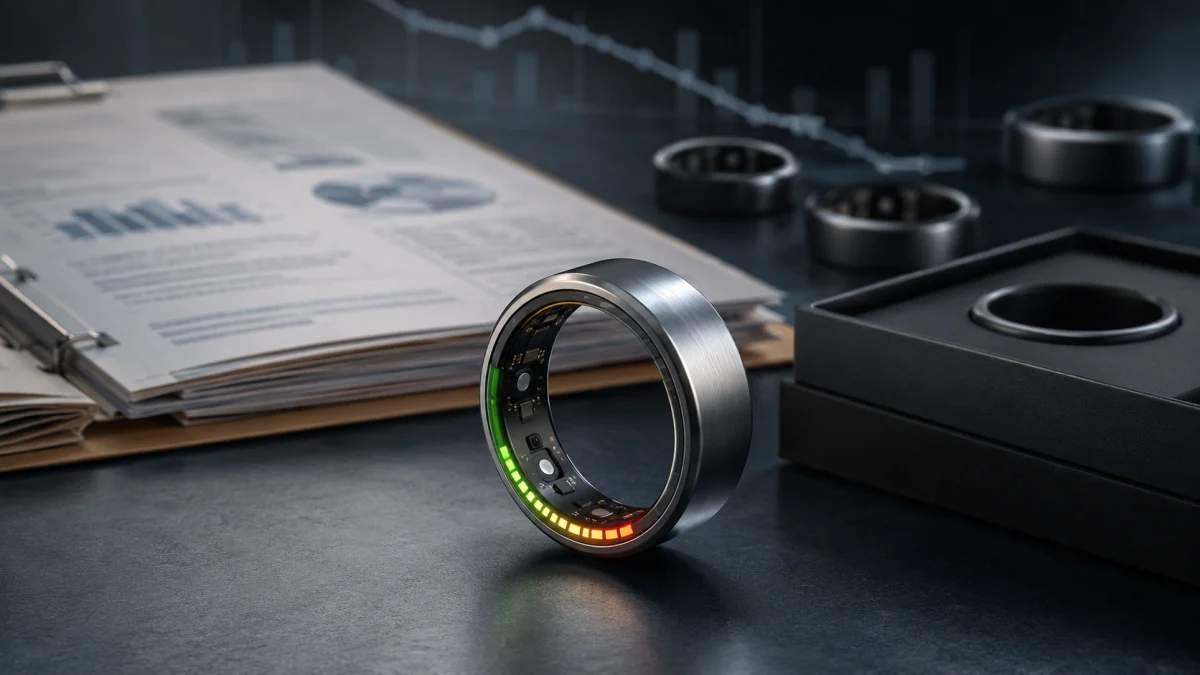
Yes. Oura Ring 4 battery problems are now confirmed by Oura itself—not merely by Reddit complaints.
In a Form S-1 filed with the U.S. Securities and Exchange Commission on September 3, 2026, Oura disclosed that “certain cohorts” of Oura Ring 4 experienced battery-performance problems that increased warranty claims and warranty-related costs. The company says it replaced affected rings free of charge under warranty and, in some cases, even after the warranty period had expired.
For fiscal 2025, Oura also disclosed an $84.4 million year-over-year increase in warranty expense, which it says was driven by elevated warranty reserves related to battery-performance problems affecting those Ring 4 cohorts.
That is strong evidence that a real product problem existed.
It is not, however, evidence that every Oura Ring 4 is defective. Oura has not publicly disclosed which production cohorts were affected, how many rings failed, their manufacturing dates, their sizes, the relevant component supplier or an overall defect rate.
And despite a newer wave of online suspicion, there is currently no persuasive evidence that Oura deliberately degraded Ring 4 batteries through software after introducing Ring 5. Battery complaints were already widespread long before Ring 5 launched.
The evidence supports a more specific conclusion:
Some Ring 4 hardware cohorts had a genuine battery-performance problem. Oura incurred substantial warranty costs because of it. Newer complaints may represent a mixture of those failures, ordinary battery aging and possibly software-related cases, but the public evidence does not establish intentional post-Ring-5 degradation.
What is actually confirmed?
| Question | Best-supported answer | Evidence status |
|---|---|---|
| Did Oura Ring 4 have a real battery problem? | Yes. Oura says certain Ring 4 cohorts exhibited battery-performance issues. | Verified fact |
| Did those problems cost Oura substantial money? | Yes. Oura attributes an $84.4 million FY2025 increase in warranty expense to elevated reserves related to Ring 4 battery issues. | Verified fact |
| Did Oura replace affected rings? | Yes, including some replacements outside the normal warranty period. | Verified fact |
| Are all Ring 4 units defective? | There is no evidence establishing that. | Unsupported |
| How many Ring 4 units were affected? | Oura has not disclosed a failure rate or affected-unit count. | Unknown |
| Did Ring 5 or a firmware update intentionally damage Ring 4 battery life? | No evidence currently establishes this, and complaints substantially predate Ring 5. | Unverified and presently unsupported |
| Is the problem definitely caused by one specific battery defect? | Oura points broadly to older design, manufacturing and supplier dynamics but does not publicly identify one technical root cause. | Uncertain |
| Are overheating and burn allegations the same issue? | Not necessarily. A separate lawsuit makes battery-safety allegations, but those claims have not been proven. | Disputed claim |
What Oura actually disclosed in its IPO filing
The strongest evidence is buried in the risk factors and financial statements of Oura’s first public IPO registration statement.
Oura says Ring 4 is a complex hardware product incorporating batteries, sensors, firmware and software and relying on third-party manufacturers and component suppliers. In discussing the financial risk of defects, the company then gives a concrete example:
Certain Ring 4 cohorts experienced battery-performance problems severe enough to increase warranty claims and replacement costs.
Oura says affected rings were replaced free of charge under warranty and, in some instances, outside the warranty period.
That disclosure is important because it changes the evidentiary status of the story.
Before the S-1, owners could point to large numbers of complaints and replacement anecdotes. Those reports were useful signals but could not establish how Oura itself understood the problem internally.
Now they can be compared with Oura’s own representations to prospective investors.
Elsewhere in the filing, Oura says warranty costs affected margins and describes the problem as related to “backward-looking design, manufacturing and supplier dynamics.” The company says it has continued investing in testing, quality assurance and supply-chain optimization.
That language points more strongly toward a problem associated with particular hardware or production cohorts than toward the idea that every Ring 4 simply loses most of its capacity after a predictable period.
It still does not tell owners the most useful thing: which cohorts were affected.
The $84.4 million figure is real—but easy to misunderstand
Oura reported approximately $907.9 million in fiscal-2025 revenue and $471.0 million in gross profit.
During the same fiscal year, the company says cost of revenue increased partly because of an $84.4 million increase in warranty expense, driven by elevated reserves associated with Ring 4 battery-performance problems.
For scale, $84.4 million is equal to approximately:
- 9.3% of Oura’s total fiscal-2025 revenue
- 17.9% of fiscal-2025 gross profit
Those comparisons illustrate the size of the accounting impact.
They do not mean Oura literally spent $84.4 million in cash replacing defective Ring 4s.
Warranty accounting does not work that way.
Oura estimates how much fulfilling current and future warranty obligations is likely to cost based on factors including historical and current failure rates, expected claims and anticipated repair or replacement costs. It records a liability and adjusts that reserve as its expectations change.
The company-wide warranty figures show how rapidly those estimates grew:
| Oura warranty accounting | FY2024 | FY2025 | First 9 months of FY2026 |
|---|---|---|---|
| Warranty provision | $12.6M | $103.3M | $113.2M |
| Warranty claims charged against reserve | $9.7M | $28.8M | $75.5M |
| Accrued warranty liability at period end | $17.5M | $98.3M | $132.3M |
These are company-wide warranty figures, not a Ring-4-battery-only ledger. Oura does not disclose how much of every line corresponds specifically to the battery problem. But it explicitly attributes the $84.4 million year-over-year increase in warranty expense to elevated reserves related to Ring 4 battery-performance issues.
That is substantially stronger evidence than attempting to estimate the scale of the problem from Reddit posts.
So how widespread is the Oura Ring 4 battery defect?
We do not know.
That may be the single most important limitation in the available evidence.
Oura says it sold 2.3 million rings in fiscal 2025, up from 1 million the year before. Ring 4 launched in October 2024 and was a major contributor to that growth. But the company does not disclose how many Ring 4 units experienced battery problems.
There is no public breakdown by:
- manufacturing date;
- serial-number range;
- ring size;
- purchase date;
- battery supplier;
- manufacturing facility;
- geographic market; or
- age at failure.
That means neither Reddit complaints nor Oura’s warranty expense can legitimately be converted into a defect percentage.
For example, a large number of complaints proves that failures occurred and can establish recurring patterns. It does not tell us whether 1%, 5%, 20% or some other percentage of Ring 4 owners experienced the problem.
The filing does contain one potentially encouraging clue.
For the nine months ending June 30, 2026, Oura said warranty costs remained higher in absolute dollars, but its overall gross margin improved partly because warranty rates were lower than for earlier hardware cohorts.
That is consistent with—although it does not prove—the possibility that the worst battery problems were concentrated in earlier production cohorts and improved as Oura changed manufacturing or supply-chain processes.
Again, Oura has not disclosed enough information for owners to identify whether their individual ring belongs to one of those cohorts.
Did Oura intentionally make Ring 4 battery life worse after Ring 5?
This is where chronology matters.
After Ring 5 entered the picture, some Ring 4 owners began connecting sudden battery deterioration to the new model and asking whether Oura was intentionally degrading the older product.
That suspicion is understandable when a previously healthy device abruptly loses battery life around the time its replacement arrives.
But timing alone does not establish causation.
More importantly, the underlying Ring 4 battery problem clearly predates Ring 5.
An April 30, 2025 Reddit thread described an abrupt decline from roughly five days per charge to around three. Numerous owners subsequently reported similar deterioration, and several said Oura diagnostics resulted in replacement rings. Some later commenters described batteries lasting only about 48 hours.
A June 19, 2025 thread produced another large collection of similar reports. The original poster later said Oura support determined there was a battery problem and issued a replacement.
Another owner in July 2025 described a Ring 4 plunging from a full charge to 5% in approximately 18 hours and said Oura immediately began processing a replacement.
These complaints occurred long before Ring 5.
Oura Ring 5 did not launch until June 4, 2026. Oura confirms that date in its SEC filing.
So Ring 5 cannot explain the existence of the Ring 4 battery problem.
The problem was already there.
Could firmware still affect Ring 4 battery life?
Yes.
That is a much narrower and more defensible question than claiming intentional planned obsolescence.
Battery consumption in a wearable is partly controlled by software. Firmware determines when sensors operate, how frequently components communicate, how data is processed and how aggressively power-saving behavior is used.
Oura’s own Ring 4 firmware history makes clear that software changes can affect battery performance.
Updates have included:
- “Battery life improvements”
- “Small power optimizations”
- internal optimizations and bug fixes
- earlier changes involving battery behavior and reporting
For example, Oura lists battery-life improvements in Ring 4 firmware versions 2.5.3 and 2.9.2 and small power optimizations in version 2.6.2. The first Ring 4 firmware released after Ring 5 launched, version 2.12.0 on June 17, 2026, is described only as containing internal optimizations and bug fixes.
Owners also reported suspected firmware-related battery changes before Ring 5 existed. In one March 2025 thread, an owner noticed substantially faster drain after firmware 2.2.0. Another commenter said Oura diagnostics classified the battery as defective and replaced the ring; the replacement, running the same firmware, performed substantially better.
That is an important clue.
It shows why an apparent correlation with a firmware update does not automatically prove that firmware caused the underlying battery failure.
A software update may expose, accelerate, temporarily worsen or simply draw attention to degraded hardware. Or it may genuinely cause increased power consumption.
Different cases may have different explanations.
Oura’s public Known Issues page, last updated September 1, 2026, does not currently list a general Ring 4 rapid-battery-drain problem.
That does not prove a software bug is impossible.
It means Oura has not publicly acknowledged one there.
The strongest evidence available today remains Oura’s own SEC disclosure, which describes its warranty problems in terms of older design, manufacturing and supplier dynamics, not an intentional software strategy.
The planned-obsolescence theory is therefore not supported by the evidence currently available.
What does Oura’s “5–8 days” battery claim actually mean?
Oura currently says a fully charged Ring 4 can achieve approximately five to eight days of battery life.
That figure comes from controlled testing rather than a promise that every owner will receive eight days under every combination of settings and usage.
Oura says its test used:
- new, unworn Ring 4 devices;
- ring sizes 8–10;
- all-day wear;
- one hour per day of Automatic Activity Detection with Activity Heart Rate;
- Blood Oxygen Sensing disabled;
- eight hours of sleep tracking per night; and
- discharge from a full charge to 0%.
Real-world battery life can therefore vary with ring size, battery age and enabled features.
That distinction matters because getting less than eight days does not by itself prove a defective battery.
A ring delivering five days of battery life under relatively heavy use may simply be operating within normal variation.
A ring that reliably delivered five or six days for months and then abruptly begins dying in 24 or 48 hours with no major change in usage is a different situation—particularly now that Oura has acknowledged that certain Ring 4 cohorts suffered genuine battery-performance problems.
What should you do if your Ring 4 battery suddenly gets worse?
The first step is to establish whether the change is persistent rather than relying on one unusual discharge cycle.
Oura recommends keeping both the app and ring firmware updated. Its battery troubleshooting guidance also recommends completing two charge cycles from 100% down to approximately 25% after a firmware update, backing up ring data after each cycle.
If battery life remains dramatically worse than it previously was, contacting Oura support is reasonable.
Oura’s warranty documentation says its virtual assistant, Finn, can troubleshoot products and, depending on eligibility, may initiate a replacement or escalate the case to a Member Care representative.
For a sudden-drain complaint, it is worth documenting:
- your current firmware version;
- when the ring reached 100%;
- its battery percentage after roughly 12, 24 and 48 hours;
- whether Blood Oxygen Sensing or other power-intensive features are enabled;
- whether the problem persisted across Oura’s recommended charging cycles;
- approximately when the deterioration began; and
- how long a charge typically lasted before the problem appeared.
That gives support something much more useful than simply saying the battery “doesn’t last anymore.”
Will Oura replace a Ring 4 after the warranty expires?
Possibly.
But it is not guaranteed.
Oura’s current U.S. limited warranty generally covers new products for one year, although longer periods apply where local law requires them. Its warranty FAQ also lists batteries among consumable components that normally are not covered simply because they wear out.
The Ring 4 battery issue is more complicated because Oura itself has now acknowledged product-level battery-performance problems.
Most importantly, the company told prospective investors that it has replaced affected Ring 4 units both under warranty and, in some cases, outside the warranty period.
That does not create a blanket entitlement to a free replacement for every older Ring 4.
Oura explicitly cautions in the same filing that it may not continue replacing damaged or faulty products in the future at the same level or on the same terms historically offered for Ring 4.
Still, an owner experiencing the kind of abrupt battery failure Oura has now acknowledged has a stronger factual basis for asking support to investigate the device rather than simply accepting the deterioration as ordinary battery aging.
If Oura approves a replacement, its warranty FAQ says the replacement will generally be the same model and size and may be a factory-reset, tested “like-new” unit.
For a new product that is still under warranty, replacement coverage lasts for the remainder of the original warranty or 90 days after delivery of the replacement, whichever is longer.
There is also a separate Ring 4 battery-safety lawsuit
Battery runtime problems should not automatically be conflated with claims that Ring 4 batteries can overheat.
In May 2026, plaintiffs Brittney Fomin and Taylor Rapsky filed Fomin et al. v. Oura Ring, Inc. in the U.S. District Court for the Northern District of California. The case is a proposed class action involving allegations concerning Oura Ring 4 batteries.
The plaintiffs’ attorneys allege that the Ring 4’s lithium-polymer pouch battery can contain manufacturing or material flaws capable of producing an internal short circuit under certain conditions.
That claim should be treated precisely for what it is:
an allegation in litigation, not an established technical finding.
The fact that Oura has acknowledged Ring 4 “battery performance issues” in its SEC filing does not automatically prove the plaintiffs’ proposed failure mechanism, nor does it establish that the runtime failures experienced by some owners are the same phenomenon alleged in the lawsuit.
Those are separate propositions and should remain separate unless stronger technical evidence connects them.
What remains unknown
Oura’s SEC filing resolves the most fundamental question—whether at least some Ring 4 battery problems were real—but leaves many of the most useful details unanswered.
Oura has not publicly disclosed:
- the affected production dates;
- serial-number ranges;
- the percentage of Ring 4 units affected;
- whether particular ring sizes were disproportionately affected;
- which battery supplier or suppliers were involved;
- the exact physical or electrical failure mechanism;
- the average age of a ring when the problem appears;
- what portion of current warranty reserves will ultimately become actual replacement costs;
- whether some 2026 complaints have a separate firmware component; or
- whether Ring 5 completely eliminates the underlying problem.
Those are not trivial omissions.
They are precisely the information an individual Ring 4 owner would need to determine whether their device is likely part of an affected cohort.
The strongest conclusion
For more than a year, the internet contained two incomplete versions of this story.
Owners had the symptoms: Ring 4 batteries that sometimes appeared to fall off a cliff after months of normal performance, followed by repeated reports of Oura diagnostics and replacement rings.
Oura had the official specifications and troubleshooting instructions.
Its September 2026 IPO filing finally connects those two bodies of evidence.
Oura Ring 4 did have a battery-performance problem affecting at least some hardware cohorts, and its financial impact was substantial enough to materially increase Oura’s warranty expense and reserves.
Oura replaced affected devices, including some outside their normal warranty periods.
But the evidence does not show that every Ring 4 is defective.
It does not tell us the overall failure rate.
And it does not support the stronger claim that Oura intentionally crippled Ring 4 battery life to push owners toward Ring 5.
The pragmatic answer is therefore neither “all Ring 4 batteries are bad” nor “it is just Reddit complaining.”
There was a real problem.
We now have Oura’s own SEC filing confirming that much.
What owners still do not have is the information that may matter most: which Ring 4 cohorts were affected.
References and Further Reading
Primary documents and Oura technical sources
Oura Inc. — Form S-1 filed September 3, 2026 — The primary source for Oura’s acknowledgement that certain Ring 4 cohorts experienced battery-performance problems, the $84.4 million warranty-expense increase, warranty accounting and replacements outside the normal warranty period. View the SEC filing
Oura Ring 4 Battery Life — Oura Member Care — Explains the testing conditions behind Oura’s 5–8-day battery estimate and factors that can reduce real-world battery life. Read Oura’s Ring 4 battery-life guidance
Oura Device Firmware Versions — Oura Member Care — Official Ring 4 firmware history, including releases containing battery-life improvements and power optimizations. View Oura’s firmware history
Warranty FAQs — Oura Member Care — Current warranty periods, troubleshooting process, replacement policy and replacement-warranty terms. Read Oura’s warranty FAQ
Known Issues — Oura Member Care — Oura’s regularly updated public list of acknowledged software and hardware issues. View Oura’s known-issues list
Litigation
Fomin et al. v. Oura Ring, Inc., No. 3:26-cv-03955 — Federal docket confirming the proposed class action filed in the Northern District of California. View the case docket
Migliaccio & Rathod — Oura Ring litigation allegations — Plaintiffs’ counsel’s description of the alleged Ring 4 battery defect. This is an interested-party source and should be read as the plaintiffs’ theory, not independent proof of the allegation. Read the plaintiffs’ attorneys’ description
Owner reports and chronology
April 2025 Oura Ring 4 sudden battery-drop discussion — A large owner thread useful for establishing that widespread battery complaints and replacement reports materially predated Ring 5. Anecdotal evidence; it cannot establish the overall defect rate. View the April 2025 discussion
June 2025 Ring 4 battery-life discussion — Additional pre-Ring-5 reports, including the original poster saying Oura ultimately identified a battery issue and provided a replacement. View the June 2025 discussion
March 2025 firmware and battery-drain discussion — Useful for understanding why firmware has long been suspected by owners, while also illustrating that a replacement ring running the same firmware could perform normally. View the firmware discussion
Editorial currency note: This article was researched and verified on September 4, 2026. Oura’s firmware, warranty practices, known-issues list, IPO disclosures and the status of pending litigation may change. The article should be revisited if Oura identifies specific affected production cohorts, publishes a technical root cause, issues a recall or service program, or files materially updated warranty information with the SEC.