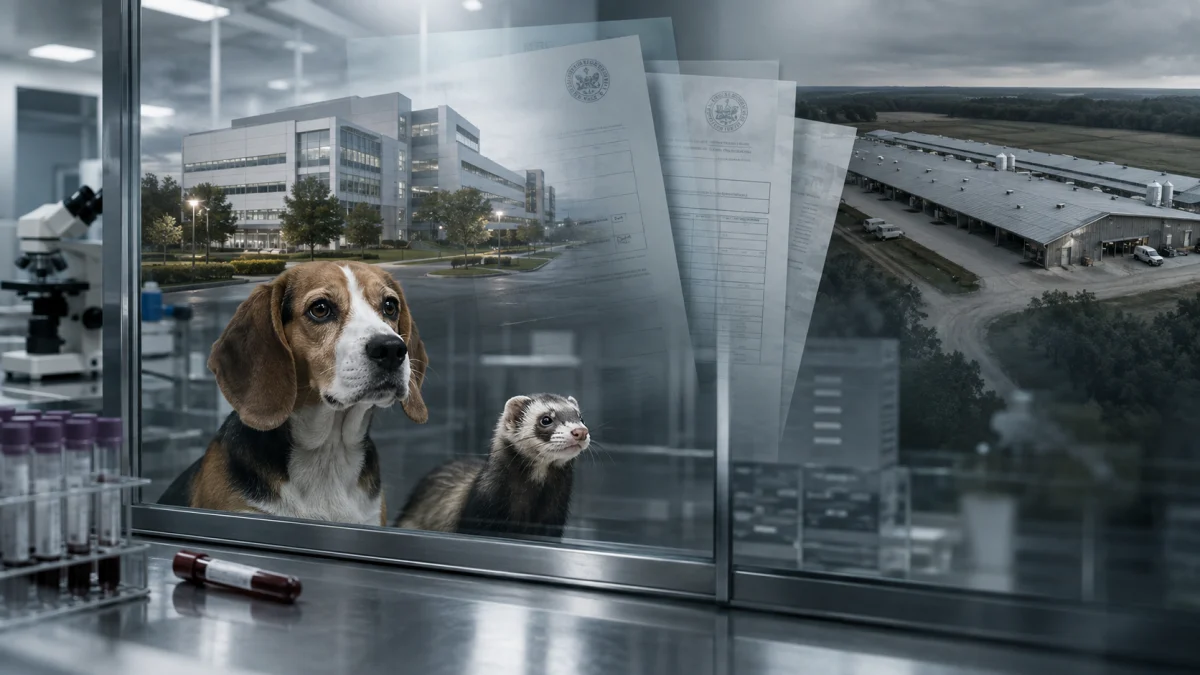
Yes. Peer-reviewed scientific papers directly document Labcorp research using animals supplied by Marshall BioResources.
A 2026 Nature Communications paper describes a study conducted by Labcorp Early Development Laboratories in the United Kingdom using male beagles and states that the animals were received from Marshall Bioresource UK. A separate 2023 npj Vaccines study says ferrets were purchased from Marshall Bio-Resources in North Rose, New York, and used at Labcorp Early Development Laboratories’ Denver facility.
So the central claim in a viral video from Dr. Aria Young—that Labcorp has obtained research animals from Marshall—is supported by unusually direct evidence.
But the viral version compresses several different questions into one emotionally charged claim.
The records do not establish that Marshall supplies all, most, or even a currently measurable percentage of Labcorp’s research animals. Nor does the publication date of a 2026 paper prove that Labcorp is purchasing Marshall animals today; scientific studies can be conducted long before their results are published.
The animal-welfare story requires the same distinction.
Marshall has a real and documented history of USDA animal-welfare deficiencies, including dogs whose health problems had gone unnoticed during required observations, fecal accumulation in dog enclosures, a kitten incident USDA classified as critical, unsafe puppy flooring, and food-storage problems.
At the same time, some of the most disturbing allegations now circulating—including claims about painful euthanasia, violent restraint, puppy deaths and efforts to conceal conditions before inspections—come from whistleblower accounts incorporated into an August 31, 2026 criminal referral. They are serious allegations. They are not criminal convictions, charges, USDA findings or facts that sherafy.com can presently verify independently.
Marshall denies the accusations and says its recent USDA inspections were clean. An APHIS-derived inspection database independently lists a May 19, 2026 inspection under Marshall Farms Group’s Class A breeder license as having no violations; Marshall says May and July 2026 inspections both resulted in no citations.
That leaves a more complicated answer than either “nothing is wrong” or “everything in the viral posts has been proven.”
The evidence at a glance
| Claim | Evidence status | What we can actually establish |
|---|---|---|
| Labcorp has used research animals supplied by Marshall | Verified | Peer-reviewed papers document Marshall-supplied beagles and ferrets in Labcorp studies. |
| Marshall is Labcorp’s sole or primary animal supplier | Not established | The records prove a supplier relationship, not exclusivity or market share. |
| Labcorp still conducts animal research | Verified | Labcorp’s current SEC filings and website explicitly describe animal-based preclinical research. |
| Marshall has a history of USDA animal-welfare violations | Verified | Multiple USDA inspection reports document specific noncompliant conditions. |
| Marshall is currently failing USDA inspections | Not supported by the latest records reviewed | Recent records include inspections with no cited violations. |
| Marshall “tortures animals” | Not an established legal or regulatory finding | There are documented welfare violations and serious new cruelty allegations, but “torture” is a characterization rather than a USDA finding or adjudicated fact. |
| A Marshall dog was “stomped to death” | Misleading version of an allegation | The underlying allegation describes a dog being restrained with a foot on its neck while an euthanasia drug was administered—not death caused by stomping. |
| Animal-welfare laws essentially do not exist | False literally | The Animal Welfare Act and other oversight systems apply. Whether they are sufficiently protective or effectively enforced is a separate question. |
| Wayne County authorities have had no involvement | False | County minutes from April say the FBI was involved and law-enforcement partners were coordinating, though the nature of that involvement remains unclear. |
| Petco and PetSmart sell Marshall products | Verified | Both retailers currently list Marshall-branded ferret products. |
| Every purchase of Marshall pet products directly funds laboratory-animal breeding | Not established | The relevant Marshall businesses have corporate connections but are legally and operationally distinct in important respects. |
The Labcorp-Marshall connection is not speculation
The cleanest evidence in this entire story appears in an ordinary scientific methods section.
A paper published in Nature Communications on June 17, 2026 describes cardiovascular safety testing on four conscious male beagles. The work was performed by Labcorp Early Development Laboratories Ltd. in the UK as Labcorp study No. 8453010.
The paper states:
“Animals were received from Marshall Bioresource, UK.”
The dogs were 27 to 28 weeks old and weighed about 9.2 to 10.1 kilograms. The study had been approved by Labcorp’s Animal Welfare and Ethical Review Body in Harrogate.
A second peer-reviewed paper provides a U.S. example.
Researchers testing experimental influenza vaccines reported that six-month-old male ferrets were purchased from Marshall Bio-Resources in North Rose, New York. The ferret experiments were then performed at Labcorp Early Development Laboratories Inc. under the Denver site’s animal-care protocol.
There is therefore no need to rely on an activist organization, social-media screenshot or secondhand claim to establish the relationship.
Labcorp has used animals supplied by Marshall BioResources.
What we cannot responsibly convert that into is: “Marshall supplies Labcorp’s animals,” if that wording implies that Marshall is Labcorp’s exclusive or dominant supplier.
The public evidence does not establish that.
Labcorp really does conduct animal research
Another possible misunderstanding is that Labcorp is merely the company people visit for blood tests and that animal research belonged to some old, separate business.
Labcorp’s current filings say otherwise.
Labcorp reports two principal business segments: Diagnostics Laboratories and Biopharma Laboratory Services, or BLS. In 2025, Diagnostics accounted for approximately 78% of company revenue and BLS approximately 22%. BLS generated about $3.1 billion in revenue that year.
Its BLS operations include preclinical safety assessment, toxicology, safety pharmacology and other early-development research.
Labcorp’s 2025 Form 10-K explicitly states that animal research at its U.S. BLS facilities must comply with the Animal Welfare Act and that its preclinical services depend on healthy research-animal populations.
Labcorp is equally explicit on its own website, where it says it operates roughly 20 nonclinical testing sites and describes animal research as part of its drug-development business.
So this isn’t a hidden corporate connection uncovered only by activists. Animal research is an acknowledged part of Labcorp’s business.
Does choosing Labcorp for a normal blood test “fund animal testing”?
In the broad corporate sense, a customer purchasing Labcorp services is doing business with the same publicly traded parent company whose Biopharma Laboratory Services division conducts animal research.
But the viral framing can easily become more specific than the evidence warrants.
There is no evidence that money from a particular CBC, thyroid panel or cholesterol test is earmarked to purchase a dog or ferret. Diagnostics and Biopharma Laboratory Services are separate operating segments, even though both ultimately contribute to Labcorp’s consolidated financial results.
The defensible formulation is:
Choosing Labcorp supports a corporation that also operates a substantial animal-research business.
The more dramatic formulation—“your blood test pays for laboratory beagles”—would require financial tracing we do not have.
Labcorp says the welfare of animals at its suppliers is its responsibility too
This point makes the Marshall relationship more consequential.
Labcorp’s 2025 corporate-responsibility report says its animal-welfare commitment extends to animal-related suppliers and that its animal-welfare team evaluates those suppliers, including monitoring animal health, welfare and regulatory compliance. Labcorp also says it regularly audits animal vendors.
That does not prove Labcorp knew about, approved of or ignored any particular problem at Marshall.
It does mean supplier welfare cannot simply be dismissed as something occurring completely outside Labcorp’s stated oversight structure.
The unanswered questions for Labcorp are therefore straightforward: whether Marshall remains a supplier, what Labcorp’s vendor audits have found, whether the USDA violations affected its supplier assessments, and whether the company has evaluated the new whistleblower allegations.
Those answers are not in the public records we reviewed.
What USDA inspectors actually found at Marshall
The strongest case for concern does not require relying on the new whistleblowers at all.
Copies of federal USDA Animal and Plant Health Inspection Service reports document multiple problems at Marshall Farms Group’s North Rose operation.
August 2021: dogs with health problems staff had not identified
During an August 23, 2021 routine inspection, USDA inspectors identified multiple dogs with interdigital cysts, which the report noted can be painful.
Inspectors also documented a dog with a hock injury that had been present for more than a day without being identified during daily observations; another with a chest growth; another missing a toenail with a reddened wound and no treatment notation; and another with a puncture wound affecting a mammary gland that also had not been noted in daily observations.
The same inspection found old feces accumulating on enclosure mesh and mats. In one whelping building, USDA wrote that dams and puppies could not avoid walking through remaining feces.
Inspectors additionally reported dirty fans and vents, old feed containers with mold and older food that had turned green.
This was a very large operation. USDA’s inspection-day count for that site was 75,126 animals, including 12,607 adult dogs, 7,710 puppies, 52,116 ferrets and 2,693 pigs. That number is a snapshot of animals present during that inspection, not an annual production figure.
May 2023: USDA classified a kitten incident as “Critical”
A May 15, 2023 USDA inspection documented a kitten that had lost approximately half its tail.
According to USDA, facility staff had initially failed to handle the injury according to the veterinary standard operating procedure or contact the veterinarian as required.
Medical records later indicated the kitten had been moved into an enclosure with other male kittens after its tail was recorded as healed. The kitten was euthanized that same day after the injured tail had been chewed to the bone by other kittens.
USDA classified the enclosure-related finding as Critical, saying the placement and insufficient behavioral observations failed to ensure the animal’s safety.
March 2024: unsafe puppy flooring and badly rusted food-container hardware
During a March 26, 2024 re-licensing inspection, USDA found severely rusted metal hardware surrounded by caked food in a diet container. Inspectors said the rust could not be adequately cleaned and created a contamination risk.
In two puppy pens, openings in the slotted flooring were large enough for puppies’ feet to pass through, creating a potential injury hazard.
USDA counted 11,822 adult dogs, 7,027 puppies and 39,000 ferrets at that site during the inspection.
August 2024: food-storage and mold problems—but an important caveat
An August 2024 inspection found improperly stored bags of dog food near waste and six empty enclosures containing moldy dry food after an automated feeder malfunction.
Here the details matter.
USDA specifically said the affected enclosures were empty and that no dogs had been offered the contaminated food. The problems were corrected at the time of inspection.
It would therefore be misleading to turn this inspection into the simpler claim that Marshall “fed moldy food to dogs.”
It didn’t say that.
Recent inspections also need to be included
Historical violations do not tell us automatically what conditions are like today.
An APHIS-derived database lists Marshall Farms Group’s May 19, 2026 routine inspection under certificate 21-A-0008 as having no violations, and the license is listed as active through May 2027.
Marshall says its May and July 2026 unannounced USDA inspections both produced clean reports with no citations. We independently found support for the May result; we have not independently verified every inspection encompassed by Marshall’s statement about July.
That evidence should not be buried.
It also does not erase the earlier violations.
A clean USDA inspection means inspectors did not document noncompliance during that inspection. It is meaningful evidence of compliance at the time. It is not proof that no misconduct could ever occur outside the inspection period.
The reverse is equally important: violations from 2021 or 2024 are not proof that the same conditions exist in September 2026.
What are the new 2026 allegations?
The newest controversy comes from a criminal referral dated August 31, 2026, prepared by attorney and former federal prosecutor Bonnie S. Klapper and submitted to Wayne County District Attorney Christine Callanan and other authorities on behalf of animal-rights advocates.
A criminal referral is a request for authorities to investigate alleged conduct. It is not an indictment, criminal charge, conviction or official finding that the allegations are true.
The referral reportedly incorporates whistleblower accounts, photographs and existing inspection material and alleges, among other things, that:
- some conscious dogs were given sodium pentobarbital through an intraperitoneal injection when intravenous access could not be obtained, allegedly resulting in prolonged distress;
- during one such episode, a dog was allegedly restrained with a person’s foot against its neck;
- puppies allegedly died after entering pans of warm wet food that were being used in cold conditions;
- employees allegedly conducted intensive “panic cleans” before inspections;
- and some dogs allegedly were euthanized when deemed unsuitable for customers because of physical or behavioral characteristics.
These are allegations under referral, not established facts. The organization promoting the referral is openly campaigning against Marshall and therefore should be treated as an interested source, even when it possesses potentially important evidence.
Marshall categorically disputes whistleblower accusations, says reports from former contractors and employees have been proven untrue, and says it provides humane and ethical care.
An investigation is exactly what would allow evidence on both sides to be tested more rigorously.
No, the underlying allegation is not that a dog was “stomped to death”
This is an example of how a serious claim can become less accurate as it spreads online.
Social-media posts amplifying the story now say a Marshall dog was killed by someone “stomping the dog’s neck.”
That is not a careful description of the underlying allegation.
The account publicized by the organization behind the referral alleges that a dog was restrained with a foot against its neck while pentobarbital was being injected into the abdomen.
If true, the alleged event is disturbing enough without changing its mechanics.
There is presently no evidence before us establishing that the dog’s neck was stomped on until the animal died.
The euthanasia-method claim also needs more nuance
The referral’s allegation concerning intraperitoneal, or IP, pentobarbital deserves scrutiny, but the route itself is not categorically forbidden.
The American Veterinary Medical Association’s euthanasia guidelines describe intravenous barbiturate injection as the preferred approach for dogs and cats. They also allow IP administration under certain circumstances, particularly with puppies, small dogs and other animals when intravenous access would itself be distressing, dangerous or impractical.
But the same guidance says IP administration is not practical for medium or large dogs because of the volume required and the prolonged time to death, and suggests general anesthesia followed by another injection route when intravenous access cannot be obtained. NIH’s Office of Laboratory Animal Welfare requires covered research programs to use euthanasia methods consistent with AVMA recommendations unless a scientifically justified deviation has been approved.
So there are two bad fact checks available here:
“IP pentobarbital is perfectly normal, therefore nothing could be wrong.”
and
“IP pentobarbital is categorically illegal in dogs, therefore the allegation itself proves cruelty.”
Neither follows from the veterinary guidance.
Whether the alleged Marshall procedures met appropriate standards would depend on details such as the animals’ size, drug formulation and dosage, use of sedation or anesthesia, restraint, circumstances and veterinary protocol. Those facts have not yet been established through an independent public investigation.
Animal-welfare laws absolutely do exist
Dr. Young says in the video, rhetorically, that animal-welfare laws seem as though they “don’t even … exist.”
As an expression of frustration, the point is obvious.
Taken literally, however, it is incorrect.
The federal Animal Welfare Act establishes standards for the humane care and treatment of covered animals used or intended for research, and USDA APHIS licenses or registers covered facilities and conducts inspections. USDA says routine compliance inspections are unannounced and examine facilities, records, husbandry, veterinary care and animal handling.
Labcorp itself acknowledges in its SEC filings that its U.S. animal research is subject to the AWA and periodic USDA inspections.
Additional rules can apply through Institutional Animal Care and Use Committees, Public Health Service policies and other regulatory frameworks depending on the research.
The legitimate debate is not whether animal-welfare rules exist.
It is whether those rules are strong enough, broad enough and enforced effectively enough to prevent suffering that society would consider unacceptable.
Those are very different questions.
Wayne County records reveal something the viral story leaves out: law enforcement was already involved
The August 31 referral asks Wayne County authorities to investigate Marshall.
But an official county record shows that law-enforcement attention did not begin with that referral.
Minutes from the Wayne County Public Safety Committee’s April 7, 2026 meeting state that officials discussed Marshall Farms, that “the FBI is now involved,” and that law-enforcement partners were coordinating. The same record says no specific site visit was scheduled at that time and that the department was maintaining readiness for developments.
That is significant.
It is also frustratingly vague.
The minutes do not say what the FBI was investigating, identify a criminal case, explain which agency requested federal involvement, or describe the scope of the coordination.
There is another reason not to overinterpret the passage. The same county minutes say related UK operations had been “shut down.” Yet Britain’s official Companies House database still lists MBR Acres Limited as active, with accounts filed in July 2026, and the UK Home Office said as recently as July 1 that regulators remained in regular contact with MBR Acres under its ongoing scientific-animal licensing regime.
The county record therefore establishes something important but narrower:
Wayne County officials were discussing Marshall with law-enforcement partners and recorded FBI involvement months before the latest criminal referral. The public record does not yet tell us exactly what that involvement means.
As of September 4, sherafy.com found no public charging document or official announcement establishing that the August 31 referral has resulted in criminal charges or explaining whether it has triggered a new investigation separate from the earlier law-enforcement activity.
Marshall’s defense deserves to be presented accurately
Marshall says it breeds and supplies animals but does not itself conduct pharmaceutical or medical-device testing on them.
It says animals receive veterinary care, daily monitoring, enrichment and socialization, and that its facilities operate under USDA oversight. It points to recent clean inspections and voluntary AAALAC accreditation as evidence that activists are portraying the operation inaccurately.
Those facts and arguments matter.
But some of Marshall’s own public language goes beyond what a clean inspection can logically prove. The company says reports from former employees and contractors have been “proven to be untrue.”
A clean inspection does not, by itself, prove that every whistleblower account about events on other dates is false.
Likewise, a whistleblower’s account does not become true merely because it is vivid, accompanied by photographs, or repeated by an attorney.
The evidence needs to be tested allegation by allegation.
Petco and PetSmart really do sell Marshall-branded products
Dr. Young’s caption also calls attention to Petco and PetSmart.
That factual premise is current.
As of September 4, Petco lists roughly two dozen Marshall Pet Products items, including ferret food, litter, treats, toys and grooming products. PetSmart likewise currently lists Marshall-branded ferret food, litter and accessories.
PetSmart, for example, currently lists Marshall Premium Ferret Food.
Whether consumers should boycott those products is an ethical judgment rather than a fact-checking question.
But there is an important corporate distinction before making the argument that buying a bag of ferret food directly pays for laboratory-animal breeding.
Marshall Pet Products and Marshall Farms Group are connected—but they are not simply the same legal business
A 2022 New York court decision gives us unusually useful detail about the Marshall companies.
The court described Marshall Farms Group as a specialty breeder that breeds animals for sale and medical research. It described Marshall Pet Products as selling pet ferrets and ferret accessories.
According to evidence summarized by the court, the companies had different boards and separate day-to-day management, accounting, tax returns and business functions.
There were nevertheless administrative connections. Marshall Farms Group acted as paymaster for Marshall Pet Products and provided payroll and benefits administration.
The most accurate description is therefore neither “completely unrelated companies” nor “one identical company under two names.”
They are distinct businesses with documented connections within the broader Marshall enterprise.
A consumer can reasonably decide that those connections are enough to avoid Marshall-branded products.
What cannot presently be proven is the stronger financial claim that every dollar spent on a Marshall product at Petco or PetSmart flows directly into breeding dogs for laboratory research.
What we still do not know
Several important questions remain genuinely unresolved.
Is Labcorp still purchasing animals from Marshall right now? The 2026 paper is powerful evidence that Labcorp has used Marshall-supplied dogs, but a paper’s publication date is not necessarily the date the animals were purchased.
How important is Marshall to Labcorp’s animal supply chain? We found direct evidence that Marshall is a supplier. We did not find evidence establishing what proportion of Labcorp’s animals comes from Marshall.
What did Labcorp’s own supplier audits find? Labcorp says it audits animal suppliers and monitors their welfare and regulatory compliance. We have not found those vendor-audit records publicly.
Are the new whistleblower allegations true? The allegations are sufficiently detailed and serious to justify investigation, but allegations are not findings.
What exactly is the FBI doing? Wayne County’s own minutes say the FBI was involved months before the latest referral. Public records reviewed by sherafy.com do not explain the nature of that involvement.
What happened after the August 31 referral? As of publication, we found no public charges or definitive official statement resolving that question.
Those uncertainties are not reasons to dismiss the story. They are the areas where additional evidence matters most.
Bottom line
The viral story is built around a real underlying connection.
Labcorp has used research animals supplied by Marshall BioResources. That can be established directly from peer-reviewed scientific literature, including both beagles in a Labcorp UK study and ferrets supplied from Marshall’s New York operation to a Labcorp Denver study.
Labcorp also continues to operate an animal-research business, and its own policies say animal welfare obligations extend to its suppliers.
Marshall has a documented history of animal-welfare deficiencies found by federal inspectors. Those are not activist inventions. USDA records themselves describe dogs whose injuries or health problems went unidentified, fecal accumulation, sanitation problems, unsafe flooring and a kitten incident classified as critical.
But the evidence also requires boundaries.
The newest and most graphic allegations remain allegations. Marshall denies them. Recent inspections include clean reports. Animal-welfare laws do exist. Intraperitoneal pentobarbital is not categorically prohibited in every dog. Petco and PetSmart sell Marshall products, but the retail and research-animal businesses should not be collapsed into one corporation without qualification. And while Wayne County records reveal previous FBI and law-enforcement involvement, we do not yet know its precise nature.
None of those qualifications makes the documented facts trivial.
They make the story more accurate.
The strongest case for scrutiny of Marshall and Labcorp does not require exaggerating anything: there is already a documented supplier relationship, a genuine federal inspection history, a current corporate policy making Labcorp responsible for monitoring its animal vendors, serious new whistleblower allegations, and an official county record showing that law enforcement was discussing Marshall months before the latest public campaign.
The next meaningful development will not be another viral post.
It will be evidence: an investigative finding, charging decision, additional USDA record, supplier response from Labcorp, or documentation showing what authorities already know.
References and Further Reading
Direct evidence of the Labcorp–Marshall relationship
Nature Communications — “Reverse engineering of BNIP3 identifies a mitochondrial protective peptide” Published June 17, 2026. Its methods section identifies the dog work as a Labcorp Early Development study and states that the beagles came from Marshall Bioresource UK.
npj Vaccines — “Self-amplifying mRNA seasonal influenza vaccines … protect ferrets” The methods section documents ferrets purchased from Marshall Bio-Resources in North Rose, New York, and experiments conducted at Labcorp Early Development Laboratories’ Denver site.
Labcorp’s current business and animal-welfare policies
Labcorp Holdings Inc. 2025 Form 10-K — SEC filing Primary corporate filing documenting Labcorp’s Diagnostics and Biopharma Laboratory Services segments, ongoing animal research, applicable Animal Welfare Act requirements and dependence on research-animal populations.
Labcorp — Animal CARES: Commitments in Action Labcorp’s current statement of its animal-welfare commitments and animal-research practices.
Labcorp 2025 Corporate Responsibility Report — Animal care and welfare Important because Labcorp explicitly says its animal-welfare obligations extend to animal-related suppliers and describes supplier monitoring.
USDA oversight and inspection records
USDA APHIS — Animal Welfare Act Inspection and Annual Reports USDA’s explanation of routine, unannounced inspections and what inspectors evaluate.
USDA APHIS — August 23, 2021 Marshall Farms Group inspection report Official USDA report documenting dog health-observation failures, fecal accumulation and sanitation issues. The copy is hosted by an animal-welfare transparency archive; the document itself is USDA’s inspection report.
USDA APHIS — May 15, 2023 Marshall Farms Group inspection report Official USDA report containing the kitten incident classified as a critical enclosure violation.
USDA APHIS — March 26, 2024 Marshall Farms Group re-license inspection Documents rusted food-container hardware and puppy flooring that allowed feet to pass through openings.
USDA APHIS — August 14, 2024 Marshall Farms Group inspection report Documents food-storage deficiencies and mold in empty enclosure feeders while specifically noting that no dogs were offered the contaminated food.
APHIS-derived current license and inspection record for Marshall Farms Group, certificate 21-A-0008 Third-party presentation of APHIS data showing an active license and a May 19, 2026 routine inspection with no violations. USDA’s own Public Search Tool remains the authoritative database.
Current allegations and company response
August 31, 2026 criminal referral concerning Marshall BioResources The underlying advocacy-generated legal referral requesting investigation. It should be read as a collection of allegations and evidence submitted for authorities to evaluate, not as a judicial finding.
The Simple Heart — public explanation of the August 31 referral An interested animal-rights source involved in promoting the referral. Useful for understanding the allegations, but not appropriate as neutral verification that they occurred.
Marshall BioResources — Facts and FAQs Marshall’s current response to animal-welfare accusations, its description of its practices, and its claim that recent USDA inspections were clean. This is the company’s own interested-party account.
Veterinary and regulatory standards
NIH Office of Laboratory Animal Welfare — AVMA euthanasia-guideline requirements Explains how AVMA euthanasia recommendations interact with animal-research oversight under Public Health Service policy.
USDA APHIS — Animal Welfare Act Public Search Tool and regulatory overview Primary federal explanation of licensing, registration, inspections and Animal Welfare Act compliance.
Wayne County and law-enforcement context
Wayne County Public Safety Committee — April 7, 2026 minutes Official county record stating that the FBI was involved regarding Marshall Farms and law-enforcement partners were coordinating, while providing little detail about the scope.
Wayne County Public Safety Committee — June 2, 2026 minutes Documents subsequent county discussion of a Marshall Farms vigil and an agreement for veterinary services connected generally to animal-cruelty investigations.
UK operation cross-check
UK Companies House — MBR Acres Limited company record Shows MBR Acres Limited remains an active UK company.
UK Home Office — July 1, 2026 answer concerning MBR Acres oversight Confirms continuing regulatory engagement with MBR Acres and complicates the Wayne County minutes’ statement that related UK operations had been shut down.
Marshall corporate structure and retail products
Smith v. Marshall Farms Group, Ltd. — New York Supreme Court, Wayne County (2022) Useful primary legal record describing the functional and corporate distinctions—and some administrative links—among Marshall Farms Group, Marshall Pet Products and related businesses.
Petco — current Marshall Pet Products listings Confirms that Petco currently sells numerous Marshall-branded ferret products.
PetSmart — current Marshall product listings Confirms that PetSmart currently carries Marshall-branded ferret products.
Original viral source
Dr. Aria Young — Instagram reel discussed in this article The viral source that prompted this investigation by readers. The clean canonical link is provided without social-media tracking parameters.
Editorial currency note: This article was verified through September 4, 2026. Criminal investigations, USDA inspection records, retailer inventory, supplier relationships and company statements can change. The most important facts to update are any official statement defining the FBI’s role, action on the August 31 criminal referral, new USDA inspections, and any Labcorp statement addressing its present relationship with Marshall BioResources.