
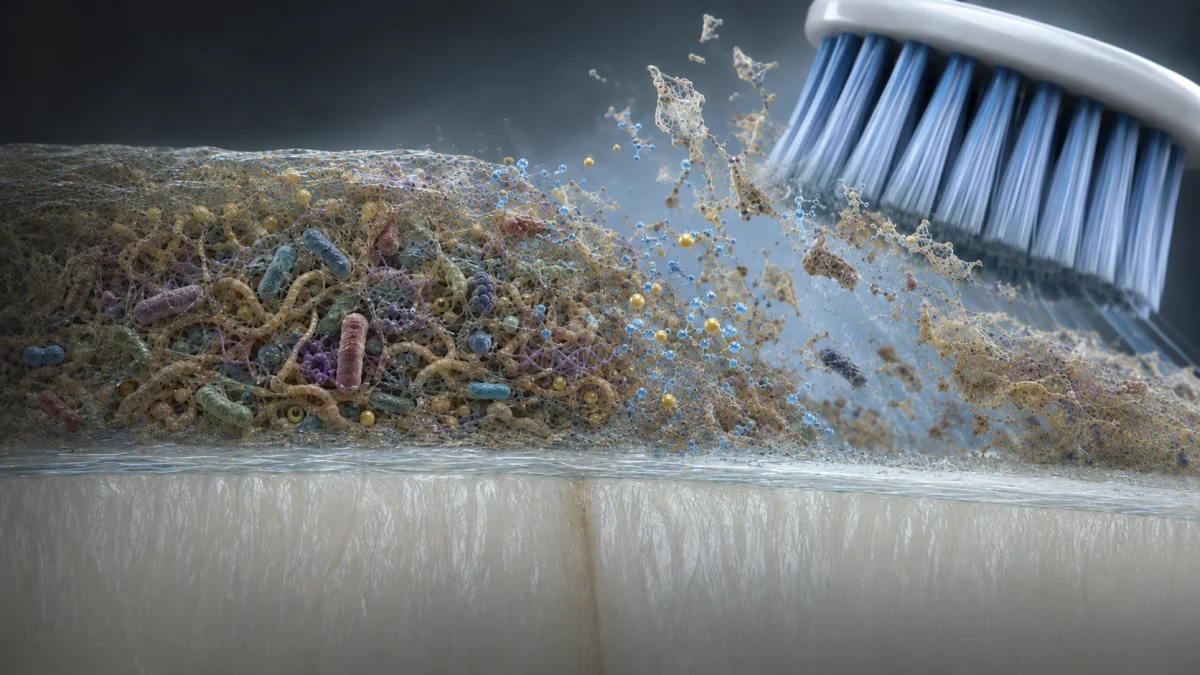
Yes, dental plaque can be chemically weakened or disrupted—but “dissolving plaque” is an oversimplification of what the evidence shows.
That distinction matters because LIVFRESH markets an unusual toothpaste technology called “Activated Edathamil,” saying it breaks the molecular bond between plaque and teeth rather than simply scrubbing plaque away. Some versions of the advertising go further, describing calcium as essentially the glue holding plaque together and claiming the formulation chemically dissolves those bonds.
That sounds suspiciously tidy.
Plaque does contain calcium and other metal ions, and the LIVFRESH formulation uses EDTA, one of the best-known metal-chelating compounds in chemistry. There is also randomized human research—including direct optical imaging—showing substantially more plaque disruption and removal with EDTA-containing LIVFRESH formulations than with several comparison toothpastes. In one imaging study, researchers actually observed what they described as macroscopic breakup of the plaque layer into smaller deposits.
But plaque is not held to your teeth by one type of calcium bond. It is a complex microbial biofilm made from bacteria, polysaccharides, proteins, extracellular DNA, lipids and other molecules interacting with one another and with the salivary coating on the tooth. An older human study even found that EDTA by itself did not disrupt established dental plaque.
So the interesting scientific question is not simply whether LIVFRESH “works.”
It is:
How could an EDTA-containing toothpaste make plaque easier to break apart—and how much of the proposed mechanism has actually been demonstrated?
The answer is surprisingly interesting.
First: What Dental Plaque Actually Is
Plaque is often described as a sticky film of bacteria, but that description misses much of its biology.
Dental plaque is a biofilm: an organized microbial community embedded inside a hydrated extracellular matrix. That matrix contains carbohydrates, proteins, nucleic acids, lipids and other macromolecules. It helps microorganisms attach to the tooth, attach to each other, maintain the three-dimensional structure of the community and resist chemical and mechanical disruption.
A useful analogy is not dirt stuck to a wall, but a microscopic city encased in scaffolding.
Bacteria initially encounter a tooth that is already coated by a thin layer of salivary proteins called the acquired pellicle. Early colonizers attach to that surface. Other organisms attach to them. Extracellular polymers accumulate around the growing community, eventually creating mature plaque.
The resulting structure is held together by numerous forces and molecular interactions, including bacterial adhesins, polysaccharides, extracellular DNA, protein interactions, hydrogen bonding, hydrophobic forces, electrostatic interactions and interactions involving positively charged ions such as calcium.
That is why the phrase “the calcium bond holding plaque to your tooth” is too simple.
There is no single plaque bond waiting for a toothpaste to cut it.
Calcium Does Matter to Biofilm Structure
This is where LIVFRESH’s underlying idea becomes more plausible.
Calcium is a positively charged divalent ion: Ca²⁺. Many molecules within extracellular biofilm matrices contain negatively charged chemical groups. Positively charged ions can interact with those groups and, under some circumstances, behave somewhat like molecular bridges between components of the matrix.
Modern experimental work confirms that divalent ions such as calcium, magnesium and zinc can interact with extracellular polysaccharides and alter the structure and composition of cariogenic biofilms. One 2020 study found that released calcium could become incorporated into biofilm and potentially strengthen its structure.
So a strategy that removes selected metal ions from the plaque environment is not chemically absurd.
The mistake would be jumping from that fact to:
calcium = plaque glue → remove calcium = plaque dissolves.
The biology is considerably more complicated.
A particularly important study from the Journal of Periodontology examined natural plaque on children’s teeth and exposed it to EDTA. Researchers found that the established plaque was not disrupted by EDTA. They concluded that calcium appeared important during early bacterial attachment but did not appear responsible for the strong bonds maintaining established plaque.
That 1982 paper does not prove EDTA cannot contribute to plaque removal under other conditions. But it is strong evidence against treating calcium chelation as a complete explanation by itself.
What Is “Activated Edathamil”?
“Activated Edathamil” sounds like a proprietary new molecule. The published research and patent documents make the chemistry less mysterious.
Edathamil is EDTA—ethylenediaminetetraacetic acid—or a salt of EDTA.
EDTA is a chelating agent. Its molecular structure allows it to coordinate with metal ions such as calcium, magnesium, iron and other multivalent metals, producing stable complexes.
Chelation is not exotic technology. It is established chemistry, and chelating compounds are already used for multiple purposes in dentistry and toothpaste formulation. A 2023 Journal of Periodontology paper notes that tartar-control toothpastes may use several types of chelators, including pyrophosphates, hexametaphosphate, citrate and EDTA.
What is unusual about the LIVFRESH approach is the formulation around EDTA.
The underlying patent describes an anti-plaque composition combining a chelator such as EDTA with a transport enhancer, particularly methylsulfonylmethane, or MSM. The theory is that EDTA alone does not penetrate biological barriers and biofilms particularly well, while MSM helps transport it deeper into the plaque structure.
The clinical literature generally describes the original test gel as containing 2.6% activated edathamil with MSM.
So “Activated Edathamil” is better understood as a proprietary EDTA-centered formulation or delivery system, rather than a newly discovered chemical element that selectively melts plaque.
Why Add MSM?
This may help reconcile one of the biggest apparent contradictions in the evidence.
EDTA is an excellent chelator in a test tube. But a mature biofilm is specifically designed, in evolutionary terms, to make penetration difficult. Its extracellular matrix can slow or alter the transport of chemicals into deeper layers.
The LIVFRESH patent explicitly identifies poor EDTA penetration as a limitation and proposes MSM as a transport enhancer.
There is independent experimental evidence that MSM can improve EDTA transport through biological tissue—but not directly from dental plaque. A 2009 study applied radiolabeled EDTA to rat corneas. With MSM present, EDTA entered ocular tissues; without MSM, researchers reported that EDTA did not penetrate the eye.
That supports the general permeability concept.
It does not prove MSM carries EDTA through human dental plaque in precisely the manner proposed.
That distinction is important. The transport mechanism is plausible, but the strongest independent permeability experiment commonly cited in this context involved rat eye tissue, not dental biofilm.
So How Might the Toothpaste Actually Break Plaque Apart?
The evidence supports a more defensible model than the marketing version.
The formulation reaches plaque while the user brushes. EDTA chelates accessible metal ions within and around the biofilm. This may alter ionic interactions within the matrix, interfere with attachment or reattachment, and change the mechanical stability of the biofilm. Brushing then supplies physical shear, allowing weakened portions of the plaque layer to detach.
In other words:
It probably does not “melt” plaque. It appears to make plaque easier to fragment and physically remove.
This distinction also fits experiments with EDTA outside the LIVFRESH literature.
EDTA often shows relatively weak direct antimicrobial activity. In one human dental-biofilm experiment, even a 24% EDTA gel did not significantly reduce bacterial vitality compared with saline. Another biofilm experiment found EDTA affected some bacterial membranes but removed relatively few cells from several established biofilms.
That is consistent with an important point:
EDTA does not need to kill the bacteria to help remove the structure they live in.
A compound can interfere with a biofilm matrix, adhesion or mineral interactions without acting like an antiseptic.
Researchers Have Actually Imaged the Plaque Breaking Apart
This is probably the most important evidence behind the entire concept.
A randomized, controlled, double-blind study involving 25 people examined the EDTA/MSM dental gel over 21 days. Instead of relying only on a dentist visually scoring plaque, researchers used optical coherence tomography and nonlinear optical microscopy to examine the biofilm itself.
The researchers reported macroscopic breakup of the plaque layer, with plaque remaining as smaller fragmented deposits after use of the test formulation. They also reported that the underlying salivary pellicle appeared to remain intact.
The comparison toothpaste removed plaque too—as brushing obviously should—but the imaging showed a greater reduction in plaque thickness, continuity and surface coverage with the test gel.
That is significant because it moves the evidence beyond a purely theoretical EDTA mechanism.
There is direct human imaging consistent with biofilm fragmentation.
But it still does not prove the company’s entire molecular explanation.
The researchers did not watch individual EDTA molecules enter plaque, identify specific calcium bridges being removed and then demonstrate that those exact interactions caused each fragment to detach. The study demonstrates the physical result, not every molecular step leading to it.
It was also a small study, and its funding included both NIH support and Livionex, the company behind the product. The authors reported no conflicts of interest.
What Do the Human Clinical Trials Show?
The clinical evidence is considerably stronger than a typical supplement or alternative-health marketing story. There are multiple randomized human studies, including later research published in the Journal of Periodontology.
But the evidence base also needs to be described accurately: multiple papers came from the same broad University of California, Irvine research program, several received Livionex funding, and published studies of a complete toothpaste formulation cannot tell us exactly how much of an observed effect comes from EDTA alone.
| Study | Design | What it found | Major limitation |
|---|---|---|---|
| 2014 plaque/gingivitis trial | 25 participants, randomized, double-blind, 21 days | Plaque index fell about 86% with test gel vs. 33% with control | Very small; Livionex among funders |
| 2014 imaging study | 25 participants, randomized, double-blind | Optical imaging showed greater plaque reduction and fragmentation | Small; does not isolate molecular mechanism |
| 2016/2017 crossover study | 22 participants, 8-week crossover | Test gel produced significantly better plaque control than control | Small; Livionex among funders |
| 2021 periodontal-maintenance study | 65 participants, 6 months | 2.6% EDTA gel improved plaque/inflammatory measures and probing depth more than stannous-fluoride control | Specialized periodontal population |
| 2023 trial | 60 participants, 3 months | Stannous fluoride + 2.6% EDTA produced much larger plaque and gingival improvements than sodium-fluoride control | Complete formulations differed |
| 2023 five-toothpaste trial | 150 participants, 3 months | Stannous fluoride + EDTA formulation outperformed four sodium/stannous-fluoride comparison toothpastes | Single center; manufacturer funding; young population |
The small 2014 trial found a striking difference. Plaque Index dropped from approximately 2.2 at baseline by 1.92 points in the EDTA-formulation group versus 0.74 points in the control group after 21 days. The authors described this as an 86% plaque reduction versus 33% with the control.
A later randomized crossover study similarly found significantly better plaque control with the test formulation.
The evidence became more interesting as larger studies were published.
A 65-person randomized, double-blind periodontal-maintenance trial compared a 2.6% EDTA gel with a 0.454% stannous-fluoride dentifrice for six months. The EDTA formulation produced greater reductions in several periodontal and plaque-related measurements.
A 60-person randomized trial then compared a formula containing 0.454% stannous fluoride plus 2.6% EDTA with a sodium-fluoride toothpaste for three months. Plaque Index improved by an average of 1.43 points in the test group versus 0.49 in the control group.
The strongest comparative study involved 150 participants divided among five toothpaste groups. One product contained stannous fluoride plus 2.6% EDTA; three other products contained the same concentration of stannous fluoride without that EDTA formulation, and one used sodium fluoride. No professional cleaning was performed during the trial.
After three months, mean Plaque Index had fallen:
53.29% with the stannous-fluoride/EDTA gel, compared with 23.17%, 19.89%, 11.04% and 9.91% in the four comparison groups.
The EDTA-containing formulation significantly outperformed all four comparisons, including the other stannous-fluoride toothpastes. The researchers also adjusted statistically for baseline differences and still found significant differences.
That result is difficult to dismiss as simply “toothpaste works because people brushed their teeth.”
Something about that complete formulation performed substantially better in that trial.
What the trial cannot establish is that EDTA chelation alone caused the entire difference. The products differed in more than one ingredient and formulation characteristic.
Are These Independent Replications?
Not entirely.
This is one place where simply counting the number of published papers can make the evidence look stronger than it is.
Several of the UCI studies were conducted under the broad ClinicalTrials.gov protocol NCT02271815, “A Clinical and Imaging Study to Evaluate a Novel Dentifrice.” The completed study record reports an actual enrollment of 194 participants, and the later 150-person comparison paper explicitly identifies that same registration.
That does not make the resulting papers invalid. Different analyses and participant groups can legitimately answer different questions.
But it means that claims such as “dozens of studies” should not automatically be interpreted as dozens of independent research teams repeatedly reproducing the same result.
The 150-person trial was single-center, performed at UCI, and supported by several government and foundation grants as well as Livionex Inc. The authors reported no conflicts of interest.
The most valuable next step scientifically would be a large preregistered multicenter trial run by investigators with no financial relationship to the manufacturer, using identical brushing protocols and formulations designed to isolate EDTA/MSM from the other ingredients.
Does LIVFRESH Really “Dissolve” Plaque?
“Disrupt” is better supported than “dissolve.”
The imaging evidence supports plaque becoming thinner, less continuous and more fragmented. Clinical studies support less plaque being present after repeated use.
Neither observation requires the entire plaque mass to chemically dissolve into solution.
This matters because LIVFRESH currently uses much stronger descriptions, including claims that Activated Edathamil “chemically dissolves the calcium bonds holding plaque to your teeth,” that “dissolving leaves nothing,” and that the biofilm does not survive.
The scientific literature does not justify that level of simplicity.
Mature plaque contains a complex matrix with many independent modes of adhesion and cohesion. Calcium can contribute to biofilm structure, but an older direct human study found calcium was not responsible for the strong bonds maintaining established plaque.
The strongest evidence therefore supports this wording:
The EDTA-containing formulation appears capable of weakening or disrupting dental biofilm so that brushing removes it more effectively.
That is still an interesting mechanism. It just is not the same as chemically melting plaque away.
What About the “Negative Zeta Potential” Claim?
LIVFRESH proposes another mechanism: after treatment, the tooth surface supposedly develops a more negative zeta potential, which helps repel negatively charged bacteria and makes it harder for new plaque to attach.
There is legitimate surface chemistry behind the general idea.
Many oral bacteria carry a net negative surface charge. Experiments have also shown that the electrical properties of enamel, dentin and salivary pellicles can influence bacterial adhesion. In one classic study, lowering ionic strength increased electrostatic repulsion and reduced adhesion for some—but not all—oral bacterial species.
Other research has demonstrated that altering enamel’s surface properties, including its zeta potential, can affect adhesion by particular Streptococcus species.
But the important words are “some” and “can.”
Bacterial attachment to teeth is governed by far more than electrical charge. Salivary proteins, bacterial adhesins, hydrophobicity, surface energy, roughness, ionic conditions and species-specific interactions all matter.
I found good independent evidence that zeta potential can influence bacterial adhesion.
I did not find comparably strong independent human evidence establishing that the LIVFRESH formulation creates a persistent negative electrostatic barrier on teeth and that this is a major reason for its clinical plaque results.
So the evidence grades differently:
| Claim | Evidence assessment |
|---|---|
| Dental plaque is a structured biofilm that can potentially be chemically disrupted | Strongly supported |
| EDTA chelates calcium and other metal ions | Established chemistry |
| Divalent ions can participate in oral biofilm structure | Supported, but complex |
| EDTA alone dissolves the “calcium glue” holding mature plaque together | Not supported; contradicted by some evidence |
| EDTA/MSM LIVFRESH formulations can produce greater plaque reduction than comparison toothpastes | Supported by several randomized trials |
| Human imaging has shown plaque fragmentation with the formulation | Supported |
| MSM improves EDTA penetration through biological barriers | Supported generally; direct dental-plaque proof is limited |
| LIVFRESH works because it creates a persistent negative-zeta-potential barrier | Plausible but not well established clinically |
| The toothpaste literally dissolves all plaque rather than helping detach it | Too strong for the evidence |
What Does “250% More Plaque Removal” Actually Mean?
LIVFRESH prominently advertises plaque removal as approximately “250% better” or “250% more” than a leading toothpaste.
The early clinical data help explain where a number in that neighborhood probably comes from.
After 21 days in the 2014 study:
Test formulation: Plaque Index decreased by 1.92 points.
Control: Plaque Index decreased by 0.74 points.
Dividing 1.92 by 0.74 gives approximately 2.59.
So the measured reduction was roughly 2.6 times as large as the control reduction in that small trial.
That is not mathematically the same as “259% more.”
A result that is 2.59 times another result is approximately 159% greater, or 259% of the comparison value. Saying “250% more” ordinarily implies approximately 3.5 times as much.
The paper itself uses clearer language: 86% plaque reduction versus 33%.
There are later studies in which the EDTA formulation performed strongly enough that different relative comparisons can produce even larger percentages. The 150-person study, for example, found a 53.29% Plaque Index reduction with the EDTA/stannous-fluoride formulation versus 9.91% for the sodium-fluoride control.
But those numbers measure changes in plaque indices over specific study periods. They should not be casually translated into a universal promise that each brushing physically removes exactly “250% more plaque.”
The clinical evidence is already interesting without forcing it into a single marketing percentage.
Plaque Is Not the Same Thing as Tartar
This distinction is especially important for anyone searching whether a toothpaste can “dissolve plaque.”
Plaque is the relatively soft microbial biofilm accumulating on teeth.
Calculus, or tartar, is plaque that has mineralized and hardened.
The National Institute of Dental and Craniofacial Research explains that plaque can be disrupted through oral hygiene before it calcifies, but once it has hardened into calculus, ordinary brushing and flossing cannot remove it; professional dental instruments are needed.
So evidence that an EDTA-containing toothpaste improves plaque control should not be interpreted as proof that someone can brush away established chunks of hardened calculus at home.
Those are different scientific questions.
Could EDTA Damage Enamel by Removing Calcium?
This is a reasonable question because enamel itself is calcium-rich hydroxyapatite and EDTA binds calcium.
At sufficiently high concentrations and under the right conditions, EDTA absolutely can alter mineralized dental tissue. Dentists use much stronger EDTA preparations in procedures such as endodontic treatment specifically because of their chelating ability.
That does not mean a 2.6% EDTA toothpaste automatically strips calcium from teeth.
The dental-gel studies used much lower concentrations and repeated oral exposure under toothpaste conditions, and the published clinical literature has not shown an obvious pattern of enamel damage under those study conditions. The later clinical papers describe previous evaluations as finding minimal impact on tooth-surface microarchitecture or microhardness.
Still, it would be incorrect to argue that EDTA somehow knows the difference between “bad calcium in plaque” and “good calcium in enamel.” Chemistry is not that selective.
Concentration, pH, formulation, exposure time, saliva and mineral equilibrium matter.
That is another reason the complete formulation needs to be evaluated rather than reasoning from EDTA alone.
Plaque Removal and Cavity Prevention Are Also Different Questions
An anti-plaque effect does not automatically establish equivalent protection against cavities.
Fluoride has a large separate evidence base for preventing dental caries, and the American Dental Association’s general oral-care recommendation remains brushing twice daily with fluoride toothpaste. ADA-accepted toothpastes making cavity-prevention claims must contain fluoride.
Some early LIVFRESH studies tested fluoride-free EDTA formulations. More recent studies tested formulations combining 2.6% EDTA with 0.454% stannous fluoride.
Those should not be treated as interchangeable scientific questions.
A study demonstrating less plaque does not by itself prove equal cavity prevention, and a study of a stannous-fluoride-plus-EDTA formulation cannot automatically be applied to every fluoride-free formulation sold under the same brand.
There Is Also a Current Formulation Problem Worth Keeping in Mind
The company’s current public information makes it difficult to determine exactly how closely every retail formulation corresponds with the products in the older studies.
As of September 2026, a LIVFRESH page lists the fluoride-free product as containing:
Activated Edathamil, glycerin, water, hydrated silica, sorbitol, sodium lauroyl sarcosinate, flavor, xanthan gum, sodium saccharin and citric acid.
Yet multiple current LIVFRESH pages simultaneously advertise “zero abrasives” while giving that ingredient list—including hydrated silica.
Hydrated silica is commonly used in toothpaste as an abrasive or polishing agent.
More importantly for interpreting the research, older published studies specifically describe their test product as a 2.6% activated-edathamil formulation involving MSM. The company’s patent also contemplates many possible additional ingredients and formulations.
That does not undermine the clinical results for the formulations actually tested.
It simply means those results should be attributed to the studied formulations, rather than assuming every current or future product bearing the LIVFRESH name is chemically identical.
So Is the Science Legit?
The core idea is legitimate. The simplified marketing explanation is not the same thing as the science.
Dental plaque is a physical biofilm with a chemically organized extracellular matrix. It is entirely plausible to target that matrix chemically rather than relying only on abrasive cleaning or antimicrobial killing.
EDTA is a real chelator. Metal ions participate in biofilm chemistry. MSM has evidence as a permeability enhancer in other biological tissue. Randomized human studies repeatedly report greater plaque reduction with EDTA-containing LIVFRESH formulations. Most unusually, researchers using optical imaging actually observed greater fragmentation and breakup of plaque in people using the test gel.
That is substantially more evidence than would be expected behind a typical “revolutionary toothpaste” advertisement.
But several things remain unresolved.
The evidence does not establish a single calcium “glue” holding mature plaque together. EDTA alone has failed to disrupt established plaque in some experiments. MSM’s proposed role in penetrating dental plaque has less direct evidence than its general permeability-enhancing effect. The persistent negative-zeta-potential mechanism is plausible but not comparably demonstrated in clinical studies. Multiple favorable papers come from the same broad UCI research program, and Livionex helped fund several studies.
So the strongest conclusion is narrower—and scientifically more interesting—than the advertisement:
An EDTA-containing dental formulation appears capable of changing the structure or attachment of dental biofilm enough that normal brushing removes substantially more of it. Human imaging has directly documented plaque fragmentation consistent with that mechanism. Exactly which molecular interactions are responsible, and how much EDTA, MSM, electrostatics and the rest of the formulation each contribute, has not been conclusively established.
Calling that process “biofilm disruption” is defensible.
Calling it “dissolving the calcium glue that holds plaque to your teeth” turns a complicated and genuinely interesting piece of chemistry into a marketing cartoon.
And in this case, the real science is more compelling than the cartoon.
References and Further Reading
Dental Plaque and Biofilm Biology
The Dental Plaque Biofilm Matrix — Periodontology 2000 / PubMed A comprehensive review of the extracellular matrix that gives dental plaque its structure, adhesion and resistance to disruption.
Effect of Divalent Ions on Cariogenic Biofilm Formation — BMC Microbiology / PubMed Experimental evidence examining how calcium, magnesium and zinc interact with extracellular polymers and influence dental biofilm.
Calcium, Matrix Polymers and Plaque Formation — Journal of Periodontology / PubMed Important counterevidence to the simplified calcium-glue explanation: EDTA did not disrupt established natural plaque in this study.
LIVFRESH / EDTA Clinical Evidence
Multimodality Imaging of the Effects of a Novel Dentifrice on Oral Biofilm — PMC The particularly important imaging study documenting fragmentation and macroscopic breakup of plaque after use of an activated-edathamil dental gel.
Effects of a Novel Dental Gel on Plaque and Gingivitis: A Comparative Study — PMC The small early randomized trial reporting an 86% plaque-index reduction with the test formulation versus 33% with the control.
Plaque Removal and Gingival Health After Use of a Novel Dental Gel: A Clinical Study — PMC Randomized crossover evidence comparing the EDTA formulation with a conventional control dentifrice.
Evaluating Efficacy of a Novel Dentifrice in Stage I and II Periodontitis Maintenance Patients — PubMed Six-month randomized trial comparing the 2.6% EDTA gel with a stannous-fluoride dentifrice.
Better Living Through Chemistry? Randomized Trial of Stannous Fluoride Plus 2.6% EDTA — Journal of Periodontology Sixty-person randomized trial of a stannous-fluoride/EDTA formulation versus sodium-fluoride toothpaste.
Randomized Trial Comparing Five Fluoride-Containing Dentifrices — Journal of Periodontology The largest directly relevant comparison located: 150 participants, five toothpaste groups, with the EDTA/stannous-fluoride formulation producing the largest plaque and gingival improvements.
ClinicalTrials.gov NCT02271815 — A Clinical and Imaging Study to Evaluate a Novel Dentifrice The UCI clinical-trial registration underlying several publications and useful for understanding how the evidence base overlaps.
Mechanism
Anti-Plaque Oral Compositions — Patent WO2014100775A1 The patent describing the proposed combination of a chelator such as EDTA with a transport enhancer such as MSM. A patent establishes what was invented and claimed, not clinical proof that the mechanism is correct.
Assessment of Methylsulfonylmethane as a Permeability Enhancer for EDTA Chelation Therapy — PubMed Evidence that MSM can markedly improve EDTA transport across biological tissue, although this experiment involved rat ocular tissue rather than dental plaque.
Effect of Zeta Potential and Surface Energy on Bacterial Adhesion to Human Enamel and Dentin — PubMed Foundational evidence showing that electrostatic surface properties can influence adhesion by some oral bacteria while also demonstrating the complexity of the process.
Antibacterial Effect of an Enamel Matrix Protein Derivative on In Vivo Dental Biofilm Vitality — PubMed Includes a 24% EDTA comparison showing that EDTA did not significantly reduce biofilm bacterial vitality, useful for distinguishing plaque disruption from bacterial killing.
Plaque, Tartar and Standard Oral-Care Guidance
NIDCR: Do I Really Need to Floss? Clear National Institutes of Health explanation of plaque as biofilm and calculus as mineralized plaque that requires professional removal.
American Dental Association: Home Oral Care Evidence-based ADA guidance supporting twice-daily brushing with fluoride toothpaste.
American Dental Association: Toothpastes Useful background on fluoride, tartar-control ingredients and ADA toothpaste requirements.
Manufacturer Claims and Current Formulation
LIVFRESH Official Website Primary source for the manufacturer’s current “Activated Edathamil,” plaque-removal and comparative-performance claims. These claims are treated in this article as interested-party statements, not independent evidence.
Editorial currency note: Product formulations and marketing claims can change. Ingredient information and manufacturer claims in this article were checked on September 3, 2026. Clinical findings are attributed to the formulations actually tested in the cited studies rather than assumed to apply automatically to every current or future LIVFRESH product.