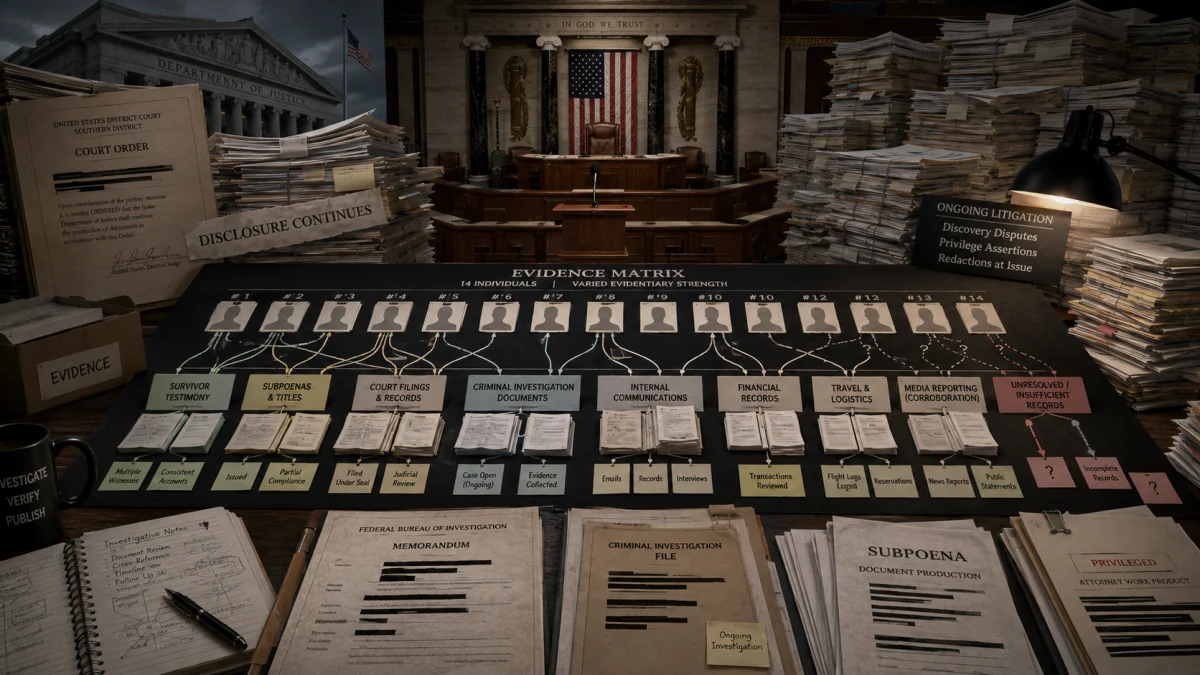
Rep. Thomas Massie did something unusual on the House floor on August 31, 2026: he publicly named 14 people he described as Jeffrey Epstein co-conspirators who should be investigated and prosecuted.
The names were Jes Staley, Leon Black, Les Wexner, David Copperfield, Lapo Elkann, Tom Pritzker, Glenn Dubin, Frédéric Fekkai, Edoardo Teodorani-Fabbri, Jean-Luc Brunel, Daniel Siad, Ramsey Elkholy, Andrew Mountbatten-Windsor—formerly Prince Andrew—and Lesley Groff.
But there is something important missing from the viral version of the story.
Massie did not reveal a single official government “client list,” nor has his office publicly released a document-by-document explanation showing why these particular 14 people meet one common definition of “co-conspirator.”
We looked for that evidence.
What we found is more complicated—and in several cases more serious—than another viral list of Epstein-associated names.
Some people Massie named appear in FBI documents explicitly categorized as co-conspirators. Some were directly accused by women in sworn testimony or federal investigative records. Some were investigated or formally referred for criminal investigation. Some have documentary evidence showing that they recruited or introduced women to Epstein after his 2008 conviction.
And at least one name, Lapo Elkann, currently has a much weaker publicly documented basis for Massie’s characterization than the others.
That discrepancy matters. Not because anyone on the list deserves the benefit of an assumption that the evidence does not support, but because putting a documented alleged recruiter, a person directly accused of rape, and someone merely appearing in Epstein correspondence into one undifferentiated category makes the strongest evidence easier—not harder—to dismiss.
A denial is not evidence. The absence of charges is not an exoneration. And a congressional speech is not proof by itself.
The question is much simpler:
What do the underlying records actually show?
What Massie actually said—and what the viral version gets wrong
Massie said the government continued to withhold more than three million Epstein records and announced a new effort to force a House vote on the Epstein Files Transparency Act II, or H.R. 9694. He then named the 14 people and called for perpetrators to be investigated and prosecuted. He subsequently said he had begun collecting the 218 signatures required for a discharge petition.
Two details should be corrected.
First, Massie said it had been “a year” since the original Epstein Files Transparency Act was signed. President Donald Trump signed the law on November 19, 2025. Massie delivered his speech on August 31, 2026—roughly nine and a half months later, not a year.
Second, the recurring “three million files” formulation is imprecise. DOJ has generally measured its production in pages. In January, the department said it had identified more than six million potentially responsive pages and released nearly 3.5 million pages, along with thousands of videos and images.
Those numerical mistakes do not make the underlying disclosure problem imaginary.
In fact, the legal record is now considerably worse for DOJ than a simple “Massie says one thing, DOJ says another” framing would suggest.
On June 25, U.S. District Judge Emmet Sullivan granted a preliminary injunction in Phang v. Blanche. The court wrote that the Attorney General had “conceded that he is in violation of the Act.” The court also addressed DOJ’s failure to complete review of foreign-language records and its failure to publish the redaction log required by Congress by the December 19, 2025 deadline. DOJ has appealed.
So Massie’s numbers were sloppy. His broader claim that DOJ compliance remains an unresolved—and judicially substantiated—problem was not.
The evidence behind Massie’s 14 names
The most useful way to understand the list is not to ask whether each person “knew Epstein.”
That threshold is nearly meaningless.
The relevant questions are whether the record contains direct allegations of abuse, evidence of recruitment or facilitation, government investigative findings, co-conspirator designations, subpoenas, criminal charges or other evidence showing something beyond social proximity.
| Person | Strongest public evidence identified | Status and response |
|---|---|---|
| Jes Staley | A December 2019 SDNY memorandum titled Investigation into Potential Co-Conspirators of Jeffrey Epstein memorialized a woman’s allegation that Epstein directed her to massage Staley at Epstein’s New York residence and that Staley sexually assaulted and raped her. The memo also referenced contemporaneous Staley-Epstein communications obtained from JPMorgan. | Staley has denied serious sexual-misconduct allegations and recently continued denying knowledge of Epstein’s trafficking while acknowledging extensive contact with him. |
| Leon Black | The same 2019 federal prosecutors’ memorandum recorded an allegation that Epstein directed a woman to massage Black and that Black initiated sexual contact against her will. Other released investigative material records additional allegations and extensive financial dealings between Black and Epstein. | Black has repeatedly denied sexual misconduct and knowledge of Epstein’s trafficking activities. The allegations have not produced an Epstein-related criminal conviction. |
| Les Wexner | An August 2019 FBI document literally placed Wexner under the heading “Secondary co-conspirators.” It says SDNY had contacted his attorneys and served a subpoena. The same record also states there was “limited evidence regarding his involvement.” | Wexner denies knowing about Epstein’s sexual crimes and has portrayed himself as having been deceived and financially exploited by Epstein. His attorneys have said a prosecutor told them he was not considered a target or co-conspirator. That later account does not erase the FBI document. |
| David Copperfield | A 2007 DOJ/FBI record connected Copperfield to an investigation involving Epstein and described him in strikingly close terms. Other released FBI material described a “clear connection” and considered whether the men were referring possible victims to one another. | Copperfield has denied wrongdoing and has said his relationship with Epstein has been exaggerated. The FBI’s concern was real; the public record located here does not establish that investigators proved knowing participation in Epstein’s trafficking operation. |
| Lapo Elkann | A released 2017 email shows Epstein telling an intermediary who was working with Elkann that he could tell Elkann that Epstein and Elkann were friends. | We found no publicly released primary record comparable to the evidence involving Staley, Wexner, Groff, Fekkai, Brunel or Elkholy that establishes why Massie specifically characterized Elkann as a co-conspirator. We also found no public response from Elkann to Massie’s speech as of publication. |
| Tom Pritzker | In sworn testimony connected to Giuffre v. Maxwell, Virginia Giuffre was questioned about Pritzker and stated that she believed she had been with him once, while acknowledging uncertainty about whether there were additional occasions. | Pritzker has called the allegation false and has denied it. The public material does not establish a criminal adjudication against him. |
| Glenn Dubin | Giuffre testified under oath that Ghislaine Maxwell directed her to give Dubin a “massage,” which Giuffre explained in that context meant sex. | Dubin has denied Giuffre’s allegation and denied knowing about Epstein’s criminal conduct. Maxwell also denied sending Giuffre to him. |
| Frédéric Fekkai | Sarah Kellen told House investigators in May 2026 that Fekkai sexually assaulted her. The House Oversight Committee then formally asked DOJ to investigate Fekkai and said he had played a role in Epstein’s grooming system by providing salon services to women at Epstein’s direction. | Fekkai has denied assaulting anyone, denied illegal conduct and denied knowledge of Epstein’s trafficking. The congressional referral remains an allegation requiring criminal investigation, not a conviction. |
| Edoardo Teodorani-Fabbri | DOJ-numbered records document a close relationship with Epstein extending well beyond Epstein’s 2008 conviction, including 2019 travel and social logistics and communications concerning women. | The records justify scrutiny of the relationship. We have not located a public primary record establishing that Teodorani-Fabbri knowingly participated in Epstein’s trafficking operation, nor a public response from him to Massie’s accusation. |
| Jean-Luc Brunel | Brunel was far beyond a social acquaintance. French authorities placed him under formal investigation on allegations including rape of minors and sexual harassment, while investigators scrutinized his role in supplying young women to Epstein. | Brunel denied wrongdoing before his death. He was found hanged in a Paris jail in 2022 and died before the case could be tried. Later reporting on the official investigation continued to support suicide rather than homicide. |
| Daniel Siad | French prosecutors were investigating Siad over allegations involving rape and human trafficking, and his name appears extensively throughout released Epstein material. | Siad denied the allegations. He was found dead at his Paris home in July 2026. The latest prosecutor information we found said the autopsy showed no recent violence, identified health problems including evidence of a prior heart attack, but had not yet established a final cause of death pending further tests. |
| Ramsey Elkholy | Released emails document the modeling agent repeatedly arranging or offering women to Epstein years after Epstein’s sex-offense conviction. In one 2013 exchange, Epstein told Elkholy that the women could not be “just any model” and needed to be reviewed carefully; Elkholy discussed producing 20 to 30 candidates. Other exchanges explicitly discussed Epstein’s age preferences. | Elkholy has acknowledged introducing models to Epstein but says he did nothing illegal, received no payment from Epstein and sometimes exaggerated in crude emails to impress him. Documentary recruitment is established; whether prosecutors could prove the knowledge required for a trafficking offense is a separate evidentiary question. |
| Andrew Mountbatten-Windsor | Virginia Giuffre’s federal complaint directly alleged that Epstein and Maxwell trafficked her to Andrew and that Andrew sexually abused her in New York while she was 17. The complaint also alleged abuse elsewhere. Federal prosecutors separately sought to interview Andrew during the Epstein investigation. | Andrew has denied Giuffre’s allegations. He settled her civil lawsuit in 2022 without an admission of liability. Massie’s declaration that Andrew “committed sex crimes in the United States” is therefore a congressional accusation supported by a direct victim allegation—not an adjudicated U.S. criminal conviction. |
| Lesley Groff | Epstein’s extraordinary 2007 federal non-prosecution agreement explicitly named Groff among his “potential co-conspirators” whom federal prosecutors agreed not to charge under the agreement. | Groff testified to Congress in June 2026 that she was unaware of Epstein’s crimes and declared, “I am not a conspirator.” |
The point of that table is not that every accusation is equally proved.
They plainly are not.
The point is that there is serious documentary material behind a substantial portion of Massie’s list, and in several instances the word “co-conspirator” did not originate on social media or with Massie. It appears inside government records.
Jes Staley: a federal prosecutors’ memo contains a direct rape allegation
Jes Staley’s entry cannot reasonably be reduced to “he knew Epstein.”
A December 19, 2019 SDNY memorandum called Investigation into Potential Co-Conspirators of Jeffrey Epstein summarized evidence gathered after Epstein’s arrest. DOJ’s public Epstein library identifies the memo as EFTA02731082.
The document memorialized a woman’s allegation that Epstein sent her to massage Staley at Epstein’s New York residence and that Staley forced sexual contact and raped her. Prosecutors also noted JPMorgan records containing communications between Staley and Epstein around the relevant period.
Staley has denied serious sexual-abuse allegations. His recent congressional testimony also attempted to minimize aspects of his relationship with Epstein even though the documentary record contains extensive communications between them. House investigators released Staley’s transcript in August.
The allegation was not converted into a criminal charge. That tells us what prosecutors did. It does not tell us that the allegation was disproved.
Those are different statements.
Leon Black: another direct allegation appears in the same prosecutors’ investigation
Leon Black also appears in the 2019 potential-co-conspirators investigation.
The memorandum records a woman’s account that Epstein directed her to massage Black and that Black initiated sexual contact despite her resistance. The investigative material also records what the woman said she learned from another alleged victim.
Black has denied sexual misconduct and denied knowledge of Epstein’s criminal operation.
Again, a denial belongs in the record because readers should know what is contested. A denial is not independent evidence disproving the allegation.
Nor does the failure to charge Black establish that investigators concluded nothing happened. Prosecutors can decline charges because of corroboration problems, jurisdiction, limitations periods, witness issues or inability to prove every element beyond a reasonable doubt.
Les Wexner: the FBI itself used the co-conspirator label
For Les Wexner, there is no need to speculate about whether law enforcement ever viewed him as a possible co-conspirator.
A New York FBI Crimes Against Children/Human Trafficking document from August 2019 placed “Leslie Wexner” beneath the heading “Secondary co-conspirators.”
It says SDNY was communicating with his attorneys, that a subpoena had been served, and that investigators had “limited evidence regarding his involvement.”
Both halves of that record matter.
The FBI did categorize Wexner as a secondary co-conspirator.
The FBI also expressly characterized the evidence then available as limited.
Wexner has denied knowing about Epstein’s abuse and has said Epstein deceived and stole from him. His representatives have additionally said that a federal prosecutor told Wexner’s lawyer that he was not regarded as a co-conspirator or target.
That statement, if accurate, may describe a later prosecutorial assessment. It does not make the earlier FBI document disappear.
David Copperfield: investigators were asking much harder questions than “did he know Epstein?”
The released Copperfield records are considerably more serious than photographs at a dinner party.
A 2007 DOJ record concerning an FBI investigation referenced Copperfield’s relationship with Epstein and described Copperfield in unusually close terms. Other FBI material described a “clear connection” and considered whether Copperfield and Epstein might have referred possible victims to one another.
Those are investigative suspicions, not findings of guilt.
But calling them merely “guilt by association” would be equally inaccurate. Federal investigators were examining a concrete possible relationship between the two men’s conduct.
Copperfield has denied wrongdoing and disputed descriptions of himself as a close Epstein friend.
If Massie has additional records that elevate Copperfield from the subject of serious FBI investigative concern to a person he believes can presently be prosecuted as an Epstein co-conspirator, those records should be published.
Lapo Elkann: this is where Massie’s public evidentiary case is weakest
Lapo Elkann is the clearest problem with treating Massie’s 14 names as though they came from one established government co-conspirator list.
We found a DOJ-numbered 2017 email in which an intermediary told Epstein he had been photographing Elkann. Epstein responded that the intermediary could tell Elkann that Epstein and Elkann were friends.
That establishes an asserted relationship.
It does not establish sex trafficking, recruitment, sexual assault or conspiracy.
After searching the released materials and current reporting, sherafy.com could not identify a public primary document showing why Elkann belongs in the same evidentiary category as people directly accused by survivors, formally identified in co-conspirator records or documented recruiting women for Epstein.
That does not establish that Massie has no such evidence.
It establishes something narrower and important:
Massie has not publicly shown it.
If his office possesses a victim statement, FBI memorandum, Bates-numbered DOJ record or other evidence that supports the accusation, the obvious next step is to release it.
Tom Pritzker: Giuffre made the allegation under oath
Tom Pritzker’s name is supported by more than an Epstein contact book.
In testimony from Giuffre v. Maxwell, Virginia Giuffre was questioned about Pritzker and indicated that she believed she had been with him once, while allowing that it could have been more than once.
Pritzker has denied the allegation and called it false.
The important distinction is straightforward.
There is an underlying sworn allegation. This is therefore not a case where someone’s name merely surfaced in an address book or flight manifest.
But the available public record does not give enough confidence about date, jurisdiction and surrounding evidence to declare that a viable criminal prosecution presently exists.
Glenn Dubin: Giuffre directly described being sent to him
The evidence underlying Glenn Dubin’s inclusion is also a direct allegation.
Giuffre testified that Maxwell instructed her to give Dubin a “massage,” and she expressly explained that, within Epstein’s operation, that meant sex.
Dubin has denied the allegation.
Maxwell separately denied sending Giuffre to Dubin when questioned in her own deposition.
Those denials leave a factual dispute. They do not erase the existence of the sworn testimony.
Frédéric Fekkai: Congress has already formally asked DOJ to investigate him
The Fekkai evidence is both recent and unusually concrete.
On May 21, 2026, former Epstein assistant Sarah Kellen gave a transcribed interview to the House Oversight Committee. She accused celebrity hairstylist Frédéric Fekkai of sexual assault.
On June 4, House investigators sent Acting Attorney General Todd Blanche a formal letter asking DOJ to investigate Fekkai and former Miami Beach mayor Philip Levine. The letter stated that Fekkai had been a close Epstein friend and had played a role in Epstein’s grooming operation by routinely providing salon services to women at Epstein’s direction.
Fekkai has denied assaulting anyone, denied committing illegal acts and denied knowing about Epstein’s trafficking.
What is notable here is that Massie did not have to infer that Fekkai deserved investigation.
A House committee had already formally requested one.
Edoardo Teodorani-Fabbri: extensive post-conviction contact, but the public criminal predicate remains unclear
Released DOJ-numbered communications document Edoardo Teodorani-Fabbri’s continuing and apparently close relationship with Epstein years after Epstein became a registered sex offender.
Records from 2019 show travel arrangements, repeated familiar communications and discussions involving women.
That makes this materially different from an old name appearing once in a Rolodex.
But our primary-document review did not locate a public victim accusation or government record establishing that Teodorani-Fabbri knowingly participated in sex trafficking.
The messages justify investigation.
They do not independently prove the conspiracy Massie alleged.
As with Elkann and Copperfield, Massie should publish the specific records underlying his conclusion.
Jean-Luc Brunel: he was already facing criminal proceedings when he died
Jean-Luc Brunel is one of the least ambiguous names on Massie’s list in terms of whether authorities viewed the allegations as serious enough for criminal proceedings.
The French modeling agent was detained in 2020 and placed under formal investigation on allegations including rape of minors and sexual harassment. French authorities were also investigating his relationship with Epstein and longstanding allegations concerning the movement and recruitment of young women.
Brunel denied wrongdoing.
He was found hanged in his cell at La Santé prison in Paris in February 2022 before trial.
Massie described Brunel as “conveniently” dead by suicide.
There is no public evidence we found that supports turning the word “conveniently” into an allegation of homicide or a cover-up. Later reporting on the French investigation continued to describe his death as suicide, and the criminal proceedings against him ended because a dead defendant cannot be tried.
There is no need to invent a murder theory to make Brunel’s record disturbing.
The documented allegations and criminal investigation are serious enough on their own.
Daniel Siad: under investigation, then found dead in Paris
Daniel Siad, a model scout with extensive appearances in the released Epstein records, was being investigated in France over allegations including rape and human trafficking before he was found dead at his Paris home in July 2026. He denied wrongdoing while alive.
As of September 1, we found no authoritative public announcement establishing a final cause of death.
The latest prosecutor information reported after the autopsy said investigators found no sign of recent violence. Siad had significant health problems, and the autopsy reportedly showed evidence of a previous heart attack, while toxicology and additional testing remained pending.
That is where the evidence currently stops.
Anyone claiming the death was a murder, suicide or deliberate silencing event needs evidence that has not yet been publicly established.
Ramsey Elkholy: the emails document recruitment, not just friendship
Ramsey Elkholy presents a different type of evidence.
Released emails document Elkholy repeatedly communicating with Epstein about models and women long after Epstein’s 2008 conviction.
In a 2013 exchange, Epstein told Elkholy that proposed models could not simply be arbitrary candidates and said they needed to be reviewed carefully. Elkholy discussed the difficulty of assembling 20 to 30 suitable women. Other communications reflected knowledge of Epstein’s preferences regarding age.
The Washington Post reported after reviewing more than 100 emails that Elkholy acknowledged introducing five or six models to Epstein. Elkholy said he did nothing illegal, was not paid by Epstein and sometimes exaggerated or wrote crude messages to impress him.
That distinction is important for prosecution, but not because the correspondence is harmless.
The recruitment activity itself is documented.
The unresolved criminal question is whether evidence can establish that Elkholy knew, or under the legally applicable version of federal law recklessly disregarded, that the women he was directing toward Epstein would be subjected to unlawful commercial sexual activity.
That is a question for investigators with access to the full record—not a reason to pretend the emails are merely social.
Andrew Mountbatten-Windsor: a direct U.S. allegation exists
Massie went further with Andrew than with the other names, declaring that the former prince had committed sex crimes in the United States.
There is substantial underlying evidence explaining why Andrew appears on the list.
Virginia Giuffre filed a federal civil complaint in New York alleging that Epstein and Maxwell trafficked her to Andrew and that Andrew sexually abused her at Epstein and Maxwell’s invitation while she was 17. The complaint specifically alleged conduct in New York as well as overseas.
Federal prosecutors also publicly accused Andrew in 2020 of repeatedly declining requests to cooperate with the Epstein investigation despite his public claims that he was willing to assist.
Andrew has consistently denied Giuffre’s account. He settled her civil case in 2022 without admitting liability.
Massie is therefore not inventing the existence of a U.S. allegation.
But sherafy.com should not convert Massie’s congressional declaration into a criminal judgment that no American criminal court has made.
There is a direct victim allegation.
There is a documented U.S. location.
There was federal investigative interest.
There has not been a U.S. criminal conviction.
All four can be true simultaneously.
Lesley Groff: the government literally named her a “potential co-conspirator”
Lesley Groff’s inclusion has perhaps the clearest primary-document answer.
Epstein’s infamous 2007 federal non-prosecution agreement did not merely grant favorable treatment to Epstein.
It also said the United States would not institute criminal charges against Epstein’s “potential co-conspirators,” explicitly naming Sarah Kellen, Adriana Ross, Lesley Groff and Nadia Marcinkova.
Groff testified before Congress in June 2026 that she had no knowledge of Epstein’s criminal operation. She said Epstein had manipulated her and objected strongly to the government having labeled her a potential co-conspirator, telling lawmakers: “I am not a conspirator.”
Massie went further, calling Groff “not a victim” and accusing her of conspiring to traffic women.
The first part is unnecessary and too categorical based on the public record.
Victimization and facilitation are not logically mutually exclusive. Epstein’s network contained women who have described being abused or coerced themselves while also being accused of recruiting or facilitating access to other victims.
The stronger point needs no embellishment:
Federal prosecutors themselves explicitly included Groff by name in a non-prosecution provision covering Epstein’s potential co-conspirators.
That is a primary document, not an internet theory.
Why these 14? Massie has not publicly explained the standard
After reviewing Massie’s legislative materials, prior correspondence, released Epstein files, court records and current reporting, we could not locate a public Massie document that does the thing readers now most need:
Name → Bates number or case number → alleged conduct → reason Massie considers that person an Epstein co-conspirator.
Massie and Rep. Ro Khanna had already asked DOJ in January for access to unredacted victim FBI 302 reports, the draft 2007 indictment, the prosecution memorandum and other records necessary for congressional oversight. That means Massie has been actively seeking deeper source material than what the public can easily search.
But that still does not tell us why these exact 14 names were chosen.
And the list plainly does not come from one existing government document.
Consider two simple examples.
The 2007 non-prosecution agreement names not only Groff but also Kellen, Ross and Marcinkova as potential co-conspirators. Massie named Groff, not the other three.
The House Oversight Committee’s June 2026 criminal-investigation referral concerned both Frédéric Fekkai and Philip Levine. Massie named Fekkai, not Levine.
That does not make Massie’s list illegitimate.
It establishes that the 14 names are a curated selection assembled from different bodies of evidence rather than one official Epstein co-conspirator roster.
The public evidence suggests at least four different categories.
There are people directly accused by survivors in sworn testimony or federal investigative records.
There are people explicitly categorized as possible co-conspirators or subjected to formal criminal investigation.
There are people for whom documents show recruitment, facilitation or serious investigative concern.
And there are people, most notably Lapo Elkann, for whom Massie’s precise evidentiary basis remains publicly unexplained.
If Massie has a unifying criterion and supporting source packet, he should publish it.
Doing so would strengthen—not weaken—the demand for accountability.
No, this is not an “Epstein client list”
The phrase “Epstein client list” is becoming an all-purpose label for almost any collection of famous names found in Epstein-related documents.
It is a poor description of what Massie presented.
The 14 names do not share one documented status.
A person appearing in an email is not automatically equivalent to a person accused by a survivor.
A person accused by a survivor is not automatically equivalent to someone formally charged with a crime.
An FBI investigative label is not a criminal conviction.
And someone repeatedly recruiting women for Epstein after his sex-offense conviction presents a dramatically different evidentiary question from someone appearing once in correspondence.
Those distinctions do not protect powerful people.
They stop weak evidence from being used to discredit strong evidence.
If everything is called proof, then nothing is being graded for proof.
The Epstein record deserves better than that.
Could the living people Massie named still be prosecuted?
Potentially, yes.
But there is no intellectually serious one-sentence answer.
A common claim online is that “sex trafficking has no statute of limitations, so they can all still be prosecuted.”
Current federal law does provide that an indictment may be brought “at any time without limitation” for a Section 1591 sex-trafficking offense and several other specified federal sexual offenses. Congress added that provision in 2006.
That does not mean modern law can simply be pasted backward over every alleged act connected to Epstein.
Section 1591 itself changed substantially over time. Congress enacted it in 2000, changed its knowledge and recklessness provisions in 2008, and in 2015 expressly expanded the statutory language to include conduct such as patronizing and soliciting.
Prosecutors must therefore determine what law existed when the conduct allegedly occurred, what elements applied, where it happened, whether federal jurisdiction exists and whether the limitations period applicable at the relevant time expired.
The Supreme Court’s 2003 decision in Stogner v. California creates another hard constitutional boundary: the government cannot simply enact a new criminal limitations period and use it to revive a prosecution that was already time-barred.
So the useful answer is this:
| Person | Could prosecution still be possible? | Central unresolved issue |
|---|---|---|
| Jes Staley | Potentially. The public allegation includes conduct said to have occurred in New York. | Exact date, corroboration, applicable federal/state offense and limitations history must be established. |
| Leon Black | Potentially, depending on which allegation and date prosecutors examine. | Different allegations involve different time periods and potentially different limitations problems. |
| Les Wexner | Impossible to determine responsibly from the currently public facts. | The public record does not identify a sufficiently specific criminal act, date and jurisdiction. |
| David Copperfield | Potentially only if additional evidence establishes a prosecutable offense or conspiracy. | Earlier allegations involved jurisdictional problems, including conduct outside the United States; the FBI’s suspicion alone does not supply every criminal element. |
| Lapo Elkann | No responsible conclusion can presently be reached. | Massie’s underlying criminal factual predicate has not been publicly demonstrated. |
| Tom Pritzker | Unknown. | The public allegation lacks sufficiently precise date/location facts for a confident limitations and jurisdiction analysis. |
| Glenn Dubin | Unknown to potentially viable depending on underlying facts. | Exact conduct, date, location, corroboration and applicable law remain essential. |
| Frédéric Fekkai | A present investigation is clearly possible—the House has already requested one. | Kellen’s allegation appears to concern conduct around 2000–2001; prosecutors would have to determine the specific offense and historical limitations law, including Hawaii law if appropriate. |
| Edoardo Teodorani-Fabbri | Undetermined. | Public records show concerning association but do not yet provide a sufficiently defined alleged criminal offense. |
| Ramsey Elkholy | Potentially significant if investigators can establish knowing participation in trafficking. | Emails establish recruitment activity; criminal liability would still require proof of the knowledge or recklessness required by the version of Section 1591 applicable at the time. |
| Andrew Mountbatten-Windsor | Potentially, depending on offense, evidence and limitations analysis. | Giuffre alleged New York conduct, but prosecutors must apply the criminal statutes in force during the alleged 2001-era conduct rather than later-expanded law. |
| Lesley Groff | Potentially complicated rather than automatically impossible. | Epstein’s non-prosecution agreement expressly named her, but its geographical and legal reach is not unlimited. |
Brunel and Siad are dead and therefore cannot be criminally prosecuted.
None of this prevents prosecutors from investigating conduct merely because the ultimate charging analysis may be difficult.
Quite the opposite.
The way to determine whether a viable prosecution exists is to investigate the evidence and apply the law—not to decide in advance that a wealthy or prominent suspect is untouchable because the case is old.
Groff’s non-prosecution agreement is a real obstacle—but not necessarily a nationwide shield
Groff presents a distinct legal problem because the federal government made an astonishingly broad promise in Epstein’s 2007 non-prosecution agreement.
The agreement expressly said the United States would not institute criminal charges against Epstein’s potential co-conspirators and specifically named Groff.
That is not something prosecutors can casually pretend never happened.
But it also should not be exaggerated into permanent worldwide immunity from every conceivable prosecution.
Ghislaine Maxwell attempted to use the same agreement to block her later federal prosecution in New York. The Second Circuit rejected that argument, holding that the Southern District of Florida agreement did not bind the Southern District of New York in Maxwell’s prosecution.
Groff’s position would not necessarily be identical to Maxwell’s because Groff was expressly named in the agreement.
That makes the contractual argument stronger.
But the Maxwell litigation demonstrates that the NPA is not automatically a magic sentence barring every prosecutor everywhere from bringing every charge.
Nor could a federal U.S. Attorney’s non-prosecution commitment automatically prevent a state from enforcing its own criminal law unless some separate legal rule applies.
That is precisely why giving state prosecutors lawful access to the federal Epstein evidence could matter.
DOJ’s Epstein-files compliance is not merely “disputed”
The disclosure fight has advanced well beyond dueling press releases.
On January 30, DOJ announced that it had published nearly 3.5 million responsive pages and described the release as compliance with the Epstein Files Transparency Act. DOJ said other collected material consisted of duplicates, unrelated records, privileged material and records falling within statutory exceptions.
Then came Phang v. Blanche.
The original Act required covered records and a redaction log by December 19, 2025. The lawsuit challenged, among other things, the continued redaction of potential co-conspirator names, underlying FBI material, unreviewed foreign-language records and the missing redaction log.
On June 25, Judge Emmet Sullivan granted a preliminary injunction.
His opinion did not merely say that a journalist disagreed with DOJ.
It said:
“The Attorney General conceded that he is in violation of the Act.”
The court separately observed that DOJ had not completed review of foreign-language documents and that the statutory deadline for those records and the redaction log had passed more than six months earlier. The judge declined DOJ’s request to stay the preliminary relief.
That order is preliminary rather than a final judgment resolving every disputed document.
But pretending DOJ’s assertion of full compliance remains an uncontested fact is no longer defensible.
DOJ filed a notice of appeal in August, and the appeal is proceeding in the D.C. Circuit. The underlying litigation also remains active.
Meanwhile, DOJ’s own Office of Inspector General opened an audit on April 23 examining how the department identified and collected responsive records, how it made redaction and withholding decisions, and how it addressed problems discovered after publication.
So where does the “three million” claim stand?
There is a several-million-page difference between the universe DOJ said it collected as potentially responsive and the approximately 3.5 million pages it publicly released.
That does not prove that every page in the difference was legally required to be published.
It also does not mean DOJ can simply declare the matter closed.
A federal judge has already entered preliminary relief over admitted noncompliance, DOJ has appealed, and the department’s inspector general is auditing the process.
That is the current state of the evidence.
What Epstein Files Transparency Act II would actually do
Massie, Khanna and their Senate and House allies introduced the Epstein Files Transparency Act II in July as H.R. 9694.
The legislation is designed primarily to solve an enforcement problem exposed by the first law.
It would give state attorneys general, Epstein victims and members of Congress standing to challenge DOJ failures to comply with the disclosure law. It would expand access to unredacted material for victims and authorized state prosecutors and make it harder for DOJ to rely on broad common-law privileges that are not among Congress’s specified disclosure exceptions.
That could matter enormously for prosecution.
The federal government does not own every criminal case in America.
If evidence in DOJ’s possession describes conduct violating state rape, sexual-assault, trafficking, kidnapping or related statutes, state prosecutors need access to determine whether their own laws can still be enforced.
EFTA II does not, however, automatically convict or prosecute someone because their name appears in an Epstein record.
And it does not magically make an expired criminal limitations period constitutional again.
Its practical importance is that it could give survivors and state law-enforcement authorities access to evidence that the federal government has controlled.
The new discharge petition: no verified House Clerk count yet
Massie said on August 31 that he had begun collecting signatures for a discharge petition intended to force H.R. 9694 to the House floor.
A discharge petition requires 218 signatures.
As of sherafy.com’s September 1 check, the House Clerk’s public discharge-petition database did not display an H.R. 9694 or Epstein Files Transparency Act II petition entry. Searches of the Clerk page for both “9694” and “Epstein” returned no matching entry.
For that reason, we are not publishing social-media claims about the current signature count as though they were official House numbers.
Massie says the collection process has begun. The Clerk has not yet provided a public count we can independently verify.
That status can change quickly.
Massie should publish the Bates-number map
Massie has forced an issue that much of Washington plainly would have preferred to leave buried under millions of documents, redactions, procedural fights and endless arguments over what counts as evidence.
There is now also hard evidence that the federal disclosure process has not been as complete as DOJ once publicly represented. A federal judge granted preliminary relief after recording the Attorney General’s concession of statutory noncompliance.
But accountability requires the same evidentiary standard in every direction.
If Massie is going to stand on the House floor and tell the country that 14 identifiable people are Epstein co-conspirators who should be prosecuted, the evidence supporting each accusation should be public wherever victim privacy and lawful redactions permit it.
Not a vague statement that their names are “in the files.”
Not a compilation of flight logs.
Not an address book.
Publish the map:
Name → DOJ Bates number or court record → alleged conduct → witness or documentary evidence → law-enforcement action.
For several of the people Massie named, much of that map can already be reconstructed.
For Staley, there is a federal prosecutors’ memorandum containing a direct sexual-assault allegation.
For Black, the same investigation contains a direct allegation.
For Wexner, an FBI document actually uses the co-conspirator label.
For Fekkai, a congressional witness made an allegation and the House formally asked DOJ to investigate.
For Groff, the federal government itself expressly named her as a potential co-conspirator in Epstein’s non-prosecution agreement.
For Brunel and Siad, there were actual criminal investigations overseas.
For Elkholy, there are years of emails documenting the recruitment and introduction of women to Epstein after his sex-offense conviction.
For Andrew, there is a direct victim allegation describing conduct in New York and a documented federal attempt to obtain his testimony.
But for Lapo Elkann—and to a lesser extent Edoardo Teodorani-Fabbri—the publicly available evidence we found does not yet explain why Massie placed them in the same category.
That is not a reason to disregard the rest of the list.
It is a reason to demand the missing evidence.
The bottom line
Thomas Massie did not expose a newly authenticated “Epstein client list.”
He did something more specific: he named 14 people he believes should be investigated and prosecuted as Epstein co-conspirators.
There is substantial primary-source evidence supporting serious scrutiny of many of those names.
Some were directly accused by survivors.
Some appear in formal law-enforcement co-conspirator records.
Some were under criminal investigation.
Some have documented recruitment or facilitation activity.
Some remain the subjects of allegations that were never adjudicated.
And at least one currently lacks a publicly demonstrated evidentiary basis comparable to the others.
The correct response is neither to declare everyone guilty because a congressman said their names nor to hide behind the equally dishonest claim that nothing matters unless DOJ already secured a conviction.
Investigate the evidence. Release the lawful records. Let state prosecutors see what the federal government has. Follow the allegations wherever they lead. And if Massie has primary documents supporting all 14 accusations, publish them.
The Epstein scandal has already shown what happens when prosecutors grant extraordinary protection, investigations stall, records remain hidden and powerful networks are treated as peripheral to the crimes occurring around them.
There is no legitimate public interest in repeating that history.
References and Further Reading
-
Thomas Massie — Epstein Files Transparency Act II: — Official congressional description of H.R. 9694 and its proposed enforcement mechanisms.
-
Massie and Khanna — January 2026 records request: — Shows the lawmakers seeking FBI 302s, the draft indictment and other records before Massie’s August speech.
-
DOJ Epstein Library — Data Set 12: — Official DOJ index containing EFTA02731082, the 2019 potential-co-conspirators prosecutors’ memorandum.
-
FBI co-conspirator record — EFTA00175080: 2019 FBI Epstein co-conspirators memorandum — FBI record placing Les Wexner under “Secondary co-conspirators” while also noting limited evidence at that stage.
-
Copperfield-related DOJ record — EFTA00013506: DOJ Epstein file EFTA00013506 — Primary federal record concerning investigators’ interest in David Copperfield’s relationship with Epstein.
-
House Oversight — Fekkai investigation referral: — Primary congressional referral following Sarah Kellen’s 2026 testimony.
-
Giuffre v. Andrew: — Primary civil filing alleging that Epstein and Maxwell trafficked Giuffre to Andrew and describing alleged New York conduct.
-
Epstein non-prosecution agreement: — Shows Groff, Kellen, Ross and Marcinkova explicitly named in the agreement.
-
Groff’s 2026 congressional testimony: — Records Groff’s denial that she knowingly conspired in Epstein’s crimes.
-
Phang v. Blanche: June 25, 2026 preliminary-injunction opinion in Phang v. Blanche — Critical current ruling documenting the Attorney General’s concession of noncompliance with the Epstein Files Transparency Act.
-
DOJ Inspector General: — Ongoing independent review of collection, production, redaction, withholding and post-release problems.
-
DOJ January 30 production announcement: — DOJ’s official account of the scale of its production and reasons for material it did not publish.
-
18 U.S.C. § 1591: Federal sex-trafficking statute and amendment history — Important because the statute’s elements changed during the period covered by Epstein-related allegations.
-
18 U.S.C. § 3299: Federal statute eliminating limitations periods for specified sex offenses — Current federal limitations provision covering Section 1591 and other enumerated offenses.
-
Stogner v. California: U.S. Supreme Court decision on reviving expired criminal limitations periods — Establishes the constitutional problem with retroactively reviving an already time-barred criminal prosecution.
-
Jean-Luc Brunel: — Background on the formal criminal proceedings pending when Brunel died.
-
Daniel Siad: — Supports the current conclusion that no final public cause of death has been established and that the autopsy showed no recent violence.
Editorial currency note: This investigation reflects records and docket information available through September 1, 2026. The H.R. 9694 discharge petition, Phang v. Blanche litigation, DOJ Inspector General audit, state investigations and newly released Epstein records are active matters. This article should be updated when the House Clerk posts the petition, the D.C. Circuit acts in Phang, the OIG publishes findings, prosecutors announce charging decisions, or additional primary records materially change the evidence concerning any individual.