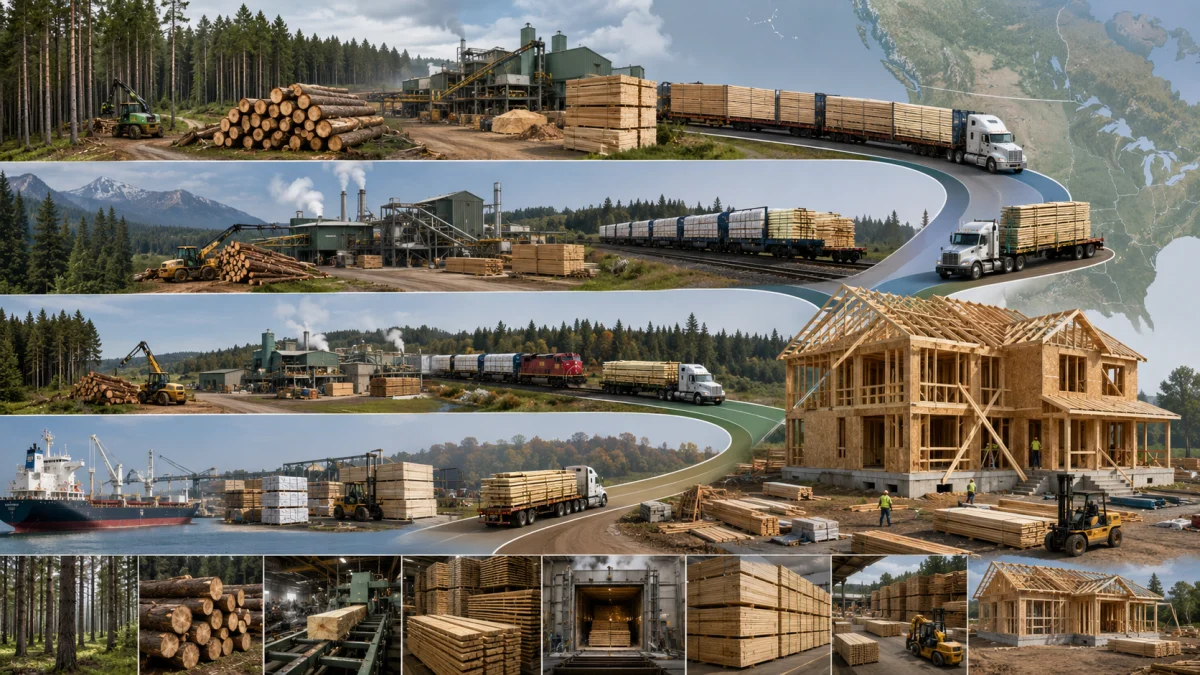
The United States imports so much lumber from Canada not because America is running out of trees, but because trees are only the first input in a much longer industrial supply chain.
A forest has to contain commercially useful timber. That timber has to be accessible and economical to harvest. Logs have to reach a sawmill capable of turning them into the right dimensions and grades of structural lumber. The lumber then has to be dried, planed, graded and transported to the places where houses are actually being built.
Canada already has an enormous industry built to do exactly that for the U.S. market.
In 2022, Americans consumed about 53 billion board feet of softwood lumber. U.S. producers supplied 68.7% of it. Canada supplied 24.1%, or nearly 12.8 billion board feet. Other countries supplied the remaining 7.2%. (US ITC)
So the apparent contradiction is real:
How can a country with more than 765 million acres of forest still import roughly one-fifth to one-quarter of its construction lumber from Canada?
Because:
forest acreage ≠ harvestable timber ≠ sawmill capacity ≠ finished lumber where builders need it.
And there is an important second part to the answer.
The United States appears to have enough biological timber growth to replace much of its Canadian lumber supply over time. What it does not have is the ability to turn an additional 10 or 12 billion board feet of domestic timber into finished construction lumber overnight.
That distinction explains almost the entire U.S.-Canada lumber relationship.
America Really Does Have an Enormous Amount of Forest
There is no need to minimize the premise.
The United States Forest Service counts more than 765 million acres of planted and natural forest land, plus another 58 million acres classified as woodland. Forest covers roughly a third of the country. (US Forest Service R&D)
But pointing to all 765 million acres tells us surprisingly little about how much lumber American sawmills can economically produce.
The Forest Service uses a narrower category called timberland: unreserved forest capable of producing at least 20 cubic feet of industrial wood per acre per year. About 514 million acres, or roughly two-thirds of U.S. forest land, met that definition in the Forest Service’s national sustainability assessment. (Forest Service)
Even "timberland" does not mean a forest is immediately available to make two-by-fours.
Trees may be too far from a mill. Harvesting may be uneconomical. A region may lack logging crews or trucks. A mill may need a different species or log diameter. Transportation costs may erase the advantage of cheap timber. Some mills may lack profitable markets for wood chips and other residual products that are an important part of sawmill economics.
A standing tree has a long way to go before it becomes part of a wall.
A tree is not a two-by-four
The actual supply chain looks more like this:
forest
↓
commercially usable timber
↓
logging
↓
log transportation
↓
sawmill
↓
drying and planing
↓
structural grading
↓
rail or truck transportation
↓
lumber distributor or lumberyard
↓
construction site
That is the first key to the paradox.
America can simultaneously have enormous forests and an economic reason to import finished lumber.
How Much U.S. Lumber Actually Comes From Canada?
There is an important terminology point here.
The long-running Canada trade dispute concerns primarily softwood lumber: the structural lumber produced from conifer species such as spruce, pine, fir and Douglas fir and heavily used in wood-frame construction.
It does not mean one-quarter of every wood product Americans buy originates in Canada.
The U.S. International Trade Commission’s 2022 market data provide one of the clearest official snapshots:
| Source | Share of U.S. softwood-lumber consumption |
|---|---|
| U.S. producers | 68.7% |
| Canada | 24.1% |
| Other foreign suppliers | 7.2% |
Total U.S. consumption was approximately 53.0 billion board feet, including about 12.8 billion board feet imported from Canada. (US ITC)
Canada’s share has also been declining.
West Fraser, one of North America’s largest lumber producers, reported that industry data showed Canadian mills supplying approximately 25% of U.S. lumber consumption from 2020 through 2024. The company’s disclosures also describe a North American industry in which Canadian production has been contracting while substantial mill capacity has shifted toward the U.S. South. Because West Fraser is itself a major producer on both sides of the border, those figures are useful current industry data rather than neutral evidence about trade policy.
The durable answer, therefore, is:
Canada has supplied roughly one-fifth to one-quarter of U.S. softwood-lumber consumption in recent years, although that share has been trending downward.
Where Does the Rest of America’s Lumber Come From?
The domestic industry is increasingly centered in the South.
According to data cited by the USITC, in 2022:
- 58.6% of U.S. softwood-lumber production came from the South;
- 37.2% came from the West;
- about 4.2% came from other U.S. regions. (US ITC)
That produces a useful mental map of an American house.
A framing package could include:
U.S. South → Southern yellow pine
Pacific Northwest → Douglas fir, Hem-fir and other western species
Canada → primarily spruce-pine-fir
Europe and elsewhere → supplemental imported softwoods
The United States is not choosing between "American forests" and "Canadian forests." Builders purchase from a continental network of mills producing interchangeable and semi-interchangeable products at different locations and prices.
Why Canada Became Such a Huge Lumber Supplier
Canada does not merely have a lot of trees.
It has a massive softwood-lumber industry designed around turning those trees into construction material and exporting it.
Statistics Canada reported that about 98% of Canadian lumber production in 2024 was softwood. Of approximately 47.9 million cubic meters of softwood produced that year, about 42.8 million cubic meters consisted of spruce, pine and fir. More than 58% of Canada’s softwood-lumber production was exported to the United States. (Statistics Canada)
Natural Resources Canada says most Canadian dimension lumber is produced from the species grouping known as spruce-pine-fir, or SPF, while Southern yellow pine is a major U.S. counterpart. (Natural Resources Canada)
Over decades, Canadian lumber companies built:
- sawmills;
- kilns;
- planing facilities;
- grading systems;
- rail connections;
- trucking networks;
- distribution relationships;
- U.S. customer bases.
The U.S. International Trade Commission has specifically pointed to Canadian producers’ existing infrastructure, logistics and customer relationships as reasons they can serve the American market at scale. (US ITC)
That infrastructure matters just as much as the forests themselves.
If an established Canadian mill can place a trainload of graded SPF lumber into an American distribution network more economically than a hypothetical new U.S. mill that has not yet been built, the fact that America has unused tree growth somewhere else does not solve the immediate supply problem.
Is Canadian Lumber Better Than American Lumber?
Not in the simplistic way this question is sometimes answered online.
Canadian SPF is extremely well suited to residential construction. It is widely available, relatively light and produced at enormous scale.
But American forests also produce excellent structural lumber.
Southern yellow pine is one of the country’s dominant construction species. The American Wood Council notes that Southern Pine can be stronger and stiffer than spruce in relevant structural applications, although exact design properties depend on species grouping, grade, dimensions and intended use. (American Wood Council)
A 2024 peer-reviewed study examined the relationship between Canadian SPF and U.S. Southern yellow pine prices and found significant evidence of substitution between the two, particularly when their prices were relatively close. (US Forest Service R&D)
So the explanation is not:
Canada has special trees America cannot replace.
Species certainly matter. Building codes and structural designs require particular engineering properties and grades. A contractor cannot arbitrarily substitute one piece of lumber for another.
But Canadian lumber’s market share is primarily an industrial and economic phenomenon, not proof that American forests grow inferior construction timber.
Could the United States Produce Enough Lumber Without Canada?
Probably—eventually.
This is where the question becomes much more interesting.
Forisk, a forestry research and consulting firm, examined what it would take for the United States to replace its Canadian softwood-lumber imports.
It estimated that the United States was importing roughly 12 billion board feet of lumber from Canada and that domestic mills would need roughly 50 million additional tons of logs per year to replace that volume.
Forisk then compared that requirement with U.S. Forest Service timber data.
As of its underlying 2019-2020 Forest Service data, private U.S. timberlands were producing approximately 96 million tons per year of net softwood sawtimber growth—wood added each year after removals—with most of that surplus concentrated in the South.
Its conclusion was straightforward: the raw timber resource appears to exist. (Forisk)
That means America’s dependence on Canadian lumber is not fundamentally equivalent to a country importing a natural resource it simply does not possess.
The bottleneck comes afterward.
Replacing approximately 12 billion board feet of Canadian production would require some combination of:
- new sawmills;
- expansion of existing mills;
- billions of dollars of capital;
- logging equipment;
- skilled mill workers;
- additional logging crews;
- trucks and rail capacity;
- drying and finishing equipment;
- reliable markets for mill residuals;
- distribution capacity into regions far from the Southern timber base.
Forisk notes that the South added nearly 11 billion board feet of sawmill capacity between 2009 and 2024. That proves major expansion is possible.
It also proves the point.
It took 15 years of investment to add an amount of capacity roughly comparable to the volume the United States currently imports from Canada. (Forisk)
So Is the United States Actually Dependent on Canadian Lumber?
It depends on what "dependent" means.
Is America biologically dependent on Canadian forests?
No.
The United States possesses enormous timber resources and substantial unused net softwood growth.
Could America eventually replace most Canadian lumber?
Probably.
The biological resource appears sufficient, particularly in the South, although doing so economically would require substantial additional industrial investment.
Could America eliminate Canadian lumber tomorrow without disruption?
No.
Canadian mills still supply a material share of the U.S. market. Removing billions of board feet of established supply faster than domestic or alternative foreign production could replace it would put upward pressure on prices and force buyers to compete for a smaller supply.
The best way to describe the relationship is:
America can replace Canadian lumber much more easily than it can replace Canada overnight.
Then Why Aren’t U.S. Sawmills Already Running at Full Capacity?
This creates another apparent contradiction.
If America is importing billions of board feet from Canada, shouldn’t every American mill be operating flat out?
They aren’t.
NAHB’s analysis of Federal Reserve and Census data put U.S. sawmill capacity utilization at about 71.8% in the first quarter of 2026. It also estimated that total theoretical sawmill capacity had fallen about 6% over the previous year. (National Association of Home Builders)
But an idle percentage point of sawmill capacity is not necessarily waiting for someone to push a green button.
A mill can technically possess capacity while still being unable to operate it profitably.
It may face:
- expensive or insufficient nearby logs;
- labor shortages;
- weak lumber prices;
- aging equipment;
- transportation constraints;
- high electricity or operating costs;
- inadequate demand;
- lost markets for chips, bark and other residual material.
West Fraser provides a useful real-world illustration.
The company permanently closed its Augusta, Georgia lumber mill in 2025, citing weak lumber demand and the loss of economically viable outlets for residual products. It closed a mill in British Columbia because it could no longer reliably obtain enough economically viable timber.
Same industry. Two countries. Two different bottlenecks.
That is why "unused sawmill capacity" does not automatically mean "unused cheap lumber."
Why Has the U.S. and Canada Lumber Fight Lasted for Decades?
Because the two countries do not organize their timber industries the same way.
This dispute goes back to the early 1980s.
One of the central differences involves ownership of the forests.
About 94% of Canada’s forest land is publicly owned, mostly by provincial and territorial governments. Companies generally receive rights to harvest public timber and pay government-established royalties or stumpage charges under provincial systems. (Natural Resources Canada)
A much larger share of commercially important U.S. timber is privately owned and bought and sold through private markets.
American lumber producers have long argued that Canadian provincial systems allow Canadian mills to obtain timber for less than a genuine market price, effectively subsidizing their production.
U.S. authorities have repeatedly sided with the American industry under U.S. trade law.
The Department of Commerce has found Canadian softwood lumber to be subsidized and, in some cases, dumped into the U.S. market. In 2017 the USITC concluded that Canadian imports materially injured the U.S. industry; in its subsequent five-year review, the commission concluded that removing the orders would likely lead to continuation or recurrence of material injury. (US ITC)
Those are verified legal determinations.
But they do not completely settle the broader economic question.
Is Canadian Lumber Really Subsidized?
Under U.S. trade law, Commerce has determined that certain Canadian softwood-lumber production receives countervailable subsidies.
That is a fact.
But a broader statement such as "Canada simply gives its lumber companies trees below market price" leaves out important complications.
The Congressional Research Service reviewed the longstanding stumpage dispute and described evidence of a U.S.-Canada pricing disparity as inconclusive.
Why?
Because straightforward comparisons are difficult.
Canadian and American timber can differ in:
- tree species;
- log sizes;
- grades and quality;
- measurement systems;
- harvesting obligations;
- road-building requirements;
- reforestation responsibilities;
- environmental obligations;
- forest-protection costs.
CRS noted that some analyses have found Canadian stumpage fees higher, others have found U.S. fees higher, and government investigations have reached different conclusions depending on methodology and period examined. (Congress.gov)
So both of these statements can simultaneously be true:
Verified legal fact: U.S. authorities have determined that Canadian lumber receives subsidies as defined under U.S. trade law.
Broader economic reality: Comparing the actual economic value of Canadian public timber rights with U.S. private stumpage transactions is more complicated than comparing two posted prices.
That distinction is largely lost in political arguments over lumber.
What Tariffs Does Canadian Lumber Face Now?
This is the part of the article most likely to change.
As of September 1, 2026, certain Canadian softwood-lumber imports face two separate layers of U.S. trade restrictions.
First are longstanding antidumping and countervailing duties, which vary by producer.
Current sixth-review combined cash-deposit rates include:
| Canadian exporter | Antidumping + countervailing rate |
|---|---|
| Canfor | 47.59% |
| West Fraser | 26.47% |
| "All others" rate | 35.16% |
Those are not the only possible rates because companies can have different histories under the trade orders. (Global Affairs Canada)
The Commerce Department has also issued lower seventh-review preliminary and post-preliminary figures, but those rates have not yet taken effect as of this article’s publication. (Global Affairs Canada)
Separately, the United States imposed a 10% Section 232 tariff on specified softwood timber and lumber beginning October 14, 2025. The presidential proclamation made that duty additional to otherwise applicable duties, including relevant antidumping and countervailing duties.
That is why saying:
"The tariff on Canadian lumber is X%"
is often inaccurate.
There is no single universal tariff rate that applies identically to every Canadian lumber producer.
Who Actually Pays the Tariff?
At the border, the legal answer is simple.
The U.S. importer is responsible for paying the tariff to the U.S. government.
The economic answer is much more complicated.
The importer can try to recover that cost through a higher selling price. The Canadian producer may accept lower margins to preserve market share. U.S. producers may increase prices because their Canadian competition has become more expensive. Builders may substitute different lumber. European exporters may gain market share. Buyers may delay purchases. Mills may increase domestic production.
Economists call this tariff incidence: who ultimately bears the economic cost after the market adjusts.
That is different from asking whose name appears on the customs paperwork.
Do Tariffs on Canadian Lumber Raise U.S. Lumber Prices?
Generally, yes.
But a 25% tariff does not mean lumber prices automatically rise 25%.
A Forest Service-published economic model examined the effects of a 20.83% U.S. tariff on Canadian softwood lumber. Its long-run simulations estimated:
- Canadian lumber imports falling roughly 4.7% to 8.0%;
- U.S. lumber production increasing roughly 0.9% to 1.7%;
- U.S. lumber prices increasing roughly 0.3% to 2.3%. (US Forest Service R&D)
That result illustrates what happens after a tariff enters a real market.
Domestic producers respond.
Other exporters respond.
Consumers respond.
Canadian producers respond.
Supply shifts.
Demand shifts.
Inventories matter.
So the tariff rate and the resulting change in the retail or wholesale price of lumber are two different numbers.
That does not make the tariff free to Americans. It means its cost is distributed through a market rather than mechanically added to every two-by-four.
How Much Lumber Is in a Typical New House?
This is where the scale becomes tangible.
Surveys conducted by Home Innovation Research Labs and cited by the National Association of Home Builders estimate that an average new single-family home uses roughly:
- 15,000 board feet of framing lumber;
- more than 2,200 square feet of softwood plywood;
- more than 6,800 square feet of oriented strand board, or OSB. (National Association of Home Builders)
Fifteen thousand board feet gives us a useful way to test claims about lumber-price increases.
Lumber prices are commonly expressed per 1,000 board feet.
So:
15,000 board feet ÷ 1,000 = 15
That means every $1 change per thousand board feet corresponds to about $15 across 15,000 board feet of lumber.
Or:
| Increase in lumber price | Arithmetic across 15,000 board feet |
|---|---|
| $50 per 1,000 board feet | $750 |
| $100 per 1,000 board feet | $1,500 |
| $200 per 1,000 board feet | $3,000 |
| $500 per 1,000 board feet | $7,500 |
So if framing lumber throughout a typical house genuinely costs $100 more per thousand board feet, the direct arithmetic across 15,000 board feet is approximately:
$1,500
That is not the same as saying the final sale price of the home must rise exactly $1,500.
The 15,000-board-foot figure is an average. Houses vary enormously. Lumber benchmarks do not perfectly represent builders’ actual framing-package costs. Wholesaler margins, transportation, waste, contracts, inventory, financing and builder margins can amplify or absorb some changes.
But the calculation provides a far more transparent starting point than simply repeating an industry lobbying number.
How Much Could Lumber Tariffs Add to a Mortgage Payment?
Researchers have tried to model that broader effect as well.
A peer-reviewed 2025 study hosted by the Forest Service modeled a hypothetical 25% tariff on Canadian softwood lumber and traced it through construction costs into mortgage payments.
For a $420,000 home in the study’s baseline scenario, the tariff increased modeled monthly principal-and-interest payments by approximately $26 to $41, depending on how flexibly markets adjusted.
For comparison, a one-percentage-point increase in the mortgage rate increased the modeled payment by about $229 per month. (US Forest Service R&D)
That comparison is important.
Lumber tariffs can make housing more expensive.
But in the overall economics of buying a home, mortgage rates can have a much larger effect than lumber trade policy.
Both things can be true at once.
Who Benefits When Canadian Lumber Gets More Expensive?
This is where the interests diverge.
U.S. lumber producers can benefit
Making Canadian lumber more expensive reduces some foreign competition. Domestic mills may sell more lumber and may receive higher prices.
That is the purpose of antidumping and countervailing duties: to provide relief to a domestic industry that U.S. authorities have determined is being injured by unfairly traded imports.
U.S. timber owners can benefit
If American mills expand production, they need more logs.
That can increase demand for standing timber, particularly in regions with abundant commercial forests.
Canadian producers can lose
Higher border costs make Canadian mills less competitive in their largest export market.
Canada’s lumber exports have already been trending down. The Bank of Canada reported that by February 2026, Canadian lumber exports were roughly 20% below their 2024 average, although the decline reflects a combination of longstanding industry contraction and newer trade restrictions rather than tariffs alone. (Bank of Canada)
Other foreign suppliers can benefit
The U.S. does not have only two choices.
Between 2016 and 2022, the share of American softwood-lumber consumption supplied by countries other than Canada increased from 1.9% to 7.2%. The USITC identified Germany, Sweden and other European suppliers as important contributors to that growth. (US ITC)
Builders generally lose from higher input prices
Homebuilders want predictable supplies of inexpensive materials.
NAHB, which represents the building industry and therefore has a clear economic interest in the issue, has aggressively opposed lumber tariffs on housing-affordability grounds.
Its concern remains current. On August 24, 2026, the association warned that renewed U.S.-Canada trade tensions and tariffs on additional building materials were increasing construction uncertainty and costs. The latest round did not add another tariff to softwood lumber already covered by Section 232, but it illustrates how closely housing and trade policy remain connected. (National Association of Home Builders)
These interests are genuinely in conflict.
A policy that helps American sawmills compete can simultaneously increase costs for an American builder buying lumber.
That is not a contradiction. It is the trade-off.
The Lumber Industry Is Becoming Less "Canadian vs. American" Than It Sounds
There is another complication hiding behind the national labels.
Some of the largest "Canadian" lumber companies now own enormous amounts of American sawmill capacity.
West Fraser is headquartered in Canada, but in 2025 54% of its lumber capacity was located in the U.S. South, compared with 28% in Alberta and 18% in British Columbia.
Its newest lumber mill opened in Henderson, Texas.
That means a Canadian corporation can:
buy American logs,
operate an American sawmill,
employ American workers,
produce Southern yellow pine,
and sell it to American homebuilders.
That lumber is U.S.-produced for trade purposes.
This helps explain a major structural trend in the industry: capital has increasingly followed the timber south.
Canadian Lumber Capacity Is Actually Shrinking
The future may involve less Canadian dependence, not more.
Western Canada’s lumber industry has faced serious structural problems, especially in British Columbia.
Among them:
- timber destroyed by mountain pine beetles;
- reductions in allowable harvest;
- longer distances between available forests and mills;
- wildfires;
- high fiber costs;
- mill closures.
Forisk’s mill database estimated that Canada’s maximum softwood-lumber production capacity as of April 2026 was about 24.9 billion board feet.
That was approximately 32% below Canada’s peak two decades earlier and 18% below its level ten years earlier. (Forisk)
At the same time, Canadian producers have invested heavily in U.S. mills.
The result is an industry slowly reorganizing itself around where economically competitive timber remains abundant.
And increasingly, that means the American South.
So Why Not Just Ban Canadian Lumber and Build More U.S. Mills?
Because long-run industrial policy and short-run housing supply are not the same problem.
Suppose the United States wanted to replace 12 billion board feet of Canadian lumber with domestic production.
If investors knew American lumber would remain sufficiently profitable for decades, they might finance new sawmills. Timber owners could expand harvesting. Rail networks could adjust. Workers could be trained. Production could increase.
But those investments take years.
During the transition, a sudden reduction in Canadian imports would remove existing supply before the replacement infrastructure was ready.
That creates the central policy tension.
Tariffs can encourage domestic production precisely because they make competing imports more expensive.
But those higher prices are also part of the mechanism through which tariffs encourage investment.
There is no serious version of the policy in which domestic producers receive greater protection while imported Canadian lumber simultaneously remains just as cheap and abundant as before.
The disagreement is over whether the long-term benefit of greater domestic production is worth the near-term costs—not whether the trade-off exists.
The Answer to the Paradox
The United States imports enormous quantities of Canadian lumber for essentially the same reason countries import many products they could theoretically make themselves:
having the natural resource is not the same thing as having the finished product at the lowest delivered cost.
America has more than 765 million acres of forest.
It has hundreds of millions of acres classified as productive timberland.
It appears to have enough additional softwood timber growth to support much more domestic lumber production.
Yet Canada already possesses forests, logging systems, mills, kilns, grading operations, rail connections, trucking routes and customer relationships built specifically to supply the American construction market.
That is why the United States can simultaneously:
- grow more timber than it harvests in important regions;
- operate some sawmills below theoretical capacity;
- build new mills in the South;
- import billions of board feet from Canada;
- and economically rationalize every one of those things at the same time.
The apparent contradiction disappears once we stop counting trees and start following the lumber.
Forest acreage is not lumber supply. The economically relevant resource is a tree that can be harvested, milled, graded and delivered to a builder at a competitive price.
Canada has been very good at supplying that product.
America probably can supply more of it itself.
The difficult part is not growing the trees.
It is everything between the forest and the house.
References and Further Reading
U.S. forest resources and lumber market
U.S. Forest Service — Forest Atlas of the United States — National Forest Service overview documenting more than 765 million acres of U.S. forest land. Forest Atlas of the United States
U.S. Forest Service — National Report on Sustainable Forests — Defines timberland and documents roughly 514 million acres of U.S. timberland in the 2017 national assessment. National Report on Sustainable Forests
U.S. International Trade Commission — Softwood Lumber Products From Canada — Core government report for U.S. consumption, Canadian market share, domestic production, regional production and the history of the trade orders. Softwood Lumber Products From Canada
Canadian production and species
Statistics Canada — A Look at Canada’s Lumber Industry in 2024 — Production by softwood type and Canadian exports to the United States. A Look at Canada’s Lumber Industry in 2024
Natural Resources Canada — Dimension Lumber — Explains Canadian SPF, U.S. Southern yellow pine, dimension lumber and grading. Dimension Lumber
Natural Resources Canada — Forest Land Ownership — Documents Canada’s predominantly public forest-ownership system and provincial timber-management structure. Forest Land Ownership in Canada
Can the U.S. replace Canadian lumber?
Forisk — What Would Be Required for the U.S. to Be Self-Sufficient for Softwood Lumber? — Estimates the timber, mill capacity, labor and logistics required to replace Canadian imports. What Would Be Required for the U.S. to Be Self-Sufficient for Softwood Lumber?
Forisk — Declining Lumber Capacity in Western Canada — Documents the long decline in Canadian sawmill capacity and movement of forest-industry investment into the United States. Declining Lumber Capacity in Western Canada Supports Continued U.S. Investment
West Fraser — 2025 Annual Report — Useful current industry disclosure showing the company’s U.S. South/Canada mill mix and its estimate of Canada’s recent share of U.S. lumber consumption. West Fraser is an interested industry participant, so policy claims should not be treated as neutral evidence. West Fraser 2025 Annual Report
Species and substitution
U.S. Forest Service — Substitutability of U.S. and Canadian Softwood Lumber — Peer-reviewed analysis of substitution between Canadian SPF and U.S. Southern yellow pine. Substitutability of U.S. and Canadian Softwood Lumber
American Wood Council — Understanding Loads and Span Tables — Technical background on how species, grade, strength and stiffness determine structural lumber applications. Tutorial for Understanding Loads and Using Span Tables
Trade dispute and tariffs
Congressional Research Service — Softwood Lumber Imports From Canada: Current Issues — Especially useful for understanding why comparisons between Canadian public-land stumpage and U.S. timber pricing remain contested. Softwood Lumber Imports From Canada: Current Issues
Government of Canada — Softwood Lumber Frequently Asked Questions — Tracks current U.S. antidumping and countervailing cash-deposit rates by producer. Current U.S. Softwood Lumber Duty Rates
Government of Canada — Softwood Lumber Recent Developments — Tracks preliminary and post-preliminary administrative-review results and their effective status. Softwood Lumber Recent Developments
Federal Register — Section 232 Measures on Timber, Lumber and Wood Products — Primary text imposing the additional 10% duty on covered softwood timber and lumber beginning October 14, 2025. Section 232 Timber and Lumber Proclamation
Prices and housing effects
U.S. Forest Service — Projected Effects of U.S. Tariffs on Canadian Softwood Lumber — Economic modeling of tariff effects on U.S. prices, domestic production and Canadian imports. Projected Effects of U.S. Tariffs on Canadian Softwood Lumber
U.S. Forest Service — The Asymmetric Effects of Softwood Lumber Duties, Tariffs, and Mortgage Rates on Housing Payments — Peer-reviewed modeling comparing lumber-tariff effects with mortgage-rate effects on homebuyers. Softwood Lumber Tariffs and Housing Payments
National Association of Home Builders — Framing Lumber Prices — Source for Home Innovation Research Labs’ estimate that a typical new single-family house uses roughly 15,000 board feet of framing lumber. NAHB is an industry advocacy organization, so its policy conclusions should be distinguished from the underlying material-use data. NAHB Framing Lumber Prices and Home Material Use
Editorial currency note: Tariff rates and administrative-review results can change. The current-duty section reflects information available September 1, 2026. The underlying explanation of U.S.-Canadian lumber trade is intended to remain evergreen even as specific tariff rates change.