The short answer is that the public record still does not tell us.
Caroline Ellison and Nishad Singh each held Anthropic shares separate from the much larger Anthropic investment owned through Sam Bankman-Fried’s FTX and Alameda empire. After Ellison and Singh pleaded guilty in the FTX fraud case, their shares went through criminal forfeiture to the United States, rather than into FTX’s bankruptcy estate.
Business Insider reported on August 31, 2026 that the U.S. Marshals Service subsequently sold those shares to existing Anthropic investors sometime in 2025. But the government has not disclosed the exact sale dates, the buyers, the prices paid, or the amount the government received. (Business Insider)
That leaves an unusually important accounting question.
FTX’s latest financial report says its Recovery Trust had received $638 million from “Government Receivables” by June 30, 2026, while another $925 million remained recorded as Government Receivables. But those public accounts do not identify Ellison’s or Singh’s Anthropic proceeds as a separate line item.
So the strongest conclusion available today is narrower than either extreme:
There is no evidence that the Anthropic money vanished. But there is also no public asset-level accounting showing exactly where the proceeds went.
And one detail now spreading online needs an immediate correction: February and April 2025 were the dates Ellison’s and Singh’s forfeitures became final. They are not known sale dates.
That distinction makes many of the enormous “the government lost billions” calculations circulating around the story impossible to substantiate.
There were three different pools of Anthropic money
Much of the confusion begins because coverage collapses several legally distinct assets into one story.
They were not one pool of shares.
| Anthropic assets | What happened |
|---|---|
| FTX/Alameda corporate Anthropic stake | Entered the FTX bankruptcy process and was sold for creditors in 2024 |
| Caroline Ellison’s separate Anthropic shares | Forfeited to the United States through her criminal case |
| Nishad Singh’s separate Anthropic shares | Forfeited to the United States through his criminal case |
| Cash from the Ellison/Singh government sale | Entered the federal forfeiture system; asset-specific public disposition remains unclear |
That first distinction matters enormously.
FTX’s bankruptcy estate sold most of its Anthropic position in March 2024. Court records listed 29,465,891 shares sold for approximately $884.1 million in the first major tranche. The estate later sold its remaining roughly 15 million shares, bringing its total Anthropic recovery to about $1.3 billion. (Scribd)
That money belonged to the bankruptcy recovery.
Ellison’s and Singh’s holdings took another route entirely.
In fact, the FTX estate’s own 2024 settlement with Ellison reinforces the distinction. Ellison agreed to turn over substantially all of her remaining assets to the bankruptcy estate except assets subject to criminal forfeiture, restitution or fines. (Midpage)
Her Anthropic shares were among the property being forfeited to the government.
The easiest way to understand the story is therefore:
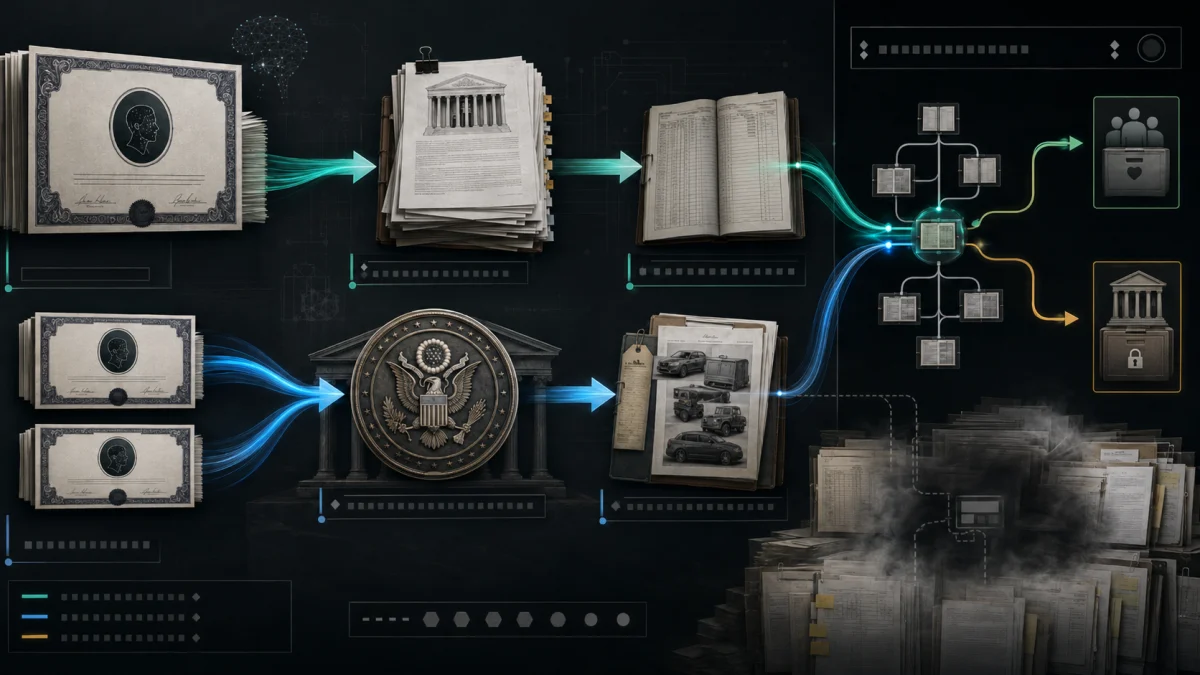
FTX Anthropic shares → bankruptcy estate
Ellison/Singh Anthropic shares → United States → Marshals sale → federal forfeiture proceeds
It is that final money trail that remains opaque.
What Caroline Ellison actually forfeited
Ellison’s February 18, 2025 final forfeiture order is unusually specific.
It identifies Series B Preferred Stock in Anthropic PBC acquired around May 13, 2022 through a Simple Agreement for Future Equity, or SAFE, that Ellison had purchased for $10 million on or about March 31, 2022. (vLex)
The order says that all of Ellison’s right, title and interest in that property became vested in the United States.
The U.S. Marshals Service was then authorized to take possession and dispose of the property according to law.
Importantly, the order does not disclose how many Anthropic shares Ellison ultimately received from the SAFE.
Nor does it disclose a sale.
February 18 is the date of the final forfeiture order.
That is not the same thing as evidence that the stock was sold that day.
Nishad Singh forfeited a much larger Anthropic investment
Singh’s final order followed on April 22, 2025.
It identifies Series B Preferred Stock acquired around May 13, 2022 through a SAFE purchased for $40 million on April 5, 2022. The order again vested the property in the United States and directed the Marshals Service to dispose of it according to law. (Midpage)
Singh forfeited other assets as well, including real estate and financial accounts, making another point important:
FTX’s public “Government Receivables” figures combine multiple government-seized assets. They are not an Anthropic-specific ledger.
That makes it dangerous to look at one large number in the FTX accounts and assume it represents the Anthropic transaction.
February and April 2025 were not the reported sale dates
This may be the most consequential factual distinction in the entire story.
Ellison’s final forfeiture order was entered February 18, 2025.
Singh’s final forfeiture order was entered April 22, 2025.
Those orders established the United States’ title to the forfeited property and authorized its disposition. (vLex)
Business Insider, citing a person familiar with the transaction, reported something different about the eventual sales: the Marshals Service sold the shares to existing Anthropic investors sometime during 2025.
The precise dates remain unknown. (Business Insider)
That matters because Anthropic’s valuation was changing at extraordinary speed.
| Date | Anthropic valuation |
|---|---|
| March 3, 2025 | $61.5 billion |
| September 2, 2025 | $183 billion |
| February 12, 2026 | $380 billion |
| May 28, 2026 | $965 billion |
Anthropic itself announced each of those fundraising valuations. (Anthropic)
If someone assumes Ellison’s shares were sold on February 18 and Singh’s on April 22, that person can manufacture an apparently precise calculation of how much upside the government supposedly missed.
But the underlying premise is unsupported.
We do not know when the sales happened.
So how much did the government actually receive?
That is not publicly known.
Business Insider reported two outside estimates for what the combined Ellison and Singh holdings might have been worth when the government sold them in 2025.
UCLA professor Olav Sorenson estimated approximately $300 million to $1.1 billion, depending on timing. PitchBook analyst Harrison Rolfes estimated approximately $250 million to $630 million. (Business Insider)
That is already a remarkably wide range.
And the uncertainty is not just about the sale date.
Private-company stock cannot always be valued by taking a headline corporate valuation and multiplying it by an assumed ownership percentage.
The calculation can depend on dilution from later financing rounds, the economic rights attached to a particular preferred-stock series, transfer restrictions, discounts in secondary transactions and the exact number of shares being sold.
The final forfeiture orders identify the original $10 million and $40 million SAFE purchases, but they do not disclose the exact number of Anthropic shares forfeited. (vLex)
Without the share counts, transaction dates and sale prices, there is no reliable way to reconstruct the government’s proceeds from the public forfeiture orders alone.
Did the government really “lose $5 billion” by selling too early?
There is currently no factual basis for assigning a precise multibillion-dollar loss to the government.
That does not mean selling in 2025 necessarily turned out to be a good financial decision.
Anthropic’s subsequent appreciation was extraordinary. Business Insider reported estimates putting the current hypothetical value of Ellison’s and Singh’s combined holdings anywhere from about $2.62 billion to more than $5 billion, depending on methodology. (Business Insider)
But three different concepts are being blurred together.
Sale proceeds are what the government actually received.
Present hypothetical value is what the stock might be worth if it had never been sold.
Opportunity cost is the additional appreciation the government could theoretically have captured by holding longer.
Those are not interchangeable.
If an asset is sold for $500 million and later becomes worth $5 billion, it is fair to ask whether selling early sacrificed billions in potential appreciation.
It is not accurate simply to say that $4.5 billion “disappeared.”
And in this case, we cannot even calculate the opportunity cost because the most basic transaction data remain undisclosed.
A legitimate investigation therefore begins one step earlier:
When did the Marshals Service sell the shares, how many did it sell, and what did the buyers pay?
Until those questions are answered, the spectacular multibillion-dollar numbers are estimates built on missing variables.
Where does money from a federal criminal forfeiture normally go?
The government’s handling of forfeiture proceeds is discretionary in important respects, but it is not a legal void.
Federal law directs the Attorney General to dispose of forfeited property through sale or another commercially feasible method. The same statute expressly authorizes the Attorney General to grant remission or restore forfeited property to crime victims. (Legal Information Institute)
The Department of Justice also operates the Assets Forfeiture Fund, a Treasury fund into which proceeds of DOJ forfeitures generally are deposited. Federal law authorizes the fund to pay expenses connected with seizing, maintaining, valuing and selling forfeited assets and to make payments through the remission process. (Legal Information Institute)
The federal regulations are even clearer about the basic sequence.
When forfeited property is sold, the rules contemplate payment of expenses associated with the forfeiture and sale, qualifying third-party interests, payments to eligible victims, and ultimately any remaining balance to the Assets Forfeiture Fund. (Legal Information Institute)
So saying that the Justice Department can simply “do whatever it wants with the money” overstates the case.
There is a statutory and regulatory system.
At the same time, that system gives the Attorney General substantial discretion, particularly in deciding remission and restoration.
And money remaining in the Assets Forfeiture Fund can ultimately support authorized federal law-enforcement and related purposes.
That is why determining whether the Ellison/Singh proceeds were designated for FTX victims is not a trivial accounting question.
Could FTX victims still receive the Anthropic proceeds?
Yes. Federal law allows it. But it is not automatic.
DOJ regulations permit victims to receive remission from the net proceeds of forfeitures connected to the criminal activity that caused their loss.
The rules also require consideration of other compensation. A victim cannot simply recover the same loss twice from multiple sources. (Legal Information Institute)
DOJ describes returning forfeited property to victims as a central purpose of its Asset Forfeiture Program. Its current Justice Manual says valid owners, lienholders, certain regulatory claims and victims receive priority treatment through the forfeiture process. (Department of Justice)
That matters in FTX because there is already a massive bankruptcy apparatus distributing money to customers and creditors.
Business Insider reported that prosecutors said during Ellison’s sentencing that DOJ could either establish its own claims process or coordinate with the FTX bankruptcy process to identify victims and distribute forfeiture proceeds. (Business Insider)
That leaves several possible lawful outcomes for the Anthropic money.
Some or all could ultimately be restored or remitted for victims.
Some could first be reduced by allowable forfeiture-related costs or claims.
A remaining balance could stay within the Assets Forfeiture Fund.
What the available public records do not reveal is which path the Anthropic proceeds have taken.
What FTX’s latest financial records actually show
This is where the numbers become particularly interesting.
The FTX Recovery Trust’s 2025 annual report says it had received approximately $638 million from Government Receivables by December 31, 2025. (EPIQ Document Services)
Its later financial statements show:
| Reporting date | Government Receivables on balance sheet | Cumulative cash received from Government Receivables |
|---|---|---|
| Dec. 31, 2025 | $1.016 billion | $638 million |
| March 31, 2026 | $953 million | $638 million |
| June 30, 2026 | $925 million | $638 million |
The June 30 report explicitly says the Government Receivables consist solely of assets seized by the Department of Justice. It also warns that the amounts are estimates and that actual recoveries can differ materially. (EPIQ Document Services)
Most strikingly, the Trust reported no additional cash receipts from Government Receivables during the second quarter of 2026. Cumulative receipts remained $638 million.
But nowhere in these public financial statements is there a line that says:
Ellison Anthropic sale proceeds: $X
or:
Singh Anthropic sale proceeds: $X
That is why the public accounting cannot presently answer the question.
The $638 million does not solve the mystery
At first glance, the obvious theory would be that some unknown portion of the $638 million already received from the government must include the Anthropic money.
That cannot safely be assumed.
A February 2026 Justice Department Inspector General audit disclosed a separate enormous FTX-related forfeiture transaction: on October 10, 2025, the Marshals Service received $627.9 million as a partial payment toward the $11 billion Alameda Research forfeiture order, with payments subsequently going to victims. (Oversight.gov)
That does not by itself prove how the FTX Recovery Trust classified every dollar.
But it demonstrates why the $638 million figure cannot simply be relabeled “Anthropic sale proceeds.”
There were other enormous seized FTX and Alameda assets moving through the federal forfeiture system at the same time.
Without asset identifiers or transaction-level accounting, matching one aggregated number to Ellison’s and Singh’s stock would be speculation.
FTX still carried $925 million in Government Receivables in June
The other side of the ledger is just as important.
As of June 30, 2026, the Trust still recorded $925 million of Government Receivables.
Could some or all of the Anthropic proceeds be represented somewhere within that number?
Possibly.
But the filing does not say.
The Trust explains that non-digital government-seized assets are valued according to estimated recoverable amounts, informed by financial information, legal and regulatory considerations and the expected timing of recovery. It explicitly warns that the estimates contain substantial uncertainty.
That makes $925 million an accounting estimate—not a list of government bank accounts awaiting wire transfers.
Still, it means the most current primary record does not support reducing the unresolved government recovery pool to roughly $400 million.
Business Insider reported that the estate expects about $400 million more from the government. The annual financial statements, however, show a total Government Receivables balance of $1.016 billion at December 31, 2025, falling to $925 million by June 30, 2026. (Business Insider)
Those statements are not necessarily contradictory. The $400 million could refer to some narrower class of anticipated recovery that is not separately identified in the public report.
But for the overall government-receivable balance, the latest primary-record number is $925 million.
There is already a separate remission fund connected to government recoveries
The Recovery Trust records reveal another wrinkle.
Under its Preferred Shareholder Agreement, the Trust is required to deposit a portion of proceeds from certain Government Receivables into a separate Preferred Shareholder Remission Fund.
The June report says the lesser of 18% or $230 million from specified government recoveries is subject to that arrangement.
The Trust funded the remission trust with $115 million on May 19, 2026, and roughly $77 million had already been paid to preferred-equity holders by June 30.
Again, there is no basis for claiming that Ellison’s or Singh’s Anthropic proceeds specifically funded that mechanism.
But it shows how complicated the destination of a forfeited FTX-related dollar can become.
“Did FTX get the money?” is not necessarily a simple yes-or-no question.
Funds can move through DOJ forfeiture accounts, remission arrangements, the Recovery Trust and specialized distribution structures without appearing publicly under the name of the original asset.
That makes transaction-level disclosure essential.
Who bought Ellison and Singh’s Anthropic shares?
Their identities remain unknown.
Business Insider’s source said only that the Marshals Service sold the holdings to existing Anthropic investors. The publication reported that it could not determine which investors bought the shares, how they were selected, what they paid, or exactly when the transactions occurred. (Business Insider)
That distinction matters because many well-known institutions appear elsewhere in Anthropic’s financing history.
Anthropic’s March 2025 financing, for example, included investors such as Fidelity, Jane Street, General Catalyst and others. Its later rounds involved an even larger collection of major institutional investors. (Anthropic)
Separately, FTX’s bankruptcy estate sold its own Anthropic shares to identifiable purchasers including a Mubadala-linked entity, Jane Street and Fidelity-managed funds. (Scribd)
None of that establishes that any of those entities bought the forfeited Ellison or Singh shares.
Until transaction records identify the purchasers, attaching names would be speculation.
What remains unknown
The public record is remarkably detailed about how the government obtained these securities and remarkably thin about what happened afterward.
To resolve the story, the government would need to disclose—or a public-records investigation would need to uncover—the exact number of shares sold, transaction dates, purchasers, price per share, total consideration, sale or brokerage expenses, any appraisal used by the Marshals Service, the method used to select purchasers, and the federal accounting or asset identifiers attached to the proceeds.
Most importantly, the public needs an answer to one accounting question:
Are the Ellison and Singh Anthropic sale proceeds included anywhere within the FTX Recovery Trust’s $925 million of Government Receivables as of June 30, 2026?
A yes would substantially narrow the mystery.
A no would raise the next question: where in the federal forfeiture system are they being held or spent?
What we can actually say with confidence
The evidence supports several firm conclusions.
Verified: Ellison held Anthropic Series B shares tied to a $10 million SAFE, while Singh held Series B shares tied to a $40 million SAFE. Their holdings were separate from FTX’s corporate Anthropic stake. (vLex)
Verified: Their shares became property of the United States through criminal forfeiture. Ellison’s final order was entered February 18, 2025; Singh’s was entered April 22, 2025. (vLex)
Credibly reported but not publicly documented at the transaction level: The Marshals Service sold the shares to existing Anthropic investors during 2025. (Business Insider)
Unknown: The exact sale dates.
Unknown: The buyers.
Unknown: The sale price.
Unknown: The amount of net proceeds.
Unknown: Whether those proceeds are represented inside FTX’s current $925 million Government Receivables balance.
Unsupported: Claims that Ellison’s shares were sold in February and Singh’s in April merely because those were the dates of their final forfeiture orders.
Unsupported: Claims assigning a precise $4 billion, $5 billion or similar “loss” to the government.
There is a real transparency problem here.
It simply is not the same thing as proof that billions disappeared.
The bottom line
We know where Caroline Ellison’s and Nishad Singh’s Anthropic shares went. We still do not know exactly where the money went.
The shares became property of the United States through criminal forfeiture. Business Insider reports that the U.S. Marshals Service then sold them to existing Anthropic investors sometime in 2025.
Federal law provides a legitimate pathway for those proceeds: forfeiture expenses can be paid, eligible victims can receive remission or restoration, and remaining money can ultimately reside in the Justice Department’s Assets Forfeiture Fund. (Legal Information Institute)
What is missing is the bridge between those rules and this particular transaction.
The government has not publicly disclosed how many shares it sold, when it sold them, who bought them, how much they paid, or where those specific proceeds now sit.
Meanwhile, FTX’s Recovery Trust reports $638 million already received from government-seized assets and another $925 million still recorded as Government Receivables, without identifying Ellison’s or Singh’s Anthropic stock in either category.
That is the story as the evidence currently stands.
Not “the government lost $5 billion.”
Not “billions vanished.”
But something potentially more consequential in the long run:
The federal government sold what may have been hundreds of millions of dollars in extraordinarily valuable private stock connected to one of the largest fraud cases in American history, and the public accounting still does not show the transaction price or the ultimate destination of the proceeds.
That is a reasonable question for the government to answer.
References and Further Reading
Criminal forfeiture records
- United States v. Ellison — Final Order of Forfeiture, February 18, 2025 — Establishes the Anthropic Series B property tied to Ellison’s $10 million SAFE and the date the United States obtained clear title.
- United States v. Singh — Final Order of Forfeiture, April 22, 2025 — Identifies Singh’s Series B Anthropic shares tied to his $40 million SAFE and directs the Marshals Service to dispose of the forfeited property.
- FTX motion approving the Caroline Ellison bankruptcy settlement — Shows the bankruptcy estate’s agreement to recover Ellison’s assets that were not otherwise subject to criminal forfeiture.
FTX Recovery Trust records
- FTX Recovery Trust Q2 2026 Financial Report — Latest public financial report reviewed for this article; reports $925 million in Government Receivables and $638 million in cumulative receipts.
- FTX Recovery Trust 2025 Annual Financial Report — Reports the initial $638 million in Government Receivable recoveries.
- FTX Chapter 11 Anthropic share sale filing — Documents the separate bankruptcy sale of 29,465,891 Anthropic shares for approximately $884.1 million.
Federal forfeiture law and policy
- 21 U.S.C. § 853 — Criminal Forfeitures — Governs disposition of criminally forfeited property and authorizes restoration to victims.
- 28 U.S.C. § 524 — Department of Justice Assets Forfeiture Fund — Establishes where DOJ forfeiture proceeds are generally deposited and how the fund may be used.
- 28 C.F.R. § 9.8 — Remission Procedures for Victims — Sets requirements and limits governing victim compensation.
- 28 C.F.R. § 9.9 — Distribution of Forfeiture Sale Proceeds — Explains the disposition of proceeds, including expenses, victim payments and residual Assets Forfeiture Fund deposits.
- DOJ Justice Manual — Remission, Mitigation and Restoration of Forfeited Property — Current Justice Department policy guidance on returning forfeited assets to victims.
- DOJ Inspector General Audit of the Assets Forfeiture Fund, FY2025 — Identifies the separate $627.9 million Alameda-related forfeiture payment received in October 2025 and subsequent victim payments.
Anthropic valuations
- Anthropic Series E — $61.5 billion valuation, March 2025
- Anthropic Series F — $183 billion valuation, September 2025
- Anthropic Series G — $380 billion valuation, February 2026
- Anthropic Series H — $965 billion valuation, May 2026
Original reporting
- Business Insider — The feds seized a stake in Anthropic from Sam Bankman-Fried’s friends. What happened to the shares? — Original August 31, 2026 reporting that revealed the Marshals Service sale and the remaining uncertainty surrounding its terms and proceeds.
Editorial currency note: The forfeiture and FTX Recovery Trust processes remain active. Government receivable balances, victim distributions and information about the Anthropic transactions may change if DOJ, the Marshals Service or the Recovery Trust releases additional records.