The United States imports millions of barrels of crude oil every day despite producing more oil than any other country because crude oil is not a uniform product, U.S. refineries are not all optimized for the same type of crude, and moving the right barrel to the right refinery can matter more economically than whether that barrel was produced inside the United States.
The result can look absurd from a distance.
In 2025, the United States produced a record 13.6 million barrels of crude oil per day, more than any other country. It nevertheless imported about 6.2 million barrels per day of crude oil while simultaneously exporting about 4.0 million barrels per day. The United States therefore remained a net importer of crude oil by roughly 2.2 million barrels per day.
None of those numbers is a typo.
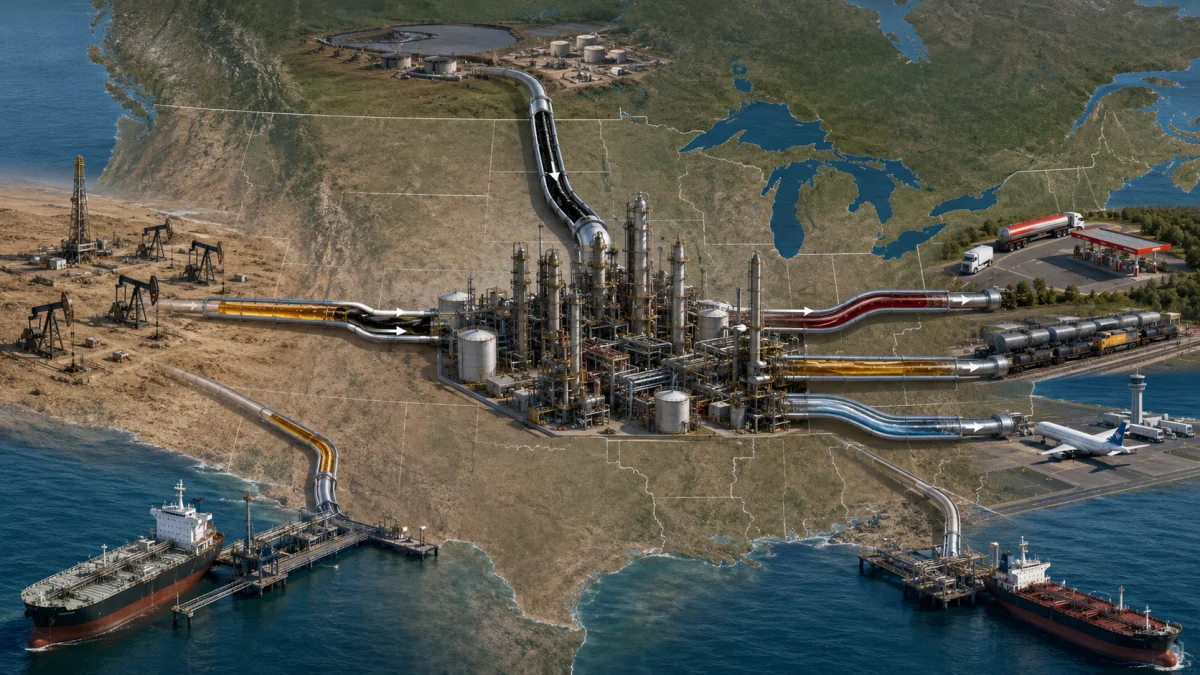
America can produce a barrel of relatively light crude in Texas, export it to a refinery in Europe, import a denser Canadian barrel into the Midwest, refine that barrel into gasoline or diesel, and then export some of those finished petroleum products—all while being a net energy exporter overall.
That is not necessarily an inefficiency. Much of it is the result of refinery engineering, geography and price.
The numbers behind the apparent contradiction
The completed 2025 data show how large all sides of the U.S. petroleum system have become.
| 2025 U.S. crude-oil measure | Approximate volume |
|---|---|
| Domestic crude production | 13.6 million barrels/day |
| Crude imports | 6.2 million barrels/day |
| Crude exports | 4.0 million barrels/day |
| Net crude imports | 2.18 million barrels/day |
| Crude processed by U.S. refineries | 16.4 million barrels/day |
| Net exports of crude oil + petroleum products combined | 2.80 million barrels/day |
The last two rows are especially important.
U.S. refineries processed substantially more crude oil than American wells produced because imported crude supplied part of their feedstock. But once crude oil and finished petroleum products are considered together, the United States exported about 2.8 million barrels per day more petroleum than it imported in 2025.
So two statements can simultaneously be true:
The United States is a net importer of crude oil.
And:
The United States is a net exporter of petroleum overall.
The apparent contradiction largely disappears once crude oil and the products made from crude oil are treated as different things.
Reason No. 1: A barrel of crude oil is not interchangeable with every other barrel
The most common mistake in this discussion is treating crude oil like electricity or purified water—as though one barrel is functionally identical to another.
It is not.
Crude oils differ in density, sulfur content, acidity, metals, viscosity and the proportions of hydrocarbons that become gasoline, diesel, jet fuel, asphalt, petroleum coke and other products after refining.
Two particularly important measurements are API gravity and sulfur content.
API gravity measures density. A higher API gravity generally means a lighter crude. The U.S. Energy Information Administration has described crude above roughly 38° API as light and crude at approximately 22° API or below as heavy.
Sulfur is another major distinction. Lower-sulfur crude is called “sweet”; higher-sulfur crude is called “sour.” Sour crude generally requires additional treatment to remove sulfur and meet fuel specifications.
The shale revolution dramatically increased U.S. production of relatively light crude oil, particularly from regions such as the Permian Basin and Bakken.
But a substantial part of America’s refining system was built or upgraded during an earlier era when refiners expected to process large quantities of heavier crude.
That history still matters.
The import data show the quality difference clearly
This is not merely an old explanation that survived after the market changed.
EIA’s 2025 crude-import data show that:
9.75% of imported crude had an API gravity of 20° or less.
50.46% was between 20.1° and 25° API.
10.14% was between 25.1° and 30° API.
Taken together, approximately 70.4% of U.S. crude imports in 2025 had an API gravity of 30° or lower.
Only about 2.4% of imported crude was above 40° API.
That is a remarkable concentration at the denser end of the market.
The United States is therefore not simply importing more of the same crude that domestic shale fields already produce in abundance.
Imports disproportionately supply lower-API crude that complements America’s domestic production.
Reason No. 2: Some U.S. refineries were designed to make money from heavier crude
A refinery is not just a giant tank into which any crude can be poured with identical results.
Its configuration matters.
The basic refinery separates crude into fractions through distillation. More complex facilities then use equipment such as catalytic crackers, hydrocrackers, cokers and hydrotreaters to convert lower-value portions of a barrel into higher-value fuels while removing contaminants such as sulfur.
A refinery equipped with expensive conversion units can often profitably buy cheaper heavy or sour crude and transform more of it into gasoline, diesel and jet fuel.
That investment creates an economic preference.
EIA has specifically noted that U.S. refineries are among the world’s most complex and that access to imported crude allows individual facilities to select a crude slate suited to their equipment. EIA has also explained that running only lighter domestic crude could leave some heavy-oil processing equipment underused.
This does not mean American refineries are incapable of processing American shale oil.
They clearly do process enormous quantities of it, and refinery crude slates have become lighter as domestic production has grown.
The more accurate statement is:
A refinery designed and financed to profitably process a particular mix of crude oils does not automatically maximize its economics by replacing every imported heavy barrel with a lighter domestic barrel.
That distinction matters.
Why would anyone prefer harder-to-refine heavy oil?
Because it is often cheaper.
Heavy and sour crude generally commands a discount relative to comparable light, sweet crude because it requires more processing.
For a simple refinery, that discount may not compensate for the difficulty.
For a highly complex refinery with cokers, hydrocrackers and sulfur-removal equipment already installed, the opposite may be true. The refinery can purchase a discounted crude and use its expensive equipment to turn lower-value material into higher-value products.
Canadian Western Canadian Select, or WCS, is a classic example. EIA notes that it is a heavier crude blend that requires more intensive processing and has historically traded at a discount to lighter benchmark crudes.
The refinery therefore is not asking:
Is this barrel American?
It is asking something closer to:
At today’s crude prices, transportation costs and product values, which combination of barrels will generate the highest return from the equipment we have?
That is why gross imports alone can be misleading as a measure of whether the country “needs foreign oil.”
Reason No. 3: Most U.S. imported crude now comes from Canada—not the Middle East
Another outdated mental picture is that U.S. oil imports primarily mean tankers arriving from Saudi Arabia or other Persian Gulf producers.
That is no longer remotely accurate.
Canada supplied an average of about 3.9 million barrels of crude oil per day to the United States in 2025. Total U.S. crude imports averaged about 6.2 million barrels per day.
That means Canada alone supplied roughly 63% of gross U.S. crude imports.
By comparison, the entire Middle East Gulf region—Bahrain, Iraq, Kuwait, Oman, Qatar, Saudi Arabia and the United Arab Emirates—supplied approximately 490,000 barrels per day, or about 8% of U.S. crude imports in 2025.
That gives a very different picture of American oil dependence.
For every 100 barrels of crude the United States imported in 2025, roughly:
63 came from Canada.
8 came from the Middle East Gulf.
The remainder came from Mexico, South America, Africa and other suppliers.
Saudi Arabia alone supplied roughly 98 million barrels during 2025, or about 269,000 barrels per day—far below Canadian volumes.
Why Canadian oil fits U.S. refineries so well
Canada and the United States have something close to a continental petroleum system.
Large quantities of Canadian crude move south through pipelines into the U.S. Midwest and Gulf Coast. Many refineries in those regions are well positioned to process the heavier grades produced from Western Canada’s oil sands.
That supply is geographically close, connected by established infrastructure and often technically well suited to refinery configurations that were built to process heavier crude.
Meanwhile, lighter American crude can move toward Gulf Coast export terminals and find buyers overseas willing to pay competitive prices for it.
So the United States can rationally do both at once:
Import heavy Canadian crude.
Export lighter American crude.
The barrels serve different markets and refinery configurations.
Reason No. 4: Geography can matter more than the national border
There is another problem with treating America as one giant oil tank.
It is enormous.
Oil production, refineries, pipelines, ports and consumers are not located in the same places.
A barrel produced in the Permian Basin in West Texas may have excellent pipeline access to the Gulf Coast. That does not mean it can be moved just as cheaply to a refinery in Pennsylvania, Washington state or California.
The U.S. petroleum system is traditionally divided into five Petroleum Administration for Defense Districts, or PADDs. Those regions have very different infrastructure and supply patterns.
The Gulf Coast is the center of American refining and petroleum exports.
The Midwest has exceptional pipeline access to Canadian crude.
The East Coast has relatively little refinery capacity and limited crude-oil pipeline connectivity from major domestic producing regions.
The West Coast is even more geographically isolated from the massive refining and pipeline network centered around Texas and Louisiana.
EIA has specifically noted that the West Coast produces relatively less crude oil than the Gulf Coast and lacks sufficient pipeline access to easily replace seaborne imports with barrels from other U.S. regions.
This produces situations that appear strange only if the border is treated as the most important transportation boundary.
Sometimes a foreign barrel is physically easier or economically cheaper to deliver to a U.S. refinery than an American barrel produced thousands of miles away.
The East Coast shows how transportation economics can override nationality
East Coast refineries have historically chosen among imported crude, domestic crude moved by rail, and domestic crude shipped by eligible tankers or barges.
EIA has documented how these decisions change when the price difference between domestic West Texas Intermediate and internationally traded Brent changes.
When domestic crude was deeply discounted, moving American oil to the East Coast could become worthwhile.
When that discount narrowed, imports became more competitive again.
The underlying point is important:
An American refinery does not receive free transportation simply because the crude was produced in America.
Pipelines, railcars, storage terminals, tankers and regulatory constraints all cost money.
Then why does the United States export crude oil at all?
Because foreign buyers want it and are sometimes willing to pay more for it than the marginal U.S. buyer.
For decades, most U.S. crude-oil exports were restricted. Congress effectively repealed the broad export restrictions in December 2015.
Exports subsequently expanded dramatically as shale production increased and U.S. producers gained access to overseas markets.
By 2025, the United States was exporting almost 4 million barrels of crude oil per day. Europe and Asia have been major destinations.
This is not inherently different from the United States exporting wheat while importing certain foods, or exporting automobiles while importing other automobiles.
“Oil” describes a category of commodities, not one perfectly interchangeable product located in one place.
Does exporting oil force the United States to import replacement barrels?
Sometimes an exported domestic barrel and an imported foreign barrel effectively substitute for one another within the overall market.
But the relationship is not one-for-one.
The U.S. Government Accountability Office studied what happened after Congress removed the crude export restrictions.
GAO found that the repeal expanded the market available to American producers and helped bring U.S. crude prices closer to comparable international prices. But during the period GAO examined, total U.S. crude imports remained largely unchanged.
That is important evidence against the simplistic argument:
Every exported American barrel necessarily causes another foreign barrel to be imported.
The market is more complicated.
Refinery preferences, crude quality, domestic production incentives, transportation costs and international prices all adjust simultaneously.
Would banning U.S. oil exports eliminate imports?
Probably not.
An export restriction could change the economics substantially. By trapping more domestic crude inside the United States, it could lower the relative price of some American grades and encourage some refiners to substitute domestic barrels for imports.
That happened to some extent during the earlier era of export restrictions.
But it would not change the physical characteristics of the crude, relocate refineries, create pipelines to geographically isolated regions or magically convert a light shale barrel into the heavy feedstock a refinery may prefer.
GAO’s post-2015 analysis also found limited effects on refined-product markets and noted that U.S. gasoline prices are heavily connected to global markets.
So an export ban could alter trade flows.
It is much harder to support the claim that it would make crude imports unnecessary.
Is the United States “energy independent”?
The answer depends entirely on what the phrase means.
If “energy independent” means the United States produces more total energy than it consumes or exports more total energy than it imports, then the country has crossed that threshold.
The United States has been an annual net total-energy exporter since 2019.
In 2025, total U.S. energy exports reached a record 31 quadrillion British thermal units, while imports totaled about 21 quadrillion Btu. Net exports therefore reached approximately 11 quadrillion Btu.
But if “energy independent” means the country imports no energy, then the United States plainly is not energy independent.
It continues to import crude oil, petroleum products, natural gas and other energy commodities while exporting large volumes of its own energy.
Those facts are not mutually exclusive.
A country can be a net exporter while maintaining enormous two-way trade flows.
Crude oil, petroleum and energy are three different measurements
A great deal of confusion comes from politicians and commentators switching among these categories without saying so.
Crude oil is unrefined petroleum extracted from the ground.
Petroleum is a much broader category that includes crude oil plus products and other hydrocarbon liquids.
Total energy is broader still and includes natural gas, coal, nuclear energy, renewables and electricity in addition to petroleum.
That is how the United States could simultaneously be, in 2025:
A net importer of crude oil by about 2.18 million barrels per day.
A net exporter of crude oil and petroleum products combined by about 2.80 million barrels per day.
And a net exporter of total energy by approximately 11 quadrillion Btu.
All three statements are true.
Any argument about “energy independence” that does not specify which measurement it is using should therefore be treated cautiously.
If America produces 13.6 million barrels a day, why do its refineries process more than that?
Because refinery demand and crude production are not the same measurement.
U.S. refinery crude inputs averaged roughly 16.4 million barrels per day in 2025.
Domestic crude production averaged about 13.6 million barrels per day.
Imports supplied part of the difference, while other domestic barrels were exported or added to inventories.
Crude also does not become a one-for-one volume of finished products because refinery processes change volumes and because additional feedstocks enter the petroleum system.
The United States is not simply producing 13.6 million barrels, consuming 13.6 million barrels and importing anything beyond that.
It operates one of the world’s largest refining and petroleum-export systems.
Why not rebuild every refinery to run entirely on American crude?
Technically, refiners can modify equipment and crude slates.
Economically, the question is whether doing so makes sense.
U.S. operable atmospheric crude-distillation capacity stood at about 18.2 million barrels per calendar day at the beginning of 2026, spread among 130 operable refineries. Many of those facilities contain billions of dollars of specialized downstream equipment.
A refinery owner considering a major redesign has to compare the capital cost against a much simpler alternative:
Keep the refinery configuration and buy crude that fits it.
If a reliable supply of Canadian heavy crude can reach the refinery by pipeline at an attractive price, rebuilding a functioning refinery merely to eliminate the word “import” from the supply chain may destroy rather than create economic value.
That calculation could change if prices, trade rules or supply security change.
But imports are not automatically proof of insufficient domestic resources.
Sometimes they are a deliberate feedstock choice.
Does importing oil make gasoline more expensive?
Not in the simple sense that “foreign oil equals expensive gasoline.”
The price of crude oil is usually the largest component of the retail gasoline price. But crude oil trades in a highly interconnected global market, and prices for different crude grades tend to move together even though quality and location create discounts and premiums.
Higher U.S. production can increase global supply and put downward pressure on prices.
But producing record amounts of oil does not isolate U.S. motorists from a major disruption elsewhere in the world.
If a war, embargo, hurricane or other event removes millions of barrels from global supply, buyers compete for what remains. International crude prices can rise, and American crude becomes more valuable too.
That is why the world’s largest oil-producing country can still experience gasoline-price spikes caused by events thousands of miles away.
The United States has become much less dependent on net petroleum imports than it was two decades ago.
It has not left the global oil market.
Does America still depend on Saudi oil?
Much less than many people assume.
Saudi Arabia remains an important producer in the global market, so changes in Saudi production can affect crude prices even if the United States buys relatively few Saudi barrels directly.
But direct U.S. import dependence on Saudi crude has fallen dramatically.
In 2025, the entire Middle East Gulf accounted for only 8% of U.S. crude imports, while Canada supplied roughly 63%.
This illustrates an important distinction:
Direct import dependence asks where American refiners physically obtain their crude.
Market exposure asks what can influence the price American refiners and consumers pay.
The United States can have relatively little direct dependence on Middle Eastern crude and still be economically affected by a Middle Eastern oil disruption because oil is globally traded.
Could the United States survive without imported crude?
“Could” and “at what cost” are different questions.
The United States has enormous domestic production, substantial inventories, extensive refining capacity and large petroleum-product output. A loss of imported crude would therefore be radically different today from the country’s position during the oil crises of the 1970s.
But abruptly eliminating all imports would require major adjustments.
Some refineries would need different crude slates. Crude prices between regions would change. Pipelines, rail and coastal shipping would have to move barrels differently. Some refinery units could become less economical to operate. Regional supply problems could emerge even while the country as a whole had ample crude.
The United States could also reduce petroleum consumption, alter exports or expand infrastructure over time.
So the useful question is not whether a mathematically imaginable path to zero imports exists.
It is:
Would refusing an economically useful imported barrel improve U.S. energy security enough to justify the additional cost and disruption?
That answer depends on the specific barrel, refinery, region and geopolitical circumstance.
The real lesson: Gross imports are a poor shorthand for energy dependence
The statistic “America imports 6 million barrels of crude oil every day” sounds as though the country is short 6 million barrels.
That is not what the number means.
Gross imports measure barrels crossing into the United States.
They do not account for the nearly 4 million barrels of crude exported each day.
They do not account for the even larger flow of exported petroleum products.
They do not identify whether imported crude is replacing domestic crude of the same quality.
They do not tell you whether a refinery is importing because it has no alternative or because the foreign barrel is the most profitable feedstock.
And they do not reveal whether the imported barrel will ultimately become fuel consumed in the United States or a product exported somewhere else.
EIA explicitly cautions that it cannot precisely determine what share of imported crude is ultimately consumed domestically because imported and domestic crude can be mixed, stored, refined and ultimately exported as petroleum products.
For understanding national exposure, net trade, source countries, crude quality, refinery configuration and regional infrastructure provide considerably more information than gross imports alone.
So why does America import oil while producing more than anyone else?
Because the U.S. oil industry is not a self-contained national bucket.
It is part of a continental and global petroleum system.
American shale fields produce enormous quantities of relatively light crude.
Canadian producers supply large volumes of heavier crude that fit many U.S. refinery configurations.
Complex refineries profit by choosing the crude slate best suited to their equipment.
Pipelines make some cross-border movements extraordinarily efficient while leaving other U.S. regions poorly connected to domestic producing centers.
American producers can sell light crude overseas when foreign refiners value it more.
U.S. refineries can turn both domestic and imported crude into enormous volumes of gasoline, diesel, jet fuel and other products and then export those products around the world.
That is how the United States can be the largest crude-oil producer on Earth, a major crude importer, a major crude exporter, a net crude importer, a net petroleum exporter and a net energy exporter at the same time.
Once those categories are separated, the paradox largely disappears.
The United States still imports oil not primarily because it has run out of American oil, but because the right barrel, in the right place, at the right price, matters more to a refinery than the flag attached to the well that produced it.
References and Further Reading
-
U.S. Energy Information Administration — The United States Produced More Crude Oil Than Any Other Country in 2025. Primary source for the record 13.6-million-barrel-per-day production figure and America’s position as the world’s largest crude producer. EIA: U.S. crude oil production record in 2025
-
U.S. Energy Information Administration — Annual U.S. Crude Oil Exports Decrease for First Time Since 2021. Provides 2025 crude exports and net crude-import figures and explains the growth of U.S. exports following the removal of export restrictions. EIA: U.S. crude oil exports and net imports in 2025
-
U.S. Energy Information Administration — U.S. Crude Oil Supply & Disposition. Definitive annual accounting for domestic production, imports, refinery inputs, exports and inventories. EIA: U.S. crude oil supply and disposition data
-
U.S. Energy Information Administration — Percentages of Total Imported Crude Oil by API Gravity. Primary dataset showing the unusually low-API composition of U.S. crude imports, including the roughly 70% share at 30° API or below in 2025. EIA: Imported crude oil by API gravity
-
U.S. Energy Information Administration — U.S. Crude Oil Production Increases; Imports Remain Strong to Support Refinery Operations. Explains why complex U.S. refineries combine lighter domestic crude with heavier imported grades and how refinery configuration affects crude selection. EIA: Why U.S. refineries continue to import crude oil
-
U.S. Energy Information Administration — Lower Crude Oil Prices Reduced U.S.-Canada Energy Trade Value in 2025. Primary source for Canada’s approximately 3.9-million-barrel-per-day crude supply to the United States in 2025. EIA: U.S.-Canada crude oil trade in 2025
-
U.S. Energy Information Administration — The Middle East Gulf Was Source for 8% of 2025 U.S. Crude Oil Imports. Provides current context on how small direct Middle Eastern crude imports have become relative to Canada and explains the specific refinery demand for medium-sour grades. EIA: Middle East share of U.S. crude imports in 2025
-
U.S. Energy Information Administration — The United States Is a Major Energy Exporter and Importer, Especially for Petroleum. Explains how the United States can simultaneously maintain major imports and exports while being a net exporter of total energy and petroleum. EIA: U.S. energy imports and exports in 2025
-
U.S. Government Accountability Office — Crude Oil Markets: Effects of the Repeal of the Crude Oil Export Ban. Independent federal review of what changed after the 2015 repeal, including effects on crude prices, refinery economics, imports and exports. GAO: Effects of repealing the U.S. crude oil export ban
-
U.S. Energy Information Administration — Factors Affecting Gasoline Prices. Explains the relationship between crude-oil prices and U.S. retail gasoline prices and why domestic motorists remain exposed to global crude markets. EIA: Factors affecting gasoline prices
Editorial currency note: Petroleum production, trade flows, refinery capacity and source-country shares change continuously. The annual figures in this article use full-year 2025 data—the latest complete calendar-year dataset available at publication in August 2026. The underlying engineering and market explanation is structural, but numerical figures should be refreshed as EIA publishes subsequent annual data.