The clip is real.
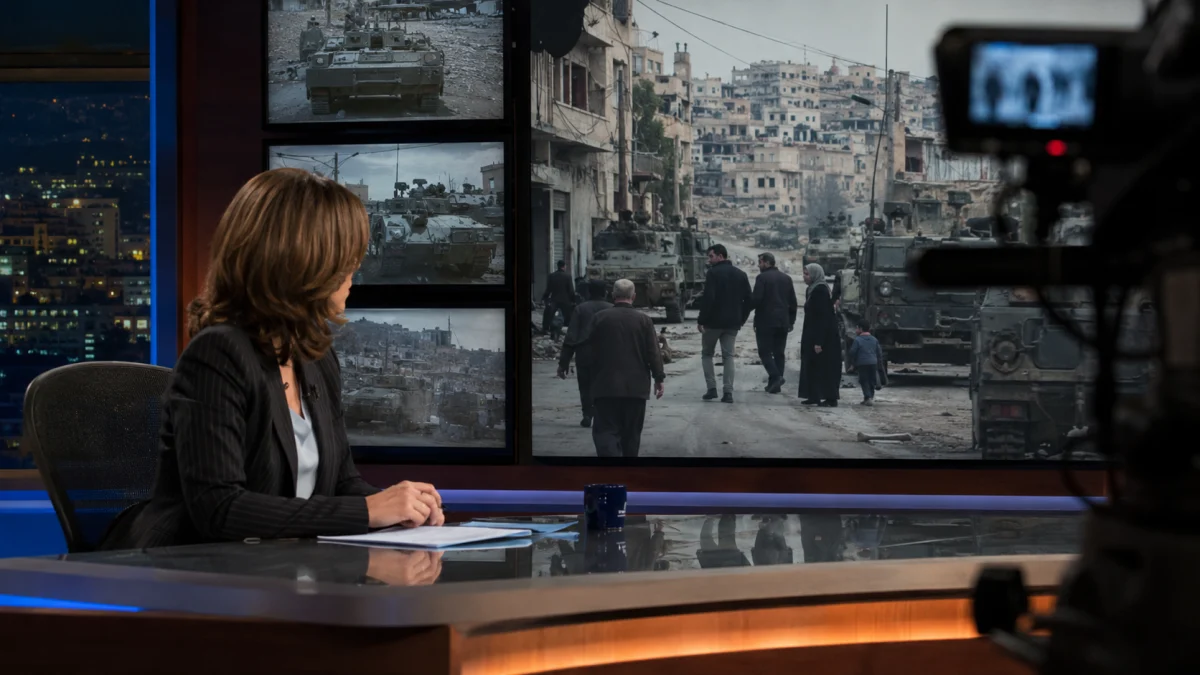
On April 6, 2002, Tina Fey sat behind the Saturday Night Live Weekend Update desk and delivered a monologue about Israel and Palestine. After mocking Palestinian leader Yasser Arafat, she turned to Israeli Prime Minister Ariel Sharon, referring to him “storming West Bank towns and bulldozing people’s homes.” Then came the turn.
Fey said Saddam Hussein would pay $25,000 to the family of a Palestinian suicide bomber, remarked, “That’s a lot of money to these people,” and concluded that “Palestinians would clean up on Fear Factor.”
Watching it almost a quarter-century later, the temptation is to treat it as another artifact from a less sensitive era: an old joke that aged badly, filed beside thousands of others.
I think that misses what is interesting about it.
The joke matters precisely because it was not delivered by someone openly arguing that Palestinians deserved what was happening to them. The same monologue criticized Sharon. It mocked George W. Bush’s simplistic “with us or with the terrorists” worldview. It was presented as the enlightened position—the person above the conflict, sophisticated enough to recognize absurdity on every side.
And that is what makes it worth examining.
Because beneath all of that irreverence was a frame: Palestinians were not primarily people living through occupation, military incursions and an increasingly catastrophic conflict. They were the people who blow themselves up.
The joke did not have to deny Palestinian suffering.
It only had to make Palestinian suffering part of the joke.
First, Get the Facts Right
The viral commentary now circulating around the clip makes claims that go much further than the evidence allows. There is no basis here to declare that Tina Fey was personally selected for her career because she would remain politically silent, nor can this clip establish some categorical hiring rule in which SNL employs or hosts only “Zionists.”
We do not need those claims.
We also cannot responsibly say that Fey personally wrote every word of this passage.
What we can establish is substantial enough.
Fey was not merely an actor reading somebody else’s material. By 2002, she was Saturday Night Live’s head writer as well as the co-anchor of Weekend Update. The Television Academy credits her as the show’s head writer that year. A 2003 New Yorker profile described the Middle East passage specifically while discussing Fey’s recurring political rants on Weekend Update. But that same profile also describes Weekend Update as a collaborative writing process involving Fey, producers and other writers. The safest formulation, therefore, is straightforward: Fey delivered the monologue while serving as SNL’s head writer; the available record does not establish who wrote each individual line.
That distinction is not a defense of the material.
It is simply what the evidence permits us to say.
The $25,000 Claim Was Real
There is another uncomfortable complication.
The Saddam Hussein part was not invented.
In 2002, the Iraqi government was providing money to Palestinian families through the Arab Liberation Front. Families of Palestinians killed during the uprising could receive payments, and families of suicide bombers were offered a larger amount: $25,000.
Three days before the SNL broadcast, CBS News reported that Hussein had increased the suicide-bomber-family payment from $10,000 to $25,000 and that families had reported actually receiving the money. Human Rights Watch subsequently documented the Iraqi program and the differential payment structure as well.
So if we turn this into a fact check and declare, “SNL lied about Saddam paying $25,000,” we would be wrong.
The number was real.
What matters is what the joke did with it.
A payment to a dead attacker’s relatives became an explanation of an entire people. Their desperation became the setup. Their poverty became part of the punchline. Palestinian political violence, occupation, nationalism, revenge, religious ideology, militant recruitment, repression and the enormous history underneath the Second Intifada were compressed into something much easier for an American television audience to digest:
These people are so poor and so accustomed to danger that they would be great on a reality show.
Later empirical research would make the economic caricature look particularly crude. Economists Alan Krueger and Jitka Malečková found little evidence for a simple causal relationship between poverty, low education and participation in terrorism. Their work included Palestinian survey data and evidence concerning Palestinian suicide bombers; other research similarly found that militants and suicide attackers were not simply drawn from the poorest and least educated portions of the population. The researchers repeatedly cautioned that the relationship was more complicated than economic desperation.
That research was published after the SNL broadcast, so it would be unfair to pretend Fey’s writers ignored a study they could not yet have read.
But it matters when evaluating the idea embedded in the joke today.
The fact was $25,000.
The frame was something else.
Now Look at the Date
April 6, 2002.
That date changes the clip.
Nine days earlier, on March 27, a Hamas suicide bomber walked into the Park Hotel in Netanya during a Passover Seder and detonated an explosive device. Thirty people ultimately died and roughly 160 were injured. Hamas claimed responsibility. It was an appalling attack on civilians and one of the deadliest attacks of the Second Intifada.
Israel launched Operation Defensive Shield on March 29. Israeli forces entered Ramallah first, followed by other West Bank cities. Jenin and Nablus were entered on April 3. By then, Israeli forces had moved into six of the largest Palestinian cities in the West Bank and their surrounding communities.
Then came April 6.
The same April 6 on which Fey made the joke.
Human Rights Watch researchers, working in Jenin after the operation, later reconstructed what happened that morning. They found particularly intense Israeli helicopter missile fire across the refugee camp. Missiles struck civilian homes. HRW documented a woman killed by helicopter fire and a four-year-old child injured when a missile struck a house. The organization concluded that Israeli forces had at times fired indiscriminately and had failed to adequately distinguish civilian from military objects.
Armored bulldozers were also operating in Jenin.
One of the cases Human Rights Watch reconstructed involved 37-year-old Jamal Fayid, who had been disabled since birth and could not move without assistance. His relatives said Israeli soldiers initially prevented them from retrieving him from the family home. Five women were eventually permitted to enter. A bulldozer then began demolishing the building while they were still trying to get him out.
The women escaped.
Fayid did not.
His body was eventually recovered from the rubble. Human Rights Watch said the incident required investigation as a possible war crime.
There is an important chronology point here. The most extensive destruction of Jenin’s Hawashin district occurred after April 9, when 13 Israeli soldiers were killed in an ambush and the IDF dramatically intensified its use of bulldozers and heavy weapons. We should not backdate that later destruction to April 6.
But we do not need to.
The events actually documented on April 6 are enough.
And there is something almost surreal about placing the two records beside each other.
In Jenin that morning, people were waking to missile strikes.
On American television that night, Palestinians were being compared to contestants on Fear Factor.
That Does Not Mean SNL Knew Everything We Know Now
Retrospective criticism can become dishonest in its own way.
The Human Rights Watch investigation had obviously not been published when Fey went on television that night. Neither had Amnesty International’s later investigation, which concluded that some Israeli actions in Jenin and Nablus amounted to grave breaches of the Fourth Geneva Convention and war crimes.
It would therefore be unfair to write as though the SNL writers had HRW’s subsequent case files sitting on their desks and chose to ignore them.
But there is a detail in the monologue itself that makes that defense less important than it initially appears.
SNL already knew homes were being bulldozed.
Fey says it.
That is part of the joke.
The military incursion was not invisible to the writers. Palestinian homes were not invisible. Sharon was explicitly mocked for appearing to enjoy the destruction.
The suffering entered the frame.
It simply did not remain there very long.
And that is the part I cannot stop thinking about.
The Sophisticated Position Was That Everybody Was Crazy
The opening premise of Fey’s monologue was essentially that anyone with a firm position on the Middle East must be crazy.
At first glance, that can sound wonderfully reasonable.
It is the posture American political comedy often prizes: distrust everyone, refuse ideological allegiance, mock all leaders and stand somewhere above the tribalism.
There is value in skepticism.
There is also danger in mistaking detachment for objectivity.
An occupying military and an occupied population do not become equivalent merely because people associated with both have committed atrocities. A Palestinian suicide bomber murdering civilians does not make an Israeli missile striking a civilian home morally irrelevant. An unlawful Israeli killing does not make the Park Hotel massacre less monstrous.
Those facts can coexist.
That is precisely why reducing the conflict to “both sides are crazy” is intellectually comfortable and analytically useless.
It relieves the audience of having to ask harder questions about power.
Who controls the territory?
Who has an army?
Who controls movement?
Who is living under military occupation?
Who is targeting civilians?
What forms of violence are being used?
What preceded the event being discussed?
What happened afterward?
Which actions are the decisions of governments or armed organizations, and which are being projected onto millions of ordinary people?
The moment everyone becomes equally crazy, those questions disappear.
That Is Where the Fear Factor Joke Does Its Real Work
The joke is not troubling because Palestinians are incapable of being mocked.
No population should be placed beyond satire. Palestinian leaders, militant organizations, political factions and social institutions can all be legitimate subjects of comedy.
The problem is whom the joke actually targets.
It does not primarily ridicule Hamas leadership for recruiting suicide bombers.
It does not ridicule Saddam Hussein for turning dead Palestinians into instruments of Iraqi regional politics.
It does not ridicule the grotesque economics of paying bereaved families more when their relative dies while deliberately killing civilians.
Those would all contain obvious satirical targets.
Instead, the object becomes Palestinians.
Not one organization.
Not one attacker.
Palestinians.
They supposedly would dominate Fear Factor because, in the logic of the joke, they inhabit a world so desperate, violent and primitive that an American reality show could offer them nothing frightening enough.
Once you notice that distinction, the joke becomes much more revealing.
The bomber ceases to be an individual produced by a particular political and militant structure.
The bomber becomes a Palestinian archetype.
And the Palestinian civilian standing behind him begins disappearing from view.
American Media Had a Framing Problem Larger Than SNL
It would be too convenient to make Tina Fey uniquely responsible for this.
She was operating inside a much larger American information environment.
Researchers examining U.S. coverage of the Second Intifada have subsequently documented patterns in how Palestinian and Israeli violence were described and contextualized.
Amani Ismail’s study of U.S. news coverage found that the terrorism label was attached exclusively to Palestinian political violence in the material she examined and argued that the framing stripped Palestinian violence of much of its political context. A later large-scale study by Holly Jackson examined more than 33,000 New York Times articles covering the First and Second Intifadas and reported significant differences in language and framing disadvantageous to Palestinians.
Those studies do not prove that SNL was following instructions.
They do not prove that Tina Fey consciously intended to dehumanize anyone.
They do not prove a coordinated entertainment conspiracy.
They establish something more mundane and, in some ways, more unsettling:
A cultural frame does not need a meeting.
People absorb assumptions from the information environment around them. Writers inherit shorthand. Audiences learn which associations require explanation and which ones can simply be invoked. Eventually a premise becomes so familiar that a comedian can say “Palestinian” and “suicide bomber” and the audience already understands the rest of the setup.
That is how culture works most effectively.
Not when somebody orders everyone to repeat a message.
When nobody thinks the premise needs explaining anymore.
And That Is Why the Sharon Line Matters So Much
If this had simply been an openly pro-Israel monologue, it would actually be less interesting.
It wasn’t.
Fey mocked Sharon.
She mocked Arafat.
She mocked Bush.
She mocked America’s alliances with authoritarian governments.
The segment viewed itself as cynical toward everybody.
That is precisely the point.
Bias does not always look like cheerleading.
Sometimes it looks like a perfectly symmetrical joke constructed on an asymmetrical understanding of reality.
Sharon receives a joke about his demeanor while Israeli forces bulldoze homes.
Palestinians receive a joke in which their collective identity becomes inseparable from suicide bombing, desperation and spectacle.
Both have technically been insulted.
The ledger looks balanced.
The frames are not.
There Is a Difference Between Explaining Violence and Excusing It
This subject produces a predictable trap.
The moment someone provides historical context for Palestinian violence, someone else hears justification.
It should not be difficult to reject that equation.
Hamas’s deliberate murder of civilians at the Park Hotel was wrong.
The suicide bombing does not become less wrong because Palestinians lived under occupation.
And Israeli violations do not become acceptable because Israelis had just suffered a horrific terrorist attack.
Context is not absolution.
It is how serious people determine what happened.
In fact, removing context can itself become a form of moral distortion because it leaves one side’s violence appearing to emerge from nowhere.
A bomb explodes.
Then there is retaliation.
Then another bomb.
Then another incursion.
Eventually history becomes a series of disconnected explosions committed by inexplicably hateful people.
That may be convenient television.
It is not understanding.
I Don’t Think the Most Important Question Is Whether Tina Fey Is a Zionist
I cannot establish Tina Fey’s private beliefs about Zionism from this clip.
Neither can the person posting it.
And I don’t think we need to.
The more interesting question is why we instinctively search for a hidden ideological identity when the artifact itself is sitting directly in front of us.
We have the broadcast.
We have the words.
We have the date.
We have the historical record.
We know what happened in the West Bank that week.
We know what happened at the Park Hotel before it.
We know Saddam’s payments existed.
We know what subsequent researchers found about simplistic economic explanations for terrorism.
We know what scholars have found about American media framing of Palestinians.
There is no reason to replace that evidence with mind-reading.
Perhaps the more uncomfortable possibility is that nobody had to secretly infiltrate American entertainment for this framing to appear.
Perhaps this was simply normal.
The Joke Aged. The Mechanism Did Not.
That is what stays with me about the clip.
Not that a joke from 2002 violates the sensibilities of 2026.
Of course cultural standards change.
What matters is how naturally the joke functioned at the time.
An audience could hear that Palestinian homes were being bulldozed and, seconds later, laugh at Palestinians as unusually well suited for a show built around fear.
The transition itself was invisible.
There was no sinister music.
No government official appeared to explain what the audience should believe.
Nobody announced that Palestinian suffering mattered less.
They didn’t have to.
A joke can tell us what a culture already assumes because comedy depends on shared premises. The comedian supplies the final connection; the audience has to possess the rest before the punchline can work.
That is why old comedy can sometimes function as a better historical document than an old editorial.
An editorial tells us what someone wanted us to think.
A joke can reveal what nobody thought needed to be explained.
And on April 6, 2002, while civilians in Jenin were trapped amid missiles, gunfire and bulldozers, one of America’s most sophisticated comedy institutions could acknowledge that Palestinians were having their homes destroyed and almost immediately turn Palestinians themselves into the punchline.
The remarkable part is not that the joke was cruel.
It is how little explanation the cruelty required.
References and Further Reading
The SNL Segment and Tina Fey
- Peacock — Saturday Night Live, Cameron Diaz: April 6, 2002 — NBC/Peacock’s episode listing confirming the broadcast date and season.
- SNL Transcripts Tonight — Weekend Update with Jimmy Fallon & Tina Fey — Transcript of the relevant Weekend Update segment.
- The New Yorker — “How Tina Fey Remade Saturday Night Live” — 2003 profile documenting Fey’s role as head writer, the collaborative Weekend Update process and the Middle East rant.
- Television Academy — Tina Fey Credits and Awards — Confirms Fey’s head-writer credit for Saturday Night Live in 2002.
Operation Defensive Shield and Jenin
- United Nations — Report on Recent Events in Jenin and Other Palestinian Cities — Contemporary UN reconstruction of Operation Defensive Shield, its precipitating violence and the West Bank incursions.
- Human Rights Watch — Jenin: IDF Military Operations — Detailed field investigation of civilian deaths, missile strikes, bulldozer destruction, human shielding and other alleged violations.
- Amnesty International — Shielded from Scrutiny: IDF Violations in Jenin and Nablus — Later investigation concluding that some documented IDF actions amounted to grave breaches of the Fourth Geneva Convention and war crimes.
- Israel Ministry of Defense Archives — The Second Intifada and Operation Defensive Shield — Israeli government’s account of the Park Hotel bombing and the rationale for launching the operation.
Saddam Hussein’s Payments
- CBS News — “Salaries for Suicide Bombers” — Contemporary April 3, 2002 report on the increase to $25,000 and families reporting receipt of payments.
- Human Rights Watch — Iraqi Support for Families of Palestinian Suicide Bombers — Documents the Iraqi payment structure and the Arab Liberation Front’s role in distributing funds.
Research on Terrorism and Economic Status
- National Bureau of Economic Research — Education, Poverty, Political Violence and Terrorism — Krueger and Malečková’s research finding little direct causal relationship between poverty or education and participation in terrorism.
- American Economic Association — Education, Poverty and Terrorism: Is There a Causal Connection? — Peer-reviewed published version of the research.
- Princeton Industrial Relations Section — Evidence About the Link Between Education, Poverty and Terrorism Among Palestinians — Palestinian-specific analysis of Hamas and Palestinian Islamic Jihad participants.
U.S. Media Framing
- Media, War & Conflict — Mission Statehood: Portraits of the Second Palestinian Intifada in U.S. News Media — Academic analysis of the framing of Palestinian political violence in American news.
- Media, War & Conflict — The New York Times Distorts the Palestinian Struggle — Large-scale analysis of more than 33,000 articles examining linguistic and framing differences during the First and Second Intifadas.
Editorial note: Casualty figures from fast-moving conflicts often changed as victims later died from injuries and investigators gained access. Where contemporary 2002 sources differ slightly, this article uses later-established totals where available and avoids treating early provisional numbers as final.