Potentially, yes—but only for certain state and local minor-source air authorizations, and not automatically.
Why We Investigated This: A viral version of the story says the government is about to let data centers obtain pollution permits in secret. The underlying EPA proposal is narrower—but the part being changed is real. We wanted to answer the more useful question: exactly which permits could lose a federal public-notice guarantee, and how can a massive data center qualify as a “minor” pollution source in the first place?
The Environmental Protection Agency is proposing to remove the federal minimum requiring public notice and an opportunity to comment on decisions made under state and local minor New Source Review, or minor NSR, programs.
Under the proposal, states and local air agencies would decide whether, when and how much public participation to require for those minor-source authorizations. EPA explicitly says agencies could reduce or even eliminate their existing minor-NSR participation requirements through the state implementation plan process.
But that is not the same as eliminating public notice for every data center.
The proposal does not remove the separate federal public-participation requirements governing major-source Prevention of Significant Deterioration permits, major nonattainment NSR permits or several other permitting programs. Existing state requirements also do not disappear automatically if EPA finalizes the rule.
The reason data centers matter is more surprising:
“Minor source” does not mean a small facility.
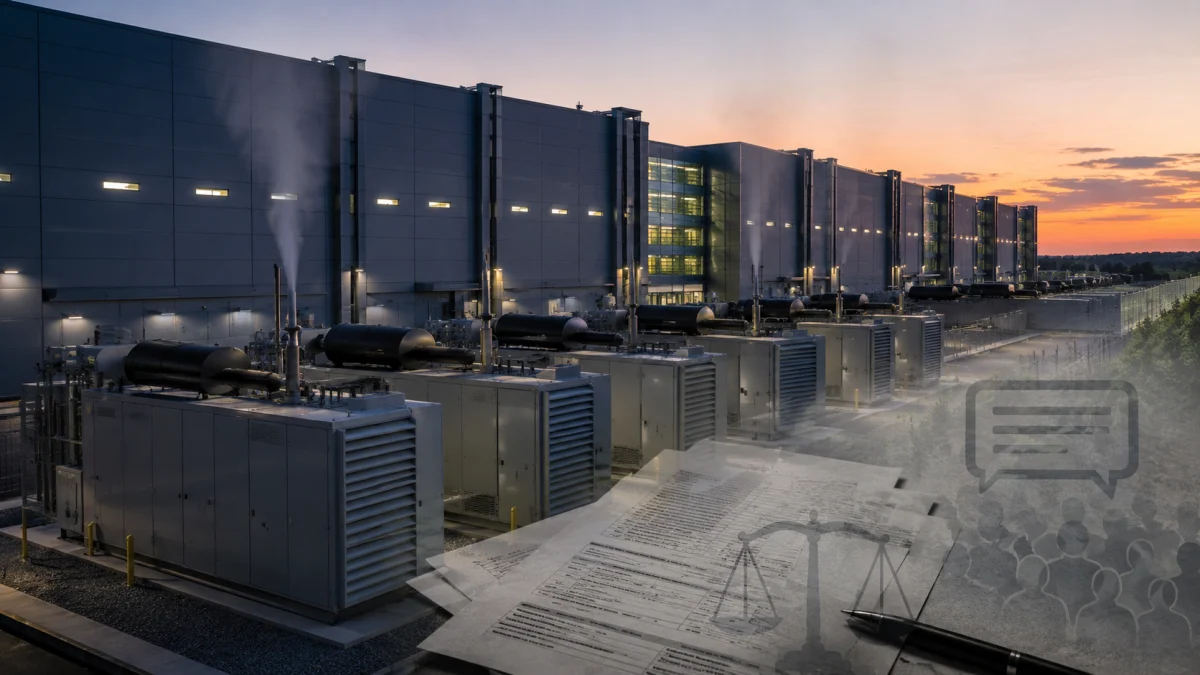
A data-center campus spanning hundreds of acres and containing more than 100 large diesel generators can still be processed through minor NSR if its legally defined potential emissions remain below the applicable major-source thresholds.
Virginia’s proposed Google Project Raspberry is an unusually clear real-world example.
What EPA is actually proposing to change
The current federal rule at 40 CFR § 51.161 establishes a minimum public-participation framework for affected New Source Review decisions.
EPA describes the current “opportunity for public comment” as containing three principal elements:
- the application information and air agency’s analysis must be available for public inspection;
- the public receives 30 days to submit comments; and
- notice must be prominently advertised in the affected area.
EPA now proposes removing that federal minimum as it applies to state and local minor NSR programs.
The agency’s stated interpretation is that the Clean Air Act requires states to regulate construction and modification of minor sources as necessary to achieve the National Ambient Air Quality Standards, but does not require EPA to mandate one particular public-participation procedure for every minor-source authorization.
EPA therefore proposes giving state and local agencies discretion to decide whether public participation is appropriate for different types of minor projects.
That produces a more precise picture than either side’s simplest talking point.
| Question | Current federal framework | Under EPA proposal |
|---|---|---|
| Must state/local minor NSR programs provide a federal minimum opportunity for public participation? | Yes | No |
| Is a 30-day comment opportunity part of the current federal minimum? | Yes | Federal minor-NSR requirement removed |
| Must states eliminate their own notice requirements? | No | No |
| Can states retain stronger requirements? | Yes | Yes |
| Are major PSD public-participation rules removed? | No | No change |
| Are major nonattainment NSR participation rules removed? | No | No change |
| Does this proposal itself eliminate the National Ambient Air Quality Standards? | No | No |
| Are Tribal minor NSR public-participation rules being eliminated by this proposal? | No | No |
EPA is therefore not proposing to prohibit public notice.
It is proposing to stop making a particular level of public notice and comment a federal minimum for state and local minor NSR programs.
That distinction matters.
Why an enormous data center can still be called a “minor source”
“Minor” sounds like a description of physical scale.
Under air-permitting law, it generally is not.
The relevant questions concern emissions and the particular permitting program being applied—not simply:
- how many acres a facility occupies;
- how much electricity it consumes;
- how many servers it contains;
- how much it cost to build;
- or how many diesel generators are installed.
EPA itself warns against treating major/minor status as one permanent label attached to an entire facility.
New Source Review applicability can be pollutant-specific. A source can potentially be subject to PSD for one pollutant, nonattainment NSR for another and minor NSR for another.
There is another important distinction.
True minor sources
A true minor source is below the relevant major-source emissions thresholds without needing special enforceable restrictions to get there.
Synthetic minor sources
A synthetic minor source could otherwise reach or exceed a major-source threshold but accepts enforceable limits that keep its legally recognized potential emissions below that threshold.
Those restrictions might limit:
- annual operating hours;
- fuel use;
- production;
- generator operation;
- or emissions themselves.
EPA specifically confirms that both true minor and synthetic minor sources fall within minor NSR programs.
That concept is particularly important for data centers because their backup-generator fleets may have enormous theoretical generating capacity while operating relatively few hours during normal years.
It is therefore possible for something that looks anything but “minor” from the road to be a minor source for purposes of a particular air-permitting determination.
Google’s Project Raspberry shows what “minor” can actually mean
Consider Project Raspberry, a Google data-center campus proposed in Botetourt County, Virginia.
Virginia’s Department of Environmental Quality says the project would disturb about 240 acres of a 343.6-acre site.
The proposed campus includes:
- three data-center buildings of approximately 300,000 square feet each;
- three electrical substations;
- a roughly 28,000-square-foot office building;
- roads, utilities and other supporting infrastructure.
That is roughly 900,000 square feet of data-center buildings alone.
For air permitting, the project proposes:
- 114 Caterpillar 3516E generator sets, each rated at 2,750 electrical kilowatts;
- six Caterpillar 3512C generators, each rated at 1,750 kWe;
- additional smaller generators;
- two emergency diesel fire pumps;
- and 48 cooling towers.
Yet Helio Capital LLC applied for an Article 6 Minor New Source Review permit for the campus.
Why?
According to the application figures published by Virginia DEQ, Project Raspberry’s proposed potential emissions include:
| Pollutant | Proposed potential emissions |
|---|---|
| Nitrogen oxides | 99.39 tons/year |
| Particulate matter | 6.34 tons/year |
| Carbon monoxide | 20.56 tons/year |
| Volatile organic compounds | 1.79 tons/year |
| Sulfur dioxide | 0.09 tons/year |
| Highest individual hazardous air pollutant | 0.04 tons/year |
| Total hazardous air pollutants | 0.08 tons/year |
Virginia DEQ describes a source as minor in this permitting context when it emits less than 100 tons per year of a criteria pollutant, less than 10 tons per year of a single hazardous air pollutant and less than 25 tons per year of total hazardous air pollutants.
The applicant also proposes a combined limit of 3,617 operating hours per rolling 12-month period across the 120 principal generators.
The result is an almost perfect illustration of the problem with ordinary language:
A roughly 900,000-square-foot data-center campus containing 120 large emergency generators can still be processed through a program called minor New Source Review.
What should we make of the 99.39-ton number?
The proposed nitrogen-oxide figure is particularly striking because it sits just below Virginia DEQ’s stated 100-ton threshold for a criteria pollutant in this context.
That deserves scrutiny.
It does not, by itself, prove that Google or its applicant manipulated the numbers improperly to evade major-source regulation.
Permitting systems routinely use enforceable operating restrictions when calculating potential emissions. The meaningful questions are whether the assumptions are legally permissible, whether the operating limits become enforceable, whether the emissions calculations are sound and whether actual operations comply with the resulting permit.
Those are evidence questions.
The number being close to a threshold is a reason to examine the permit—not evidence, by itself, that the permit is improper.
Project Raspberry would still receive public participation under Virginia’s current rules
Project Raspberry also demonstrates why the viral “secret permit” description goes too far.
Virginia DEQ notified the applicant on June 1 that the minor NSR permit will require a public-participation period.
Virginia’s regulations require at least a 30-day public-comment period for several categories of minor-NSR applications, including projects that DEQ determines have the potential for public interest concerning air-quality issues. The regulation lists opposition, adverse media coverage and negative comments from governmental or public-review processes among the factors DEQ may consider.
So even though Project Raspberry is being handled under minor NSR, EPA’s proposal would not simply cause its public process to vanish.
That is because the practical answer depends on state law and the state’s EPA-approved implementation plan.
Minor-NSR permitting is already common for Virginia data centers
Project Raspberry is not an isolated curiosity.
Virginia DEQ maintains a database of issued air permits for data centers, and the list shows extensive use of Article 6 minor NSR for facilities operated by Amazon, Microsoft, Digital Realty, NTT, Vantage, Yondr and other companies.
Recent examples include:
| Data-center permit | Issue date | Program |
|---|---|---|
| Amazon IAD-51 / 56 / 88 / 89 | July 7, 2026 | Article 6 — mNSR |
| Amazon IAD-114 / 115 | July 29, 2026 | Article 6 — mNSR |
| Amazon IAD-134 / 135 / 136 | July 29, 2026 | Article 6 — mNSR |
| Gainesville Crossing Data Campus | July 29, 2026 | Article 6 — mNSR |
| DataBank Data Center Culpeper | Aug. 5, 2026 | Article 6 — mNSR |
| Yondr Data Center | Aug. 13, 2026 | Article 6 — mNSR |
Virginia’s database contains many more.
This is an important point because EPA’s proposal is not a special data-center exemption.
The regulation applies broadly to state and local minor NSR programs.
Data centers have entered the controversy because enormous data-center projects already make frequent use of the permitting category whose federal public-participation floor EPA is proposing to remove.
But not every giant data center falls into this potential gap
A second project shows why simply labeling data centers “minor” or “major” can also be misleading.
Amazon’s proposed Energy Way Tech Campus in Richmond County, North Carolina, plans to install 588 diesel-fired emergency engines for backup electricity.
Separately, Duke Energy sought permission to install 57 diesel engines on Amazon’s property to temporarily provide what Duke calls “bridge power” until the project receives normal grid service.
Both facilities agreed to emissions restrictions intended to avoid triggering the federal Prevention of Significant Deterioration, or PSD, program.
That sounds at first like precisely the type of situation EPA’s minor-NSR proposal could affect.
But there is another layer.
North Carolina says both projects require Title V major-source air permits.
North Carolina held a public hearing on the draft permits and provided a public-comment period.
That illustrates an important rule:
Avoiding PSD does not necessarily mean a facility avoids every major-source permitting program.
Air permitting is a collection of overlapping legal programs, not a single major/minor switch.
EPA’s current proposal does not abolish Title V’s separate public-participation process. In fact, EPA warns in the proposed rule that issuing minor-NSR authorizations without notice could make those underlying decisions more vulnerable to scrutiny later during Title V permitting.
So the Amazon project is useful—but not as an example of a data center that EPA’s proposal would simply allow to be permitted in secret.
It demonstrates why each permit must be examined individually.
Would your state actually stop giving public notice?
Not necessarily.
This may be the single most important practical limitation on the viral version of the story.
EPA says that if the rule becomes final, states would be permitted—but not required—to change existing minor-NSR public-participation rules.
If a state does nothing, the participation provisions already contained in its EPA-approved State Implementation Plan remain in force.
A state seeking to weaken an existing SIP-approved participation requirement generally cannot simply ignore it the morning after EPA issues a final rule.
EPA says the state would first need to develop a SIP revision.
That process itself requires reasonable notice and public hearings, after which the revised plan would be submitted to EPA for review.
The progression therefore looks more like this:
EPA finalizes the rule
↓
Federal minimum for state/local minor-NSR public participation disappears.
↓
Does the state’s existing approved program still require notice?
Yes → that requirement continues.
No → the state may already have more discretion.
State wants to weaken an existing SIP requirement → it generally must revise the SIP, conduct the required participation process and obtain EPA approval.
That is materially different from saying:
“EPA issues rule; data-center pollution permits immediately become secret nationwide.”
They would not.
But saying “states can still provide notice” also understates the change
There is an equally misleading counterargument.
It goes something like this:
Nothing meaningful is happening because states remain free to notify the public.
That misses what EPA is actually removing.
A federal minimum is itself a legal protection.
Today EPA interprets its regulations as requiring qualifying state and local minor-NSR programs to provide public participation meeting the federal standard.
Under the proposal, EPA would no longer require that minimum.
A state could retain it.
Another could narrow it.
Another could potentially eliminate project-specific participation for categories of minor sources if the resulting program is otherwise legally approvable.
EPA itself says the proposal could allow agencies to reduce or eliminate existing minor-NSR public-participation requirements through the SIP process.
So the accurate description is neither “nationwide secret permitting” nor “nothing changes.”
It is:
EPA is proposing to convert a federal public-participation floor for state and local minor NSR into an issue largely left to state and local discretion.
“No public notice” is not necessarily the same as a “secret permit”
There is another useful distinction.
A permit can be obtainable through a public-records request or eventually appear in an agency database even if the government was never required to affirmatively notify affected residents before approving it.
Those are not equivalent forms of transparency.
Formal public participation can require an agency to:
- announce a proposed decision;
- make the application and technical analysis available;
- give residents a defined period to respond;
- accept comments before acting;
- and, depending on the program, address issues raised during that process.
A permit file technically available somewhere after the fact does not provide the same opportunity.
For that reason, the most precise description of EPA’s proposal is that some minor-source authorizations could eventually be issued without federally required advance public notice and comment.
Calling every such permit “secret” overstates what the proposal says.
Pretending the loss of mandatory advance notice makes no difference understates it.
What EPA’s proposed rule does—and does not—do
| Claim | What the record actually shows |
|---|---|
| EPA is eliminating public notice for every data center. | False. The proposal concerns state and local minor NSR programs. |
| Every minor-source permit will become private. | False. States can retain notice and comment requirements. |
| Nothing changes because states can keep their rules. | Misleading. EPA would remove an existing federal minimum. |
| A minor source must be a small facility. | False. “Minor” is an emissions-permitting classification. |
| A major data center cannot use minor NSR. | False. Large projects routinely receive minor-NSR permits depending on emissions and the applicable program. |
| Avoiding PSD makes a project completely “minor.” | False. A facility can still be subject to other major-source programs, including Title V. |
| EPA is repealing federal air-quality standards through this rule. | False. The proposal changes public-participation requirements; it does not repeal the NAAQS. |
| States must weaken public participation if EPA finalizes the rule. | False. They may keep their existing requirements. |
| Existing state notice rules disappear automatically. | False. EPA says existing SIP provisions continue unless revised. |
Why EPA says the requirement should be removed
EPA’s legal argument begins with the text of the Clean Air Act.
Section 110(a)(2)(C) requires state implementation plans to regulate construction and modification of stationary sources as necessary to assure that national ambient air-quality standards are achieved.
EPA now argues that, unlike portions of the Clean Air Act governing major sources, that language does not specify a mandatory public-participation procedure for minor NSR.
The agency therefore says state and local authorities should have greater discretion to decide which minor projects warrant public notice, how long comment periods should last and whether participation is necessary in a given category.
EPA also cites administrative burden.
The agency says state and local officials reported that some permitting programs process so many minor-source applications that providing a full 30-day comment opportunity for every covered action consumes significant staff time and resources. EPA’s own stakeholder summary found considerable variation among existing programs.
Those are EPA’s legal and policy rationales.
They do not resolve the separate policy question of whether eliminating the nationwide floor is desirable.
What is actually at stake for communities
The strongest criticism does not require claiming that EPA is legalizing unlimited pollution or creating a special favor for data centers.
The more concrete issue is procedural.
If EPA finalizes the proposal and a state subsequently reduces its minor-NSR participation requirements, a community could have less advance opportunity to learn about, inspect and challenge a proposed minor-source authorization before it is approved.
And, as Project Raspberry demonstrates, “minor source” can include industrial projects whose physical scale would surprise most people hearing that term for the first time.
That creates a real federalism question.
Should every state have complete discretion to determine whether residents receive advance notice of such permits?
Or should there continue to be a minimum national procedural guarantee?
EPA is proposing the former.
The present regulations provide more of the latter.
That is the actual debate.
There is another consequence EPA itself acknowledges
EPA’s proposal contains an interesting warning for permitting agencies considering eliminating public participation.
Title V operating permits consolidate many Clean Air Act requirements into one permit. Those permits often receive public comment and EPA oversight.
EPA’s position is generally that when an underlying NSR permit has already gone through public notice, comment and judicial-review opportunities, the substance of that NSR decision is ordinarily not reopened during Title V review.
But when an NSR authorization did not receive public notice and comment, EPA says the underlying decision may be subject to further scrutiny during the Title V process.
In other words, eliminating participation at the minor-NSR stage may not always make controversy disappear.
For Title V sources, it could shift some of that dispute downstream.
EPA explicitly warns that reducing minor-NSR participation could increase the number of underlying authorizations challenged through Title V petitions.
That is an important complication largely missing from simplified versions of the story.
What happens next?
As of August 28, 2026, this is still a proposed rule.
EPA signed the proposal on July 1. It was published in the Federal Register on July 7 as 91 FR 41591, document 2026-13667, under docket EPA-HQ-OAR-2025-1212.
The public-comment deadline was August 21.
EPA must now consider the administrative record before deciding whether to issue a final rule and whether to alter the proposal.
Until a final rule is issued, the current federal regulations remain in place.
And even if EPA finalizes the rule substantially as proposed, the next question will be state by state:
Which air agencies actually choose to reduce their existing public-notice requirements?
That may ultimately matter more than the federal rule itself.
The bottom line
The viral version—“EPA will let data centers get pollution permits secretly”—is too broad.
But dismissing the controversy because states can voluntarily retain public notice would also be misleading.
EPA is proposing a real change.
It would remove the federal minimum public-participation requirement for state and local minor New Source Review programs and allow those agencies substantially more discretion over when the public gets notice and a chance to comment.
Major PSD and nonattainment NSR participation requirements remain. Other programs such as Title V can create separate public processes. Existing state requirements would remain until legally changed.
What makes the issue particularly important for data centers is that “minor source” can describe projects that are anything but physically minor.
Google’s Project Raspberry illustrates the point almost perfectly: roughly 900,000 square feet of data-center buildings, 120 large emergency generators and proposed potential nitrogen-oxide emissions of 99.39 tons per year—yet a minor NSR permit application.
Virginia is requiring public participation for that project under its current rules.
Another state, under a future EPA-approved system with weaker participation requirements, might make a different choice.
That—not a nationwide ban on public notice—is the actual significance of EPA’s proposal.
References and Further Reading
Primary federal rulemaking
EPA Federal Register — Minor New Source Review Program Air Permitting Public Participation Requirements for State Implementation Plans — The primary proposed rule, Federal Register document 2026-13667, explaining the existing requirements, proposed changes, legal rationale, unaffected programs and SIP revision process.
EPA — New Source Review Regulatory Actions — EPA’s regulatory-action page confirming the status and scope of the July 2026 minor-NSR proposal.
EPA — Proposal to Streamline State and Local Permitting Process for Minor Sources — EPA’s announcement stating directly that the proposal would eliminate federal minimum public-participation requirements for state and local minor sources.
Virginia data-center permitting
Virginia DEQ — Google’s Project Raspberry — Primary state project page containing the campus size, minor-NSR application, generator fleet, emissions estimates, operating-limit proposal and permitting documents.
Virginia Administrative Code — 9VAC5-80-1170 Public Participation — Virginia’s current minor-NSR public-participation requirements, including circumstances requiring a 30-day public-comment period.
Virginia DEQ — Issued Air Permits for Data Centers — State database demonstrating widespread use of Article 6 minor NSR permits for Virginia data centers.
North Carolina comparison
North Carolina DEQ — Amazon Data Center and Duke Energy Air Quality Permits in Richmond County — Primary state explanation of Amazon’s proposed 588 backup engines, Duke Energy’s 57 bridge-power engines, Title V status and emissions restrictions intended to avoid PSD.
North Carolina DEQ — Public Hearing on Amazon and Duke Energy Richmond County Permits — Public-hearing record illustrating the separate participation process applicable to these Title V major-source permits.
Editorial currency note: This article describes a proposed EPA regulation and active permitting matters as of August 28, 2026. The federal rule may change before finalization, and individual state requirements may later be amended. The article should be updated when EPA takes final action or when a state proposes a material change to its minor-NSR public-participation rules.