The available public record does not establish that Charlie Kirk’s necklace was formally seized as evidence and then improperly returned to his wife. But it also does not establish the opposite: that investigators documented it, examined it, determined it had no evidentiary value and properly cleared it for release.
What we can establish is unusual enough to deserve a direct answer.
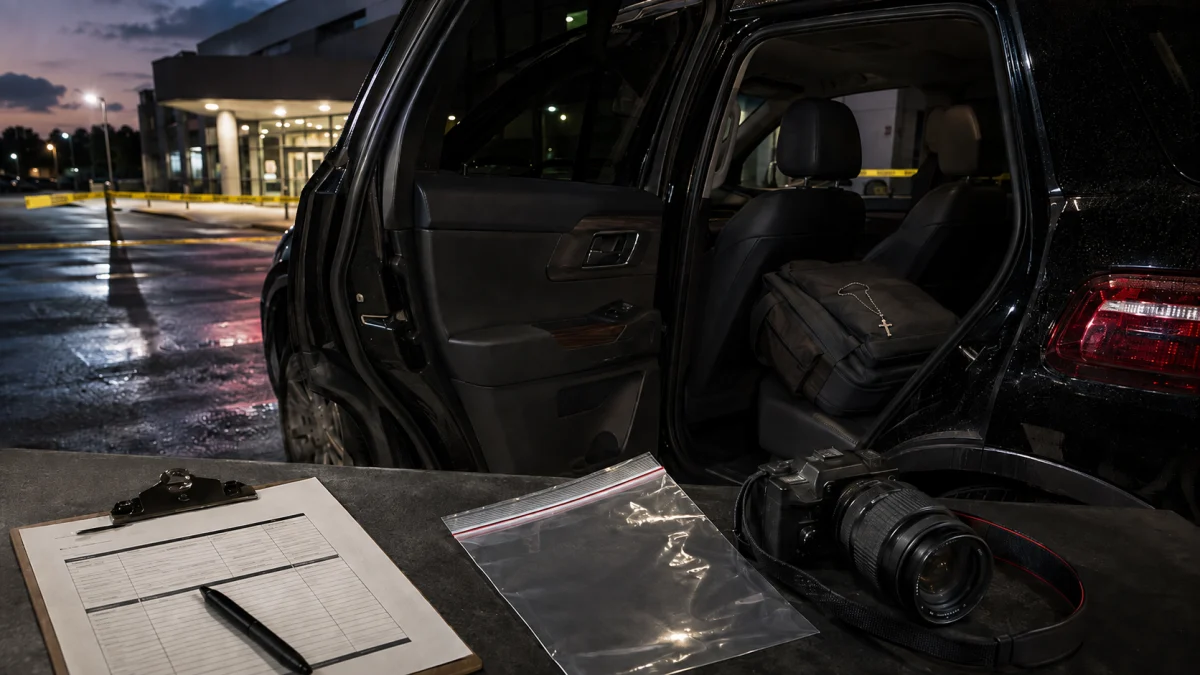
Frank Turek, who accompanied Kirk to the hospital after he was shot at Utah Valley University on September 10, 2025, says the SUV used to transport Kirk was temporarily treated as a crime scene. Turek says he could not retrieve his own wallet or computer bag from it. When access was eventually restored, he found Kirk’s cross-and-medallion necklace draped over that bag. In his first public account, Turek said he gave the necklace to Mikey McCoy to deliver to Erika Kirk. In a later account, he added that the FBI had cleared the vehicle before he entered it, that he had heard authorities were looking for the necklace, and that an unidentified “cop” said, “we’ve been looking for that.” Turek responded that he had it and “just took it.” (CrossExamined)
That leaves an important question that neither a presumption of government competence nor a presumption of conspiracy can answer:
Before Kirk’s necklace left that controlled vehicle and entered private possession, was it photographed, inventoried, examined, swabbed, entered into an evidence or property log, or affirmatively determined not to be evidence?
We have not found a public record answering that question.
And that matters because national death-investigation guidance specifically calls for evidence and personal effects to be documented, for collected items to have custodians and disposition records, and for personal effects removed during emergency treatment to be documented and photographed. Utah itself has formal procedures for distinguishing personal property from evidence and, when seized property is returned, requires detailed documentation. (Office of Justice Programs)
The proper conclusion at this stage is therefore neither “the necklace proves a cover-up” nor “there is nothing unusual here.”
It is much simpler:
Show the chain.
Why We Investigated This
The raw reader question behind this investigation is:
If Charlie Kirk’s necklace was on or near his fatal neck wound, was reportedly removed during emergency treatment, then turned up inside a vehicle investigators had restricted as a crime scene, how did it return to his family so quickly—and what records show what investigators did with it first?
That question has increasingly been mixed together online with explosive-device theories, claims that the FBI deliberately disposed of evidence, and assertions that every belonging of a homicide victim legally has to remain in an evidence locker until trial.
None of those propositions should simply be assumed.
There is a more basic factual question underneath all of them: what actually happened to this object?
That is what we tried to reconstruct.
The Evidence Ledger
| Status | What the record currently supports |
|---|---|
| Verified from Turek’s account | The SUV was temporarily treated as a crime scene and access to belongings inside was restricted. |
| Verified from Turek’s account | Kirk had been lying over Turek’s computer bag during the drive to the hospital. |
| Verified from Turek’s account | When Turek later retrieved the bag, Kirk’s necklace was draped over it. |
| Verified from Turek’s first account | Turek says he handed the necklace to Mikey McCoy for Erika Kirk. |
| Added in Turek’s later account | Turek says the FBI had to “clear” the vehicle before they could enter it. |
| Added in Turek’s later account | Turek says an unidentified “cop” told him authorities had been looking for the necklace. |
| Reported through Erika Kirk’s later interview | The necklace was reportedly removed while people were attempting to stop Kirk’s bleeding, and a trace of his blood remained in the cross. |
| Established by Utah authorities | Utah DPS and the FBI were formally co-leading the shooting investigation. |
| Established at the preliminary hearing | Investigators distinguished between items transferred as evidence and Kirk’s personal property being returned to his family. |
| Not publicly established | Whether the necklace received an evidence/property number. |
| Not publicly established | Whether investigators photographed or separately inventoried it. |
| Not publicly established | Whether any forensic examination was performed. |
| Not publicly established | Whether it was ever formally seized. |
| Not publicly established | Who decided it could leave the controlled SUV. |
| Not publicly established | Whether a release or property receipt exists. |
That last group is where the investigation remains open.
Start With Frank Turek’s First Account
Turek’s earliest detailed public account is especially valuable because he gave it on September 16, 2025—six days after Kirk was killed.
In that telling, Turek said the SUV they had used to transport Kirk “had been considered a crime scene.” He said nobody could retrieve their belongings from it. His wallet, computer and computer bag remained inside, and Kirk had been lying over the computer bag during the frantic drive to Timpanogos Regional Hospital. (CrossExamined)
Later that day, according to Turek, they finally regained access to the SUV.
Erika Kirk was asking for the necklace her husband had been wearing. Turek entered the back seat, pulled out his bag and found the necklace “just kind of draped over the bag.” He said he gave it to Mikey McCoy and asked McCoy to give it to Erika. (CrossExamined)
That account establishes something important without requiring any speculation:
The necklace was inside a vehicle to which authorities had deliberately restricted access because of the investigation.
It also raises the first unanswered question.
If the necklace had been removed while people were treating Kirk, how did it end up draped over Turek’s bag inside the SUV?
When, Exactly, Did the Necklace Come Off Kirk?
Subsequent reporting based on an interview with Erika Kirk described the necklace as the St. Michael pendant Kirk was wearing when he was shot. The account said people trying to stop his bleeding removed it and that a trace of Kirk’s blood remained in a crevice of the cross afterward. (Us)
That account is relevant, but it does not give us a complete custody history.
Turek’s own description of the trip to the hospital makes clear that Kirk was rushed there in an SUV rather than transported by ambulance. Turek and others inside were attempting emergency measures during the drive. The group encountered an ambulance but chose to continue directly to the hospital. (CrossExamined)
So “medics ripped it off” leaves several possibilities.
The necklace could have come off during efforts inside the SUV. It could have been removed during the transfer from the vehicle. Hospital personnel could have removed it and someone subsequently returned it to the SUV. Or the later description of exactly who removed it could simply be imprecise.
At present, we do not have enough evidence to choose among those explanations.
But that uncertainty makes contemporaneous documentation more—not less—important.
A hospital property record, photographs of Kirk’s effects, a vehicle-processing report or an evidence inventory could potentially establish the answer.
Turek’s Later Account Adds Several Important Details
Turek later retold the story during an appearance on The Megyn Kelly Show.
The basic sequence remained the same, but several new details appeared.
| Detail | September 16, 2025 account | Later account |
|---|---|---|
| SUV treated as crime scene | Yes | Yes |
| Access to belongings restricted | Yes | Yes |
| FBI specifically identified as clearing SUV | Not stated | Yes |
| Turek had heard authorities were looking for necklace | Not stated | Yes |
| Officer says authorities had been looking for it | Not stated | Yes |
| Necklace draped over computer bag | Yes | Yes |
| Turek’s description of disposition | Gave it to Mikey McCoy for Erika | “I just took it” |
In the later account, Turek said they could not enter the vehicle until “the FBI cleared it.” After he found the necklace, he said he had heard “they were looking for that.” He then described an unidentified “cop” reacting to the discovery by saying authorities had been looking for it. Turek said he responded that he had it and “just took it.” (PodScripts)
Two points need to be kept separate.
First, Turek did not say an FBI agent handed him the necklace out of an evidence bag. The FBI is mentioned in connection with clearing the SUV. The person who comments about the necklace is described only as a “cop.”
Claims that “the FBI returned the necklace to Erika” therefore go beyond Turek’s actual words.
Second, that correction does not make the episode uninteresting.
It arguably sharpens the question.
If an officer at a controlled vehicle knew the necklace was missing and said authorities had been looking for it, why did the item apparently leave with Turek rather than with the officer?
There may be a straightforward answer. Perhaps investigators had already photographed it. Perhaps they knew exactly what it was and had determined that it was merely personal property. Perhaps the person Turek calls a “cop” was only helping locate an item Erika wanted.
But those are possible explanations.
They are not documentation.
There Is a Plausible Innocent Explanation for Why Authorities Were Looking for It
Turek’s first account actually supplies one.
Before Turek retrieved his bag, he says Erika was already asking for Kirk’s necklace. (CrossExamined)
Therefore, the later statement that authorities had been “looking for” the necklace cannot legitimately be treated as proof that investigators believed it contained forensic evidence.
They may simply have been helping a widow locate her husband’s personal property.
That explanation deserves to be included because it fits the chronology.
But it still leaves another question:
Did anyone first determine that the necklace was only personal property?
The distinction matters.
An investigator helping locate a widow’s necklace is unremarkable. An investigator allowing a potentially relevant physical object to leave an active evidentiary environment without first documenting or evaluating it would be something different.
The record we have seen does not tell us which occurred.
Was the SUV Really Part of the Investigation?
Turek appeared puzzled that the SUV had been restricted, saying in his later account that it was not really part of the crime scene.
From a forensic standpoint, however, treating the transport vehicle as potentially relevant is hardly inexplicable.
Kirk was placed into the SUV immediately after being shot. Multiple people entered it. Emergency treatment occurred in or around it. Blood and other material were transferred into it. Kirk was lying over Turek’s bag. The vehicle therefore potentially contained evidence about the victim’s condition, medical intervention, personal effects and the movement of objects after the shooting.
NIJ’s 2024 death-investigation guide specifically warns that investigators sometimes deal with multiple locations and modes of transport after an injury and should attempt to determine the locations associated with the injury and subsequent movement of the decedent. (Office of Justice Programs)
So restricting the SUV was not, by itself, suspicious.
The more consequential question is:
What did investigators do while it was restricted?
Who processed it?
Was it photographed?
What was inventoried?
Was the necklace seen?
What agency released the vehicle?
And what did “the FBI cleared it” actually mean operationally?
Those questions require records, not assumptions.
What Professional Death-Investigation Guidance Says About Personal Effects
One misleading argument circulating around this story is that every item belonging to a homicide victim must remain in evidence until trial.
That is not how evidence works.
An investigator can determine that a wallet, watch, necklace or other possession has no continuing evidentiary value and return it.
But that does not mean documentation is optional.
The 2024 NIJ Death Investigation: A Guide for the Scene Investigator says that protecting the integrity of both evidence and personal effects through chain-of-custody procedures is vital. Its stated policy is that evidence and personal effects must be documented before collection and that a custodian and chain of custody should be maintained for collected items. It additionally calls for recording where evidence was found, when it was collected, where it went and who handled it. (Office of Justice Programs)
The same guide specifically instructs investigators conducting the external body examination to document and photograph the presence, absence and condition of clothing and personal effects, including items removed by emergency responders or law enforcement before the medicolegal investigator arrived. (Office of Justice Programs)
It also says valuables and property should be safeguarded for processing and eventual return to next of kin, while evidence on or near the body should be preserved for further evaluation. (Office of Justice Programs)
Those are professional guidelines, not proof of what happened in Utah.
That distinction is important.
A procedure manual can tell us what good documentation looks like. It cannot tell us whether investigators actually created that documentation in this case.
The relevant question is whether the Kirk investigation produced the corresponding records.
Utah’s Own Medical Examiner Procedures Draw the Same Distinction
Utah’s Office of the Medical Examiner publicly states that personal property brought to its office—such as wallets and clothing—is generally released with the deceased to the funeral home unless law enforcement needs the item as evidence. Someone separately retrieving property must show identification and sign a release. (Office of the Medical Examiner)
The OME also says that when evidence is discovered during an autopsy and handed to law enforcement, the officer receiving it signs a release. If law enforcement is not present, the OME generates a form detailing the evidence. (Office of the Medical Examiner)
Again, none of that proves the necklace went through the OME.
It tells us something more useful:
Utah has processes for distinguishing evidence from personal effects and documenting transfers between custodians.
If the necklace traveled through one of those systems, there should be a record.
If it never entered one of those systems because Turek recovered it directly from the SUV, then we need to understand the separate law-enforcement process that allowed that to happen.
If Police Seized the Necklace and Returned It, Utah Law Calls for Paperwork
Utah law creates an especially useful investigative fork.
Utah Code § 77-11a-301, in effect at the time of Kirk’s death, permits an agency or prosecutor to return seized property when it determines that the property does not need to be retained or preserved as evidence.
But if seized property is returned to its owner, the statute says the owner must sign a receipt listing the returned property in detail, and the agency must retain a copy. (Utah Legislature)
That does not mean such a receipt necessarily exists for Kirk’s necklace.
The provision applies to seized property.
If no agency ever took legal or physical custody of the necklace—if investigators had completed their processing of the SUV and simply allowed Turek to retrieve an object that remained private property—then this particular statutory return procedure may never have been triggered.
That leaves three broad possibilities:
1. The necklace was never seized
Investigators regarded it as personal property and allowed Turek to take it.
If so, the key questions become whether the item had first been observed, photographed or otherwise evaluated, and who made the decision that it did not need to be collected.
2. The necklace was seized or taken into agency custody, then released
If so, there should normally be property documentation associated with that custody and return—including, where § 77-11a-301 applies, the detailed receipt required by Utah law.
3. The necklace was collected as evidence
If so, there should be an evidence identifier and a custody trail showing collection, storage, examination and any eventual release.
Determining which of those scenarios occurred would resolve most of the controversy.
The Preliminary Hearing Confirms That Investigators Were Separating Evidence From Personal Effects
The July 2026 preliminary hearing provides another useful clue.
Former lead investigator David Hull was asked whether anything from Kirk’s autopsy had been transferred to investigators.
Hull testified that his understanding of standard procedure was that anything of evidentiary value collected by the medical examiner would be transferred through a chain of custody. He then said he was aware of items being transferred as evidence as well as Kirk’s personal items to be returned to the family. (Wave AI Podcast Notes)
That establishes that at least some of Kirk’s possessions were being sorted into two conceptually different categories:
evidence, and personal items being returned to his family.
What the testimony does not establish is where the necklace fell.
We found no reference to “necklace,” “cross,” “pendant,” “medallion” or “chain” in the searchable portion of that hearing testimony.
That absence is not proof that investigators failed to document it. A preliminary hearing is not supposed to recite every item in an evidence room.
But Hull’s testimony makes the missing classification especially relevant:
Was Kirk’s necklace among the personal items formally processed for return, or had it already left the SUV through Turek before that formal property process occurred?
Those are not the same thing.
A Newly Surfaced Hospital Search-Warrant Record Could Become Important—but It Needs Primary-Source Verification
During this investigation, we found another potentially significant lead.
An online reproduction published in August 2026 purports to quote Search Warrant No. 3212261, dated September 10, 2025, concerning Kirk’s body at Timpanogos Regional Hospital.
The reproduced text says investigators sought access to Kirk’s body, electronics and belongings that traveled with him to the hospital, along with authority to photograph his body and belongings. It also refers to an inventory associated with the warrant return. (SurvivorBB)
If authentic and complete, that warrant could be highly relevant to the necklace.
But there is an evidentiary problem: we have not independently obtained the original warrant and return from the court record.
The currently searchable source is a reproduction embedded in commentary, not the official court PDF.
Accordingly, sherafy.com is not treating its exact wording, purported return or claimed missing attachment as independently verified evidence at this stage.
That is now one of the highest-priority records to obtain.
The questions for the original warrant package are simple:
- Does its inventory identify a necklace, chain, cross, pendant, medallion or jewelry?
- Does it list Kirk’s other personal belongings?
- Were photographs of his effects actually taken?
- Is there an attachment to the return?
- Who took custody of any listed property?
A clean original copy could materially change this investigation.
Was Charlie Kirk’s Necklace Automatically Evidence?
No.
Being owned by a homicide victim does not automatically transform an object into evidence.
That point should not be controversial.
The harder question is whether this particular object had enough potential relevance that investigators should have evaluated it before allowing it into uncontrolled private custody.
Several facts could plausibly have mattered:
- Kirk was reportedly wearing it at the time he was shot.
- His fatal injury was to the neck.
- The necklace reportedly had to be removed during emergency treatment.
- Subsequent reporting says Kirk’s blood remained on it.
- Its precise condition could potentially help establish how and when it left his neck.
- It was later found inside the vehicle carrying Kirk from the shooting scene.
- That same vehicle had temporarily been restricted by investigators.
None of those facts establishes that the necklace contained evidence identifying the shooter.
They do establish a reasonable basis for asking what evaluation occurred.
The Physical Condition of the Chain Could Have Been Relevant
Even without any exotic theory, a basic examination might have recorded whether the chain was:
- normally unclasped;
- pulled apart at the clasp;
- fractured at a link;
- cut;
- stretched;
- otherwise damaged.
That could help test competing descriptions of how the necklace came off.
If an emergency responder physically tore it away while attempting to treat Kirk, the condition of the chain might be consistent with that account.
If it simply came loose during transport, its condition might look different.
This would not necessarily be consequential to the prosecution. But once an item has been repaired, repeatedly handled or worn for months, some of the original physical information may no longer be recoverable.
That is exactly why contemporaneous photographs and inventory records matter.
What About Blood or Other Trace Evidence?
A trace of Kirk’s own blood on his necklace would not, by itself, identify whoever shot him.
But documenting biological material can establish the relationship of an object to an injury, treatment or location. Trace material can also be transferred, contaminated or lost through repeated handling.
The relevant question is therefore not whether “blood on the necklace solves the murder.”
It almost certainly does not.
The question is whether investigators preserved enough information about the item before private handling changed its condition to permit later forensic questions to be answered.
Was Charlie Kirk’s Necklace Tested for Explosive Residue?
We found no publicly released laboratory result establishing that Kirk’s necklace was tested for explosives.
We also found no publicly released forensic evidence establishing that an explosive device caused Kirk’s fatal injury.
Those two facts need to remain together.
There are online theories proposing that Kirk’s necklace, microphone or another object near his neck somehow contained or was affected by an explosive device. The existence of those theories is not evidence that an explosion occurred.
At the same time, the underlying forensic proposition that metal surfaces can retain explosive residue is real. The FBI’s forensic-services handbook says explosive residue can be deposited on metal, plastic, glass, fabric and other surfaces and emphasizes prompt collection and protection from contamination because some residue can degrade or disappear. (FBI) NIST likewise studies the persistence and collection of trace explosive particles from surfaces. (NIST)
That means:
Could a metal necklace theoretically be examined for explosive residue? Yes.
Does that establish that Kirk’s necklace contained explosive residue? No.
Does the absence of a public test result establish that authorities deliberately avoided testing it? No.
The evidence-handling question does not depend on the explosive theory being true.
A wound-adjacent, reportedly blood-bearing personal effect whose removal history is unclear can raise documentation questions for much more ordinary reasons.
Did the FBI Have No Business Being Involved Because This Was a State Crime?
No. That claim from some of the commentary surrounding this story is not supported.
On September 10, 2025, the Utah Department of Public Safety publicly announced that Utah DPS and the FBI were co-leading the investigation, working with the Utah County Attorney, Utah County Sheriff’s Office and local police departments. (Utah Department of Public Safety)
One can still investigate whether a particular FBI action was justified or competently performed.
But “this was a state crime, therefore the FBI had no legitimate role” is not a serious basis for doing so.
The better questions are factual:
Which agency controlled the SUV?
Which agency processed it?
Who decided it was cleared?
What did clearing it entail?
Which agency, if any, encountered the necklace?
Those questions can be answered with evidence.
Jurisdictional insinuation cannot substitute for them.
Did the FBI Give Erika Kirk the Necklace?
Based on the public evidence we reviewed, that claim is too strong.
Turek’s later account says the FBI had to clear the SUV before he could enter it. He separately refers to an unidentified “cop” saying authorities had been looking for the necklace. Turek then describes taking the necklace himself. (PodScripts)
His earlier account is even simpler: access to the SUV was restored, he found the necklace and handed it to Mikey McCoy for Erika. (CrossExamined)
Neither account describes an FBI evidence custodian formally releasing the necklace to Erika.
So the accurate question is not:
Why did the FBI give evidence back to Erika?
It is:
What, if anything, did law enforcement do with the necklace before Turek took possession of it?
That is both less sensational and much harder to dismiss.
The Records That Could Settle This
This investigation does not require another round of anonymous theories.
It requires paperwork.
| Record | What it could answer |
|---|---|
| SUV scene-processing report | Which agency processed the vehicle and what investigators found |
| Vehicle photographs | Whether the necklace was visible before Turek entered |
| Evidence/property log | Whether the necklace received an item number |
| Hospital patient-property inventory | Whether the necklace arrived with Kirk or was removed there |
| Medical Examiner intake inventory | Whether the necklace traveled with Kirk’s body |
| OME transfer documentation | Whether it was classified as evidence or personal property |
| Search Warrant 3212261 and complete return | Whether Kirk’s belongings were inventoried and whether the necklace appears |
| Property-release receipt | Whether an agency formally returned a seized necklace |
| Laboratory submission log | Whether the necklace was submitted for biological, trace or residue testing |
| Turek/McCoy interview reports | What investigators contemporaneously recorded about the necklace’s discovery and transfer |
| SUV release authorization | Who determined investigators were finished with the vehicle and when |
Some of these records may currently be withheld because the prosecution remains active.
That is not proof they do not exist.
But if the answer to public concern is “the necklace was properly documented and cleared,” then eventually the evidence supporting that answer should be identifiable.
One Detail From the Preliminary Hearing Makes the Documentation Question Even More Important
Hull’s July testimony is worth returning to.
He did not say that investigators simply handed every one of Kirk’s possessions to the family.
He described an investigative process in which evidentiary material was transferred through chain of custody while personal effects were returned to the family. (Wave AI Podcast Notes)
That means the necklace controversy can be reduced to a remarkably straightforward question:
Which category was it in?
If the necklace was evaluated and classified as personal property, show the record.
If it was temporarily seized and later released, show the property trail.
If it was collected as evidence, show the chain of custody.
If it was never processed because it remained inside an already-cleared vehicle, identify when the vehicle was processed and what investigators documented before clearing it.
The problem is not that only one of those outcomes would be acceptable.
The problem is that the currently available public record does not tell us which one happened.
A Third Turek Account Circulating Online Needs Better Source Verification
There is one more wrinkle we are deliberately not using as a foundation for this article.
A clip circulating from an April 2026 interview with Turek has been presented by critics as containing an even more detailed exchange in which an officer allegedly sought to take the necklace and Turek refused.
That would be materially different from the later account in which the officer merely says authorities had been looking for it.
However, the transcript currently circulating most widely comes through highly adversarial secondary commentary rather than a clean authenticated transcript of the original interview. (Wave AI Podcast Notes)
Until the original recording is checked directly and the complete exchange is established in context, that alleged version should not be treated as a settled fact.
The appropriate reporting response to a potentially important inconsistency is not to ignore it—or prematurely declare somebody a liar.
It is to obtain the primary source.
What We Can Actually Conclude
The strongest conclusion supported by the evidence is narrower than the allegations circulating online, but it is not reassuring simply because it is narrower.
We cannot currently establish that Charlie Kirk’s necklace was formally seized as evidence and improperly released.
We also cannot establish that it was photographed, inventoried, examined and affirmatively cleared before it entered private possession.
Turek’s own accounts place the necklace inside a vehicle authorities had temporarily restricted as a crime scene. His later account says the FBI had to clear that vehicle before he could enter it and that an officer knew authorities had been looking for the necklace. His first account says he subsequently gave the necklace to Mikey McCoy for Erika Kirk. (CrossExamined)
Professional death-investigation guidance says personal effects should be documented and inventoried and specifically contemplates items removed during emergency treatment. Utah’s Medical Examiner uses documented property/evidence transfer procedures. Utah law requires a detailed receipt when seized property is formally returned to an owner. (Office of Justice Programs)
And at the July preliminary hearing, the former lead investigator acknowledged that Kirk’s evidentiary items and personal effects were being treated as different categories. (Wave AI Podcast Notes)
So the unexplained fact is not that Erika Kirk ultimately received her husband’s necklace.
Families routinely receive a deceased person’s personal belongings.
The unexplained fact is what happened to this particular object before she received it.
It was reportedly on Kirk at the time of a fatal neck injury. It was reportedly removed while people were trying to save him. It somehow ended up draped over a bag inside the SUV carrying him to the hospital. Investigators restricted access to that vehicle. Turek later retrieved the necklace from it. And the publicly available record we have reviewed still does not show the intermediate forensic or property process.
Authorities may have records that resolve every one of those questions.
If they do, those records—not institutional reputation, not speculation and not assurances that standard procedure would normally have been followed—are the answer.
Show the chain.
Case-status note
As of August 28, 2026, Tyler Robinson has been charged in Kirk’s killing but has not been convicted. The next hearing is scheduled for September 1, 2026, at 10:00 a.m. MDT, when the court is expected to hear argument over whether prosecutors have established probable cause sufficient to support the charges. (Utah County Attorney)
This article should be updated if the September 1 proceeding, subsequent discovery, or newly released property/evidence records address Kirk’s necklace or other personal effects.
References and Further Reading
Primary and Case-Specific Sources
Frank Turek — “The Greatness of Charlie Kirk: An Eyewitness Account,” September 16, 2025 — Turek’s earliest detailed public account. It establishes the restricted SUV, Kirk lying over Turek’s computer bag, the necklace being found draped over it and Turek giving it to Mikey McCoy for Erika. (CrossExamined)
Frank Turek interview on The Megyn Kelly Show — later necklace account — Contains Turek’s later additions that the FBI cleared the SUV, that he had heard authorities were looking for the necklace and that an unidentified “cop” said they had been looking for it. (PodScripts)
July 2026 Preliminary Hearing — Day 2 transcript — Includes former lead investigator David Hull’s testimony concerning evidence transferred from the Medical Examiner and Kirk’s personal property being returned to the family. (Wave AI Podcast Notes)
Utah County Attorney — Charlie Kirk Case Updates — Official case-status page. The September 1, 2026 hearing concerns whether prosecutors have established probable cause. (Utah County Attorney)
Utah Evidence and Medical-Examiner Procedures
Utah Code § 77-11a-301 — Return of Seized Property to Claimant — The law in effect at the time of the shooting allowed agencies to return seized property not needed as evidence but required a detailed receipt when seized property was returned to its owner. (Utah Legislature)
Utah Office of the Medical Examiner — Information for Families — Explains that personal property generally accompanies the deceased to the funeral home unless law enforcement requires it as evidence, and describes property-release procedures. (Office of the Medical Examiner)
Utah Office of the Medical Examiner — Law-Enforcement Procedures — Explains how evidence discovered during autopsy is transferred to law enforcement and documented. (Office of the Medical Examiner)
Utah Office of the Medical Examiner — Hospital Guidance — Describes Utah’s death-investigation and evidence-preservation practices in hospital cases. (Office of the Medical Examiner)
Forensic Standards and Trace Evidence
National Institute of Justice — Death Investigation: A Guide for the Scene Investigator, 2024 — Current national professional guidance covering chain of custody, documentation of personal effects, effects removed by emergency responders, and preservation of evidence associated with a body. (Office of Justice Programs)
FBI Laboratory — Handbook of Forensic Services — Explains explosive-residue examinations, including that residue can be deposited on metal and other surfaces and that collection timing and contamination control matter. This establishes technical feasibility, not evidence that an explosion occurred in Kirk’s case. (FBI)
NIST — Fire Debris and Explosives Research — Current research on trace explosive-residue persistence and analysis. (NIST)
Official Investigation Context
- Utah Department of Public Safety — September 10, 2025 UVU Shooting Update — Confirms that Utah DPS and the FBI were formally co-leading the investigation with county and local agencies. (Utah Department of Public Safety)
Investigative Lead Requiring Primary Verification
- Online reproduction discussing Search Warrant No. 3212261 — Reproduces what is represented as a September 10 hospital search warrant covering Kirk’s body and belongings. sherafy.com has not independently authenticated the original warrant package, so this source is treated as a lead for obtaining the primary court record rather than proof of its complete contents. (SurvivorBB)
Editorial currency note: This article reflects records and sources reviewed through August 28, 2026. The criminal case remains active, the probable-cause argument is scheduled for September 1, and additional evidence inventories, warrant returns, testimony or discovery could materially change the conclusions above. Utah statutory provisions should also be checked for subsequent amendments when this article is updated.