Update — August 28, 2026: After publication, David Spevak identified the men and others involved in the Washington Square Park encounter as connected to Frontline Advocates. We updated this article with the organization’s own description of its IDF-veteran advocacy operation, its pre-announced August 23–30 New York campaign, its stated focus on filming and digitally amplifying confrontations, and separate pre-incident reporting that Frontline members had entered another Palestine-related event undercover. Spevak has also alleged that one of the men has a Mossad connection; we have not independently established that claim and do not present it as fact.
David Spevak says two men identified as IDF soldiers approached him in New York’s Washington Square Park, told him they were Palestinian students from Gaza, and then began describing horrific acts of rape and child murder as if they had personally committed them.
But the most important part of what happened is not simply that Israelis allegedly dressed up and pretended to be Palestinians.
It is what kind of Palestinians they chose to become.
According to Spevak, the men presented themselves as supporters of the Palestinian resistance, showed him graphic images of Israeli victims from October 7, and then claimed responsibility for grotesque atrocities depicted in those images. One claimed to have repeatedly raped and murdered a woman. The other described killing a crying child because, he said, the child would eventually grow up to become an IDF soldier.
None of those statements represented Palestinian testimony. The men were not confessing to Palestinian crimes.
They were performing Palestinians.
And then, Spevak says, they tried to get him to respond on camera.
That changes the meaning of the entire encounter.
What happened in Washington Square Park
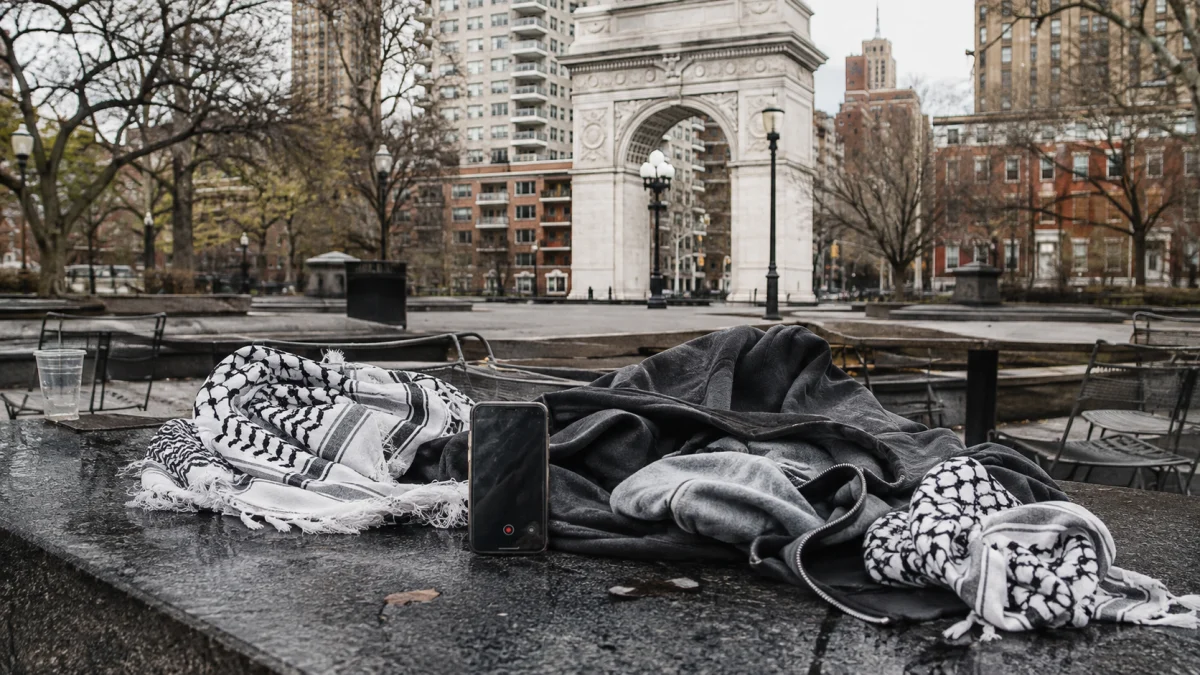
Spevak, a Jewish anti-Zionist creator who posts as @davidsaysstuff, says he was confronting people at an Israeli fundraising table in Washington Square Park when two men approached him.
They introduced themselves as Palestinian students from Gaza.
Spevak says he spoke with them for several minutes before one of the men asked whether he was “with the resistance.”
Then came the images.
The men showed him graphic photographs and videos of October 7 victims while pretending that the people responsible for what he was seeing were standing directly in front of him.
According to Spevak, one man pointed to the photograph of a female victim and claimed he had raped and stabbed her. They then showed him an image of a young child and described killing the child because he might someday become an Israeli soldier.
Spevak understood what was happening as an attempted trap.
Support “the resistance” after being fed those stories, and a camera could capture a Jewish anti-Zionist apparently endorsing rape and the murder of children.
Reject what they were calling “the resistance,” and the resulting footage could potentially be used to portray even a committed Palestine supporter as repudiating Palestinian resistance itself.
Spevak refused the premise.
Later, after people with him began publicly identifying the men as IDF soldiers pretending to be Palestinians, Spevak says they entered a bathroom, changed clothes, returned toward the Israeli table and rejoined the people there.
The encounter was witnessed by others around Spevak, and portions of what followed were filmed.
His summary was simpler:
“They didn’t expose Palestinians. They exposed themselves.”
Watch David Spevak’s original account on Instagram
The men were apparently part of an organized Israeli advocacy campaign already operating in New York
A day after the encounter, Spevak said he had identified the men and others present at Washington Square Park as connected to Frontline Advocates, an Israeli nonprofit that sends military veterans and other trained advocates into American campuses, public squares and protest environments.
That identification adds important context to what happened.
Frontline Advocates describes itself as a “rapid-response unit” of IDF veterans, officers and Special Forces professionals deployed to places including Columbia University and Washington Square Park. The organization says its advocates operate in close collaboration with Israel’s Ministry of Foreign Affairs.
Its model is explicitly built around confrontation and media amplification. Frontline Advocates says that its public engagements are documented and converted into digital campaigns intended to reach much larger online audiences.
And the timing is difficult to dismiss as coincidence.
Two weeks before Spevak’s encounter, Frontline Advocates co-founder Stav Cohen publicly discussed a seven-person delegation scheduled to operate in New York from August 23 through August 30. Its planned activities included public debates and filming social-media content near NYU, Columbia University and several other New York campuses.
Spevak’s encounter occurred in Washington Square Park, beside NYU, on August 27—during that publicly announced deployment.
Cohen has said Frontline Advocates is not funded by Israel’s Foreign Ministry. But he also acknowledged that the ministry supports the organization in other ways, including providing facilities and instructors for its speaker-training program. Frontline Advocates itself describes the relationship as a close collaboration.
That distinction matters when determining who authorized any particular action. It does not erase the institutional relationship.
There is also evidence that undercover engagement was not foreign to Frontline Advocates before the Washington Square Park incident.
On August 26, L’Espresso reported that two Frontline Advocates members had entered a pro-Palestinian rights event on Staten Island undercover before revealing themselves by confronting people at the event. That incident did not involve the same alleged Palestinian impersonation Spevak describes. But it shows that members of this organization were already using concealed identity as part of their engagement with ideological opponents.
The Washington Square Park episode therefore looks different with this context.
It was not simply an encounter with two anonymous Israelis who happened to have cameras nearby.
Spevak says the men belonged to an organization whose publicly stated purpose is to enter contentious American spaces, confront critics of Israel, document those encounters and turn them into social-media content—and whose delegation had publicly announced that it would be doing precisely that in New York during the week he encountered them.
The fake identity was not incidental. It was the mechanism.
There is an enormous difference between someone saying:
“Palestinians commit atrocities.”
and someone pretending to be Palestinian and saying:
“I committed these atrocities because I am Palestinian.”
The first is an accusation.
The second manufactures the evidence for the accusation.
That is what makes Spevak’s account important.
The men he encountered did not simply appear to be arguing that Palestinian resistance is barbaric. They assumed Palestinian identities and supplied the barbarism themselves.
They created the speaker, created the confession, created the ideology behind it and then tried to make another person react to the package.
The resulting message would appear to come from Palestinians when, in reality, the Palestinian voice itself had been fabricated.
There is an old information-warfare concept for this basic mechanism.
A 1951 U.S. State Department document classified propaganda according to its source. “Black” propaganda was material in which the genuine source was concealed and the message was instead attributed to the hostile side. The principle is straightforward: a message becomes much more persuasive when audiences believe the enemy said it about themselves.
Whether the men in Washington Square Park knew or cared about that terminology is irrelevant. The structure Spevak describes follows the same logic.
The alleged Palestinian extremist was convincing because the audience was supposed to believe he was actually Palestinian.
He wasn’t.
This is where dehumanization becomes something more
Palestinians are constantly represented through other people’s descriptions of them.
Violent. Fanatical. Jew-hating. Indifferent to civilian life. Celebratory of death.
The Washington Square Park incident described by Spevak crosses another line.
Instead of merely telling an audience what Palestinians supposedly think, the men allegedly became fictional Palestinians and said it themselves.
That is a particularly corrosive form of dehumanization because it removes the target population from its own representation.
You no longer need an actual Palestinian expressing the belief you want attributed to Palestinians.
You can manufacture one.
Spevak put the problem another way:
“Palestinians have been dehumanized enough. We can’t allow IDF soldiers to take over their identities too.”
That may be the most consequential statement in his video.
A population already fighting to be heard on its own terms cannot meaningfully defend itself against a statement it never made, spoken by a person falsely claiming to belong to it.
And Israeli forces posing as Palestinians is not an invented historical connection
The Washington Square Park incident occurred in an entirely different setting from military undercover operations in the occupied Palestinian territories. But the underlying practice of Israeli personnel passing themselves off as Palestinians has a long, extensively documented history.
Israeli undercover units commonly known as mista’arvim have operated by assimilating into Palestinian communities and protests, using Palestinian clothing, language, mannerisms and identities to avoid detection.
Human Rights Watch documented the practice extensively in its 1993 report A License to Kill, describing Israeli army and Border Police units whose members frequently disguised themselves as Palestinians while conducting operations in the occupied West Bank and Gaza.
B’Tselem likewise documented Israeli undercover units operating in the occupied territories, describing the mista’arvim as central to Israeli operations against wanted Palestinians.
More recent footage has repeatedly shown Israeli undercover officers dressed as Palestinian demonstrators before suddenly drawing weapons and making arrests. In a widely documented 2017 incident near Ramallah, undercover personnel wearing keffiyehs, masks and even a Palestinian flag mingled with demonstrators before revealing themselves.
But there is an even more relevant precedent.
Israeli undercover personnel have previously participated in the behavior they were supposedly infiltrating
At a 2005 demonstration in the West Bank village of Bil’in, protesters alleged that men they believed were Palestinians began throwing rocks toward Israeli forces.
The men were actually undercover Israeli personnel.
Years later, testimony during the criminal trial of Israeli Knesset member Mohammed Barakeh brought the incident back into focus. A commander from the Israeli Prison Service’s elite Masada unit acknowledged that his undercover personnel had thrown stones in the direction of Israeli soldiers during the demonstration.
The U.S. State Department subsequently noted the case in its 2012 human-rights report, citing reporting that undercover Israeli soldiers had hurled rocks at IDF personnel in circumstances tied to arrests and stronger crowd-dispersal measures.
That precedent matters.
It is one thing for an undercover officer to dress like a Palestinian so the officer can enter a crowd unnoticed.
It is another for an officer dressed as a Palestinian to perform the conduct being attributed to Palestinians.
The latter creates an obvious evidentiary problem.
Someone watching from a distance sees a Palestinian throwing rocks.
Except the Palestinian isn’t Palestinian.
The behavior is real. The identity attached to it is false.
That does not establish that the Washington Square Park encounter was directed by the Israeli government or connected to a mista’arvim unit. It establishes something more relevant and narrower: Israeli personnel impersonating Palestinians and participating in provocative conduct while under that identity is not merely a hypothetical scenario. There is historical evidence of it happening.
What the Frontline Advocates connection changes
None of this tells us how often people connected to Israeli advocacy organizations have impersonated Palestinians in the United States.
It does change how this particular episode should be understood.
What initially appeared to be two unidentified men engaging in a bizarre act of provocation now sits inside a traceable organizational context.
Frontline Advocates had publicly announced that its delegation would be operating in New York that week. Its leadership said members would hold confrontations and film social-media content. Its website specifically identifies Washington Square Park as one of its operating environments and describes digital amplification as a central part of its strategy.
Separately, members of the organization had already been reported entering another Palestine-related event undercover.
If Spevak’s identification of the men as Frontline Advocates participants is correct, the important unanswered question is therefore no longer simply why two men decided to do this.
It is how the impersonation fit into the activities of the organization they were there with—and who else knew about it.
Those are now legitimate questions for Frontline Advocates itself.
The attempted trap tells us what the men thought would work
Perhaps the most revealing part of Spevak’s story is the stereotype the men allegedly chose.
They could have pretended to be Palestinians and discussed displacement.
They could have talked about checkpoints.
They could have described losing relatives in Gaza.
They could have argued for Palestinian statehood.
Instead, according to Spevak, they presented themselves as Palestinians who rape Israeli women, murder Jewish children and regard those acts as components of Palestinian resistance.
Why?
We cannot know what was inside their heads.
But we can examine the construction.
It was almost perfectly designed to collapse several different questions into one:
Do Palestinians have a right to resist occupation?
Do armed Palestinian groups ever commit war crimes?
Was October 7 justified?
Is sexual violence acceptable?
May civilians or children deliberately be killed?
Those are not the same question.
The setup Spevak describes made them the same question.
“Are you with the resistance?” becomes impossible to answer cleanly after the speaker has first redefined resistance as personally raping women and shooting children.
That is not debate.
It is a loaded premise wearing somebody else’s identity.
David Spevak’s reaction was personal for a reason
Spevak began crying when he realized what he believed was happening.
His father served in the IDF.
Spevak describes having grown up with a particular understanding of Israel and Palestinians before eventually rejecting Zionism and becoming a vocal advocate for Palestinians.
So the encounter hit him at two levels.
Politically, he believed he was watching men manufacture precisely the Palestinian monster he had been taught to fear.
Personally, he was watching people associated with an institution connected to his own family history perform it in front of him.
His anger at the end of the video is unmistakable. He argues that the problem cannot simply be reduced to Benjamin Netanyahu and condemns Israeli society in sweeping terms.
The evidence here supports a more precise—and ultimately more useful—version of that argument.
A propaganda culture does not require the prime minister to personally write every script.
Narratives can be reproduced by institutions, soldiers, activists, media operations and ordinary people who have learned which stories will activate an audience.
What Spevak says he saw in Washington Square Park was not Netanyahu standing behind a podium.
It was people participating in an organized Israeli advocacy environment performing an extraordinarily dehumanizing version of Palestinian identity in service of an argument about Palestinians.
That distinction matters.
So does resisting the temptation to turn two men’s behavior into an essential characteristic of millions of Israelis. Doing that would reproduce the same collective logic this article is criticizing.
The conduct is disturbing enough without exaggerating it.
They used real victims to create a fake perpetrator
There is another part of this incident that should not disappear beneath the politics.
The photographs being shown to Spevak depicted real Israeli victims of October 7.
If his account is accurate, those victims were being used as props in a performance.
Their suffering was paired with a fictional Palestinian perpetrator who stood in front of Spevak and pretended to have inflicted it.
That does not honor the dead.
It instrumentalizes them.
Real Israeli suffering and real Palestinian suffering do not require fictional perpetrators, fabricated testimony or manufactured identities to make them morally significant.
Once evidence becomes theater, even genuine victims become raw material for someone else’s narrative.
The lesson extends far beyond Washington Square Park
Social media has trained people to treat video as the end of an argument.
There he is.
Look at what he said.
See what these people believe.
But video proves only what the camera actually establishes.
If the identity of the speaker is part of the claim, then the identity of the speaker is part of the evidence.
A video of “a Palestinian” celebrating rape means something radically different if the person speaking is not Palestinian.
A video of “Palestinian protesters” initiating violence means something radically different if some of the people initiating it are undercover security personnel.
And a perfectly inflammatory statement from the opposing side should invite more scrutiny, not less, when it seems almost too perfectly designed to confirm everything an audience already believes.
The Washington Square Park encounter does not tell us how many similar encounters have happened without someone recognizing the people involved.
It does tell us why that question is worth asking.
David Spevak thought two Palestinians had walked up to him and revealed something horrifying about Palestinians.
Instead, he says, two IDF soldiers walked up to him and revealed something about themselves.
They didn’t discover the Palestinian monster they wanted him to confront.
They had to manufacture him first.
References and Further Reading
Primary source
David Spevak — Original Washington Square Park video on Instagram Spevak’s first-person account of the encounter, including his description of the men’s claimed identities, statements, clothing change and return to the Israeli group.
David Spevak — Follow-up identifying Frontline Advocates
Spevak’s August 28 follow-up identifying the people involved as connected to Frontline Advocates and describing what he says was the broader purpose of the confrontation.
Undercover Israeli units and Palestinian impersonation
Human Rights Watch — A License to Kill: Israeli Undercover Operations Against “Wanted” and Masked Palestinians A detailed Human Rights Watch investigation of Israeli military and Border Police undercover units that frequently operated while disguised as Palestinians.
B’Tselem — Activity of the Undercover Units in the Occupied Territories Historical human-rights documentation of mista’arvim and Israeli undercover operations in the occupied Palestinian territories.
The Guardian — Israeli Undercover Soldiers Seen Arresting Palestinian Protesters Video-documented example of undercover Israeli personnel posing as Palestinian protesters before revealing themselves and making arrests.
Bil’in and manufactured protest activity
+972 Magazine — Commander Admits Undercover Israeli Officers Threw Stones at Soldiers in Bil’in Reports court testimony from a commander acknowledging that undercover personnel threw stones toward Israeli soldiers while infiltrating a Palestinian demonstration.
U.S. Department of State — 2012 Country Report on Human Rights Practices: Israel and the Occupied Territories The State Department’s human-rights report noted reporting about Israeli undercover personnel throwing rocks at IDF soldiers in connection with arrests and crowd-dispersal tactics.
Propaganda and false source attribution
U.S. Department of State Office of the Historian — 1951 Foreign Service Circular on Propaganda Classification Historical U.S. government document defining “black” propaganda as messaging whose real source is concealed and falsely attributed to a hostile source.
Frontline Advocates and the New York campaign
Frontline Advocates — Official Website
The organization describes itself as a rapid-response advocacy unit composed of IDF veterans, officers and Special Forces personnel, explicitly names Washington Square Park among its operating locations, says its engagements are converted into digital campaigns, and states that it works in collaboration with Israel’s Ministry of Foreign Affairs.
JNS — “Trying to Prevent Next Mamdani,” Say Israeli Vets Slated to Visit NYC Campuses
Pre-incident reporting on Frontline Advocates’ planned August 23–30 New York delegation, including public debates and social-media filming near NYU and other campuses. The important value here is that the itinerary was reported before the Washington Square Park incident.
L’Espresso — Israeli Reservists Conducting Advocacy Campaign Outside U.S. Universities
Published before Spevak’s encounter, this report describes Frontline Advocates’ U.S. campaign and documents two members entering a pro-Palestinian event undercover before revealing themselves during a confrontation.
Editorial currency note: This article distinguishes the documented history of Israeli undercover impersonation from the specific Washington Square Park encounter. Additional footage, witness accounts, identification records or information concerning the individuals involved may further clarify the circumstances of that incident and should be incorporated if they become available.