The basic question of who fired the gunfire that killed Shireen Abu Akleh is no longer especially mysterious.
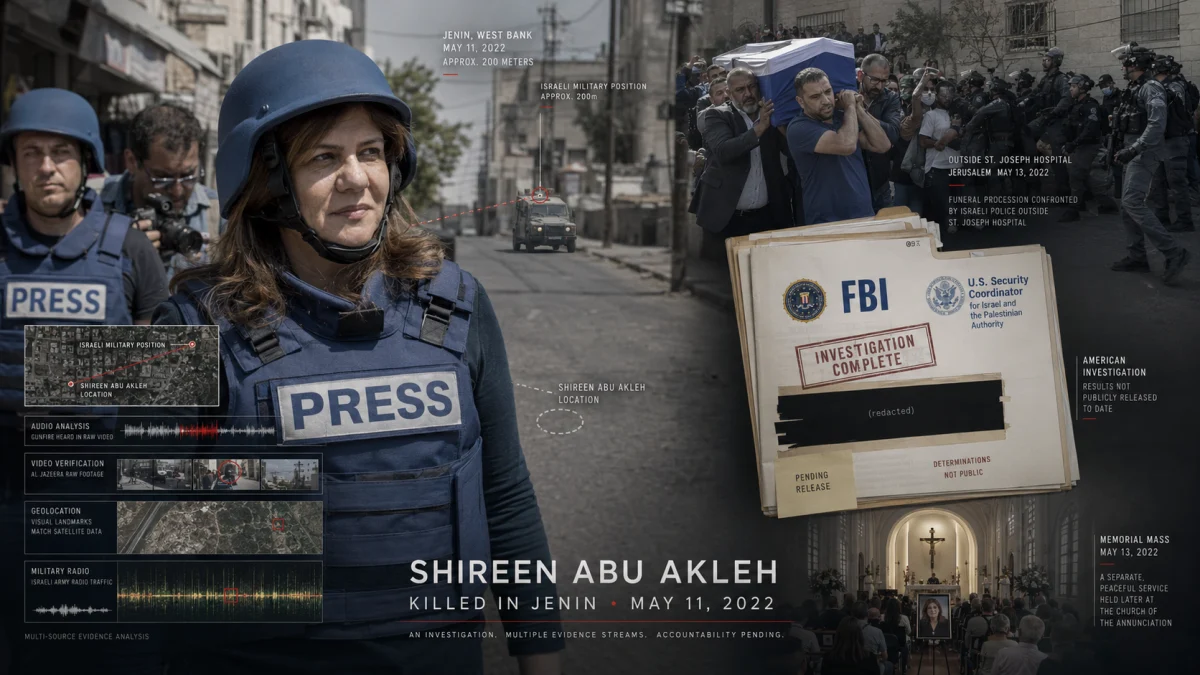
Abu Akleh, a Palestinian-American journalist and one of the Arab world’s most recognizable television correspondents, was shot in the head on May 11, 2022, while reporting on an Israeli military raid in Jenin in the occupied West Bank. She was wearing a helmet and blue protective vest prominently marked PRESS.
The United Nations Human Rights Office concluded that the shots came from Israeli security forces. Multiple independent investigations reached the same basic conclusion. The United States said gunfire from an Israeli military position was "likely responsible." And after initially suggesting Palestinian gunmen were probably responsible, the Israeli military eventually acknowledged a "high possibility" that Abu Akleh was hit by Israeli fire.
What remains genuinely disputed is narrower and more consequential:
Which Israeli soldier fired the fatal shot? Did the shooter know he was firing at journalists? And why, more than four years later, has the United States still not publicly resolved the killing of one of its own citizens?
Those questions have become harder—not easier—to dismiss as new evidence has emerged.
Who was Shireen Abu Akleh?
Abu Akleh was 51 years old and had worked for Al Jazeera since 1997. For millions of Arabic-speaking viewers, particularly Palestinians, she was not simply another foreign correspondent. She had spent roughly a quarter-century reporting from the Israeli-occupied Palestinian territories through the Second Intifada, Israeli military operations, elections, raids and repeated periods of war.
She was also an American citizen.
And one frequently repeated detail should be corrected: Abu Akleh was Christian, but she was a member of the Melkite Greek Catholic Church, not Greek Orthodox. Her funeral service was held at Jerusalem’s Greek-Melkite Catholic Cathedral of the Annunciation. Her burial in a Greek Orthodox cemetery appears to be one source of the confusion.
That distinction is minor compared with what happened to her, but accuracy matters in a case already surrounded by competing narratives.
What happened in Jenin?
The U.N. Human Rights Office conducted its own monitoring investigation using video, photographs, audio, witness interviews, expert consultation, official information and an examination of the scene.
Its reconstruction is unusually specific.
Shortly after 6 a.m. on May 11, seven journalists arrived near the western entrance of the Jenin refugee camp to cover an Israeli arrest operation and clashes elsewhere in the area.
According to the U.N., the journalists deliberately approached by a side street to avoid Palestinian gunmen and moved slowly so Israeli forces positioned farther down the road could see them.
At the location where the journalists were standing, the U.N. found no shooting taking place and no armed Palestinians in their immediate vicinity.
At approximately 6:30 a.m., four journalists moved into the street leading toward the camp. They were wearing protective helmets and flak jackets marked PRESS.
Then the shooting began.
The U.N. described several individual shots coming from the direction of Israeli forces as apparently well aimed. Journalist Ali al-Samoudi was struck in the shoulder. Another bullet hit Abu Akleh in the head and killed her.
Additional shots were fired while an unarmed man attempted to reach Abu Akleh and while another journalist sheltered behind a tree.
That sequence matters.
This was not simply a journalist standing somewhere inside a massive firefight and being struck by an unknowable stray bullet from an unknowable direction.
There had been armed clashes in Jenin that morning. But the evidence gathered by the U.N. distinguished the broader fighting from what was happening on the particular street, at the particular time, where Abu Akleh and the other journalists were shot.
Israel initially pointed toward Palestinian gunmen
Within hours of the killing, then-Israeli Prime Minister Naftali Bennett publicly said there was a "considerable chance" that Palestinian gunmen had killed Abu Akleh.
Israeli officials circulated video of Palestinian gunmen firing elsewhere in Jenin and argued that comments audible in the footage about someone being hit could indicate that Palestinians had mistakenly killed the journalist.
That explanation quickly encountered a serious problem.
Israeli human-rights organization B’Tselem went to Jenin and geolocated the Palestinian shooting shown in the video. Its reconstruction found that the gunman was in a different location and did not have a direct line of fire toward Abu Akleh.
Bellingcat independently examined the geography and reached the same conclusion: the alley shown in the circulated footage terminated behind a wall and could not provide the trajectory necessary for those particular shots to have struck the journalists.
Israel’s position subsequently changed.
By September 2022, the IDF’s final internal review stated that although it could not determine the source "unequivocally," there was a "high possibility" that Abu Akleh had been accidentally hit by IDF gunfire.
The military nevertheless maintained that Palestinian gunfire remained another possible explanation and said it found no basis for opening a Military Police criminal investigation.
That is an important evolution:
likely Palestinian fire → uncertainty → high possibility of Israeli fire.
It does not by itself prove deliberate targeting.
It does make the original attempt to place probable responsibility on Palestinian gunmen difficult to reconcile with the evidence that emerged afterward.
The damaged bullet did not erase the rest of the evidence
One source of confusion surrounding the case involves the bullet recovered from Abu Akleh.
When it was eventually examined under a U.S.-coordinated process, investigators determined that the projectile had been too badly damaged to make a conclusive ballistic match to a specific rifle.
That finding is sometimes treated as though it left the entire shooting unknowable.
It did not.
Ballistics could not identify a particular weapon. But ballistics were only one category of evidence.
The U.N. examined location, trajectories, video, audio, eyewitness accounts and activity around the journalists. Independent media organizations conducted similar reconstructions. The United States itself ultimately concluded that Israeli positions were probably responsible.
There is an enormous difference between:
"We cannot prove which rifle fired this damaged bullet"
and:
"We cannot determine which side the gunfire came from."
By late 2022, the available evidence overwhelmingly favored the Israeli-force explanation.
Was Shireen Abu Akleh deliberately targeted?
This is where the evidence requires more care.
There are really three different questions:
- Did Israeli fire kill Abu Akleh?
- Did the shooter deliberately fire at the group containing the journalists?
- Did the shooter specifically recognize Shireen Abu Akleh and decide to assassinate her personally?
The evidence supporting the first proposition is extremely strong.
The second is much more serious than the Biden administration’s early public language suggested.
The third remains unproven.
That distinction matters.
A U.S. investigator later challenged Washington’s public account
On July 4, 2022, the State Department announced that the U.S. Security Coordinator had found Israeli fire likely responsible but had found "no reason to believe" the killing was intentional, describing it instead as the result of "tragic circumstances."
Three years later, that characterization came under extraordinary pressure from inside the American review itself.
Retired U.S. Army Col. Steve Gabavics, who has been identified in subsequent reporting as the lead American investigator examining the shooting for the U.S. Security Coordinator’s office, said he concluded the gunfire was intentional.
According to a May 2026 letter from Senators Chris Van Hollen, Jeff Merkley and Peter Welch summarizing that reporting, Gabavics based his assessment on factors including Israeli military radio communications, visibility at the scene and the precision of the shooting.
The senators said Gabavics repeatedly included stronger language concerning intentionality in drafts of the American assessment, while his superior, Lt. Gen. Michael Fenzel, disagreed and removed or softened it.
Fenzel has defended his judgment and said he remains confident in the integrity of the conclusions reached by his office.
This disagreement cannot simply be wished away.
It means the American government’s public statement that investigators found no reason to believe the shooting was intentional did not reflect a unanimous assessment among the American officials closely examining the evidence.
According to the senators, the eventual U.S. report did not resolve the shooter’s state of mind in part because Israel did not grant U.S. investigators access to key witnesses.
That is a very different picture from a straightforward investigation conclusively determining that the shooting was accidental.
A 2025 investigation named an alleged shooter
The story developed again in May 2025.
The documentary Who Killed Shireen?, produced by Zeteo, identified an Israeli Duvdevan special-forces soldier named Alon Scagio as the person it says fired the fatal shot.
The filmmakers based the identification in part on interviews with two Israeli soldiers.
Scagio was later transferred to another unit, promoted and killed during an Israeli military operation in Jenin in 2024.
The IDF disputed the documentary’s certainty and said there remained no definitive determination establishing who fired the shot.
This therefore needs to be described precisely:
Scagio has been identified as the alleged shooter by a substantial journalistic investigation. He has not been established as the shooter through a criminal prosecution or judicial finding.
The documentary nonetheless raises an obvious question for American investigators:
If journalists were able to obtain testimony identifying a specific soldier, what did the FBI obtain?
More than four years after the killing, the public still does not know.
Then Israeli police attacked mourners carrying her coffin
Two days after Abu Akleh was killed, another set of images traveled around the world.
As mourners attempted to carry her coffin from St. Joseph Hospital in East Jerusalem, Israeli police moved into the crowd.
Video showed officers striking mourners and pallbearers with batons. The men carrying Abu Akleh’s coffin lost their footing and came close to dropping it.
Christian church leaders in Jerusalem later issued a joint statement saying police had entered the Christian hospital, assaulted mourners, used smoke grenades and rubber bullets, frightened patients and nearly forced the pallbearers to drop the coffin.
Israeli police offered a different justification.
They said the funeral arrangements had called for Abu Akleh’s coffin to leave the hospital in a hearse, that people in the crowd took the coffin contrary to those plans and that officers encountered thrown objects while attempting to restore the planned procession.
Those circumstances may explain why police intervened.
They do not erase what the video shows officers doing.
And there is another factual correction worth making: available evidence places the notorious police assault at and around St. Joseph Hospital during the procession, not inside the Greek-Melkite cathedral during Abu Akleh’s religious service.
Her coffin subsequently reached the cathedral.
The distinction makes the story more accurate, not less disturbing.
The United States did speak. That is not the real scandal.
It is tempting to summarize the American response by saying Washington said nothing.
That is not true.
And the documented reality is arguably worse.
Secretary of State Antony Blinken publicly said the United States was "deeply troubled" by Israeli police intruding into Abu Akleh’s funeral procession and said families should be able to bury their loved ones with dignity.
The State Department subsequently announced that Israeli gunfire was likely responsible for Abu Akleh’s death.
Officials repeatedly used the word accountability.
In July 2022, State Department spokesman Ned Price said the United States expected accountability for Abu Akleh’s "wrongful death." Discussing the case again, he said the investigation needed to culminate in accountability.
So the problem was not silence.
The problem is what happened after the statements.
The FBI investigation appears to have gone nowhere publicly
The FBI reportedly opened its own criminal investigation into Abu Akleh’s killing in November 2022.
As of August 28, 2026, the Bureau has released no public findings and no public timetable for completing the investigation that we could locate.
The Committee to Protect Journalists wrote to the Justice Department and FBI on May 7, 2026, describing the case as effectively stagnant.
CPJ was careful about what it could prove. It did not claim definitively that the FBI had done nothing.
It said it was not aware of any formal interviews with willing witnesses and had seen no signs of FBI investigative activity to collect evidence in Israel or the Palestinian territories.
Five days later, Senators Van Hollen, Merkley and Welch asked Secretary of State Marco Rubio and FBI Director Kash Patel for answers.
Their letter disclosed something particularly remarkable.
A Senate Appropriations Committee briefing had previously been arranged concerning the status of the Abu Akleh investigation. According to the senators, the FBI officials who appeared for the briefing were not familiar with Abu Akleh’s case and instead spoke generally about the FBI’s capabilities and limitations.
The senators also demanded release of a separate 2023 U.S. Security Coordinator report concerning Abu Akleh’s death—a report that remains unavailable to the general public.
The FBI does have legitimate rules limiting what it reveals about active criminal investigations. Protecting evidence, witnesses and uncharged individuals can require secrecy.
But that explanation only goes so far.
It does not explain why members of Congress say an FBI briefing on the case was conducted by officials unfamiliar with the case.
It does not explain why the separate U.S. Security Coordinator report remains unpublished.
And it does not resolve the allegation from an American military investigator that the government’s public description understated internal evidence concerning intentionality.
Secrecy is not proof of a cover-up. But secrecy also cannot substitute indefinitely for accountability.
The most important unanswered document may be America’s own report
The 2023 U.S. Security Coordinator summation report deserves far more attention.
According to the May 2026 Senate letter, it contains findings about the IDF unit involved in the Jenin operation and about the conduct of Israeli forces operating in the West Bank.
The senators say it was selectively shared with some members of Congress but has never been released publicly.
They also say that after Abu Akleh’s killing, Blinken asked Israel to review its rules of engagement in the West Bank and was rebuffed.
That raises a basic transparency question.
If the United States investigated the killing of an American journalist by the military of a close U.S. ally, generated a substantive report and believes that report supports its public characterization of events, why not release as much of it as legitimately can be released?
Redact intelligence sources if necessary.
Protect cooperating witnesses if necessary.
But the central evidence, methodology and conclusions should not remain indefinitely hidden while the government simultaneously invokes them as the basis for its position.
August 2026: Congress is now trying to force the broader accountability question
The latest development does not resolve Abu Akleh’s case, but it shows that the issue has not disappeared.
On August 27, 2026, Van Hollen, Tim Kaine, Bernie Sanders and eight other senators announced plans to introduce a privileged resolution under Section 502B(c) of the Foreign Assistance Act.
The proposed measure would require the State Department to report to Congress on violence and human-rights conditions in the West Bank, including what has happened in investigations of American citizens killed by Israeli settlers or Israeli security forces.
The senators specifically pointed to nine Americans killed in the West Bank in recent years and said none had received accountability or justice from either the Israeli or U.S. governments.
Abu Akleh is among those cases.
This is not the same thing as reopening her investigation, identifying her shooter or releasing the FBI file.
But it represents a significant escalation in congressional pressure.
Because a Section 502B resolution is privileged, its sponsors can potentially force Senate consideration even without the cooperation of Senate leadership. If such a resolution ultimately passes and the administration fails to provide the required report within the statutory period, certain U.S. security assistance could be affected.
Whether the measure will pass is another question.
What matters for Abu Akleh’s case is that four years after Washington first promised accountability, members of Congress are now resorting to a statutory mechanism designed to force the executive branch to provide information it has not voluntarily provided.
That fact speaks for itself.
What real accountability would require
At minimum, the United States should now:
- Release the 2023 U.S. Security Coordinator report with only genuinely necessary redactions.
- Disclose whether the FBI investigation remains active and what stage it has reached.
- Explain what access Israel granted or denied to American investigators.
- Address the evidence concerning military radio communications, visibility and shot precision described by Col. Gabavics.
- State whether the FBI has investigated the 2025 identification of Alon Scagio as the alleged shooter.
None of those steps requires prejudging whether a criminal prosecution is warranted.
They require showing that the killing of an American citizen was treated as something more than a diplomatic inconvenience.
What can actually be concluded?
The evidence should be divided into what is established, what is strongly supported and what remains unresolved.
Established or overwhelmingly supported: Shireen Abu Akleh was clearly identifiable as a journalist when she was shot. The U.N. found no armed Palestinians in the journalists’ immediate vicinity at the relevant moment. The gunfire that killed her came from the direction of Israeli forces. The United States concluded Israeli fire was likely responsible. Israel itself eventually acknowledged a high possibility that one of its soldiers fired the fatal shot. Israeli police later violently confronted mourners carrying her coffin. No one has been criminally held accountable.
Strong evidence, but still contested: The shooter deliberately aimed at people he could identify as journalists or at minimum noncombatants. An American investigator who closely examined the case concluded that the shooting was intentional, while his superior disagreed. Subsequent reporting has exposed that internal dispute.
Not established through a judicial process: that Alon Scagio was the individual shooter; that the shooter specifically recognized Abu Akleh personally; or that there was an institutional Israeli order to assassinate her.
Those distinctions are important because the case does not need exaggeration.
Four years later, "accountability" is still a promise
The most revealing part of the Shireen Abu Akleh story may ultimately be what happened after investigators largely resolved the first question.
Israel initially pointed toward Palestinian gunmen.
That explanation weakened.
Independent investigations pointed toward Israeli forces.
The U.N. pointed toward Israeli forces.
The United States pointed toward an Israeli position.
Israel eventually acknowledged that Israeli fire was highly possible.
Then an American investigator said the evidence convinced him the shooting was intentional.
Then journalists reported the identity of a specific alleged shooter.
And still, more than four years after an American citizen was killed while visibly working as a journalist, there has been no criminal accountability and the public still cannot read the principal American report examining what happened.
As of August 28, 2026, senators are now trying to use federal law to compel answers about Abu Akleh and other Americans killed in the West Bank.
The United States did not say nothing.
It said accountability.
Again and again.
The question now is what that word was supposed to mean.
References and Further Reading
Primary and Official Sources
-
U.N. Human Rights Office findings on the killing of Shireen Abu Akleh — The U.N.’s reconstruction of the shooting, including the journalists’ location, PRESS markings, direction of fire and absence of armed Palestinians in their immediate vicinity.
-
Israel Defense Forces: Final Conclusions of the Shireen Abu Akleh Investigation — Israel’s September 2022 finding that there was a "high possibility" Abu Akleh was accidentally struck by IDF gunfire, while declining to open a Military Police investigation.
-
U.S. State Department: On the Killing of Shireen Abu Akleh — The July 2022 American assessment that gunfire from IDF positions was likely responsible while saying U.S. officials found no reason to conclude the killing was intentional.
-
U.S. State Department: Escalations in Jerusalem at the Funeral of Shireen Abu Akleh — Secretary Antony Blinken’s official response to Israeli police intervention during the funeral procession.
-
May 2026 Senate letter demanding release of the U.S. report and an FBI update — Senators Van Hollen, Merkley and Welch describe the reported internal disagreement over intentionality, the unreleased 2023 USSC report and the status of the FBI investigation.
-
Committee to Protect Journalists letter to the DOJ and FBI, May 2026 — Documents the absence of publicly demonstrable progress in the FBI investigation and requests a timeline and public findings.
-
August 27, 2026: Senators announce privileged resolution seeking answers on West Bank violence — The newest congressional development, seeking a State Department accounting of West Bank human-rights conditions and investigations into Americans killed there.
-
Christian Churches of the Holy Land statement on violence at St. Joseph Hospital — Church leaders’ account and condemnation of police conduct during Abu Akleh’s funeral procession.
-
Knesset record of Naftali Bennett’s initial statement on Abu Akleh’s death — Primary record of the Israeli prime minister’s early assertion that Palestinian gunfire had a considerable chance of being responsible.
Independent Investigations and Follow-Up Reporting
-
B’Tselem reconstruction of Shireen Abu Akleh’s killing — Geospatial and evidentiary analysis, including examination of the Palestinian-gunman video initially circulated in support of Israel’s early explanation.
-
Bellingcat: Unravelling the Killing of Shireen Abu Akleh — Independent open-source geolocation analysis showing why the Palestinian gunfire depicted in the circulated video could not have struck Abu Akleh.
-
The Guardian: Documentary identifies alleged Israeli shooter in Abu Akleh killing — Reporting on the 2025 Zeteo investigation identifying Alon Scagio as the alleged shooter and documenting new testimony concerning intentionality.
-
Committee to Protect Journalists: Documentary names soldier it says killed Shireen Abu Akleh — Independent press-freedom organization’s coverage of the documentary and the continuing lack of criminal accountability.
-
Committee to Protect Journalists: FBI investigation appears stalled four years later — May 2026 assessment of the latest publicly known status of the American investigation.
Editorial currency note: This article reflects publicly available evidence reviewed through August 28, 2026. The newest material development located was the August 27 announcement of a proposed Section 502B congressional resolution addressing the killings of American citizens in the West Bank. We found no subsequent public release of FBI findings or the 2023 U.S. Security Coordinator report. Any release of those records, judicial finding identifying Abu Akleh’s shooter or substantive response to the congressional demands should be incorporated into this article.