
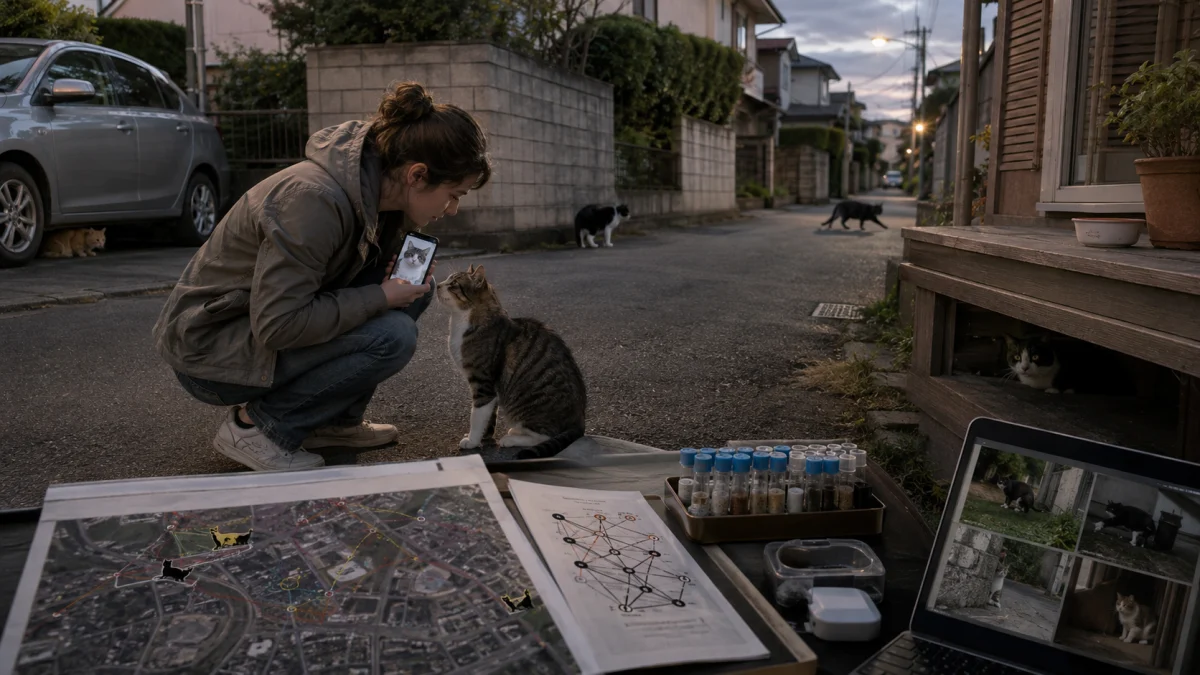
People keep reporting the same strange experience: their cat disappears, they go outside and tell neighborhood cats that their pet is missing, and sometime afterward their cat comes home.
Sometimes the missing cat reportedly returns within hours. In some of the strangest accounts, another cat appears to accompany it.
The practice has become known online as the “Japanese Missing Cat Method.”
There is currently no scientific evidence that a neighborhood cat can understand a human request to locate a particular missing cat, deliberately find that animal, and communicate “your human wants you to go home.” No controlled study identified for this article has tested that chain of events.
But dismissing the entire phenomenon as ridiculous also goes beyond the evidence.
Scientists have established several pieces of feline behavior that make the underlying situation considerably more interesting. Domestic cats can form non-random social networks. They distinguish individual cats through scent. Household cats can associate another cat’s spoken name with that cat’s face. Cats use sophisticated facial, olfactory and vocal signals with one another. And a lost house cat is often hiding surprisingly close to where it escaped.
So there are really two separate questions.
Do cats maintain neighborhood relationships and exchange information with other cats? Yes.
Can you give a stray cat a verbal missing-person assignment and have it deliver the message? That remains completely unproven.
That gap is where this story gets interesting.
What Is the Japanese Missing Cat Method?
The basic ritual is simple.
When a cat goes missing, the owner approaches one or more outdoor cats in the neighborhood and talks to them. Different versions tell the owner to give the missing cat’s name, describe what the cat looks like, show a photograph, explain that the cat is missed and ask the neighborhood cat to tell it to return home.
Treats are sometimes offered as a kind of payment.
The story sounds like folklore because, at least in its current form, it largely is.
One important correction is that calling this an ancient or established Japanese tradition would be difficult to justify. Japanese reporting describes it more cautiously as an internet urban legend whose precise origin is unknown. The idea circulated in Japanese online communities before becoming internationally famous, but that is not the same thing as establishing it as a traditional Japanese practice.
One well-documented Japanese viral episode occurred in May 2019.
A Japanese X/Twitter user, Yoshinori Ishikawa, posting as @charlie0816, wrote that his cat had escaped two days earlier. He remembered seeing someone online suggest telling neighborhood cats to ask a missing cat to return home. He tried it with a stray living near a convenience store.
His cat was outside his home the following morning.
Significantly, Ishikawa’s post itself says he had learned the method from somebody else on Twitter. The 2019 incident therefore helped popularize an existing idea rather than originating it. Responses to the post quickly filled with similar stories from other cat owners.
The phenomenon gained another major audience in 2025 after British comedian Mel Moon said she tried the method while searching for her missing cat, Wade. According to Moon, Wade returned roughly 10 minutes later. Her TikTok went viral and generated another wave of people describing comparable experiences.
These stories establish that the phenomenon is real as a recurring human observation and belief.
They do not establish why the cats returned.
That requires a different kind of evidence.
The First Surprise: Cats Really Do Form Social Networks
The popular image of the domestic cat as a purely solitary animal is too simple.
Domestic cats have unusually flexible social behavior. Free-ranging cats can live alone, but when food and shelter permit, they also form groups with repeated relationships between particular individuals. A review of research into free-ranging cats concluded that their relationships are not simply random: some groups contain strong social bonds and preferred associates, while others remain much more loosely organized.
A particularly relevant study was published in Ethology in 2025.
Researchers examined 20 adult free-ranging cats living on an Ohio farm and mathematically mapped their interactions using social-network analysis. They measured affiliative behavior, aggression, investigation and how frequently individual cats stayed close to particular other cats.
The result was not a random collection of animals wandering around the same food source.
Certain cats preferentially associated with particular other cats. Affiliative relationships and proximity networks differed significantly from what researchers would expect if the cats were interacting randomly. Changing how food was distributed also changed aspects of those networks.
Calling this a cat social network is therefore not metaphorical.
Researchers literally constructed social networks from the cats’ relationships.
That does not turn the neighborhood into a feline telecommunications system. But it changes the starting question considerably.
If your indoor cat escapes into an area occupied by free-ranging cats, those cats are not necessarily isolated strangers who happen to inhabit the same streets. They may already occupy an interconnected social environment containing familiar individuals, preferred companions, rivals and repeated meeting places.
Your missing cat may have just entered that environment.
Neighborhood Cats May Notice a New Cat Before You Do
Think about the problem from the perspective of the owner.
A cat slips through a door and disappears into a neighborhood containing hundreds of houses, parked cars, gardens, crawlspaces, sheds, alleys and bushes.
The owner has lost information.
But the neighborhood cats haven’t necessarily lost anything.
They continue moving through the same territories they moved through yesterday. They visit feeding areas. They patrol familiar routes. They encounter other cats.
And suddenly there may be a new one.
A frightened indoor cat crouching under a porch may be nearly invisible to a standing human walking down the sidewalk. To an outdoor cat that routinely passes beneath that porch or investigates scent markings around it, the newcomer may be considerably more obvious.
This is a reasonable inference from known cat behavior, not a demonstrated explanation for the Japanese Missing Cat Method.
But it suggests an important distinction:
A neighborhood cat does not have to understand a photograph or a human sentence to possess useful information about a missing cat.
It only has to have encountered it.
Cats Can Identify Other Individual Cats by Smell
Much of the feline world is organized through information humans barely perceive.
Cats investigate and deposit chemical information through urine, feces, glandular secretions and body rubbing. Scent is involved in territory, reproductive behavior, familiarity and individual recognition.
Researchers have even tested whether cats can distinguish individual cats using smell.
In one study, scientists analyzed volatile compounds in feline anal-sac secretions and then performed habituation-discrimination experiments. The chemical profiles differed between individual cats, and the tested cats could distinguish the odors of different individuals.
The researchers concluded that these secretions can provide information useful for individual recognition.
In human terms, imagine walking through a neighborhood where people continuously left detectable markers saying approximately:
I was here.
This is my area.
This is me.
Cats inhabit something much closer to that sensory environment than we do.
Again, there is no evidence that one scent mark says, “Your owner is looking for you.”
But there absolutely is evidence that cats exchange identity and territorial information chemically.
Cats Even Learn the Names of Other Cats
This is one of the most surprising findings relevant to the story.
In a 2022 Scientific Reports study, researchers tested whether cats could associate the spoken names of familiar companion cats with their faces.
The cats first heard a familiar cat’s name spoken aloud. They were then shown either the correct cat or a different familiar cat on a screen.
Household cats looked longer when the name and face did not match—an expectancy-violation response suggesting that they had anticipated the corresponding individual after hearing the name.
The researchers concluded that household cats had learned associations between the names and faces of cats they lived with, apparently through ordinary daily experience rather than explicit training.
Earlier research had already shown that household cats can distinguish their own names from general words and from the names of other cats living with them.
This does not prove the viral method.
The experiment involved familiar cats that lived together. It does not establish that you can walk up to an unfamiliar outdoor cat, say “Have you seen Winston?”, and cause that cat to construct a mental representation of Winston.
It certainly does not establish that an unfamiliar cat can inspect a phone photograph, understand that the pictured animal is missing and launch a search.
Those are enormous additional cognitive steps for which there is currently no evidence.
But the study does overturn another simplistic assumption: spoken human labels can become meaningful social information to cats.
Cats Are Also Better at Tracking Us Than They Appear
Cats do not merely react to sounds.
They can apparently use familiar voices to make predictions about where individuals should physically be.
A 2021 PLOS ONE experiment played an owner’s voice from different locations around a cat. The cats showed greater surprise when the owner’s voice seemed to suddenly move to an implausibly different position.
Researchers concluded that cats maintain a mental representation of an out-of-sight owner and can map that person spatially from their voice.
That finding suggests another possible factor in the missing-cat stories.
Someone performing the “Japanese method” is usually doing more than speaking to a cat. They are outside, walking slowly around the neighborhood, repeatedly talking in their normal voice and spending time close to places where their missing cat might be hiding.
If the missing cat is nearby, the owner’s voice may itself be meaningful.
Whether that actually increases the probability of recovery has not been demonstrated by this study. The experiment tested spatial cognition, not lost-cat recovery.
But it supplies a plausible mechanism that requires no feline courier service whatsoever.
Cats Communicate With Each Other More Elaborately Than We Once Assumed
Cat-to-cat communication also appears more complicated than the stereotype suggests.
Researchers observing 53 adult cats at a Los Angeles cat café recorded 276 distinct facial-signal combinations, composed from 26 facial movements. The physical composition of those signals differed depending on whether the interactions were affiliative or non-affiliative.
A subsequent Scientific Reports analysis continued investigating how these signals function during social interactions.
That does not mean cats have 276 “words.” Facial signals are not equivalent to human language.
It does mean there is considerably more information passing between cats than a casual observer may recognize.
Add scent, posture, tail position, rubbing, grooming, vocalizations, proximity, avoidance and territorial behavior, and the feline social environment becomes information-rich even without anything resembling human speech.
What Science Has Not Shown
This distinction is the most important part of the story.
The scientific evidence supports many capabilities surrounding the viral phenomenon.
It does not currently support its central supernatural-sounding claim.
There is no controlled evidence showing that an unfamiliar cat can receive a complex verbal description of another cat from a human, understand that the animal is absent, infer that the human wants it found, search for that particular animal, communicate the human’s request to it and cause it to return home.
Nor is there evidence that neighborhood cats systematically relay these requests from cat to cat.
No direct experimental test of that process surfaced in the research conducted for this article.
That does not prove it never happens.
It means we do not currently have evidence showing that it happens.
That is an important difference.
Then Why Are There So Many Success Stories?
This is where the phenomenon can become convincing very quickly.
Consider what usually happens before somebody tries the technique.
Their cat has already been missing.
They have searched.
Nothing has worked.
Then they learn about the strange method, go outside, speak to several cats—and their pet returns.
The timing makes the intervention feel causal.
But missing cats return without anyone speaking to neighborhood cats.
A major 2018 study analyzed 1,210 missing cats. Among cats recovered alive with a recorded distance, the median distance from the escape point was only 50 meters. Three-quarters were found within 500 meters.
Indoor-only cats stayed considerably closer: their median recovery distance was just 39 meters, and 75% were found within 137 meters.
That produces an enormous opportunity for coincidence.
If a cat is already hiding 40 meters from home and is eventually going to emerge, practically anything the owner happens to do several hours before that return can appear responsible.
Post a Facebook message.
Shake a food container.
Pray.
Walk around the block.
Talk to a tabby.
If the cat comes home afterward, the last unusual intervention is psychologically difficult not to credit.
There is another problem: failed attempts are less visible than successes.
“Asked a stray cat for help and nothing happened” is not a compelling TikTok.
“Asked a stray cat for help and my cat appeared ten minutes later” is.
Millions of people can encounter an idea while the unusual successes become the stories that circulate. That can create the appearance of an extraordinarily high success rate even when nobody actually knows the denominator.
But Coincidence May Not Be the Whole Explanation
This is where a reflexively skeptical explanation can become too confident.
The absence of evidence for literal message delivery does not mean every success story must be pure coincidence.
There are plausible intermediate mechanisms.
A person performing the ritual spends additional time physically searching the immediate neighborhood—a strategy supported by the missing-cat research. They may speak repeatedly within earshot of the missing animal. They tend to focus on places frequented by outdoor cats, which may overlap with sheltered travel corridors or hiding locations.
The neighborhood cat itself could also affect the missing cat without understanding the human request.
A resident cat could encounter the newcomer and approach it.
It could chase it from one hiding place to another.
It could vocalize nearby.
A socially familiar outdoor cat might interact affiliatively with it.
A frightened missing cat could even follow another cat toward a familiar location.
These possibilities are reasonable hypotheses, not verified explanations.
The important point is that there is a large unexplored territory between:
“The cats telepathically understood everything.”
and
“Nothing happened except coincidence.”
Animal behavior rarely has to fit either extreme.
Could Information Spread Through a Cat Network Without Anything Like Human Language?
Potentially—but this is precisely the experiment nobody has done.
Information does not require sentences.
One animal’s behavior can change another animal’s behavior. That altered behavior can affect a third animal. Social networks in many animal species allow information, behavior and responses to propagate through groups even though no participant is constructing human-style propositions.
For cats specifically, we already know that their relationships can form measurable networks, that individual cats preferentially associate with certain others, and that food distribution alters some patterns of proximity and affiliation.
What we do not know is whether information relevant to a missing individual propagates through such a network.
That would be a fascinating research question.
Imagine a neighborhood where ten outdoor cats have known relationships. One encounters an unfamiliar indoor cat hiding beneath a deck. Does anything about the behavior of the surrounding cats change afterward? Do familiar associates investigate the location? Does the newcomer begin interacting with one member of the network? Does information about an unfamiliar animal effectively spread through repeated encounters?
None of those outcomes requires a cat to understand:
“Mittens, your mother says dinner is ready.”
It only requires socially responsive animals exchanging cues.
That is a much more scientifically plausible version of the “cat network” hypothesis—and, at present, largely unanswered.
What About Stories Where Another Cat Literally Brings the Missing Cat Back?
These are the hardest anecdotes to wave away emotionally because versions of them appear repeatedly.
Responses to the viral 2019 Japanese post included people claiming that neighborhood cats had appeared with their missing pets. Similar stories resurfaced around the international 2025 wave.
They remain anecdotes.
Without continuous observation, we cannot know whether one cat intentionally retrieved the other, whether the two animals already knew one another, whether they happened to meet, whether the missing cat followed the resident cat, or whether both simply arrived at the same location.
Still, stories in which two cats physically return together deserve a somewhat different scientific question from stories in which the missing cat simply appears hours later.
They are not proof.
They are potentially testable observations.
There is a difference.
Should You Try the Japanese Missing Cat Method?
If your cat is missing, there is little reason not to speak calmly to familiar neighborhood cats as an addition to a real search, provided you interact with them safely and do not disturb, chase or capture animals unnecessarily.
Just don’t mistake the ritual for a substitute for methods supported by evidence.
The 1,210-cat study found that thorough physical searching—particularly close to the escape location and during the first week—was important. Indoor-only cats in particular were frequently located extremely close to home.
The ASPCA also recommends immediately searching the house and surrounding neighborhood, looking beneath porches and shrubs, asking neighbors to inspect garages and sheds, contacting shelters and veterinary facilities, distributing clear lost-pet notices, using local social networks, and ensuring microchip contact information is current.
So talk to the neighborhood cat if you want.
Then look underneath the neighbor’s deck.
The second action has much stronger evidence behind it.
The Most Accurate Answer: The Cat Network Is Real. The Message Delivery Is Not Proven.
The viral story becomes less silly once the claim is separated into its individual components.
Verified: Free-ranging cats can form non-random social networks.
Verified: Cats distinguish individual cats through social and chemical information.
Verified: Household cats can learn associations between familiar cats’ names and faces.
Verified: Cats can distinguish human words such as their own names and use familiar voices to make predictions about where people are.
Verified: Cat-to-cat communication uses a surprisingly rich combination of facial, bodily, vocal and olfactory signals.
Verified: Missing cats—especially indoor cats—are frequently found close to where they disappeared.
Not verified: That an unfamiliar neighborhood cat understands a human description or photograph of a missing cat.
Not verified: That a cat can intentionally search for that animal because a human asked it to.
Not verified: That cats relay the owner’s request through a neighborhood communication network.
Plausible but untested: Neighborhood cats may encounter a missing cat, recognize that it is unfamiliar, interact with it and potentially affect its movements.
Plausible but untested: Some versions of the ritual may accidentally encourage useful human search behavior by keeping owners walking, listening and talking near the area where their cat is hiding.
That is where the evidence stands.
The internet version—“tell the stray cats and they will deliver your message”—has not been demonstrated.
But the alternative assumption that neighborhood cats are oblivious strangers with no knowledge of one another is also inconsistent with what scientists now know.
There really are cat social networks.
There really is information traveling through them.
What we don’t yet know is whether some tiny part of the strange story people have been telling for years is hiding inside that biology.
And that may be the most interesting thing about the Japanese Missing Cat Method: science has given us enough evidence to reject the magical explanation, but not enough to say we fully understand the phenomenon underneath it.
References and Further Reading
Primary Research: Cat Social Behavior and Communication
Influence of Food Distribution and Relatedness on Social Interactions in a Colony of Free-Ranging Domestic Cats — Ethology (2025) — Social-network analysis of 20 free-ranging adult cats showing non-random affiliative relationships and proximity patterns.
Cats Learn the Names of Their Friend Cats in Their Daily Lives — Scientific Reports (2022) — Experimental evidence that household cats can associate the spoken names of familiar companion cats with their faces.
Domestic Cats Discriminate Their Names From Other Words — Scientific Reports (2019) — Experimental evidence that cats can distinguish their own names from other human utterances.
Socio-Spatial Cognition in Cats: Mentally Mapping Owner’s Location From Voice — PLOS ONE (2021) — Shows that cats can maintain a mental representation of an unseen owner and use vocal information to infer location.
Olfactory Discrimination of Anal Sac Secretions in the Domestic Cat — Journal of Ethology — Provides evidence that cats can distinguish individual conspecifics using chemical information contained in scent.
Feline Faces: Unraveling the Social Function of Domestic Cat Facial Signals — Behavioural Processes (2023) — Documents 276 facial-signal combinations observed during cat-to-cat social interactions.
Free-Ranging Cat Social Organization
The Social Lives of Free-Ranging Cats — Animals (2022) — Review of the scientific literature on free-ranging cat sociality, including preferred relationships, group formation and the effects of familiarity, kinship and resources.
Influence of Familiarity and Relatedness on Proximity and Allogrooming in Domestic Cats — American Journal of Veterinary Research (2003) — Demonstrates that familiarity and relatedness influence which cats remain close to and groom one another.
Missing-Cat Behavior and Recovery
Search Methods Used to Locate Missing Cats and Locations Where Missing Cats Are Found — Animals (2018) — Study of 1,210 missing cats showing that most recovered cats were found relatively close to their point of escape, with particularly short distances among indoor-only cats.
Finding a Lost Pet — ASPCA — Practical guidance on immediate physical searching, neighborhood outreach, shelters, identification and other established lost-pet recovery measures.
History and Viral Spread of the “Japanese Missing Cat Method”
2019 Japanese Report on the Viral Neighborhood-Cat Method — BUZZmag — Preserves the May 2019 Japanese account in which @charlie0816 said his missing cat returned after he spoke to a neighborhood stray.
Japanese “Missing Cat” Method Spreads Overseas Through TikTok — INTERNET Watch (2025) — Japanese coverage describing the practice as an internet urban legend with an uncertain original source and documenting its later international spread.
Tales of the “Japanese Missing Cat Method” Spread on TikTok — The Daily Dot (2025) — Documents the Mel Moon case and the 2025 wave of anecdotal reports that pushed the method into wider English-language social media.
Editorial note: Research and source availability were reviewed August 20, 2026. No controlled peer-reviewed experiment directly testing whether cats can relay a human’s request to a missing cat was identified. The absence of such evidence should not be confused with evidence that the behavior is impossible; it means the central claim remains untested.