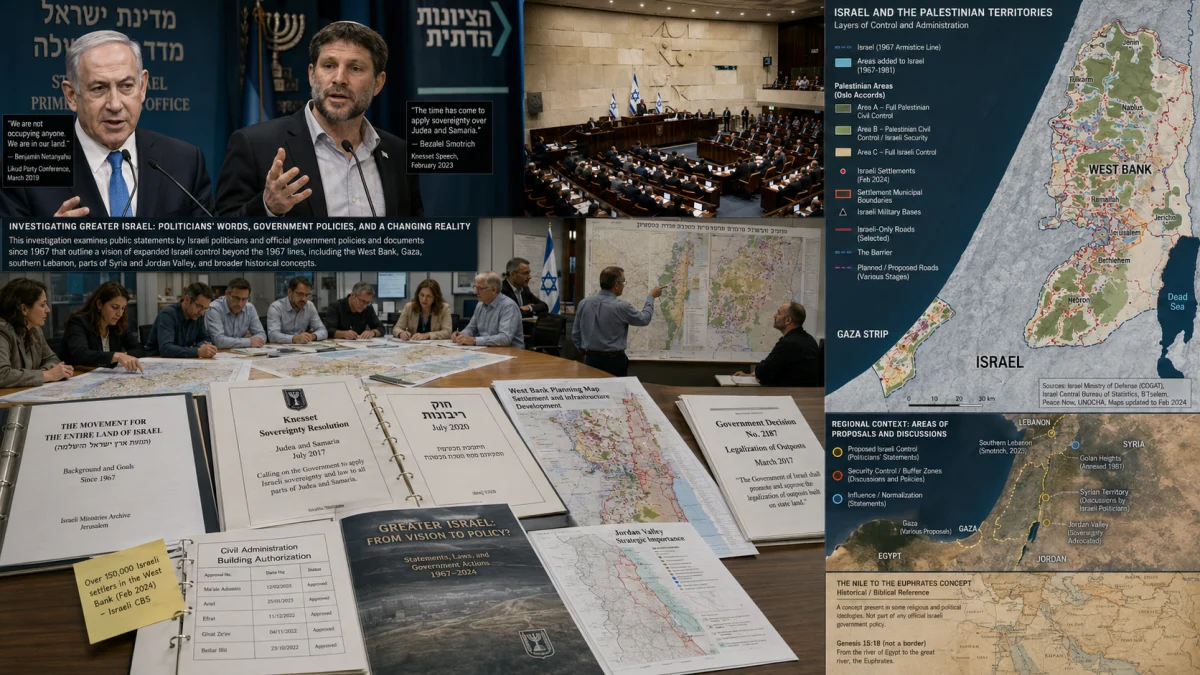
Yes. “Greater Israel” is real.
It is a documented Israeli political and religious-nationalist ideology with decades of history. It has been promoted by organized political movements, settlement organizations, cabinet ministers and members of the Knesset.
More importantly, one major version of the idea is no longer merely ideological.
Permanent Israeli sovereignty over the occupied West Bank, the expansion of Jewish settlements there and the prevention of Palestinian statehood have become explicit objectives of powerful members of Israel’s government—and substantial parts of that program are already being implemented.
Israel’s own Institute for National Security Studies reached an unusually blunt conclusion in April 2026. Its researchers described a systematic transformation underway in the West Bank and said the government’s policy increasingly reflects Finance Minister Bezalel Smotrich’s 2017 “Decisive Plan,” intended to defeat Palestinian national aspirations and realize “Greater Israel” through annexation and Israeli sovereignty over the entire West Bank.
That is not Hamas saying it.
It is not Iran saying it.
It is not an anti-Israel TikTok account interpreting a suspicious-looking map.
It is an Israeli national-security research institution analyzing the policies of Israel’s own government.
But an equally important correction is necessary.
There is no single universally accepted definition of “Greater Israel,” and there is no credible evidence that the Israeli government has formally adopted the enormous “Nile to Euphrates” map frequently circulated online as a secret blueprint for conquering Egypt, Jordan, Lebanon, Syria, Iraq and parts of Saudi Arabia.
Those two facts have routinely been collapsed into one argument.
For years, exaggerated claims about an all-encompassing Israeli master plan made it easy to dismiss the entire Greater Israel subject as a conspiracy theory.
That dismissal no longer survives contact with the evidence.
The more serious question in 2026 is not whether the ideology exists.
It is how much of it has already become policy—and how far its most powerful supporters intend to take it.
Greater Israel: What Is Actually Established?
| Claim | Evidence status | What the record shows |
|---|---|---|
| Greater Israel exists as a historical Israeli political ideology | Verified | Organized movements explicitly campaigned for “Greater Israel” and permanent retention and settlement of territories captured in 1967. |
| Netanyahu’s government supports permanent Israeli control and settlement of the West Bank | Verified | Coalition documents, Netanyahu’s statements, Knesset votes and government actions establish this directly. |
| Smotrich is pursuing de facto annexation before formal sovereignty | Verified | Smotrich has described the strategy publicly and in recorded remarks; Israeli institutional analysis reaches the same conclusion. |
| Significant parts of Israel’s governing right want to prevent Palestinian statehood through settlement and sovereignty | Verified | Senior ministers repeatedly say this openly. |
| Important Israeli politicians support resettling Gaza | Verified | Numerous ministers and coalition lawmakers have publicly advocated it, although Netanyahu has said it is not formal government policy. |
| Senior Israeli politicians have advocated territorial control beyond the West Bank and Gaza | Verified | Smotrich has called for moving Israel’s Lebanon border to the Litani River; Greater Israel imagery including Jordan has appeared at his events. |
| Netanyahu endorsed a “Greater Israel” vision | Verified, but ambiguous in scope | Netanyahu said he felt “very much” connected to a Greater Israel vision in 2025 but later said Israel has no territorial demands against neighboring states. |
| Israel has an official plan to conquer everything from the Nile to Euphrates | Not established | No Israeli law, cabinet decision, coalition agreement or official territorial plan located in this investigation establishes those borders as state policy. |
| The Yinon essay proves a secret government plan controls every subsequent Middle Eastern war | Not established | The 1982 essay is real and striking, but evidence that it was adopted as an operational Israeli government master plan is lacking. |
That evidence hierarchy is the key to understanding the issue.
What Does “Greater Israel” Actually Mean?
There is no single Greater Israel map.
That is the first thing most internet explainers get wrong.
At least three overlapping ideas are commonly given the label.
1. The political Greater Israel: Israeli sovereignty west of the Jordan River
This is the version with the strongest connection to current state policy.
It generally means rejecting an independent Palestinian state and maintaining Israeli sovereignty or permanent control over the land between the Mediterranean Sea and Jordan River—most importantly the West Bank.
Different advocates disagree over what political status Palestinians living there should ultimately have.
But the territorial principle is straightforward:
The West Bank should not become a sovereign Palestinian state because it is regarded as part of the Jewish homeland and ultimately part of Israel.
This is not a hypothetical future doctrine.
The current Israeli government has put versions of that principle into writing and increasingly into practice.
2. The broader historical or religious Greater Israel
Other interpretations extend the claimed Land of Israel beyond today’s Israel and the Palestinian territories.
Some early Revisionist and religious-nationalist traditions included territory east of the Jordan River.
This is why maps incorporating modern Jordan periodically appear within hardline Israeli nationalist circles.
In 2023, for example, Smotrich spoke in Paris behind a map of Israel that included modern Jordan. Israel’s Foreign Ministry subsequently emphasized that Israel recognizes Jordan’s territorial integrity and remains committed to the 1994 peace treaty.
Both facts matter.
A senior Israeli minister appeared with the map.
The Israeli state simultaneously denied that the map represented its territorial policy.
3. The maximalist biblical “Nile to Euphrates” Greater Israel
This is the version most likely to appear in viral social-media posts.
It derives from interpretations of biblical passages describing land promised to Abraham and can be represented as stretching from Egypt toward Mesopotamia.
Applied literally to modern borders, such a concept could encompass territory belonging to multiple sovereign Arab countries.
It exists as a religious and ideological idea.
But an ideological or theological claim is not automatically an Israeli government war plan.
That distinction became especially visible in February 2026 when U.S. Ambassador to Israel Mike Huckabee was pressed by Tucker Carlson about a biblical territorial interpretation extending across much of the Middle East.
Huckabee initially said it would be “fine” if Israel took all of the biblical territory, then immediately stressed that Israel was not asking to take over those countries and later characterized his initial statement as hyperbolic. The U.S. government said its Israel policy had not changed.
That controversy demonstrates exactly why “Greater Israel” needs careful definitions.
A biblical territorial concept exists. That does not prove that every territory contained within its broadest interpretation is an operational Israeli objective.
Is Greater Israel a Conspiracy Theory?
No.
Calling the entire concept a conspiracy theory is historically indefensible.
Peer-reviewed research by Israeli scholars Amir Goldstein and Elchanan Shilo traces the Movement for the Entire Land of Israel, formed shortly after the 1967 Six-Day War.
Its founders explicitly struggled for what the researchers describe as “Greater Israel” and promoted settlements intended to secure permanent Israeli possession of territories captured during the war.
Interestingly, the movement’s earliest leadership did not come exclusively from today’s religious right. Prominent figures from the Labor movement helped establish it.
During the 1970s, however, leadership of the territorial project increasingly passed to Gush Emunim, the religious-nationalist settlement movement that became enormously influential in the West Bank.
That history matters because it demonstrates that Greater Israel is not a phrase recently invented by Israel’s enemies.
It has a documented Israeli political genealogy.
The legitimate criticism concerns something narrower:
Some modern claims take the existence of Greater Israel ideology and leap from that fact to an unsupported claim that every Israeli military operation is secretly implementing one unified Nile-to-Euphrates master plan.
That leap requires evidence.
But debunking that leap does not debunk Greater Israel.
It merely establishes where the evidence currently stops.
Netanyahu’s Government Put Territorial Maximalism Into Its Governing Principles
When Netanyahu formed Israel’s 37th government at the end of 2022, the coalition released official governing guidelines.
The opening territorial principle was extraordinary:
“The Jewish people have an exclusive and inalienable right to all parts of the Land of Israel.”
The document then pledged to promote settlement throughout the Land of Israel, explicitly naming the Golan Heights and Judea and Samaria—the West Bank.
The guidelines are political commitments rather than legally binding statutes.
But they are still the government’s formal declaration of its governing priorities.
Netanyahu’s separate coalition agreement with Smotrich’s Religious Zionism party went further.
It committed the coalition in principle to extending Israeli sovereignty into the West Bank, subject to Netanyahu’s decisions about timing and Israel’s domestic and international interests.
That is annexation as an agreed political objective with timing left unresolved.
It is difficult to reconcile that record with the claim that Greater Israel exists only in the imaginations of Israel’s critics.
Netanyahu Has Said Israel Must Control Everything West of the Jordan River
Netanyahu himself has been unusually clear about the territorial outcome he opposes.
In January 2024, he said he would not compromise on full Israeli security control over all territory west of the Jordan River.
He explicitly linked that position to his longstanding effort to prevent the establishment of a Palestinian state.
Weeks later, during another official security briefing, Netanyahu said Israeli security control “will always be ours,” including Gaza, and that Israel must retain the ability to enter territory whenever necessary.
There is a meaningful distinction between security control and formal sovereignty.
Netanyahu frequently uses that distinction.
But permanent Israeli control over the entire territory combined with continued settlement expansion and explicit rejection of Palestinian sovereignty raises an obvious question:
At what point does permanent “security control” become the practical architecture of a one-state territorial system?
Smotrich’s answer appears to be: before formal annexation is even declared.
Then Netanyahu Said He Connected “Very Much” With Greater Israel
The terminology became explicit in August 2025.
During an interview with Israel’s i24NEWS, presenter Sharon Gal gave Netanyahu an amulet that Gal described as representing the Promised Land.
Gal asked Netanyahu whether he connected to the vision.
Netanyahu answered:
“Very much.”
Gal then clarified that he was referring to Greater Israel.
Netanyahu again affirmed the connection and described himself as being engaged in a historic and spiritual generational mission.
There is an important limitation.
The amulet itself was not clearly visible in the publicly available interview footage, meaning the exchange alone cannot establish precisely which geographical Greater Israel map Netanyahu was endorsing.
And after substantial diplomatic backlash, Netanyahu issued an English-language clarification:
Israel, he said, has no territorial demands against neighboring countries.
That clarification belongs in the record.
So does the original statement.
The intellectually serious conclusion is therefore not:
Netanyahu publicly announced a plan to conquer the Middle East.
He did not.
It is:
Netanyahu affirmatively associated himself with the language and vision of Greater Israel while simultaneously maintaining that Israel has no territorial claims against neighboring sovereign states.
How those positions coexist depends largely on what Netanyahu means by Greater Israel.
In the West Bank, however, his government’s policy leaves much less ambiguity.
Smotrich Wrote the Ideological Blueprint Before He Was Given the Power to Implement It
Bezalel Smotrich is crucial to this story because he did something unusually helpful for historians.
He wrote down his desired end state before obtaining broad administrative power over the West Bank.
In 2017, Smotrich published what became known as his Decisive Plan.
The plan rejected partition and Palestinian national sovereignty west of the Jordan River.
Its proposed destination was one sovereign national framework controlled by Israel.
Palestinians accepting Israeli rule could remain under arrangements that stopped short of independent national sovereignty. Palestinians unwilling to accept that future would be encouraged to leave, while armed resistance would be defeated through force.
An archived English translation of the original essay remains available, but its modern importance does not depend solely on critics’ interpretations of it.
Israel’s own Institute for National Security Studies now explicitly connects the plan with government policy.
In April 2026, INSS researchers Udi Dekel and Tammy Caner wrote that West Bank policy had undergone a “conceptual and practical transformation.”
Their assessment is unusually direct.
They described a systematic program involving settlement expansion, strengthened Israeli governance, weakened Palestinian institutions, obstruction of a future two-state arrangement and groundwork for Israeli sovereignty.
They concluded that this represents movement toward Smotrich’s Decisive Plan, whose objective they describe as defeating Palestinian national aspirations and realizing Greater Israel through annexation of the West Bank.
This is the point where the argument changes.
Smotrich is no longer merely an ideologue explaining what he would do someday.
He is a senior minister holding the administrative authority necessary to do significant portions of it.
Smotrich Explained the Strategy: Annex First in Practice
The most revealing evidence may be Smotrich’s own explanation of the mechanism.
After receiving unusual authority over civilian affairs in the West Bank through his additional Defense Ministry role, major responsibilities historically administered through the military began shifting toward civilians working under his political authority.
In a 2024 recording, Smotrich described the transformation as “mega-dramatic.”
He explained that Israel had created a separate civilian system while retaining enough Defense Ministry structure to make the arrangement more defensible internationally.
He then gave away the political rationale:
The structure, he said, would make the change easier for the world to “swallow” without declaring that Israel was carrying out annexation.
Those comments become even more important when compared with what Smotrich later said publicly.
At an official Knesset hearing on July 29, 2025, he described a two-stage sovereignty strategy.
The first stage, he said, was “de facto sovereignty.”
Administrative and legal groundwork would be completed first.
Formal sovereignty could follow later.
Smotrich told lawmakers the preparatory work had progressed to the point that Israel was “ready to press the button.”
There is little need to speculate about what the bureaucratic changes mean.
The politician directing them has explained what they mean.
The Knesset Then Voted 71–13 for West Bank Sovereignty
One of the easiest ways to minimize Greater Israel politics is to describe Smotrich as an extremist commanding a small political faction.
That description is incomplete.
On July 23, 2025, Israel’s parliament adopted a declaration calling on the government to apply Israeli sovereignty in the West Bank and Jordan Valley.
The vote was not close.
Seventy-one members voted in favor. Thirteen opposed it.
The resolution was non-binding, so it did not itself annex territory.
But its language was sweeping.
It asserted Israel’s natural, historical and legal right to the territories of Eretz Israel and urged the government to apply Israeli law, jurisdiction and administration to Jewish settlement areas throughout the West Bank and Jordan Valley.
Likud Knesset Speaker Amir Ohana declared that Israel was there to stay and argued that 1967 had ended an occupation of the Jewish homeland rather than begun one.
A few days later, Smotrich told the Knesset committee that formal sovereignty could now be implemented.
Committee chairman Tzvi Sukkot summarized his desired end state even more plainly: one state between the Jordan River and Mediterranean Sea, a Jewish state.
This is no longer a conversation taking place exclusively at settlement rallies.
It is happening inside the legislature of the State of Israel.
Israeli Ministers Say Sovereignty Is Already Being Created “On the Ground”
The institutional evidence continued.
In October 2025, the Knesset gave preliminary approval to legislation applying Israeli sovereignty to settlement regions in the West Bank and separately to Ma’ale Adumim.
The legislation had not yet become law.
But Education Minister Yoav Kisch of Netanyahu’s Likud explained that the government supported sovereignty even while objecting to the particular legislative route being used.
His description of government policy was striking:
Israel was “creating the sovereignty on the ground every day.”
Formal legislation, he said, would eventually follow.
That statement closely mirrors Smotrich’s two-stage strategy.
First change the physical, administrative and legal reality.
Then change the formal legal status.
By 2026, the Administrative Project Was Becoming Physical
The argument that this is merely rhetoric became much more difficult to maintain during 2026.
Israeli outlet Ynet reported in February that the cabinet had approved far-reaching changes to West Bank land registration, property acquisition and Israeli enforcement authority.
Ynet described them as another step toward de facto annexation.
Israel’s Defense Ministry itself described the decisions as fundamentally altering the legal and civilian reality in the territory.
In January, Ynet had already described settlement officials’ strategy for 2026 as one designed to create physical territorial continuity, populate strategic areas and make Palestinian statehood increasingly impossible in practice.
The article’s headline was blunt:
“This is what annexation looks like.”
Then came the settlements themselves.
By July 2026, Israeli reporting said Netanyahu’s government had approved or regularized 103 West Bank settlements during its term, including a March decision authorizing 34 additional settlements.
The government subsequently allocated roughly NIS 1.3 billion—about $431 million—to begin establishing dozens of these communities physically, with additional money planned for roads and infrastructure.
Smotrich described the program as a settlement revolution.
In May, he called for eliminating the Oslo-era distinctions between Areas A, B and C, saying:
“The Land of Israel is ours in its entirety.”
He said his government had recognized previously unauthorized outposts, established new settlements and advanced tens of thousands of homes.
His stated objective was equally direct: preventing a Palestinian state.
In June, another 2,162 settlement housing units moved through the planning system.
Smotrich said the construction would strengthen Israel’s hold on the territory and create facts preventing Palestinian statehood.
At this stage, “Greater Israel” is no longer useful merely as an ideological label.
There is a measurable territorial program underneath it.
International Law Already Describes Parts of This Process as Annexation
The legal question should not be confused with Israeli domestic terminology.
Israel has not formally annexed most of the West Bank.
But in its July 2024 advisory opinion, the International Court of Justice concluded that Israel’s settlement, infrastructure, land and legal policies were designed to create durable and effectively irreversible changes.
The court found that these policies and practices amount to annexation of large parts of the occupied Palestinian territory and violate the prohibition on acquiring territory by force.
The ICJ also concluded that Israel’s continued presence in the occupied Palestinian territory was unlawful and must end as rapidly as possible.
Israel rejected the court’s conclusions and has long disputed the prevailing international legal characterization of the territory and settlements.
The advisory opinion is not identical to a binding judgment between litigating states.
It nevertheless represents the legal conclusion of the United Nations’ principal judicial organ.
United Nations Security Council Resolution 2334 had already declared in 2016 that Israeli settlements in territory occupied since 1967 have no legal validity under international law and demanded that settlement activity stop.
The resolution passed 14–0, with the United States abstaining.
So when Israeli ministers describe “de facto sovereignty,” international lawyers have another term available:
de facto annexation.
Why “Self-Defense” Is Not a Complete Explanation
Israel has genuine security threats.
October 7 happened.
Hamas killed Israeli civilians and took hostages.
Hezbollah has fired rockets and drones into Israel.
Iran has armed organizations fighting Israel and has itself attacked Israel.
Those facts do not need to be minimized to examine territorial policy critically.
The problem is using self-defense as a universal explanation for policies that Israeli politicians themselves describe in territorial, ideological and demographic terms.
A temporary military position created during an active conflict can plausibly be explained primarily through immediate security concerns.
But security alone does not adequately explain:
civilian settlement construction;
moving families permanently onto occupied land;
legalizing previously unauthorized outposts;
transferring governance from military administration toward civilian Israeli institutions;
rewriting land-registration systems;
building permanent settlement roads and infrastructure;
openly pledging sovereignty;
or politicians repeatedly saying their purpose is to prevent another people from ever establishing a state there.
Smotrich is particularly useful because he rejects the need for outsiders to infer the purpose.
He repeatedly states the purpose himself.
Security and territorial ideology can also coexist.
A government may genuinely believe that expanding control makes it safer.
That does not make the territorial expansion cease to be territorial expansion.
Indeed, INSS’s 2026 analysis explicitly describes the current Israeli approach as combining an ideology of decisive territorial sovereignty with a post-October 7 concept of “absolute security.”
Treating the word “security” as the end of the analysis rather than the beginning is therefore inadequate.
What About Gaza? Is Resettlement Really an Israeli Political Project?
Yes—but it is not currently established as formal Netanyahu government policy.
That distinction matters.
Israel removed its settlements and permanent ground forces from Gaza in 2005.
After October 7, a movement demanding their return rapidly gained political support.
In January 2024, thousands attended a Jerusalem conference dedicated to rebuilding Jewish settlements in Gaza.
This was not merely a gathering of activists.
Eleven cabinet ministers and 15 additional coalition members of Knesset attended, according to the organizers and Israeli reporting.
Participants included Smotrich, National Security Minister Itamar Ben Gvir and multiple Likud ministers.
Some speakers explicitly advocated Palestinian emigration alongside Jewish resettlement.
Smotrich linked settlement with security.
Ben Gvir has repeatedly advocated renewed Jewish settlement in Gaza and Palestinian emigration.
Other coalition politicians have made similar arguments.
Netanyahu, however, has repeatedly maintained that resettling Gaza is not his government’s official policy.
That distinction prevents us from saying Israel has formally decided to recolonize Gaza.
It does not justify saying Gaza resettlement is a fringe fantasy with no meaningful government support.
When cabinet ministers openly attend mass conferences devoted to implementing a policy, the policy is politically relevant whether or not the prime minister has signed it.
Israelis Do Not All Support This
A serious article must also distinguish Israeli government policy from Israeli society.
Greater Israel is not a collective Jewish belief.
It is not even a universally held Israeli belief.
The Israel Democracy Institute’s October 2025 polling found that 41% of Jewish Israelis supported annexing the West Bank to Israel.
That is a substantial constituency.
It is not a majority.
The ideological split was enormous.
Among Jewish Israelis on the political right, 58% favored annexation.
Among the center, the figure was 19%.
Among the left, 7%.
Gaza produced another distinction.
An August 2025 IDI survey found 40.2% of Jewish respondents supported establishing Jewish settlements in Gaza, while 52.8% opposed the idea.
Across the entire Israeli sample, including Arab citizens, support was 34.8% and opposition 58.6%.
So the accurate conclusion is not:
Israelis want Greater Israel.
It is:
Territorial maximalism possesses a large and politically powerful Israeli constituency, especially on the right, while substantial portions of Israeli society reject significant parts of it.
That political distinction matters enormously.
A committed minority does not require majority support for every individual policy when its parties hold pivotal positions in a governing coalition.
The Idea Is Also Becoming Harder to Confine to Israel’s Far Right
There is another revealing complication.
In February 2026, Israeli opposition leader Yair Lapid was asked directly by religious news outlet Kipa about the concept of the complete or Greater Land of Israel in the wake of Huckabee’s comments.
Lapid explicitly rejected simplistic talk of conquering Iraq and stressed practical security, diplomatic and temporal constraints.
But he also said he supported making the Jewish homeland as broad as possible, described the Bible as the basis of Zionism’s claim to the land and ultimately said he supported the principle of a broad and complete Land of Israel to the extent allowed by Israeli security and policy considerations.
Lapid’s position is not Smotrich’s.
He has supported political separation and has previously advocated a two-state solution.
But the exchange is nevertheless revealing.
The language of biblical territorial entitlement is capable of reaching much further into Israeli politics than Smotrich and Ben Gvir alone.
The real political divide is increasingly about implementation, borders, demographics and international consequences—not simply whether biblical Jewish attachment to a broader Land of Israel exists.
What About Jordan?
Jordan illustrates exactly why the evidence must be separated into levels.
In March 2023, Smotrich delivered a speech in Paris from a podium displaying a Greater Israel map that incorporated modern-day Jordan.
During the same appearance, he denied the existence of a Palestinian people.
The incident generated an immediate diplomatic crisis.
Jordan summoned Israel’s ambassador.
Israel’s Foreign Ministry publicly stated that the country remained committed to its 1994 peace treaty with Jordan and recognized the Hashemite Kingdom’s territorial integrity.
Therefore:
It is factual to say that a senior Israeli cabinet minister appeared with Greater Israel imagery incorporating Jordan.
It is not factual to transform that episode into proof that the Israeli cabinet has adopted a plan to annex Jordan.
Those are different claims.
But the event still matters because it demonstrates that broader territorial imagery exists close to the center of governmental power, not solely on anonymous internet forums.
And What About Lebanon?
Here the rhetoric became dramatically more explicit in 2026.
In March, as Israel fought Hezbollah inside Lebanon, Smotrich publicly argued that the country’s border should be moved roughly 30 kilometers north.
His formulation was unambiguous:
“The Litani must be our new border with the state of Lebanon.”
He compared that proposed arrangement with Israel’s security zones in Gaza and Syria.
This was not official Israeli government policy.
The Times of Israel specifically noted that Smotrich frequently advances positions beyond those formally adopted by Netanyahu’s government.
And in June, Defense Minister Israel Katz explicitly said Israel had “no territorial ambitions in Lebanon.”
Katz nevertheless simultaneously said Israeli forces would not withdraw further until Hezbollah was disarmed.
Israel and Lebanon subsequently entered U.S.-backed talks intended to produce phased Israeli withdrawals in exchange for Hezbollah’s disarmament and restoration of Lebanese government control in the south. Those negotiations were still continuing in August 2026.
Again, reality is more complicated than either propaganda version.
It would be wrong to say:
Israel has officially decided to annex southern Lebanon.
It would be equally wrong to say:
Nobody important in Israel advocates taking Lebanese territory.
A finance minister sitting in the security cabinet has publicly called for precisely such a border change.
Israel Is Also Holding More Territory Outside Its Prewar Lines
Words become more consequential when the physical geography begins changing.
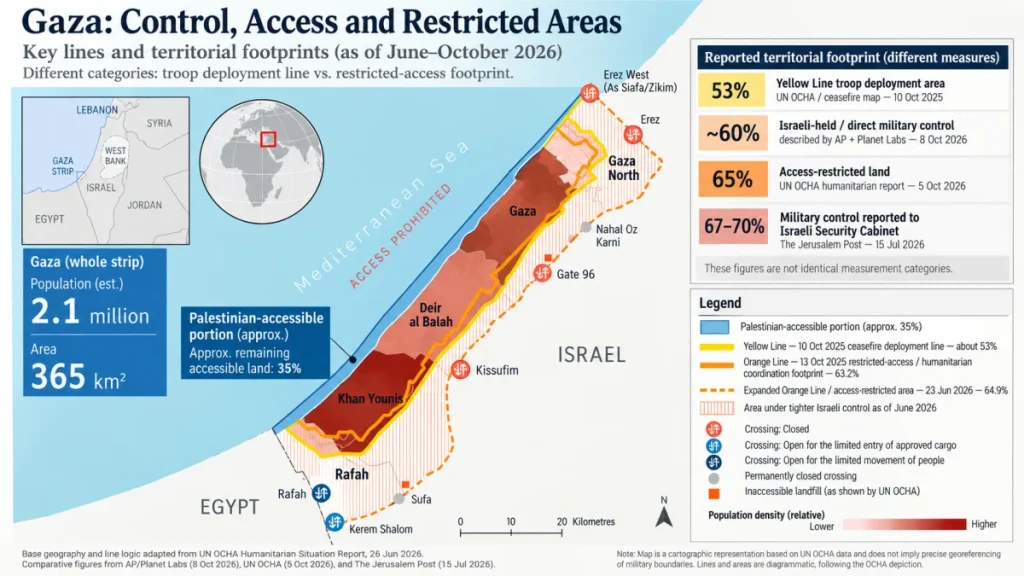
In June 2026, the Associated Press calculated that Israel had taken military control of roughly 1,000 square kilometers—386 square miles—of territory in Gaza, Lebanon and Syria since 2023.
AP described it as Israel’s largest expansion of militarily occupied territory in decades.
At the time of its analysis, Israel held approximately 608 square kilometers inside Lebanon, more than 60% of Gaza and the approximately 235-square-kilometer buffer zone inside Syria created after the fall of Bashar Assad’s government.
Israel describes these areas as security or buffer zones, not new sovereign borders.
Subsequent negotiations have begun producing limited withdrawals in Lebanon, so the exact August 2026 footprint may no longer match AP’s June calculation.
But the broader point remains.
Israel is currently exercising military control over substantial territory beyond the lines it controlled before October 7.
That fact does not prove those areas will be annexed.
It does make statements about permanent or indefinite Israeli control considerably more consequential than they would be in a purely hypothetical debate.
Security Zones Can Be Temporary—Until They Aren’t
Israel’s history makes the word “temporary” worthy of scrutiny.
Military occupation is not identical to sovereign annexation.
Security zones created during active warfare can genuinely be temporary.
But permanence cannot be assessed solely by the government’s chosen label.
One should examine:
how long troops remain;
whether civilian communities follow;
whether infrastructure becomes permanent;
whether Israeli civilian law replaces military administration;
whether ministers propose new borders;
whether displaced residents are allowed to return;
and whether the government establishes a credible withdrawal mechanism.
The current situations differ considerably.
The West Bank possesses a massive permanent civilian settlement enterprise and a growing Israeli administrative structure.
Gaza has military control and an organized political movement demanding renewed civilian settlement, but no officially adopted resettlement policy.
Lebanon has an Israeli military occupation tied to negotiations over Hezbollah, while the defense minister denies territorial ambitions even as Smotrich has advocated moving the border.
Syria has an Israeli-controlled buffer zone, with Israel citing continuing security concerns.
Collapsing all of these into one claim would lose important distinctions.
But dismissing them all as interchangeable temporary self-defense measures would lose the broader pattern.
Does Netanyahu’s “Greater Israel” Mean the Nile to the Euphrates?
We do not have sufficient evidence to say that.
This is one of the most important corrections in the entire article.
Netanyahu did affirm that he connected with the “Greater Israel” vision during the 2025 i24NEWS exchange.
But the object Gal handed him was not sufficiently visible for outside observers to verify the precise map being referenced.
Netanyahu later explicitly stated that Israel had no territorial demands against neighboring countries.
There is therefore no evidentiary basis for writing:
Netanyahu announced that he intends to conquer everything from Egypt to Iraq.
That would be sensational.
It would also be unsupported.
What we can establish is already important enough:
Netanyahu heads a government whose foundational agreement asserts an exclusive Jewish right throughout the Land of Israel;
his coalition agreement contemplates sovereignty in the West Bank;
he repeatedly rejects a Palestinian sovereign state west of the Jordan;
he says Israeli security control over that entire territory must remain permanent;
his government is building and regularizing settlements at an unprecedented rate;
and he personally expressed affinity with the term Greater Israel.
None of those facts requires the Nile-to-Euphrates map to be official.
What Is the Yinon Plan—and Is It Real?
Another subject repeatedly entangled with Greater Israel is the Yinon Plan.
The document itself is real.
In February 1982, Oded Yinon published an essay titled A Strategy for Israel in the Nineteen Eighties in Kivunim, a journal published by the World Zionist Organization’s Department of Publicity.
Yinon argued that the Middle East’s Arab states were internally fragile and divided along ethnic and sectarian lines.
He envisioned strategic advantages for Israel if surrounding states fragmented into smaller entities and discussed regaining Israeli control of Sinai under certain circumstances.
The essay also rejected territorial compromise over the West Bank and emphasized Israeli control extending to and beyond the Jordan River.
Those positions are real.
But an important evidentiary jump often follows.
Because later conflicts fragmented Iraq, Syria and other regional states in ways that superficially resemble scenarios Yinon described, the essay is sometimes presented as Israel’s official master blueprint secretly controlling subsequent Middle Eastern history.
This investigation found no evidence establishing that proposition.
Yinon wrote a strategic essay.
Its publication by a World Zionist Organization journal makes it historically relevant.
Its contents deserve scrutiny.
But publication is not equivalent to formal cabinet adoption.
A strong Greater Israel article should therefore neither pretend the Yinon document is fake nor pretend that its existence proves every later war was execution of a secret Israeli plan.
The document is evidence of a current of Israeli strategic thought—not automatic proof of operational command.
The Stronger Case Does Not Require a Secret Master Plan
This is ultimately why the viral version of Greater Israel can distract from the much stronger story.
People search for a hidden document.
They search for a map.
They search for evidence that Netanyahu secretly intends to conquer six countries.
Meanwhile, Israeli officials openly discuss permanent sovereignty over the West Bank.
Smotrich openly describes de facto sovereignty.
The Knesset votes 71–13 for sovereignty.
A Likud minister says sovereignty is being created on the ground every day.
The government approves dozens of new settlements.
Hundreds of millions of dollars are allocated to transform those approvals into roads, homes and physical communities.
Smotrich says the purpose is to kill the prospect of Palestinian statehood.
An Israeli national-security institute says the policy is implementing a vision of Greater Israel.
At some point, obsessing over whether there is a secret map becomes less investigative than examining what is happening in plain sight.
Greater Israel Does Not Require Israel to Annex Tehran, Cairo or Baghdad
This distinction also matters when Greater Israel is discussed alongside Israel’s wars with Iran and its military operations throughout the region.
A territorial project does not require every neighboring country to become Israeli territory.
Regional power matters.
A government seeking permanent freedom of action in the West Bank, Gaza, Lebanon or Syria benefits strategically when neighboring actors capable of resisting that policy are weakened.
That does not prove every Israeli war is fought for Greater Israel.
It does mean the two issues cannot always be cleanly separated.
Destroying Hezbollah changes Israel’s freedom of action in Lebanon.
Destroying Iranian military power changes the balance supporting Hezbollah and Palestinian armed factions.
Weakening Syria changes the military environment surrounding the occupied Golan Heights and Israeli positions farther inside southern Syria.
None of that proves a secret territorial blueprint.
It demonstrates why territorial objectives, regional military dominance and security policy can reinforce one another.
The mistake is assuming there can only be one motive.
Is Greater Israel Official Israeli Government Policy?
The most accurate answer is:
Parts of it are. Parts of it are not.
If by Greater Israel you mean permanent Israeli settlement, control and eventual sovereignty over substantial or all of the West Bank while preventing Palestinian sovereignty, then major elements of that project are unmistakably embedded in current Israeli government policy.
The evidence includes:
the government’s coalition principles;
its coalition agreements;
Netanyahu’s rejection of Palestinian sovereignty;
administrative restructuring of the occupation;
Smotrich’s two-stage sovereignty strategy;
the 71–13 Knesset declaration;
preliminary sovereignty legislation;
record settlement authorization;
land-registration changes;
massive infrastructure funding;
and government ministers explicitly describing these policies as preparation for sovereignty.
If by Greater Israel you mean renewed Israeli settlement in Gaza, that is an influential political project advocated by multiple cabinet ministers but has not been formally adopted as government policy.
If you mean annexation of southern Lebanon, a powerful cabinet minister has explicitly advocated it, but Netanyahu’s government has not formally adopted it and senior government officials have denied territorial ambitions there.
If you mean annexing Jordan, Greater Israel imagery incorporating Jordan has appeared alongside a senior Israeli minister, but the Israeli government officially recognizes Jordan’s territorial integrity.
And if you mean an operational Israeli state plan to conquer everything between the Nile and Euphrates, there is presently insufficient evidence to claim one exists.
That is the evidence-based answer.
Why the “Conspiracy Theory” Label Became Increasingly Unsustainable
For years, discussion of Greater Israel often followed a predictable pattern.
Someone would post the most enormous biblical map possible.
A defender of Israeli policy would correctly point out that it was not an official Israeli government map.
From that, they would incorrectly conclude that Greater Israel itself was invented propaganda.
The argument worked because it replaced one question with another.
The relevant question was never merely:
Has Israel published a cabinet-approved Nile-to-Euphrates invasion map?
The more useful questions are:
What territorial ideology exists inside Israeli politics?
What do the governing coalition agreements say?
What do cabinet ministers say they are trying to accomplish?
What territory is being settled?
What territory is being governed?
What legal structures are changing?
What borders are ministers proposing?
What Palestinian political outcomes are those policies designed to prevent?
And are those policies temporary—or being deliberately made difficult to reverse?
Once those questions are asked, the picture changes substantially.
The Project Is Most Advanced Where People Look Least
The strongest documented Greater Israel project is not a dramatic arrow pointing toward Baghdad.
It is bureaucratic.
It looks like land-registration rules.
Planning committees.
Civilian administrators.
Outpost legalization.
Highways.
Housing approvals.
Government budgets.
New jurisdiction.
Settlement continuity.
Demolition authority.
Cabinet resolutions.
And eventually sovereignty legislation recognizing a reality created beforehand.
That is why Smotrich’s phrase “de facto sovereignty” is so important.
It describes a political strategy in which formal annexation can become the final step rather than the first.
By then, the map may already have changed.
So, Is Greater Israel Real?
Yes.
Greater Israel is not merely an antisemitic conspiracy theory or an invention of Israel’s enemies.
It is a documented family of Israeli territorial ideologies with an organized political history going back decades.
The post-1967 Movement for the Entire Land of Israel explicitly pursued Greater Israel and permanent settlement of newly occupied territories.
Gush Emunim transformed that aspiration into a powerful settlement movement.
Today’s religious-nationalist right inherited and expanded the project.
Netanyahu’s government formally asserts an exclusive Jewish right throughout the Land of Israel and has committed itself to expanded West Bank settlement.
Smotrich openly developed a political program for replacing Palestinian national sovereignty with permanent Israeli sovereignty.
He subsequently obtained substantial authority over West Bank administration.
He has explicitly described the strategy as de facto sovereignty before formal sovereignty.
An official Knesset declaration supporting sovereignty passed 71–13.
Government ministers say sovereignty is already being built on the ground.
Dozens of new settlements have been authorized.
Hundreds of millions of dollars have been allocated to establish them physically.
An Israeli national-security institute now says government policy is moving toward Smotrich’s Decisive Plan and the realization of Greater Israel through West Bank annexation.
Netanyahu himself has publicly expressed affinity with a Greater Israel vision.
And senior Israeli ministers have gone beyond the West Bank: appearing beside a map incorporating Jordan, advocating renewed Jewish settlement in Gaza and, in Smotrich’s case, explicitly proposing that Israel’s border with Lebanon be moved to the Litani River.
Those are facts.
The evidence does not establish that Netanyahu’s government has adopted a secret plan to conquer every country between the Nile and Euphrates.
It does not establish that every Israeli war is secretly being fought to enlarge Israel’s borders.
And it does not mean Israeli citizens—or Jewish people—collectively support territorial maximalism.
Those claims go beyond the evidence.
But acknowledging what is unproven should not require pretending that what is proven is insignificant.
The evidence now supports a much more consequential conclusion:
A significant Greater Israel project is real, politically powerful and already being implemented most visibly in the West Bank.
Its broader geographic limits remain contested, including within Israel itself.
That is precisely why the question should no longer be:
“Does Greater Israel exist?”
The serious question is:
“Where does the project stop?”
Evidence Classification
Verified facts: Greater Israel has a documented history inside Israeli politics; Netanyahu’s current coalition formally supports settlement throughout the West Bank; its agreements contemplate Israeli sovereignty there; Netanyahu insists on permanent Israeli security control west of the Jordan River; Smotrich advocates full sovereignty and has described current policy as de facto sovereignty; the Knesset voted 71–13 for a sovereignty declaration; Israel has dramatically accelerated settlement approval and funding; multiple cabinet ministers advocate Gaza resettlement; Smotrich has advocated moving Israel’s Lebanon border to the Litani; Netanyahu publicly expressed affinity with a Greater Israel vision while later denying territorial claims against neighboring states.
Strong inference: The current Israeli government’s West Bank policies constitute an incremental Greater Israel strategy in which territorial, administrative and demographic realities are changed before formal annexation. This inference is strengthened substantially by Israeli officials’ own descriptions and by the 2026 INSS assessment.
Disputed or ambiguous: The exact geography Netanyahu had in mind when affirming the Greater Israel vision in August 2025; whether Israeli military security zones in Gaza, Lebanon and Syria will ultimately remain permanent; how far Greater Israel ideology will influence Israeli policy beyond the occupied Palestinian territories.
Not established: A formally adopted Israeli government plan to conquer all territory between the Nile and Euphrates; the claim that the Yinon essay is a binding secret Israeli government master plan; the claim that every Israeli military action in the Middle East is part of one coordinated territorial-conquest program.
References and Further Reading
Primary Israeli Government and Knesset Records
Knesset Declaration Calling for Israeli Sovereignty in Judea, Samaria and the Jordan Valley — July 23, 2025 — Primary parliamentary record of the 71–13 sovereignty vote, including the declaration’s text and statements by Likud and Religious Zionism lawmakers.
Smotrich Addresses Knesset Judea and Samaria Subcommittee on “De Facto Sovereignty” — July 29, 2025 — Primary record of Smotrich explicitly describing sovereignty as a two-stage process and saying the administrative and legal groundwork was ready.
Knesset Preliminary Approval of West Bank Sovereignty Bills — October 22, 2025 — Primary source containing Likud Education Minister Yoav Kisch’s statement that Israel was already creating sovereignty on the ground.
Prime Minister Netanyahu: Full Israeli Security Control West of the Jordan River — January 21, 2024 — Official government statement documenting Netanyahu’s rejection of Palestinian sovereignty and insistence on permanent Israeli security control.
Netanyahu Government Security Briefing — February 11, 2024 — Official statement in which Netanyahu says Israeli security control west of the Jordan River, including Gaza, must continue into the future.
Israeli Political Documents and Reporting
Full Governing Principles of Israel’s 37th Government — The Times of Israel — Full English translation of the Netanyahu coalition’s governing guidelines, including its assertion of exclusive Jewish rights throughout the Land of Israel and commitment to West Bank settlement.
Netanyahu Coalition Agreements Back West Bank Annexation in Principle — The Times of Israel — Details Likud’s coalition agreement with Religious Zionism committing to extension of sovereignty subject to Netanyahu’s timing and international considerations.
Netanyahu Says He Feels Connected to a “Greater Israel” Vision — The Times of Israel — Israeli reporting of Netanyahu’s August 2025 i24NEWS interview and its important caveat that the exact amulet/map referenced was not visible.
Netanyahu Clarifies Israel Has No Territorial Demands Against Neighboring Countries — Ynet — Netanyahu’s later clarification following regional criticism of his Greater Israel remarks.
Smotrich, Annexation and Current West Bank Policy
A Conceptual Shift in the West Bank: Absolute Security, Decisive Outcome, and the Application of Sovereignty — Institute for National Security Studies — One of the most important Israeli sources for this investigation; concludes current government policy is moving toward Smotrich’s Decisive Plan and realization of Greater Israel through West Bank annexation.
How Smotrich Turned His West Bank Annexation Vision Into Reality — Ynet — Detailed July 2026 Israeli examination of civilianization, outpost legalization and settlement expansion under Smotrich.
Israeli Military Shifts West Bank Powers to Smotrich’s Civilian Administration — The Jerusalem Post — Reports the transfer of military administrative powers and Smotrich’s recorded explanation of why the structure could obscure accusations of annexation.
Cabinet Moves Deepen Israeli Control of West Bank Land and Administration — Ynet — February 2026 account of government decisions changing land registration, enforcement and civilian authority.
Smotrich Calls for Ending Areas A, B and C, Saying the Entire Land Belongs to Israel — The Times of Israel — May 2026 reporting on Smotrich’s plan to erase Oslo administrative divisions and his public description of the government’s settlement “revolution.”
Government Announces Funding for 34 New West Bank Settlements — The Times of Israel — July 2026 reporting on hundreds of millions of dollars allocated to convert settlement approvals into physical communities and infrastructure.
Historical Greater Israel Movement
Generational Crossover: The Movement for the Entire Land of Israel From the Labour Movement to Gush Emunim — Bar-Ilan University Research Portal — Peer-reviewed historical research tracing the explicit post-1967 Greater Israel movement and its evolution into the religious-nationalist settlement movement.
The Early Israeli Settler Movement: The Birth Pangs of Gush Emunim — Jeffrey Kaplan — Recent academic history of the ideological and religious roots of the settlement movement.
Gaza Resettlement Movement
Cabinet Ministers Call to Resettle Gaza and Encourage Palestinian Emigration — The Times of Israel — Detailed account of the January 2024 conference attended by numerous cabinet ministers and coalition lawmakers advocating renewed Jewish settlement in Gaza.
Israel Democracy Institute August 2025 Gaza Settlement Poll — Full Data — Representative Israeli polling showing that Gaza resettlement has substantial support but does not command majority support among either Jewish Israelis or the population overall.
Jordan, Lebanon and Wider Territorial Claims
Smotrich Speaks Beside a Greater Israel Map Including Jordan — The Times of Israel — Documents the 2023 Paris appearance that triggered a major diplomatic controversy.
Israel Reaffirms Jordan’s Territorial Integrity After Smotrich Map Controversy — The Times of Israel — Important counterevidence establishing that Smotrich’s map did not represent the Israeli government’s formal policy toward Jordan.
Smotrich Says the Litani River Should Become Israel’s New Lebanon Border — The Times of Israel — March 2026 documentation of explicit territorial expansion rhetoric from a sitting Israeli cabinet minister.
Defense Minister Katz Says Israel Has No Territorial Ambitions in Lebanon — The Times of Israel — Important evidence showing disagreement within the Israeli government over the long-term meaning of its military presence in Lebanon.
Current Territorial Control
Israel Seized More Land From Neighbors Since 2023 Than It Has in Decades — Associated Press — Detailed June 2026 geographic analysis estimating roughly 1,000 square kilometers under new Israeli military control in Gaza, Lebanon and Syria.
Israel-Lebanon Talks Address Withdrawal, Borders and Hezbollah Disarmament — The Times of Israel — August 2026 update important for understanding that Israel’s current Lebanon footprint remains subject to active negotiations.
Israeli Public Opinion
Israel Democracy Institute October 2025 Survey on West Bank Annexation — Representative polling showing 41% of Jewish Israelis favored annexation, including 58% of Jewish respondents identifying with the political right.
Israel Democracy Institute August 2025 Survey on Gaza Settlement and Withdrawal — Useful evidence demonstrating substantial Israeli disagreement over territorial expansion and Gaza resettlement.
International Law
International Court of Justice Advisory Opinion on Israeli Policies in the Occupied Palestinian Territory — July 19, 2024 — Principal international judicial finding that Israeli policies and practices amount to annexation of large parts of occupied Palestinian territory and that Israel’s continued presence is unlawful.
United Nations Security Council Resolution 2334 on Israeli Settlements — Primary international legal record stating that Israeli settlements in occupied Palestinian territory have no legal validity.
The Yinon Document
- Oded Yinon, “A Strategy for Israel in the Nineteen Eighties” — Archived English Translation — Reproduction of the 1982 essay originally published in Kivunim. Useful as a primary historical text; its existence does not by itself establish that its proposals were adopted as official Israeli government policy.
Editorial currency note: This investigation reflects publicly available evidence through August 24, 2026. Settlement approvals, Israeli coalition policy, West Bank sovereignty legislation and Israel’s military presence in Gaza, Lebanon and Syria remain active issues. The exact amount of territory under Israeli military control can change as ceasefire and withdrawal agreements are implemented. Future cabinet decisions, election results, declassifications or territorial agreements could materially change parts of this analysis.