Short answer: not in humans—at least not yet.
The study behind the viral claim is real, peer-reviewed and considerably more interesting than the average microbiome headline. Researchers found that people with more of a gut bacterium called Roseburia inulinivorans tended to have greater muscle strength. Among 33 healthy older adults, those with detectable levels had 29% greater handgrip strength than those in whom the bacterium was undetectable.
But those people were never given R. inulinivorans. That part of the study was observational.
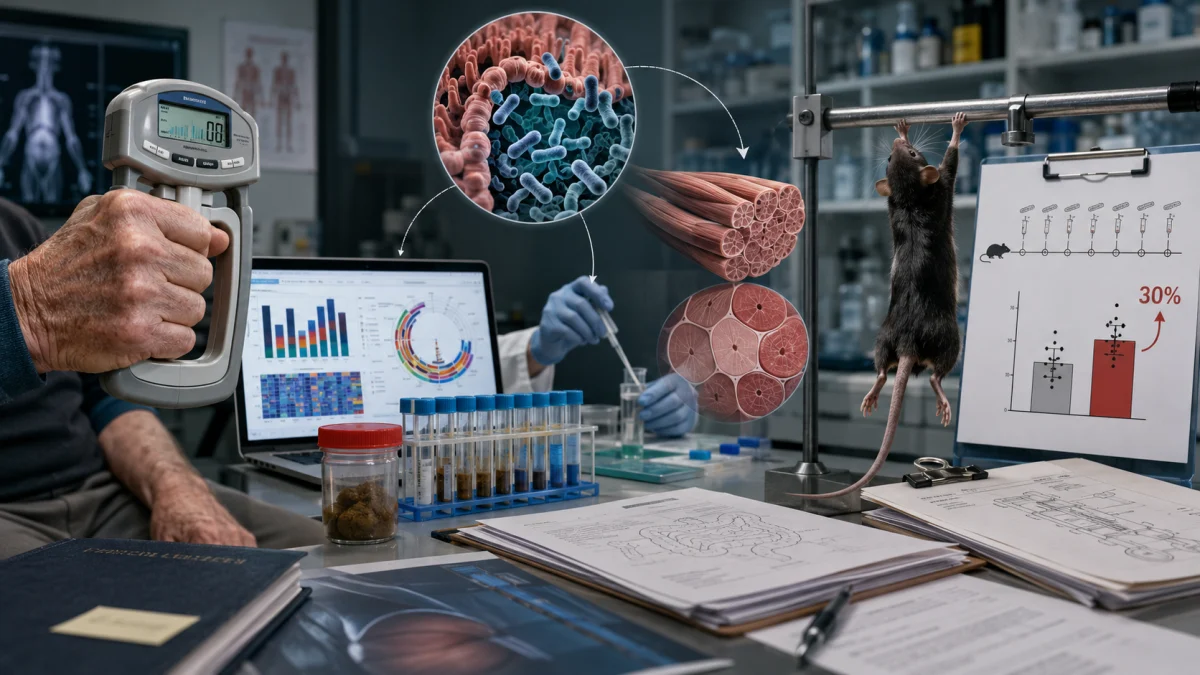
The experiment that produced an approximately 30% increase in strength happened in mice. Researchers first depleted the animals’ existing gut microbiomes with broad-spectrum antibiotics and then repeatedly administered R. inulinivorans. The treated mice developed about 30% greater forelimb grip strength, larger muscle fibers and changes toward more type-II, or fast-twitch, muscle fibers.
Those are two important findings.
They are not the same finding.
So the viral version—
“Scientists found a gut bacterium that makes you 30% stronger”
—is reasonably accurate if the subject is an experimentally treated mouse.
It is not yet an established claim about a probiotic humans can take.
Where the “30% stronger” number actually comes from
The study, published online in Gut on March 10, 2026, examined two human cohorts and then conducted a controlled mouse experiment.
Researchers analyzed 90 sedentary adults ages 18 to 25 and 33 healthy sedentary adults ages 65 to 75. They compared gut-bacteria abundance with measures including handgrip strength, and in the younger cohort, bench press, leg press and cardiorespiratory fitness.
Among the 33 older adults, those with detectable R. inulinivorans had approximately 29% greater handgrip strength.
Among the younger adults, greater R. inulinivorans abundance was associated with stronger handgrip and higher peak oxygen uptake. R. inulinivorans and R. intestinalis were also positively correlated with bench-press and leg-press performance.
But none of that proves the bacterium made the humans stronger.
Stronger people could develop different microbiomes. Diet, physiology, exercise history, genetics or another factor could influence both bacterial abundance and strength.
That is why the researchers moved to mice.
What happened in the mice
Thirty-two six-week-old male mice were first given antibiotics for two weeks to reduce their native gut microbiota. They were then divided into four groups of eight.
Three groups received one of three Roseburia species:
- R. faecis DSM16840
- R. intestinalis DSM14610
- R. inulinivorans DSM16841
The fourth group received a control solution.
The bacteria were delivered by oral gavage at 200 million colony-forming units per dose, three times a week for eight weeks.
Only R. inulinivorans produced the striking grip-strength effect.
At weeks four, six and eight, those mice showed approximately 30% greater forelimb grip strength than controls, with statistical significance reported at p<0.001. The difference remained after researchers corrected grip strength for lean body mass.
That is meaningful causal evidence.
It is also a very different experiment from a person buying a probiotic capsule.
What the study found—and what it did not
| Claim | What the evidence says |
|---|---|
| People with more R. inulinivorans tend to be stronger | Supported |
| Older adults with detectable R. inulinivorans had 29% greater handgrip strength | Supported in a small observational cohort of 33 people |
| Giving R. inulinivorans to mice increased grip strength about 30% | Supported |
| The bacterium increased mouse endurance | No. Running time to exhaustion did not improve |
| Scientists gave the bacterium to humans and made them 30% stronger | No |
| A Roseburia probiotic will make people stronger | Not demonstrated |
| It prevents or treats sarcopenia in humans | Not demonstrated |
| Any species of Roseburia should work | Not supported |
| Inulin supplements reproduce the effect | Not demonstrated |
That distinction matters because the commercial version of this story almost writes itself.
The species name matters more than supplement marketing may suggest
One of the strongest parts of the study is also one of the easiest details for future marketing to blur.
This was not simply a finding that “Roseburia is good for muscles.”
Researchers administered three different Roseburia species to mice.
Only R. inulinivorans produced the approximately 30% grip-strength increase. R. faecis and R. intestinalis did not.
That means a supplement containing another Roseburia species—or one merely advertised as “supporting Roseburia”—cannot legitimately use this study as evidence that its product produces the same effect.
This is particularly relevant because next-generation probiotic products containing other Roseburia species are already appearing commercially. R. intestinalis, for example, can be found in at least some current probiotic formulations.
But R. intestinalis is not R. inulinivorans.
In this experiment, that difference mattered.
Can you buy Roseburia inulinivorans?
Not as a proven human strength probiotic.
As of August 24, 2026, there is no published human intervention trial showing that taking R. inulinivorans increases human muscle strength, prevents age-related muscle loss or treats sarcopenia.
The researchers explicitly identify rigorous human intervention trials as the next step.
Research suppliers do offer R. inulinivorans cultures, including the DSM16841 strain used in the mouse experiment, but research listings explicitly describe such material as for research use rather than human consumption or medical treatment.
That distinction should not be ignored.
Finding a bacterial culture for sale on the internet does not turn it into a tested probiotic.
There is already a patent
There is another piece of context largely missing from the viral version of the story.
Five authors of the Gut study disclose that they are inventors on an international patent titled “Improvement of Muscle Mass and Strength,” derived from this work. The paper nevertheless lists “none declared” under competing interests while separately providing the patent disclosure.
The underlying patent family goes considerably further than merely describing the bacterium.
The published patent materials cover proposed uses of R. inulinivorans, probiotic compositions, postbiotic preparations and prebiotic approaches intended to increase the bacterium. Potential applications described include muscle strength, muscle mass, sarcopenia, frailty and athletic performance. A U.S. application was published on February 5, 2026 and is listed as pending.
That does not mean the research is compromised or the result is false.
Universities routinely patent discoveries before commercial development, and the patent was disclosed in the scientific paper.
But it does make one point particularly important:
Commercialization of this discovery is not merely something supplement companies might someday think of. Intellectual property covering probiotic, prebiotic and postbiotic applications already exists.
A patent, however, is not proof that a treatment works in humans. It is not FDA approval, and it is not a clinical trial.
Those evidentiary steps still have to happen.
Why the mouse experiment does not translate directly into a human probiotic
Several features of the experiment make the 30% number especially difficult to carry over to humans.
1. The mice had their microbiomes deliberately disrupted
Before receiving R. inulinivorans, the animals underwent two weeks of broad-spectrum antibiotic treatment.
The authors themselves identify this as a limitation because antibiotics can alter physiology and gut ecology in ways that affect how an introduced organism behaves.
A normal human microbiome is a vastly more competitive ecosystem.
2. These were young, healthy mice
The mice were six weeks old.
They were not old mice with naturally occurring sarcopenia.
That makes the result interesting for muscle biology, but it is not an animal demonstration that R. inulinivorans reverses age-related human muscle loss.
3. The bacterium did not permanently colonize them
Perhaps the most intriguing result is that the researchers found very little evidence that the administered human-derived Roseburia actually established a lasting population in the mice.
Samples collected 72 hours after administration showed extremely low Roseburia abundance.
The authors therefore suggest that the effect may have resulted from temporary microbial signals, metabolites or interactions with other gut organisms rather than permanent colonization.
That raises an important future question: researchers may eventually discover that the useful therapy is not the live organism itself at all.
It could be something the bacterium produces.
It may not be working through butyrate
Roseburia bacteria are well known for producing short-chain fatty acids, particularly butyrate, so an obvious hypothesis would be that more butyrate improved muscle function.
That is not what the experiment found.
Short-chain fatty-acid concentrations were broadly comparable between groups.
Instead, R. inulinivorans produced unusually large changes in amino-acid availability and was associated with activation of purine metabolism and the pentose-phosphate pathway within skeletal muscle. Treated mice also developed larger muscle fibers.
The researchers propose that altered intestinal amino-acid handling may trigger metabolic adaptations within muscle.
That mechanism remains a hypothesis rather than a completed causal chain.
But it is one reason this paper deserves more attention than the usual “good gut bacteria associated with good outcome” study: the researchers did not stop at a microbiome correlation. They generated a reproducible physiological effect in animals and started tracing the metabolic pathway behind it.
Does Roseburia inulinivorans really decline with age?
Possibly—but this part of the story is weaker than many headlines suggest.
The researchers’ own young and older cohorts showed considerably less R. inulinivorans in the older participants. A larger public microbiome dataset also showed a modest age-related difference.
But the authors then performed a broader meta-analysis incorporating multiple public cohorts.
In that analysis, R. inulinivorans again trended lower in older adults, but the overall difference was not statistically significant.
So “this bacterium disappears as we age” goes beyond the current evidence.
A more defensible conclusion is:
Some datasets suggest that R. inulinivorans becomes less abundant with age, but that relationship is not yet consistent across populations.
That matters because lower bacterial abundance in old age is part of the argument for eventually using the organism against sarcopenia.
The premise is plausible.
It is not settled.
Can eating inulin increase Roseburia inulinivorans?
This is where the bacterium’s name creates an irresistible shortcut.
Inulinivorans is indeed capable of using inulin, a fermentable plant fiber. Laboratory work has identified the genes and enzymes that allow the species to metabolize inulin and fructo-oligosaccharides.
Inulin occurs naturally in foods including chicory root, Jerusalem artichoke, garlic, onions, leeks, asparagus, wheat and some other plants.
That makes this reasoning tempting:
Eat inulin → grow R. inulinivorans → become stronger.
The evidence does not currently support that chain.
Gut ecosystems are competitive. A bacterium being able to eat a substrate in a laboratory culture does not mean supplying that substrate to a human will selectively increase that organism.
Research examining dietary fibers has repeatedly shown substantial person-to-person variability in microbiome responses. Reviews have specifically noted that R. inulinivorans has not always increased after fructan supplementation in complex microbial communities despite its ability to grow well on inulin in isolation.
There is some encouraging evidence for other fibers. In a randomized controlled feeding study of 80 adults, replacing conventional refined wheat with a specially developed high-amylose, resistant-starch wheat increased fecal R. inulinivorans in one intervention group after four weeks.
But that study did not test whether the microbiome change increased muscle strength.
And in the 2026 muscle study itself, researchers reported no significant correlation between participants’ reported fiber intake and the abundance of the Roseburia strains they measured.
So eating more fermentable fiber remains a reasonable nutritional strategy.
Calling inulin or resistant starch a R. inulinivorans muscle-strength treatment would be premature.
Could it treat sarcopenia?
That may ultimately be the most important question.
Sarcopenia—the progressive loss of muscle strength and muscle mass with aging—can contribute to falls, disability, frailty and loss of independence.
A safe microbiome intervention capable of preserving muscle function would therefore have obvious medical value.
There are also earlier human data connecting reduced R. inulinivorans abundance with poor muscle status. A previous proof-of-concept study found the species depleted in older adults with low muscle mass and performance.
The 2026 Gut paper adds substantial experimental support to that hypothesis.
But the older adults in this study were healthy participants, not patients enrolled because they had diagnosed sarcopenia, and nobody was treated with the organism.
The appropriate conclusion today is therefore:
Potential sarcopenia treatment: yes. Demonstrated sarcopenia treatment: no.
What should older adults do now?
For someone worried about age-related muscle loss, the strongest evidence still points toward much less exotic interventions.
International clinical guidelines strongly recommend resistance-based exercise for sarcopenia and conditionally recommend adequate protein intake or a protein-rich diet, generally in combination with physical activity.
There may eventually be a microbiome treatment that complements those interventions.
This study gives researchers a credible candidate.
It does not replace resistance training with a capsule.
And no, a fecal transplant is not the shortcut
Online discussions of the study have predictably included jokes—and occasionally serious suggestions—about obtaining the bacterium through a fecal microbiota transplant.
That would be a particularly bad interpretation of this research.
FMT transfers an entire microbial community, not a controlled dose of R. inulinivorans, and the FDA has documented risks of transmitting serious pathogenic and multidrug-resistant organisms. Current U.S. enforcement discretion for conventional FMT is narrowly focused on certain C. difficile infections that have not responded to standard treatment—not muscle enhancement.
There is no evidence supporting DIY FMT for this purpose.
So did scientists discover a strength bacterium?
In mice, arguably yes.
That is what makes this paper worth following rather than dismissing as another correlation-heavy microbiome story.
Researchers found a human association, reproduced a functional effect experimentally, demonstrated that the result was unusually specific to one bacterial species, documented changes inside skeletal muscle and identified possible metabolic mechanisms.
But the gap between that result and a consumer product remains substantial.
The cleanest description of the evidence is:
Humans with more Roseburia inulinivorans tended to be stronger. Giving R. inulinivorans to antibiotic-treated mice made the mice roughly 30% stronger. Scientists have not yet shown that giving it to humans will do the same thing.
If a future randomized trial produces anything close to the mouse result in older adults, this could become a significant development in sarcopenia and healthy-aging research.
Until then, “30% stronger probiotic” is the headline.
“Promising bacterial target awaiting its first real human treatment test” is the science.
References and Further Reading
Primary Study
- Roseburia inulinivorans increases muscle strength — Gut / DOI — Original peer-reviewed study examining human microbiome associations and experimental supplementation in mice.
- PubMed record: Roseburia inulinivorans increases muscle strength — Indexed abstract, authorship, DOI and study summary.
- ACTIBATE study — ClinicalTrials.gov NCT02365129 — Registration for the young-adult cohort from which baseline data were used.
Patent and Commercialization Context
- WO2024025418A1 — Roseburia inulinivorans for use in improving muscle mass and strength — International patent publication covering proposed probiotic, postbiotic and prebiotic applications.
- US20260034181A1 — Roseburia inulinivorans for improving muscle mass and strength — U.S. patent publication, published February 5, 2026.
Diet, Inulin and Resistant Starch
- Substrate-driven gene expression in Roseburia inulinivorans — PubMed — Laboratory evidence showing how the bacterium utilizes inulin, fructo-oligosaccharides and starch.
- High-resistant-starch wheat and Roseburia inulinivorans — randomized controlled trial — Human feeding study reporting increased R. inulinivorans after a resistant-starch intervention.
- Dietary fibre complexity and its influence on the human gut microbiota — Review explaining why a bacterium’s ability to consume a fiber in isolation does not guarantee predictable stimulation inside the human microbiome.
- Inulin: properties and health benefits — PubMed — Review of inulin biology and common dietary sources.
Sarcopenia and Existing Treatment Evidence
- International Clinical Practice Guidelines for Sarcopenia — PubMed — Evidence-based recommendations emphasizing resistance exercise and adequate protein intake.
- The Gut-Muscle Axis in Older Subjects With Low Muscle Mass and Performance — Earlier human research linking R. inulinivorans depletion with poorer muscle status.
Current Resurfacing and Safety Context
- ScienceDaily: This gut microbe may help keep you strong as you age — August 21, 2026 republication that helped renew attention around the study.
- FDA guidance on fecal microbiota transplantation — Current U.S. regulatory context for conventional FMT.
- FDA safety alert on pathogenic-organism transmission through FMT — Documents serious infections associated with fecal microbiota transplantation.
Editorial currency note: Microbiome therapeutics and next-generation probiotics are developing quickly. Consumer availability, patent status and human clinical-trial activity involving R. inulinivorans should be rechecked when this article is materially updated.