Yes, the enormous underground complex beneath Kansas City is real. But calling SubTropolis a secret “underground city” makes it sound stranger—and in some ways less interesting—than it actually is.
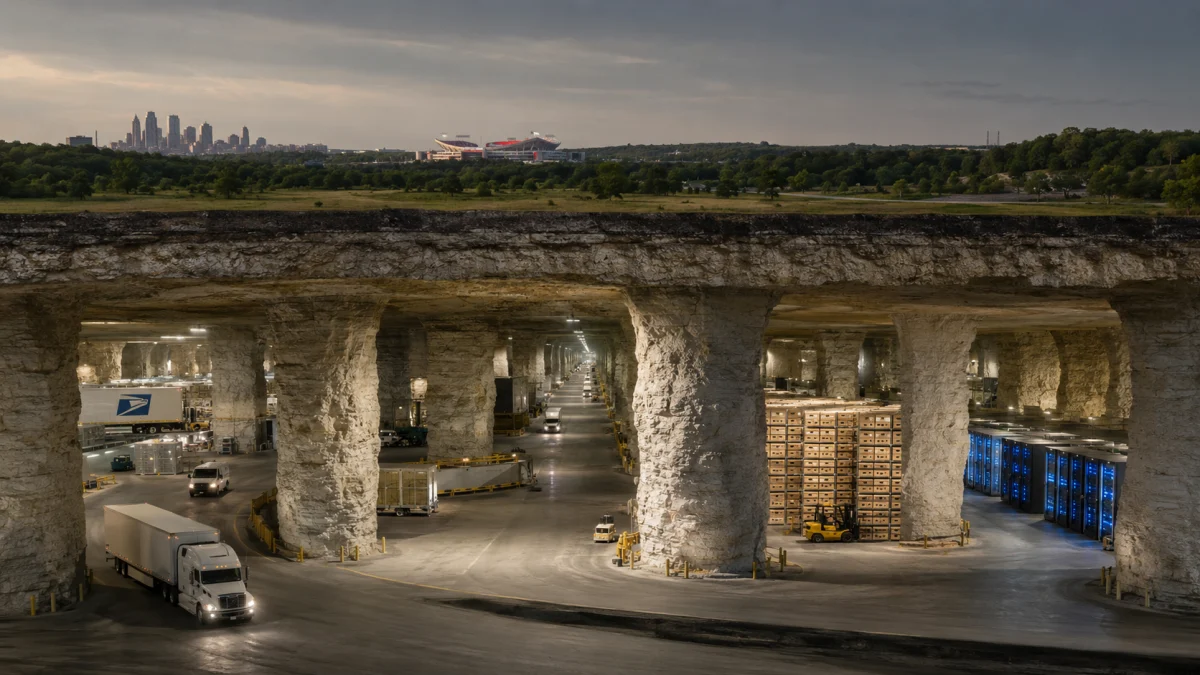
SubTropolis is a functioning commercial and industrial complex carved into a former limestone mine in Kansas City, Missouri. Hunt Midwest, the property’s owner, currently describes it as a 14-million-square-foot facility with about 10 million square feet developed, more than 55 tenants, 13 miles of illuminated paved roads, hundreds of loading docks and thousands of people working underground. Parts of the complex sit beneath roughly 150 feet of Missouri limestone.
It really does contain a U.S. Postal Service facility, a National Archives federal records facility and an underground data center. There is also good support for the astonishing claim that the complex is large enough to accommodate the footprint of dozens of football stadiums.
But several details spreading in viral videos are wrong or misleading. There are not 10,000 roads. We could not verify a McDonald’s operating underground. SubTropolis does not appear to have a ZIP code exclusively to itself. And Lamar Hunt did not simply discover an abandoned mine in the 1960s and decide to build a city inside it.
The true story is more complicated—and arguably more impressive.
SubTropolis fact check: what is true and what is not?
| Viral claim | Verdict | What the evidence shows |
|---|---|---|
| There is an underground “city” beneath Kansas City | Basically true, with important context | SubTropolis is a huge underground business complex, not an incorporated city or secret residential settlement. |
| It is about 150 feet underground | Mostly true | Hunt Midwest describes portions as beneath about 150 feet of limestone. The data-center section is described by its operator as about 125 feet underground. |
| It has more than 10,000 lighted roads | False | Hunt Midwest currently lists 13 miles of paved, lighted roads. An older company brochure listed more than 10,000 limestone pillars, which may explain the viral mix-up. |
| Around 55 businesses operate there | Essentially true | Hunt Midwest currently says 55+ tenants, although not every tenant is technically a private business. |
| About 3,000 people work underground | Reasonable approximation | Current Hunt Midwest pages conflict slightly: the main property page says 2,500+ tenant employees, while newer staff pages refer to almost or more than 3,000. |
| There is a McDonald’s underground | Not verified | McDonald’s official locator shows a restaurant in ZIP code 64161 on 210 Highway, but we found no reliable current evidence of a McDonald’s inside SubTropolis itself. |
| The Postal Service operates underground | True | USPS operates its Stamp Fulfillment Services facility there. USPS calls it its only underground facility. |
| The National Archives operates there | True, with nuance | The National Archives runs a Federal Records Center inside SubTropolis. It is not the same thing as the public National Archives research facility in downtown Kansas City. |
| There is an extremely secure data center | True in substance; superlative unproven | LightEdge operates a Tier III-grade underground data center there. Claims that it is “one of the most secure in the world” are promotional and not supported by an independent global ranking we could find. |
| It can fit 42 NFL stadiums | Surprisingly close to a real claim | A Hunt Midwest executive was quoted saying SubTropolis was wide enough to hold 42 Arrowhead Stadiums. |
| Lamar Hunt discovered an abandoned mine and created it | Misleading | Mining began in 1945 and commercial underground storage began in 1964. Hunt became a key investor in the company that acquired the operation around 1969–1970. |
| SubTropolis has its own ZIP code | Misleading | Its addresses use 64161, but that ZIP code is also used by locations outside the underground complex. |
What exactly is SubTropolis?
SubTropolis is essentially an industrial park built inside the empty spaces left behind by limestone mining.
The underground chambers were created using room-and-pillar mining. Instead of removing all of the rock, miners extracted large sections while leaving enormous square limestone columns in place to support the ceiling.
Those pillars are part of what gives SubTropolis its distinctive appearance: enormous white limestone columns repeating into the distance, separated by roads, warehouses, loading docks and commercial spaces.
Hunt Midwest says the limestone deposit itself is roughly 270 million years old, while mining at this particular site began in 1945.
The underground environment is remarkably stable. Hunt Midwest describes temperatures in the complex as generally remaining around 65 to 68 degrees Fahrenheit, substantially reducing the heating and cooling requirements that a comparable surface warehouse would face. USPS similarly says the cave’s consistent temperature and humidity are useful for preserving its stamp inventory.
This is less a futuristic city built underground from scratch than a very clever second use for something mining had already created.
Does SubTropolis really have 10,000 roads?
No.
This is one of the clearest errors in the viral version of the story.
Hunt Midwest currently lists 13 miles of lighted, wide, paved roads inside SubTropolis.
So where might “10,000 roads” have come from?
An older Hunt Midwest brochure contained another memorable statistic: more than 10,000 limestone pillars. The same document separately listed 6.5 miles of paved roads at the time.
It is impossible to know exactly how the viral claim originated without tracing the specific video’s sourcing, but a very plausible explanation is that someone turned “10,000 limestone pillars” into “10,000 roads” while retelling the story.
The real number—13 miles of roads underground—is still enormous. It just is not 10,000 roads.
How big is SubTropolis?
The numbers require some care because SubTropolis has expanded substantially over time, and older articles therefore report smaller figures.
Hunt Midwest’s current property page describes:
- 14 million square feet in the overall facility
- roughly 10 million square feet developed/leasable
- another 4 million square feet of expansion
- 55+ tenants
- 13 miles of paved roads
- 500+ truck docks
- 2,500+ tenant employees
That helps explain why older stories may mention 5 million, 6 million or 7 million square feet. They were not necessarily wrong when published; SubTropolis has continued expanding.
In 2026, Hunt Midwest says Grainger began operating a 1.46-million-square-foot distribution center there, which the developer describes as the world’s largest underground build-to-suit warehouse.
This is very much a functioning industrial property, not an abandoned curiosity.
Could 42 NFL stadiums really fit inside?
This viral claim initially sounds like classic social-media exaggeration, but it has a legitimate source.
The Kansas City Public Library reported that Hunt Midwest executive Mike Bell described SubTropolis as “wide enough to hold 42 Arrowhead Stadiums.” KCUR has repeated the same comparison.
Arrowhead Stadium is, of course, an NFL stadium—the home of the Kansas City Chiefs.
So saying “42 NFL stadiums” strips away an important detail, but it is not simply invented. The more accurate formulation is:
Hunt Midwest has said the complex is wide enough to accommodate the footprint of about 42 Arrowhead Stadiums.
That is different from saying 42 fully three-dimensional stadium structures could literally be constructed inside the mine with their upper decks and roofs intact.
How many people actually work in SubTropolis?
The safest current answer is roughly 2,500 to 3,000 people.
Hunt Midwest’s main SubTropolis page lists 2,500+ tenant employees. But current company staff biographies published elsewhere on the same website refer to “more than 3,000” or “almost 3,000” tenant employees working there.
That discrepancy may reflect different counting methods, timing or inclusion of workers associated with different parts of the property.
Rather than manufacture a precise number the sources themselves do not consistently provide, “about 3,000 workers” is a reasonable shorthand.
Is there really a U.S. Postal Service facility underground?
Yes. This part of the story is firmly documented.
USPS operates its Stamp Fulfillment Services facility inside SubTropolis. The Postal Service says the operation is located in a limestone cave approximately 150 feet beneath the ground and describes it as the agency’s only underground facility.
The facility stores and distributes enormous quantities of stamps and other philatelic products.
USPS has said the naturally stable underground temperature and humidity help keep stamps in mint condition while the limestone environment provides protection from hazards including severe storms and flooding.
So this is not a decorative post office placed underground for novelty. It is an industrial-scale fulfillment and storage operation whose unusual location serves a practical purpose.
Is the National Archives really inside SubTropolis?
Yes, but this claim can easily create the wrong mental picture.
The National Archives and Records Administration operates a Federal Records Center at 8600 NE Underground Drive, Pillar 300-G, Kansas City, Missouri. NARA itself identifies the underground entrance as being in SubTropolis.
Federal Records Centers primarily store records for government agencies. They should not be confused with the National Archives museum in Washington, D.C., where documents such as the Constitution and Declaration of Independence are displayed.
NARA explains that underground limestone facilities are attractive for records storage because they provide stable temperatures, relatively inexpensive space, room for expansion and enhanced physical protection. The Kansas City SubTropolis facility opened in 2012.
Some permanent archival records have also been stored there. For example, NARA previously documented moving historic bankruptcy case files into its SubTropolis archival facility.
So “the National Archives is underground in Kansas City” is true—but it does not mean America’s founding documents have secretly been relocated into a Missouri cave.
Is there really a highly secure data center down there?
Yes.
Hunt Midwest created the SubTropolis Technology Center in 2014, and LightEdge became its first data-center tenant.
LightEdge describes its Kansas City facility as a Tier III-grade underground data center approximately 125 feet beneath the surface. Its published specifications emphasize the surrounding solid limestone, redundant infrastructure and protection from severe weather.
Hunt Midwest also advertises 24/7 armed security at SubTropolis and a biometrically secured telecommunications area serving its data-center infrastructure.
That supports describing the data center as unusually physically protected.
But “one of the most secure data centers in the world” is a different claim. We found no independent global security ranking establishing that distinction.
The defensible version is impressive enough: SubTropolis contains a purpose-built underground data center protected by a massive limestone environment and extensive physical-security infrastructure.
Is there really a McDonald’s inside SubTropolis?
We could not verify one.
This is a good example of why viral descriptions of SubTropolis need to be checked line by line.
McDonald’s official restaurant locator does show a Kansas City restaurant in ZIP code 64161, the same ZIP code used by SubTropolis.
But McDonald’s lists that restaurant at 210 Highway, not at an Underground Drive address.
Hunt Midwest’s current SubTropolis materials do not identify a McDonald’s as a tenant, and we found no credible current source establishing that one operates inside the underground complex.
That does not prove that no restaurant has ever operated somewhere in SubTropolis’s decades-long history. But the specific claim “there is a McDonald’s inside SubTropolis” should not be repeated as a current fact without better evidence.
Does SubTropolis have its own ZIP code?
Not in the way viral videos often imply.
SubTropolis uses addresses such as:
8300 NE Underground Drive Kansas City, MO 64161
The National Archives facility similarly uses 64161.
But 64161 is not an exclusive ZIP code belonging only to the underground complex. McDonald’s, for example, lists its 210 Highway restaurant under the same ZIP code. Other surface properties in the Hunt Midwest Business Center also use 64161.
SubTropolis does, however, have unusually memorable internal addresses. Businesses can have addresses on NE Underground Drive, and individual locations may be identified by the enormous numbered limestone pillars around them.
That may be where the “it has its own ZIP code” legend became attached to the story.
Did Kansas City Chiefs founder Lamar Hunt build SubTropolis?
Lamar Hunt became central to its development—but the viral origin story compresses several decades into a much simpler tale.
Mining at the site began in 1945, when Midwest Precote started extracting limestone there.
In 1964, before Hunt controlled the operation, a company was formed to lease some of the underground space left by mining. Early commercial tenants included companies such as Pillsbury and Russell Stover.
Hunt entered the story later.
Hunt Midwest’s historical timeline says Great Midwest Corporation acquired Midwest Precote around 1969–1970, with Lamar Hunt becoming a key investor. The company continued investing in the commercial reuse of the mined-out underground space.
In 1985, Hunt and Jack Steadman combined Great Midwest Corporation with Mid-America Enterprises to form Hunt Midwest Enterprises.
So there is no need for the cinematic version in which Hunt wanders into a forgotten mine and suddenly decides to create an underground city.
The more accurate story is that commercial reuse had already begun, and Hunt helped turn that unusual real-estate opportunity into the enormous industrial complex that exists today.
Was Lamar Hunt also the man who named the Super Bowl?
Yes.
This apparently unrelated detail in the viral story is real.
Lamar Hunt founded the American Football League and the franchise that became the Kansas City Chiefs. During discussions surrounding the AFL-NFL merger, he began informally referring to the leagues’ championship game as the “Super Bowl.”
Hunt later said the phrase may have entered his mind because his children played with a popular Wham-O toy called the Super Ball. The nickname spread even though NFL officials initially preferred more formal names.
The same Hunt family that became synonymous with Kansas City football therefore also became deeply involved in one of America’s strangest pieces of commercial real estate.
Why put businesses underground in the first place?
The appeal becomes much easier to understand once SubTropolis is viewed as an industrial property rather than a novelty.
The limestone provides several advantages.
Stable temperatures
The underground environment naturally stays around the mid-to-upper 60s Fahrenheit much of the year. Less energy is required to maintain useful industrial temperatures than in a conventional warehouse exposed directly to Kansas City’s hot summers and cold winters.
Hunt Midwest advertises total energy-cost savings of roughly 50 to 70 percent, depending on the operation. That is a developer claim rather than a universal guarantee for every tenant, but the basic thermal advantage of the underground space is real.
Severe-weather protection
A warehouse surrounded by hundreds of feet of rock is naturally less exposed to tornadoes, hail, high winds and other surface weather.
That is particularly useful for archives, stamps, data infrastructure and other sensitive inventory. USPS explicitly cites weather protection as one benefit of its underground facility.
Existing structural space
Mining already created the roof and enormous open rooms.
Turning those cavities into warehouses often requires building interior walls, utilities, loading infrastructure and fire-protection systems rather than constructing an entire conventional building shell from the ground up.
Logistics
SubTropolis is close to major interstate highways and Kansas City’s enormous freight and distribution network.
That is one reason the underground complex contains not just archival storage but manufacturing, automotive, pharmaceutical, food-storage and distribution operations.
It is essentially an industrial park whose roof happens to be millions of tons of Missouri limestone.
Is SubTropolis actually secret?
No.
It may feel hidden because most people can spend years in Kansas City without realizing millions of square feet of commercial space exist beneath the surface.
But SubTropolis itself is not secret.
Hunt Midwest openly markets the property. Federal agencies publish their SubTropolis addresses. Thousands of people work there. Trucks enter and leave routinely.
The complex has even hosted the Groundhog Run, an underground 5K and 10K charity race, since 1982. Hunt Midwest says thousands of runners and visitors participate.
Kansas City’s official tourism organization also identifies certain SubTropolis businesses that receive visitors, including underground attractions and a botanical operation.
That does not mean the entire industrial complex should be treated as a public tourist attraction. Individual facilities are private workplaces with their own access and security requirements.
SubTropolis is hidden mainly in the literal sense: there is a giant business district beneath the landscape that is easy to miss from above.
So is there really an underground city beneath Kansas City?
There is something very close to what people imagine when they hear that phrase—just without apartments, a mayor, city government or thousands of underground residents.
SubTropolis is a vast underground industrial district with miles of roads, workplaces, government records, postal operations, trucks, warehouses, data infrastructure and thousands of employees.
The fundamental viral claim is therefore real.
What makes the story misleading is the accumulation of smaller embellishments around it.
There are 13 miles of roads, not 10,000 roads. The 10,000 figure appears to belong to limestone pillars.
There really are roughly 55 or more tenants and somewhere around 2,500 to 3,000 workers.
The Postal Service and National Archives really do operate underground.
The data center is real and unusually protected, although claims that it ranks among the world’s most secure are not independently established.
The 42-stadium comparison has a real basis: Hunt Midwest said SubTropolis was wide enough for 42 Arrowhead Stadiums.
The McDonald’s claim could not be verified.
The private ZIP-code claim is misleading.
And Lamar Hunt played a major role in turning SubTropolis into what it is today, but he did not discover an abandoned cave and single-handedly invent the idea in the 1960s.
The interesting part is that SubTropolis does not need those embellishments.
A 14-million-square-foot commercial complex carved into ancient limestone beneath Kansas City—with federal archives, hundreds of millions of stamps, data servers, distribution centers, 13 miles of roads and thousands of workers—is strange enough on its own.
References and Further Reading
Primary and Official Sources
Hunt Midwest — SubTropolis Underground Business Complex — Current owner specifications for developed space, tenant count, workforce, roads, loading docks and operational features.
Hunt Midwest — A Legacy of Development — Company chronology covering the 1945 mining operation, commercial leasing, Lamar Hunt’s investment, formation of Hunt Midwest and later SubTropolis expansion.
U.S. Postal Service — Stamps in Caves — USPS confirmation that its Kansas City Stamp Fulfillment Services operation is approximately 150 feet underground and is the Postal Service’s only underground facility.
National Archives — Kansas City Federal Records Center — Official location and description of NARA’s Federal Records Center at 8600 NE Underground Drive in SubTropolis.
National Archives — The National Archives Goes Underground — NARA history explaining why federal records are stored in underground limestone facilities and documenting the SubTropolis operation.
LightEdge — Kansas City Underground Data Center Specifications — Data-center operator specifications describing the underground facility, Tier III-grade design and physical setting.
EPA ENERGY STAR — Hunt Midwest SubTropolis Facility — Federal ENERGY STAR record documenting SubTropolis’s warehouse certification and historical facility information.
History and Independent Local Reporting
Kansas City Public Library — Kansas City Is a City of Caves and Tunnels — Local historical reporting containing Hunt Midwest’s comparison that SubTropolis is large enough for 42 Arrowhead Stadiums.
KCUR — Kansas City’s Underground Spaces and Caves — Independent overview of SubTropolis and the wider network of underground commercial spaces around Kansas City.
Visit KC — Kansas City Underground — Kansas City’s tourism organization on publicly accessible destinations associated with the area’s underground spaces.
Lamar Hunt and the Super Bowl
Pro Football Hall of Fame — Lamar Hunt and the Origin of “Super Bowl” — Hunt’s own account of how the Super Ball toy helped inspire the championship game’s now-famous name.
Kansas City Chiefs — How Lamar Hunt Named the Super Bowl — Chiefs history detailing Hunt’s role in creating the term during AFL-NFL merger discussions.
Editorial currency note: Tenant counts, developed square footage, employment totals, access rules and individual businesses inside SubTropolis can change as the complex expands. Current operational figures were checked against sources available August 22, 2026. Historical claims were cross-checked against Hunt Midwest’s corporate timeline, federal records and independent Kansas City reporting.