
No—the new 119-person mosquito study does not show that mosquitoes prefer certain blood types.
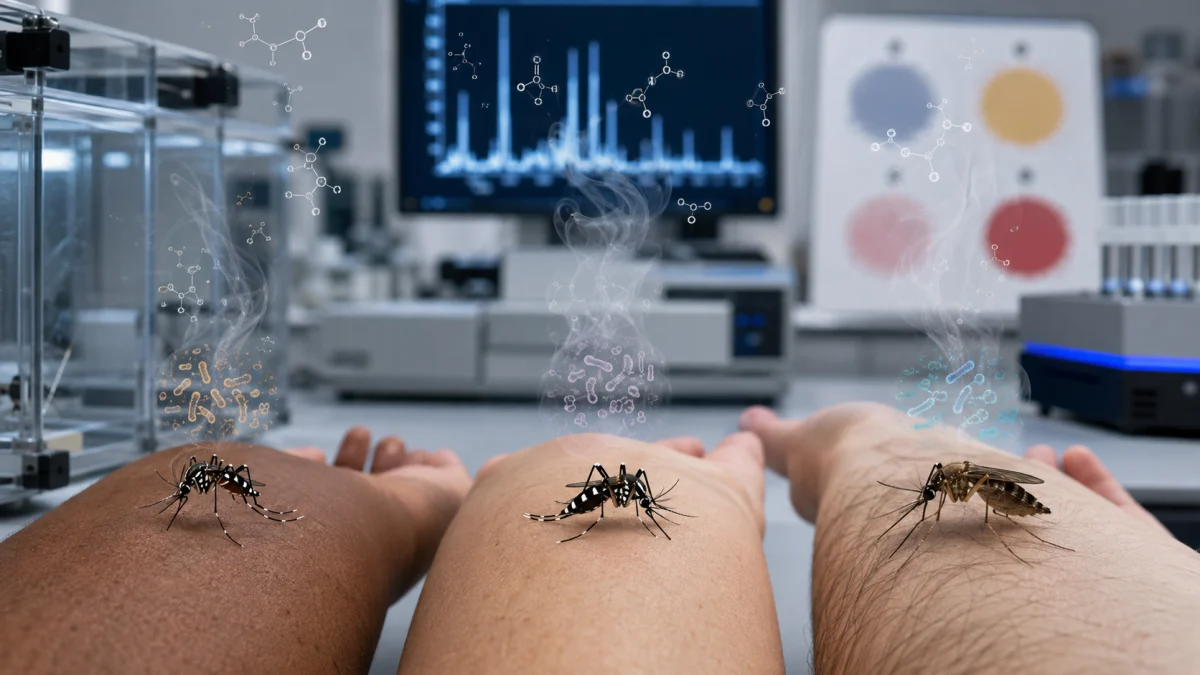
The study, published in iScience on August 21, 2026, found that three mosquito species were attracted to different people and that those differences were associated with human odor compounds, skin bacteria and, in one species, sex. Blood type was not reported as an explanatory variable in the study’s findings.
That distinction matters because at least one article promoting the research carried the headline “Mosquitoes target specific blood types—and yours may not be among them.” Yet the article itself goes on to describe ketones, volatile organic compounds, skin microbiomes and sex differences—the variables the researchers actually studied. It does not present a finding that type O, A, B or AB blood explained mosquito attraction.
There is older research suggesting that blood group may influence the attractiveness of some people to some mosquito species. But that evidence is limited, inconsistent and often much less dramatic than the popular claim that mosquitoes simply “prefer type O blood.”
The new study actually points toward a more complicated—and scientifically more interesting—answer: different mosquitoes appear to read different chemical signatures on different people.
What did the new mosquito study actually test?
Researchers from Florida International University and the University of Zürich studied 119 adults between ages 18 and 59 in Miami, Florida.
The public manuscript describes 61 self-reported male and 58 female participants. Researchers tested three medically important mosquito species:
Aedes aegypti, the yellow-fever mosquito;
Aedes albopictus, commonly called the Asian tiger mosquito; and
Culex quinquefasciatus, the southern house mosquito.
For Aedes aegypti and Aedes albopictus, participants placed a forearm into a sealed olfactometer apparatus. Thirty female mosquitoes were released on the other side, and researchers measured how many entered the attraction chamber in response to the participant.
Because Culex quinquefasciatus normally seeks hosts at night, participants instead wore nylon material over their arms to collect their odor. Those odor samples were later tested under nighttime-like conditions. The experiments lasted eight minutes, and the Aedes tests were repeated three times for each participant and species.
Researchers then analyzed chemical compounds coming from participants’ skin with gas chromatography-mass spectrometry and characterized skin bacteria through 16S ribosomal sequencing. Participants at roughly the highest and lowest 10% of attraction for each mosquito species were compared to look for chemical and microbial signatures associated with being particularly attractive or unattractive.
That is an elaborate odor-and-microbiome experiment.
It is not a blood-type experiment.
Different mosquito species preferred different people
Perhaps the most interesting result was that there did not appear to be one universal category of “mosquito magnet.”
Someone highly attractive to one species could be much less interesting to another.
In the public manuscript, attraction to Aedes aegypti and Aedes albopictus was only weakly correlated. Attraction to either of those species was barely correlated with attraction to Culex quinquefasciatus. The final iScience paper summarizes the result more broadly: each of the three species ranked the participants differently and favored a distinct subset of the group.
That finding is important because “mosquitoes prefer me” may not be a single biological trait.
It can depend on which mosquito is doing the choosing.
Aedes aegypti showed a slight preference for male participants
One demographic result did appear.
Aedes aegypti showed somewhat greater attraction to male participants than to female participants. In the public manuscript, the difference reached statistical significance at P = 0.02.
The other two mosquito species did not show the same sex difference.
The researchers also found numerous differences in odor compounds and skin bacteria between male and female participants. But they explicitly cautioned that they could not determine which of those differences, if any, caused the increased Aedes aegypti attraction.
The final paper appropriately describes the effect as slight.
So this result should not become the next viral rule that “mosquitoes prefer men.” One mosquito species showed a modest difference in this particular population. Two others did not.
The strongest signals involved smell and the skin microbiome
The researchers found different chemical patterns depending on the mosquito species.
For Aedes aegypti and Culex quinquefasciatus, high attraction was associated partly with the absence of compounds that might act as deterrents, including certain cyclic alcohols and monoterpenes.
Aedes albopictus behaved differently. Higher attraction was associated with the presence of several compounds, including ketones.
Skin bacteria also differed between highly and weakly attractive participants. The researchers identified bacterial communities associated with attraction for individual mosquito species and proposed that microorganisms living on our skin may help create the volatile chemical mixtures mosquitoes detect.
That fits with a growing body of research showing that mosquito attraction is heavily mediated by smell.
A major 2022 Cell study, for example, followed people whose attractiveness to Aedes aegypti remained remarkably stable over time. Highly attractive participants tended to produce higher levels of several skin-derived carboxylic acids.
In other words, there is substantial evidence that mosquitoes really do prefer certain people.
The unresolved question is exactly why.
This study measured attraction—not who actually got bitten most
There is another important distinction.
The new study primarily measured whether mosquitoes moved toward a person’s odor in a controlled laboratory apparatus. It did not put 119 people outside and count how many bites each received.
For two mosquito species, researchers presented participants’ arms as odor sources. For the nocturnal Culex mosquitoes, the insects were responding to odor collected on nylon material rather than to a person standing nearby.
Real-world host selection also involves carbon dioxide, heat, humidity, movement, visual cues, environmental conditions and opportunities to feed.
That does not weaken the experiment’s main finding. The study was deliberately designed to isolate chemical attraction.
It does mean that “more attractive in this olfactometer” should not automatically be translated into an exact increase in real-world mosquito bites or mosquito-borne disease risk.
So why do people say mosquitoes prefer type O blood?
This claim did not come from nowhere.
One of the most frequently cited studies was published in the Journal of Medical Entomology in 2004.
Researchers tested Aedes albopictus mosquitoes against 64 people representing the four ABO blood groups. Type O participants had the highest average landing rate, followed by B, AB and A.
But there is a large qualification that tends to disappear from popular summaries.
Type O was statistically significantly more attractive only when compared with type A. The study did not establish a statistically significant type-O advantage over every other blood group.
Researchers also experimented with ABO-related antigens applied to skin. Those experiments failed to provide a straightforward biological explanation for the apparent preference.
The authors themselves wrote that selective landing based on blood type was not strongly supported by their overall results and suggested that other unknown factors might explain the differences.
That is substantially weaker than the internet version:
“Mosquitoes love type O blood.”
Another 2026 mosquito study actually tested blood type—and found no significant effect
There is a useful comparison from another iScience paper published earlier this year.
Researchers studying Aedes aegypti and human body odor asked participants about their ABO blood types as part of an experiment involving 42 women.
Among the participants who supplied blood-type information, the researchers found no statistically significant relationship between ABO blood type and mosquito attractiveness: P = 0.16.
They also did not find meaningful separation of participants’ overall odor profiles according to ABO group.
That does not prove blood type has absolutely no effect. Only 28 participants provided ABO information, including just two people with type B blood, so the analysis was relatively small.
But it illustrates why the broad claim remains unsettled.
A study specifically looking for an ABO association failed to detect one, while the much larger 119-person study now being turned into a “blood type” story did not report ABO blood type as the explanation for its results.
Some of the modern blood-type literature is even shakier
Another study sometimes encountered when researching this subject reported that Anopheles stephensi mosquitoes strongly preferred blood group B.
There is a serious problem with using it as evidence: the paper was retracted.
Scientific Reports retracted the study in 2022 after duplicated or overlapping figures and unresolved discrepancies were identified. The authors said they had lost confidence in the integrity of the data.
That does not invalidate every study examining mosquito behavior and ABO blood groups.
It does demonstrate why search results can make this field look more settled than it actually is.
Can mosquitoes detect your blood type before biting you?
This question exposes one of the problems with the simplified explanation.
Mosquitoes must first find and select a host before obtaining the blood meal.
They do this using sensory information such as carbon dioxide, heat, moisture and compounds emitted from skin. Skin bacteria help transform sweat and other secretions into volatile chemicals that can also affect mosquito behavior.
ABO biology is somewhat more complicated because people who are “secretors” can express soluble blood-group antigens in saliva and other bodily secretions. That possibility is one reason older mosquito studies investigated both ABO type and secretor status.
But the evidence has not established a simple sensory mechanism in which a mosquito identifies “type O” from a distance and heads toward that person.
The 2004 study’s antigen experiments notably failed to provide such a clean explanation.
Does having type O blood mean you will get more mosquito bites?
Not reliably.
It is reasonable to say that some laboratory studies have reported associations between ABO blood group and attraction for particular mosquito species.
It is not reasonable to turn those findings into a universal biological rule.
Mosquito species differ. Human odor differs. Skin microbiomes differ. Chemical emissions differ. Environmental circumstances differ. Even two people with the same ABO blood type can have dramatically different skin chemistry.
The new 119-person study strengthens that species-specific picture rather than the blood-type theory.
The same person was not consistently irresistible to all three mosquito species.
What should you do if mosquitoes seem to love you?
Your blood type is not a useful basis for deciding whether you need protection.
If mosquitoes are active where you are, use the same proven precautions regardless of whether your blood type is O, A, B or AB.
The CDC recommends EPA-registered repellents containing ingredients such as DEET, picaridin, IR3535, oil of lemon eucalyptus, PMD or 2-undecanone, along with appropriate clothing and other mosquito-control measures.
The new research may eventually help scientists design repellents that interfere with particular microbial or chemical signals used by individual mosquito species.
It is not yet a practical method for changing your skin microbiome or altering your body odor to become “invisible” to mosquitoes.
The bottom line
The headline “Mosquitoes target specific blood types” is not supported by the new 119-person study being cited beneath it.
The study’s actual finding is more nuanced: three mosquito species responded differently to individual people, with attraction associated with different combinations of skin odor compounds and microorganisms. Aedes aegypti also showed a slight preference for male participants.
Older experiments provide some evidence that ABO blood group could influence attraction under particular circumstances, including a small 2004 study in which type O participants attracted more Aedes albopictus than type A participants.
But the broader evidence does not justify the simple rule that mosquitoes prefer type O—or any other particular blood type.
The better-supported conclusion is that mosquito attraction is a species-specific sensory problem involving the chemical signature of the person they are trying to find.
Ironically, that is also what makes the new study interesting.
It just is not what the blood-type headline says.
References and Further Reading
Primary Study and Underlying Data
- Individual Humans Are More Attractive to Certain Mosquito Species — iScience (2026) — The peer-reviewed 119-person study at the center of this article. Researchers tested Aedes aegypti, Aedes albopictus and Culex quinquefasciatus and found species-specific differences associated with human odor compounds and skin bacteria. Aedes aegypti was also slightly more attracted to male participants. The reported findings do not identify ABO blood type as the explanation for those differences.
- Data and Code From the 119-Person Mosquito-Attraction Study — Dryad — The researchers’ public dataset and analysis files, including attraction, demographic, odor and microbiome data. Particularly useful for checking what variables were actually analyzed rather than relying on headlines about the study.
- Individual Humans Attract Different Mosquito Species — bioRxiv — The pre-publication version of the research, with additional methodological detail and links to the underlying sequencing data and analysis repository. The peer-reviewed iScience paper above should be treated as the authoritative version.
What the Evidence Actually Says About Blood Type
- Landing Preference of Aedes albopictus on Human Skin Among ABO Blood Groups, Secretors or Nonsecretors, and ABH Antigens — Journal of Medical Entomology (2004) — The frequently cited 64-person study behind much of the claim that mosquitoes prefer type O blood. Type O participants had the highest average landing rate, but type O was statistically significantly more attractive only than type A. The researchers’ additional antigen experiments did not establish a simple general mechanism explaining mosquito preference by ABO type.
- Cyphers and Cycles: A Chemical Basis of the Differential Attraction of Mosquitoes to Human Odor — iScience (2026) — A separate 2026 study of Aedes aegypti that actually included ABO blood type as a potential explanatory variable. It found no statistically significant association between ABO blood type and mosquito attractiveness (P = 0.16) and no volatile organic compounds significantly associated with a particular ABO group. The analysis was relatively small, so it does not prove that blood type can never matter, but it directly challenges the idea that ABO type is a dominant predictor.
- Retraction Note: Human Blood Type Influences the Host-Seeking Behavior and Fecundity of the Asian Malaria Vector Anopheles stephensi — Scientific Reports (2022) — Important context when evaluating the blood-type literature. A paper reporting strong blood-type effects was retracted after unresolved errors, discrepancies and figure overlaps led the authors to lose confidence in the integrity of the data.
Why Some People Really Are Mosquito Magnets
- Differential Mosquito Attraction to Humans Is Associated With Skin-Derived Carboxylic Acid Levels — Cell (2022) — A major experimental study showing that some people remain consistently more attractive to Aedes aegypti over time and linking greater attractiveness to higher levels of several skin-derived carboxylic acids. It provides strong evidence that individual skin chemistry—not simply blood type—helps explain why mosquitoes prefer certain people.
How the New Study Was Presented
- Every Mosquito Has a Type — and You May Not Be It — Florida International University/EurekAlert — The research team’s institutional news release. Its description closely tracks the study itself: different mosquito species preferred different people and were associated with different odor and skin-microbiome signatures. Here, “type” refers to the kind of person or odor profile a mosquito prefers—not ABO blood type.
- Mosquitoes Target Specific Blood Types—and Yours May Not Be Among Them — Scienmag — An example of the misleading headline framing discussed in this article. Despite the headline’s explicit claim about “blood types,” the story itself describes body odor, volatile organic compounds, skin bacteria and sex differences from the 119-person study rather than presenting evidence that the researchers tested or identified an ABO preference.
Practical Mosquito-Bite Prevention
- Preventing Mosquito Bites — CDC — Current evidence-based guidance on mosquito protection, including EPA-registered repellents, protective clothing and reducing mosquito breeding sites. Whatever role genetics, body chemistry or blood type may play in attractiveness, prevention recommendations do not differ by ABO blood group.
Editorial currency note: Mosquito host-selection research remains an active field. This evidence review reflects peer-reviewed research and source materials available through August 22, 2026. Future larger studies may clarify whether ABO blood group has a small species-specific effect after odor chemistry, skin microbiome, sex, environmental conditions and other variables are accounted for.