The short answer: a large new study found that people who regularly consumed at least one sugar-sweetened beverage per day had about 2.45 times the adjusted risk of developing stomach cancer compared with people who consumed less than one per month. But that does not mean a daily soda gives you anything close to a 2.45% chance of getting stomach cancer—and the study does not prove that sugary drinks caused the cancers.
The absolute numbers were much smaller than the headline makes them sound. A clinical synopsis of the study calculated roughly 16 gastric cancers per 100,000 person-years among daily sugary-drink consumers, compared with about 8 per 100,000 person-years in the lowest-consumption group. In other words, the study found a large relative difference involving a disease that remained uncommon in both groups.
The finding deserves attention. It came from decades of prospective data, remained after researchers adjusted for numerous health and lifestyle factors, and was statistically significant. But it is also the first U.S. study to report this association, it was based on only 278 stomach cancers, and previous large studies have not consistently found the same relationship.
That distinction is what most versions of the viral headline leave out.
What did the new sugary-drink study actually find?
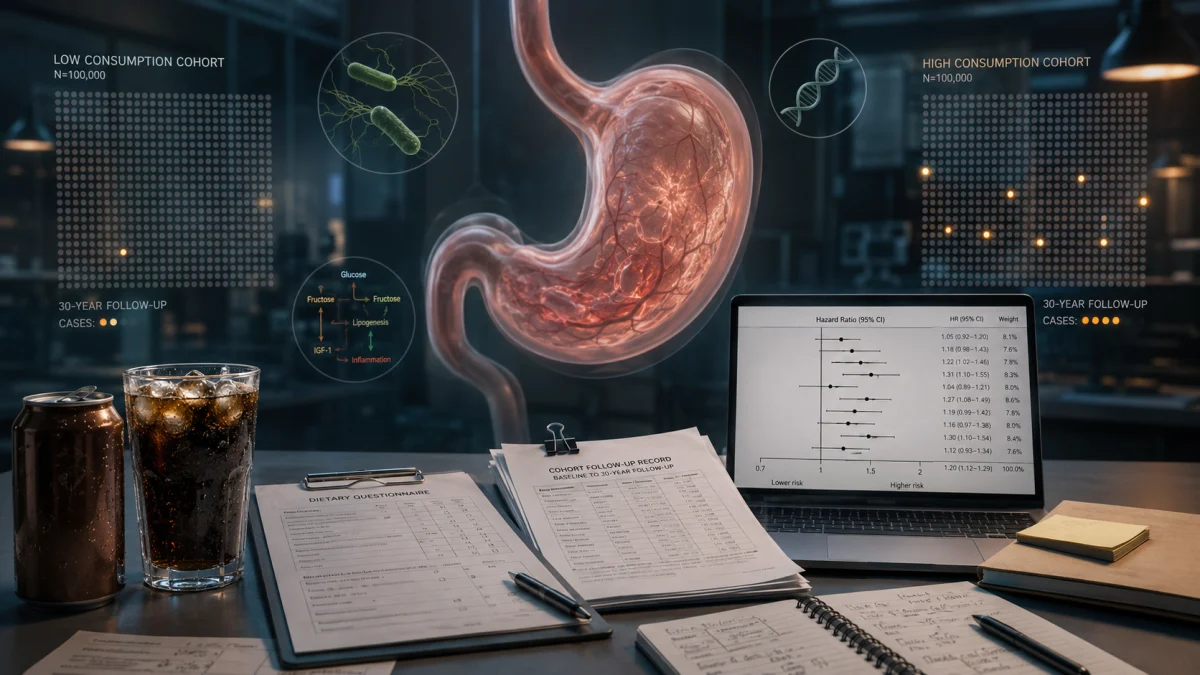
The study, published August 17, 2026, in Gastro Hep Advances, analyzed approximately 112,000 participants from two of the longest-running health cohorts in the United States: the Nurses’ Health Study and the Health Professionals Follow-Up Study.
Researchers tracked participants from roughly 1986 through 2021 or 2022, repeatedly collecting information about diet, lifestyle and health. Beverage intake was assessed with food-frequency questionnaires approximately every four years. Across more than 3.2 million person-years of observation, researchers identified 278 cases of gastric cancer.
The main result was:
| Finding | What it means |
|---|---|
| Adjusted hazard ratio | 2.45 |
| 95% confidence interval | 1.49–4.04 |
| Comparison | At least roughly one sugary-drink serving daily vs. less than one per month |
| Approximate observed incidence | 16 vs. 8 cases per 100,000 person-years |
| Total gastric cancers | 278 |
| Artificially sweetened drinks | No statistically significant association with gastric cancer |
The 2.45 hazard ratio is statistically significant because its confidence interval does not include 1.0. But the interval is also fairly wide: the data are compatible with an effect substantially smaller—or considerably larger—than the central estimate. That uncertainty matters when only 278 cancers occurred in a cohort of more than 100,000 people.
Does “2.45 times the risk” mean a 245% increase?
No.
A risk that is 2.45 times as high is a 145% relative increase over the comparison group.
More importantly, neither number tells you the absolute probability of developing cancer.
If one group experiences approximately 8 cases per 100,000 person-years and another experiences approximately 16, the absolute difference is roughly 8 additional cases per 100,000 person-years.
That is very different from saying that 2.45% of daily soda drinkers developed stomach cancer.
It is also worth noting that the approximately 16-versus-8 comparison represents observed incidence rates, whereas 2.45 is the result of an adjusted time-to-event statistical model. Those figures therefore should not be expected to produce exactly the same ratio.
So does soda cause stomach cancer?
This study does not establish that it does.
It was a prospective observational study, not a randomized experiment. Researchers observed what people habitually consumed and then compared later cancer rates.
That design is considerably stronger than asking people who already have cancer what they used to drink. Because diet was measured before cancer developed and was reassessed repeatedly, the study reduces problems such as recall bias.
But observational research still cannot completely separate the beverage itself from everything else that differs between people who drink sugary beverages every day and people who almost never do.
The researchers adjusted for numerous potential confounders, including factors such as body mass index, smoking, alcohol consumption, diabetes, overall diet and use of acid-suppressing medications. The association remained. That makes a simple explanation such as “the soda drinkers were just heavier” less convincing, but it does not prove that sugar itself caused the cancers.
What drinks counted as sugar-sweetened beverages?
The researchers’ sugar-sweetened beverage category included regular carbonated drinks, punch, lemonade and sports drinks.
The dietary analysis standardized beverage intake around an 8-ounce serving, about 237 milliliters. That is smaller than a typical 12-ounce soda can, which contains about one and a half 8-ounce servings.
This is another reason the phrase “one soda a day” is an approximation rather than a literal description of the research exposure.
The publicly described study definition also does not simply lump every sweet-tasting beverage into one category. For example, 100% fruit juice was not listed as part of the main sugar-sweetened beverage definition.
What about H. pylori?
This is one of the biggest caveats.
Helicobacter pylori, or H. pylori, is a bacterium that can chronically infect the stomach. It is a well-established major cause of gastric cancer, particularly non-cardia cancers arising in the main portion of the stomach. Treating the infection can reduce gastric-cancer risk.
The sugary-drink researchers did look at H. pylori, but only in a subset of 940 participants who had blood-serology information available.
About one-third tested positive for evidence of infection, and sugary-drink consumption was not associated with H. pylori positivity in that subset.
That is useful evidence against the simple explanation that people drinking more soda were simply more likely to carry H. pylori.
It is not the same thing, however, as having detailed H. pylori information for the entire 112,000-person cancer analysis. The researchers themselves identified limited H. pylori information as an important limitation. They also lacked complete information on family history, tumor location and previous upper endoscopy.
Was the increased risk just because sugary-drink consumers were more likely to be obese?
Apparently not entirely.
The statistical models accounted for BMI, diabetes and other lifestyle and dietary factors, yet the association persisted.
That does not necessarily mean obesity and metabolic health are irrelevant.
They may actually be part of the biological pathway.
The researchers proposed several possible mechanisms linking habitual sugar-sweetened beverage consumption with cancer, including insulin resistance, elevated glucose and insulin signaling, inflammation, weight gain, hormonal changes and alterations in the microbiome.
Those are hypotheses, not mechanisms demonstrated by this study.
Higher total fructose consumption was also associated with greater gastric-cancer incidence, particularly among women, which the authors considered supportive of a possible metabolic explanation. But again, that is an observational association rather than evidence that fructose directly caused tumors.
Why was the association apparently stronger in women?
Among women in the Nurses’ Health Study, the estimated hazard ratio for high daily consumption was 3.04. Among men in the Health Professionals Follow-Up Study, it was 1.99.
It is tempting to conclude that sugary beverages therefore affect women’s stomach-cancer risk more strongly.
The study does not establish that.
The researchers did not find statistically significant evidence of heterogeneity between the sexes. In other words, although the point estimate happened to be larger among women, the uncertainty around those estimates was substantial enough that a genuine male-female difference could not be demonstrated.
So “sugary drinks triple women’s stomach-cancer risk” would be a stronger claim than the data justify.
Did people who drank soda occasionally have the same increased risk?
No clear increase was reported in the intermediate consumption categories.
The elevated signal was concentrated among people consuming sugary beverages daily, while monthly and weekly categories did not show the same statistically significant increase.
That is interesting, but it also complicates the causal interpretation.
A smooth dose-response pattern—where risk consistently rises as consumption increases—would generally strengthen a causal hypothesis. This result looks more like a pronounced elevation at the highest consumption level than a simple staircase in which every additional drink produces proportionally more stomach cancer.
That does not disprove causation. Biological effects can have thresholds. But it is another reason not to interpret 2.45 as a precise amount of cancer risk generated by each individual drink.
Haven’t previous studies already shown that sugary drinks cause stomach cancer?
No.
This is an especially important piece of context.
A 2023 prospective Japanese study followed 74,455 adults and recorded 2,141 gastric cancers—far more gastric-cancer cases than the new U.S. study. It found no association between sugary-drink consumption and overall gastric-cancer risk in either men or women. Results remained broadly unchanged when researchers considered H. pylori infection and atrophic gastritis in subgroup analyses.
A separate systematic review and dose-response meta-analysis of prospective cohorts, published in 2023, likewise found no significant relationship between an additional 250 mL of sugar-sweetened beverages per day and gastric cancer: relative risk 1.00, 95% CI 0.85–1.17. The researchers rated the certainty of the gastric-cancer evidence as very low.
More broadly, a World Cancer Research Fund-linked systematic review released as a 2026 preprint found stronger evidence connecting sugary beverages with pancreatic and colorectal cancers. Gastric cancer was not among the positive associations highlighted in its main findings. Importantly, that evidence review searched studies only through September 2024, so it does not include this new August 2026 study.
The new paper therefore represents a meaningful new signal that conflicts with much of the earlier gastric-cancer literature, not the final confirmation of a long-established relationship.
Replication will matter.
Does diet soda cause stomach cancer?
This study found no statistically significant association between artificially sweetened beverages and gastric cancer.
But that sentence needs two qualifications.
First, the artificially sweetened category was largely defined as low-calorie carbonated beverages. It should not automatically be generalized to every food or beverage containing every artificial or non-nutritive sweetener.
Second, “no statistically significant association was found” does not mean researchers proved that diet soda prevents cancer or proved that every level of consumption is harmless.
It means this particular cohort did not produce evidence of increased gastric-cancer incidence associated with those beverages.
Earlier meta-analytic evidence has similarly failed to establish a clear overall gastrointestinal-cancer association for artificially sweetened soft drinks, although individual cancer types and sweeteners remain areas of continuing research.
How big is stomach-cancer risk in the United States generally?
Stomach cancer is relatively uncommon in the United States compared with several other major cancers.
The American Cancer Society estimates approximately 31,510 new U.S. stomach-cancer cases in 2026, accounting for about 1.5% of newly diagnosed cancers. The lifetime risk is approximately 1 in 104 for men and 1 in 153 for women, although individual risk varies substantially with age, ancestry, H. pylori infection, smoking, weight, family history and other factors.
Those lifetime statistics should not be directly compared with the study’s annualized person-year rates. They measure different things.
They do, however, help explain why a large relative-risk increase can coexist with a relatively small absolute annual risk.
Should you stop drinking sugary beverages because of this study?
There are already good reasons to limit habitual sugar-sweetened beverage consumption without treating this one cancer study as definitive.
Sugary beverages are associated with weight gain and metabolic disorders, and broader cancer research has produced stronger evidence for some cancers than currently exists for stomach cancer. The senior author of the new study has similarly emphasized that more common metabolic consequences are already sufficient reasons to reduce consumption.
What this study adds is the possibility that gastric cancer belongs on that list as well.
What it does not show is that occasionally drinking a Coke causes stomach cancer, that one particular can increases someone’s personal cancer probability by 145%, or that eliminating soda reduces gastric-cancer risk by a known amount.
Those questions would require additional studies—and, ideally, replication in populations with different racial, ethnic, geographic and H. pylori profiles.
The bottom line
The viral claim that “one sugary drink a day more than doubles your risk of stomach cancer” is based on a real result, but it needs context.
In this large U.S. observational cohort, habitual daily consumers had an adjusted gastric-cancer hazard approximately 2.45 times that of people who consumed sugary beverages less than once a month.
But the absolute incidence was roughly 16 versus 8 cases per 100,000 person-years. Only 278 gastric cancers occurred. H. pylori information was available for only a small subset. The study cannot prove causation. And earlier large prospective research—including a Japanese cohort with more than 2,000 gastric cancers—did not find the same association.
So the responsible interpretation is neither “the headline is fake” nor “one Coke a day causes stomach cancer.”
It is that a strong new association has appeared in a high-quality long-running U.S. dataset, and it is significant enough to deserve replication—while the absolute risk and the wider scientific record remain far less dramatic than the headline.
References and Further Reading
Primary Study
- Gweon et al. — Association between sugar-sweetened and artificially sweetened beverage intake and gastric cancer incidence — The primary study, published in Gastro Hep Advances on August 17, 2026. The analysis combined the Nurses’ Health Study and Health Professionals Follow-Up Study and reported a 2.45 adjusted hazard ratio for gastric cancer among participants consuming at least one sugar-sweetened beverage per day compared with those consuming less than one per month.
- Mass General Brigham — Study Finds People Who Consumed Sugar-Sweetened Beverages on a Daily Basis Had Higher Risk of Stomach Cancer — Official research summary from the senior author’s institution. Useful for the study design, beverage definitions, principal findings, limitations, funding and researcher disclosures.
Absolute Risk and Clinical Interpretation
- Epocrates — Daily Sugary Drinks Tied to Gastric Cancer Risk — Clinical synopsis that places the relative-risk figure in absolute terms: approximately 16 gastric cancers per 100,000 person-years among daily consumers versus about 8 per 100,000 person-years in the reference group. It also summarizes the lack of a significant increase in the intermediate monthly and weekly intake categories.
Earlier Research and Conflicting Evidence
- Khairan et al. — Sugary Drink Consumption and the Subsequent Risk of Gastric Cancer: The Japan Public Health Center-Based Prospective Study — Large prospective Japanese cohort involving 74,455 participants and 2,141 gastric cancers. Unlike the new U.S. study, it found no overall association between sugary-drink consumption and gastric-cancer risk, including in analyses accounting for H. pylori infection and atrophic gastritis.
- Li et al. — Association of Soft Drinks and 100% Fruit Juice Consumption With Risk of Cancer: A Systematic Review and Dose-Response Meta-Analysis of Prospective Cohort Studies — 2023 systematic review and meta-analysis covering 37 prospective cohorts and more than 4.5 million participants. It found associations between sugar-sweetened beverages and several cancers, but did not find a statistically significant gastric-cancer association, underscoring why the 2026 result should be treated as an important new signal rather than settled evidence.
Established Stomach-Cancer Risk Factors
- National Cancer Institute — Causes and Risk Factors for Stomach Cancer — Authoritative overview of established and suspected gastric-cancer risk factors, including chronic H. pylori infection, smoking, dietary factors and certain medical conditions. Provides important context for evaluating residual confounding in an observational beverage study.
- National Cancer Institute — Helicobacter pylori and Cancer — Detailed review of the evidence establishing chronic H. pylori infection as a causal risk factor for gastric adenocarcinoma. Particularly relevant because comprehensive H. pylori information was unavailable for most participants in the new sugary-drink study.
U.S. Stomach-Cancer Risk and Incidence
- American Cancer Society — Key Statistics About Stomach Cancer — Current U.S. incidence and lifetime-risk estimates. The American Cancer Society projects approximately 31,510 new stomach-cancer cases in the United States in 2026, helping place the study’s large relative-risk estimate in the context of a comparatively uncommon U.S. cancer.
Editorial currency note: The sugar-sweetened beverage finding was published on August 17, 2026 and represents newly emerging evidence. Earlier prospective and pooled studies did not consistently identify an association with gastric cancer. The evidence should therefore be revisited as independent cohorts, replication studies and updated meta-analyses incorporate the new findings.