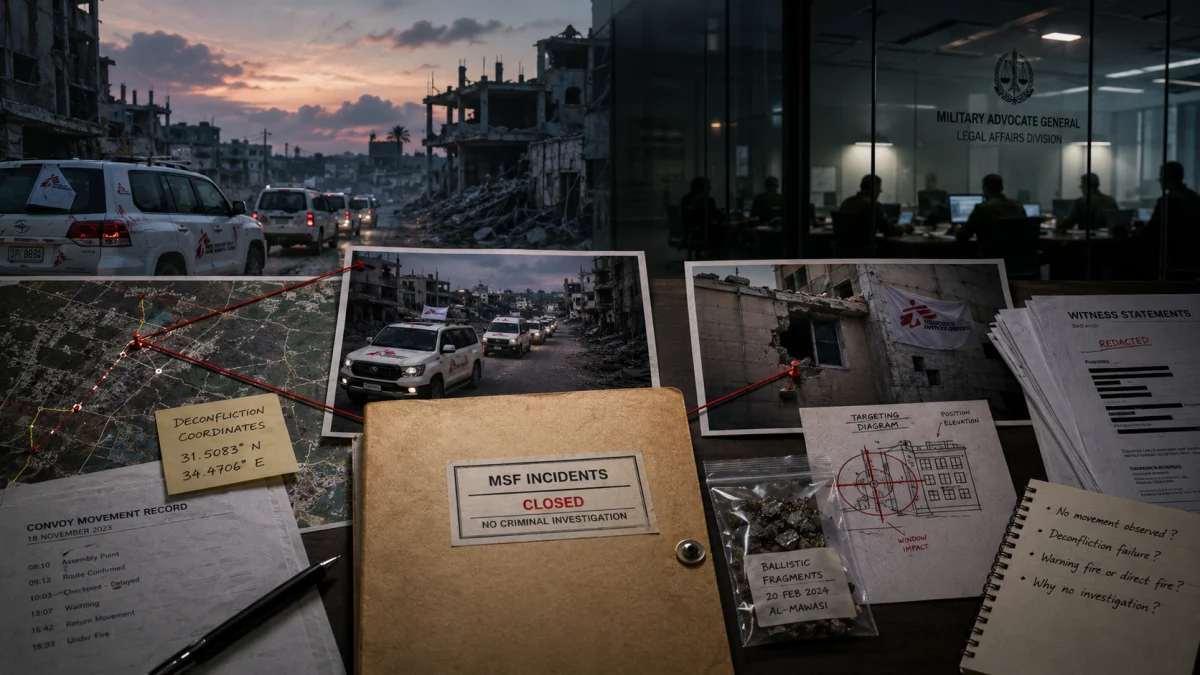
Israel’s military did not entirely refuse to examine the two deadly incidents submitted by Doctors Without Borders, formally known as Médecins Sans Frontières or MSF. It conducted internal fact-finding assessments and sent the results to the Military Advocate General.
But that process ended with the military closing both cases without opening criminal investigations—even though Israel acknowledges that its forces fired in both incidents, four people were killed, and critical humanitarian-coordination information failed to reach troops in the field.
The public findings do not resolve the central factual disputes. In the first case, an MSF eyewitness describes Israeli personnel aiming at the organization’s vehicles and firing directly at them. Israel says its troops fired only at the road and that fragments probably struck the victims. In the second case, Israel acknowledges firing a tank shell into an MSF shelter after observing no movement inside or around it, while also admitting that the force did not have updated information identifying the building as an MSF location.
That does not automatically prove that a particular soldier committed a war crime. It does establish something narrower but important: the available evidence contains unresolved contradictions serious enough to justify an independent investigation rather than an internal administrative closure.
The Answer in Brief
Verified: Israeli forces fired in both incidents. Two people were killed during the November 18, 2023 MSF convoy incident in Gaza City. Two women were killed when an Israeli shell struck an MSF shelter in Al-Mawasi on February 20, 2024. After internal military reviews, the Military Advocate General declined to open criminal investigations in either case.
Disputed: MSF says its convoy was directly fired upon. Israel says the deaths were probably caused by fragments from warning fire directed at the road. MSF says the shelter’s coordinates had been provided and acknowledged; Israel says the attacking force did not have updated information identifying the building as an MSF site. Israel says the shelter presented a military threat because of its position, although its own review says troops observed no movement inside or nearby before firing.
Reasonable conclusion: The public findings are insufficient to establish individual criminal guilt. They are also insufficient to clear the incidents convincingly. The evidence supports an independent investigation with access to the underlying military records, witness testimony, ballistic material and humanitarian-coordination data.
What Israel Actually Investigated—and What It Did Not
The most accurate description is not that Israel “did no investigation.”
The Israeli military referred the incidents to its General Staff Fact-Finding and Assessment Mechanism. That mechanism examines exceptional operational incidents and submits its findings to military prosecutors, who decide whether there is reasonable suspicion sufficient to justify a Military Police criminal investigation.
The military says the mechanism has completed reviews of approximately 150 Gaza incidents since the war began. In August 2026, it announced decisions in five high-profile cases. Criminal investigations were opened into the killing of five-year-old Hind Rajab and her family and the killing of 15 Palestinian emergency responders. The World Central Kitchen and MSF cases were closed without criminal investigations.
The distinction matters.
A fact-finding assessment is a preliminary military review used to reconstruct an event, identify operational problems and advise prosecutors. A criminal investigation examines whether individual conduct may constitute an offense and can lead to prosecution. The Israeli military describes the fact-finding mechanism as separate from the units directly involved in the incidents, but it remains institutionally inside the military and reports into the military legal system.
Opening a criminal investigation would not have meant that anyone was presumed guilty. It would have meant that the available evidence crossed the threshold for a formal examination of possible criminal conduct.
The Military Advocate General concluded that neither MSF case crossed that threshold. The problem is that the public summaries leave major evidence conflicts unresolved.
Case One: The November 2023 MSF Convoy Shooting
On November 18, 2023, an MSF convoy attempted to evacuate Palestinian staff members and their families from northern Gaza.
MSF says the convoy consisted of five vehicles carrying 137 people, including 65 children. The organization says all five vehicles were clearly marked with MSF identification, including markings on their roofs, and that both parties to the conflict had been informed of the movement.
The convoy traveled toward southern Gaza using a route indicated by the Israeli military. When it reached a checkpoint near Wadi Gaza, however, Israeli troops did not allow it through.
MSF says the group waited for approximately three hours. As darkness approached and shooting could be heard, the convoy turned back toward MSF facilities in Gaza City. An MSF staff member said colleagues contacted the organization’s Jerusalem office to report that they were returning and to request authorization for the movement.
What the MSF eyewitness described
According to MSF, the convoy came under fire on Al-Wahida Street near its Gaza City office.
A staff member traveling in the fourth vehicle said he saw Israeli tanks and personnel positioned above the street and believed their weapons were pointed toward the fourth and fifth vehicles. He described gunfire striking the convoy, with one projectile grazing his forehead before hitting volunteer nurse Alaa Al Shawa in the head.
Al Shawa, who had been supporting MSF teams at Al-Shifa Hospital, died despite efforts by colleagues to save him. A second person suffered an abdominal wound and later died.
This is not merely an allegation that Israeli forces happened to be operating somewhere nearby. It is an eyewitness account of weapons being aimed at specific vehicles and occupants being hit directly.
What the Israeli military says happened
Israel’s account agrees on several important underlying facts.
The military confirms that the convoy’s movement south had been coordinated, that final approval was issued shortly before it departed, and that the approval had not reached the soldiers operating the checkpoint when the convoy arrived.
It says the convoy was told to wait while the situation was clarified. Instead, the vehicles eventually returned north without an approved coordination arrangement, traveling against the direction of the designated evacuation route.
Israeli troops farther along the route saw the vehicles approaching and interpreted the movement as a possible threat. According to the military, soldiers first fired warning or “removal” rounds—not at the vehicles, but toward the road. When the convoy continued approaching, additional fire was directed at the road approximately 100 meters from the vehicles.
The military says fragments from that fire may have killed the two passengers. Its review found no evidence that soldiers fired directly at the convoy.
Why the two accounts cannot simply be combined
The disagreement is not a minor question of wording.
MSF’s witness describes soldiers aiming at the vehicles and a projectile passing close enough to graze his forehead before striking the person beside him in the head.
The Israeli military says no one fired directly at the vehicles and that the deaths were probably caused by fragments from rounds aimed at the road.
Both accounts cannot be fully accurate.
That conflict should be testable through evidence such as:
- The weapons and ammunition used by the Israeli unit
- Fire-control and gunner-optics recordings
- Unit positions and lines of sight
- Radio and command communications
- Ammunition expenditure records
- Photographs of the vehicles
- Medical and ballistic evidence
- Interviews with the surviving occupants
- Projectile or fragment trajectories
The military’s public announcement provides its conclusion but does not release that underlying evidence.
Returning without coordination did not settle the legal question
The convoy’s decision to return north without final authorization is relevant. It may help explain why Israeli troops perceived the vehicles as unusual or threatening.
But it does not, by itself, answer whether the soldiers correctly identified the vehicles, took feasible precautions, recognized their humanitarian markings or fired in a legally permissible manner.
A breakdown in coordination can explain how danger developed. It does not automatically excuse everything that followed.
The military’s own account also confirms that the coordination system had already failed before the convoy turned around: authorization had been approved but had not reached the checkpoint force.
What happened to the vehicles afterward?
MSF says Israeli armored vehicles and a bulldozer destroyed five clearly marked MSF vehicles on November 20, two days after the shooting. The organization described those vehicles as potential evidence in any independent investigation.
MSF also reported firing at its facilities and the destruction of another marked evacuation vehicle on November 24.
These remain allegations from an involved party, although MSF published photographs and witness testimony supporting its account. The Israeli military’s August 2026 public summary addresses the November 18 shooting but does not explain whether the later destruction of the vehicles and damage to the facilities were included in the review.
That omission matters. Investigators should determine whether physical evidence was destroyed, why the vehicles were crushed or burned, and whether the destruction was operationally necessary.
Case Two: The February 2024 Strike on an MSF Shelter
On the evening of February 20, 2024, an Israeli tank shell struck a house in Al-Mawasi, southwest of Khan Younis, that was being used to shelter MSF employees and their families.
The wife and daughter-in-law of an MSF employee were killed.
MSF reported that six other people were injured, five of them women or children. The Israeli military’s final review says seven people were injured. The reason for that one-person discrepancy is not explained in the public record.
MSF says 64 people were inside the shelter. It says the precise coordinates had been provided to Israeli authorities, the presence of MSF personnel at the location had been acknowledged, and a two-by-three-meter MSF flag was displayed outside. It says no evacuation warning was issued before the shell struck.
MSF also reported gunfire hitting the front gate, exterior walls and ground-floor interior.
What Israel now acknowledges
The Israeli military confirms that its force fired one shell through a window of the building.
According to the military’s review, Israeli personnel were moving along a route near Hamas combat areas that had not yet been fully secured. They saw a building in what the military described as a topographically commanding position over the route.
The force assessed that someone inside the building could observe its movement and direct or conduct an attack. It therefore fired a shell at one of the windows.
The same military review says:
- The building’s lights were off.
- No movement was observed inside or around it before the shot.
- The troops did not possess updated information identifying it as an MSF site.
- The MSF sign was on the building’s front, while the force approached from behind and could not see it.
- The failure to provide the force with updated information about the MSF location represented an acknowledged information gap.
Despite that gap, the Military Advocate General concluded that the shell was fired for a military purpose at a building the troops assessed to be a military objective. A criminal investigation was rejected, although the military said command measures could still be considered because of deficiencies in the attack process.
The Shelter Explanation Raises More Questions Than It Answers
The military’s public account does not establish that soldiers saw a gunman, weapon, hostile movement or fire coming from the building.
It says the opposite: no movement was observed.
The stated threat was based primarily on the building’s location and the possibility that someone inside could observe the Israeli route.
A structure can qualify as a military objective because of its location. International humanitarian law does not limit military objectives to weapons depots or buildings already being used to fire at troops. But the legal standard still requires the object to make an effective contribution to military action and its neutralization to offer a definite military advantage under the circumstances at that time.
The public summary does not reveal what evidence moved the building from being a theoretically useful observation point to an actual military objective.
That distinction is central. In an urban war, countless windows overlook roads used by military forces. Treating every dark or elevated building as a military objective would effectively erase civilian protection.
The darkness may have had a civilian explanation
The military’s findings emphasize that the shelter’s lights were off.
A witness interviewed by Sky News in 2024 provided a possible explanation. The witness said occupants heard what sounded like tank tracks approaching, ran to close the shelter’s entrance and turned off the exterior lights.
That account does not prove what Israeli soldiers knew or perceived. It does show why darkness cannot automatically be treated as evidence of hostile activity. Civilians hearing tanks approach in a combat zone may turn off lights because they are frightened and trying not to attract attention.
Israel’s public explanation appears to have changed
After a March 2024 Sky News investigation, the Israeli military said its forces had fired at a building identified as one where “terror activity is occurring.”
At the time, the military did not publicly release evidence supporting that assertion.
The August 2026 findings offer a noticeably different explanation. They do not identify militants, weapons, hostile fire or observed movement. Instead, they say the building was considered threatening because of its commanding position and its potential use for observing Israeli forces.
Those explanations are not necessarily impossible to reconcile. The military could possess intelligence that has never been made public.
But the public record does not reconcile them.
Was there affirmative intelligence of militant activity inside the shelter, as the 2024 statement implied? Or did the force infer a threat from the building’s location despite observing no movement, as the 2026 summary says?
That question should have been answered before the case was closed.
The forensic evidence confirms a direct strike
Sky News interviewed five witnesses, visited the shelter and examined photographs, videos and weapon fragments with outside specialists.
Its investigation found evidence consistent with a large-caliber tank round entering through a first-floor window at an upward angle. One weapons expert believed the shot was fired at relatively close range, although Sky could not determine the precise distance or exact weapon independently.
Israel’s 2026 findings now confirm the basic mechanism: its force intentionally fired one shell at a window.
The unresolved question is therefore not who fired the shell. Israel acknowledges that.
The unresolved question is whether the force had a legally sufficient basis to classify the shelter as a military objective and whether feasible precautions could have prevented the deaths.
The Deconfliction Failure Is Not a Minor Administrative Detail
Humanitarian organizations regularly provide military authorities with the coordinates of offices, hospitals, shelters and convoy routes. This is often called deconfliction or humanitarian notification.
It is not a magical shield. A notified location does not become permanently immune from attack if it is genuinely converted into a military objective.
But the process is supposed to ensure that military planners and frontline units know where protected humanitarian personnel and civilian facilities are located.
MSF says Israel received and acknowledged the shelter’s precise coordinates. Israel says the force that fired did not have updated information identifying the building as an MSF location.
Those statements can both be true—and, if they are, they describe a serious system failure.
The information was reportedly supplied. It was reportedly acknowledged. It did not reach the people making the lethal decision.
That is not evidence that the coordination process worked. It is evidence of how it failed.
International humanitarian law requires parties to do everything feasible to verify that targets are military objectives and to take all feasible precautions to avoid or minimize civilian harm. Humanitarian relief personnel and objects used in relief operations must also be respected and protected while they retain their civilian status.
An investigation should therefore examine more than whether the tank crew could physically see an MSF sign from its approach direction. It should examine why the force did not already know that the coordinates belonged to a notified humanitarian shelter.
Does the Public Evidence Prove a War Crime?
Not by itself.
Civilian deaths—even terrible and avoidable ones—do not automatically establish a war crime. Investigators would need to examine the target’s actual status, what the soldiers and commanders knew, what precautions were feasible, what intelligence was available and whether anyone intentionally attacked protected people or objects.
The Rome Statute identifies intentionally directing attacks against civilians, civilian objects and protected humanitarian personnel or vehicles as potential war crimes under the required circumstances. It also protects hospitals and places where the sick and wounded are collected when they are not military objectives.
The available public record is not enough to assign individual criminal responsibility.
But that is not the same question as whether a criminal investigation was justified.
The evidence needed to make a stronger determination is largely controlled by the Israeli military itself:
- Operational logs
- Fire orders
- Intelligence assessments
- Targeting records
- Gunner and surveillance imagery
- Ammunition data
- Unit communications
- Humanitarian-notification records
- Internal witness interviews
- The complete fact-finding files
Saying the public lacks enough evidence to convict someone cannot become a circular justification for preventing investigators from obtaining the evidence necessary to determine whether a crime occurred.
Why MSF Does Not Accept the Internal Review as Accountability
MSF says it waited nearly two years after formally submitting its requests before receiving the closure decisions. It also says it filed a submission with Israel’s High Court of Justice challenging the Military Advocate General’s failure to answer.
The organization argues that a military mechanism reviewing the conduct of the same military cannot provide the independence required for credible accountability. It is demanding review by an impartial investigative body.
Israel’s fact-finding mechanism is not identical to allowing the units involved to review themselves. The military says it operates outside the ordinary operational command structure and uses officers and specialists who were not involved in the incidents being examined.
That offers some separation from the immediate actors.
It does not create institutional independence from the military whose conduct is under review.
The difference becomes more consequential when internal reviews repeatedly end without criminal investigation.
The Israeli human-rights organization Yesh Din examined the fact-finding mechanism’s record across three earlier Gaza operations. Using figures substantially drawn from military information, it identified at least 664 complaints sent to the mechanism. Of 573 cases with known outcomes, one ultimately produced a prosecution—a rate of approximately 0.17%.
Those historical figures do not prove that the outcome of either MSF case was predetermined. They do provide a factual basis for skepticism about whether the mechanism regularly produces meaningful criminal accountability.
What About MSF’s Use of the Word “Genocide”?
MSF’s August 2026 statement places these cases within its broader allegation that Israel is committing genocide against Palestinians in Gaza.
These two incidents alone cannot establish—or disprove—genocide. Genocide is a broader legal question involving prohibited acts and the specific intent to destroy a protected group, in whole or in substantial part. Individual incidents may form part of the evidence, but the legal determination depends on the overall pattern, policies, statements, conduct and intent.
In September 2025, a United Nations Independent International Commission of Inquiry concluded that Israeli authorities and security forces were committing genocide in Gaza. Israel rejects the accusation. The separate genocide case brought by South Africa against Israel remains pending before the International Court of Justice, which has not issued a final merits judgment. In May 2026, the court established additional written-pleading deadlines extending into 2027 and 2029.
The conclusion of this article does not depend on resolving that larger case.
Whatever position a reader takes on the genocide allegation, Israeli forces acknowledge firing in both MSF incidents. The evidence conflicts remain. The coordination failures remain. The need for independent examination remains.
What an Independent Investigation Would Need to Examine
A credible investigation should obtain and compare at least the following evidence:
-
The complete Military Advocate General closure letters, not only the abbreviated public announcement.
-
The underlying fact-finding files, including internal interviews, maps, timelines, intelligence and recommendations.
-
Every deconfliction record, including the coordinates supplied by MSF, Israeli acknowledgments, timestamps and records showing which military units received the information.
-
The convoy fire records, including weapon types, ammunition expenditure, firing positions, lines of sight and any gunner-optics or surveillance footage.
-
Ballistic and medical evidence, including the head and abdominal injuries described by MSF and any fragments recovered from the vehicles.
-
Interviews with the convoy survivors, including the witness who said a projectile grazed his forehead before striking Alaa Al Shawa.
-
The shelter target assessment, including what evidence supported the original 2024 assertion of “terror activity” and why that language does not appear in the final 2026 explanation.
-
The information available to the tank crew, including whether the building had been plotted as a humanitarian site in military systems.
-
The later destruction of MSF vehicles, including whether that destruction was operationally necessary and whether it eliminated evidence relevant to the November 18 shooting.
-
The injury-count discrepancy, since MSF reports six people injured at the shelter while the Israeli findings report seven.
These are not abstract demands for unlimited access to military secrets. They are the evidentiary questions created by the military’s own public explanation.
The Bottom Line
Israel has provided an account of why its forces fired in the two MSF incidents.
It has not publicly demonstrated that this account resolves the evidence.
In the convoy case, an eyewitness account of direct fire conflicts with the military’s theory that fragments from rounds aimed at the road killed the passengers.
In the shelter case, Israeli forces fired a tank shell into a building containing 64 people after observing no movement, while lacking humanitarian-location information that MSF says had already been supplied and acknowledged. The original public assertion that the building contained “terror activity” has not been reconciled with the later explanation that the threat was inferred from its location.
None of that proves in advance that a particular soldier is criminally guilty.
It does mean the cases should not be considered factually resolved simply because the military institution involved has closed its own files.
A criminal investigation would not presume guilt. It would test the evidence.
Closing a case is not the same as answering it.
References and Further Reading
Primary Records and First-Party Accounts
MSF Condemns the Israeli Military Decision to Deny Criminal Investigations Into the Killings and Injuries of Its Personnel and Families — MSF’s August 20, 2026 statement demanding an impartial investigation and explaining its objection to the Military Advocate General’s closure decisions.
Israeli Military Findings on Five Gaza Incidents Reviewed by the General Staff Fact-Finding Mechanism — The Israeli military’s August 19, 2026 public findings, including its explanations for closing the two MSF cases. Published in Arabic.
MSF Convoy Attacked in Gaza: All Elements Point to Israeli Army Responsibility — MSF’s detailed reconstruction of the November 18 convoy shooting, including survivor accounts and its allegations concerning the subsequent destruction of vehicles.
MSF’s Initial Report on the Al-Mawasi Shelter Strike — MSF’s February 2024 account of the shelter’s occupants, casualties, markings, coordinates and lack of an evacuation warning.
How the Israeli Military Describes Its Fact-Finding and Criminal-Investigation Process — An official explanation of how incidents move from General Staff factual assessment to a possible Military Police investigation.
Independent Reporting
Sky News Investigation Into the Israeli Strike on the MSF Shelter — Combines site visits, five witness interviews, imagery analysis and outside weapons expertise. It also preserves the Israeli military’s original 2024 explanation that the building was associated with “terror activity.”
Associated Press: Israel Opens Two Gaza Criminal Investigations but Declines MSF and World Central Kitchen Probes — Independent overview of the five August 2026 military decisions and the wider accountability debate.
International Humanitarian Law
ICRC Customary IHL Rule 8: Definition of Military Objectives — Explains when an object may qualify as a military objective because of its nature, location, purpose or use.
ICRC Customary IHL Rule 15: Precautions in Attack — Requires all feasible precautions to avoid or minimize civilian loss and damage.
ICRC Customary IHL Rule 16: Target Verification — Requires parties to do everything feasible to verify that proposed targets are military objectives.
ICRC Customary IHL Rule 31: Protection of Humanitarian Relief Personnel — Summarizes the protection owed to humanitarian relief personnel.
ICRC Customary IHL Rule 32: Protection of Humanitarian Relief Objects — Covers vehicles, materials and other objects used in humanitarian relief operations.
Rome Statute of the International Criminal Court, Article 8 — Defines relevant categories of war crimes, including certain intentional attacks on civilians, humanitarian missions and protected facilities.
Accountability and Broader Legal Context
Yesh Din: The General Staff “Whitewashing Mechanism” and Gaza Accountability — An Israeli human-rights organization’s historical analysis of the fact-finding mechanism’s delays, investigation rates and prosecution outcomes. Its figures concern earlier Gaza operations and should not be treated as proof of the outcome in these specific cases.
International Court of Justice: South Africa v. Israel Genocide Convention Case — The official docket for the still-pending genocide case, including provisional measures and current filing deadlines.
UN Commission of Inquiry Report Concluding That Israel Is Committing Genocide in Gaza — The commission’s September 2025 legal and factual analysis. It is separate from the pending International Court of Justice case.
Editorial currency note: This article reflects the publicly available record through August 21, 2026. The factual picture could change if MSF releases the complete closure letters, Israel publishes the underlying fact-finding files, the Israeli High Court issues relevant decisions, or an independent body obtains access to military and ballistic evidence.