There is substantial evidence of an ethnic-cleansing process in parts of the occupied West Bank if the term is used in its ordinary international meaning: using force, intimidation or coercive conditions to remove one population from particular territory.
That is not the same as saying an international court has convicted Israel of a crime called “ethnic cleansing.” Ethnic cleansing is not itself a standalone crime under international law, and no international court has issued such a judgment concerning the West Bank.
The more legally precise findings are already serious.
The International Court of Justice concluded in 2024 that Israeli settlements in the West Bank and East Jerusalem are being maintained in violation of international law; that Israeli policies including forced evictions, extensive demolitions and movement restrictions can leave Palestinians with little choice but to leave; and that these practices violate the prohibition against forcible transfer. The Court also found that Israel’s continued presence in the occupied Palestinian territory is unlawful and that it must cease new settlement activity and evacuate settlers.
Meanwhile, the physical pattern on the ground has accelerated.
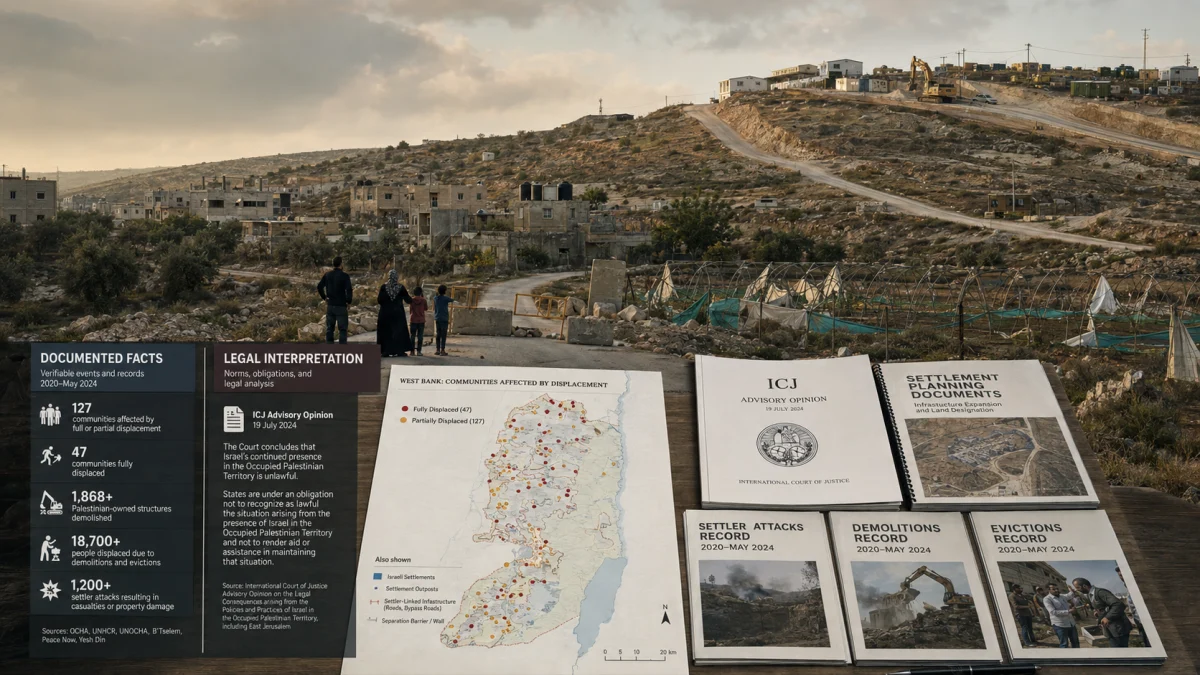
As of August 2026, the United Nations says 127 Palestinian communities have experienced full or partial displacement since January 2023. Forty-seven have been entirely displaced. More than 6,390 Palestinians have been affected. In 2026 alone, roughly 3,800 Palestinians — nearly half of them children — had been displaced due to a combination of settler violence, demolitions and evictions by August 10.
Those figures do not prove every element of every accusation made about Israel.
They do make it increasingly difficult to describe what is happening as merely a collection of unrelated attacks by a few extremist settlers.
What happened in Qusra?
The immediate story bringing renewed attention to the issue is Qusra, a Palestinian village south of Nablus.
Beginning on August 9, 2026, Israeli settlers blocked access to several Palestinian homes on the village’s outskirts. The affected Abu Ridi and Hassan families said their electricity and water supplies had been cut and that they were effectively trapped.
Security-camera footage reviewed by the BBC showed settlers dismantling a wall outside one home and using the stones to block access. The first Israeli soldiers who arrived were filmed praying alongside the settlers — conduct for which the Israeli military later said disciplinary action would be taken.
The episode became stranger when Israeli forces subsequently attempted to remove the settlers.
Security forces confronted a larger group of settlers with tear gas and stun grenades but initially failed to clear them. During a later military operation, about a dozen Palestinian households were temporarily instructed to leave their properties. The military said this was done to protect the residents and reported dismantling two unauthorized outposts and detaining one Israeli. Some Palestinian families were later permitted to return.
This matters because the evidence does not support a simplistic claim that every Israeli soldier or government agency was cooperating with the settlers in Qusra. Israeli officials explicitly condemned the attempted seizure of Palestinian property as illegal and promised arrests and prosecution.
But the incident also exposed a deeper problem.
Settlers were able to establish themselves beside Palestinian homes, cut utilities and block access for days. Israeli forces initially failed to remove them. And Qusra was not an isolated case.
The UN Human Rights Office says an unauthorized Israeli outpost was established near Qusra in November 2025 and that Palestinians subsequently faced increasingly frequent home invasions, assaults, vandalism, theft and arson. The UN documented settlers cutting water and electricity to three homes before closing their entrances in August.
Nearby Jalud had already provided a disturbing preview: settlers surrounded a Palestinian home for more than two weeks in July. After the owners left, settlers took over the property.
By August 17, UN humanitarian personnel had reached the families in Qusra and the immediate siege had eased.
The larger pattern had not.
The “127 communities” statistic is real
One of the most striking claims circulating online is that 127 Palestinian communities have been displaced in only a few years.
That figure is not an activist estimate. It comes from the United Nations.
In an August 11 briefing to the Security Council, UN Deputy Special Coordinator Ramiz Alakbarov reported:
- 127 Palestinian communities had experienced full or partial displacement since January 2023.
- 47 communities had been entirely displaced.
- More than 6,390 Palestinians had been affected.
- About 3,800 Palestinians had been displaced during 2026 because of settler violence, demolitions and evictions.
- Nearly half of those displaced in 2026 were children.
- More than 1,430 settler incidents resulting in casualties, property damage or both had been documented in 2026 across roughly 260 Palestinian communities.
One qualification is important.
The 3,800 figure should not be reported as 3,800 people displaced solely by settler attacks. The UN figure combines several causes: settler violence, demolitions and evictions.
OCHA’s more narrowly defined data are still extraordinary. By late July, it had recorded more than 2,300 Palestinians displaced during 2026 specifically in connection with settler attacks and related access restrictions. It described these incidents as the principal driver of displacement within the categories it was tracking.
That distinction matters because accuracy matters.
It does not make the underlying trend less severe.
This is not simply people fleeing after individual attacks
The strongest evidence for an ethnic-cleansing analysis is not the number of violent incidents by itself.
It is the sequence of events documented across multiple communities.
OCHA reports recurring combinations of:
- settler incursions;
- physical attacks and threats;
- destruction of homes or livelihood infrastructure;
- blocked access to farmland and grazing areas;
- destruction or seizure of water infrastructure;
- establishment or expansion of settlement outposts;
- restrictions on Palestinian movement;
- families eventually abandoning homes or entire communities.
This is particularly visible among Bedouin and herding communities, where losing access to water or grazing land can make remaining physically possible but economically impossible.
For example, OCHA reported in June that settlers had taken control of the only water points serving the Dar Faza’a and East Tayba Bedouin communities, cutting more than 200 people off from their normal water supply.
Approximately 980 Palestinians from 10 communities along the Allon Road area had been displaced over the preceding three years. Nine of those communities had been completely emptied.
This is why “they chose to leave” can be misleading.
International law does not require someone to be dragged physically from a house before a transfer can be considered forcible.
The ICJ stated explicitly that transfer can be forcible when people “have no choice but to leave.”
If a family’s water is cut, livestock cannot graze, roads become inaccessible, neighboring homes are attacked, property is repeatedly vandalized and the threat of further violence becomes persistent, eventual departure is not necessarily voluntary simply because no soldier physically carries the family away.
What happens after Palestinians leave is critical
Displacement by itself does not automatically establish ethnic cleansing.
What happens to the territory afterward matters.
And this is where the pattern becomes more difficult to explain as ordinary communal violence.
In its August Security Council briefing, the UN said Palestinian populations were increasingly being displaced from West Bank villages before settlers took control of the vacated land. It also reported that settler attacks previously concentrated in Area C were increasingly appearing in Areas B and A.
Qusra is significant partly because the affected homes are in Area B, where the Palestinian Authority exercises civilian administration while Israel retains security authority.
Settlement-driven coercion moving beyond isolated Area C herding communities would represent an important geographic escalation.
The Jalud case provides a particularly clear example of the sequence: settlers surrounded a Palestinian property for weeks; the family eventually fled; settlers then occupied the property.
One case proves little by itself.
Dozens of communities experiencing variations of the same process are harder to dismiss.
Are these just rogue settlers?
Israeli officials frequently distinguish violent extremists from the hundreds of thousands of ordinary Israeli civilians living in settlements.
That distinction is legitimate.
Israeli Prime Minister Benjamin Netanyahu has described violent settlers as a tiny minority and said he does not accept vigilantism. During the Qusra crisis, Israeli officials condemned the settlers’ actions, and Israeli security forces eventually confronted settlers and dismantled outposts.
It would therefore be inaccurate to claim that every settler is violent or that every individual assault is directly ordered by the Israeli government.
But that does not resolve the larger question.
The settlements themselves are not a private project operating independently of the state.
Israel provides planning approvals, roads, security, utilities, governmental administration and public funding for settlements.
And in 2026, that governmental role has expanded dramatically.
Israel is simultaneously accelerating settlement expansion
As Palestinians are being displaced, Israel is rapidly increasing the physical infrastructure of Israeli settlement in the same occupied territory.
By August 11, Israeli planning authorities had advanced or approved approximately 12,360 settlement housing units during 2026:
- roughly 7,200 in Area C of the West Bank;
- roughly 5,160 in East Jerusalem.
In March, Israel’s Cabinet approved 34 settlements across Area C — a combination of new settlements and the formalization or reclassification of existing outposts and settlement areas.
In July, the government announced approximately $431 million to support those settlements, including infrastructure and prefabricated housing.
The UN also reported an unprecedented Israeli seizure order involving privately owned land in Area A for a road connecting two settlements.
These are governmental decisions.
Whatever one believes about individual acts of settler violence, settlement expansion itself cannot reasonably be described as the work of unsupervised fringe actors.
E1 makes the territorial objective unusually explicit
The E1 settlement project east of Jerusalem is particularly revealing because its political purpose has barely been disguised.
On August 18, Israel opened a new tender for 1,234 housing units in the E1 area, part of a larger approved project containing 3,401 units.
The site lies between East Jerusalem and the settlement of Ma’ale Adumim. Development there would severely disrupt Palestinian territorial continuity between the northern and southern West Bank while further separating East Jerusalem from surrounding Palestinian areas.
This is not merely an interpretation imposed by opponents of the project.
When the project was approved, Israeli Finance Minister Bezalel Smotrich openly presented it as a way of eliminating the possibility of a Palestinian state.
That matters when evaluating intent.
A government does not need to issue a secret document saying “remove Palestinians from the West Bank” for observers to evaluate what its policies are designed to accomplish.
Public statements, settlement maps, appropriations, planning decisions, infrastructure and the resulting demographic changes are evidence too.
What does “ethnic cleansing” actually mean?
The phrase is frequently used as though it were a specific criminal charge like genocide.
It is not.
The United Nations explains that ethnic cleansing has never been recognized as an independent crime under international law, and there is no treaty establishing one universally controlling definition.
The concept developed primarily during the wars in the former Yugoslavia.
A UN Commission of Experts described it as a purposeful policy by one ethnic or religious group to remove another civilian population from a geographic area through violent or terror-inspiring means.
Potential methods can include displacement, deportation, intimidation, killing, destruction of property and other coercive acts.
Those underlying acts may separately constitute war crimes or crimes against humanity.
That makes “ethnic cleansing” primarily a description of a process and objective, not a standalone criminal verdict.
Does the West Bank evidence fit that description?
In at least some areas, increasingly, yes.
The relevant evidence is not one statistic or one violent incident.
It is the combined pattern:
1. A geographically identifiable Palestinian population is being displaced.
Thousands have been displaced, with dozens of communities completely emptied.
2. Coercion is a documented cause.
Settler attacks, threats, destruction of livelihoods, denial of access to land and water, demolitions, evictions and movement restrictions have repeatedly preceded displacement.
3. The displaced population is not simply being replaced by empty land.
Settlers and settlement infrastructure are expanding into the same geographic areas. The UN has documented cases in which land is taken over following Palestinian departure.
4. Settlement expansion is being facilitated by the Israeli state.
Thousands of housing units are being advanced, new settlements formalized and hundreds of millions of dollars allocated for expansion.
5. Permanent territorial change is an openly stated political objective among senior officials.
Israeli UN Ambassador Danny Danon told the Security Council in August that the settlements would remain and grow, declaring: “We are not going anywhere.”
Smotrich has presented E1 development specifically as a means of eliminating Palestinian statehood.
None of those facts individually proves a centrally coordinated plan directing every violent act.
Taken together, however, they provide substantial evidence of a broader territorial process in which Palestinian presence is being reduced while permanent Israeli presence expands.
That is why describing what is happening in parts of the West Bank as ethnic cleansing is no longer confined to social-media activists.
The UN Human Rights Office has itself raised the ethnic-cleansing question
In February 2026, the UN Human Rights Office released a report warning that forcible transfers and other policies in Gaza and the West Bank appeared aimed at permanent Palestinian displacement and raised concerns of ethnic cleansing.
A group of independent UN human-rights experts went further in March, describing what they regarded as an accelerating Israeli campaign of “ethnic cleansing and annexation” in the West Bank.
In June, another group of UN experts said escalating settler violence was functioning as an instrument of coercion facilitating ethnic cleansing.
These statements require one important qualification.
UN Special Rapporteurs and independent experts are not courts, and their statements should not be presented as judicial verdicts.
But neither can their conclusions fairly be dismissed as merely something social-media activists invented.
The stronger legal term is “forcible transfer”
For legal analysis, the most important phrase may not be “ethnic cleansing” at all.
It is forcible transfer.
Article 49 of the Fourth Geneva Convention prohibits forcible transfers of protected persons from occupied territory.
The ICJ’s 2024 advisory opinion directly examined Israeli policies in the West Bank and concluded that:
- forcible evictions;
- extensive house demolitions;
- restrictions on residence and movement;
often leave Palestinians in Area C with little choice but to leave.
The Court therefore concluded that the relevant Israeli policies and practices were contrary to the prohibition against forcible transfer.
That conclusion is substantially more important legally than arguing over whether journalists should use the words “ethnic cleansing.”
The ICJ has also ruled that the settlements themselves violate international law
The legality of Israeli settlements is sometimes reported as though two equally authoritative interpretations remain unresolved.
That is misleading.
Israel disputes the prevailing international interpretation. Its official legal position argues that sovereignty over the West Bank was unresolved after 1967, that permanent-status questions were reserved for Israeli-Palestinian negotiations under the Oslo framework and that the settlements cannot simply be declared illegal through international bodies.
That position should be reported.
It is not the position adopted by the International Court of Justice.
In 2024, the ICJ concluded that Israel’s transfer and maintenance of settlers in the West Bank and East Jerusalem violates Article 49 of the Fourth Geneva Convention.
It further found that:
- Israeli settlements and their associated regime violate international law;
- Israeli policies involving Palestinian displacement violate the prohibition against forcible transfer;
- settlement policy, infrastructure and related measures have contributed to annexation of large parts of occupied Palestinian territory;
- Israel’s continued presence in the occupied Palestinian territory is unlawful;
- Israel must immediately cease new settlement activity;
- and Israel must evacuate settlers from the occupied Palestinian territory.
The advisory opinion is not legally binding in the same manner as a judgment between states in a contentious case.
But the ICJ is the United Nations’ principal judicial organ, and the opinion represents an authoritative determination of the international-law questions presented to it.
The UN Security Council had already reached the same fundamental conclusion regarding settlements in Resolution 2334, stating that they have “no legal validity” and constitute a flagrant violation of international law.
Historical and biblical claims do not settle the legal question
Danny Danon’s declaration that Jewish communities in the West Bank are permanent was accompanied by an appeal to Jewish biblical and historical connections to Judea and Samaria.
There is nothing inherently illegitimate about acknowledging Jewish historical connections to the territory. They are real and extend back thousands of years.
Palestinians likewise possess deep historical, familial and cultural connections to the land.
But modern international law does not determine territorial sovereignty by deciding which population can produce the oldest religious or historical connection.
The controlling questions involve occupation, sovereignty, self-determination, civilian population transfer and the prohibition against acquiring territory by force.
On those questions, the ICJ found that Israel is not entitled to sovereignty over any part of the occupied Palestinian territory simply because it exercises control there.
“We are not going anywhere” is therefore a political declaration.
It is not a rebuttal to the legal findings.
Palestinian attacks do not legalize settlement or displacement either
Israel has legitimate security concerns in the West Bank.
Palestinians have carried out shootings, bombings, vehicle attacks, stabbings and other attacks against Israeli civilians and security personnel. Israeli officials frequently argue that international coverage minimizes this violence while placing disproportionate attention on settler attacks.
Danon made precisely that argument at the August Security Council meeting.
Palestinian attacks against civilians are unlawful and should not be minimized.
But they do not make civilian settlements in occupied territory lawful.
Nor does one population’s violence authorize the forced displacement of another civilian population.
These are separate legal questions.
Recognizing one does not require denying the other.
The distinction between settlements and outposts also matters
Another source of confusion is the word “illegal.”
Many Israeli settlement outposts are unauthorized even under Israeli domestic law.
Established settlements, by contrast, may have formal Israeli government authorization.
The international legal position is different.
The ICJ and UN Security Council regard Israeli civilian settlements throughout the occupied West Bank, including East Jerusalem, as unlawful regardless of whether the Israeli government formally authorized them.
So when Israeli forces dismantle an “illegal outpost,” that generally means illegal under Israeli administrative law.
It does not imply that government-authorized settlements are therefore legal under international law.
What is verified, what is disputed and what is inference?
This case becomes much easier to understand once those categories are separated.
Verified
The UN has documented the full or partial displacement of 127 Palestinian communities since January 2023, including 47 completely displaced communities. More than 6,390 Palestinians have been affected.
Settler attacks and related access restrictions have become a major driver of Palestinian displacement.
Israeli authorities are simultaneously accelerating settlement construction, approving new settlements and allocating substantial state resources to them.
The ICJ has concluded that Israel’s settlement regime violates international law and that Israeli policies and practices involving displacement violate the prohibition against forcible transfer.
Israeli officials have publicly stated their intention for West Bank settlements to remain and expand.
Disputed
Israel rejects much of the international legal framework applied to its presence in the West Bank and argues that sovereignty and permanent-status issues must be resolved through negotiation.
Israeli officials also reject the implication that settler violence represents Israeli society or settlement communities as a whole and point to Palestinian attacks and Israeli enforcement actions against violent settlers.
Those are genuine disputes and should be represented accurately.
Reasonable inference
The evidence supports a conclusion that the combination of settler violence, coercive restrictions, demolition and eviction policies, settlement expansion and subsequent territorial takeover is producing systematic demographic and territorial change, rather than merely a random collection of interpersonal conflicts.
Where Palestinians are deliberately pressured from identifiable geographic areas and Israeli settlers subsequently consolidate control over those areas, describing the process as ethnic cleansing is consistent with the established descriptive meaning of the term.
What has not been established publicly is a single comprehensive command document showing that every settler assault is centrally directed by the Israeli government.
That distinction should remain clear.
So, is Israel ethnically cleansing the West Bank?
The most defensible answer is:
There is substantial evidence that ethnic cleansing is occurring in parts of the occupied West Bank through a broader process of coercive Palestinian displacement and expanding Israeli territorial control.
That conclusion should not be exaggerated into claims the evidence does not establish.
Not every Palestinian displacement is caused by settlers. Not every settler is violent. Israeli security forces have sometimes intervened against extremist settlers. And “ethnic cleansing” is not a standalone criminal offense on which an international court has rendered a West Bank judgment.
But those qualifications do not erase what is documented.
Communities are being emptied.
Settler violence and coercive access restrictions are helping drive people from their homes.
Settlers have taken over territory and property after Palestinians leave.
Israeli settlement construction is simultaneously accelerating.
The government is financing new settlements and infrastructure.
Senior Israeli officials openly say those communities will remain permanently and that strategically important settlement projects are intended to prevent Palestinian statehood.
And the world’s highest international court has already concluded that the settlement regime is unlawful, that Israeli practices have violated the prohibition against forcible transfer and that policies creating permanent territorial change amount to annexation of large portions of occupied Palestinian territory.
The strongest argument, therefore, does not depend on whether the BBC has suddenly become alarmed.
It does not depend on trusting Palestinian activists.
And it does not require believing that every act of settler violence was secretly ordered from Jerusalem.
The evidence is increasingly visible in where Palestinians are leaving, why they are leaving, who controls the land afterward, and what the Israeli state is building there next.
That is the question that matters.
And as of August 2026, the answer is becoming increasingly difficult to explain as anything resembling a temporary or accidental change.
References and Further Reading
International Court of Justice and International Law
International Court of Justice — Summary of the Advisory Opinion of 19 July 2024 on Israel’s Policies and Practices in the Occupied Palestinian Territory The most important primary legal source. The ICJ addresses settlement legality, forcible transfer, settler violence, annexation, Palestinian self-determination and the legality of Israel’s continued presence in the occupied territory.
United Nations Security Council Resolution 2334 — Illegality of Israeli Settlements in Territory Occupied Since 1967 The Security Council resolution stating that Israeli settlements in territory occupied since 1967 have no legal validity and constitute a flagrant violation of international law.
United Nations — Definitions of Genocide and Related Crimes: Ethnic Cleansing Explains that ethnic cleansing is not a standalone crime under international law and summarizes the UN Commission of Experts’ description of the term.
Current UN Data on the West Bank
UN Security Council Briefing — “The West Bank Is at the Breaking Point,” August 11, 2026 Primary source for the 127 communities, 47 fully displaced communities, 6,390 Palestinians affected, approximately 3,800 displaced during 2026, settler-violence statistics and 2026 settlement approvals.
OCHA — Humanitarian Situation Report, July 31, 2026 Provides detailed contemporary data on settler attacks, Palestinian injuries and displacement associated specifically with settler violence and access restrictions.
OCHA — Humanitarian Situation Report, July 16, 2026 Documents displacement patterns in the Jordan Valley and the rapidly increasing frequency of settler attacks and injuries.
UN Human Rights Office — Settler Encroachments and Attacks on Palestinian Homes Are Beyond a Boiling Point, August 13, 2026 Documents the Qusra situation and the wider pattern of settler encroachment, utility disruption and attacks surrounding the village.
Ethnic-Cleansing Assessments
UN Human Rights Office — Ethnic Cleansing Concerns in Gaza and the West Bank, February 19, 2026 The institutional UN human-rights report raising concern that forcible transfers and permanent displacement could constitute an ethnic-cleansing process.
UN Independent Experts — State-Backed Violence, Ethnic Cleansing and Annexation in the West Bank, March 19, 2026 A stronger characterization from independent UN experts. Important context, but it should be distinguished from a judicial ruling or institutional court finding.
Israeli Government and Legal Position
Government of Israel — Palestinian Compliance With the Oslo Accords: Legal Status of the Territories and Settlements Provides Israel’s official counterposition: that final sovereignty remains unresolved, the Oslo framework governs interim authority and settlement questions should be resolved through negotiation.
Israel Ministry of Foreign Affairs — Israel and International Law: ICJ Proceedings Collects Israel’s formal legal submissions challenging the premises and jurisdictional framing used in international proceedings.
Qusra and Recent Settlement Expansion
BBC — Palestinians Told to Leave Homes in Village Where Israeli Settlers Besieged Houses Detailed on-the-ground reporting from Qusra, including the utility cutoff, settler siege, Israeli military response, temporary evacuations and neighboring Jalud takeover.
PBS NewsHour — August 13, 2026 Reporting From Qusra and Israeli Officials’ Response Includes statements from Israeli officials condemning settler vigilantism and Danny Danon’s declaration that West Bank settlements will remain.
BBC — Israel Opens Tenders for 1,234 Homes in the E1 Settlement Project, August 19, 2026 Current reporting on the newest E1 tender and its implications for Palestinian territorial continuity and the viability of a future Palestinian state.
Editorial Currency Note
West Bank displacement figures, settlement approvals, casualties and individual incidents are changing rapidly. Statistics in this article are current through August 20, 2026, with the latest consolidated displacement figures drawn primarily from the UN’s August 11 Security Council briefing. Future publication updates should check OCHA, OHCHR, UNSCO and Israeli planning or land-authority records for revised totals.