Yes, the central story is real.
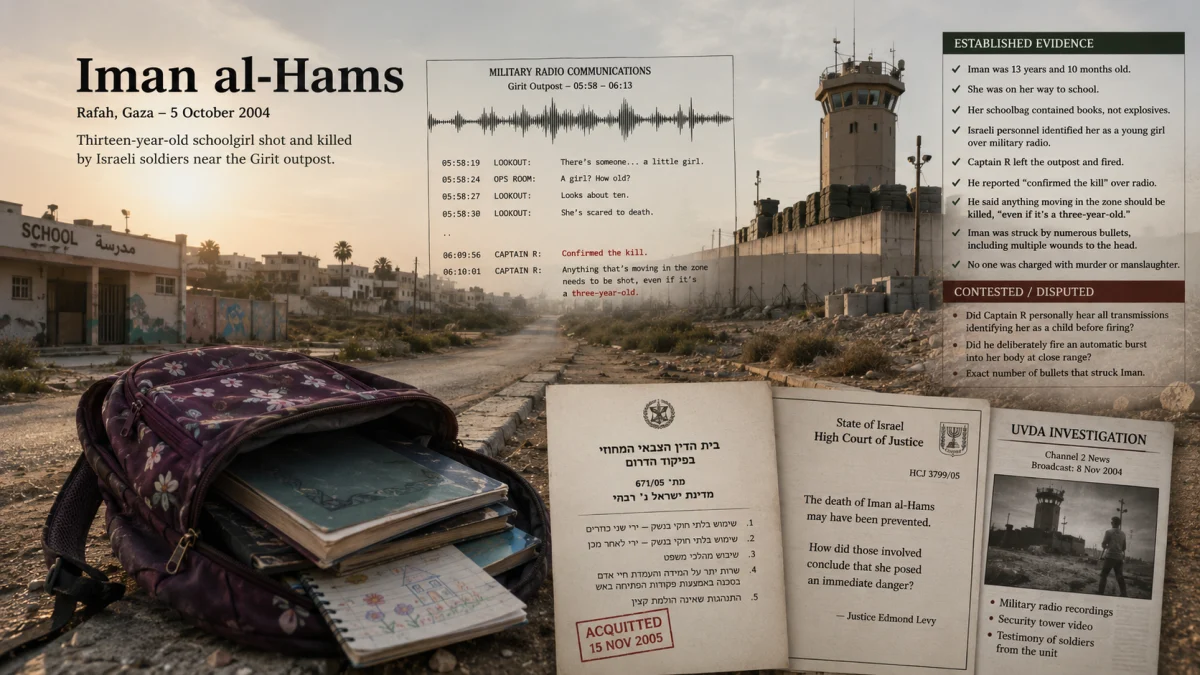
On October 5, 2004, 13-year-old Palestinian schoolgirl Iman al-Hams was shot and killed by Israeli soldiers near the Girit military outpost in Rafah, in the southern Gaza Strip.
Her schoolbag contained books, not explosives.
Israeli military communications recorded soldiers monitoring the incident describing the person near the outpost as a young girl—at one point estimating her age at about 10 and describing her as “scared to death.”
The company commander, publicly identified only as Captain R, left the fortified position and fired during the incident. He subsequently reported over the military communications network that he had “confirmed the kill.”
He then issued an instruction that has followed the case for more than two decades: anything moving inside the security zone, he said, should be killed, “even if it’s a three-year-old.”
Medical accounts described Iman’s body as having at least 15 gunshot wounds, with some contemporary accounts reporting 17 or more than 20, including multiple wounds to her head.
And despite everything that followed—the radio recordings, testimony from Israeli soldiers, a military-police investigation, an indictment, a nationally broadcast Israeli television investigation, a military trial and eventually intervention by Israel’s High Court of Justice—neither Captain R nor any other soldier was ever charged with murdering or manslaughtering Iman al-Hams.
That last point is essential.
It is often said that Captain R was “acquitted of murdering Iman al-Hams.”
He wasn’t.
He was never tried for her murder.
What he was tried for—and what happened before and after that trial—is considerably more complicated.
Who was Iman al-Hams?
Iman Darweesh al-Hams was a Palestinian girl from Rafah. Israeli Supreme Court records later described her as 13 years and 10 months old at the time of her death.
Contemporary reporting and Amnesty International describe her as being near her school on the morning of October 5, 2004. The Washington Post reported that she was wearing a school uniform and carrying a backpack packed with books on her way to class.
She approached an area close to the Israeli military’s fortified Girit position near the Gaza-Egypt border.
Why she came so close to the installation was never conclusively established.
What happened next is much better documented.
Israeli soldiers saw her.
An alarm was raised.
Gunfire began.
And Iman died.
The soldiers were discussing a young girl over the radio
One reason Iman’s case became so controversial was that it did not depend entirely on competing Palestinian and Israeli accounts.
The Israeli military’s own communications system recorded portions of the event.
According to contemporary reporting based on those recordings, a lookout described the person approaching the area as a “little girl.”
The operations room asked whether they were talking about a girl younger than 10.
The lookout estimated that she was about 10 and described her as frightened.
The Washington Post reported that several minutes later soldiers opened fire.
Israel’s Supreme Court later confirmed that the subsequent television investigation into the incident relied on recordings from the installation’s communications network as well as video recorded by the installation’s security towers and testimony from soldiers serving there.
This is an important distinction from some retellings of the case.
It is well documented that members of the unit were identifying Iman as a young girl over the military network.
It is less certain from the public record exactly which transmissions Captain R himself personally heard before he fired. That became one of several disputed elements in later proceedings.
But there is no serious dispute that the Israeli military system observing the incident was discussing a child.
Her schoolbag did not contain a bomb
The Israeli military initially treated Iman as a possible security threat.
The context was genuinely dangerous. The Girit installation was operating in an area where Israeli forces had faced Palestinian attacks, and later Israeli judicial findings noted that fire came from the Rafah area toward Captain R and his soldiers during at least part of the incident.
That context matters.
It does not, however, turn Iman’s schoolbag into an explosive device.
It contained schoolbooks.
Amnesty International reported weeks after the killing that the Israeli army had initially said Iman was suspected of carrying explosives in the bag but subsequently acknowledged that it contained only her schoolbooks.
Contemporary accounts said Iman dropped the bag as she tried to get away.
The later Israeli Supreme Court account similarly states that she threw down the bag, fled and took cover behind a sand berm.
The distinction between a dangerous military environment and a particular person actually posing a lethal threat is crucial.
The first was real.
The second was never established in Iman’s case.
Iman was shot repeatedly
There is some disagreement in contemporary reporting about precisely how many bullets struck Iman.
That should not be hidden or artificially resolved.
Amnesty International reported medical sources finding at least 15 bullet wounds in the upper part of her body, including several in her head.
A Rafah hospital doctor cited by The Washington Post reported at least 20 bullet wounds, including numerous wounds to her head.
Other contemporary reporting put the number at approximately 17.
The responsible conclusion is therefore not that an autopsy established one universally accepted exact number.
It is that multiple medical accounts agreed that the 13-year-old child had been struck by many bullets, including multiple shots to the head.
Amnesty also reported that Iman’s body remained on the ground for more than an hour before the Israeli military permitted an ambulance to approach.
What did Captain R actually do?
This is where separating established facts from disputed allegations becomes especially important.
Captain R unquestionably left the military position and fired his weapon during the incident.
A later Israeli Supreme Court summary of the judicial record states that he ran toward the unidentified person, fired two shots in Iman’s direction, retreated, then retraced his steps and fired a burst toward an area east of where she lay.
The original prosecution case went further.
According to the indictment as contemporaneously reported by The Washington Post, prosecutors alleged that Captain R approached where Iman was lying, fired two rounds at her and then returned and fired an automatic burst into her prone body.
Soldiers from his own unit made similar allegations.
That distinction matters because the allegation that Captain R deliberately emptied an automatic burst into Iman’s body was ultimately contested at trial.
Captain R denied doing so.
His defense maintained that at least some of his fire was directed toward the ground or elsewhere in response to Palestinian gunfire.
A key prosecution witness who had previously implicated him later recanted significant testimony. The U.S. State Department’s 2005 human-rights report noted that one witness withdrew his account and another could not confirm that Captain R had aimed his weapon at Iman.
So it would be inaccurate to write that a court conclusively established that Captain R personally fired every one of the rounds found in Iman’s body.
It would be equally inaccurate to pretend nothing significant is established about his actions.
He fired during the incident. He approached the area where Iman lay. His conduct generated criminal charges. And his own recorded statement afterward included the language “confirmed the kill.”
What did “confirm the kill” mean in this case?
After Iman had been shot, Captain R was recorded reporting over the military network that he had “confirmed the kill.”
Human Rights Watch documented the recording in its 2005 investigation into Israeli military accountability.
The phrase became central to the case because soldiers accused their commander of intentionally firing at Iman after she had already been incapacitated.
His defense disputed that interpretation of his fire.
But the words themselves were not invented by Palestinian witnesses or added years later on social media.
They came from the military communications recording.
So did the most disturbing statement associated with the case.
After the shooting, Captain R was recorded telling the soldiers under his command that anything moving in the zone—even a three-year-old—needed to be killed.
There is another frequently repeated error worth correcting.
Captain R did not make the “three-year-old” remark as a defiant statement from the witness stand during his trial.
It was made over the military communications system around the time of the incident.
That makes the remark no less significant. If anything, its operational context makes it more important.
Israeli soldiers themselves helped expose the case
Another fact frequently lost in simplified accounts is who challenged the first version of events.
Israeli soldiers serving under Captain R did.
The military’s initial internal investigation concluded that the commander had not acted unethically. Human Rights Watch reported that soldiers subsequently released the communications tape, helping force greater scrutiny of the incident.
The Washington Post reported that Israeli newspapers published accounts from soldiers who said they had witnessed the shooting and that Israel’s Channel 2 broadcast the radio communications.
Then-IDF Chief of Staff Moshe Ya’alon, who had publicly defended Captain R’s conduct, eventually acknowledged that the initial investigation had been a serious failure.
This is important because the controversy cannot reasonably be dismissed as simply an accusation generated outside Israel.
Some of the most damaging allegations came from Israeli servicemen inside Captain R’s own company.
Their testimony later became contested, and one important witness recanted.
Both facts belong in the story.
Captain R was prosecuted—but not for killing Iman
A military-police investigation eventually resulted in a five-count indictment.
Israel’s Supreme Court later summarized those charges as:
- unlawful use of a firearm for two shots fired in Iman’s direction;
- unlawful use of a firearm for the subsequent burst allegedly fired at her;
- obstruction of justice;
- exceeding authority in a way that created a life-threatening danger through rules of engagement he allegedly gave his soldiers; and
- conduct unbecoming an officer.
Notice what is missing.
Murder.
And manslaughter.
Human Rights Watch specifically noted at the time that the indictment contained neither charge.
A later Yesh Din review of prosecutions during the Second Intifada put the distinction even more plainly: Captain R was prosecuted for offenses surrounding the alleged “confirmation of killing” and obstruction of justice, not for an offense concerning Iman’s actual killing.
That means the commonly repeated sentence—
“The Israeli captain was acquitted of murdering Iman al-Hams”
—is wrong.
He was acquitted.
But murder was not the charge from which he was acquitted.
Why was Captain R acquitted?
On November 15, 2005, the Southern Command military court acquitted Captain R of all five charges.
That acquittal must be reported accurately.
It should also not be inflated into something it was not.
The prosecution’s case had suffered serious evidentiary problems.
Most notably, a soldier who had previously said he witnessed Captain R fire at Iman’s body recanted his account. Another witness was unable to confirm that the officer’s weapon had been aimed at her.
The military court also sharply criticized aspects of the investigation.
That was enough to produce an acquittal on the charges actually before it.
An acquittal means the prosecution did not establish those criminal charges to the required legal standard.
It does not mean Iman was not shot.
It does not mean her backpack contained explosives.
It does not erase the military recording.
It does not erase Captain R’s own gunfire.
It does not erase the statement about killing anyone moving in the zone, “even if” the person were three years old.
And it cannot constitute an acquittal on a murder charge that prosecutors never filed.
Those are separate propositions, and collapsing them together badly distorts the case.
Did the radio recording prove Captain R knew she was a child?
Not as cleanly as some retellings suggest.
Soldiers monitoring Iman unmistakably discussed a young girl over the military network.
But later litigation raised a narrower question: did Captain R personally hear those particular exchanges before firing?
That was disputed.
The Israeli Supreme Court’s later account acknowledges that soldiers were estimating Iman’s age over the communications network while also describing the installation as being on high alert and soldiers, including Captain R, believing a terrorist incident might be developing.
This means the most defensible formulation is:
Israeli personnel observing Iman had identified her as a young girl. The evidence does not establish with the same certainty that Captain R personally heard every transmission identifying her as a child before he fired.
That qualification should not be expanded into the broader and unsupported assertion that Israeli forces simply had no idea a child was present.
The recordings show otherwise.
Was Iman herself attacking the soldiers?
There is no evidence in the material reviewed for this article that Iman was armed.
There were no explosives in her schoolbag.
No weapon was recovered from her.
The documented suspicion was that her presence might be connected to a larger attack—for example, that she might be carrying explosives or being used to draw soldiers into the open.
Later Israeli court records also say shots came toward Captain R and his soldiers from the Rafah area during the encounter.
That broader threat environment cannot simply be deleted from the historical record.
But neither can it substitute for evidence that Iman herself was attacking anyone.
The two questions are different.
A soldier may operate in a dangerous area and still confront a civilian who is not a lawful target.
That distinction is exactly why rules governing the use of lethal force exist.
Israel’s High Court later ordered another investigation
The military acquittal did not completely end scrutiny of the killing.
Iman’s parents and the Public Committee Against Torture in Israel pursued further legal action questioning the legality of the open-fire orders in effect at the Girit outpost.
Israel’s High Court of Justice eventually ordered the military police and prosecution to investigate whether the order to open fire had departed from the IDF’s own regulations.
The court raised a question that cut to the heart of the case: how had soldiers guarding the outpost concluded that Iman presented an immediate danger?
Justice Edmond Levy wrote that he was troubled by the possibility that her death could have been prevented had those involved acted as required.
That is significant.
After the officer’s acquittal, Israel’s highest court was still not prepared to treat every question surrounding Iman’s death as resolved.
The later Supreme Court case did not erase the allegations either
The story took another unusual legal turn after Captain R sued Israeli journalist Ilana Dayan and the television company behind Uvda, the investigative program that broadcast the case.
A district court initially found aspects of the program defamatory.
The litigation eventually reached Israel’s Supreme Court.
The Supreme Court did not convict Captain R of anything. That case was about defamation and journalism, not criminal responsibility for Iman’s death.
But the result is still revealing.
An earlier Supreme Court appellate panel held that Dayan was protected, with two justices concluding that the report satisfied the truth-of-publication defense and another relying on good-faith protections.
An expanded nine-justice panel later left the operative result protecting Dayan’s investigative report in place, emphasizing protection for responsible, good-faith journalism on matters of substantial public importance. The television promos were treated differently.
The Supreme Court’s factual summary also confirms that the underlying investigative program used actual military communications, security-tower footage and testimony from soldiers in the company.
In other words, the allegations did not originate from an anonymous internet rumor.
They generated years of litigation inside Israel’s own legal system.
What is established, and what remains disputed?
The case is easiest to understand by refusing to mix the two.
| Claim | Evidence |
|---|---|
| Iman al-Hams was a 13-year-old Palestinian girl killed by Israeli gunfire on October 5, 2004 | Established |
| She was carrying a schoolbag containing schoolbooks rather than explosives | Established |
| Israeli personnel observing her described her over military communications as a young girl | Established |
| She was described as frightened or “scared to death” | Documented in the radio communications as reported contemporaneously |
| Captain R left the outpost and fired during the incident | Established |
| Captain R reported that he had “confirmed the kill” | Established by recorded military communications |
| Captain R said anything moving in the zone should be killed, even if it were a three-year-old | Established by recorded military communications |
| Iman suffered numerous gunshot wounds, including head wounds | Established; exact count varies among medical accounts |
| Captain R deliberately emptied an automatic magazine directly into Iman’s body | Alleged by soldiers and reflected in the original prosecution theory; disputed by Captain R and not proven to the military court’s satisfaction |
| Captain R personally heard every radio transmission identifying Iman as a child before he fired | Not conclusively established |
| Captain R was acquitted | Established |
| Captain R was acquitted of murdering Iman | False—he was never charged with murder or manslaughter |
| Someone was convicted of killing Iman | No |
That last line may be the most important one.
No one was convicted for killing Iman al-Hams
There is a temptation when discussing politically charged cases to make every fact serve one side’s preferred narrative.
That is unnecessary here.
The documented record is serious enough without exaggeration.
A 13-year-old child walked near an Israeli military installation carrying schoolbooks.
Soldiers opened fire.
She was killed by numerous bullets.
Military personnel were discussing the presence of a young girl.
The commander went into the area and fired.
He reported that he had “confirmed the kill.”
He then told his unit that anything moving in the zone should be killed, even if it were three years old.
His own soldiers accused him of shooting the girl at close range.
The military’s first investigation cleared him of unethical conduct.
Those soldiers helped bring contrary evidence into public view.
A military-police investigation followed.
The commander was prosecuted.
A key witness later recanted.
The commander was acquitted.
But nobody ever prosecuted him—or anyone else—for murder or manslaughter in Iman’s death.
And a later Israeli High Court proceeding still found enough unresolved questions about the open-fire orders to require further investigation.
That sequence does not prove every accusation made against Captain R.
It also does not remotely justify treating his acquittal as evidence that nothing wrongful happened.
Why the Iman al-Hams case still matters
Human Rights Watch placed Iman’s killing within a broader examination of Israeli military accountability during the Second Intifada.
Its 2005 report said that more than 1,600 Palestinians it classified as civilians not participating in hostilities—including at least 500 children—had been killed by Israeli security forces between September 2000 and November 2004. At the time, the IDF told Human Rights Watch that it had conducted 74 criminal investigations into alleged unlawful use of lethal force.
Those figures are historical and depend on the classification methodologies used at the time. They should not be treated as a simple measure proving criminality in every death.
But they explain why Iman’s case became about more than one child and one officer.
Her killing raised a larger question about what happens when military institutions investigate their own use of lethal force against civilians—and what level of evidence is required before the death of a Palestinian civilian becomes a homicide case rather than an operational incident.
The unusual part of Iman’s case was that so much evidence escaped the normal confines of an internal military investigation.
There were soldiers willing to speak.
There were radio recordings.
There was surveillance footage.
There was an indictment.
There was investigative journalism.
There were years of court proceedings.
And still, more than two decades later, the most basic accountability question has the same answer:
Iman al-Hams was killed. No one was convicted of killing her.
That is not an allegation.
It is the documented outcome of the case.
References and Further Reading
Israeli court and legal records
Israeli Supreme Court Project — Anonymous v. Orbach, CFH 2121/12 — English translation of the Israeli Supreme Court’s later defamation decision concerning Ilana Dayan’s Uvda investigation. Especially useful for the court’s summary of the shooting, Captain R’s gunfire, the five criminal charges, his acquittal and the evidence used in the television investigation.
Israeli Supreme Court Project — Summary of Anonymous v. Orbach — Concise legal overview confirming that the Uvda investigation relied on military communications, security-tower video and testimony from soldiers, as well as the subsequent history of the defamation litigation.
Ynet — Court: Iman al-Hams Death May Have Been Prevented — Contemporary account of the High Court of Justice ordering investigation of whether the Girit outpost’s open-fire order violated IDF regulations and of the court’s unresolved concerns about Iman’s death.
Yesh Din — Exceptions: Prosecution of IDF Soldiers During and After the Second Intifada, 2000–2007 — Legal-accountability study documenting the prosecution of Israeli soldiers during the period. Its treatment of the al-Hams case makes the important distinction that Captain R was not charged with an offense concerning Iman’s actual killing.
Contemporary documentation of Iman’s killing
Amnesty International — Israel and the Occupied Territories and the Palestinian Authority: Act Now to Stop the Killing of Children! — Published in November 2004, weeks after Iman’s death. Documents the schoolbooks in her bag, medical reports of at least 15 wounds, the delay before an ambulance was permitted to reach her and the early military investigation.
The Washington Post — A Girl’s Chilling Death in Gaza — Detailed contemporaneous reconstruction based on radio transmissions, military-court documents, Israeli soldiers, the defense and Iman’s family. Particularly valuable for showing how the initial military account changed as additional evidence emerged.
The Guardian — Not Guilty: The Israeli Captain Who Emptied His Rifle Into a Palestinian Schoolgirl — Contemporary coverage of the November 2005 acquittal, including portions of the military radio exchange and the evidentiary problems that developed during the prosecution.
Military accountability and independent review
Human Rights Watch — Promoting Impunity: The Israeli Military’s Failure to Investigate Wrongdoing — Major 2005 examination of Israeli military investigations. Documents the al-Hams communications recording, Captain R’s “three-year-old” statement and the fact that the indictment did not include murder or manslaughter.
Amnesty International — Israel and the Occupied Territories: Road to Nowhere — Amnesty’s 2006 review of accountability practices, including a specific discussion of Iman’s killing, Captain R’s acquittal and the absence of a murder charge.
U.S. Department of State — 2005 Country Report on Human Rights Practices: Israel and the Occupied Territories — U.S. government reporting on the case, useful particularly for the military prosecution, the recantation of a prosecution witness and the family’s subsequent effort to obtain a broader investigation.
Editorial note: This article concerns a historical event and relies heavily on contemporaneous reporting, human-rights documentation and later Israeli judicial records. Some details—particularly the exact number of bullets that struck Iman and the precise direction of Captain R’s automatic burst—differ among sources or remained contested in court. Those disagreements are identified rather than silently resolved. Transliteration also varies between sources; “Iman al-Hams,” “Iman Hams” and “Iman al Hams” refer to the same person.