
No, scientists have not shown that choline reverses aging in humans.
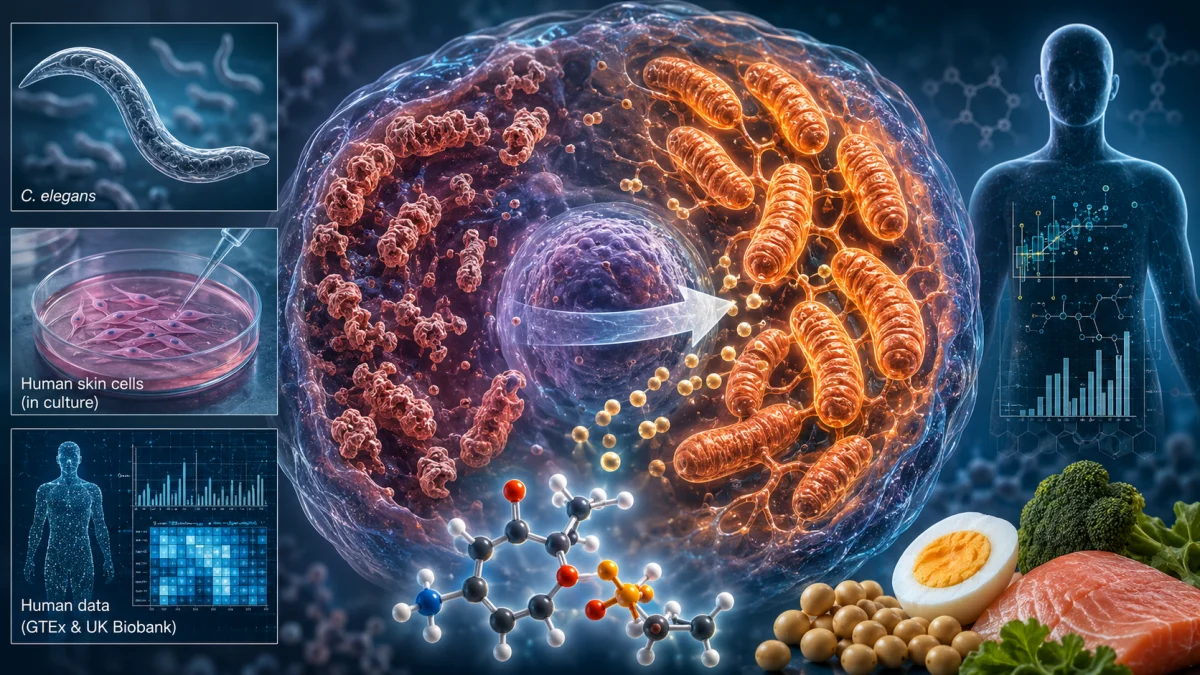
A 2026 Nature Communications study found something considerably narrower—but still potentially important: production of a membrane lipid called phosphatidylcholine declines with age, contributing to mitochondrial deterioration. Increasing phosphatidylcholine, including by providing its precursor choline, restored several measures of mitochondrial structure and function in aging C. elegans worms. Choline also protected cultured human cells subjected to mitochondrial stress.
That is legitimate aging research.
It is not evidence that taking a choline supplement makes a person biologically younger, extends human lifespan, reverses the aging process throughout the body, or functions as a proven anti-aging treatment.
The distinction became particularly important after Popular Mechanics resurfaced the research on August 17, 2026 under the headline “Scientists Uncovered a Hidden Switch Inside Our Cells That Could Slow—or Even Reverse—Aging.”
There really is an intriguing biological mechanism here. There just isn’t yet a human “reverse aging” switch.
What did the scientists actually discover?
The study, “Aging-associated decline of phosphatidylcholine synthesis is a malleable trigger of natural mitochondrial aging,” was published April 18, 2026 in Nature Communications by researchers led by Maria Ermolaeva at the Leibniz Institute on Aging–Fritz Lipmann Institute in Germany.
The researchers were investigating a basic question in aging biology:
Why do mitochondria progressively stop working as well as organisms get older?
Mitochondria are best known for producing cellular energy, but they are not static little batteries. They continually change shape, divide, fuse together and exchange material. Healthy mitochondria can form interconnected networks that help cells distribute energy, metabolites and other components while compensating for local damage.
That flexibility deteriorates with age.
The researchers identified declining production of phosphatidylcholine, or PC, as one contributor to that decline.
Phosphatidylcholine is a major component of biological membranes, including mitochondrial membranes. Adequate membrane composition helps mitochondria maintain the physical flexibility necessary for normal fusion and network formation.
In aging worms, several proteins involved in a phosphatidylcholine-production pathway were among the most strongly reduced proteins the researchers identified. Interfering with the same pathway experimentally in younger worms caused their mitochondria to become abnormally fragmented and function more poorly.
Then came the important part:
Increasing phosphatidylcholine again could rescue some of those defects.
The researchers did this both by directly providing phosphatidylcholine in some experiments and by providing choline, which cells can use as a precursor to synthesize phosphatidylcholine.
That is the basis for the “reverse aging” headlines.
But what was reversed matters enormously.
What exactly was “reversed”?
The researchers reversed or alleviated specific aging-associated mitochondrial abnormalities.
They did not reverse the entire biological aging process.
During normal worm aging, mitochondria became increasingly fragmented. Providing choline reduced that age-associated fragmentation. Choline also improved mitochondrial oxygen consumption in older, post-reproductive worms—a measure related to mitochondrial respiratory function.
The institute behind the study described treated mitochondria as regaining a “more youthful structure” and emphasized the “reversibility of aging-associated failures.”
That language is defensible when referring specifically to the measured mitochondrial phenotype.
It becomes misleading when converted into:
“Scientists reversed aging.”
Those are not equivalent statements.
Aging is a systemic process involving genomic instability, epigenetic changes, altered protein maintenance, cellular senescence, immune changes, stem-cell exhaustion, mitochondrial dysfunction and numerous interacting metabolic and signaling processes.
Improving one component of one aging-associated pathway is meaningful.
It is not the same as converting an old organism into a young one.
What the study showed—and what it did not
| Claim | What the evidence supports |
|---|---|
| Phosphatidylcholine synthesis declines during worm aging | Demonstrated experimentally |
| Reduced PC synthesis can contribute to mitochondrial dysfunction | Strong experimental evidence in worms |
| Choline can increase PC and improve aging-related mitochondrial abnormalities | Demonstrated in worms |
| Choline improved mitochondrial respiration in older worms | Demonstrated |
| Related PC metabolism changes with age in humans | Supported by observational human datasets |
| Choline protected human cells under mitochondrial stress | Demonstrated in cultured cells |
| Choline made humans biologically younger | Not tested |
| Choline reverses whole-body aging in animals | Not established by this study |
| Choline extends normal lifespan | Not demonstrated by the choline intervention in this study |
| Choline supplements are a proven longevity treatment | No |
Did the worms actually become younger?
Not in the ordinary meaning of the word.
The researchers examined mitochondrial morphology, respiration, lipid metabolism, stress responses, body-size abnormalities and other biological measures.
Some of those measures improved substantially after phosphatidylcholine or choline was supplied.
That means an old or experimentally impaired biological system retained more reversibility than might have been assumed.
It does not mean the worms returned globally to a youthful biological state.
This is an important distinction because modern aging research increasingly studies individual hallmarks or mechanisms of aging. An intervention can improve one hallmark without reversing all the others.
A drug that restores an aging immune response, for example, would not automatically “reverse aging.” Neither would improving mitochondrial fusion.
The more accurate conclusion from this study is:
At least part of age-associated mitochondrial decline appears to be metabolically modifiable rather than permanently irreversible.
That is a significant finding without requiring the stronger claim.
Did choline make the worms live longer?
This is another place where the headlines can create the wrong impression.
The paper contains lifespan experiments, but those experiments primarily examined genetic disruption of pathways such as sams-1, pmt-1 and pmt-2. Some genetic alterations produced complex effects on lifespan depending on the worm strain and mitochondrial background.
The choline experiments highlighted in the aging section instead focused on measures such as:
- phosphatidylcholine levels,
- mitochondrial fragmentation,
- mitochondrial network integrity, and
- oxygen consumption.
The study does not establish that feeding ordinary aging worms choline extended their lifespan.
That matters because better mitochondrial measurements are not automatically equivalent to longer life.
They may eventually contribute to improved health or longevity. But that requires evidence.
What about the claim that the effect happened in only two days?
There is some truth behind this claim, but it can also be presented misleadingly.
In experimentally disrupted worms, mitochondrial morphology could recover rapidly when phosphatidylcholine or choline was supplied. The Leibniz Institute’s press release emphasized that mitochondria regained a more youthful-looking structure within roughly two days.
But the study also separately examined normal aging.
In those experiments, worms received choline during adulthood and were evaluated later in life. For example, mitochondrial oxygen consumption was measured on adulthood day six, while mitochondrial morphology was examined at adulthood days four and six.
So the viral shorthand—
“Scientists gave old worms choline and reversed their aging in 48 hours”
—is not an accurate description of the full experimental design.
The researchers ran several different experiments answering related but distinct questions.
How strong was the worm evidence?
For a mechanistic animal study, it was substantial.
The researchers combined proteomics, lipidomics, genetic manipulation, microscopy, mitochondrial respiration measurements and lifespan experiments.
Their large proteomic samples contained at least 500 worms per biological replicate, with three independent replicates in several comparisons. Some lifespan experiments contained 140 worms per experimental condition, while mitochondrial morphology and stress-response experiments commonly examined dozens of animals per condition and were repeated multiple times.
In the normal-aging choline experiment, each lipidomics sample contained 800 worms. Mitochondrial morphology was evaluated in at least 54 animals per condition, and oxygen-consumption measurements involved at least 190 worms per condition.
The problem is therefore not that scientists performed a tiny or meaningless experiment.
The problem is translation.
C. elegans is one of biology’s most useful model organisms precisely because researchers can manipulate its genes, metabolism and lifespan efficiently. But a nematode is not a miniature human.
Promising results in worms frequently identify biological mechanisms worth investigating without becoming human therapies.
Did researchers find the same thing in humans?
They found evidence that parts of the same biological pattern may exist in humans.
That is considerably different from demonstrating that choline reverses human aging.
Human gene-expression data
The scientists examined data from the Genotype-Tissue Expression, or GTEx, project.
They focused on PEMT, a human enzyme that participates in phosphatidylcholine synthesis and serves as a functional counterpart to part of the pathway investigated in the worms.
Across 46 human tissues, PEMT expression tended to decline with age particularly in tissues where the gene is normally highly expressed.
The researchers examined 192 subcutaneous adipose-tissue samples more closely and again observed an age-related relationship.
That supports the possibility that age-related changes in phosphatidylcholine synthesis are not unique to worms.
But it is observational evidence.
Nobody was given choline in GTEx.
UK Biobank metabolomics
The researchers also analyzed human blood metabolomics from UK Biobank.
Their analysis included a pool of 30,278 participants with available proteomic and metabolomic data, although the number used varied depending on the measurement being analyzed.
They found age-related changes in phosphatidylcholine measurements and reported associations between higher PC-related measures and several markers of better metabolic or physiological health.
One particularly interesting pattern occurred among women: the relative decline in phosphatidylcholine was especially pronounced around the age range associated with menopause.
That deserves further research.
It does not, however, establish that falling phosphatidylcholine causes menopause-related fatigue, that restoring it reverses aging, or that supplementation would improve those symptoms.
Correlation is useful when it points toward a mechanism already supported by experiments.
It is still correlation.
What happened in human cells?
This is the strongest direct human-biological intervention in the paper—but the humans were cells in a laboratory dish, not study participants.
Researchers used BJ human skin fibroblasts and exposed them to metformin under conditions designed to create substantial mitochondrial stress.
They then tested choline, succinate or a combination of the two.
Choline reduced cell death and helped preserve mitochondrial membrane potential. The combination with succinate produced the strongest rescue in the reported experiment.
That is useful evidence that the biological effect is not necessarily confined to nematodes.
But cell culture is still several steps removed from clinical medicine.
A substance can produce a dramatic effect in isolated human cells and fail to produce the same outcome in a living person because of absorption, metabolism, dosage, tissue distribution, gut bacteria, compensatory systems or unintended effects elsewhere in the body.
The authors themselves specifically warn that human choline and phosphatidylcholine metabolism is more complicated than metabolism in laboratory worms, including because humans possess a much more complex intestinal microbiome.
So what is the “switch” scientists supposedly found?
Calling it a switch is useful shorthand, but scientifically it is too clean.
The researchers identified an aging-sensitive metabolic pathway.
In the worms, proteins including SAMS-1, PMT-1 and PMT-2—which help support phosphatidylcholine synthesis—declined markedly with age. Lower PC production altered the composition and physical behavior of mitochondrial membranes, contributing to fragmentation and impaired mitochondrial function.
Choline provides another route toward phosphatidylcholine production.
That appears to be why supplying choline could partially bypass the declining pathway and restore PC levels.
This behaves somewhat like a controllable lever.
It is not an on/off master switch for aging.
And even the researchers concluded that phosphatidylcholine decline is only one strong contributing factor among multiple processes damaging mitochondria with age. Choline did not restore every age-related defect.
That limitation is actually scientifically revealing.
If choline completely rejuvenated the mitochondria, a single-pathway explanation would become much more plausible.
It didn’t.
Aging remained more complicated.
What is phosphatidylcholine?
Phosphatidylcholine is one of the body’s major phospholipids—fat-like molecules that form much of the structural material in cell membranes.
Its importance goes far beyond aging research.
Phosphatidylcholine contributes to:
- cell-membrane structure,
- lipid transport,
- signaling,
- liver function,
- mitochondrial membranes, and
- production and transport of certain molecules containing choline.
The body can produce phosphatidylcholine through more than one metabolic pathway, and dietary choline can be incorporated into PC through the CDP-choline pathway.
This is why the researchers could use choline as a relatively convenient way of increasing PC availability in some experiments.
It does not mean swallowing choline and swallowing phosphatidylcholine are biologically interchangeable in every context.
Is choline already a normal nutrient?
Yes.
Choline is an essential nutrient involved in cell membranes, neurotransmitter production, lipid transport and other basic physiological processes.
This study did not discover choline.
People already consume it through ordinary foods.
The National Institutes of Health lists major dietary sources including eggs, meat, poultry, fish and dairy products, as well as soybeans, beans, cruciferous vegetables, nuts, seeds and whole grains. About half of the dietary choline consumed in the United States is already estimated to occur in phosphatidylcholine form.
Current U.S. Adequate Intake levels are:
- 550 mg per day for adult men
- 425 mg per day for adult women
- 450 mg per day during pregnancy
- 550 mg per day during lactation
These are nutritional adequacy targets—not anti-aging doses.
Should you take choline supplements to reverse aging?
There is currently no good evidence-based reason to start taking choline specifically to reverse aging.
The 2026 study did not conduct a human supplementation trial.
It did not identify a human longevity dose.
It did not measure biological age before and after choline supplementation.
It did not demonstrate reduced age-related disease, longer human survival or human rejuvenation.
The correct takeaway is therefore not:
“Start taking choline.”
It is:
“This pathway now deserves human testing.”
Those are very different stages of medical evidence.
More choline is not automatically better
Choline is necessary for health, but essential nutrients do not become more beneficial indefinitely as the dose increases.
The NIH currently sets the adult Tolerable Upper Intake Level at 3,500 mg per day from food and supplements combined.
High choline intake can cause effects including vomiting, excessive sweating and salivation, low blood pressure, fishy body odor and liver toxicity.
There is also an unresolved cardiovascular question involving trimethylamine N-oxide, or TMAO.
Certain gut bacteria can metabolize choline into trimethylamine, which the liver converts into TMAO. Higher circulating TMAO has been associated with cardiovascular risk, although the biology and causal implications remain debated and depend heavily on diet, kidney function, microbiome composition and other factors.
Importantly, different forms of choline may behave differently.
A randomized human trial found that choline bitartrate supplements increased circulating TMAO and platelet responsiveness, while an equivalent intervention using eggs or phosphatidylcholine did not significantly increase those measurements during the study period.
That does not prove choline bitartrate causes cardiovascular disease.
It does show why translating “choline helped worms” into “buy a choline supplement” is premature.
The supplement form, dose, metabolism and biological context all matter.
Is there any human evidence linking choline with healthier aging?
There is some encouraging evidence, but it remains far short of age reversal.
A 2025 prospective cohort study followed 10,310 Chinese participants for a median of 6.1 years.
Researchers recorded 1,150 new cases of frailty and found that participants with moderate-to-higher dietary choline intake generally had lower subsequent frailty rates than those in the lowest intake group.
Higher phosphatidylcholine intake was also associated with lower frailty incidence.
That finding makes the 2026 mitochondrial study more interesting because two different lines of evidence point in a compatible direction.
But the frailty study was observational.
People who consume different amounts and sources of choline can differ in many other ways. Even sophisticated statistical adjustment cannot establish that choline itself caused the difference.
So the combined picture is:
Mechanistic evidence in worms: strong.
Human cellular evidence: interesting.
Human observational evidence: suggestive.
Human anti-aging treatment evidence: not yet there.
The most interesting finding may not be choline at all
The supplement angle is what attracts headlines, but the deeper scientific finding is more important.
A common mental model of aging treats mitochondrial deterioration as the cumulative result of irreversible damage: mutations accumulate, structures degrade, energy systems fail, and eventually there is little that can be done.
This study suggests that at least one part of mitochondrial decline may work differently.
Some dysfunction may emerge because an aging cell gradually loses its ability to maintain the chemical composition of its mitochondrial membranes.
That matters because metabolic deficiencies can sometimes be manipulated.
The researchers essentially found that part of an old mitochondrion’s dysfunctional state was not permanently locked in place. Correcting the relevant biochemical environment allowed some function to return.
That is a much more defensible—and scientifically more interesting—meaning of “reversal.”
The study did not demonstrate that aging itself is reversible. It demonstrated that a particular consequence of aging was, at least partly, reversible in the experimental systems tested.
Why the headline isn’t entirely the media’s fault
There is another wrinkle worth acknowledging.
The “reversal” framing did not appear out of nowhere after journalists discovered the paper.
The Leibniz Institute’s own May 2026 press release emphasized the “reversibility of aging-associated failures,” said treated worm mitochondria regained a “more youthful structure,” and described phosphatidylcholine supplementation as an effective “anti-aging intervention” in the model organism.
The original paper itself also discusses the pathway as a possible target for interventions against aging-associated decline.
So this is not a story in which responsible scientists said something mundane and a magazine simply invented the rest.
The actual progression is more subtle:
Researchers found reversible aspects of mitochondrial aging in an animal model.
The institution presented that result partly through an anti-aging framework.
Media coverage compressed “reversible mitochondrial aging-associated defects” into a much more intuitive idea: scientists found a switch that can reverse aging.
By the time that reaches a reader—or a social-media post—the experimental boundaries can disappear entirely.
The final statement sounds much stronger than the evidence underneath it.
Does this mean the study was overhyped?
The human implication was overhyped. The underlying science was not necessarily overhyped.
That distinction is important.
The researchers appear to have identified a previously underappreciated contributor to natural mitochondrial aging.
They linked that pathway to aging through several complementary experiments.
They showed that manipulating the pathway could cause mitochondrial deterioration.
They then demonstrated that increasing phosphatidylcholine availability could partially restore function.
They found compatible age-related patterns in large human datasets.
And they produced a restorative effect in cultured human cells exposed to mitochondrial stress.
That is a coherent mechanistic story.
What they have not yet demonstrated is the final step that matters most to people reading an anti-aging headline:
Does increasing phosphatidylcholine availability safely improve meaningful aging outcomes in living humans?
Until that experiment is done, claims about human rejuvenation remain speculation.
What would researchers have to show next?
A convincing human translation would require controlled clinical trials.
Researchers would need to determine whether choline, phosphatidylcholine or another intervention can alter the relevant pathway in people at achievable and safe doses.
Then they would need to determine whether those biochemical changes produce meaningful outcomes.
Potential measurements could include:
- mitochondrial function in relevant tissues,
- validated metabolic-health endpoints,
- physical performance,
- frailty,
- age-related disease outcomes,
- biomarkers that actually track clinically meaningful aging,
- adverse effects, and
- eventually, long-term healthspan or mortality.
A trial would also need to determine whether effects differ by age, sex, menopausal status, diet, baseline choline intake, genetics, microbiome composition or supplement formulation.
There is a substantial distance between a worm mitochondrial network becoming less fragmented and a human being remaining healthier at 80.
This study gives researchers a plausible road to investigate.
It does not tell us where that road ends.
The bottom line
Scientists did not discover that choline reverses human aging.
What they discovered may still matter.
A 2026 Nature Communications study found that declining phosphatidylcholine synthesis contributes to mitochondrial deterioration during normal aging in C. elegans. Increasing phosphatidylcholine availability—sometimes by supplying its precursor, choline—restored parts of mitochondrial structure and function in aging worms.
Related age-dependent patterns appeared in human gene-expression and metabolomic datasets, and choline helped cultured human cells withstand experimentally induced mitochondrial stress.
That provides a plausible biological mechanism worth testing in people.
But nobody in the study took choline and became younger.
No human lifespan was extended.
No human biological age was reversed.
And no evidence from this paper establishes choline supplements as an anti-aging treatment.
The genuinely interesting result is more precise:
Some mitochondrial deterioration that accompanies aging may be caused by modifiable metabolic changes rather than irreversible damage alone.
If that eventually translates into humans, it could become important longevity research.
For now, it is a promising mechanism—not a youth pill.
References and Further Reading
Primary Research
Aging-associated decline of phosphatidylcholine synthesis is a malleable trigger of natural mitochondrial aging — Nature Communications — The April 18, 2026 primary study underlying the claims discussed in this article. It contains the worm experiments, human GTEx and UK Biobank analyses, and human fibroblast experiments.
Aging-associated decline of phosphatidylcholine synthesis is a malleable trigger of natural mitochondrial aging — PubMed — U.S. National Library of Medicine indexing and bibliographic record for the original study.
Research Institution and Media Framing
When Energy Fades: The Hidden Chemistry of Aging Mitochondria — Leibniz Institute on Aging — The research institute’s May 21, 2026 press release, including its discussion of “more youthful” mitochondrial structure, reversibility and possible anti-aging implications.
Scientists Uncovered a Hidden Switch Inside Our Cells That Could Slow—or Even Reverse—Aging — Popular Mechanics — August 17, 2026 coverage that brought renewed attention to the study and illustrates how the mitochondrial findings have been translated into a broader “reverse aging” claim.
Choline Nutrition and Safety
Choline: Fact Sheet for Health Professionals — NIH Office of Dietary Supplements — Authoritative U.S. reference for choline intake recommendations, dietary sources, supplement forms, deficiency and upper intake limits.
Dietary Choline Supplements, but Not Eggs, Raise Fasting TMAO Levels in Participants with Normal Renal Function: A Randomized Clinical Trial — Human randomized trial showing that choline form and source can produce different effects on TMAO concentrations and platelet responsiveness, relevant to why worm supplementation results should not be translated directly into human supplement advice.
Human Aging Context
Association of Dietary Choline Intake With Incidence of Frailty: A Nationwide Prospective Cohort Study From China — Prospective observational study of 10,310 participants linking moderate-to-higher dietary choline and phosphatidylcholine intake with lower subsequent frailty incidence. Useful supporting human evidence, but not proof of causation or age reversal.
Editorial note: This article reflects the published evidence and U.S. nutrition guidance available as of August 20, 2026. Human clinical research on phosphatidylcholine, choline and aging may change the evidence base, and dietary-reference or supplement-safety guidance can also be updated over time.