If you buy socks, toys, luggage, fabric, small appliances or Christmas decorations made in China, there is a surprisingly good chance the product came from a region that specializes heavily in that particular category.
That is not an accident.
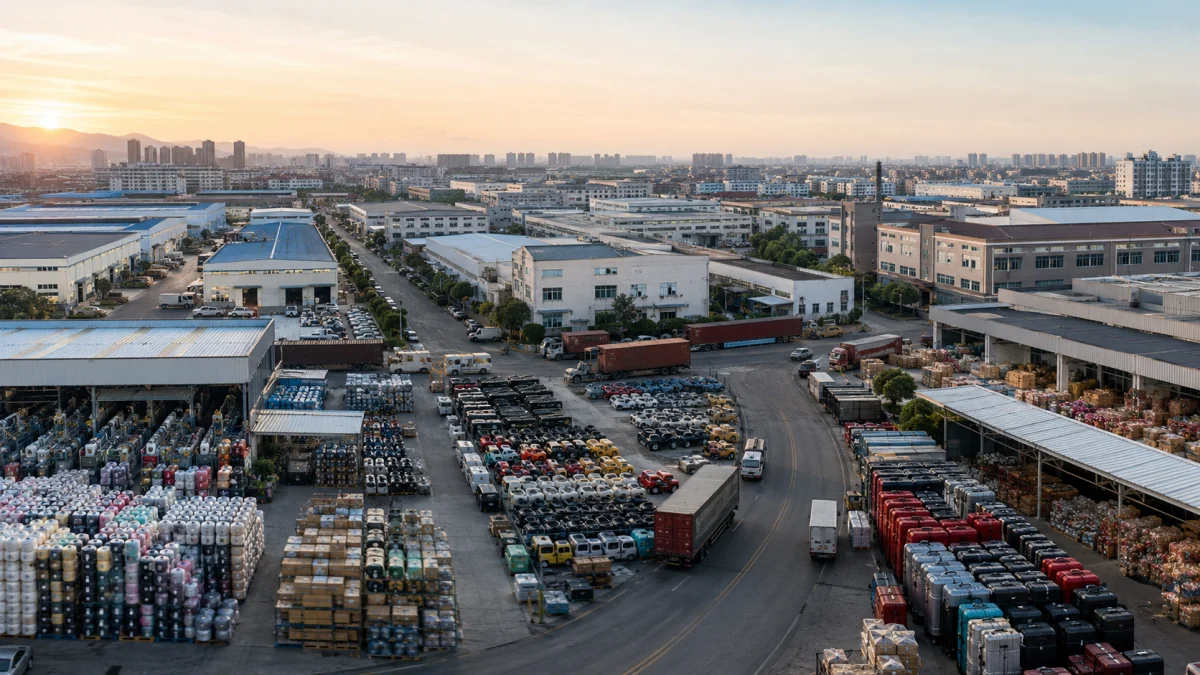
China has developed extraordinarily dense industrial clusters: geographic concentrations of manufacturers, component suppliers, skilled workers, machinery companies, repair technicians, wholesalers, logistics providers and other businesses that all serve the same industry.
The result can look almost absurd from the outside. One district becomes famous for toys. Another for socks. Another for luggage. Another for furniture.
But the important part is not that a town contains a lot of factories making the same thing.
It is that almost everything those factories need is nearby.
That distinction explains a large part of China’s manufacturing advantage—and why simply moving an assembly plant to another country does not necessarily reproduce the same cost, speed or flexibility.
The World Bank defines an industrial cluster as a geographic concentration of interconnected firms and related institutions in a particular field. Its research on Chinese clusters describes the advantages created by specialization, supplier networks, shared services and other forms of industrial agglomeration.
In other words:
You are often not competing with one Chinese factory. You are competing with the ecosystem around it.
China Manufacturing Cities by Product: A Quick Map
These are representative clusters, not exclusive manufacturing locations. China is enormous, products are made in multiple provinces, and industrial boundaries rarely line up perfectly with municipal boundaries.
| Product or industry | Major Chinese cluster | What makes it notable |
|---|---|---|
| Socks and hosiery | Datang, Zhuji, Zhejiang | Zhuji says it produced more than 20 billion pairs in 2024, roughly 35% of global output. |
| Christmas decorations and small commodities | Yiwu, Zhejiang | Yiwu is the center of an enormous small-goods trading and production ecosystem; Chinese reporting estimates the area supplies about two-thirds of global Christmas goods. |
| Toys | Chenghai, Shantou, Guangdong | Chenghai has developed a dense toy cluster spanning design, injection molding, components, assembly, trade and newer digital services. |
| Small and smart appliances | Cixi, Ningbo, Zhejiang | Cixi is a nationally recognized appliance cluster; its large smart-appliance companies reported 94.9 billion yuan in revenue in 2024. |
| Textiles and fabrics | Keqiao, Shaoxing, Zhejiang | Keqiao combines textile manufacturing with China Textile City, a massive global fabric trading center and increasingly sophisticated textile-service ecosystem. |
| Luggage and bags | Baigou, Baoding, Hebei | Baigou reported more than 7,000 luggage producers and annual output of roughly 1 billion bags in 2025. |
| Furniture and home furnishings | Shunde, Foshan, Guangdong | The Lecong-Longjiang area combines furniture manufacturing, materials, wholesale markets, logistics and specialized labor. |
| Electronics and smart devices | Shenzhen-Dongguan, Guangdong | Dongguan alone describes a trillion-yuan-scale electronics ecosystem with supply chains covering components, modules, complete devices and supporting services. |
Those numbers should not be interpreted as permanent market shares. Industrial statistics change, methodologies differ, and some widely repeated production-share estimates originate with local governments or industry organizations.
But the underlying clustering phenomenon is well documented.
What Is an Industrial Cluster?
Imagine trying to manufacture a hair dryer.
The finished product may require:
- an electric motor;
- heating elements;
- molded plastic housings;
- switches and buttons;
- wiring;
- circuit boards;
- screws and fasteners;
- packaging;
- printed instructions;
- molds and tooling;
- product testing;
- assembly;
- freight and export services.
A conventional mental picture of manufacturing imagines one giant factory doing most of this itself.
Modern manufacturing frequently works differently.
The company assembling the hair dryer may buy motors from one supplier, molded shells from another, heating assemblies from another, packaging from another and tooling from yet another.
Now imagine that many of those companies are located within the same industrial region.
A supplier can deliver a redesigned component quickly. A broken mold can be repaired locally. An engineer can visit three vendors in a day. A manufacturer with excess capacity can subcontract work. Workers who leave one factory can already understand the industry’s machinery when they join another.
That density creates what economists call agglomeration economies.
The World Bank identifies several advantages associated with clusters, including specialized labor, supplier networks, reduced logistics costs, competition, access to customers and specialized services. Its detailed study of Wenzhou’s footwear cluster found networks of businesses specializing separately in shoe machinery, soles, leather, lasts, decorative components and other inputs.
The shoe factory was only one piece of the shoe industry.
Why Does China Have So Many Product-Specialized Manufacturing Regions?
There was no single national master plan assigning socks to one town and toys to another.
Many clusters developed far more organically.
World Bank research on China’s industrial development distinguishes government-created special economic zones from clusters that frequently emerged through a more bottom-up process. Local entrepreneurs began producing something that worked, related businesses followed, and specialization compounded over time. Government policy and infrastructure often became important later in strengthening or formalizing the cluster.
The mechanism is essentially a feedback loop.
1. A product becomes locally successful
A few businesses learn how to make and sell a particular product.
Workers acquire experience.
Suppliers notice demand.
Other entrepreneurs imitate successful firms.
Production increases.
2. Component suppliers move closer
Once enough manufacturers need the same materials and parts, specialized suppliers have a reason to locate nearby.
A town making thousands of different products might not support a business dedicated entirely to sock-knitting machinery.
A town making billions of socks can.
The same logic applies to yarn sellers, dyeing operations, packaging suppliers, machinery repair companies and designers.
The cluster becomes deeper.
3. Workers become specialized too
Manufacturing knowledge is not confined to an instruction manual.
Someone who has spent years setting up hosiery machines understands problems differently from someone encountering one for the first time.
A worker experienced in furniture finishing, toy injection molding or small-appliance assembly carries practical knowledge between companies.
The labor market therefore becomes part of the infrastructure.
A new factory entering the cluster does not have to build an experienced workforce completely from scratch.
4. Specialized machinery and services become economically viable
This is one of the less obvious advantages.
Once an industry becomes sufficiently concentrated, businesses can exist solely to serve that industry.
That can include:
- machine dealers;
- spare-parts shops;
- mold makers;
- testing laboratories;
- design firms;
- freight forwarders;
- inspection companies;
- material markets;
- training services;
- repair technicians;
- trade fairs;
- industry associations.
The World Bank’s Wenzhou footwear case documented this progression explicitly: specialized production stages were eventually surrounded by supplier markets, technical institutions, industry associations and service businesses.
At that point, the industry is no longer simply located in the city.
The city itself has become infrastructure for the industry.
Datang Shows How Extreme the Effect Can Become
One of the clearest examples is Datang, a subdistrict of Zhuji in Zhejiang province.
Datang is frequently described as the world’s “sock capital.”
According to Zhuji’s municipal government, the wider city had more than 10,000 sock-making businesses by the end of 2024 and produced more than 20 billion pairs annually—about 70% of Chinese production and 35% of global production under the city’s estimates.
Xinhua separately reported in 2024 that Datang produced approximately 25 billion pairs annually, or about one-third of world output. The numerical difference illustrates why these figures should be treated as estimates rather than immutable statistics.
The remarkable part is not simply the number of socks.
Zhuji also produces sock-making machinery.
That is industrial clustering reaching another level: the region does not merely manufacture the finished product; it develops businesses that manufacture the machines used to manufacture the product.
The distinction matters.
A competitor attempting to reproduce the industry elsewhere needs more than a building and inexpensive workers. It needs yarn suppliers, machines, technicians, dyeing and finishing capacity, packaging, designers, logistics, buyers and people who understand the business.
Datang accumulated those capabilities over decades.
Yiwu Is More Complicated Than “The City That Makes Christmas Decorations”
Yiwu is another famous example, but it also illustrates why the phrase “one city makes one product” can be misleading.
Yiwu is not simply a giant Christmas-decoration factory.
It is one of the world’s most important small-commodity trading ecosystems, connecting enormous numbers of manufacturers, traders and international buyers.
Christmas products are one highly visible specialization inside that system.
Chinese reporting in late 2025 described Yiwu as manufacturing roughly two-thirds of global festive products and exporting more than 20,000 varieties to over 100 countries. One manufacturer described developing a more complex Christmas product through collaboration with more than 20 supply-chain partners.
Independent reporting has also documented Yiwu’s extraordinary concentration of Christmas-goods businesses and the close connection between the wholesale market and factories in the surrounding region.
This distinction matters because manufacturing clusters do not necessarily respect city limits.
A showroom may be in Yiwu.
A component factory may be somewhere else in Zhejiang.
A nearby city may specialize in another stage of production.
A trader can nevertheless coordinate the whole order through the cluster.
The economically meaningful unit is therefore often the regional supply network, not the address printed on a business license.
Chenghai Built an Entire Economy Around Toys
Chenghai, a district of Shantou in Guangdong, demonstrates the same principle with toys.
The local government’s industrial plan does not treat toy manufacturing simply as assembly. It describes a broader “toy creative industry” involving manufacturing, design, intellectual property, digital platforms, trade and related services.
Recent municipal reporting describes factories and trading companies increasingly connected through digital systems that can coordinate injection molding, painting, assembly, capacity and product sourcing. Small component suppliers can participate in the same ecosystem.
That is exactly what mature clusters tend to do.
They become networks.
A company can specialize in one small link and still serve a global industry because thousands of potential customers and collaborators are already nearby.
Why Doesn’t the Factory Just Move Somewhere Cheaper?
This is where the manufacturing-cluster concept becomes much more important than a trivia question about Chinese cities.
Suppose a company discovers that wages are lower somewhere else.
It may appear obvious that production should move.
But moving the assembly factory does not automatically move:
- its component suppliers;
- experienced technicians;
- tool-and-die companies;
- machinery repair businesses;
- freight routes;
- testing facilities;
- packaging vendors;
- local subcontractors;
- specialized workers;
- wholesale markets;
- established buyer networks.
The new factory can rebuild those relationships.
But rebuilding them takes time, capital and sufficient production volume to make every supporting business economically viable.
This is why the idea that manufacturing competition can be explained entirely by hourly wages is incomplete.
China’s earlier manufacturing rise unquestionably benefited from labor availability, export demand, foreign investment, infrastructure, policy support and relatively low production costs. But studies of Chinese industrial clusters show that competitive advantages became embedded in local supplier networks and division of labor as those industries matured.
Reasonable inference: once that network becomes sufficiently dense, it creates a form of industrial gravity.
Leaving the cluster means giving up some of the benefits that accumulated there.
The Factory Is Not the Productive Unit You Think It Is
This leads to a useful way of thinking about modern manufacturing.
When consumers see:
Made in China
they tend to imagine a factory.
But for many products, the more accurate mental model is:
Made by a network in China.
The assembly factory may be the company whose name appears on paperwork, but the productive system includes upstream component makers, downstream traders and many businesses that never touch the finished product.
That helps explain why manufacturing capacity can be difficult to reproduce rapidly.
A government can subsidize construction of a factory.
It can build a road.
It can provide inexpensive land.
It can train workers.
Those things matter.
But it cannot instantly decree that 200 independent component suppliers, experienced engineers, machine shops and logistics companies should suddenly become commercially viable around the plant.
The World Bank’s research on clusters makes essentially this point from another direction: clusters often develop organically, and simply attempting to create them from the top down is difficult because the underlying commercial ecosystem has to exist.
This Does Not Mean Chinese Manufacturing Clusters Are Invincible
The cluster effect is powerful, but it is not magic.
Extreme specialization creates vulnerabilities of its own.
A region that becomes extraordinarily good at producing one category can suffer badly if:
- global demand collapses;
- tariffs close important markets;
- the technology becomes obsolete;
- labor or land costs rise;
- environmental regulations increase production costs;
- competitors develop superior processes;
- the cluster fails to innovate beyond its established industry.
Recent economic research provides an important counterweight to the idea that industrial concentration is always beneficial.
A revised 2026 NBER study examining the long-term effects of major industrial plants in China found that specialization can eventually suppress diversification and innovation under some conditions. Places that initially benefited enormously from industrial concentration did not automatically maintain that advantage forever.
The World Bank’s Wenzhou footwear case similarly documented problems including rising land costs, skilled-labor shortages, environmental pressures and the need for technological upgrading.
So the correct conclusion is not:
Clusters always win.
It is:
Clusters can create enormous competitive advantages, but those advantages must continue evolving.
Is “One Chinese City Makes One Product” Literally True?
No.
It is a catchy description of a real phenomenon, but it should not be taken literally.
China does not have a national system assigning one product to every city.
Major manufacturing cities often contain many industries.
Dongguan, for example, has electronics, machinery, textiles, new energy and other manufacturing sectors. Shenzhen’s industrial economy extends far beyond electronics. Foshan produces far more than furniture.
And many clusters are actually smaller than a city.
Datang is a subdistrict.
Chenghai is a district.
Baigou is a town-level manufacturing center.
Others extend across several neighboring municipalities.
The more accurate statement is:
China contains a remarkable number of places where one industry became concentrated enough to create a self-reinforcing local ecosystem.
That is less catchy.
It is also much more useful.
One Viral Claim About These Clusters Should Be Treated Carefully
A version of this argument circulating among sourcing professionals claims that choosing the “wrong” Chinese city can immediately increase a buyer’s costs by 20% to 40%.
The source material supplied for this article makes that claim but does not provide data supporting the percentage.
We could not verify a general rule establishing a 20%–40% penalty across Chinese manufacturing.
The broader proposition is reasonable: sourcing outside an established cluster can increase transportation costs, reduce supplier choice and make specialized components or services harder to obtain.
The specific percentage should not be presented as established fact without evidence.
That distinction matters.
Industrial clusters are fascinating enough without adding precision that the evidence does not support.
If You Are Sourcing From China, Should You Choose the Cluster Before the Factory?
As a general strategy, identifying the relevant industrial cluster can make sense.
A buyer looking for luggage would have a reason to investigate Baigou.
Someone sourcing toys should understand Chenghai.
A textile buyer should know what Keqiao is.
An appliance buyer should at least understand the significance of places such as Cixi and the wider Ningbo region.
But location is not a substitute for supplier due diligence.
Being surrounded by good manufacturers does not automatically make a particular factory good.
Buyers still need to evaluate:
- product quality;
- certifications;
- production capacity;
- financial stability;
- intellectual-property risk;
- labor and compliance issues;
- export experience;
- defect rates;
- tooling ownership;
- subcontracting practices;
- delivery performance.
The cluster helps explain where capabilities are concentrated.
It does not tell you which individual company deserves an order.
Why This Matters Far Beyond China
The larger lesson is about how industrial power actually works.
Public debates about manufacturing often reduce the problem to the factory itself.
Close this factory.
Build that factory.
Move the factory from China to Vietnam.
Bring the factory back to the United States.
But a factory is frequently only the visible center of a much larger system.
If a country wants to rebuild an industry, building final assembly capacity may be only the beginning.
It may also need:
- domestic component suppliers;
- tooling capacity;
- specialized education;
- industrial maintenance;
- materials processing;
- ports and logistics;
- financing;
- testing laboratories;
- experienced managers;
- enough stable demand for supporting companies to survive.
That is one reason manufacturing ecosystems take years or decades to mature.
China’s industrial clusters did not become formidable simply because someone built a large number of factory buildings.
They became formidable because one successful manufacturer created demand for another business, which created demand for another, until entire regional economies learned how to make the same family of products extraordinarily well.
And once that happens, the relevant question changes.
It is no longer:
Where is the cheapest factory?
It becomes:
Where is the deepest ecosystem capable of making this product?
That is the manufacturing map most consumers never see.
Frequently Asked Questions
What city in China has the most factories?
There is no meaningful single answer because “factory” includes radically different industries and scales. Large manufacturing centers include Shenzhen, Dongguan, Suzhou, Foshan, Ningbo and many others, while smaller districts and towns can dominate particular product categories.
What is Yiwu famous for manufacturing?
Yiwu is best understood as a vast small-commodities production and trading ecosystem. It is particularly famous internationally for Christmas decorations, accessories, toys, household items and enormous wholesale markets. The manufacturing network also extends into surrounding parts of Zhejiang.
Where are most socks made in China?
Zhuji in Zhejiang province—and particularly Datang—is China’s best-known hosiery cluster. Local government statistics put Zhuji at roughly 70% of Chinese sock production and around one-third of world output.
Where are toys manufactured in China?
Toy production exists throughout China, but Chenghai district in Shantou, Guangdong, is one of the country’s most important toy manufacturing clusters, with extensive supporting businesses in components, molding, design, assembly and trade.
Why is China still competitive in manufacturing?
There is no single explanation. Infrastructure, scale, investment, industrial policy, workforce capabilities, export networks, automation and supplier depth all matter. Industrial clusters help explain why the advantage can persist even after another country offers cheaper labor: recreating an entire supplier ecosystem is considerably harder than recreating one assembly line.
Are manufacturing clusters unique to China?
No. Industrial clustering is a general economic phenomenon. Technology in Silicon Valley, automobiles around Detroit historically, finance in major financial centers and specialized manufacturing districts in Europe are familiar examples. What makes the Chinese case notable is the density and scale of manufacturing specialization visible across numerous product categories.
References and Further Reading
Industrial Clusters and the Economics Behind Them
- World Bank — Building Engines for Growth and Competitiveness in China: Experience with Special Economic Zones and Industrial Clusters — Extensive World Bank study of China’s industrial clusters, including their formation, supplier networks, government involvement and detailed case studies of Wenzhou footwear and other industries.
- NBER — Industrial Clusters in the Long Run: Evidence from Million-Rouble Plants in China — Research examining both the benefits and potential long-term costs of extreme industrial specialization. The working paper was substantially revised in July 2026.
Socks — Zhuji and Datang
- Zhuji Municipal Government — Fashion Hosiery Industry — Current municipal overview reporting Zhuji’s production scale, number of manufacturers, exports and estimated share of Chinese and global hosiery production.
- State Council / Xinhua — Production Lines of Sock Companies in East China Operate in Full Swing — Provides an earlier estimate for Datang of approximately 25 billion pairs annually and about one-third of world production.
Yiwu and the Christmas-Goods Ecosystem
- Zhejiang Government / China Daily — Yiwu Sets Global Business Rhythm for Christmas Trade — Detailed account of the Christmas-products ecosystem, international trade and the multiple suppliers involved in developing individual products.
- TIME — Viewing Trump’s Trade War From the World’s Shopping Mall in China — Independent reporting from Yiwu illustrating the relationship between its enormous wholesale market, nearby manufacturers and global buyers.
Toys — Chenghai, Shantou
- Chenghai District Government — Toy Creative Industry High-Quality Development Plan, 2023–2030 — Primary government planning document describing Chenghai’s toy industry as an integrated industrial cluster rather than merely an assembly sector.
- Shantou Municipal Bureau of Commerce — Exploring Chenghai’s Toy Innovation Industry — Useful current description of the district’s manufacturers, component suppliers, digital platforms, design capabilities and international trade system.
Small Appliances — Cixi
- Cixi Municipal Government — Building the Core Service Area of a Global Smart-Appliance Innovation Center — Official overview of Cixi’s appliance cluster, including industrial revenue and development of services surrounding manufacturing.
Textiles — Keqiao, Shaoxing
- Keqiao District Government — From a Textile Industry Hub Toward a World-Class Industrial Base — Current overview of Keqiao’s integrated textile manufacturing, research, fabric markets and digital infrastructure.
- Zhejiang Government — China Textile City Reports Growth in First-Half 2026 Trade — Current data on the scale of China Textile City and the increasingly digital supplier ecosystem surrounding it.
Luggage — Baigou
- Baoding Municipal Government / Economic Daily — Baigou’s Luggage Industry Goes Global — Detailed 2025 account reporting more than 7,000 luggage manufacturers, roughly 1 billion units of annual output and the cluster’s supplier, logistics and digital infrastructure.
Furniture and Home Furnishings — Foshan and Shunde
- Foshan Municipal Government — Implementation Plan for High-Quality Development of the Home-Furnishing Industry — Government strategy describing Foshan’s broader home-furnishing industrial ecosystem and efforts to develop it into a world-class cluster.
Electronics — Dongguan and the Pearl River Delta
- Dongguan Municipal Government — 2025 Industrial and Information Technology Work Plan — Primary source describing Dongguan’s enormous electronics industry and development of its smart-device supply chains.
- Invest in Dongguan — Electronics and Information Industry Ecosystem — Describes the regional electronics chain extending from equipment and hardware manufacturing through systems integration and supporting services.
Editorial currency note: Manufacturing output, company counts, export values and global production shares can change rapidly, and local authorities sometimes use different geographic boundaries or methodologies when reporting cluster statistics. Figures in this article are tied to the cited source and reporting period rather than presented as permanent market shares.