Yes: there is credible evidence that sexual violence occurred during the October 7, 2023 attack, and United Nations experts found reasonable grounds to believe that rape and gang rape occurred.
But that is not the end of the question.
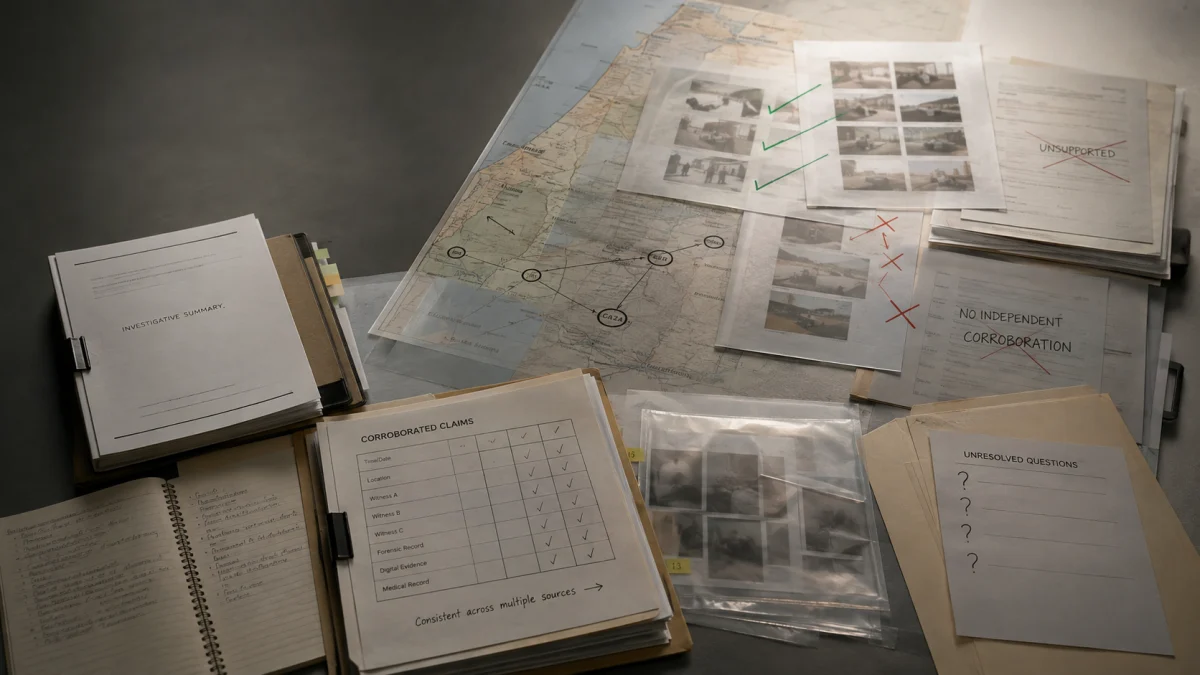
It is also true that some of the most widely circulated early sexual-violence stories were false or could not be verified. The exact number of rapes remains unknown. Attribution is incomplete. And the much broader claim that Hamas leadership deliberately organized rape as a centrally directed weapon of war is not established by the independent evidence with the same level of confidence as the underlying conclusion that sexual violence occurred.
Those distinctions have largely disappeared from public discussion.
By 2025, the United Nations had formally listed Hamas among parties credibly suspected of responsibility for patterns of rape or other forms of conflict-related sexual violence. The UN reported clear and convincing information that sexual violence occurred during the October 7 attacks in at least six locations. At the same time, the UN said access restrictions had prevented investigators from definitively determining the patterns, trends, and systematic nature of sexual violence in the conflict.
So the evidence does not support the blanket assertion that the October 7 rape allegations were simply invented.
It also does not justify treating every allegation, every early atrocity story, every claimed victim count, and every assertion about organized Hamas policy as established fact.
The evidence is more complicated than either slogan.
“Did Rape Happen?” Is Actually Several Different Questions
Much of the argument becomes incoherent because four separate factual questions are treated as though they are interchangeable.
Did sexual violence occur during the October 7 attack?
The evidence strongly supports that it did.
Multiple UN investigations have found credible evidence of sexual and gender-based violence associated with the attack. The UN Commission of Inquiry later concluded that the incidents it documented were not simply isolated events and identified similar acts occurring in several locations and involving multiple Palestinian perpetrators.
Is there credible evidence that rape occurred?
Yes.
The UN mission led by Special Representative Pramila Patten found reasonable grounds to believe that rape and gang rape occurred in at least three locations: the Nova music festival area and its surroundings, Road 232, and Kibbutz Re’im.
The same mission found even stronger evidence concerning hostages, concluding that there was clear and convincing information that some hostages were subjected to sexual violence, including rape, during captivity.
That makes categorical claims that “no rape happened” difficult to reconcile with the available evidence.
Do we know how many women were raped?
No.
There is no reliable, independently established rape count.
Amnesty International’s extensive 2025 investigation concluded that Palestinian assailants committed sexual assaults during the October 7 attacks and that some captives experienced sexual violence, but Amnesty said it could not determine the scope or scale of that violence and was frequently unable to determine which armed organization individual perpetrators belonged to.
The number matters because claims ranging from isolated rapes to dozens or hundreds of systematically planned rapes are not merely different ways of describing the same evidence. They are different factual propositions.
Has it been established that Hamas leadership ordered a systematic mass-rape campaign?
That is considerably less certain.
There is now substantial evidence supporting a pattern of sexual violence, and later Israeli investigations argue explicitly that the violence was systematic and integral to the October 7 operation.
But proving that sexual violence occurred repeatedly is not identical to proving that Hamas leadership planned, ordered, encouraged, or deliberately deployed rape as an organizational strategy.
A written command ordering rape would obviously be powerful evidence, but a written order is not required. Organized policy can also be inferred from repeated conduct, perpetrator affiliation, geographic distribution, coordination, communications, command knowledge, tolerance, operational planning, or other circumstantial evidence.
The problem is that the independent public record remains incomplete on precisely those questions.
What the First UN Sexual-Violence Mission Actually Found
The March 2024 UN mission headed by Pramila Patten is probably the most frequently cited international assessment of the allegations.
Its findings were significant.
The mission reported reasonable grounds to believe that conflict-related sexual violence occurred during the October 7 attacks, including rape and gang rape in at least three locations. It also found clear and convincing information concerning sexual violence against hostages.
But there is an important limitation that routinely disappears when the report is cited politically:
The mission itself explicitly said it was not an investigative mission.
Its purpose was to gather and assess available information, not conduct the equivalent of a criminal investigation capable of determining individual criminal responsibility. Patten consequently called for a full investigation.
That does not make its findings meaningless. “Reasonable grounds to believe” is a serious evidentiary conclusion.
It does mean the report should not be transformed into something it was not.
The mission also found that some highly publicized allegations could not be substantiated. At least two widely repeated stories from Kibbutz Be’eri were determined to be unfounded, including a gruesome claim involving a pregnant woman and her fetus. Other allegations involving genital mutilation or objects allegedly inserted into victims could not always be verified.
The actual UN findings therefore contained both things at once:
credible evidence of sexual violence, and reasons to reject or withhold judgment on particular sensational allegations.
That nuance was largely lost in the political argument that followed.
The UN Commission of Inquiry Reached a More Complicated Finding
A separate United Nations body—the Independent International Commission of Inquiry—later conducted its own investigation.
It found evidence indicating sexual and gender-based violence at multiple locations in southern Israel and described a pattern of similar violence involving multiple perpetrators.
But when it examined allegations specifically involving rape, the Commission said it had not been able to independently verify the rape allegations presented to it.
That is not the same as concluding that rape did not occur.
The Commission described substantial evidentiary obstacles. It lacked access to some victims, witnesses, and crime scenes. It noted an absence of usable forensic evidence for many alleged sexual crimes. It had not interviewed a survivor of October 7 sexual violence despite attempting to do so, and Israeli authorities did not provide the Commission full investigative access.
The Commission also reviewed reports claiming that documents recovered from Palestinian attackers contained instructions to strip civilians or commit sexual violence. It was unable to obtain the purported documents and therefore could not authenticate them.
This is one reason apparently different UN conclusions should not be reduced to “the UN confirmed rape” versus “the UN couldn’t confirm rape.”
They were different exercises using different evidence and mandates.
The Patten mission concluded there were reasonable grounds to believe rape occurred.
The Commission of Inquiry documented a broader pattern of sexual violence but could not independently verify the specific rape allegations it examined.
Both statements can be true.
Some of the Most Famous October 7 Atrocity Stories Really Were False
This part should not be sanitized.
In the chaotic aftermath of the attack, some Israeli first responders interpreted horrific scenes and described what they believed had happened. Several of those interpretations rapidly became international news.
Some were wrong.
The Associated Press later reconstructed two prominent allegations originating with volunteers from ZAKA, an Israeli emergency-response organization.
In one case, a volunteer reported finding a teenage girl whose pants were pulled down and interpreted the scene as evidence that she had been sexually assaulted.
According to information later obtained by ZAKA, Israeli soldiers had moved the girl’s body while checking it for explosives, causing her clothing to shift.
Another first responder circulated an especially graphic account involving a pregnant woman and her fetus. A separate responder who was at the scene did not corroborate that description. The UN Patten mission also determined that the allegation was unfounded.
Correcting those stories is not “rape denial.”
It is evidence correction.
And the inverse mistake is equally serious: discovering that one atrocity story was false does not prove that every other sexual-violence allegation was false.
The proper conclusion is narrower.
Some prominent allegations were wrong. Other evidence of sexual violence remained credible.
A serious evidence standard requires accepting both facts simultaneously.
The Evidence for a Broader Pattern Has Strengthened Since 2024
It would also be misleading to freeze the debate in early 2024.
Additional investigations have since been published.
In 2025, the UN Secretary-General formally included Hamas on the UN list of parties credibly suspected of committing or being responsible for patterns of rape or other forms of sexual violence in armed conflict.
The UN reported clear and convincing information that sexual violence occurred during the October 7 attack in at least six locations and continued to express serious concern about sexual violence against hostages.
That development makes simplistic claims that the sexual-violence allegations were wholly manufactured even harder to sustain.
But the UN simultaneously acknowledged that it had been unable to definitively determine the complete patterns, trends, and systematicity because investigators did not receive sufficient access.
That qualification matters.
A UN listing based on credible information about a pattern of sexual violence is significant evidence.
It is not automatically a judicial finding that Hamas leadership ordered a centrally coordinated campaign of mass rape.
Israeli Investigations Now Explicitly Argue That the Violence Was Systematic
The evidence advocating the stronger interpretation should not be ignored simply because it comes from Israeli organizations.
The Dinah Project published a major report in 2025 arguing that sexual violence on October 7 was widespread and systematic and should be understood as a weapon of war.
Its evidence base included testimony from a survivor of attempted rape, returned hostages who reported experiencing or witnessing sexual violence, eyewitness and earwitness accounts, first-responder testimony, and digital and forensic material.
Then, in May 2026, Israel’s Civil Commission on October 7 Crimes by Hamas Against Women and Children released Silenced No More, an even larger evidence synthesis.
The organization says it reviewed more than 430 testimonies and interviews, approximately 1,800 hours of visual material, and roughly 10,000 photographs. Its conclusion is unequivocal: sexual violence was widespread, systematic, and integral to the October 7 attack and subsequent captivity.
Those findings deserve serious consideration.
They also need to be described accurately.
These are Israeli civil-society investigations specifically created to document the October 7 crimes and advocate recognition and accountability. Their institutional origin does not make their evidence false. But it does make independent corroboration particularly valuable when their conclusions extend beyond whether sexual violence occurred to broader claims about systematic strategy and organizational intent.
The Associated Press reported in May 2026 that it could not independently verify the Civil Commission’s findings.
The responsible approach is therefore neither to discard these reports as “Israeli propaganda” nor to treat every conclusion in them as independently adjudicated fact.
Examine the evidence.
Separate the evidence from the conclusion drawn from it.
Then ask how much independent corroboration exists.
That standard should apply regardless of who produced the report.
Was October 7 Sexual Violence “Systematic”?
This depends partly on what someone means by systematic.
If the claim is that sexual violence occurred more than once, involved multiple perpetrators, and appeared across multiple locations, the evidentiary case has become increasingly strong.
The UN Commission itself identified a pattern and said the acts it documented were not isolated. Later Israeli evidence reviews go substantially further.
If “systematic rape” instead means that Hamas leadership intentionally designed, ordered, or institutionally deployed rape as an organized tactic of the October 7 operation, that is a more specific claim.
The publicly available independent evidence has not established that proposition with the same confidence with which it establishes the occurrence of sexual violence itself.
That does not mean the stronger proposition is false.
It means it is a separate proposition requiring separate evidence.
This is exactly where public discussion tends to break down.
Someone hears:
There is credible evidence that rape occurred.
And translates it into:
Therefore the entire claim of a centrally organized systematic mass-rape campaign is proven.
Someone else discovers:
Several famous atrocity stories were false.
And translates that into:
Therefore nobody was raped.
Neither inference follows.
Why the Number of Victims Is Still So Difficult to Establish
There is another uncomfortable fact: the final number may never be known.
Many alleged victims were killed. Crime scenes were chaotic. Bodies had to be recovered amid an active war environment. Sexual-crime forensic evidence was not systematically collected in a way that would allow conventional case-by-case prosecution of every allegation.
Witness recollections sometimes conflict.
Some evidence is visual. Some is circumstantial. Some comes from first responders describing body positioning or clothing. Some comes from witnesses reporting incidents they say they directly observed. Some comes from hostages describing their own experiences or those of others.
Those categories should not all be given identical evidentiary weight.
This is why announcing a precise number of October 7 rapes as though investigators have compiled a conventional list of independently verified cases is misleading.
The honest answer remains:
The evidence supports sexual violence and reasonable grounds to believe rape occurred, but the total number of rapes is not known.
Amnesty International reached essentially that limitation in its 2025 investigation, saying it could not determine the scope or scale of the sexual violence it documented.
The Evidentiary Standard Cannot Change Depending on the Victim
There is an additional problem with the politics surrounding this issue.
Sexual violence cannot become credible or incredible depending on who the alleged perpetrator is.
Evidence that Palestinians were sexually abused by Israeli forces does not disprove the rape of an Israeli woman on October 7.
That would be whataboutism.
But refusing to apply the same evidentiary standard to Palestinian victims is a legitimate issue.
In the UN Secretary-General’s 2026 report on conflict-related sexual violence, Israeli armed and security forces were added to the same UN annex of parties credibly suspected of responsibility for patterns of rape or other sexual violence in armed conflict.
Hamas remained on the list as well.
The UN reported verifying conflict-related sexual violence against 31 Palestinian victims from Gaza and the West Bank across incidents occurring from 2023 through 2025.
It said rape or gang rape was perpetrated against nine victims and attributed documented violations to personnel including members of the Israel Defense Forces, Israel Prison Service, and Israeli police units.
The reported abuse included sexual assault in detention and other forms of sexualized violence.
Israel strongly rejects the UN’s characterization and has accused the organization of bias, saying relevant information supplied by Israel was ignored.
That dispute should be reported.
But the underlying principle is straightforward.
If “reasonable grounds,” witness testimony, pattern evidence, medical documentation, and UN verification are meaningful when Israeli victims are involved, the same categories of evidence cannot suddenly become worthless when the alleged victims are Palestinian.
Conversely, accusations against Israeli institutions should not automatically be inflated beyond what their evidence demonstrates either.
One evidentiary standard. Every victim. Every perpetrator.
Anything else is politics wearing the clothes of fact-finding.
Sexual Violence Became Part of the Information War
The UN Commission itself warned about a particularly destructive dynamic surrounding these allegations.
Sexual violence can be denied for political purposes.
It can also be exploited for political purposes.
Both behaviors harm victims.
The Commission warned that misinformation, inflammatory rhetoric, disbelief, and the political exploitation of sexual violence can silence victims, shift attention away from them, and contribute to the dehumanization that accompanies war.
That is almost a perfect description of what happened to the October 7 rape debate.
The victims became evidence in an argument larger than themselves.
One side sometimes treated skepticism toward any allegation as antisemitism or support for Hamas.
Another side sometimes treated the collapse of particular stories as proof that the entire sexual-violence record was manufactured.
The underlying evidence became secondary to what each political camp needed the evidence to mean.
That is exactly when evidence discipline matters most.
What Is Actually Established as of August 2026?
Verified or strongly supported: Sexual violence occurred during the Hamas-led October 7 attack. UN experts found reasonable grounds to believe rape and gang rape occurred. Sexual violence against some hostages is supported by particularly strong evidence. Multiple investigations identify a non-isolated pattern of sexual violence. Hamas has been listed by the UN since 2025 among parties credibly suspected of patterns of conflict-related sexual violence.
Also verified: Some widely circulated October 7 sexual-violence stories were false, inaccurate, or unsupported. Correcting those stories does not negate the remaining evidence.
Still uncertain: There is no independently established final number of October 7 rape victims. Attribution of every alleged offense to Hamas rather than another Palestinian armed group or participant is not possible from the public evidence.
More strongly disputed: Israeli evidence reviews now argue that sexual violence was widespread, systematic, and an integral component of the attack. Those reports substantially add to the evidence for a recurring pattern, but the more specific claim that Hamas leadership centrally planned or ordered rape as an organizational strategy has not been established by independent investigations with the same confidence as the occurrence of sexual violence itself.
Separately established: UN investigators have also documented conflict-related sexual violence against Palestinians in Israeli custody, and Israeli armed and security forces were added to the UN’s conflict-related sexual-violence list in 2026. That does not cancel October 7 crimes. It establishes that the same seriousness and evidentiary discipline must apply to Palestinian victims.
The Evidence Does Not Fit Either Slogan
It is not responsible to say that women simply were not raped on October 7.
The available evidence does not support that conclusion.
There are reasonable grounds to believe rape and gang rape occurred, credible evidence of broader sexual violence, stronger evidence involving some hostages, and an increasingly substantial record showing that sexual violence was not confined to one isolated allegation.
But acknowledging that does not require pretending the evidence proves things it does not.
We do not know the final number of rapes.
Some of the stories presented to the world as evidence were false.
Some allegations remain unverifiable.
The identity and organizational affiliation of individual perpetrators is not always known.
And evidence that sexual violence followed a pattern is not, by itself, identical to independently proving that Hamas leadership centrally ordered a campaign of systematic rape.
Those distinctions are not semantic loopholes.
They are the difference between investigating an atrocity and constructing a narrative around one.
People who care about sexual-violence victims should have the strongest reason to insist on that distinction.
False or exaggerated allegations give denialists ammunition. Blanket denial erases credible victims. Politically selective standards turn human suffering into a propaganda instrument.
The answer should therefore be neither “the October 7 rapes were debunked” nor “every claim made about systematic mass rape has been proven.”
The evidence supports something narrower, but much harder to honestly dismiss:
Sexual violence occurred. There are reasonable grounds to believe rape and gang rape occurred. Some allegations were demonstrably false. The total scale remains unknown. A recurring pattern is increasingly well supported. Whether rape was centrally planned and deployed by Hamas leadership as an organized strategy is a further claim whose public independent evidence remains less conclusive.
That answer may satisfy neither political camp completely.
It is still the answer the evidence supports.
References and Further Reading
United Nations and Primary International Findings
- United Nations — Mission of the Special Representative of the Secretary-General on Sexual Violence in Conflict to Israel and the West Bank — The March 2024 Patten mission that found reasonable grounds to believe rape and gang rape occurred in at least three locations and stronger evidence of sexual violence against some hostages. It also makes clear that the mission was not itself a criminal investigation.
- UN Independent International Commission of Inquiry — Detailed Findings on Attacks Carried Out on and After 7 October 2023 in Israel — The Commission’s detailed evidence assessment, including its finding of a pattern of sexual violence, inability to independently verify specific rape allegations it examined, evidentiary limitations, and rejection of several inaccurate allegations.
- United Nations Secretary-General — Conflict-Related Sexual Violence, 2025 Report (S/2025/389) — The report under which Hamas was formally listed among parties credibly suspected of patterns of rape or other conflict-related sexual violence. It also discusses continuing evidentiary and access limitations.
- United Nations Secretary-General — Conflict-Related Sexual Violence, 2026 Report (S/2026/321) — The current UN record covering Hamas and the subsequent listing of Israeli armed and security forces, including UN-verified cases involving Palestinian victims.
Independent Human-Rights Investigation
- Amnesty International — Investigation of Crimes by Palestinian Armed Groups During and After the October 7 Attacks — Amnesty’s extensive 2025 investigation found evidence of sexual assault and other serious crimes but said it could not determine the complete scope or scale of sexual violence and could not always establish the perpetrators’ organizational affiliation.
Later Israeli Evidence Reviews
- The Dinah Project — October 7 Sexual-Violence Evidence and Legal Analysis — A major Israeli civil-society evidence synthesis arguing that October 7 sexual violence was widespread and systematic. Useful because it presents the strongest developed case for the systematicity argument rather than merely repeating early media accounts.
- Civil Commission on October 7 Crimes by Hamas Against Women and Children — Silenced No More — The Commission’s 2026 evidence review arguing that sexual violence was widespread, systematic, and integral to the October 7 attack and subsequent captivity. Its institutional origin and methodology should be considered alongside independent verification.
Independent Reporting and Verification
- Associated Press — Investigation of Debunked October 7 Sexual-Violence Accounts From First Responders — Reconstructs how several highly publicized atrocity allegations originated and why specific accounts were later determined to be incorrect, while separately noting the broader credible evidence of sexual violence.
- Associated Press — Israeli Civil Commission Reports Systematic Sexual Violence on October 7 — Independent coverage of the 2026 Civil Commission report, including the important qualification that AP could not independently verify its findings.
- Associated Press — UN Adds Israeli Forces to Conflict-Related Sexual-Violence List — Covers the 2026 UN listing, documented Palestinian cases, and the Israeli government’s rejection of the UN’s findings.
Editorial currency note: This article reflects publicly available evidence and major investigative findings through August 19, 2026. Investigations into October 7, hostage captivity, Palestinian detention, and individual criminal responsibility remain active or incomplete. Future forensic evidence, survivor testimony, court proceedings, document releases, or independent investigations could materially change specific conclusions.