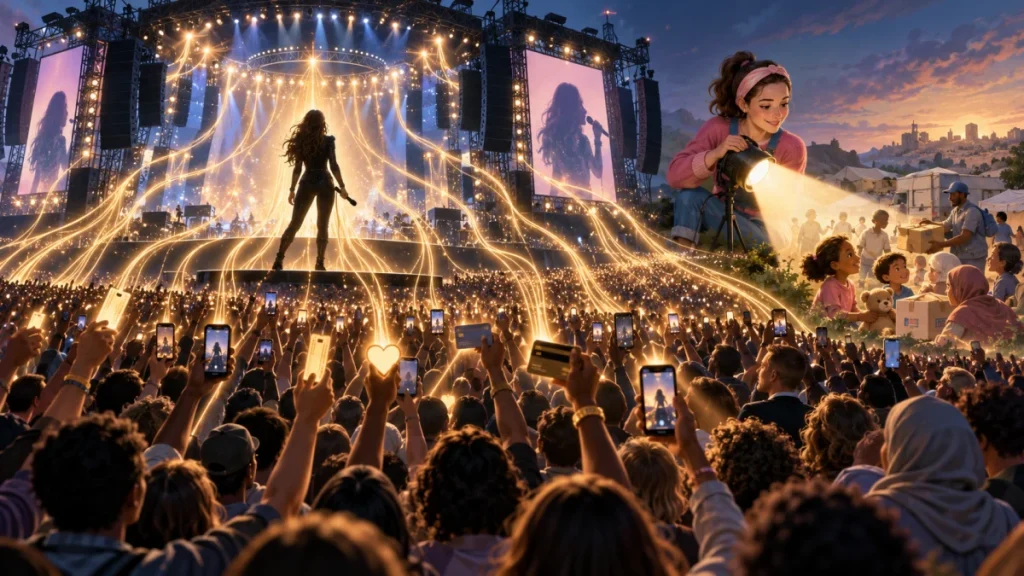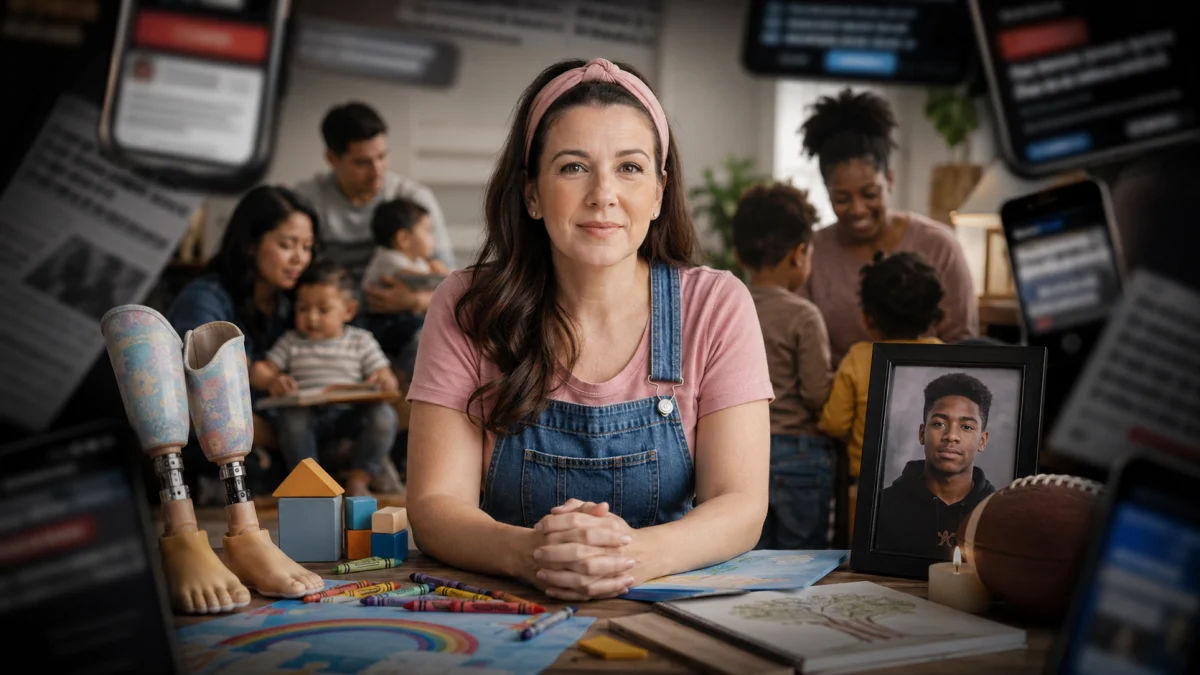
The short answer: Ms. Rachel became controversial largely because she stopped expressing compassion for children only in the abstract and began applying it to children whose suffering sits inside some of America’s most politically contentious issues.
Rachel Griffin Accurso built her career telling very young children that they are important, capable and worthy of care. Her official biography describes her as an educator with master’s degrees in early childhood development and music education and identifies children’s rights as part of her work.
That philosophy attracted little political controversy when it meant helping a toddler learn a new word.
It became much more contentious when it meant Palestinian children in Gaza.
It became contentious again when she publicly welcomed LGBTQ+ families.
And in 2026, it became contentious when she argued that the mysterious death of Black teenager Nolan Wells would have been treated differently had Wells been white and the friends who returned without him been Black.
Not every criticism of Ms. Rachel is dishonest. She can make factual mistakes. She can state an inference more confidently than the available evidence can conclusively prove. She once accidentally liked an overtly antisemitic Instagram comment, acknowledged the like, said she had been attempting to delete the comment, and publicly apologized.
But those legitimate points do not explain the scale or nature of the campaign against her.
Because much of the backlash has depended on something else: transforming ordinary humanitarian advocacy into evidence of hidden extremism, treating proximity to a politically disfavored person as guilt by association, and demanding a level of proof for concern about Palestinian or Black children that is rarely demanded before extending empathy to children whose innocence is socially uncontested.
The underlying fight is therefore bigger than Ms. Rachel.
It is about who is allowed to be treated simply as a child.
What Did Ms. Rachel Actually Do?
Ms. Rachel first became enormously popular through educational videos designed around speech, language, music and early childhood development. Her channel began in 2019 after her own son’s speech delay helped inspire the project.
Her public advocacy did not suddenly begin with Gaza.
She has spoken about early-childhood education, disability, LGBTQ+ inclusion, immigration and children’s rights. In June 2024, she faced a conservative backlash after posting a short Pride Month message welcoming LGBTQ+ families and saying she was glad they were who they were.
The common thread is not difficult to identify.
Ms. Rachel’s stated position is that her concern for children does not stop at nationality, religion, race, disability or sexual orientation.
The political problem began when she demonstrated that she intended to apply that principle consistently.
Gaza Was the Turning Point
In May 2024, Ms. Rachel launched a fundraiser benefiting Save the Children’s emergency work for children affected by crises including Gaza, Sudan, Ukraine and the Democratic Republic of the Congo. It raised more than $50,000 in a matter of hours.
She was then attacked for supposedly excluding Israeli children.
Her response was straightforward: she said she cared about Palestinian children, Israeli children, Muslim children, Jewish children, Christian children and children everywhere.
Her advocacy nevertheless intensified as the destruction and humanitarian emergency in Gaza continued.
She highlighted children who had been killed, injured, displaced or deprived of food and medical care. She met Rahaf Saed, a three-year-old Palestinian girl who lost both legs in an Israeli airstrike and traveled to the United States for treatment through the Palestine Children’s Relief Fund. Ms. Rachel later filmed an ordinary children’s segment with Rahaf in which they played, sang and danced together.
That distinction matters.
She did not present Rahaf as an ideological argument.
She presented her as a child.
And for some critics, that itself became political.
The Suffering of Palestinian Children Is Not a Social-Media Theory
One way criticism of Ms. Rachel has operated is by treating the underlying humanitarian premise as though it were itself suspicious.
The evidence does not support that framing.
In June 2026, the United Nations’ human-rights office reported extraordinary levels of death, injury, displacement and insecurity among Palestinian children. It cited more than 21,000 children reported killed in Gaza since October 2023 and documented hundreds of child deaths in the occupied West Bank.
That same month, the UN Independent International Commission of Inquiry released a report concluding that Israeli authorities and security forces had deliberately targeted Palestinian children and that the conduct formed part of genocide and other atrocity crimes in Gaza and war crimes in the West Bank. Israel disputes accusations of genocide, and a commission’s conclusion is not the same thing as a final judgment by an international court. But the factual record of enormous civilian and child suffering does not depend on accepting every contested legal characterization.
Save the Children, UNICEF, UN agencies and numerous humanitarian organizations have independently documented severe hunger, injury, displacement and destruction affecting children in Gaza.
So when Ms. Rachel says Palestinian children are suffering catastrophically, the meaningful debate is not whether suffering exists.
It plainly does.
The debate is whether prominent Americans should say so.
Was Ms. Rachel Being Paid by Hamas?
There is no credible evidence we found that Ms. Rachel was being paid by Hamas or another foreign actor to advocate for Palestinian children.
Yet in April 2025, the pro-Israel advocacy organization StopAntisemitism asked the U.S. Justice Department to investigate whether she was being paid to disseminate what it called “Hamas-aligned propaganda.”
That accusation sounds explosive.
The supporting evidence was not.
When the organization’s director was asked what evidence showed that Ms. Rachel had actually received foreign payments, the response cited the general fact that influencers sometimes have paid collaborations and the observation that Ms. Rachel had begun posting heavily about Gaza. No concrete evidence of a payment was produced in the reporting.
That is an important example of how narratives can be manufactured.
The established facts were:
Ms. Rachel had a large following.
Influencers sometimes accept money.
Ms. Rachel spoke frequently about Gaza.
From those facts came the suggestion that perhaps a foreign actor was secretly paying her.
But the conclusion does not follow from the premises.
Suspicion is not evidence simply because the allegation is serious.
Did Ms. Rachel “Work With Hamas”?
Another accusation has grown out of Ms. Rachel’s interaction with Palestinian photojournalist Motaz Azaiza.
Ms. Rachel featured Azaiza in a social-media video. Critics have pointed to inflammatory statements Azaiza has made about Israel and to comments they interpret as sympathetic toward Hamas. Those statements are fair subjects for criticism.
But another factual leap often follows.
Azaiza becomes “Hamas.”
Then Ms. Rachel’s appearance with Azaiza becomes “Ms. Rachel worked with Hamas.”
Those are different claims.
TIME identified Azaiza as a Palestinian photographer and included him among its 100 most influential people of 2024 for documenting civilian life in Gaza during the Israeli bombardment. The Committee to Protect Journalists has likewise identified him in the context of Palestinian journalism and threats against reporters.
We found no credible evidence establishing that Azaiza is a Hamas member or operative.
A person can reasonably condemn something Azaiza has said.
A person can believe Ms. Rachel exercised poor judgment by featuring him.
Neither proposition establishes that she “worked with Hamas.”
That mutation—from “she appeared with a Palestinian journalist whose politics I object to” into “she collaborated with Hamas”—is precisely how guilt by association becomes misinformation.
But Has Ms. Rachel Condemned Hamas?
Yes.
In July 2025, Ms. Rachel publicly condemned Hamas, the October 7 attacks, the killing of Israeli civilians and children, and the taking of Israeli hostages. In the same statement she condemned the Israeli government’s killing of Palestinian civilians and children, starvation, attacks on schools and hospitals, and violations of human rights and children’s rights.
People are free to argue that she should have said something earlier, said it more often or emphasized different victims.
But the claim that her position is simply “Palestinian children matter and Israeli children do not” is difficult to reconcile with what she has actually said.
Her stated principle is substantially more consistent:
Children do not stop being children because adults have divided themselves into hostile political tribes.
The Antisemitic Instagram Like Was Real. Context Still Matters.
There is one incident critics are justified in raising.
In January 2026, an antisemitic comment appeared beneath one of Ms. Rachel’s posts. Her account liked it.
The comment was plainly hateful.
Ms. Rachel said the like occurred accidentally while she was attempting to remove the comment, deleted it and publicly apologized. Her contemporaneous private response to a follower who alerted her also indicated revulsion at the comment rather than agreement with it.
Readers can decide how plausible that explanation is.
But evidence should be evaluated as a whole.
An accidental click followed by immediate rejection of the statement and an apology is evidence of something very different from repeatedly expressing the underlying belief.
Calling the incident a mistake is justified.
Using it as retrospective proof that every previous statement she made about Palestinian children was secretly motivated by hatred of Jewish people requires evidence that the incident itself does not provide.
Then Came Nolan Wells
In July 2026, Ms. Rachel entered another controversy after the death of Nolan Xavier Wells, an 18-year-old Black college student and football player from Mississippi.
Wells went to Horn Island on July 4 with friends. His friends returned to the mainland. Nolan did not. His body was found two days later.
Ms. Rachel later wrote:
“We know the investigation and everything that followed would have been different if Nolan Wells were white and his friends were black.”
She added that Nolan and his family deserved justice.
Critics immediately called the statement unsupported.
That description is too simplistic.
Can Anyone Prove What Would Have Happened if Nolan Wells Were White?
No.
Counterfactuals cannot usually be proven in the way a laboratory result can be proven.
We cannot rerun July 4 with Nolan as a white teenager and his companions as Black teenagers while holding every other variable constant.
So Ms. Rachel’s exact statement is an inference, not a directly verified fact.
But an inference can still have substantial factual support.
And this one does.
The Nolan Wells Case Gives People Legitimate Reasons to Question the Initial Response
According to Nolan’s mother, when she began trying to report him missing she contacted multiple agencies and encountered confusion over jurisdiction. The family eventually met an officer in a McDonald’s parking lot after midnight. She later described wondering where the urgency was. The next morning, Nolan’s parents and his football coach used the coach’s boat to search the island themselves.
There were also immediate factual questions about the story that Nolan had voluntarily stayed behind.
His phone came back to the mainland.
So did his keys.
He did not.
His parents said some information appeared to have been deleted from the phone. A witness account reported by the family’s attorney also conflicted with the theory that Nolan simply chose not to leave with his friends.
The Jackson County sheriff said early in the investigation that authorities did not suspect foul play. Nolan’s family viewed that conclusion as premature. An independent autopsy commissioned by the family later classified the cause and manner of death as undetermined pending further investigation. It found no fractures or deep-tissue injuries but identified unexplained discoloration at the back of Nolan’s head and could not rule out non-accidental factors.
See “Why the Nolan Wells Case Matters—and Why the Public Should Not Forget”
As of August 19, 2026, the official Mississippi autopsy has been completed but has not been publicly released. Jackson County District Attorney Angel Myers McIlrath says the completed investigation and autopsy evidence will be presented to a grand jury.
None of this proves murder.
None proves that Nolan’s friends harmed him.
None proves that law enforcement acted with conscious racial prejudice.
It does establish that serious unanswered questions exist and that the family has identifiable reasons—not merely internet speculation—for questioning how their son’s disappearance and death were initially handled.
That distinction is essential.
And There Is a Factual Basis for Asking Whether Race Changes How Black Children Are Protected
The larger racial concern did not originate with Ms. Rachel.
Researchers have repeatedly documented differences in how innocence, vulnerability and victimhood are assigned across racial groups.
A major study published in the Journal of Personality and Social Psychology found that Black boys were perceived as older and less innocent than white boys of the same age. The researchers also found relationships between dehumanizing racial attitudes and racial disparities in police use of force against children.
The study focused primarily on minors, while Nolan Wells had just turned 18. It therefore cannot be mechanically applied to his case.
But it demonstrates something important about the social environment surrounding the claim: the idea that Black boys can receive less of the presumption of vulnerability automatically extended to white children is an empirically documented phenomenon, not something invented by social-media activists.
There are comparable disparities in public attention.
A criminological review of what researchers call “Missing White Woman Syndrome” found persistent evidence that missing white women receive disproportionate media attention compared with missing people from racial minorities. Research involving social-media appeals for missing children has likewise found substantially greater engagement for white girls than Black girls.
The U.S. Justice Department’s Office of Justice Programs has itself acknowledged systemic neglect surrounding missing and murdered Black women and girls, including concerns about law-enforcement responsiveness when Black families report loved ones missing.
Again, none of those findings proves what one particular Mississippi officer would have done under reversed racial circumstances.
They do something different.
They demonstrate why a Black family looking at an apparently low-urgency response to its missing son is not irrational for asking whether race mattered.
That is the point too often erased by demands for a “smoking gun.”
Racism Rarely Arrives With a Receipt
There is a recurring mistake in public discussion of discrimination.
Unless someone finds an email saying, We treated this person differently because he is Black, the racial hypothesis is declared disproven.
That is an absurd evidentiary standard.
Bias can be unconscious.
It can operate through assumptions about danger, innocence, credibility, urgency and who appears to require protection.
It can emerge statistically across thousands of decisions even when no individual decision-maker admits racial intent.
And it can interact with ordinary institutional failures rather than replacing them.
Perhaps jurisdictional confusion in the Wells case was merely bureaucratic dysfunction.
Perhaps the initial no-foul-play assessment was based on information investigators possessed but have not yet released.
Those possibilities should remain open.
But so should another possibility: that the urgency attached to a missing young Black man was not necessarily identical to the urgency that would have surrounded a socially sympathetic white teenager in otherwise comparable circumstances.
The available evidence cannot conclusively settle that counterfactual.
It certainly does not justify mocking it as though American history and social-science research provide no reason to ask.
This Is the Same Argument Ms. Rachel Keeps Walking Into
Look at the controversies together.
She says LGBTQ+ families are welcome.
People tell parents to boycott her.
She raises money for children in Gaza, Sudan, Ukraine and Congo.
She is accused of not caring about Israeli children.
She continues talking about Palestinian children.
A political advocacy organization asks the Justice Department to determine whether a foreign entity might secretly be paying her, without producing evidence that such payments exist.
She appears with a Palestinian photojournalist.
The association is transformed online into claims that she works with terrorists, despite no evidence establishing the journalist as a Hamas operative.
She says a Black teenager’s death might have been treated differently if the races were reversed.
Instead of seriously examining the documented racial disparities that make such a suspicion plausible, some commentary simply calls the observation divisive.
At some point the pattern itself deserves examination.
Why Does Ms. Rachel Make Certain People So Uncomfortable?
Because universal compassion sounds uncomplicated until someone insists on applying it universally.
“Protect children” is nearly meaningless as a political statement.
Everyone agrees.
The conflict begins when somebody asks:
Which children?
Palestinian children?
Children whose parents crossed a border illegally?
Black boys whom society has already begun treating as adults?
Children with two mothers?
Muslim children wearing hijabs?
A moral principle is not tested when applying it costs nothing.
It is tested at the boundary where your political tribe expects an exception.
Ms. Rachel keeps walking directly into those boundaries.
That is why a children’s educator has become politically threatening to some adults.
You Do Not Have to Agree With Everything Ms. Rachel Says
This article is not arguing that Ms. Rachel possesses perfect judgment.
She doesn’t.
No public figure does.
Her Nolan Wells statement goes beyond what can presently be established as a fact.
The antisemitic Instagram like was an error serious enough to warrant the apology she gave.
People can reasonably debate whether certain political subjects belong on a separate social account associated with preschool entertainment.
They can criticize the methodology or validity of particular statistics she has shared.
They can disagree with Motaz Azaiza’s rhetoric and question her judgment in featuring him.
Those are arguments.
But an argument has to remain attached to reality.
“She should have been more cautious” is an argument.
“She worked with Hamas” is a factual allegation requiring evidence.
“I think she overstates what can be known about racial bias in the Nolan Wells investigation” is an argument.
“There is no factual basis whatsoever for believing race could affect how a Black teenager is perceived or protected” ignores an extensive body of evidence.
“I disagree with her characterization of Israel’s conduct” is an argument.
“Talking about Palestinian children proves hatred of Jewish children” is not a logical consequence of the premise.
Those distinctions matter.
The Most Revealing Part of the Ms. Rachel Backlash
Ms. Rachel’s critics often say she should “stay in her lane.”
But her lane has always been children.
That is precisely the problem.
A philosophy like hers remains culturally comfortable so long as “children” stays an abstraction.
A smiling toddler in a nursery is politically neutral.
A Palestinian toddler with amputated legs is not treated that way.
A missing Black teenager surrounded by unanswered questions is not treated that way.
A child with gay parents is not treated that way.
Suddenly the same vocabulary—kindness, dignity, protection, inclusion—becomes political.
Not because the underlying principle changed.
Because the identity of the person receiving compassion changed.
And that may be the simplest explanation for why Ms. Rachel has become such a strangely polarizing figure.
She spent years teaching toddlers that every child matters.
Then adults discovered she meant every child.
References and Further Reading
Ms. Rachel: Background and Direct Advocacy
- Ms. Rachel — Official Team Biography — Ms. Rachel’s official biography, including her education, early-childhood focus and stated commitment to children’s rights.
- WBUR: Ms. Rachel Says She’ll Keep Advocating for Children in Gaza, Even if It Means Risking Her Career — Extended interview explaining the motivation behind her Gaza advocacy.
- Democracy Now!: Ms. Rachel on Her Gaza Advocacy — “My Deep Care for Children Doesn’t Stop at Any Border” — Interview covering Palestinian children, Rahaf Saed and Ms. Rachel’s broader child-rights philosophy.
- Glamour: The Meaning of Ms. Rachel — Long-form profile and interview exploring her children’s media career and Gaza advocacy.
- Associated Press: Ms. Rachel Announces Debut Album and Discusses Children’s-Rights Advocacy — Current August 2026 interview containing her Nolan Wells statement and explanation of her advocacy.
Gaza and the Foreign-Agent Allegation
- The Guardian: Pro-Israel Group Asks DOJ to Investigate Ms. Rachel Over Posts on Gaza Children — Detailed account of the foreign-payment allegation, including the lack of concrete payment evidence produced when the accuser was questioned.
- United Nations: Israeli Violence Is Subjecting Palestinian Children to Catastrophic Levels of Harm — June 2026 OHCHR summary of verified and reported harm to Palestinian children.
- UN Independent Commission of Inquiry: Findings on the Treatment of Palestinian Children — June 2026 findings concerning killings, injuries, starvation, detention and other harms affecting Palestinian children.
- Save the Children: A Year in Gaza — Humanitarian organization’s account of its child-protection, health, nutrition, shelter and education work.
Motaz Azaiza and the “Worked With Hamas” Claim
- TIME100: Motaz Azaiza — TIME’s profile identifying Azaiza as the Palestinian photographer whose work documented conditions inside Gaza.
- Committee to Protect Journalists: Attacks, Arrests, Threats and Censorship During the Israel-Gaza War — Press-freedom documentation that includes threats received by Azaiza while reporting from Gaza.
Nolan Wells
- Associated Press: A July 4 Boat Trip, an 18-Year-Old’s Death and a Family’s Search for Answers — Detailed reconstruction of Wells’s disappearance, the phone and keys questions, witness discrepancies and the family’s concerns.
- Associated Press: What to Know About the Autopsy and Investigation Into Nolan Wells’s Death — Explanation of the independent autopsy, unresolved cause of death and continuing investigation.
- The Guardian: Nolan Wells’s Parents Recount the Search for Their Son at the NABJ Convention — Detailed account of the family’s attempts to obtain law-enforcement assistance and their allegations of inadequate urgency.
- ABC News: Nolan Wells Case — DA Promises a Thorough Grand-Jury Presentation — The latest public status of the investigation as of August 19, 2026.
Racial Bias, Childhood Innocence and Missing-Person Attention
- Journal of Personality and Social Psychology: The Essence of Innocence — Consequences of Dehumanizing Black Children — Peer-reviewed research finding that Black boys were perceived as older and less innocent than white peers, with implications for policing and protection.
- U.S. Office of Justice Programs: Shining a Light on the Crisis of Missing or Murdered Black Women and Girls — Federal discussion of disproportionate disappearance, violence, media neglect and concerns about law-enforcement responsiveness affecting Black families.
- Social Sciences: Social Media, Newsworthiness, and Missing White Woman Syndrome — A Criminological Analysis — Research review documenting racial disparities in missing-person coverage and social-media attention.
Editorial currency note: The investigation into Nolan Wells’s death remains active as of August 19, 2026. The official state autopsy has been completed but its findings have not been publicly released, and the case is expected to be presented to a grand jury. Conclusions about the circumstances of Wells’s death should be updated if new forensic evidence, witness testimony, grand-jury findings or law-enforcement records become public.