No credible evidence shows that sunscreen causes skin cancer.
But there is a reason the claim spreading across social media sounds more convincing than the average health myth: the study being cited really did find higher rates of several skin cancers among people reporting frequent sun protection.
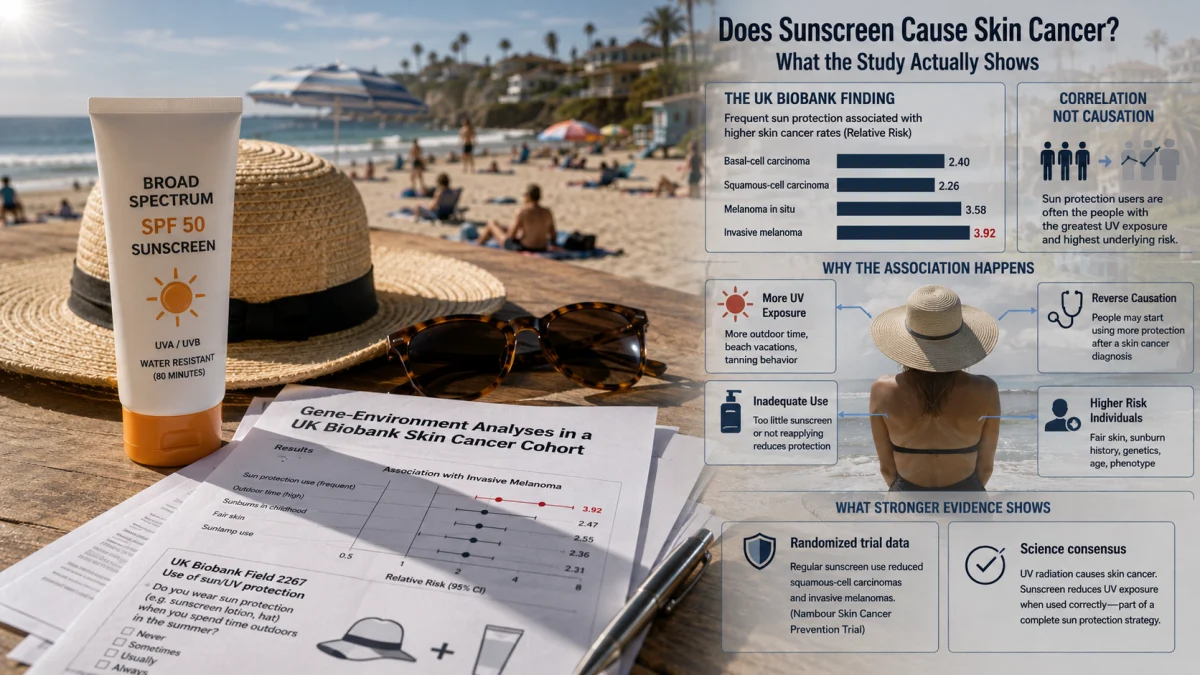
In the 2023 UK Biobank analysis at the center of the controversy, frequent use was associated with relative risks of approximately 2.40 for basal-cell carcinoma, 2.26 for squamous-cell carcinoma, 3.58 for melanoma in situ and 3.92 for invasive melanoma, compared with the study’s reference group.
Those numbers are not fabricated.
What they do not establish is that sunscreen caused those cancers.
The distinction is not semantic. It is the difference between what the study measured and what viral posts are claiming it proved.
The study was primarily a gene-environment analysis of skin-cancer risk, examining 8,798 genetic variants across 190 DNA-repair genes alongside behavioral and demographic variables in UK Biobank participants. It was not a randomized sunscreen trial. Its authors explicitly describe the sunscreen association as paradoxical and propose several obvious explanations: people using more protection may receive more ultraviolet exposure overall, may fail to apply or reapply sunscreen adequately, or may start using more sun protection after being diagnosed with skin cancer.
There is an additional problem that has largely disappeared from the viral version of the story:
The UK Biobank variable did not even measure sunscreen alone.
Participants were asked:
“Do you wear sun protection (e.g. sunscreen lotion, hat) when you spend time outdoors in the summer?”
The official UK Biobank field is called “Use of sun/UV protection.” Sunscreen and hats were examples within the same behavioral question.
So a study measuring a broad category of sun-protective behavior has been transformed online into a claim about the carcinogenicity of a particular product.
That is considerably more than the data can support.
What did the UK Biobank skin-cancer study actually study?
The paper was titled “Gene-Environment Analyses in a UK Biobank Skin Cancer Cohort Identifies Important SNPs in DNA Repair Genes That May Help Prognosticate Disease Risk.”
That title tells you something important about its purpose.
This was primarily a genetics and risk-stratification study—not a sunscreen safety trial.
Researchers from McGill University examined UK Biobank groups containing:
- 17,221 people with basal-cell carcinoma
- 2,331 with cutaneous squamous-cell carcinoma
- 1,158 with melanoma in situ
- 3,798 with invasive melanoma
- 448,164 healthy controls
They examined 8,798 single-nucleotide polymorphisms, or SNPs, covering 190 DNA-repair genes, while also studying demographic and behavioral variables including skin color, hair color, tanning ability, childhood sunburns, sunlamp use, time outdoors and use of sun protection.
The paper ultimately identified hundreds of gene-environment interactions and highlighted several variants in the FANCA DNA-repair gene that may help explain susceptibility to particular skin cancers.
Sunscreen was not the experimental treatment.
Nobody was randomly assigned sunscreen.
Researchers did not compare identical groups receiving sunscreen versus placebo.
And the study was not designed to determine whether any sunscreen ingredient causes cancer.
What were the alarming numbers?
The association deserves to be presented accurately rather than hidden because it is inconvenient.
Compared with the reference category, the study reported roughly:
| Skin cancer | Highest reported relative risk associated with frequent sun protection |
|---|---|
| Basal-cell carcinoma | 2.40 |
| Squamous-cell carcinoma | 2.26 |
| Melanoma in situ | 3.58 |
| Invasive melanoma | 3.92 |
The invasive-melanoma number is the source of versions of the viral claim saying sunscreen users experienced a 292% greater risk.
Mathematically, that characterization of an RR of 3.92 is understandable.
Scientifically, the problem comes in the next sentence—when someone turns “people reporting this behavior were more likely to have melanoma” into “the behavior caused their melanoma.”
The original paper does not make that claim.
In fact, the researchers call the result surprising and specifically discuss why it should not be interpreted that way.
The sunscreen paradox: why sunscreen users can have more skin cancer
Imagine conducting a study of seatbelt use after car accidents and discovering that people involved in severe crashes were unusually likely to have been wearing seatbelts.
That would not demonstrate that seatbelts cause crashes.
It might simply tell you that people driving long distances, driving faster roads, or otherwise spending more time in situations where crashes occur are also more likely to wear seatbelts.
Sunscreen research has a similar problem.
People who spend five summer hours outdoors at the beach are much more likely to put on sunscreen than people spending the afternoon inside.
The beachgoer can therefore have both:
more sunscreen exposure
and
more ultraviolet exposure.
UV exposure is the underlying cancer risk.
This is sometimes called the sunscreen paradox or, more broadly, a form of behavioral confounding.
Senior study author Ivan Litvinov has now repeatedly said this is how the results should be understood. He told AFP that people frequently use sunscreen as permission to spend more time tanning and noted that failure to apply enough sunscreen or reapply it can sharply reduce protection.
The paper itself makes essentially the same point. The researchers propose that the association may reflect greater UV exposure, insufficient reapplication or increased use of protection after someone has already received a skin-cancer diagnosis.
Those are not excuses invented later by people trying to rescue an inconvenient result.
They are part of the scientific interpretation of the study itself.
There is an even stranger result hiding in the same paper
One of the most useful ways to test a causal interpretation is to apply it consistently.
The study’s Figure 1 reports that frequent sun protection and limited outdoor exposure were both associated with increased risk of the skin cancers studied.
If we interpreted associations the way the viral sunscreen claim does, we would have to conclude that:
Using sun protection causes skin cancer.
And:
Spending less time outside also causes skin cancer.
Those conclusions point in conflicting directions.
A much more plausible explanation is that behavioral variables in this dataset are entangled with who is most susceptible to skin cancer and how people’s behavior changes because of that susceptibility or because they have already been diagnosed.
Someone with very fair skin, repeated childhood sunburns, a family history of melanoma or a previous suspicious lesion may deliberately avoid the sun and use protection obsessively.
That person can simultaneously be at greater underlying risk of cancer.
The protective behavior did not create the risk.
The risk helped create the protective behavior.
The study didn’t actually ask “Do you use sunscreen?”
This methodological detail may be the clearest problem with the viral claim.
UK Biobank Field 2267 is officially called “Use of sun/UV protection.”
Its questionnaire asked participants whether they wore sun protection and gave “sunscreen lotion” and “hat” as examples.
That means someone who habitually wore a wide-brimmed hat could be classified under the same general behavioral variable as someone who habitually applied sunscreen.
So even before confronting causation, the claim has another problem:
The exposure variable does not isolate sunscreen.
If the association itself were sufficient to establish causation, one could just as easily circulate a headline saying:
“UK Biobank study finds hats cause melanoma.”
Nobody would reasonably interpret the result that way.
The sunscreen interpretation deserves the same scrutiny.
Could people have started protecting themselves after getting cancer?
Yes, and the study’s authors explicitly identify this as a possible explanation.
This is called reverse causation.
Suppose someone spends decades getting heavy sun exposure, develops basal-cell carcinoma at 52 and afterward becomes extremely diligent about hats and sunscreen.
A later questionnaire asks how frequently that person uses sun protection.
The dataset can now contain:
skin cancer + heavy sun-protection use
even though the cancer preceded the behavior.
If chronology is ignored, someone looking only at the association can tell the causal story backwards.
This is one reason observational behavioral research has to be interpreted much more carefully than a randomized experiment.
What happens when sunscreen actually is randomized?
Fortunately, we have substantially better evidence than simply comparing people who choose to use sunscreen with people who do not.
The most important experiment is the Nambour Skin Cancer Prevention Trial in Queensland, Australia.
Researchers randomized 1,621 adults to either regular daily sunscreen application or discretionary sunscreen use. The intervention initially ran from 1992 through 1996, and researchers subsequently followed participants for melanoma outcomes.
During follow-up, researchers identified:
- 11 new primary melanomas in the daily-sunscreen group
- 22 in the discretionary-use group
That corresponded to a hazard ratio of 0.50, although the confidence interval for total melanoma narrowly crossed the conventional threshold for statistical significance.
For invasive melanoma, the difference was larger:
- 3 invasive melanomas in the daily-use group
- 11 invasive melanomas in the discretionary-use group
The hazard ratio was 0.27, with a 95% confidence interval of 0.08 to 0.97.
The same Australian trial also found that regular sunscreen significantly reduced the number of squamous-cell carcinomas, while no significant reduction in basal-cell carcinoma was demonstrated during the initial 4.5-year trial.
That is a much stronger design for answering the causal question because randomization reduces the behavioral differences that plague observational sunscreen research.
It still does not mean the evidence is perfect.
A major 2026 review of sunscreen and skin-cancer prevention concluded that randomized trials provide good evidence for reducing actinic keratoses and squamous-cell carcinoma, while evidence specifically for melanoma prevention remains directionally supportive but statistically limited. Evidence for basal-cell carcinoma prevention is also less clear.
That is a more accurate statement than either extreme:
“Sunscreen definitely prevents every skin cancer.”
or
“Sunscreen causes skin cancer.”
The evidence does not support the second claim.
Does sunlight actually cause skin cancer?
For the major sun-related skin cancers, ultraviolet radiation is a well-established carcinogenic exposure.
The World Health Organization states that skin cancers are caused primarily by exposure to ultraviolet radiation from the sun and artificial sources such as tanning beds.
A 2026 review in Archives of Dermatological Research similarly describes ultraviolet radiation as the principal environmental carcinogen associated with keratinocyte cancers and cutaneous melanoma. UV exposure damages DNA, affects immune function and produces biological changes involved in carcinogenesis.
This does not mean every skin cancer in every person can be attributed to sunlight.
Genetics matter.
Skin phenotype matters.
Age matters.
Immune status matters.
Different skin cancers have different exposure patterns, and some melanomas arise in areas or subtypes where ordinary solar exposure is not the dominant explanation.
But the existence of additional causes does not make UV radiation harmless.
The 2023 UK Biobank paper itself begins from the established relationship between sun exposure and skin-cancer pathogenesis and found strong interactions involving sunlamp exposure, childhood sunburns, genetic susceptibility and DNA-repair genes.
Using that paper to argue that sunlight does not contribute to skin cancer effectively contradicts the framework of the paper being cited.
Why hasn’t increasing sunscreen use eliminated melanoma?
This question is more reasonable than it first appears.
Sunscreen use has expanded dramatically over decades, yet melanoma incidence has not disappeared. That observation is sometimes presented as evidence that sunscreen cannot work.
But population trends cannot isolate sunscreen’s effect.
During the same broad period, societies have experienced enormous changes in recreational travel, tanning behavior, clothing, outdoor lifestyles, diagnostic intensity, population aging and surveillance.
And sunscreen is not a force field.
Even people who deliberately apply it frequently use far less than the amount used to determine the labeled SPF.
In the Nambour trial, researchers found that participants typically applied a median of about 0.79 mg of sunscreen per square centimeter of skin—less than half the amount required to produce the labeled SPF under testing conditions.
People also miss areas, fail to reapply, sweat, swim and remain in the sun longer because they feel protected.
The FDA emphasizes that SPF does not mean someone can remain in the sun an equivalent multiple longer. Sunscreen must be reapplied, and it should be combined with clothing, shade and limits on intense sun exposure.
So the relevant comparison is not:
“Skin cancer still exists despite sunscreen.”
It is:
“What happens to comparable UV-exposed people when sunscreen is used correctly versus when it isn’t?”
That is a very different question.
Does sunscreen prevent melanoma?
The evidence supports a protective effect, but it is less extensive than many people assume.
The Nambour randomized trial produced fewer melanomas and significantly fewer invasive melanomas among those assigned daily sunscreen.
However, melanoma takes years or decades to develop, making large randomized prevention trials unusually difficult. Researchers cannot ethically randomize thousands of people to deliberately receive unprotected UV exposure for decades.
Consequently, much of the wider melanoma literature is observational—and observational sunscreen studies are especially vulnerable to the sunscreen paradox.
A recent 2026 clinical review therefore describes the melanoma evidence as biologically plausible and directionally consistent, while acknowledging that the statistical evidence remains limited compared with the evidence for squamous-cell carcinoma.
That nuance matters.
You do not need to exaggerate sunscreen’s evidence in order to reject the claim that it causes cancer.
Are chemical sunscreen ingredients completely beyond question?
No.
This is where a useful fact-check should resist replacing one oversimplification with another.
There are legitimate scientific and regulatory questions surrounding some individual sunscreen ingredients.
The FDA has found that several organic UV filters can be systemically absorbed after topical use and has requested additional safety information regarding some longstanding sunscreen active ingredients. But the agency explicitly says that absorption does not itself demonstrate harm and continues to recommend sunscreen together with other sun-protective measures.
Research has also examined possible endocrine effects of compounds such as oxybenzone, and environmental concerns involving some UV filters are real areas of investigation.
Those questions should be researched rather than dismissed.
But they are also a separate claim.
“Researchers want better long-term safety data on some sunscreen ingredients” does not equal:
“Sunscreen has been shown to cause melanoma.”
No such causal demonstration appears in the UK Biobank study.
For people who prefer to minimize uncertainty surrounding organic filters, sunscreens based on zinc oxide or titanium dioxide provide another option.
The larger public-health point remains the same: preventing excessive UV exposure is the objective, and sunscreen is only one way to accomplish it.
What about benzene found in some sunscreens?
This is another real issue that sometimes gets folded into the broader cancer claim.
Certain sunscreen products have previously been recalled because testing detected benzene, a known carcinogenic contaminant.
But benzene is not supposed to be a sunscreen active ingredient.
A contaminated batch of sunscreen is a manufacturing or product-quality problem—not evidence that sunscreen’s intended ultraviolet filters cause skin cancer.
The FDA continues to advise consumers not to use recalled products while specifically recommending continued sunscreen use alongside other forms of sun protection.
Those two statements are perfectly compatible:
A particular contaminated sunscreen can be unsafe.
Sunscreen as a category does not therefore cause melanoma.
Is homemade sunscreen safer?
There is no good reason to assume so.
The current anti-sunscreen trend has included recipes involving beef tallow, coconut oil, olive oil and homemade zinc mixtures. AFP documented these claims spreading alongside the UK Biobank story during summer 2026.
The problem is not that every homemade ingredient is inherently toxic.
The problem is that SPF is a measured property of a finished formulation, not something that can reliably be calculated from an ingredient list.
How zinc oxide is dispersed, how evenly the product covers skin, its concentration, stability, water resistance and interaction with other ingredients all affect protection.
Commercial sunscreen products are tested against standardized UV exposure. A homemade mixture generally is not.
So adding zinc oxide to tallow does not automatically produce a predictable SPF 30 sunscreen.
For someone skeptical of particular ingredients, choosing a commercially tested mineral sunscreen is a much more evidence-based response than abandoning measured UV protection entirely.
Sunscreen should not be used as permission to tan
This may actually be the most important insight behind the entire controversy.
A person can apply sunscreen and still receive substantial ultraviolet radiation.
No sunscreen blocks 100% of UV.
People frequently apply too little.
Protection deteriorates with swimming, sweating and friction.
And sunscreen can create a behavioral problem if someone responds by staying outside much longer than they otherwise would.
The WHO explicitly warns that sunscreen should not be used to extend time in the sun and recommends shade, protective clothing and broad-spectrum SPF 30 or greater when protection is needed.
The FDA similarly recommends sunscreen as part of a broader strategy that includes limiting intense midday exposure, protective clothing, hats and sunglasses.
In other words:
Sunscreen reduces UV exposure. It does not make UV exposure harmless.
That distinction provides a much better explanation for the UK Biobank result than the idea that sunscreen mysteriously creates the same cancers associated with UV exposure.
What the viral claim gets right—and where it breaks
There is a useful way to separate the verified evidence from the unsupported conclusion.
Verified: The 2023 UK Biobank study found that people reporting frequent sun protection had higher rates of several skin cancers.
Verified: The largest reported association for invasive melanoma reached approximately RR 3.92.
Verified: The UK Biobank variable represented general sun/UV protection and explicitly included both sunscreen and hats.
Verified: The original study authors say the result may reflect greater UV exposure, inadequate reapplication and people increasing protection after a cancer diagnosis.
Verified: Randomized evidence does not show more skin cancer caused by daily sunscreen. The major Australian trial instead found fewer squamous-cell carcinomas and, during longer follow-up, fewer invasive melanomas among those assigned regular sunscreen.
Not established: That sunscreen use caused the cancers observed in the UK Biobank cohort.
Not established: That any sunscreen ingredient caused the higher melanoma rate in that study.
Not established: That abandoning sunscreen will reduce skin-cancer risk.
The viral argument therefore begins with a genuine statistical association and ends with a causal conclusion that the study cannot establish.
That is precisely why it spreads so effectively.
The number is real.
The story attached to the number is not.
The bottom line
The UK Biobank study does not demonstrate that sunscreen causes skin cancer.
It demonstrates something more useful about interpreting health research: people who engage in a protective behavior can still appear sicker in observational data because the people at greatest risk are often the people most likely to adopt the protection.
Frequent sunscreen users may spend more time in intense sunlight.
People who burn easily are more likely to protect themselves.
People with previous skin cancers may become meticulous sunscreen users afterward.
People may apply too little sunscreen and remain outside longer because they believe they are protected.
And in this particular dataset, the variable being circulated as “sunscreen use” included other protection such as hats in the first place.
None of this means sunscreen is perfect.
It does not mean every ingredient question has been resolved forever.
It does not mean sunscreen should replace shade or protective clothing.
And it does not require pretending the UK Biobank association does not exist.
It means interpreting the association correctly.
Ultraviolet radiation is a carcinogenic exposure. Sunscreen reduces that exposure when used correctly. The study currently being cited as proof that sunscreen causes cancer did not demonstrate that sunscreen caused cancer—and its own authors say that interpretation is wrong.
References and Further Reading
Primary UK Biobank Evidence
Jeremian et al. — “Gene-Environment Analyses in a UK Biobank Skin Cancer Cohort Identifies Important SNPs in DNA Repair Genes That May Help Prognosticate Disease Risk” (Cancer Epidemiology, Biomarkers & Prevention, 2023) — The original study behind the current sunscreen claim. It examines skin-cancer associations across genetic, demographic and behavioral variables and explicitly discusses the paradoxical association between sun protection and cancer.
UK Biobank — Data Field 2267: Use of Sun/UV Protection — The official questionnaire definition showing that the variable cited as “sunscreen use” actually asked about general sun protection and gave both sunscreen lotion and hats as examples.
Randomized Sunscreen and Skin-Cancer Evidence
Green et al. — “Reduced Melanoma After Regular Sunscreen Use: Randomized Trial Follow-Up” (Journal of Clinical Oncology, 2011) — Follow-up of the randomized Nambour trial. Daily sunscreen users experienced fewer total melanomas and significantly fewer invasive melanomas than the discretionary-use group.
Green et al. — “Daily Sunscreen Application and Betacarotene Supplementation in Prevention of Basal-Cell and Squamous-Cell Carcinomas of the Skin: A Randomised Controlled Trial” (The Lancet, 1999) — The core randomized Nambour trial, which found significantly fewer squamous-cell carcinomas with daily sunscreen and no evidence that sunscreen increased cancer.
Neale et al. — “Application Patterns Among Participants Randomized to Daily Sunscreen Use in a Skin Cancer Prevention Trial” (Archives of Dermatology, 2002) — Demonstrates the substantial difference between labeled SPF testing and the amount of sunscreen people actually apply in everyday use.
Current Scientific Review
Calderon Alonso, Lim & Tsao — “Sunscreen and Skin Cancer Prevention: Photobiology, Clinical Evidence, and Emerging Controversies” (Archives of Dermatological Research, 2026) — A current review of the evidence through 2026. It concludes that randomized evidence supports prevention of actinic keratoses and squamous-cell carcinoma while acknowledging that melanoma evidence, although supportive, remains statistically more limited.
UV Exposure and Current Sun-Protection Guidance
World Health Organization — “Radiation: Protecting Against Skin Cancer” — WHO guidance explaining UV-related skin-cancer risk and why sunscreen should supplement rather than replace shade and protective clothing.
World Health Organization — “Ultraviolet Radiation” — Overview of the evidence linking solar and artificial UV radiation with skin cancers.
U.S. Food and Drug Administration — “Sunscreen: How to Help Protect Your Skin from the Sun” — Current FDA information on broad-spectrum protection, SPF, application, ingredient safety questions, recalls and the role of sunscreen within broader sun protection.
Current Viral-Claim Context
The BMJ — “Anti-Sunscreen Movement: Doctor Claiming Sun Exposure ‘Doesn’t Cause Cancer’ Gets Almost a Million Facebook Views” — August 11, 2026 reporting documenting how the UK Biobank paper is being used online and including the study author’s direct rejection of the causal interpretation.
AFP — “Influencers Misinterpret Research to Claim Sunscreen Causes Cancer” — Documents the summer 2026 spread of the sunscreen claim, homemade-sunscreen recommendations and Ivan Litvinov’s explanation of the sunscreen paradox.
Editorial currency note: This article reflects research, regulatory information and public-health guidance available as of August 19, 2026. Sunscreen formulations and FDA ingredient requirements continue to evolve; ingredient-specific safety questions should be distinguished from the separate claim that sunscreen itself causes skin cancer.