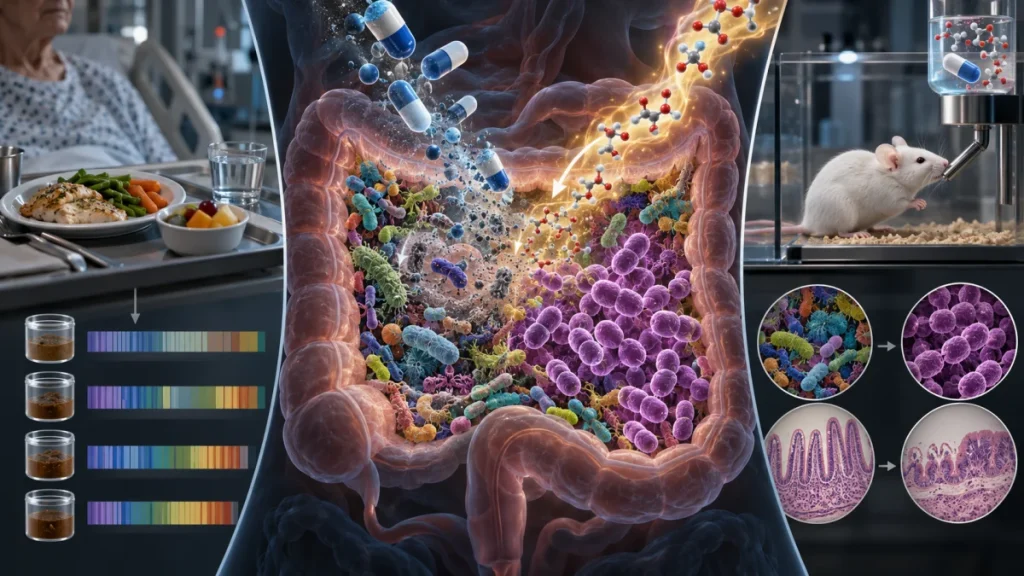

No human study has demonstrated that eating less protein makes people live longer.
That is the most important thing to understand about the new protein-and-longevity headlines.
A 2026 paper in Cell Press Blue makes a serious scientific case that restricting dietary protein—or certain amino acids within protein—can affect biological pathways involved in aging. Protein restriction has repeatedly extended lifespan in flies and rodents, and short-term human experiments have produced potentially beneficial metabolic changes.
But the leap from those findings to “eat less protein and you will live longer” has not been demonstrated in humans.
There is another important correction: the paper behind the latest headlines is a review, not a new experiment involving hundreds of people, and not a conventional meta-analysis statistically combining comparable clinical trials. The published paper itself is explicitly labeled “Review” and contains 361 references covering everything from yeast and worms to mice, observational human research and relatively short clinical interventions. Some consumer coverage has nevertheless described it as a “meta-analysis.”
That distinction changes what the paper can actually tell us.
What did the new protein and aging study actually do?
The paper, “The hallmarks of protein and amino acid restriction in aging and longevity,” was written by Bailey A. Knopf and Dudley W. Lamming of the University of Wisconsin–Madison and released in Cell Press Blue in 2026. Its purpose was to synthesize decades of research into how lower protein intake appears to affect aging biology.
The authors identify several recurring biological effects of protein restriction, including changes in metabolic health, nutrient-sensing pathways, cellular senescence, mitochondrial function and epigenetic regulation. They also examine individual amino acids—especially methionine, isoleucine and valine—that may account for some of the effects traditionally attributed to total protein restriction.
This is valuable work. Reviews can reveal patterns that individual experiments cannot.
But it is not equivalent to taking thousands of humans, randomly assigning them to different protein intakes for decades and measuring how long they live.
That experiment does not exist.
The strongest longevity evidence comes from animals
This is where the evidence becomes both fascinating and easy to overstate.
Lower-protein diets have repeatedly extended lifespan in laboratory animals. The review summarizes experiments in flies, mice and rats in which lower protein intake or restriction of particular amino acids increased lifespan—sometimes substantially.
One mouse experiment cited by the review found that reducing dietary protein extended lifespan in male mice by roughly 35%, although the same intervention did not produce the same longevity benefit in female mice. Other experiments have likewise found sex-, strain- and diet-dependent differences.
That matters.
“Protein restriction extends lifespan in animals” is reasonably well supported.
“Protein restriction therefore extends lifespan in humans” is an extrapolation.
Animal longevity studies are enormously useful because researchers can control diet for an organism’s entire life, manipulate genes and tissues, and directly observe lifespan. Those advantages are precisely what make equivalent human experiments nearly impossible.
So the animal evidence gives scientists a plausible biological hypothesis. It does not give consumers a proven longevity diet.
What has actually happened when humans eat less protein?
Human research is much less dramatic than the lifespan headlines suggest, but it is still interesting.
A 2016 randomized study found that moderately reducing protein intake over approximately six weeks decreased body weight, fat mass and fasting blood glucose while increasing the hormone FGF21. The investigators explicitly noted that applying the animal findings to humans had previously been uncertain.
Another randomized trial published in 2022 studied just 21 people with metabolic syndrome for 27 days. Ten followed an isocaloric protein-restricted diet while 11 underwent calorie restriction. The protein-restriction group experienced reductions in body fat and improvements in glucose, lipid levels, blood pressure and insulin sensitivity despite not being assigned to eat fewer calories.
Those are meaningful findings.
They are also 27-day metabolic outcomes, not evidence that anybody lived longer.
A 2025 Nature Metabolism study provides an especially useful example of the difference. Researchers placed healthy young men on protein-restricted diets containing approximately 0.8 grams of protein per kilogram of body weight. Protein restriction raised circulating FGF21 and apparently increased the amount of energy participants needed to consume to maintain their weight.
But this was not a giant longevity experiment. One component included eight men; another included eight; and a third enrolled seven, with one dropout. The participants were young, lean, healthy men followed for weeks—not elderly adults followed until death.
The study tells us something important about human metabolism.
It tells us almost nothing directly about human lifespan.
FGF21 may be the most interesting part of the story
One reason scientists take protein restriction seriously is fibroblast growth factor 21, or FGF21.
FGF21 is a hormone involved in the body’s response to nutritional stress. Lower protein intake reliably increases FGF21 in mice and has also been shown to raise it in humans.
In mice, the relationship goes much further.
Animals engineered to produce unusually high amounts of FGF21 have lived substantially longer, and experiments indicate that FGF21 is required for at least some of the lifespan-extending effects of protein restriction in male mice. When researchers removed functional FGF21 signaling from those animals, protein restriction no longer delivered the same longevity benefit.
That makes FGF21 much more than a random biomarker.
It provides a biologically plausible mechanism connecting lower protein availability with changes in energy expenditure, nutrient sensing and aging.
But this is precisely where scientific reasoning has to stop short of marketing logic.
Lower protein raises FGF21 in humans.
FGF21 participates in longevity effects in mice.
It does not automatically follow that deliberately raising FGF21 by eating less protein will extend a human life.
That final causal link remains unproven.
Protein itself may not even be the whole story
Another major implication of the review is that talking about “protein” as if all protein has the same biological effects may be too simplistic.
Proteins are built from amino acids. Several appear to have unusually strong effects on nutrient-sensing pathways associated with aging.
The review focuses particularly on methionine, isoleucine and valine. Restricting these amino acids has reproduced some of the metabolic and longevity effects of restricting total protein in laboratory animals.
Isoleucine and valine are branched-chain amino acids. Methionine is another essential amino acid involved in several metabolic pathways. Because these amino acids are essential, however, humans cannot simply eliminate them from the diet.
And the paper certainly does not establish an anti-aging dose for any of them.
The authors themselves emphasize how much remains unknown about the optimal amount and composition of protein for individual humans. They specifically call for additional clinical research rather than presenting amino-acid restriction as an established human longevity treatment.
So the useful takeaway is not “avoid methionine” or “stop eating BCAAs.”
It is that protein quantity may be only one part of the question. Protein composition may matter too.
Human evidence on high protein is also not simple
There is observational evidence linking higher protein consumption—particularly certain dietary patterns involving animal protein—to diabetes, cardiovascular disease or mortality. But observational nutrition research is vulnerable to confounding because people who eat differently also differ in many other ways.
There are also findings pointing in the opposite direction for particular populations.
A frequently cited 2014 study of 6,381 adults found that higher protein intake was associated with increased mortality among people aged 50–65, while among participants over 65, higher protein intake was associated with lower all-cause and cancer mortality. The study was observational, so it cannot establish that protein caused either effect.
More recent evidence reinforces another complication: what replaces what matters.
A large network meta-analysis of prospective observational studies found lower all-cause mortality associated with replacing some animal protein with plant protein. That is not the same question as simply eating less protein. It suggests that protein source and the overall dietary pattern may be at least as important as chasing a particular number of grams.
Nutrition rarely behaves like a single-variable experiment in real life.
If you reduce protein, something else usually takes its place.
A three-year human trial makes the picture even more interesting
One of the longer human experiments cited in the 2026 review comes from the multinational PREVIEW diabetes-prevention trial.
A 2025 analysis followed adults with overweight or obesity and prediabetes who had first undergone an eight-week weight-loss program. During the subsequent maintenance phase, participants were assigned either a high-protein, low-glycemic-index diet or a moderate-protein, moderate-GI diet.
Among 1,856 participants included in the analysis, the moderate-protein group had a higher rate of prediabetes remission at both one and three years. At three years, 20.6% of the moderate-protein group met the remission definition compared with 15.5% of the high-protein group.
Again, interesting.
Again, not lifespan.
The study also cannot isolate protein perfectly because the diets differed in carbohydrate amount and glycemic index. Nearly half of participants had dropped out by year three, another reason not to turn the result into a universal rule.
What it does show is that the assumption “higher protein must always produce better metabolic outcomes” is too simplistic.
So does high protein shorten your lifespan?
We do not know.
There is enough mechanistic, animal and human metabolic evidence to take the possibility seriously.
There is not enough human evidence to state that a high-protein diet shortens lifespan.
That distinction is important because the 2026 review is partly colliding with a remarkable shift in American nutrition culture. Protein has become a marketing feature in everything from cereal and snack foods to beverages, while the newest federal Dietary Guidelines for Americans recommend protein serving goals of 1.2 to 1.6 grams per kilogram of body weight per day.
The older Recommended Dietary Allowance used in the National Academies’ Dietary Reference Intake framework is 0.8 grams per kilogram for healthy adults, although individual requirements can vary substantially. The 2026 review explicitly highlights the tension between that baseline requirement, higher recommendations and emerging longevity research.
Neither number should be confused with a scientifically established longevity optimum.
We do not currently have one.
Is “proteinmaxxing” unhealthy?
Not necessarily.
For someone performing substantial resistance training, building muscle, recovering from injury or otherwise experiencing greater protein demand, consuming more protein can serve a real physiological purpose. The review itself acknowledges the clear benefits of protein for muscle growth and exercise response.
The weaker assumption is that every person benefits from maximizing protein regardless of activity level, age, diet quality or existing intake.
The longevity literature does not support that conclusion.
If someone is relatively sedentary and already consuming ample protein, adding protein to every snack and beverage has not been shown to make that person healthier or longer-lived. The new review instead raises a scientifically credible possibility that consistently high amino-acid availability may have metabolic tradeoffs.
That possibility deserves investigation.
It does not yet deserve conversion into another extreme diet.
Should older adults eat less protein to live longer?
This is probably the group that should be most cautious about interpreting the new headlines literally.
Muscle loss, frailty and inadequate food intake become increasingly important risks with age. The review’s authors explicitly warn that many older adults already consume inadequate protein and that further restriction could push them into protein or amino-acid insufficiency.
The paper similarly warns against indiscriminate protein restriction in growing children, pregnant people, people restricting calories, people recovering from injuries and other groups with elevated nutritional requirements. Highly active people may also require or tolerate considerably more protein.
That produces an uncomfortable but scientifically reasonable possibility:
The amount of protein that is optimal for longevity may not be the same at every stage of life.
Some animal and observational human research even suggests that lower protein exposure earlier in adulthood and greater protein availability later in life could have different effects. That remains a hypothesis rather than a clinically proven lifespan strategy.
What the study really changes
The important result of this research is not that scientists discovered a low-protein longevity diet.
They did not.
The more consequential finding is that the modern assumption “more protein is automatically better” is becoming difficult to defend as a universal nutritional principle.
There is now substantial animal evidence that protein quantity and amino-acid composition influence aging biology. There is credible mechanistic evidence involving FGF21, mTOR and other nutrient-sensing pathways. Human experiments show that reducing protein can alter metabolism, glucose regulation and energy expenditure. Longer human studies have also produced reasons to question whether high-protein diets are automatically metabolically superior.
But there is still a missing piece that every dramatic longevity headline quietly jumps over:
We do not know whether humans who deliberately eat less protein actually live longer.
The authors of the review effectively acknowledge that gap themselves. In their limitations section, they say optimal protein levels remain unknown and call for the next generation of clinical research needed to translate protein- and amino-acid-restriction findings into human interventions.
That is where the science stands in 2026.
Protein restriction is a legitimate longevity research field.
It is not yet a proven human longevity prescription.
References and Further Reading
Primary Review
Knopf & Lamming — “The Hallmarks of Protein and Amino Acid Restriction in Aging and Longevity” (Cell Press Blue, 2026) — The primary paper behind the current headlines. It synthesizes 361 references on protein restriction, amino acids, FGF21, nutrient sensing and aging and explicitly discusses the major limitations of translating this evidence to humans.
Human Intervention Research
Nicolaisen et al. — “Dietary Protein Restriction Elevates FGF21 Levels and Energy Requirements to Maintain Body Weight in Lean Men” (Nature Metabolism, 2025) — Controlled experiments in healthy young men showing that protein restriction raised FGF21 and altered energy requirements. Important mechanistic human evidence, but based on small samples and short interventions.
Ferraz-Bannitz et al. — “Dietary Protein Restriction Improves Metabolic Dysfunction in Patients with Metabolic Syndrome in a Randomized, Controlled Trial” (Nutrients, 2022) — A 27-day randomized intervention involving 21 people with metabolic syndrome that found improvements in several metabolic measures under protein restriction.
Fontana et al. — “Decreased Consumption of Branched-Chain Amino Acids Improves Metabolic Health” (Cell Reports, 2016) — Early randomized human evidence that moderate protein restriction can rapidly affect fasting glucose, body composition and FGF21, alongside extensive mechanistic experiments in mice.
Zhu et al. — “Long-Term Effects of Dietary Protein and Carbohydrate Quality on Prediabetes Remission” (Diabetologia, 2026) — Three-year PREVIEW trial analysis comparing higher- and moderate-protein dietary patterns in adults with prediabetes after initial weight loss.
Mechanistic and Animal Longevity Research
Hill et al. — “FGF21 Is Required for Protein Restriction to Extend Lifespan and Improve Metabolic Health in Male Mice” (Nature Communications, 2022) — A key experiment demonstrating that the hormone FGF21 is mechanistically necessary for the lifespan benefit of protein restriction in the male mouse model studied.
Nutrition Guidance
Dietary Guidelines for Americans, 2025–2030 — U.S. Department of Health and Human Services and U.S. Department of Agriculture — Current federal dietary guidance, including the newer protein serving goal of 1.2–1.6 g/kg/day.
USDA National Agricultural Library — Dietary Reference Intake Calculator for Healthcare Professionals — Official tool using Dietary Reference Intake values established by the National Academies and useful for understanding the distinction between population reference intakes and newer dietary guidance.
Coverage Behind the Current Claim
Food & Wine — “Could Eating Less Protein Help You Live Longer? Here’s What a Major New Analysis Found” — August 18 coverage that helped push the research into mainstream consumer discussion. The article describes the paper as a meta-analysis, while the underlying publication itself is labeled a review.
Editorial currency note: This article reflects research and U.S. dietary guidance available as of August 19, 2026. Protein recommendations and longevity research remain active areas of investigation, and individual needs can differ substantially with age, activity, pregnancy, illness, recovery and other medical factors.