
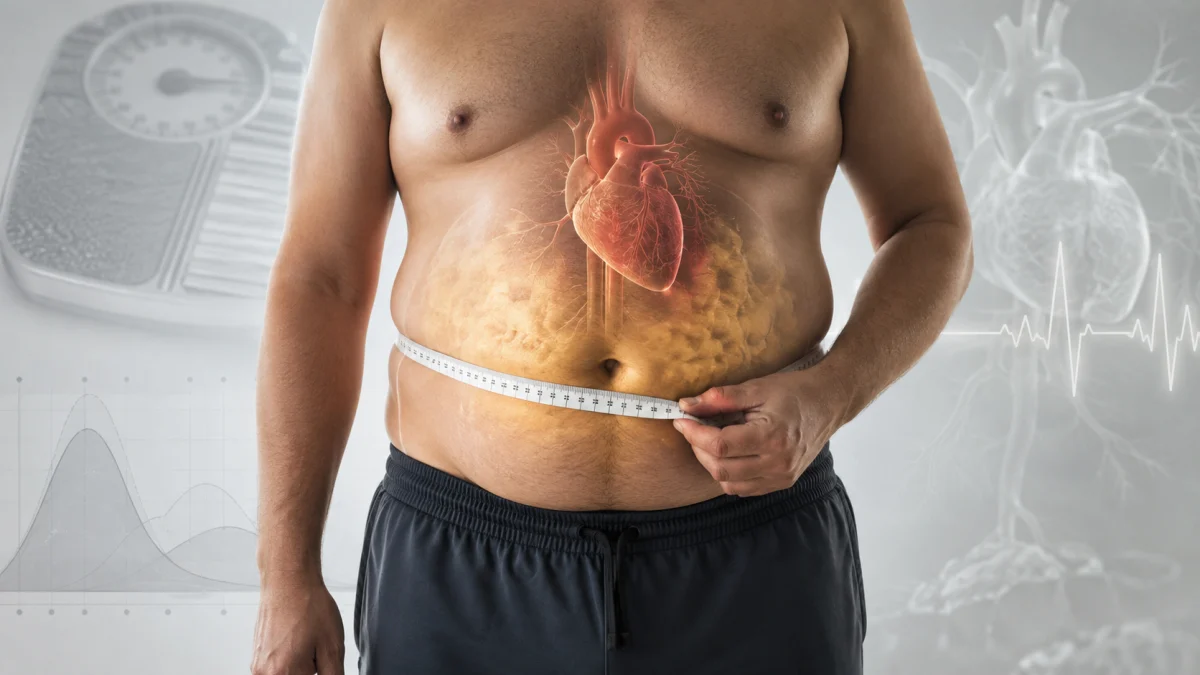
The short answer: waist size can reveal cardiovascular risk that BMI misses, but the new research does not show that BMI is useless or should simply be replaced by a tape measure.
The stronger conclusion is more practical: BMI alone is incomplete.
In a study published August 11, 2026, in the Journal of the American College of Cardiology (JACC), researchers combined data from 15 prospective cohorts involving 259,388 adults and followed participants for a median of about 20 years. Waist circumference and waist-to-hip ratio separated people with substantially different cardiovascular risks even when they fell into the same BMI category.
That matters most at the two places where BMI can be misleading.
Some people with a supposedly “normal” BMI carried substantially more abdominal fat and had higher cardiovascular risk. Conversely, some people classified as having obesity by BMI had relatively little central adiposity and substantially lower risk than BMI alone would suggest.
So the viral claim that “waist size predicts heart disease better than BMI” contains a real scientific point.
The claim that “BMI is useless” goes considerably beyond what this study found.
What did the new waist-size study actually find?
Researchers analyzed adults without coronary heart disease at baseline from the Cross-Cohort Collaboration, which combines large longitudinal studies including ARIC, CARDIA, the Framingham Heart Study, MESA, the Jackson Heart Study, the Women’s Health Initiative and others. Most cohorts were based in the United States, with ELSA-Brasil also included.
They compared BMI with two measures of central adiposity:
- Waist circumference (WC): the distance around the abdomen.
- Waist-to-hip ratio (WHR): waist circumference divided by hip circumference.
They then tracked nine cardiovascular and mortality outcomes, including heart attacks, strokes, heart failure, atrial fibrillation, coronary heart disease, overall cardiovascular disease, cardiovascular death and all-cause mortality.
The discordance with BMI was substantial.
Among people whose BMI was considered normal:
5% had a high waist circumference, while 18% had a high waist-to-hip ratio.
Among people categorized as overweight:
39% had a high waist circumference and 40% had a high waist-to-hip ratio.
And among people classified as having obesity:
9% had a low waist circumference and 45% had a low waist-to-hip ratio.
That is the heart of the study: people who look identical when sorted into a BMI category can have very different body-fat distributions.
And those differences were associated with actual health outcomes.
Among people with normal or overweight BMI, having a clinically high waist circumference or waist-to-hip ratio was generally associated with roughly 15% to 50% higher risk across most of the cardiovascular outcomes studied.
So does waist size actually predict heart disease better than BMI?
In some important respects, yes—but “better” needs qualification.
The study demonstrates that waist circumference and waist-to-hip ratio contain prognostic information that BMI does not contain. If two people have the same BMI but one carries considerably more fat around the abdomen, treating them as having equivalent cardiovascular risk can be misleading.
But this was not simply a competition in which researchers built one prediction model using BMI, another using waist circumference, and declared a universal winner.
The study was specifically designed to examine risk reclassification and heterogeneity within BMI categories. Its practical conclusion was to assess central adiposity in addition to BMI, not necessarily instead of it. The paper’s own central illustration gives the clinical implication succinctly: measure waist circumference and/or waist-to-hip ratio alongside BMI.
Earlier systematic evidence points in the same general direction. A meta-analysis of 40 studies found slightly stronger cardiovascular discrimination for waist circumference and waist-to-hip ratio than BMI, although differences were modest and much of that evidence was cross-sectional rather than decades-long prospective follow-up.
The defensible conclusion is therefore:
Waist-based measurements are generally better than BMI at revealing abdominal fat distribution. BMI remains useful for overall body-size screening. Using both usually provides more information than either alone.
What waist size is considered risky?
The new JACC study used established sex-specific clinical thresholds:
Women: above 88 centimeters, or roughly 35 inches
Men: above 102 centimeters, or roughly 40 inches
For waist-to-hip ratio, the study defined high values as:
Women: above 0.85
Men: above 0.90
Current U.S. cardiovascular guidance similarly considers abdominal obesity to begin around 35 inches for women and 40 inches for men.
But there is an important caveat that tends to disappear from social-media graphics:
35 and 40 inches are screening thresholds, not biological cliffs.
Your cardiovascular biology does not abruptly change because your waist moves from 34.9 to 35.1 inches. Cardiometabolic risk exists along a continuum, and the significance of a particular measurement also depends on factors including age, blood pressure, cholesterol, glucose control, smoking, fitness, family history and underlying disease. The international commission that proposed updated obesity definitions likewise emphasizes that disease risk rises across a continuum of increasing adiposity.
How should you actually measure your waist?
This is surprisingly important because measuring at different locations can produce different numbers.
For practical U.S. clinical use, the American Heart Association and National Institutes of Health method is straightforward:
Stand upright and expose the abdomen if possible. Locate the top of the hip bone—the iliac crest—and wrap a non-stretch measuring tape horizontally around the abdomen at that level. Keep the tape snug without compressing the skin, relax rather than sucking in your stomach, breathe out normally and take the measurement at the end of the exhalation. Repeating the measurement two or three times improves consistency.
The World Health Organization uses a slightly different standardized location: approximately halfway between the lowest palpable rib and the top of the iliac crest. WHO likewise recommends measuring while relaxed at the end of a normal breath out and repeating the measurement for accuracy.
That difference does not invalidate waist circumference. It does mean you should use the same method every time if you are tracking changes.
The new JACC analysis itself combined 15 cohorts whose exact waist-measurement protocols differed, then harmonized those measurements for analysis.
For home monitoring, consistency is therefore more useful than hunting for an anatomically perfect millimeter.
Also avoid measuring immediately after a large meal or when unusually bloated if your goal is to compare your waist over time. Current 2026 obesity standards specifically note those sources of variation.
How do you measure waist-to-hip ratio?
Measure your waist consistently using one of the established methods above.
Then measure your hip circumference around the widest portion of the buttocks, keeping the tape horizontal.
Divide:
waist circumference ÷ hip circumference = waist-to-hip ratio
A 32-inch waist and 40-inch hip circumference, for example, produces a WHR of 0.80.
WHO recommends measuring both waist and hips while standing relaxed, with the tape snug but not compressing the body.
Waist circumference vs. waist-to-hip ratio vs. BMI: which is actually most useful?
There is no single measurement that wins in every circumstance.
| Measurement | What it captures well | Main weakness | Best practical use |
|---|---|---|---|
| BMI | Overall weight relative to height | Cannot distinguish muscle from fat or show where fat is stored | Fast population and clinical screening |
| Waist circumference | Abdominal size and central adiposity | Does not directly measure visceral fat and does not account for hip size or height | Probably the simplest practical addition to BMI |
| Waist-to-hip ratio | Distribution of abdominal size relative to the hips | Requires two accurate measurements and can change because of either waist or hip size | Additional assessment of body-fat distribution |
The new study found meaningful information from both waist circumference and WHR. It did not establish one as universally superior.
There were some interesting differences.
WHR classified considerably more normal-BMI participants as having elevated central adiposity—18%, compared with only 5% using the study’s waist-circumference threshold. Yet among participants with obesity, elevated waist circumference accounted for particularly large shares of several cardiovascular outcomes at the population level.
For everyday clinical use, waist circumference has a strong practical advantage because it requires one measurement and is increasingly recommended alongside BMI. A major international consensus statement has argued for treating waist circumference almost like a cardiovascular “vital sign.”
Modern obesity frameworks also increasingly use waist-to-height ratio, which adjusts waist size for overall stature. The 2026 Standards of Care in Overweight and Obesity incorporate it into assessment, although waist-to-height ratio was not tested in this particular JACC study.
What if you have a normal BMI but a large waist?
This may be the group for whom the study is most immediately useful.
A person with a BMI of 23 can be reassured by the label “normal weight” while still carrying a disproportionate amount of abdominal fat.
The JACC data suggest that this is not rare.
About one in 20 normal-BMI participants had a waist above the study’s clinical threshold, while nearly one in five had an elevated waist-to-hip ratio. Those patterns were associated with greater cardiovascular risk across most outcomes.
A normal BMI therefore should not be interpreted as proof of low cardiometabolic risk.
Someone with a normal BMI but a disproportionately large waist may warrant closer attention to blood pressure, lipid levels, glucose or A1C, smoking, exercise, family history and overall cardiovascular risk.
A tape measure cannot diagnose heart disease—but neither should a normal BMI automatically end the conversation.
What about muscular people whose BMI says they are overweight or obese?
This is the opposite BMI problem.
BMI cannot determine whether someone’s weight comes from adipose tissue, skeletal muscle, bone or some combination of the three.
A muscular athlete can therefore have a BMI categorized as overweight—or occasionally obese—without having the abdominal-fat pattern typically associated with obesity-related cardiovascular risk.
The new JACC study provides an intriguing signal here.
Among people classified as having obesity, those with a low waist circumference generally did not have significantly different risk for most outcomes compared with normal-BMI participants who also had low waist circumference. The authors specifically suggest that better cardiorespiratory fitness or greater muscle mass could partly explain this phenotype.
But that explanation remains an inference.
The researchers did not directly measure physical activity or body composition, so the study cannot prove that its lower-waist, high-BMI participants were muscular athletes. The authors explicitly list the absence of physical-activity information among the study’s limitations.
Current 2026 obesity standards nevertheless address exactly this clinical problem: when someone appears to have unusually high muscle mass, clinicians are advised to assess central adiposity rather than diagnosing obesity from BMI alone and may consider direct body-composition measurements when appropriate.
Does waist size mean the same thing for women and men?
Not entirely.
The standard thresholds are already sex-specific because body composition and fat distribution differ substantially between women and men.
The new study also found an important sex difference.
Among men classified as having obesity but with low central adiposity, cardiovascular risk was generally much closer to the low-waist normal-BMI reference group.
Women with obesity and a low WHR, however, retained significantly higher risk across the studied outcomes than women with normal BMI and low WHR—although their risk was still lower than women with obesity and high WHR.
The authors caution that part of this pattern may reflect residual differences in BMI severity rather than WHR itself.
The study also had a predominantly female population, partly because several of the large cohorts included women specifically. That gave researchers unusual statistical power to examine female cardiovascular outcomes, but it also means the overall dataset does not represent a perfectly balanced cross-section of the population.
Does ethnicity change what waist measurement is considered risky?
Yes—and this is one reason a universal internet graphic saying simply “35 inches for women, 40 for men” is incomplete.
People from some Asian populations tend to develop metabolic and cardiovascular abnormalities at lower BMI and waist measurements than populations on which older Western thresholds were largely based.
The 2026 Standards of Care in Overweight and Obesity use lower central-adiposity thresholds for adults with Asian backgrounds:
Women: about 80 cm / 31.5 inches
Men: about 90 cm / 35.5 inches
For adults with non-Asian backgrounds, the corresponding thresholds remain approximately 88 cm and 102 cm.
The international Lancet Commission on obesity similarly recommends using anthropometric cutoffs validated for the person’s age, sex and ethnic background rather than assuming that one number perfectly applies to everyone.
The new JACC study included participants identified as White, Black, Hispanic, Asian, American Indian or Alaska Native and other backgrounds and statistically adjusted its models for race and ethnicity. But it used the same sex-specific waist and WHR thresholds across those groups rather than establishing new ethnicity-specific cutoffs.
So this paper strengthens the case for measuring central adiposity. It does not settle the question of the ideal waist threshold for every population.
What does the claim that 49% of heart-failure events were linked to waist size mean?
One of the study’s most dramatic findings is also one of the easiest to misunderstand.
Among participants with obesity, researchers calculated that elevated waist circumference was associated with a population-attributable fraction of approximately:
49% for heart-failure events, 46% for atrial-fibrillation events and 36% for coronary-heart-disease mortality.
That does not mean abdominal fat was proven to cause 49% of individual heart-failure cases.
A population-attributable fraction is a statistical estimate of how much of the observed burden is associated with a particular exposure under the assumptions of the model.
This was an observational study.
The researchers measured waist circumference and WHR once, did not have complete measures of diet, physical activity or genetic obesity risk and explicitly state that residual confounding remains possible. The study cannot establish causation.
So it would also be incorrect to claim that reducing someone’s waist below a certain number will automatically eliminate the percentage of risk attributed to elevated waist circumference.
Why is belly fat different from fat elsewhere?
Waist measurements are useful because they provide a crude signal of central adiposity, particularly the fat stored within and around the abdominal cavity.
Visceral adipose tissue surrounding internal organs is metabolically different from much of the subcutaneous fat stored directly beneath the skin.
It is associated with inflammatory signaling, insulin resistance, abnormal lipid metabolism and other processes involved in diabetes, atherosclerosis and cardiovascular disease.
But waist circumference is still only a surrogate.
It does not tell you exactly how many pounds of visceral fat you have, and two people with identical waist measurements can have different amounts of visceral fat, subcutaneous fat and muscle.
Imaging such as CT, MRI or DXA can characterize body composition more directly, but those approaches are far less practical than a $5 measuring tape for routine screening.
Does this study prove BMI is useless?
No.
That is probably the most important correction to the viral interpretation.
BMI is crude. It does not distinguish muscle from fat. It does not describe fat distribution. It can understate risk in someone with normal weight and substantial abdominal adiposity, and it can overstate adiposity in some highly muscular people.
Those are serious limitations.
But BMI still provides information about overall body size relative to height, has an enormous evidence base, is inexpensive, reproducible and remains useful for screening and population-level analysis.
Even some of the strongest contemporary criticisms of BMI do not recommend pretending it contains no information.
The 2025 Lancet Commission recommended using BMI primarily as a screening or population-level measure and confirming excess adiposity with waist measurements or direct body-fat assessment when individual diagnosis matters.
The 2026 Standards of Care in Overweight and Obesity similarly continue to use BMI for screening while incorporating waist circumference and waist-to-height ratio for more individualized assessment.
And the authors of the new JACC study themselves conclude that clinicians should consider central fat distribution across the BMI spectrum.
In other words:
The evidence supports moving beyond BMI alone—not pretending BMI never mattered.
The practical takeaway
If you want a simple number that BMI does not provide, measure your waist.
For many U.S. adults, approximately 35 inches for women and 40 inches for men are useful warning thresholds, with lower thresholds appropriate for many people of Asian background.
But treat those numbers as screening signals rather than diagnoses.
A normal BMI does not guarantee low cardiovascular risk.
A high BMI does not reveal whether your weight comes primarily from fat or muscle.
A small waist does not erase high LDL cholesterol, hypertension, diabetes, smoking or a strong family history.
And a large waist does not tell you that heart disease is inevitable.
The useful shift produced by this research is therefore not replacing one simplistic number with another.
It is recognizing that how much you weigh and where you carry that weight answer different questions.
For cardiovascular risk, knowing both is better than knowing only one.
References and Further Reading
Primary Research
Risk Reclassification Beyond BMI by Waist Circumference and Waist-to-Hip Ratio Across 9 Cardiovascular Outcomes: Results From the Cross-Cohort Collaboration — JACC / PubMed The original 2026 study involving 259,388 participants from 15 prospective cohorts and a median follow-up of approximately 20 years.
Central Adiposity as Predictor of Cardiovascular Outcomes — American College of Cardiology ACC’s clinical summary of the study, including its major risk-reclassification findings.
Clinical Guidance and Measurement
Heart-Healthy Living: Aim for a Healthy Weight — National Heart, Lung, and Blood Institute Current NIH guidance on BMI, waist circumference, cardiovascular risk and the standard U.S. waist-measurement method.
Obesity: Measuring Waist Circumference — American Heart Association Cardiovascular-Kidney-Metabolic Health Initiative Detailed 2026 clinical protocol explaining where and how waist circumference should be measured.
Screening, Diagnosis, Evaluation, and Staging of Obesity in Adults: Standards of Care in Overweight and Obesity—2026 Current clinical standards incorporating BMI, waist circumference and waist-to-height ratio, including lower thresholds for adults with Asian backgrounds.
Broader Evidence and Definitions
Definition and Diagnostic Criteria of Clinical Obesity — The Lancet Diabetes & Endocrinology Commission The influential international framework arguing that BMI should not serve as a standalone individual diagnosis of obesity and recommending confirmation of excess adiposity using additional measurements.
Waist Circumference as a Vital Sign in Clinical Practice — Nature Reviews Endocrinology International consensus review explaining why waist circumference adds information beyond BMI and recommending its routine clinical use.
Waist Circumference and Waist–Hip Ratio: Report of a WHO Expert Consultation WHO’s detailed reference on standardized measurement techniques, risk thresholds and differences related to sex, age and ethnicity.
Editorial currency note: Cardiovascular-risk and obesity-classification standards continue to evolve. Waist and BMI thresholds described here reflect major clinical guidance available as of August 18, 2026 and should be interpreted alongside individual medical history and current clinical recommendations.