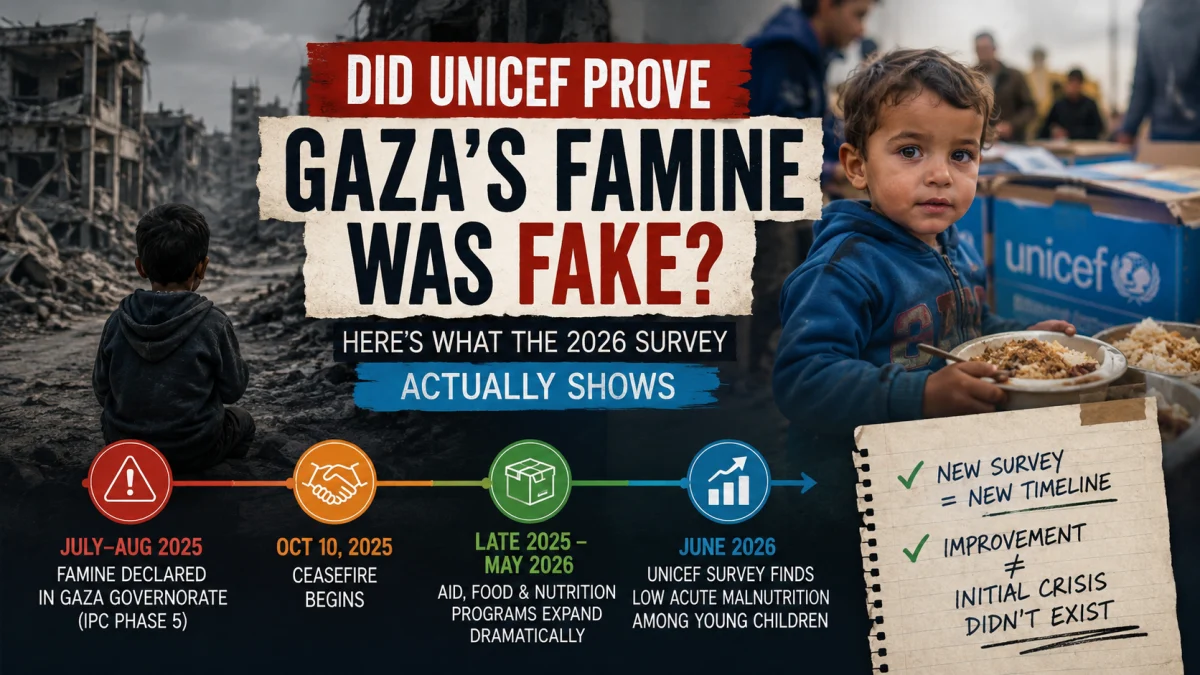
A new UNICEF-coordinated nutrition survey found surprisingly low acute malnutrition among young children in Gaza in June 2026. The finding is real. The claim that it proves Gaza’s 2025 famine was fabricated is not.
The short answer
No. UNICEF did not prove that the Gaza famine was fake.
A 2026 nutrition survey found low rates of acute malnutrition among young children in the accessible areas researchers could survey in Gaza. That is important evidence about Gaza in June 2026.
But the formal famine determination people are now attempting to discredit concerned Gaza Governorate in July and August 2025 — roughly ten months earlier.
Between those two measurements, something enormously important happened: an October 2025 ceasefire was followed by a major expansion of food assistance, nutrition programs, treatment services and commercial access.
By May 2026, food parcels were reaching roughly 1.5 million people, and nutrition support was reaching about 60% of children under five. In September 2025, nutrition-program coverage for children under five had been below 1%.
In other words:
2025: severe food insecurity and rapidly worsening malnutrition → famine classification.
Late 2025–2026: ceasefire, substantially expanded food and nutrition assistance and increased commercial flows.
June 2026: substantially lower child acute malnutrition.
That sequence is evidence that conditions changed.
It is not evidence that the earlier conditions never existed.
The claim now spreading online
On August 7, 2026, The Jerusalem Post published an article headlined:
“‘Facts prevail over fiction,’ Danon says as new UNICEF-led survey challenges Gaza famine claims.”
The article accurately reported that a UNICEF-coordinated survey found low acute-malnutrition levels among young children in Gaza. But it also prominently featured Israeli UN Ambassador Danny Danon characterizing the results as evidence that the famine narrative was false, along with an Israeli Foreign Ministry statement declaring, “There is no famine in Gaza.”
That political interpretation has since been repeated online in a much broader form:
UNICEF admitted Gaza was never experiencing famine.
Or:
The new survey proves the Gaza famine was fabricated.
Or simply:
Gaza famine debunked.
There is a basic problem with all three formulations.
The new survey did not measure Gaza during the period when famine was classified.
It measured Gaza after conditions had materially changed.
What did the 2026 Gaza nutrition survey actually find?
The underlying survey is not imaginary, and its results should not be dismissed simply because people are using them politically.
According to UNICEF’s August 2026 humanitarian situation report, the 2026 Gaza SMART Survey was conducted from June 2 through June 16, 2026.
Researchers surveyed accessible areas across all five Gaza governorates, covering approximately 83% of the population.
The study included:
UNICEF reported combined Global Acute Malnutrition among young children of 1.3% and stunting of 12.2%.
Those are strikingly low acute-malnutrition numbers considering the conditions Gaza had experienced.
They deserve to be reported.
But UNICEF’s own explanation is almost the opposite of the conclusion now being attached to them.
UNICEF explicitly cautioned that the low acute-malnutrition prevalence should not be interpreted as meaning the nutrition crisis had ended. It said sustained humanitarian assistance had likely prevented more severe nutritional deterioration while chronic malnutrition, maternal malnutrition, poor diet quality and childhood illness remained widespread.
That is a crucial distinction.
The study tells us:
Children measured in June 2026 had much better acute-malnutrition outcomes than many people might expect.
It does not tell us:
Therefore children measured in July 2025 were never severely malnourished.
A survey cannot retroactively measure a different population at a different moment in time.
The dates are the entire story
This controversy becomes much easier to understand when the relevant dates are placed next to one another.
July–August 2025
Acute malnutrition and food deprivation deteriorated sharply in Gaza Governorate.
August 15, 2025
The Integrated Food Security Phase Classification, or IPC, concluded that Famine — IPC Phase 5 — was occurring in Gaza Governorate with reasonable evidence.
October 10, 2025
A ceasefire took effect, followed by substantially expanded humanitarian assistance and improved commercial access. UNICEF and the IPC subsequently documented improvements in food availability and nutrition.
May 2026
Approximately 1.49 million people were receiving in-kind food assistance. Nutrition support reached about 60% of children under five.
June 2–16, 2026
The new SMART nutrition survey measured children and found low acute-malnutrition prevalence.
There are roughly ten months between the famine determination and the new survey.
Those were not ten uneventful months.
The conditions affecting food availability, humanitarian access and nutritional treatment changed dramatically.
That makes the argument that the 2026 findings automatically invalidate the 2025 findings fundamentally unsound.
A simple analogy
Imagine a hospital admits a patient suffering severe dehydration.
Doctors give the patient intravenous fluids and treat them for several days.
A later blood test shows normal hydration.
Would that prove the patient was never dehydrated?
Of course not.
The relevant question would be:
What happened between the first measurement and the second?
The same principle applies here.
If nutritional conditions improved following increased food availability, supplementary feeding, medical treatment and humanitarian access, then a later survey showing healthier children is not inherently suspicious.
Improvement is precisely what a successful intervention is supposed to produce.
The 2026 IPC report actually documents the intervention
This is where the “new survey proves famine was fake” argument becomes particularly difficult to sustain.
The same 2026 IPC analysis showing dramatically improved nutrition also documents why conditions improved.
Following the October 2025 ceasefire, humanitarian operations expanded substantially.
By May 2026:
Compare that with September 2025.
At that point, approximately 500,000 people were receiving some form of food assistance, while nutrition-program coverage among children under five was below 1%.
That is an enormous change in exposure to food and nutritional support.
The IPC’s conclusion was straightforward: large-scale assistance following the October 2025 ceasefire drove improvements in food security and nutrition.
Another important number: 1.9 million people
There is an even more revealing finding buried in the 2026 IPC analysis.
The IPC estimated that about 1.9 million people — roughly 90% of Gaza’s population — would face high levels of acute food insecurity without humanitarian food-security assistance through December 2026.
That does not sound like a population whose nutritional wellbeing is independent of humanitarian intervention.
It suggests the opposite.
The relatively low acute-malnutrition measurements among young children were being observed inside an environment where extraordinarily large amounts of assistance were helping prevent nutritional deterioration.
That distinction matters.
The question is not simply:
“How many children were wasted when researchers measured them?”
The more useful question is:
“How many children would have become wasted if food assistance, supplementary feeding and treatment programs had not been operating?”
A prevalence survey measures the condition researchers encounter.
It does not automatically tell you what that condition would have been without intervention.
But didn’t the survey show Gaza had lower malnutrition than neighboring countries?
This comparison is one of the most rhetorically powerful claims circulating online.
It is also easy to misunderstand.
The Jerusalem Post reported weight-for-height acute-malnutrition estimates ranging from approximately 0.2% to 0.8% in surveyed Gaza regions, while UNICEF’s humanitarian report describes combined Global Acute Malnutrition of 1.3%.
Those findings can coexist because malnutrition can be calculated using different anthropometric measures, populations and aggregations.
But even accepting the lowest reported numbers at face value, they still describe June 2026.
Comparing Gaza’s June 2026 child-malnutrition prevalence with another country’s current or historical prevalence does not answer whether famine thresholds were reached in Gaza Governorate ten months earlier.
It is a comparison of different places at a particular later point in time, not a time machine.
Was Gaza actually officially classified as being in famine?
Yes — but precision matters.
The IPC did not declare that every person everywhere in the Gaza Strip was in famine.
On August 22, 2025, the IPC reported that as of August 15, Famine was confirmed in Gaza Governorate with reasonable evidence.
At the same time, it said more than half a million people across the Gaza Strip were experiencing catastrophic conditions and projected famine could expand to Deir al-Balah and Khan Younis. Conditions in North Gaza were estimated to be as severe or worse, but insufficient data prevented a formal classification there.
This distinction is important because the word famine has a specific technical meaning within the IPC system.
A population can also experience severe hunger, starvation or household-level IPC Phase 5 “Catastrophe” without an entire geographic area satisfying all requirements for an area-level famine classification.
How does the IPC decide that a famine exists?
An IPC famine determination is not based simply on whether people report being hungry.
Three separate outcomes must converge:
For acute malnutrition, IPC methodology recognizes different thresholds depending on how children are measured.
Using weight-for-height Z-scores (WHZ), the famine threshold is generally at least 30% acute malnutrition.
Using mid-upper-arm circumference (MUAC), the threshold is generally 15%, together with evidence of rapid deterioration in underlying conditions.
This leads directly to another claim frequently attached to the “fake famine” argument.
Did the IPC secretly lower the famine threshold from 30% to 15% for Gaza?
No.
This is one of the more misleading claims circulating around the controversy.
The IPC did use a 15% MUAC threshold in its Gaza analysis.
But it did not invent that threshold for Gaza.
IPC documentation says the MUAC method has been part of its famine methodology since 2019 and was previously used in famine analyses including South Sudan and Sudan.
WHZ and MUAC are two different anthropometric measurements.
They do not generate identical prevalence estimates.
According to the IPC, WHZ typically identifies substantially more acute-malnutrition cases than MUAC, which is why their famine thresholds differ.
So:
30% WHZ and 15% MUAC are not competing definitions of the same measurement.
They are different thresholds associated with different measurement systems.
Someone can legitimately debate whether MUAC data collected in Gaza were sufficiently representative.
But saying the IPC simply “cut the famine threshold in half for Gaza” leaves out the methodological distinction that explains the two numbers.
What did the 2025 malnutrition data show?
The 2025 evidence deserves scrutiny because it was substantially messier than the June 2026 SMART survey.
During active conflict, researchers were unable to conduct the kind of full weight-and-height SMART survey later carried out in 2026.
Instead, nutrition organizations relied heavily on community-based MUAC screenings.
The IPC reported data from 19,431 children ages 6–59 months in Gaza Governorate during July 2025, collected by seven organizations.
The reported prevalence of Global Acute Malnutrition by MUAC rose from:
10.1% during July 1–15
to
16.4% during July 16–31.
The IPC’s MUAC famine threshold was 15%.
That sharp increase was one of the major pieces of evidence behind the famine determination.
It is also exactly why comparing those data with a population measured almost a year later, after a major nutrition response, requires extreme caution.
The strongest legitimate criticism of the 2025 famine finding
There is a real weakness in the original famine determination, and it should not be hidden.
Mortality was the least certain component.
The IPC famine framework includes a crude death-rate threshold of approximately two deaths per 10,000 people per day.
Direct surveillance did not demonstrate that rate cleanly in Gaza Governorate.
The IPC acknowledged that an average of only around six starvation-related deaths per day was being officially reported at the relevant point. It argued that the collapse of health and mortality-monitoring systems meant many malnutrition-related deaths were not being counted or properly attributed.
The Famine Review Committee therefore determined that the mortality threshold had likely been reached based on the wider evidence.
That is why the classification was:
Famine with reasonable evidence
rather than a stronger evidentiary classification.
IPC documentation says this designation can be used when there is clear evidence that two famine thresholds have been crossed and analysts reasonably assess that the third has likely been crossed. In Gaza’s case, the IPC said the food-insecurity and acute-malnutrition thresholds were supported directly, while mortality relied more heavily on inference.
That is a genuine methodological issue.
Anyone examining the Gaza famine determination critically should examine it.
But that is not what the 2026 survey proves
This distinction is essential.
There are two very different arguments:
Argument A
“The August 2025 IPC famine determination relied partly on indirect mortality evidence, and we should scrutinize whether the evidence was sufficient.”
That is a legitimate analytical argument.
Argument B
“Children had low acute malnutrition in June 2026, therefore the August 2025 famine was fabricated.”
That does not follow.
Even if someone ultimately concludes that the IPC was too aggressive in its August 2025 classification, the June 2026 survey by itself does not establish that conclusion.
To overturn the 2025 finding, you would need evidence about conditions in 2025.
A measurement taken after conditions changed cannot retroactively settle the earlier question.
What about the claim that famine predictions kept failing?
There is another legitimate point worth separating from the misinformation.
The IPC made several projections during the war warning that famine could develop or spread under expected conditions.
Some of the worst projected outcomes did not subsequently materialize.
The IPC itself acknowledges this.
In its August 2025 methodological response, it explained that famine warnings and projections in Gaza were repeatedly followed by changes in humanitarian access and aid delivery that altered the trajectory.
That does not automatically validate every IPC forecast.
Forecasting should be judged critically, particularly when consequential language such as famine is involved.
But there is a fundamental difference between:
“The predicted outcome did not happen.”
and
“The prediction was therefore fraudulent.”
If a hurricane forecast causes a city to evacuate and deaths are lower than predicted, that does not establish that the hurricane warning was invented.
Sometimes intervention changes the outcome.
The correct analytical question is whether the forecast was reasonable given the evidence available when it was made.
One survey also does not measure every form of hunger
Another source of confusion is treating acute malnutrition among children under five as synonymous with food security for an entire population.
It is not.
The June SMART survey found low acute malnutrition among young children, but UNICEF simultaneously reported:
Meanwhile, the IPC estimated that between mid-April and June 2026, more than 1.2 million people — 59% of Gaza’s population — were still experiencing Crisis-level or worse acute food insecurity, including about 212,000 in Emergency conditions.
Those figures are not necessarily contradictory.
A household can struggle severely to obtain food without every young child becoming acutely wasted.
Parents can reduce their own food intake to protect their children.
Supplementary feeding can specifically protect children.
Medical programs can identify and treat wasting.
Food assistance can prevent household deprivation from progressing to severe child malnutrition.
And child acute malnutrition is only one outcome among several used to understand a food emergency.
The 17% that researchers could not survey matters — but it does not invalidate the study
The 2026 SMART survey covered accessible areas containing approximately 83% of Gaza’s population.
That is substantial coverage.
It also means areas containing roughly 17% of the population were not represented because access and security conditions prevented survey teams from reaching them.
That limitation should neither be exaggerated nor ignored.
It would be wrong to say:
“The survey is worthless because it missed 17%.”
It would also be wrong to say:
“The survey proves every part of Gaza had the same nutritional conditions.”
The defensible conclusion is narrower:
The survey provides strong evidence that acute malnutrition among young children was low across the accessible areas covering most of Gaza’s population in June 2026.
That is what the evidence establishes.
So is there a famine in Gaza now?
According to the latest IPC analysis available at publication, no area of Gaza is currently classified as being in Famine, IPC Phase 5.
For mid-April through June 2026, all five governorates were classified at IPC Phase 3, Crisis, for acute food insecurity, while the analyzed governorates had much lower acute-malnutrition classifications.
That is another fact worth stating plainly.
There is not a current IPC famine classification in Gaza.
But:
“There is no famine now”
and
“there never was a famine”
are entirely different claims.
A fire department declaring that a building is no longer on fire does not prove the building was never burning.
What the new UNICEF survey proves — and what it doesn’t
| Claim | What the evidence says |
|---|---|
| A 2026 UNICEF-coordinated survey found low acute malnutrition among young children in Gaza. | True. |
| The survey covered every person and every area of Gaza. | No. Accessible areas representing about 83% of the population were surveyed. |
| Acute malnutrition improved substantially after late 2025. | Yes. |
| Humanitarian food and nutrition assistance expanded substantially before the 2026 survey. | Yes. |
| IPC currently classifies Gaza as being in famine. | No. |
| IPC classified Gaza Governorate as being in famine in August 2025. | Yes — with reasonable evidence. |
| The 2025 famine determination involved uncertainty. | Yes, particularly regarding mortality. |
| IPC secretly changed the malnutrition threshold from 30% to 15% for Gaza. | No. WHZ and MUAC have different established thresholds. |
| The June 2026 survey proves the August 2025 famine never happened. | No. |
| The 2026 data are irrelevant to evaluating the broader Gaza nutrition crisis. | Also no. They are important evidence of substantial improvement. |
Why the “famine was fake” claim is so persuasive
The argument works rhetorically because it contains a genuine fact.
That is often how misleading claims become effective.
The true part is:
Then an unsupported conclusion is attached:
The first statement lends credibility to the second.
But they are not logically equivalent.
The missing information is time.
Once the timeline is restored, the apparent contradiction largely disappears.
Could future evidence still challenge the 2025 famine determination?
Absolutely.
Scientific and humanitarian assessments are not sacred texts.
If better mortality records, representative surveys, archived food-security data or other high-quality evidence eventually show that one or more famine thresholds were not actually crossed in Gaza Governorate in August 2025, the historical classification should be revisited.
That would be evidence-based correction.
Likewise, the IPC’s reliance on community screenings rather than a full SMART survey, the representativeness of those screenings, assumptions regarding mortality and the interpretation of conflicting food-security data are all legitimate subjects for independent examination.
The IPC itself documented these limitations and disputes rather than claiming perfect certainty.
But skepticism has to work in both directions.
It is not rigorous to demand extraordinary proof for evidence suggesting famine and then accept a ten-month-later survey as definitive proof that the earlier evidence was fraudulent.
The same evidentiary standards have to apply to both conclusions.
The bottom line
The 2026 Gaza SMART Survey contains genuinely good news.
Acute malnutrition among young children measured in most accessible areas of Gaza was dramatically lower than during the worst period of the crisis.
That finding should not be minimized.
But neither should it be transformed into something the study cannot establish.
The survey does not prove that Gaza’s 2025 famine was fabricated.
It measured children in June 2026.
The IPC famine determination concerned Gaza Governorate in July and August 2025.
Between those dates came a ceasefire, increased commercial access, food assistance reaching roughly 1.5 million people, a vast expansion of nutrition programs and substantially greater treatment access.
The latest evidence therefore supports a much more straightforward conclusion:
Gaza’s nutrition situation improved dramatically.
Whether the IPC had enough evidence to apply the technical word famine in August 2025 remains a legitimate question for methodological scrutiny, particularly because the mortality threshold was inferred rather than directly demonstrated.
But that debate cannot be settled by pretending June 2026 and August 2025 were the same moment.
A later recovery does not prove an earlier crisis never occurred.
Frequently Asked Questions
Did UNICEF admit there was no famine in Gaza?
No. UNICEF reported low acute-malnutrition prevalence among young children surveyed in June 2026. UNICEF explicitly cautioned against interpreting the results as meaning the nutrition crisis had ended and said sustained humanitarian assistance likely prevented greater deterioration.
Did UNICEF prove the Gaza famine was fake?
No. The 2026 survey describes nutritional conditions roughly ten months after the August 2025 famine determination and after major changes in humanitarian assistance and food availability.
Was Gaza officially declared to be in famine?
Gaza Governorate was. The IPC classified Famine in Gaza Governorate as of August 15, 2025, using the designation “with reasonable evidence.”
Was the entire Gaza Strip officially declared in famine?
No. The formal August 2025 classification applied to Gaza Governorate. Other areas were experiencing severe food insecurity, and famine was projected or considered possible elsewhere, but the classifications differed by location and available evidence.
Is Gaza in famine in 2026?
The latest IPC analysis does not classify Gaza as currently being in famine. It continues, however, to classify large portions of the population as experiencing serious acute food insecurity.
Did IPC lower the famine threshold from 30% to 15% for Gaza?
No. The 30% and 15% thresholds correspond to different established methods of measuring acute malnutrition: WHZ and MUAC, respectively. IPC documentation indicates that both standards predate the Gaza famine analysis.
Why was mortality controversial in the 2025 famine determination?
Direct mortality monitoring was severely limited. The IPC concluded that the mortality threshold had likely been reached based on the wider evidence rather than demonstrating it through comprehensive mortality surveillance. That is why the famine was classified with reasonable evidence rather than with stronger direct evidence.
How could child malnutrition fall so quickly?
Food assistance, supplementary feeding, treatment services and commercial food access all expanded considerably after the October 2025 ceasefire. The IPC and UNICEF attribute much of the improvement to that expanded response.
References and Further Reading
Primary nutrition and humanitarian evidence
UNICEF — State of Palestine Humanitarian Situation Report No. 48, January–June 2026
UNICEF’s August 2026 report contains the primary summary of the June Gaza SMART Survey, including its dates, sample size, 83% population coverage, 1.3% combined Global Acute Malnutrition finding, 12.2% stunting finding and UNICEF’s warning against interpreting the results as proof that the broader nutrition crisis had ended.
UNICEF — Food Security and Child Nutrition Crises Persist in Gaza Despite Fragile Gains
Joint July 2026 update describing the substantial increase in food and nutrition assistance following the October 2025 ceasefire and the corresponding improvement in nutritional indicators.
World Food Programme — Food Security and Child Nutrition Crises Persist in Gaza Despite Fragile Gains
WFP’s publication of the same interagency findings, including food-aid coverage, nutrition-program expansion and continuing food-security concerns.
IPC famine and food-security classifications
IPC — Gaza Strip Acute Food Insecurity, July–September 2025
The official IPC analysis confirming Famine with reasonable evidence in Gaza Governorate as of August 15, 2025 and explaining conditions elsewhere in the Gaza Strip.
IPC — Response to Issues Raised Following IPC’s Famine Classification in the Gaza Strip
Essential methodological document addressing the 30%-versus-15% malnutrition-threshold claim, the July 2025 MUAC data, mortality uncertainty, conflicting datasets and the meaning of “reasonable evidence.”
IPC — Gaza Strip Acute Food Insecurity, April–December 2026
Current IPC food-security assessment documenting substantial improvement after the October ceasefire while finding that a majority of Gaza’s population continued to face Crisis-level or worse acute food insecurity.
IPC — Gaza Strip Acute Malnutrition, April–December 2026
Current acute-malnutrition assessment documenting the decline in child acute malnutrition following the scale-up of nutrition programs.
IPC — Gaza Strip Acute Food Insecurity and Malnutrition Special Snapshot, April–December 2026
Detailed July 2026 snapshot documenting humanitarian-aid coverage, commercial imports, changes in food consumption, nutrition-program expansion and the estimate that 1.9 million people would face high acute food insecurity without humanitarian food assistance.
Article at the center of the current claim
The Jerusalem Post — “‘Facts Prevail Over Fiction,’ Danon Says as New UNICEF-Led Survey Challenges Gaza Famine Claims”
The August 7, 2026 article helping drive the current controversy. It reports the new nutrition findings while prominently presenting Israeli officials’ interpretation that the results undermine previous famine claims. The political interpretation should be distinguished from the underlying survey findings themselves.
Editorial note: Food-security and malnutrition classifications can change rapidly as humanitarian access, conflict intensity, food availability, displacement and treatment capacity change. This article distinguishes historical classifications from current conditions and should be updated when new IPC or representative nutrition assessments are released.