Article type: evidence review
Scope: General public-health education about the 2026 cyclosporiasis outbreak, recall, epidemiology, food-safety systems, and reported claims. It is not individualized medical advice or a substitute for current official recall and clinical guidance.
Last updated: August 3, 2026
The phrase “explosive diarrhea lettuce” sounds like an internet exaggeration. Unfortunately, it describes a real and unusually large outbreak of cyclosporiasis, an intestinal illness caused by the microscopic parasite Cyclospora cayetanensis.
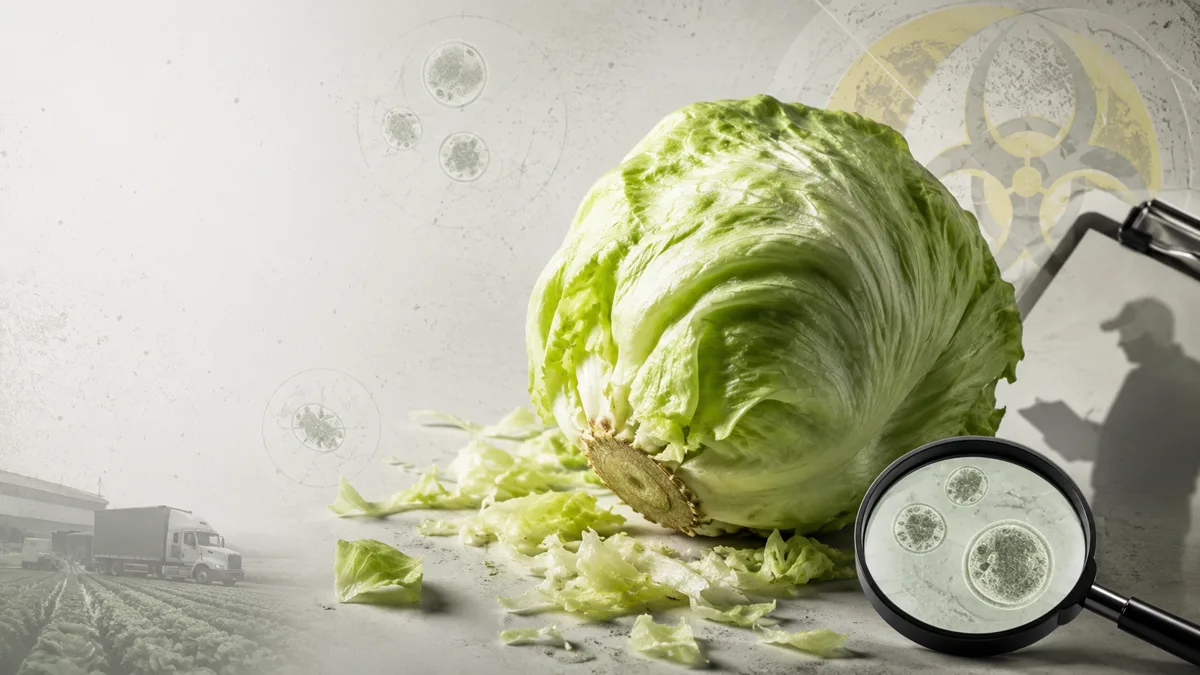
Federal investigators have linked one major nine-state outbreak to shredded iceberg lettuce supplied by Taylor Farms de Mexico and served at Taco Bell restaurants. The implicated lettuce was grown in central Mexico and distributed through a much larger network of restaurants, food-service companies and retailers.
As of the latest complete federal update, the Taylor Farms-linked cluster included at least 1,947 laboratory-confirmed illnesses and 98 hospitalizations. On August 3, Michigan officials also reported two deaths involving people with serious underlying health conditions that may have been worsened by cyclosporiasis and dehydration. The Centers for Disease Control and Prevention acknowledged the deaths on its outbreak page while noting that its numerical tables had not yet been updated.
Those figures, however, represent only one part of a much larger national problem.
Since May 1, the CDC has received reports of 6,707 laboratory-confirmed domestically acquired cases across 45 states, with at least 423 hospitalizations. The agency was also evaluating more than 11,500 additional cases that were not yet laboratory-confirmed or still required investigation, including the exclusion of international travel.
That means more than 18,000 confirmed and potential cases were somewhere in the reporting and investigation system by late July—but it does not mean Taylor Farms caused all 18,000 illnesses. The CDC has explicitly said it is investigating multiple clusters, some of which are unrelated to the recalled iceberg lettuce.
The distinction matters. There is strong evidence that Taylor Farms lettuce caused one large outbreak. There is not currently evidence that it caused every Cyclospora case reported across the country.
What We Know at a Glance
| Question | Best-supported answer |
|---|---|
| What caused the illness? | The parasite Cyclospora cayetanensis |
| What food was linked to the main outbreak? | Shredded iceberg lettuce |
| Who supplied it? | Taylor Farms de Mexico |
| Where was the lettuce sourced? | Growers in central Mexico |
| Where did many affected people eat? | Taco Bell restaurants in nine states |
| How many cases were linked to that cluster? | At least 1,947 laboratory-confirmed cases |
| How many people were hospitalized? | At least 98 in the defined lettuce-linked cluster |
| Were deaths reported? | Michigan reported two deaths on August 3 involving patients with significant underlying conditions |
| Was Cyclospora found in a lettuce sample? | No confirmed positive food sample had been reported as of the latest FDA update |
| Does that mean the lettuce was cleared? | No. Epidemiological and traceback evidence still strongly points to the lettuce |
| Is the precise contamination source known? | No. The exact field, water source or processing failure has not been publicly identified |
| Did prison labor cause the contamination? | There is no evidence establishing such a connection |
What Is Cyclospora?
Cyclospora cayetanensis is a single-celled parasite that infects the human small intestine. The resulting illness is called cyclosporiasis.
The most recognizable symptom is prolonged watery diarrhea, often involving frequent and sometimes explosive bowel movements. Other symptoms can include:
- abdominal cramps and bloating;
- excessive gas;
- nausea;
- loss of appetite;
- weight loss;
- severe fatigue;
- body aches;
- low-grade fever;
- and dehydration.
Symptoms usually begin approximately one week after infection, although they can appear anywhere from two days to two weeks or more after exposure. Without treatment, symptoms may persist for weeks, temporarily disappear and then return.
The standard treatment is the antibiotic combination trimethoprim-sulfamethoxazole, commonly sold as Bactrim. Routine stool testing does not always include Cyclospora, so patients with prolonged watery diarrhea may need to ask their healthcare provider to order a Cyclospora-specific test. Several samples may be necessary because infected people can shed the organism intermittently.
Why Cyclospora Is Different From an Ordinary Stomach Bug
Cyclospora has several characteristics that make outbreaks unusually difficult to detect and control.
First, humans are the only known host of C. cayetanensis. The parasite must therefore originate from human fecal contamination at some point in its life cycle.
That does not necessarily mean an infected restaurant worker directly handled someone’s meal. Cyclospora passed in human feces is generally not immediately infectious. It must remain in suitable environmental conditions for at least one or two weeks before it matures into a form capable of infecting another person.
Direct person-to-person transmission is therefore considered unlikely. Investigators instead focus on environmental pathways such as sewage-contaminated water, compromised septic systems, irrigation water, floodwater, soil contamination and produce-washing systems.
Second, the parasite is difficult to eliminate from fresh produce. Chlorine and many conventional produce-washing chemicals that help control bacteria are not reliably effective against Cyclospora.
Washing lettuce at home remains a reasonable food-safety practice, but washing cannot guarantee that Cyclospora will be removed. Cooking can destroy the parasite, but that is not particularly useful advice for foods normally consumed raw, such as shredded lettuce and salad greens.
What Actually Happened?
During June and July 2026, health departments began receiving an extraordinary number of cyclosporiasis reports, particularly in Michigan and neighboring states.
Investigators interviewed sick people about everything they had eaten during the two weeks before symptoms began. A large group reported eating at Taco Bell restaurants.
That did not necessarily mean Taco Bell created the contamination. Restaurants serve many ingredients from outside suppliers, so investigators had to determine which ingredient appeared consistently across affected meals.
Michigan health officials analyzed detailed meal information from 190 affected Taco Bell customers. Approximately 90 percent reported eating iceberg lettuce. Investigators then traced the lettuce served at the affected restaurants backward through distributors and processors.
The traceback converged on one supplier: Taylor Farms de Mexico, which had supplied shredded iceberg lettuce originating from growers in central Mexico.
On July 17, Taylor Farms initiated a broader recall of all iceberg lettuce sourced from the affected central Mexican region, including products distributed to restaurants, food-service customers and retailers. The recall included Marketside-brand iceberg salad and shredded lettuce sold through Walmart, as well as numerous food-service products sold under abbreviated brand and distribution codes.
Why Taco Bell Became the Center of the Investigation
The outbreak was initially easiest to identify through Taco Bell because the restaurant chain created a common exposure among a large number of patients.
CDC’s defined multistate cluster included people who became infected with Cyclospora and reported eating at Taco Bell before becoming ill. Cases were identified in:
- Illinois;
- Indiana;
- Kansas;
- Kentucky;
- Michigan;
- Ohio;
- Oklahoma;
- Pennsylvania;
- and West Virginia.
Taco Bell removed the affected lettuce from its supply chain. The restaurant chain was therefore a major distribution point for the contaminated ingredient, but the lettuce itself arrived through an external agricultural and processing network.
This is an important distinction. Calling it a “Taco Bell outbreak” may be useful for identifying where many patients encountered the food, but it does not mean the parasite originated inside Taco Bell restaurants.
The Taylor Farms Recall
Taylor Farms de Mexico voluntarily removed iceberg lettuce sourced from central Mexico from the United States market on July 17.
The recalled shredded lettuce and salad products had been distributed from June 29 through July 16 to at least 27 states. They included:
- shredded iceberg lettuce;
- chopped lettuce;
- iceberg and romaine blends;
- prepared salad mixes;
- and Marketside retail products sold through Walmart.
Some affected products had “Best if Used By” dates extending through August 3, 2026. Consumers were instructed to discard the products or return them to the place of purchase.
Taylor Farms said it stopped receiving lettuce from the implicated lot, suspended distribution of central Mexican iceberg lettuce and temporarily halted production at its central Mexico facility while independent experts reviewed its food-safety procedures.
The company also stated that it spends more than $200 million annually on food-safety programs and emphasized that no product sample had produced a confirmed positive Cyclospora result. Those statements represent the company’s position; they do not override the CDC and FDA’s epidemiological findings.
The False-Positive Laboratory Result
One of the most confusing moments in the investigation occurred when the FDA briefly reported that a border sample of Taylor Farms lettuce had tested positive for Cyclospora.
Laboratory experts subsequently reexamined the test and concluded that the result did not represent genuine amplification of the parasite’s genetic material. The finding was reclassified as a false positive and removed from the FDA’s public update.
Taylor Farms used the correction to challenge the strength of the government’s case.
However, the false-positive result did not clear the lettuce.
The FDA explained that its conclusion was not based on that single laboratory sample. It was based on several converging lines of evidence:
- a large group of patients shared exposure to Taco Bell;
- ingredient-level analysis pointed overwhelmingly toward iceberg lettuce;
- the affected restaurants had a common lettuce supplier;
- traceback records converged on Taylor Farms de Mexico and central Mexican growers;
- and new illnesses continued to fit the same epidemiological pattern.
The FDA stated that the corrected laboratory result did not change the basis of the recall or the “overwhelming epidemiological data” supporting it.
How Can Investigators Blame Lettuce Without a Positive Sample?
The absence of a positive food sample is not the same as proof that the food was uncontaminated.
Fresh produce is consumed or discarded quickly. By the time health departments identify an outbreak, interview patients and trace the food, the exact contaminated package may no longer exist.
Contamination may also be uneven. One section of a field, one irrigation event or one production lot may contain the parasite while another sample from the same operation does not.
Cyclospora is also technically difficult to detect in food. A negative sample can mean:
- the tested package was not contaminated;
- contamination was present below the detection threshold;
- the parasite was distributed unevenly;
- or the original contaminated product was no longer available.
Foodborne outbreaks are therefore often established using epidemiology and traceback rather than a single “smoking gun” laboratory result.
The evidence linking Taylor Farms lettuce to the defined nine-state cluster is strong. The evidence establishing exactly how the lettuce became contaminated is not.
Where Did the Contamination Begin?
The most honest answer is that investigators have not yet publicly identified the precise origin.
There are two different meanings of “origin” in this case.
The biological origin
Cyclospora comes from human feces. At some point before the lettuce was consumed, human fecal contamination entered the agricultural or food-processing environment.
That is scientifically established by the parasite’s life cycle.
The operational origin
Investigators have not publicly identified the exact field, ranch, worker, water source, septic failure, drainage event or processing step through which contamination occurred.
Possible routes include:
- irrigation water contaminated by sewage;
- contaminated agricultural water used in pesticide or fertilizer applications;
- flooding or runoff near growing fields;
- leaking or poorly maintained septic systems;
- contaminated harvest containers or equipment;
- contaminated incoming produce entering a processing facility;
- or cross-contamination through recycled produce-washing water.
These are plausible mechanisms, not confirmed findings about this outbreak.
The most precise conclusion is:
The identified outbreak was traced to iceberg lettuce supplied by Taylor Farms de Mexico from growers in central Mexico, but the original contamination event and its exact location in the supply chain remain unknown.
The National Outbreak Is Larger Than the Taylor Farms Cluster
This is where some news coverage has become misleading.
The 1,947 Taylor Farms-linked illnesses are a subset of the wider national increase. As of July 27, CDC surveillance included:
- 6,707 laboratory-confirmed domestic cases;
- 423 hospitalizations;
- cases reported by 45 states;
- and more than 11,500 additional cases requiring confirmation or investigation.
The CDC has said it is investigating multiple clusters. Some may involve different foods, growers, suppliers or geographical regions. Others may never be connected to a common source.
Michigan illustrates why the numbers can appear contradictory.
On August 3, Michigan reported 11,234 cases and 193 reported hospitalizations. That state total included cases collected under Michigan’s broader outbreak-investigation criteria, including illnesses not yet represented in CDC’s laboratory-confirmed national count.
Michigan also stated that lettuce or salad greens appeared to be a potential source of illness, but that the state had not identified one specific product, grower or supplier capable of explaining every Michigan case.
The CDC and FDA, meanwhile, identified a narrower laboratory-confirmed cluster associated with Taco Bell and Taylor Farms iceberg lettuce.
Both things can be true:
- Taylor Farms lettuce caused a major cluster;
- and not every case in Michigan or the United States has been linked to Taylor Farms.
Confusing the two makes the evidence appear stronger than it is in some places and weaker than it is in others.
The Two Reported Deaths
On August 3, the Michigan Department of Health and Human Services reported two deaths associated with the state’s cyclosporiasis outbreak.
According to the department, both patients had significant underlying medical conditions that may have been affected by cyclosporiasis and dehydration. Both became ill before the July 17 recall.
Cyclosporiasis is not usually fatal. However, prolonged diarrhea can cause serious dehydration, electrolyte disturbances and additional stress in people who are elderly, medically fragile, immunocompromised or already living with substantial health problems.
At the time this article was prepared, the CDC had posted a notice acknowledging the two deaths but had not yet revised the numerical “fast facts” section of its outbreak page, which still displayed zero deaths. Michigan’s August 3 report is therefore the most current official source for the mortality figure.
Taylor Farms Was Linked to Another Cyclospora Outbreak in 2013
The 2026 outbreak is not Taylor Farms de Mexico’s first connection to Cyclospora.
In 2013, investigators linked a cyclosporiasis outbreak involving Olive Garden and Red Lobster customers in Iowa and Nebraska to a salad mix produced by Taylor Farms de Mexico. The mixture contained iceberg lettuce, romaine lettuce, green leaf lettuce, red cabbage and carrots.
FDA investigators examined the Taylor Farms de Mexico processing facility in Doctor Mora, Guanajuato, along with five associated ranches.
They evaluated:
- agricultural and processing water;
- septic and sewage systems;
- sanitary facilities;
- employee health and hygiene;
- incoming vegetables;
- processing equipment;
- and the use of recycled salad-washing water.
Investigators considered recycled wash water a possible cross-contamination point. If one contaminated ingredient entered a shared washing system, the parasite’s resistance to chlorine could theoretically allow it to spread to other produce.
But the FDA did not establish that this happened.
Environmental, water, produce and sanitation samples did not reveal the outbreak organism, and investigators ultimately could not determine how or where the 2013 salad mix became contaminated.
The proper conclusion is therefore not that Taylor Farms repeated a proven processing failure. It is that a Taylor Farms de Mexico operation was previously epidemiologically connected to a Cyclospora outbreak, and the precise route of contamination was never determined.
The 2026 recall also involves Taylor Farms de Mexico in Guanajuato. Publicly available information reviewed for this article does not yet establish whether the exact same production line, ranches or physical contamination pathway were involved.
What Prison Labor Has—and Has Not—to Do With the Outbreak
A Futurism article published on August 1 connected the outbreak to Taylor Farms’ history of using incarcerated workers in Arizona.
The underlying prison-labor story is real.
Reporting by Prison Legal News and the Associated Press found that Taylor Farms had previously received workers through Arizona’s correctional labor system. The workers were supplied through Arizona Correctional Industries, the commercial arm of the state prison system.
Prison Legal News reported that participating companies could obtain incarcerated workers for as little as $4.75 per hour. The Associated Press later described Taylor Farms as one of several companies that had used incarcerated workers in Arizona—but stated that Taylor Farms had since stopped using them.
Futurism described Taylor Farms in the present tense as a company “still benefiting” from prison labor. The sources cited in that story do not establish that Taylor Farms was still using incarcerated workers in 2026.
The article also stated that incarcerated workers’ pay was capped at $1.50 per hour. Arizona law is more complicated.
The statute establishes a $1.50 ceiling for some prison work but specifically exempts certain Arizona Correctional Industries programs. Private-sector contracts governed by another portion of the law must provide prisoner compensation of at least $2 per hour, after which numerous deductions and restrictions can sharply reduce how much money becomes immediately available to the worker.
The ethical criticism remains legitimate: incarcerated workers may be paid far below ordinary market wages, subjected to substantial deductions and denied protections available to conventional employees.
But the precise legal and wage structure should not be misstated.
Most importantly, there is no evidence that prison labor caused the lettuce contamination.
The recalled lettuce came from growers in central Mexico and was processed through Taylor Farms de Mexico. The prison-labor reporting concerned incarcerated workers supplied to private companies in Arizona.
No publicly available evidence reviewed for this article establishes that:
- incarcerated workers handled the recalled lettuce;
- prison labor was used at the Mexican growing or processing operations;
- an incarcerated worker introduced the parasite;
- or the Arizona labor program had any operational connection to the contaminated product.
Taylor Farms’ prison-labor history is relevant to evaluating the company’s labor practices and corporate ethics. It is not currently evidence of how Cyclospora entered the lettuce.
Combining the two stories without that distinction turns a legitimate corporate-accountability issue into an unsupported contamination theory.
Did Taylor Farms Ask the White House to Intervene?
Separate reporting by The Wall Street Journal, CBS News and The Guardian indicated that Taylor Farms contacted the White House while challenging the government’s intended outbreak announcement.
The company reportedly argued that regulators lacked a confirmed positive product sample and sought a delay while the evidence was reviewed. The White House facilitated a call involving company representatives and FDA officials.
Former FDA Commissioner Scott Gottlieb described that route of intervention as outside ordinary procedure, arguing that disagreements of this kind would generally be handled directly through regulatory channels.
The episode does not prove that the White House improperly changed the investigation. The recall proceeded, and the FDA continued to publicly support the epidemiological connection to Taylor Farms lettuce.
It nevertheless raises a valid governance question: should a large food company be able to seek political intervention when it disputes an active public-health investigation?
That question becomes more important when political donations and lobbying relationships are involved. WIRED reported that Taylor Farms and its leadership had made substantial contributions to Republican political committees and had spent heavily on lobbying, including food-safety and regulatory matters.
Political spending does not prove that the outbreak response was corrupted. But private access to senior political officials during an unresolved public-health emergency reasonably deserves disclosure and scrutiny.
The Food Traceability Rule Was Delayed
The outbreak also occurred as the United States delayed enforcement of a major food-traceability regulation.
The FDA Food Traceability Rule was designed to require businesses handling certain high-risk foods to maintain standardized records of critical events throughout the supply chain. The goal was to help investigators identify contaminated products and remove them from circulation more quickly.
The original compliance date was January 20, 2026.
FDA proposed extending the deadline by 30 months, and Congress subsequently directed the agency not to enforce the rule before July 20, 2028.
The FDA itself says stronger traceability records should enable faster identification and removal of contaminated food, reducing illnesses and deaths.
It is therefore reasonable to ask whether full implementation could have produced faster or more precise answers in the lettuce investigation.
It would be an overstatement, however, to claim that the delay caused the outbreak or that the rule would necessarily have prevented it. Traceability helps locate contaminated food after a problem emerges. It does not replace clean water, functional sanitation systems, worker protections, environmental monitoring and effective agricultural controls.
Was This a Failure of Regulation, Agriculture or Processing?
The evidence does not yet support assigning the entire failure to one stage.
The contamination may have occurred at the farm level through water or sewage. It may have entered through one vegetable and spread during processing. It may have involved a combination of agricultural contamination, inadequate detection and a highly centralized distribution system.
What is already clear is that the modern fresh-produce system can turn one contamination event into thousands of illnesses.
A single processor can receive crops from multiple growers, shred and blend them, distribute them through national food-service networks and place the same ingredient in thousands of meals before the first patients are diagnosed.
Cyclospora’s long incubation period makes that problem worse. By the time a patient becomes sick, seeks treatment, receives specialized testing and is interviewed, the implicated lettuce may have been eaten weeks earlier.
The outbreak is therefore not merely a story about “dirty lettuce.” It is a demonstration of how biological contamination interacts with industrial scale, delayed disease surveillance and incomplete supply-chain visibility.
Should People Stop Eating Lettuce?
There is no official recommendation to stop eating all lettuce or all fresh produce.
The warning applies to products included in the Taylor Farms recall. Consumers should check official recall information and discard affected products.
A label stating “Product of Mexico” does not automatically mean a product was recalled. Likewise, not every Taylor Farms product was implicated. Taylor Farms said its branded retail salad kits and chopped kits were unaffected unless specifically listed in the recall.
Consumers should:
- discard recalled lettuce rather than trying to wash it clean;
- wash refrigerator shelves, containers, cutting boards and surfaces that contacted recalled lettuce;
- wash hands after handling potentially contaminated packaging;
- and contact a healthcare provider if prolonged watery diarrhea develops.
Anyone with persistent diarrhea, significant weakness, dizziness, reduced urination or signs of dehydration should seek medical advice. Patients should specifically mention possible Cyclospora exposure because ordinary stool testing may not include it.
What Remains Unknown
Despite the scale of the outbreak, several central questions remain unanswered:
- Which precise farm or field produced the contaminated lettuce?
- Was irrigation, pesticide-mixing or processing water contaminated?
- Did sewage, wastewater or a septic-system failure enter the agricultural environment?
- Did one contaminated lot spread Cyclospora to other lettuce during processing?
- Why did the initial outbreak timeline change between federal updates?
- How many of the broader national cases are connected to Taylor Farms?
- What foods or suppliers explain the remaining clusters?
- Did gaps in reporting, staffing or traceability delay the recall?
- What did Taylor Farms know internally, and when did it know it?
- What corrective measures will prevent the same problem from recurring?
Until investigators answer those questions, claims about one precise cause should be treated cautiously.
The Evidence-Based Verdict
The evidence supports several firm conclusions.
A large outbreak of cyclosporiasis occurred. Thousands of people became ill, hundreds were hospitalized and two deaths involving medically vulnerable patients were reported in Michigan.
Federal epidemiological and traceback evidence strongly links one major nine-state cluster to iceberg lettuce supplied by Taylor Farms de Mexico from central Mexican growers.
The FDA’s false-positive product test was a serious communication and laboratory error, but it did not erase the independent evidence connecting the lettuce to the outbreak.
The exact contamination event remains unknown. Investigators have not identified the precise field, water source, sanitation failure or processing step that introduced Cyclospora.
Taylor Farms has a documented history of a previous Cyclospora-linked outbreak involving its Mexican operation. It also has a documented history of using incarcerated labor in Arizona.
Those facts deserve scrutiny, but there is no evidence that prison labor caused or contributed to the 2026 contamination. Reporting that implies such a causal relationship goes beyond the available facts.
The broader lesson is more important than the sensational framing:
A parasite originating in human fecal contamination entered a highly centralized fresh-produce supply chain, survived controls that work better against ordinary bacteria and reached thousands of consumers before public-health systems could fully identify and contain it.
That is not simply a lettuce problem. It is a warning about sanitation, traceability, regulatory capacity and the fragility of an industrial food system capable of distributing one hidden biological failure across a large portion of the country.
Frequently Asked Questions
What lettuce was recalled?
Taylor Farms recalled iceberg lettuce sourced from central Mexico, including shredded lettuce, chopped lettuce, iceberg and romaine blends, food-service salad products and certain Marketside products sold through Walmart.
Was all Taylor Farms lettuce recalled?
No. The recall was limited to specified iceberg lettuce products sourced from central Mexico. Consumers should consult the FDA recall list rather than assuming every Taylor Farms product was affected.
Was the lettuce proven to contain Cyclospora?
No confirmed positive product sample had been reported as of the latest FDA update. The link was established through patient interviews, ingredient analysis and supply-chain traceback.
How strong is the evidence against the lettuce?
For the defined Taco Bell-associated cluster, the evidence is strong. Approximately 90 percent of a detailed group of affected customers reported eating iceberg lettuce, and traceback records converged on Taylor Farms de Mexico.
Did Taylor Farms cause every Cyclospora case in 2026?
No such conclusion has been established. The CDC is investigating multiple clusters, and the Taylor Farms-linked outbreak represents only a subset of the national cases.
Can Cyclospora spread from person to person?
Direct transmission is unlikely because the parasite generally needs at least one or two weeks outside the body to become infectious.
Can washing lettuce remove Cyclospora?
Washing may remove dirt and reduce some contamination, but it cannot guarantee Cyclospora removal. Chlorine and ordinary produce washes are not reliably effective against the parasite.
How did human feces get onto the lettuce?
The exact route is unknown. Plausible sources include contaminated irrigation water, sewage, wastewater, septic failures, environmental runoff or cross-contamination during processing.
Did prison workers contaminate the lettuce?
There is no evidence supporting that claim. The prison-labor reporting concerned Taylor Farms operations in Arizona, while the recalled lettuce came through Mexican growing and processing operations.
Why did two people die?
Michigan officials said both individuals had significant underlying health conditions that may have been affected by cyclosporiasis and dehydration. Death from cyclosporiasis is uncommon, but severe dehydration can be dangerous for medically vulnerable people.
What should someone do if they ate recalled lettuce?
Discard the product, clean surfaces and refrigerator areas that contacted it, and monitor for symptoms. Anyone who develops persistent watery diarrhea should contact a healthcare provider and ask whether Cyclospora testing is appropriate.
References and Further Reading
Official outbreak information
- CDC: Cyclospora Outbreak Linked to Iceberg Lettuce in Nine States
- CDC: Investigation Update—Cyclospora Outbreak, July 2026
- CDC: National Surveillance of Cyclosporiasis
- FDA: Investigation of Nine-State Cyclospora Outbreak Linked to Iceberg Lettuce
- FDA: Taylor Fresh Foods Iceberg Lettuce Recall Notice
- Michigan Department of Health and Human Services: Current Infectious Disease Outbreaks
Cyclospora science and medical guidance
- CDC: About Cyclosporiasis
- CDC: Clinical Overview of Cyclosporiasis
- FDA: Cyclosporiasis and Fresh Produce
- FDA: Cyclospora Food-Safety Information
Historical investigation
Taylor Farms statements
Prison-labor reporting and law
- Associated Press: Prisoners Are Part of a Hidden Workforce Linked to Major Food Brands
- Associated Press: Findings From the Investigation of Prison Labor in Food Supply Chains
- Prison Legal News: Arizona Exploiting Prisoner Labor for Profit
- Arizona Revised Statutes §31-254: Compensation for Prison Labor