
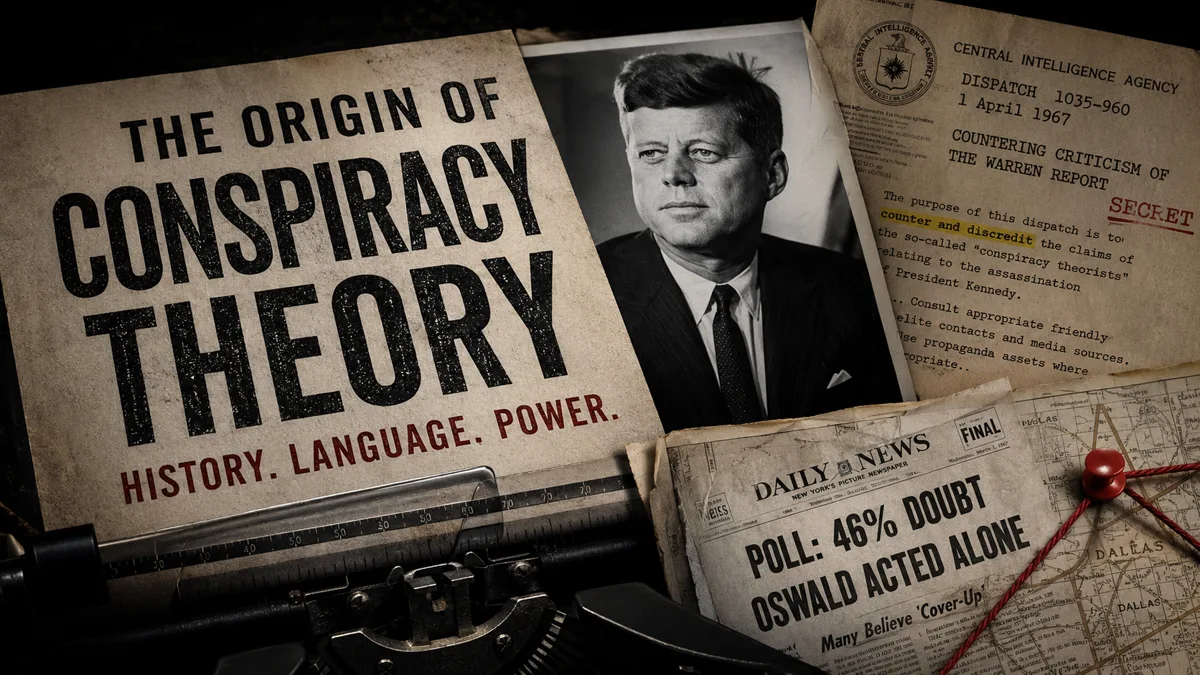
Did the CIA Invent the Term “Conspiracy Theory”?
No. The term existed long before the CIA and long before John F. Kennedy was assassinated. What is documented is different: in 1967, the CIA circulated Dispatch 1035-960, which discussed ways to counter and discredit critics of the Warren Commission.
A common story says that the Central Intelligence Agency invented the term “conspiracy theory” after the assassination of President John F. Kennedy. According to this account, the agency created the expression to ridicule people who questioned the Warren Commission’s conclusion that Lee Harvey Oswald acted alone.
That story is historically incorrect.
The phrase appeared in print long before Kennedy was killed and long before the CIA existed. The earliest known published example currently identified dates to an 1863 letter in The New York Times. Additional documented uses appeared throughout the late nineteenth century, including reports about crimes, trials and the 1881 assassination of President James Garfield. (Wiktionary)
But dismissing the entire controversy as merely another “conspiracy theory” would miss the more consequential truth.
The CIA did not invent the words. However, a declassified 1967 CIA dispatch shows that the agency deliberately sought to counter and discredit critics of the Warren Commission. It recommended working through influential politicians, editors, book reviewers, feature writers and propaganda assets. It also supplied arguments portraying critics as politically motivated, financially interested, intellectually vain, careless or emotionally attached to conclusions formed before all the evidence was available. (CIA)
The most accurate conclusion is therefore more complicated than either side usually admits:
The CIA did not create the term “conspiracy theory.” But the Kennedy era helped transform an older, relatively descriptive phrase into a stigmatizing category, and the CIA consciously exploited that emerging stigma to contain criticism of an official government investigation.
That distinction matters. It separates a demonstrably false origin story from a legitimate concern about the political use of language.
What Did “Conspiracy Theory” Originally Mean?
In its earliest recorded uses, a “conspiracy theory” was often exactly what the two words suggested: a theory that several people had conspired.
It was not automatically a synonym for insanity, misinformation or delusion.
Nineteenth-century newspapers commonly used the expression in reporting on criminal investigations and courtroom disputes. A prosecution might advance a “conspiracy theory” alleging that several defendants had coordinated a crime. A defense attorney might challenge that theory. A newspaper might report that new testimony had strengthened or weakened it.
The expression was therefore closer to “multiple-participant hypothesis” than to its modern meaning.
When President Garfield was shot in 1881, newspapers discussed a “conspiracy theory” that assassin Charles Guiteau had not acted alone. The allegation was treated as an investigative possibility to be examined, not necessarily as evidence that the person proposing it was irrational. Similar language appeared following the assassination of President William McKinley in 1901. (Grammarphobia)
This earlier usage exposes an important misconception. A theory involving a conspiracy is not inherently unreasonable. Conspiracies are real social and legal phenomena. Corporations fix prices. Political operatives coordinate illegal activities. Intelligence services conduct covert operations. Criminal organizations conceal shared plans.
The rationality of a conspiracy allegation depends on its evidence, scope, assumptions and capacity to be disproved—not on the mere fact that it alleges secret coordination.
The Phrase Existed Before JFK—But Its Meaning Changed
The modern meaning of “conspiracy theory” was not created on a single day or by a single institution. It emerged gradually during the middle of the twentieth century.
Philosopher Karl Popper helped develop one influential version of the concept through his criticism of what he called the “conspiracy theory of society.” Popper was not merely describing individual criminal plots. He was criticizing a broader way of explaining history: the belief that major social outcomes are primarily caused by deliberate schemes organized by identifiable groups.
That was a meaningful intellectual distinction. Large historical events frequently emerge from institutional incentives, economic pressures, bureaucratic failures, unintended consequences and conflicts among competing interests. Not every harmful outcome requires a central mastermind.
Other scholars increasingly associated sweeping conspiracy explanations with political extremism, anxiety, resentment and distorted reasoning. Historian Richard Hofstadter’s influential 1964 essay, “The Paranoid Style in American Politics,” did not rely heavily on the exact phrase “conspiracy theory,” but it helped construct the familiar image of the conspiratorial thinker as a recognizable psychological and political type. Recent scholarship traces how this process gradually shifted attention from the merits of a particular allegation to the presumed mentality of the person making it. (Taylor & Francis)
This was the decisive transformation.
A theory about a possible conspiracy became a conspiracy theory.
A person investigating a claim became a conspiracy theorist.
The linguistic shift was subtle, but its consequences were profound. Once the speaker had been classified, the audience no longer had to examine every piece of evidence. The label itself supplied a preliminary verdict about the person’s credibility.
JFK Did Not Create the Term. The Assassination Accelerated Its Transformation.
President Kennedy’s assassination on November 22, 1963, created nearly ideal conditions for widespread suspicion.
A president was murdered publicly. The accused assassin was killed two days later by Jack Ruby before he could stand trial. Oswald had defected to the Soviet Union, returned to the United States, advocated for Cuba and visited Soviet and Cuban diplomatic facilities in Mexico City. Meanwhile, the American government was conducting secret operations involving Cuba, organized crime figures, foreign assassinations and domestic surveillance—many of which were unknown to the public at the time.
The Warren Commission concluded in 1964 that Oswald had killed Kennedy and had acted alone. Yet the death of Oswald prevented a conventional criminal trial in which evidence could have been challenged through adversarial proceedings.
Books criticizing the Commission soon appeared. Some raised serious questions. Others built elaborate arguments from weak evidence, coincidence or selective interpretation. Still others blended legitimate anomalies with speculation that could not be tested.
This mixture created a persistent rhetorical problem: How should society distinguish a valid inquiry from a self-sealing belief system?
Instead of resolving that question, public discourse increasingly compressed all three activities—investigation, speculation and fantasy—into the same category.
The JFK assassination did not originate the phrase “conspiracy theory.” It became the historical furnace in which the phrase acquired much of its modern political force.
What CIA Document 1035-960 Actually Says
The central document in this controversy is CIA dispatch 1035-960, dated April 1, 1967, concerning criticism of the Warren Report.
The document is real.
It begins by describing growing public skepticism. According to the dispatch, 46 percent of Americans surveyed did not believe Oswald had acted alone, while more than half believed that the Warren Commission had left some questions unresolved.
The CIA characterized this trend as a matter of concern, not only because the agency itself was being accused, but because criticism threatened confidence in the broader leadership and reputation of the United States government.
The document said its purpose was to provide material for “countering and discrediting” the claims of people it called conspiracy theorists. It sought to inhibit the circulation of those claims, particularly abroad.
The recommended actions included:
- consulting “friendly elite contacts,” particularly politicians and editors;
- urging influential people to discourage what the agency considered irresponsible speculation;
- suggesting that some criticism benefited Communist propaganda;
- using propaganda assets to answer critics through book reviews and feature articles;
- attacking critics as politically or financially motivated, careless, premature or infatuated with their theories;
- emphasizing disagreements among critics as evidence against their overall credibility.
The dispatch also provided substantive arguments defending the Commission. It argued that critics overvalued conflicting witness memories, underestimated physical evidence, ignored the difficulty of concealing a large conspiracy and became emotionally attached to preferred explanations.
Some of those arguments may have been reasonable. Critics can cherry-pick evidence. Eyewitness testimony can be unreliable. Large conspiracies are generally more difficult to conceal than small ones. Financial incentives can encourage sensationalism.
The troubling feature of the document is not that the CIA disputed allegations against itself.
The problem is that an intelligence agency with undisclosed interests in the controversy sought to shape public discussion through covert or semi-covert influence, including media channels, while encouraging attacks on the motives and personalities of critics.
That is more than neutral fact-checking. It is institutional reputation management.
What the CIA Memo Does Not Prove
Document 1035-960 is significant, but it is often misrepresented.
It does not show that the CIA coined the phrase “conspiracy theory.” The expression was already approximately a century old.
It does not instruct operatives to introduce those exact words into American culture for the first time.
It does not establish that every journalist who criticized Warren Commission skeptics was secretly controlled by the CIA.
It does not prove that the CIA organized Kennedy’s assassination.
It does not prove that every objection to the Warren Report was valid.
And it does not demonstrate that the label alone produced the modern stigma surrounding conspiracy claims.
The responsible argument is narrower: the CIA recognized a category of disfavored critics, called them conspiracy theorists and instructed its contacts and assets to discredit their arguments and reputations.
That conclusion is strong enough without embellishment.
Did the CIA “Weaponize” the Term?
Whether the CIA “weaponized” the term depends on what is meant by weaponization.
If the claim means that the agency invented an unfamiliar expression and secretly planted it in the dictionary, the answer is no.
If it means that the CIA used an increasingly stigmatized category to weaken the social credibility of its critics, the description is defensible.
The dispatch did not limit itself to examining trajectories, photographs, ballistics or timelines. It encouraged communicators to portray critics as psychologically attached to their theories, professionally irresponsible or motivated by money and politics.
That rhetorical strategy changes the subject.
Instead of asking:
What evidence does this critic have?
The audience is encouraged to ask:
What kind of person believes something like this?
That move does not prove the critic wrong. It lowers the perceived obligation to hear the critic at all.
The distinction is crucial because a government agency accused of misconduct cannot be treated as a neutral judge of whether questions about that misconduct deserve circulation. It may possess relevant expertise, but it also has an institutional interest in protecting its legitimacy, operations and personnel.
The Official Investigation Was Not Beyond Legitimate Criticism
One of the weaknesses in simplistic defenses of the Warren Commission is that later official investigations themselves identified important deficiencies.
The House Select Committee on Assassinations concluded in the late 1970s that the Warren Commission had investigated Oswald’s personal responsibility thoroughly but had not adequately investigated the possibility of a conspiracy. The House committee attributed part of that failure to the Commission’s lack of access to all relevant information held by government agencies. It also found deficiencies in the CIA’s and FBI’s collection and sharing of information. (National Archives)
The House committee ultimately said Kennedy was probably killed as the result of a conspiracy, largely because acoustic evidence appeared to indicate an additional gunshot. The committee could not identify another gunman or establish the extent of any plot. A subsequent National Research Council review concluded that the acoustic evidence did not establish a shot from the grassy knoll and provided no valid basis for the claimed 95 percent probability. (National Archives)
That sequence illustrates what legitimate inquiry looks like.
An official conclusion was questioned. A later investigation reached a different conclusion. Scientists reexamined the evidence and challenged the basis of that conclusion. None of those stages required treating uncertainty as proof of a preferred narrative.
As of the major 2025 document releases, newly public files expanded knowledge about Cold War intelligence operations but did not produce evidence establishing a second gunman or proving that the CIA organized Kennedy’s murder. The National Archives now maintains more than six million pages and other materials in the JFK assassination collection. (National Archives)
The continuing absence of conclusive proof does not mean that every historical question was foolish. It means that suspicion, evidence and proof are different categories.
Why Legitimate Skepticism Is Necessary in a Democracy
The United States legally recognizes that citizens have a legitimate interest in examining government records.
The Freedom of Information Act gives any person the right to request executive-branch records, subject to specific exemptions. The Department of Justice describes an informed citizenry as necessary for checking corruption and holding government officials accountable. (Department of Justice)
That principle would be incoherent if suspicion of official conduct were itself disreputable.
FOIA exists because public institutions sometimes make mistakes, conceal failures, abuse authority, protect reputations or classify information more broadly than genuine security requires.
The Church Committee’s investigation in the 1970s uncovered extensive intelligence abuses involving federal agencies. The FBI itself now makes records concerning COINTELPRO available through its public archive. That program targeted and disrupted domestic political organizations, including civil-rights and antiwar groups. (U.S. Senate)
These confirmed episodes do not validate every allegation against the government. They establish something more modest and more important:
“The government would never do that” is not an evidentiary argument.
Institutions should not be presumed guilty without evidence. Neither should they be presumed incapable of secret wrongdoing.
The Paradox of a “Proven Conspiracy Theory”
The phrase contains a peculiar linguistic trap.
Before a secret plot is established, an allegation may be called a conspiracy theory. If the allegation is proven, society usually stops calling it that.
It becomes Watergate.
It becomes price-fixing.
It becomes illegal surveillance.
It becomes obstruction of justice, intelligence abuse or corporate fraud.
The label therefore tends to remain attached most strongly to claims that are false, unproven or socially rejected. Successful allegations graduate into other categories.
Philosophers Ole Bjerg and Thomas Presskorn-Thygesen have argued that “conspiracy theory” can function not merely as a description of a claim but as a linguistic boundary separating acceptable discourse from ideas considered unworthy of serious consideration. (CBS Research API)
That does not make the label useless. Some theories genuinely are fantastical, unfalsifiable or constructed from prejudice and coincidence.
But it does mean that calling something a conspiracy theory cannot substitute for analyzing it.
Does the Label Actually Make People Disbelieve a Claim?
The social stigma surrounding the term is real, but the psychological effect of the label is more complicated than commonly assumed.
Research has found that people generally perceive “conspiracy theory” as a negative label. Endorsing such ideas can also carry expectations of ridicule or social exclusion. Yet experimental studies have not consistently shown that attaching the label to a claim directly causes people to believe it less. Instead, people may be more likely to apply the label to claims they already find implausible. (Kent Academic Repository)
This distinction matters.
The label may not magically change a committed person’s private belief. Its more important power may be institutional and social. It can influence which questions receive airtime, which researchers are treated as credible, which subjects are considered professionally dangerous and which allegations are investigated before a consensus has formed.
The label’s power is not necessarily that it changes minds. It can change who is allowed into the conversation.
Skepticism and Conspiracism Are Not the Same Thing
Defending legitimate inquiry does not require defending every conspiracy theory.
There is a meaningful difference between skepticism and conspiracism.
Legitimate skepticism
Legitimate skepticism begins with a question. It seeks records, identifies specific inconsistencies and compares competing explanations. It distinguishes possibility from probability and probability from proof. Most importantly, it allows new evidence to change the conclusion.
A conspiracy hypothesis
A conspiracy hypothesis proposes that particular people secretly coordinated particular actions for an identifiable purpose. It should generate testable expectations: communications, money transfers, common planning, witness testimony, records, physical evidence or patterns unlikely to arise independently.
Such a hypothesis may be true or false.
Conspiracism
Conspiracism begins with the conclusion that hidden actors control events and then absorbs nearly every new fact into that belief. Evidence against the theory becomes evidence of a cover-up. Missing evidence proves that records were destroyed. A denial proves involvement. Silence proves fear.
At that point, the claim has become self-sealing. No possible discovery could disprove it.
Institutional dismissal
Institutional dismissal is the opposite error. It assumes that an allegation is unworthy of examination because it contradicts an official account, implicates respected institutions or attracts eccentric supporters.
Both conspiracism and institutional dismissal protect conclusions from scrutiny. One declares the hidden plot unquestionably real. The other declares meaningful coordination unthinkable.
Rigorous inquiry rejects both shortcuts.
A Better Standard for Evaluating Allegations
The phrase “conspiracy theory” should never be the end of an analysis. At most, it should identify the general form of a claim.
The real evaluation should ask:
- What exactly is being alleged?
Vague claims about “elites” or “the government” are difficult to evaluate. Serious allegations identify actors, actions, methods and objectives.
- What is the strongest direct evidence?
Primary records, financial transactions, authenticated communications, physical evidence and contemporaneous testimony deserve more weight than coincidence or anonymous internet claims.
- What evidence would disprove the allegation?
A theory that cannot possibly be falsified is not functioning as an investigation.
- How many people would need to participate or remain silent?
Small conspiracies are common. Vast, perfectly coordinated conspiracies maintained across rival organizations and generations are less plausible.
- Are ordinary explanations sufficient?
Incompetence, fragmented bureaucracy, self-interest and institutional cowardice can produce outcomes that resemble coordinated plotting.
- Does the official account explain the evidence better?
An official explanation is not automatically true, but an alternative must do more than identify imperfections. It must explain the total evidence with fewer unsupported assumptions.
- Does the claimant correct errors?
Serious investigators revise their positions. Propagandists merely replace disproven details while preserving the same conclusion.
This approach neither privileges authority nor romanticizes dissent. It applies the same evidentiary discipline to both.
The Deeper Lesson of the CIA Memo
The most revealing part of CIA document 1035-960 is not the use of the words “conspiracy theories.”
It is the agency’s understanding that credibility can be managed socially.
The dispatch recognized that most citizens would never personally examine every witness statement, intelligence file, autopsy record or ballistic analysis. Public understanding would be mediated by editors, politicians, reviewers and other influential interpreters.
Control the interpretation, and it becomes less necessary to control every fact.
That does not mean the CIA manufactured the entire public consensus surrounding the Kennedy assassination. It means the agency understood that shaping the reputations of critics could be as useful as rebutting their claims.
This remains relevant far beyond JFK.
Governments, corporations, political movements and media institutions all have incentives to collapse inconvenient questions into disfavored identities: extremist, propagandist, alarmist, denialist, partisan, crank or conspiracy theorist.
Sometimes those labels are accurate. Sometimes they are warnings based on a long record of unreliable behavior.
But labels become dangerous when they are used as replacements for evidence.
Final Verdict: Did the CIA Invent “Conspiracy Theory”?
No.
The phrase was used in the nineteenth century, approximately 100 years before Kennedy’s assassination and decades before the CIA was founded.
Did the CIA deliberately create the modern cultural stigma surrounding the term?
The available evidence does not support attributing that entire transformation to one agency or one memo. The stigmatization of conspiracy explanations had already been developing through journalism, social science, political commentary and Cold War debates.
Did the CIA use that emerging stigma to discredit people questioning the Warren Commission?
Yes. Document 1035-960 explicitly called for countering and discrediting critics, using influential contacts and propaganda assets while challenging critics’ motives, competence and psychological attachment to their theories.
Were all those critics therefore correct?
No. Institutional efforts to discredit an allegation do not prove the allegation. A government can behave defensively or deceptively while still being correct about the central factual question.
Was it legitimate for citizens to ask questions?
Absolutely. Later official investigations found genuine deficiencies in the original investigation and in the sharing of intelligence. American law itself recognizes public inquiry and access to records as necessary safeguards against corruption and unaccountable government.
The intellectually responsible position is therefore neither reflexive belief nor reflexive dismissal.
The CIA did not invent the phrase “conspiracy theory.” It did, however, leave behind documentary evidence showing how an institution can use the social category of the conspiracy theorist to marginalize criticism, protect its reputation and reduce pressure for further inquiry.
A democratic society must remain capable of rejecting baseless fantasies without teaching its citizens that questioning powerful institutions is itself a form of irrationality.
—
Frequently Asked Questions
Was the term “conspiracy theory” invented after the JFK assassination?
No. Documented uses date to the nineteenth century. It appeared in discussions of crimes, legal cases and presidential assassinations decades before Kennedy was killed.
Did the CIA invent the term?
No evidence supports that claim. The CIA was created in 1947, while the phrase had already appeared in print many decades earlier.
What is CIA document 1035-960?
It is a 1967 dispatch addressing criticism of the Warren Commission. It recommended using influential contacts, editors, politicians, propaganda assets, book reviews and feature articles to counter and discredit critics.
Does the memo prove the CIA killed Kennedy?
No. It proves that the CIA sought to influence discussion and defend the Warren Commission against critics. It does not establish responsibility for the assassination.
Is “conspiracy theory” always an unfair label?
No. Some claims rely on fabricated evidence, prejudice, circular reasoning or theories that cannot be disproven. The problem arises when the label is used instead of examining the evidence.
What is the difference between skepticism and conspiracism?
Skepticism asks questions and changes with the evidence. Conspiracism treats hidden coordination as a predetermined conclusion and interprets both evidence and missing evidence as confirmation.
—
References and Further Reading
- CIA, Dispatch 1035-960: Countering Criticism of the Warren Report, April 1, 1967. (CIA)
- Andrew McKenzie-McHarg, The Hidden History of Conspiracy Theory, Princeton University Press, 2026. (Google Books)
- Katharina Thalmann, The Stigmatization of Conspiracy Theory Since the 1950s. (Routledge)
- Ole Bjerg and Thomas Presskorn-Thygesen, “Conspiracy Theory: Truth Claim or Language Game?” Theory, Culture & Society. (CBS Research API)
- U.S. National Archives, Warren Commission Report. (National Archives)
- U.S. National Archives, House Select Committee on Assassinations Findings. (National Archives)
- National Research Council, Report of the Committee on Ballistic Acoustics. (National Academies)
- U.S. Department of Justice, The Purpose and History of the Freedom of Information Act. (Department of Justice)
- U.S. Senate, History of the Church Committee Investigation. (U.S. Senate)
- FBI Vault, COINTELPRO Records. (FBI)
- Karen Douglas and colleagues, research on whether the “conspiracy theory” label affects belief. (Kent Academic Repository)